Politics

Latest news about politics

Court battle begins over Republican challenge to California’s Prop. 50

Republicans and Democrats squared off in court Monday in a high-stakes battle over the fate of California’s Proposition 50, which reconfigures the state’s congressional districts and could ultimately help determine which party controls the U.S. House in the 2026 midterms.

Dozens of California politicians and Sacramento insiders — from GOP Assembly members to Democratic redistricting expert Paul Mitchell — have been called to testify in a Los Angeles federal courtroom over the next few days.

The GOP wants the three-judge panel to temporarily block California’s new district map, claiming it is unconstitutional and illegally favors Latino voters.

An overwhelming majority of California voters approved Prop. 50 on Nov. 4 after Gov. Gavin Newsom pitched the redistricting plan as a way to counter partisan gerrymandering in Texas and other GOP-led states. Democrats admitted the new map would weaken Republicans’ voting power in California, but argued it would just be a temporary measure to try to restore national political balance.

Attorneys for the GOP cannot challenge the new redistricting map on the grounds that it disenfranchises swaths of California Republicans. In 2019, the U.S. Supreme Court decided that complaints of partisan gerrymandering have no path in federal court.

But the GOP can bring claims of racial discrimination. They argue California legislators drew the new congressional maps based on race, in violation of the Equal Protection Clause of the 14th Amendment and the 15th Amendment, which prohibits governments from denying citizens the right to vote based on race or color.

On Monday, attorneys for the GOP began by homing in on the new map’s Congressional District 13, which currently encompasses Merced, Stanislaus, and parts of San Joaquin and Fresno counties, along with parts of Stockton.

When Mitchell drew up the map, they argued, he over-represented Latino voters as a “predominant consideration” over political leanings.

They called to the stand RealClearPolitics elections analyst Sean Trende, who said he observed an “appendage” in the new District 13, which extended partially into the San Joaquin Valley and put a crack in the new rendition of District 9.

“From my experience [appendages] are usually indicative of racial gerrymandering,” Trende said. “When the choice came between politics and race, it was race that won out.”

Republicans face an uphill struggle in blocking the new map before the 2026 midterms. The hearing comes just a few weeks after the U.S. Supreme Court allowed Texas to temporarily keep its new congressional map — a move that Newsom’s office says bodes poorly for Republicans trying to block California’s map.

“In letting Texas use its gerrymandered maps, the Supreme Court noted that California’s maps, like Texas’s, were drawn for lawful reasons,” Brandon Richards, a spokesperson for Newsom, said in a statement. “That should be the beginning and the end of this Republican effort to silence the voters of California.”

In Texas, GOP leaders drew up new congressional district lines after President Trump openly pressed them to give Republicans five more seats in the U.S. House of Representatives. A federal court blocked the map, finding racial considerations likely made the Texas map unconstitutional. But a few days later the Supreme Court granted Texas’ request to pause that ruling, signaling they view the Texas case, and this one in California, as part of a national politically-motivated redistricting battle.

“The impetus for the adoption of the Texas map (like the map subsequently adopted in California),” Justice Samuel A. Alito Jr. argued, “was partisan advantage pure and simple.”

The fact that the Supreme Court order and Alito’s concurrence in the Texas case went out of their way to mention California is not a good sign for California Republicans, said Richard L. Hasen, professor of law and director of the Safeguarding Democracy Project at UCLA School of Law.

“It’s hard to prove racial predominance in drawing a map — that race predominated over partisanship or other traditional districting principles,” Hasen said. “Trying to get a preliminary injunction, there’s a higher burden now, because it would be changing things closer to the election, and the Supreme Court signaled in that Texas ruling that courts should be wary of making changes.”

Many legal scholars argue that the Supreme Court’s ruling on the Texas case means California will likely keep its new map.

“It was really hard before the Texas case to make a racial gerrymandering claim like the plaintiffs were stating, and it’s only gotten harder in the last two weeks,” said Justin Levitt, a professor of law at Loyola Marymount University.

Hours after Californians voted in favor of Prop. 50 on Nov. 4, Assemblymember David J. Tangipa (R-Fresno) and the California Republican Party filed a lawsuit alleging that the map enacted in Prop. 50 for California’s congressional districts is designed to favor Latino voters over others.

The Department of Justice also filed a complaint in the case, arguing the new congressional map uses race as a proxy for politics and manipulated district lines “in the name of bolstering the voting power of Hispanic Californians because of their race.”

Mitchell, the redistricting expert who drew up the maps, is likely to be a key figure in this week’s battle. In the days leading up to the hearing, attorneys sparred over whether Mitchell would testify and whether he should turn over his email correspondence with legislators. Mitchell’s attorneys argued he had legislative privilege.

Attorneys for the GOP have seized on public comments made by Mitchell that the “number one thing” he started thinking about” was “drawing a replacement Latino majority/minority district in the middle of Los Angeles” and the “first thing” he and his team did was “reverse” the California Citizens Redistricting Commission’s earlier decision to eliminate a Latino district from L.A.

Some legal experts, however, say that is not, in itself, a problem.

“What [Mitchell] said was, essentially, ‘I paid attention to race,’” Levitt said. “But there’s nothing under existing law that’s wrong with that. The problem comes when you pay too much attention to race at the exclusion of all of the other redistricting factors.”

Other legal experts argue that what matters is not the intent of Mitchell or California legislators, but the California voters who passed Prop. 50.

“Regardless of what Paul Mitchell or legislative leaders thought, they were just making a proposal to the voters,” said Hasen, who filed an amicus brief in support of the state. “So it’s really the voters’ intent that matters. And if you look at what was actually presented to the voters in the ballot pamphlet, there was virtually nothing about race there.”

Source link

England’s resident doctors to strike for five days | Health News

Physicians are seeking a return of salaries to their 2008-2009 levels before they were eroded by inflation.

Resident doctors in England will go ahead with a five-day strike this week after rejecting the government’s latest offer aimed at ending a long-running dispute over pay and working conditions.

Formerly known as junior doctors, the physicians, who make up nearly half of England’s medical workforce, will walk out from 07:00 GMT on Wednesday until 07:00 GMT next Monday.

Recommended Stories

list of 4 itemsend of list

The action follows an online survey by the British Medical Association (BMA) in which members voted to reject the proposal.

“Tens of thousands of frontline doctors have come together to say ‘no’ to what is clearly too little, too late,” BMA resident doctors committee chairman Jack Fletcher said in a statement, adding that members had rejected the government’s latest offer on working conditions.

Fletcher said the union remained willing to work towards a resolution.

Health Secretary Wes Streeting appealed to doctors to call off the strike.

“There is no need for these strikes to go ahead this week, and it reveals the BMA’s shocking disregard for patient safety,” he said, describing the action as “self-indulgent, irresponsible and dangerous”.

Speaking to Sky News, Streeting said the government was open to the BMA rescheduling the strike to reduce risks to patients during a surge in flu cases.

Flu-related hospitalisations in England rose by more than 50 percent in early December, reaching an average of 2,660 patients a day, the highest level for this time of year. Health leaders have warned there is still no clear peak in sight.

Across Europe, health authorities are grappling with an unusually early and severe flu season, warning of rising cases across the continent.

The BMA said 83 percent of resident doctors voted to reject the government’s offer with a turnout of 65 percent among its more than 50,000 members.

The offer, made on Wednesday, did not include new pay terms. The BMA has been campaigning for improved pay even before the Labour Party won last year’s general election.

Shortly after taking office, Streeting agreed a deal offering doctors a 22 percent pay rise, short of the 29 percent sought by the union.

The BMA has also called for improvements beyond the 5.4 percent pay increase announced earlier this year, arguing resident doctors continue to suffer from years of pay erosion.

Doctors are seeking “full pay restoration”, meaning a return of salaries to their 2008-2009 levels in real terms before they were eroded by inflation.

Source link

Newsom taps former CDC leaders critical of Trump-era health policies

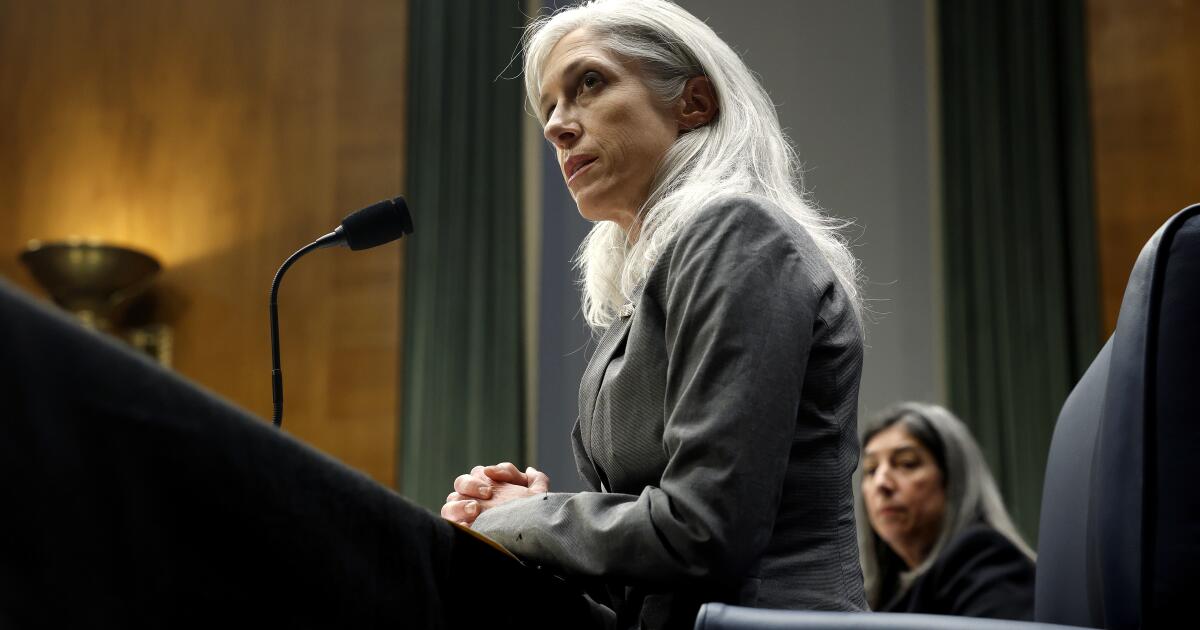
Gov. Gavin Newsom on Monday announced a new California-led public health initiative, tapping former U.S. Centers for Disease Control and Prevention officials who publicly clashed with the Trump administration, including the former agency chief who warned that the nation’s public health system was headed to “a very dangerous place.”

Newsom said the initiative will be led by Dr. Susan Monarez, the former CDC director, and Dr. Debra Houry, the CDC’s former chief medical officer. The pair will lead the Public Health Network Innovation Exchange, or PHNIX, which the governor’s office said will “modernize public health infrastructure and maintain trust in science-driven decision-making.”

The initiative was created to improve the systems that detect and investigate public health trends and build a modern public-health backbone that connects data, technology and funding across states.

“The Public Health Network Innovation Exchange is expected to bring together the best science, the best tools, and the best minds to advance public health,” Newsom said in a statement Monday. “By bringing on expert scientific leaders to partner in this launch, we’re strengthening collaboration and laying the groundwork for a modern public health infrastructure that will offer trust and stability in scientific data not just across California, but nationally and globally.”

Monarez will serve as strategic health technology and funding advisor for the initiative, helping advance private sector partnerships to better integrate healthcare data systems and enable faster disease surveillance.

“I am deeply excited to bring my experience in health technology and innovation to support PHNIX,” Monarez said in a statement shared by Newsom’s office. “California has an extraordinary concentration of talent, technology, and investment, and this effort is about putting those strengths to work for the public good — modernizing how public health operates, accelerating innovation, and building a healthier, more resilient future for all Californians.”

Houry was named senior regional and global public health medical advisor for PHNIX. Newsom’s office also announced it will work with Dr. Katelyn Jetelina, founder and chief executive of Your Local Epidemiologist. Jetelina will advise the California Department of Public Health on building trust in public health.

Monarez and Houry both described extraordinary turmoil inside the nation’s health agencies during congressional hearings, telling senators in September that Health and Human Services Secretary Robert F. Kennedy Jr. and political advisors rebuffed data supporting the safety and efficacy of vaccines. Monarez was fired after just 29 days on the job. She said Kennedy told her to resign if she did not sign off on new unsupported vaccine recommendations. Kennedy has described Monarez as admitting to him that she is “untrustworthy,” a claim Monarez has denied through her attorney.

“Dramatic and unfounded changes in federal policy, funding, and scientific practice have created uncertainty and instability in public health and health care,” Dr. Erica Pan, CDPH director and state public health officer, said in a statement. “I am thrilled to work with these advisors to catalyze our efforts to lead a sustainable future for public health. California is stepping up to coordinate and build the scaffolding we need to navigate this moment.”

The salaries of the new positions were not immediately known.

Newsom’s office said the California initiative would build on previously announced public health partnerships, such as the West Coast Health Alliance.

Source link

Column: California Democrats have momentum, Republicans have problems

You’re reading the L.A. Times Politics newsletter

Anita Chabria and David Lauter bring insights into legislation, politics and policy from California and beyond. In your inbox three times per week.

By continuing, you agree to our Terms of Service and our Privacy Policy.

It turns out Proposition 50 smacked California Republicans with a double blow heading into the 2026 congressional elections.

First, there was the reshaping of House districts aimed at flipping five Republican-held seats to Democrats.

Now, we learn that the proposition itself juiced up Democratic voter enthusiasm for the elections.

Voter enthusiasm normally results in a higher casting of ballots.

It’s all about the national battle for control of the U.S. House of Representatives — and Congress potentially exercising its constitutional duty to provide some checks and balance against the president. Democrats need a net pickup of only three seats in November’s elections to dethrone Republicans.

President Trump is desperate to keep his GOP toadies in power. So, he has coerced — bullied and threatened — some red-state governors and legislatures into rejiggering Democratic-held House seats to make them more Republican-friendly.

When Texas quickly obliged, Gov. Gavin Newsom retaliated with a California Democratic gerrymander aimed at neutralizing the Lone Star State’s partisan mid-decade redistricting.

California’s counterpunch became Proposition 50, which was approved by a whopping 64.4% of the state’s voters.

Not only did Proposition 50 redraw some GOP-held House seats to tinge them blue, it stirred up excitement about the 2026 elections among Democratic voters.

That’s the view of Mark Baldassare, polling director for the nonpartisan Public Policy Institute of California. And it makes sense. Umpteen millions of dollars were spent by Newsom and Proposition 50 backers advertising the evils of Trump and the need for Democrats to take over the House.

A PPIC poll released last week showed a significant “enthusiasm gap” between Democratic and Republican voters regarding the House contests.

“One of the outcomes of Proposition 50 is that it focused voters on the midterm elections and made them really excited about voting next year,” Baldassare says.

At least, Democrats are showing excitement. Republicans, not so much.

In the poll, likely voters were asked whether they were more enthusiastic than usual about voting in the congressional elections or less enthusiastic.

Overall, 56% were more enthusiastic and 41% less enthusiastic. But that’s not the real story.

The eye-opener is that among Democrats, an overwhelming 72% were more enthusiastic. And 60% of Republicans were less enthusiastic.

“For Democrats, that’s unusually high,” Baldassare says.

To put this in perspective, I looked back at responses to the same question asked in a PPIC poll exactly two years ago before the 2024 elections. At that time, Democrats were virtually evenly split over their enthusiasm or lack of it concerning the congressional races. In fact, Republicans expressed more enthusiasm.

Still, Democrats gained three congressional seats in California in 2024. So currently they outnumber Republicans in the state’s House delegation by a lopsided 43 to 9.

If Democrats could pick up three seats when their voters weren’t even lukewarm about the election, huge party gains seem likely in California next year. Democratic voters presumably will be buoyed by enthusiasm and the party’s candidates will be boosted by gerrymandering.

“Enthusiasm is contagious,” says Dan Schnur, a former Republican operative who teaches political communication at USC and UC Berkeley. “If the party’s concentric circle of committed activists is enthusiastic, that excitement tends to spread outward to other voters.”

Schnur adds: “Two years ago, Democrats were not motivated about Joe Biden or Kamala Harris. Now they’re definitely motivated about Donald Trump. And in order to win midterm elections, you need to have a motivated base.”

Democratic strategist David Townsend says that “enthusiasm is the whole ballgame. It’s the ultimate barometer of whether my message is working and the other side’s is not working.”

The veteran consultant recalls that Democrats “used to go door to door handing out potholders, potted plants, refrigerator magnets and doughnuts trying to motivate voters.

“But the best turnout motivator Democrats have ever had in California is Donald J. Trump.”

In the poll, 71% of voters disapproved of the way Trump is handling his job; just 29% approved. It was even worse for Congress, with 80% disapproving.

Among Democratic voters alone, disapproval of Trump was practically off the chart at 97%.

But 81% of Republicans approved of the president.

Among voters of all political persuasions who expressed higher than usual enthusiasm about the House elections, 77% said they‘d support the Democratic candidate. Also: 79% said Congress should be controlled by Democrats, 84% disapproved of how Congress is handling its job and 79% disapproved of Trump.

And those enthused about the congressional elections believe that, by far, the most important problem facing the nation is “political extremism [and] threats to democracy.” A Democratic shorthand for Trump.

The unseemly nationwide redistricting battle started by Trump is likely to continue well into the election year as some states wrestle with whether to oblige the power-hungry president and others debate retaliating against him.

Sane politicians on both sides should have negotiated a ceasefire immediately after combat erupted. But there wasn’t enough sanity to even begin talks.

Newsom was wise politically to wade into the brawl — wise for California Democrats and also for himself as a presidential hopeful trying to become a national hero to party activists.

“Eleven months before an election, nothing is guaranteed,” Schnur says. “But these poll numbers suggest that Democrats are going to start the year with a big motivational advantage.”

Trump is the Democrats’ proverbial Santa who keeps on giving.

What else you should be reading

The must-read: Kristi Noem grilled over L.A. Purple Heart Army vet who self-deported
The TK: Newsom expresses unease about his new, candid autobiography: ‘It’s all out there’
The L.A. Times Special: A Times investigation finds fraud and theft are rife at California’s county fairs

Until next week,
George Skelton


Was this newsletter forwarded to you? Sign up here to get it in your inbox.

Source link

Scott Brown: ‘Thank God’ Elizabeth Warren didn’t pose nude

With two words, Massachusetts Sen. Scott Brown launched himself into controversy Thursday morning when he joked about being glad that Elizabeth Warren, his likely Democratic opponent in 2012, had never posed in the nude.

Brown was responding to a quip Warren made at a Democratic debate Tuesday. Asked how she had paid for college – compared with Brown, who once posed partially nude for Cosmopolitan – Warren said: “I kept my clothes on.”

Brown fired back during an interview onBoston radio station WZLX: “Thank God!”

The jab went over well with the host, who laughed, then tried to stoke the flames.

“That’s what I said,” the host responded. “I said, look, can you blame a good looking guy for, you know, for wanting to…”

Brown swept into office last year on a tea party wave that helped him take a seat that had been held by Edward M. Kennedy for nearly 50 years. Democrats will fight hard to win it back in 2012.

Warren has a strong following and is known for her consumer advocacy. Obama tapped her last year to set up a new consumer protection agency, but Republicans opposed letting her head the agency.

She entered the Senate race in mid-September after being heavily courted, but her nomination is not guaranteed – the Democratic primary field is packed with other contenders. Brown’s comment made him an easy target at a time when he’d be better off laying low and letting the Democrats fight it out.

Brown cut in with an attempt to soften the jab: “You know what, listen, bottom line is I didn’t go to Harvard. You know, I went to the school of hard knocks and I did whatever I had to do to pay for school.”

(Warren also did not go to Harvard, though she is a Harvard law professor.)

Brown went on to describe how he faced “real challenges growing up.”

“You know, whatever,” he said. “You know, let them throw stones. I did what I had to do. And but not for having that opportunity, I never would have been able to pay for school and never would have gone to school and I wouldn’t probably be talking to you, so, whatever.”

The host didn’t want to let Brown’s initial comment go, and Brown wasn’t going to take all the blame.

“That’s funny you throw that jab, because –“ the host began. But Brown again cut him off.

“You said it too!” Brown replied.

The Massachusetts Democratic Party was quick to respond, scolding Brown for the comment.

“Sen. Brown’s comments are the kind of thing you would expect to hear in a frat house, not a race for U.S. Senate,” executive director Clare Kelly said in a statement. “Scott Brown’s comments send a terrible message that even accomplished women who are held in the highest esteem can be laughingly dismissed based on their looks.”

kim.geiger@latimes.com

Source link

Wilson Expands on Plan for ID Card : Immigration: Governor wants the state to be a testing ground for the tamper-proof documents. But he admits that it would probably be impossible to come up with a foolproof system.

Gov. Pete Wilson challenged President Clinton on Thursday to make California a test market for a tamper-proof federal identification card designed to keep illegal immigrants from receiving public benefits or getting jobs in the United States.

Later, a Wilson aide said one option might be a national identification card that would be carried by every legal resident of the United States, including U.S. citizens.

Wilson’s news conference at U.S. Immigration and Naturalization Service offices at Los Angeles International Airport was billed as the forum for a “major announcement regarding immigration.” In fact, Wilson’s statement expanded on his Aug. 9 program by only a small step–the proposed California test–while raising even more questions about his plan for the proposed identification card.

The governor acknowledged to a reporter that it probably is impossible to come up with a foolproof card because counterfeiters could fake birth certificates, passports or other documents that would be needed to get the card.

Wilson left unclear just who might have to possess the card: just foreign nationals living in the country legally or all U.S. citizens?

Asked who would have to carry the card, Wilson said: “Those who are applicants for employment and those who are applicants for benefits.”

Later, Wilson aide Dan Schnur said one possibility that arose during policy discussions in the governor’s office was a national identification card issued to all U.S. citizens and legal residents.

“A universal card is one option, but we’re not looking at it as an absolute condition,” Schnur said in telephone calls to reporters.

The form and scope of any card would be worked out in negotiations with the Clinton Administration, he said.

There have been periodic proposals for a national ID card, but they have always run up against strong opposition on civil liberties grounds.

Wilson was quoted by the Santa Monica Outlook while running for the U.S. Senate in 1982 that a proposed national identification card was “a lousy idea” because it would create a massive new bureaucracy. He also said he had some philosophical objections to the concept.

Schnur had no comment on that report, but he said conditions have changed greatly since the passage of immigration reform in the late 1980s and the heavy influx of illegal immigrants into California in recent years.

Thursday’s billing of a major new initiative drew a dozen television cameras and perhaps a score of reporters, a big turnout for any political event in Los Angeles. Although it turned out that Wilson’s statement was more of an expansion on a previous proposal than a major new initiative, the session did give the governor a platform for responding to critics of his Aug. 9 announcement.

Wilson said an identification card is the key to the enforcement of any of the sanctions written into federal law against employers who hire illegal immigrants for jobs in the United States. Without it, such sanctions are unenforceable, he said.

“Until we deal with the problem of document fraud, anyone proposing additional employer sanctions is simply blowing hot air,” Wilson said after examining stacks of phony passports, Social Security cards and other false documents confiscated by the INS.

Critics, including potential Democratic gubernatorial challenger Kathleen Brown, have said Wilson’s plan cracks down on illegal immigrants but not on the employers who also violate the law by hiring them.

Last week, Brown, the state treasurer, endorsed a national tamper-proof Social Security card that would have to be presented to a prospective employer before the cardholder could be hired.

In his lengthy Aug. 9 letter to Clinton, Wilson called on the federal government to compensate California for the cost of services to illegal immigrants, called for stricter enforcement of the California-Mexico border, and said children born on U.S. soil to undocumented immigrants should not automatically become U.S. citizens or be eligible to attend public schools in California.

Wilson made no mention of stronger enforcement against employers. He proposed an identification card as something that foreign nationals in the country legally would present to qualify for state services.

Wilson said California’s modern holographic drivers licenses could be the model for a federal card, but a reporter wondered if even they could be forged, since a photographic blowup of one was among the fake IDs on display.

“You know, I don’t dispute the ingenuity of counterfeiters. . . . I think it is possible to stay technologically ahead of even expert counterfeiters,” Wilson said.

“The question really is not whether you’re going to have an entirely foolproof system, but whether you have one that works to achieve its major goal, which is to screen out the vast majority of counterfeit documents.”

Later in the day, Democratic state Chairman Bill Press chided Wilson for intervening with the INS in 1989 on behalf of a San Diego supporter, Anne Evans, whose hotels were under investigation for hiring illegal immigrants. At the time, Wilson was a U.S. senator.

Evans ultimately was accused of 362 violations of employer sanctions provisions and fined $70,000.

Schnur described Wilson’s letter, which sought a conciliation between the INS and Evans, as a routine constituent service.

Source link

La Follette to Challenge Wright for State Senate : Politics: The former legislator would pose significant opposition to the Republican assemblywoman from Simi Valley in the new 19th District.

Marian La Follette, who spent 10 years as a Republican Assemblywoman from Northridge before retiring in 1990, plans to enter the state Senate race in the new district that stretches from Oxnard to the San Fernando Valley, Republican sources said Tuesday.

“I just spoke to her a little while ago, and she has made up her mind that she will be running,” said Charles H. Jelloian, a Republican from Northridge. Jelloian said he has decided to withdraw from the state Senate race, partly to make way for La Follette’s return to politics.

“Marian’s jumping into the race is a very big factor,” said Jelloian, who became acquainted with La Follette when he was an aide to state Sen. Newton R. Russell (R-Glendale). “I worked very, very well with her for a long time,” he said. “I have a lot of respect for her.”

La Follette has lived in Orange County since her retirement. She could not be reached for comment Tuesday.

If she enters the race, she could pose a formidable challenge to Assemblywoman Cathie Wright (R-Simi Valley) in the new 19th state Senate District. So far, Wright is the leading candidate in the district that encompasses Oxnard, Camarillo, Thousand Oaks, Moorpark, Fillmore, Simi Valley and Northridge.

“Both are new to this district,” said one Republican source. “I think they would start out about equal.”

Roger Campbell, a Republican city councilman in Fillmore, also has declared his candidacy in the heavily Republican district. No Democratic candidate has come forward in the district that has roughly 28,000 more registered Republican voters than Democrats.

La Follette, a conservative legislator, was best known for her persistent efforts to divide the massive Los Angeles Unified School District into smaller districts.

She decided to retire two years ago when her late husband, Jack, a Los Angeles lawyer, fell seriously ill with cancer.

When she was in the Legislature, she aligned herself with Sen. Ed Davis (R-Santa Clarita), who is vacating the Senate seat. Republican sources said they anticipate that Davis will support her candidacy against Wright, a longtime political foe.

La Follette’s candidacy is another indication that Assemblyman Tom McClintock (R-Thousand Oaks) will run for Congress. She and McClintock are strong political allies.

McClintock has toyed with the notion of running for state Senate, GOP sources said. The long-anticipated announcement of his plans has been postponed until later this week.

Source link

Geraldine Ferraro dies at 75; shattered political barrier for women as vice presidential nominee in 1984

Geraldine A. Ferraro, the savvy New York Democrat who was embraced as a symbol of women’s equality in 1984 when she became the first woman nominated for vice president by a major party, died Saturday at Massachusetts General Hospital in Boston. She was 75.

The cause was complications from multiple myeloma, her family said.

Ferraro was diagnosed with multiple myeloma, an incurable form of blood cancer, in 1998. She did not disclose her illness publicly until 2001, when she went on NBC’s “Today” show and said she had beaten the cancer into remission with thalidomide, the once-banned drug that had proven effective with some end-stage cancers. The cancer recurred, but she again went into remission after therapy with a new drug.

Initially told that she had three to five years to live, she survived for more than 12 years, long enough to witness the historic candidacies of two other women in 2008: Hillary Rodham Clinton, the former first lady and current secretary of State who ran against Barack Obama for the Democratic presidential nomination, and Sarah Palin, the former Alaska governor who was Republican Sen. John McCain’s running mate.

Ferraro was “a pioneer in our country for justice and a more open society,” former Vice President Walter Mondale told the Associated Press of his former running mate. “She broke a lot of molds, and it’s a better country for what she did.”

Palin also praised Ferraro, writing in a Facebook message that she “broke one huge barrier and then went on to break many more.”

Ferraro’s 1984 candidacy was seen as a potentially powerful weapon to turn the emerging “gender gap” of the 1980s to the advantage of the Democratic Party, which sought to regain the White House after Ronald Reagan’s first term.

But her four-month campaign almost immediately hit rough waters. She was bashed by critics who questioned the finances of her husband, John Zaccaro, a Manhattan real estate developer. A devout Roman Catholic, she was repeatedly assailed by New York’s archbishop, the late John J. O’Connor, for her views supporting abortion rights. She also endured insinuations of mob connections as the first Italian American on a national ticket.

“I was constantly being asked, ‘Was it worth it?’ Of course it was worth it!” she wrote in “Framing a Life, A Family Memoir,” published in 1998. “My candidacy was a benchmark moment for women. No matter what anyone thought of me personally, or of the Mondale-Ferraro ticket, my candidacy had flung open the last door barring equality — and that door led straight to the Oval Office.”

Her nomination astonished some of the most stalwart feminists. Among them was Ms. magazine founder Gloria Steinem, who had predicted that 1984 would be the year that politicians talked seriously about putting a woman on the national ticket, not “the year they actually did it.”

Over the next two decades, other women achieved milestones in national politics. Janet Reno became U.S. attorney general, Madeleine Albright was named secretary of State, and Nancy Pelosi became speaker of the House.

Their path was eased by Ferraro, who believed that a childhood tragedy set up her moment in history.

“I’ve often said that if my father hadn’t died, I might not have done anything,” Ferraro once told Steinem in an interview. “I saw my mother left suddenly with kids and no money…. I wanted to be able to take care of myself and not miss a beat.”

Born Aug. 26, 1935, in Newburgh, N.Y., she was the pampered daughter of Antonetta and Dominick Ferraro, Italian immigrants who had lost a son, Gerard, in a car crash and were so overjoyed at her birth a few years later that they named her Geraldine, in memory of him.

Dominick Ferraro ran a successful restaurant in Newburgh. When business fell on hard times, he turned to running a numbers game and was arrested. On the morning he was to appear in court, he died of an apparent heart attack. Ferraro was 8.

She became seriously anemic — doctors told her she had internalized her grief — and was unable to attend school for months. Strapped for money, her mother moved the family to a cramped Bronx apartment and took a job as a crochet beader. By scrimping on meat and other luxuries, she managed to send Ferraro to Marymount, an exclusive parochial school in Tarrytown, N.Y., and later to Marymount Manhattan College.

Ferraro graduated and became an elementary school teacher in Queens. At night she put herself through Fordham Law School, one of two women in a class of 179 whose professors resented her for “taking a man’s rightful place.”

Years later, when she was raising three children of her own and finally had begun to practice law, Ferraro split her legal fees with her mother and kept her maiden name in tribute.

She took the bar exam two days before her wedding in 1961 and passed, but Zaccaro did not want his wife to work, so she spent the next 13 years as a homemaker in upper-middle-class Forest Hills, N.Y. Their first child, Donna, was born in 1961, followed by John Jr. in 1964 and Laura in 1966.

She balanced her domestic responsibilities with pro bono work for women in family court and became the first woman on the board of the Forest Hills Gardens Corp. She also was elected president of a women’s bar association.

In 1974, when her youngest child was in second grade, she went to see her cousin, Queens Dist. Atty. Nicholas Ferraro, who hired her as a prosecutor. Within three years she was promoted to chief of the special victims bureau, in charge of sex crimes, child abuse, rape and domestic violence cases. It was emotionally draining work, but she won six jury trials, aided, according to a review by American Lawyer magazine, by her “straightforward eloquent approach” and “meticulous courtroom preparation.”

Her years as a prosecutor transformed her from a “small-c conservative to a liberal,” she later said. And it would lead her to adopt a supportive view of abortion that would put her in conflict with her church.

“You can force a person to have a child, but you can’t make the person love that child,” Ferraro wrote, reflecting on the child abuse cases she prosecuted. “I don’t know what pain a fetus experiences, but I can well imagine the suffering of a four-year-old girl being dipped in boiling water until her skin came off and then lying in bed unattended for two days until she died. And that was only one of the cases seared in my memory.”

In 1978, Ferraro formally entered politics. Running for Congress on the slogan “Finally, a tough Democrat,” she won by a 10% margin despite being snubbed by local party leaders.

She was reelected twice by even larger margins — 58% in 1980 and 73% in 1982.

She studiously strove to avoid the pitfalls of being a rookie and one of the few women in Congress. After overhearing a male colleague’s putdown of a new female member who “couldn’t find her way to the ladies’ room,” Ferraro mentally mapped out her exact route whenever she headed out the door. “Silly, right? And totally inconsequential,” she said. “But nothing is worse than looking as if you don’t know where you’re going.”

A quick learner, she soon caught the attention of House Speaker Tip O’Neill, who called her “a regular since the day she arrived.” She was in many ways an old-fashioned politician who could schmooze and glad-hand with the most wizened colleagues. O’Neill rewarded her with seats on the Democratic Steering and Policy Committee and the House Budget Committee, as well as the position of secretary to the House Democratic Caucus. Male colleagues found her effective but, as then-Rep. Leon E. Panetta described her, “not a Bella Abzug type,” a reference to the late New York congresswoman and feminist leader known for her confrontational style.

Ferraro supported a nuclear freeze, opposed Reagan’s tax-cut proposal, upheld support for social programs for the poor, elderly and children, and was a strong supporter of Israel. She was passionate about abortion rights and championed the Equal Rights Amendment. She also voted against mandatory busing for integration and for tuition tax credits for parochial schools, positions that won favor in her conservative, largely blue-collar district. Her record earned a description in Time as “a New Deal Democrat with a good seasoning of traditional family values,” an appealing balance that eventually would help her leap onto the national stage.

While she was building her career in Washington, interest in the gender gap began to intensify. Proportionally more men than women had voted Reagan into office in 1980. Many partisans began to take note of the fact that he had won by 8.4 million votes, a margin that they hoped could be overturned the next time by some 30 million unregistered women of voting age.

In late 1983, the drumbeat for a female vice president began at a conference of the National Organization for Women, the nation’s largest feminist group. Polls began to ask whether a woman on the ticket would make a difference, and the answer was coming back as yes.

In Washington, a group of politically connected Democratic women began a stealth campaign. Calling themselves Team A, they prodded prominent Democrats to publicly endorse the concept of a female vice president. Eventually, Mondale, Gary Hart and Edward M. Kennedy spoke favorably of the idea. The ad-hoc group floated names of potential candidates, including women then in Congress such as Barbara Mikulski of Maryland and Pat Schroeder of Colorado, and then-San Francisco Mayor Dianne Feinstein. They encouraged women in the national media to write about putting a woman on the ticket.

Early in 1984, after vetting the possibilities, the group decided that the woman with the most voter appeal was Ferraro. Over a Chinese takeout dinner, Team A broached the subject with her. Would she “stay open to the idea of becoming the actual nominee” if the concept caught on? Ferraro recalled her reaction: “I was flabbergasted and flattered.” The possibility of her nomination struck her as extremely remote, but she agreed to become the focus of the team’s efforts.

To raise her national profile, she went after a prominent role in the upcoming Democratic National Convention and became the first woman to be platform chair. She earned high marks for averting a potential convention revolt by delegates pledged to Hart and Jesse Jackson, who ultimately were satisfied that the platform reflected their views.

While she labored over the platform, prominent figures, including House Speaker O’Neill, began to drop her name as a contender for the No. 2 spot on the ticket.

By early July, she was regularly mentioned as a finalist on Mondale’s list, along with San Antonio Mayor Henry Cisneros, Los Angeles Mayor Tom Bradley, Philadelphia Mayor Wilson Goode, Kentucky Gov. Martha Layne Collins, Texas Sen. Lloyd Bentsen, and Feinstein. The party front-runner summoned her to Minnesota for an interview, but she nearly pulled herself out of contention after leaks from a high-ranking Mondale staffer resulted in stories deriding her prospects.

The waiting ended July 11 when Mondale popped the question: Would she be his running mate?

“I didn’t pause for a minute,” Ferraro wrote in “Ferraro: My Story,” published in 1985.

At a news conference that day, an unusually effervescent Mondale said — twice — “This is an exciting choice.”

Among the pundits who agreed was New Yorker political analyst Elizabeth Drew. Ferraro’s selection, she wrote, was “a lightning bolt across the political landscape.” It not only would help Mondale energize female voters, Hart supporters and independents, but would bolster the staid image of the Minnesota Democrat who, in a stroke, had “reduced ? the assumption that he is incapable of bold action.” Dragging by double digits in the polls, Mondale had grasped his “best, and perhaps only, hope” for victory in November.

On July 19, Ferraro strode onto the stage at San Francisco’s Moscone Center to accept her party’s nomination. She was greeted by roars of “Gerr-reee! Gerr-reee!” from what looked like a sea of jubilant women, many of them non-delegates who had finagled floor passes to witness this stirring moment in the nation’s history.

“My name is Geraldine Ferraro,” the then-48-year-old declared, for once slowing her usual staccato style of speech. “I stand before you to proclaim tonight, America is the land where dreams can come true for all of us.”

The mood “was so electric that just being female felt terrific,” Maureen Dowd wrote in the New York Times.

But none of Ferraro’s years in Congress prepared her for the hurricane that was coming.

The media clamored for interviews, amassing in such numbers that Capitol Hill police roped off her office to keep them at bay. More than 50,000 letters and gifts — ranging from books to a boxing glove — poured in by election day.

Within two weeks of her nomination, the flak began to hit.

Critics blasted her for taking the statutory exemption to withhold information about her husband’s finances on disclosure statements required of members of Congress. And John Zaccaro was attacked for improperly borrowing money from the estate of an 84-year-old widow. He later was removed as conservator. In subsequent weeks the public would learn that Ferraro had improperly loaned money to her first House campaign in 1978, and that Zaccaro and Ferraro had underpaid their taxes that year.

In the blur of campaigning, Ferraro approved a news release that mistakenly said she would release her husband’s tax returns. When she subsequently refused to release the returns, the candidate with a dangerous tendency toward flippancy told a reporter: “You people who are married to Italian men, you know what it’s like.”

Immediately she knew she had made a terrible gaffe. She had meant that Italian men tended to be private about their personal affairs, but her remark was interpreted as an ethnic slur. It also fueled debate about Ferraro’s toughness, with critics contending if she wasn’t strong enough to oppose her husband, she couldn’t stand up to the Soviets.

Media scrutiny of her husband was so intense that reporters even began to investigate allegations that his father had once rented space to a member of the Gambino crime family.

(Washington Post editor Benjamin Bradlee later observed that the charges, which never amounted to much, would not have been made if she had been “somebody named Jenkins. You’d have to be from another planet not to think that,” he told The Times in a post-election analysis.)

In late August, she released a detailed financial disclosure statement and faced the national media. She earned favorable reviews for her responses to 90 minutes of often hostile questioning (“Ferraro passes a vital test,” went a cover line in Time) but her candidacy never recovered.

In September, Ferraro began fending off attacks on a new front. New York’s Archbishop O’Connor lashed out at her stand on abortion rights and said she had misrepresented church teachings on abortion. He even held open the possibility of excommunication. Anti-abortion and abortion-rights groups clashed at her rallies.

The Italian American community did not rise to her defense, even when other critics attempted to smear her with allegations of underworld dealings. Some commentators decried the sexism they said was fueling the attacks. Noting the silence of the Italian American community, syndicated columnist Richard Reeves observed: “The stoning of Geraldine Ferraro in the public square goes on and on, and no one steps forward to help or protest — not even one of her kind?. The sons of Italy and fathers of the Roman Catholic Church are silent or are too busy reaching for bigger rocks?. Heresy! Mafia! Men are putting women in their place.”

Ferraro did well when she faced then-Vice President George H.W. Bush in debate. He ignored her request that she be addressed as “Congresswoman,” however, and called her “Mrs. Ferraro” instead. Shortly before the debate, she was insulted by Barbara Bush who called her “that four-million-dollar — I can’t say it, but it rhymes with ‘rich.’ ” (Ferraro and Zaccaro’s net worth had been reported at $3.8 million.)

She was discouraged by news coverage that she felt rarely reflected the enthusiasm and massive crowds she encountered on the campaign trail. “They were far less interested in what I had to say about the life-and-death issues facing the nation than they were about what I was wearing, how I looked that day, whether or not I cried, and what was happening in my marriage,” she recalled in her memoir.

Reagan, one of the most popular presidents in history, wound up with an 18-point victory, aided in part by women, who supported him in greater numbers than they had the Mondale-Ferraro ticket. Post-election analyses found that Ferraro had neither greatly helped nor hindered the Democrats’ chances.

What later became clear to Ferraro was how ambivalent the electorate — particularly women — had been about her candidacy.

Those attitudes led Ferraro to make a controversial appearance in a 1991 commercial for Pepsi-Cola, in which she endorsed being a mother over being in politics. Feminists shouted betrayal.

The commercial apparently did little to bolster her chances the following year when she ran for the Democratic nomination for Senate. She lost the 1992 Democratic primary and again in the 1998 primary, her last bid for elected office.

Fatigued after the primary, she went for a medical checkup and was diagnosed with multiple myeloma.

She was determined to remain active despite the ups and down of her health. At President Clinton’s request, she served as U.S. ambassador to the United Nations Human Rights Commission. She found a forum for her views on television as the liberal co-host of CNN’s “Crossfire” and as a Fox political analyst. In 2004, she helped found grannyvoter.org with other female activists in their 60s to encourage grandparents to become politically involved. She also worked for a number of lobbying firms.

Later, Ferraro was a feisty advocate for Hillary Clinton’s bid for the Democratic presidential nomination, garnering criticism for remarking during the heated 2008 primary season that Obama had an advantage because he is black. The remark was perceived as racist, and in the ensuing controversy, Ferraro resigned from her voluntary position on Clinton’s campaign finance committee, but she did not back away from her view of how race and gender were playing out in the campaign.

“Sexism is a bigger problem” than racism in the United States, Ferraro told the Daily Breeze in the March 2008 story that made her a liability for the Clinton campaign. “It’s OK to be sexist in some people’s minds. It’s not OK to be racist.”

She harbored no regrets at having tried to become the first female vice president, despite how grueling the struggle was. What women needed to remember, she told an interviewer in 2004, was a simple fact of politics: “If you don’t run, you can’t win.”

In addition to her husband and three children, Ferraro, who lived in New York City, is survived by eight grandchildren. Funeral arrangements are pending.

elaine.woo@latimes.com

Source link

Rob Reiner used his fame to advocate for progressive causes. ‘Just a really special man. A terrible day’

Rob Reiner was known to millions as a TV actor and film director.

But the Brentwood resident, known for the classic films “Stand by Me” and “When Harry Met Sally,” was also a political force, an outspoken supporter of progressive causes and a Democratic Party activist who went beyond the typical role of celebrities who host glitzy fundraisers.

Reiner was deeply involved in issues that he cared about, such as early childhood education and the legalization of gay marriage.

Reiner, 78, and his wife, Michelle Singer Reiner, were found dead inside his home Sunday, sparking an outpouring of grief from those who worked with him on a variety of causes.

Ace Smith — a veteran Democratic strategist to former Vice President Kamala Harris, Gov. Gavin Newsom, former Gov. Jerry Brown and presidential candidate Hillary Clinton — had known Reiner for decades. Reiner, he said, approached politics differently than most celebrities.

“Here’s this unique human being who really did make the leap between entertainment and politics,” Smith said. “And he really spent the time to understand policy, really, in its true depth, and to make a huge impact in California.”

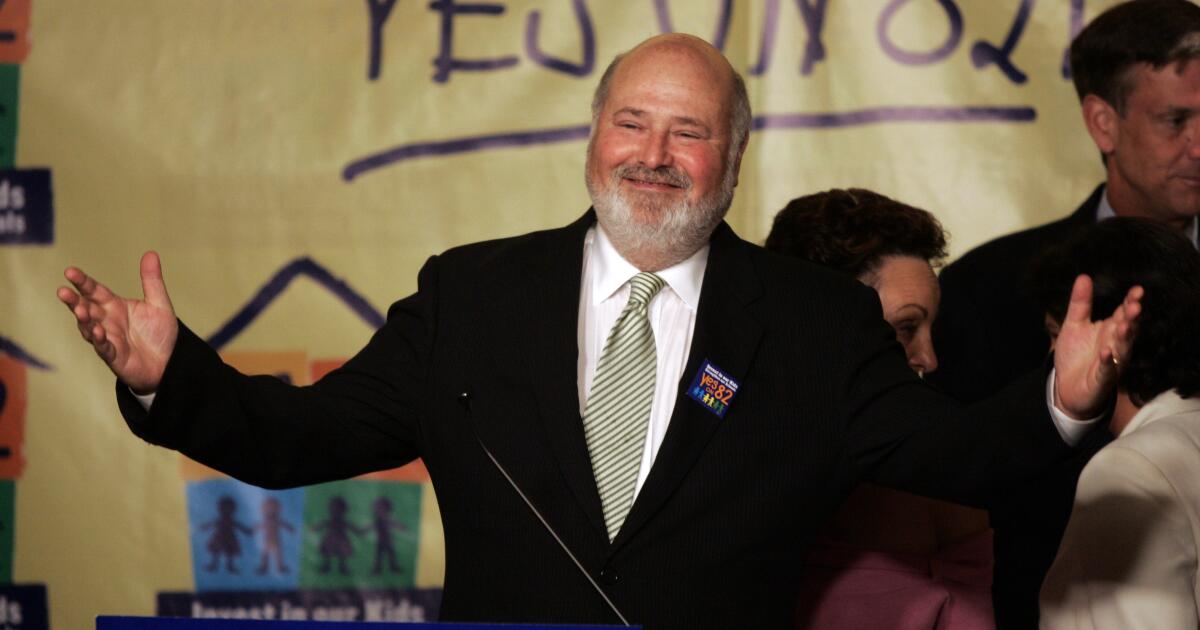
Reiner was a co-founder of the American Foundation for Equal Rights, the organization that successfully led the fight to overturn Proposition 8, the 2008 ballot measure that banned same-sex marriage. He was active in children’s issues through the years, having led the campaign to pass Proposition 10, the California Children and Families Initiative, which created an ambitious program of early childhood development services.

Proposition 10 was considered landmark policy. Reiner enlisted help in that effort from Steven Spielberg, Robin Williams, and his own father, comedy legend Carl Reiner.

“He wanted to make a difference. And he did, and he did profoundly,” Smith said.

Reiner was also a leading backer of Proposition 82, an unsuccessful measure that would have taxed the wealthy to create universal preschool in California.

Former Los Angeles Mayor Antonio Villaraigosa, who had known Reiner since he was a state lawmaker in the 1990s, worked with him on Proposition 10 and was impressed with how Reiner embraced the cause.

“He was a man with a good answer. It wasn’t politics as much as he was always focused on the humanity among us,” Villaraigosa said. ‘When he got behind an issue, he knew everything about it.”

“Just a really special man. A terrible day,” the former mayor said.

Mayor Karen Bass said in a statement that she was “heartbroken” by the day’s events, saying Reiner “always used his gifts in service of others.”

“Rob Reiner’s contributions reverberate throughout American culture and society, and he has improved countless lives through his creative work and advocacy fighting for social and economic justice,” the mayor said.

“I’m holding all who loved Rob and Michele in my heart,” Bass said.

Newsom added, “Rob was a passionate advocate for children and for civil rights — from taking on Big Tobacco, fighting for marriage equality, to serving as a powerful voice in early education. He made California a better place through his good works.”

“Rob will be remembered for his remarkable filmography and for his extraordinary contribution to humanity,” the governor said.

Source link

Far-right candidate Jose Antonio Kast wins Chile’s presidential election | Elections News

Far-right candidate Jose Antonio Kast has won a run-off election to become Chile’s 38th president, ousting the centre-left government currently in power.

On Sunday, with nearly all the ballots counted, Kast prevailed with nearly 58 percent of the vote, defeating former Labour Minister Jeannette Jara, a Communist Party politician who represented the governing centre-left coalition.

Recommended Stories

list of 3 itemsend of list

Jara and her coalition, Unity for Chile, conceded defeat shortly after the polls closed in the South American country.

“Democracy has spoken loud and clear. I have just spoken with President-elect [Kast] to wish him success for the good of Chile,” Jara wrote on social media.

“To those who supported us and were inspired by our candidacy, rest assured that we will continue working to build a better life in our country. Together and standing strong, as we always have.”

The result marks the latest victory for the far right in Latin America, which has seen a streak of right-wing leaders once considered political outsiders rise to power in countries like Argentina and Ecuador.

The tally also marks a significant comeback for Kast himself, the 59-year-old leader of the Republican Party. The 2025 election marks his third attempt to win the presidency — and his first successful bid.

During the last election, in 2021, he was trounced by outgoing President Gabriel Boric, who won by nearly a 10-point margin.

But Boric, a former student leader who became Chile’s youngest president, had seen his popularity slump to about 30 percent by the end of his four-year term. He was also ineligible to run for a second term under Chilean law.

In public opinion polls, voters also expressed frustration with recent spikes in crime and immigration, as well as a softening of Chile’s economy.

Kast, meanwhile, campaigned on the promise of change. He said he would address voter concerns by carrying out crackdowns on crime and immigration, including through a campaign of mass deportation, similar to what United States President Donald Trump has done in North America.

His security platform — dubbed the “Implacable Plan” — also proposes stiffer mandatory minimum sentencing, incarcerating more criminals in maximum security facilities, and putting cartel leaders in “total isolation” to cut them off from any communication with the outside world.

“Today, while criminals and drug traffickers walk freely through the streets, committing crimes and intimidating people, honest Chileans are locked in their homes, paralyzed by fear,” Kast writes in his security plan.

Kast has also taken a hard right stance towards social and health issues, including abortion, which he opposes even in cases of rape.

But those hardline policies earned Kast criticism on the campaign trail. Critics have also seized upon his own sympathetic comments about Chile’s former dictator, military leader Augusto Pinochet.

In 1973, Pinochet oversaw a right-wing military coup that ousted the democratically elected leader, Salvador Allende. He proceeded to rule the country until 1990. His government became known for its widespread human rights abuses and brutal oppression of political dissent, with thousands executed and tens of thousands tortured.

While Kast has rejected the label “far right”, he has repeatedly defended Pinochet’s government. Of Pinochet, Kast famously quipped, “If he were alive, he would vote for me.”

Opponents also sought to draw attention to Kast’s family ties: His father, Michael Martin Kast, was born in Germany and had been a member of the Nazi Party. The elder Kast immigrated to Chile in 1950.

Reporting from a polling site in the capital of Santiago, Al Jazeera correspondent Lucia Newman noted that Sunday’s victory was a historic one for Chile’s far right. But, she noted, Kast has sought to moderate his platform to better appeal to voters in the current election cycle.

“This is the first time since 1990 — since the military dictatorship before 1990, when Chile returned to democracy — that such a conservative government will be in power,” Newman explained.

“It’s really not certain just how conservative it will be. Jose Antonio Kast was a supporter of former dictator General Augusto Pinochet. He has shirked away from that in recent years, and certainly in this campaign.”

In the wake of Kast’s election victory, right-wing leaders from across the Americas offered their congratulations in statements on social media.

“Congratulations to Chilean President-Elect [Jose Antonio Kast] on his victory,” Trump’s Secretary of State Marco Rubio wrote. “The United States looks forward to partnering with his administration to strengthen regional security and revitalize our trade relationship.”

Argentina’s libertarian leader Javier Milei likewise chimed in, hailing it as a major win for his conservative political movement.

“FREEDOM IS ADVANCING,” Milei wrote, echoing his own campaign rallying cry.

“Enormous joy at the overwhelming victory of my friend [Jose Antonio Kast] in the Chilean presidential elections! One more step for our region in defense of life, liberty, and private property. I am sure that we will work together so that America embraces the ideas of freedom and we can free ourselves from the oppressive yoke of 21st-century socialism…!!!”

Ecuador’s right-wing President Daniel Noboa, meanwhile, said that “a new era is beginning for Chile and for the region”.

This year’s presidential race was the first time since 2012 that voting had been compulsory in the country. There are approximately 15.7 million eligible voters in the South American country.

Kast originally came in second place during the first round of voting on November 16. He scored about 23.9 percent of the vote, compared with Jara’s 26.8 percent.

But polls had widely favoured him to win in the run-off. While Chile’s left wing held a primary in June and coalesced around its victor, Jara, right-wing parties did not hold a primary to choose a coalition nominee.

The result was a fractured right in the first round of voting. But in the final contest, Kast was able to sweep up votes that had previously gone to his right-leaning adversaries, earning him a comfortable win.

Still, Kast faces a divided National Congress, which is expected to blunt some of his more hardline proposals. Kast will be sworn in on March 11.

Source link