plan

Australia PM Albanese launches gun ‘buyback’ plan after Bondi Beach attack | Gun Violence News

Albanese said Australia has more guns now than 30 years ago, when the country’s deadliest-ever mass shooting took place.

Australia will launch a national gun buyback scheme, Prime Minister Anthony Albanese has announced, as the country continues to come to terms with the deadly attack on a Jewish holiday event at Sydney’s Bondi Beach that left 15 people dead.

Albanese called the plan the country’s biggest gun buyback since 1996 – the year of Australia’s deadliest mass shooting in modern history, the Port Arthur massacre in the island state of Tasmania – and said authorities will purchase surplus, newly-banned and illegal firearms.

Recommended Stories

list of 3 itemsend of list

“Right now, there are more guns in Australia than there were during Port Arthur. We can’t allow that to continue,” Albanese told a news conference on Friday, adding that there are currently more than four million firearms in the country.

“Non-citizens have no need to own a gun. And someone in suburban Sydney has no need to own six … The terrible events of Bondi show we need to get more guns off our streets,” he said.

Albanese added that authorities in Australia’s states and territories will be tasked with collecting the weapons and processing payments for surrendered firearms under the scheme. Federal police will then be responsible for destroying them.

“We expect hundreds of thousands of firearms will be collected and destroyed through this scheme,” Albanese added.

Aided by some of the toughest gun restrictions globally, Australia has one of the lowest gun homicide rates in the world.

Restrictions were tightened after a lone gunman, armed with semiautomatic weapons, killed 35 people at the Port Arthur tourist site almost 30 years ago.

The massacre shocked the country, with authorities soon after launching a major gun amnesty and buyback scheme that removed more than 650,000 newly-prohibited firearms from circulation.

‘We need to do more to combat this evil scourge’

Sunday’s shooting in Sydney’s Bondi Beach area – in which two attackers, named as father and son Sajid Akram and Naveed Akram, went on a shooting spree and killed 15 people – has had a similarly jolting impact on Australian society as the Port Arthur massacre and prompted self-reflection.

Albanese said 50-year-old Sajid – who was shot dead at the scene – and 24-year-old Naveed – who was charged with “terrorism” and murder offences after he awoke from a coma on Tuesday – were inspired by “Islamic State ideology”.

On Thursday, Albanese announced tougher hate speech laws as he acknowledged the country had experienced a rising tide of anti-Jewish hate since the Hamas-led October 7, 2023, attacks on Israel, and Israel’s genocidal war on Gaza.

Albanese said rising anti-Semitism in Australia “culminated on Sunday in one of the worst acts of mass murder that this country has ever seen”.

“It was an attack on our Jewish community – but it was also an attack on the Australian way of life,” he said.

“Australians are shocked and angry. I am angry. It is clear we need to do more to combat this evil scourge, much more,” he added.

The prime minister also announced on Friday that Australia will hold a national day of reflection this Sunday – one week after the mass shooting.

Albanese urged Australians to light candles at 6:47pm (07:47 GMT) on Sunday, December 21 – “exactly one week since the attack unfolded”.

“It is a moment to pause, reflect, and affirm that hatred and violence will never define who we are as Australians,” he told reporters.

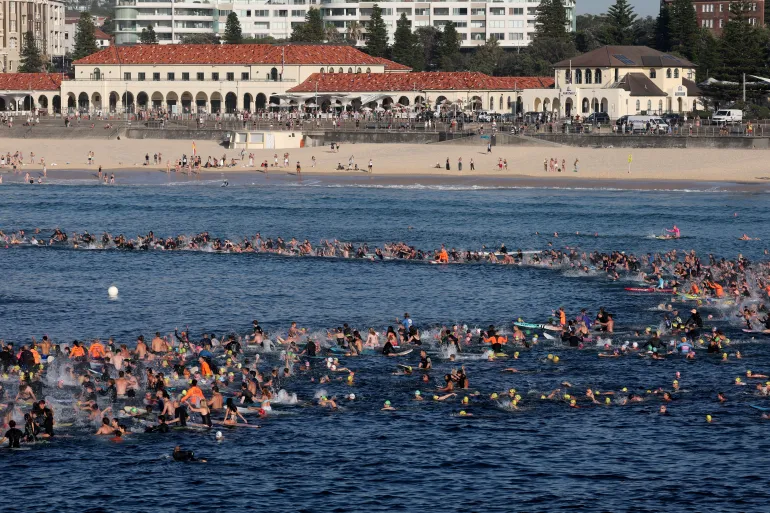
Earlier on Friday, hundreds of people plunged into the ocean off Bondi Beach in another gesture to honour the dead.

Swimmers and surfers paddled into a circle as they bobbed in the gentle morning swell, splashing water and roaring with emotion.

“They slaughtered innocent victims, and today I’m swimming out there and being part of my community again to bring back the light,” security consultant Jason Carr told the AFP news agency.

“We’re still burying bodies. But I just felt it was important,” the 53-year-old said.

“I’m not going to let someone so evil, someone so dark, stop me from doing what I do and what I enjoy doing,” he said.

Surfers and swimmers congregate in the surf at Bondi Beach as they participate in a tribute for the victims of Sunday’s Bondi Beach attack, in Sydney on December 19, 2025. Australia's leaders have agreed to toughen gun laws after attackers killed 15 people at a Jewish festival on Bondi Beach, the worst mass shooting in decades decried as antisemitic "terrorism" by authorities. (Photo by DAVID GRAY / AFP)
Surfers and swimmers congregate in the surf at Bondi Beach as they participate in a tribute for the victims of Sunday’s Bondi Beach attack, in Sydney, on December 19, 2025 [David Gray/AFP]

Source link

Beneath the rambling, Trump laid out a chilling healthcare plan

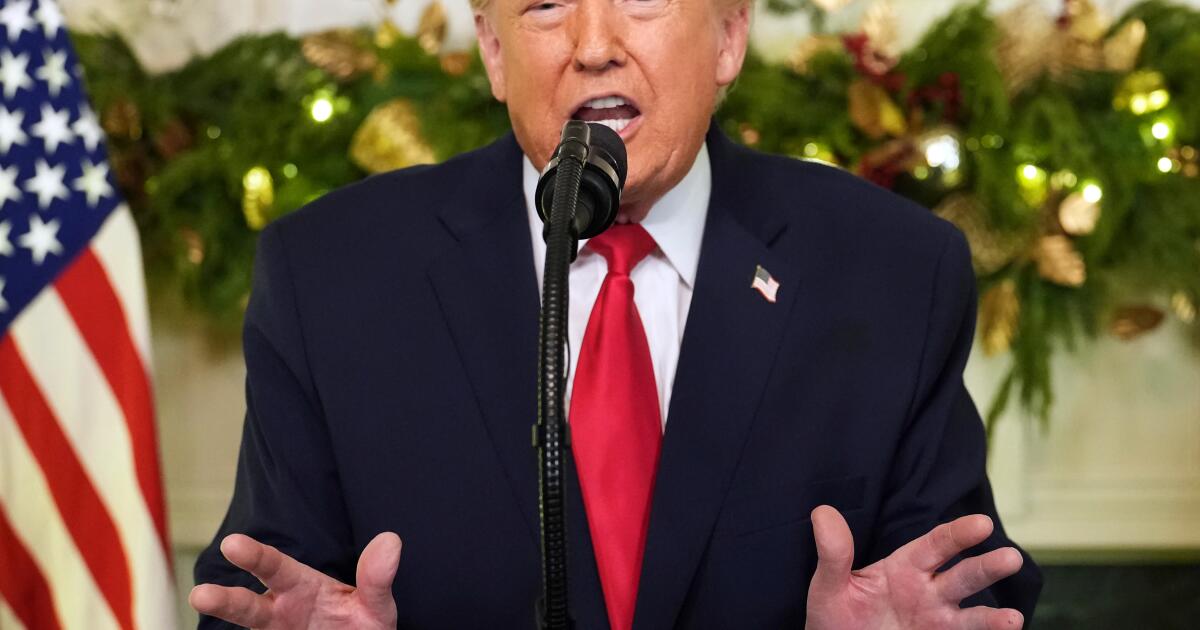
Folks, who was supposed to be watching grandpa last night? Because he got out, got on TV and … It. Was. Not. Good.

For 18 long minutes Wednesday evening, we were subjected to a rant by President Trump that predictably careened from immigrants (bad) to jobs (good), rarely slowing down for reality. But jumbled between the vitriol and venom was a vision of American healthcare that would have horror villainess M3GAN shaking in her Mary Janes — a vision that we all should be afraid of because it would take us back to a dark era when insurance couldn’t be counted on.

Trump’s remarks offered only a sketchy outline, per usual, in which the costs of health insurance premiums may be lower — but it will be because the coverage is terrible. Yes, you’ll save money. But so what? A cheap car without wheels is not a deal.

“The money should go to the people,” Trump said of his sort-of plan.

The money he vaguely was alluding to is the government subsidies that make insurance under the Affordable Care Act affordable. After antics and a mini-rebellion by four Republicans also on Wednesday, Congress basically failed to do anything meaningful on healthcare — pretty much ensuring those subsidies will disappear with the New Year.

Starting in January, premiums for too many people are going to leap skyward without the subsidies, jumping by an average of $1,016 according to the health policy research group KFF.

That’s bad enough. But Trump would like to make it worse.

The Affordable Care Act is about much more than those subsidies. Before it took effect in 2014, insurance companies in many states could deny coverage for preexisting conditions. This didn’t have to be big-ticket stuff like cancer. A kid with asthma? A mom with colitis? Those were the kind of routine but chronic problems that prevented millions from obtaining insurance — and therefore care.

Obamacare required that policies sold on its exchange did not discriminate. In addition, the ACA required plans to limit out-of-pocket costs and end lifetime dollar caps, and provide a baseline of coverage that included essentials such as maternity care. Those standards put pressure on all plans to include more, even those offered through large employers.

Trump would like to undo much of that. He instead wants to fall back on the stunt he loves the most — send a check!

What he is suggesting by sending subsidy money directly to consumers also most likely would open the market to plans without the regulation of the ACA. So yes, small businesses or even groups of individuals might be able to band together to buy insurance, but there likely would be fewer rules about what — or whom — it has to cover.

Most people aren’t savvy or careful enough to understand the limitations of their insurance before it matters. So it has a $2-million lifetime cap? That sounds like a lot until your kid needs a treatment that eats through that in a couple of months. Then what?

Trump suggested people pay for it themselves, out of health savings accounts funded by that subsidy check sent directly to taxpayers. Because that definitely will work, and people won’t spend the money on groceries or rent, and what they do save certainly will cover any medical expenses.

“You’ll get much better healthcare at a much lower price,” Trump claimed Wednesday. “The only losers will be insurance companies that have gotten rich, and the Democrat Party, which is totally controlled by those same insurance companies. They will not be happy, but that’s OK with me because you, the people, are finally going to be getting great healthcare at a lower cost.”

He then bizarrely tried to blame the expiring subsidies on Democrats.

Democrats “are demanding those increases and it’s their fault,” he said. “It is not the Republicans’ fault. It’s the Democrats’ fault. It’s the Unaffordable Care Act, and everybody knew it.”

It seems like Trump just wants to lower costs at the expense of quality. Here’s where I take issue with the Democrats. I am not here to defend insurance companies or our healthcare system. Both clearly need reform.

But why are the Democrats failing to explain what “The money should go to the people” will mean?

I get that affordability is the message, and as someone who bought both a steak and a carton of milk this week, I understand just how powerful that issue is.

Still, everyone, Democrat or Republican, wants decent healthcare they can afford, and the peace of mind of knowing if something terrible happens, they will have access to help. There is no American who gladly would pay for insurance each month, no matter how low the premium, that is going to leave them without care when they or their loved ones need it most.

Grandpa Trump doesn’t have this worry, since he has the best healthcare our tax dollars can buy.

But when he promises to send a check instead of providing governance and regulation of one of the most critical purchases in our lives, the message is sickening: My victory in exchange for your well-being.

Source link

Rolling Stones AXE plan for UK & Europe tour next year because star ‘couldn’t commit’ to gruelling leg

THE Rolling Stones have called off plans for a UK and European tour next summer.

It would have been their first string of live dates since their huge Hackney Diamonds tour in the US in 2024 – which sold almost one million tickets.

The Rolling Stones have called off plans for a UK and European tour next summerCredit: Getty
Fronted by Mick Jagger, the band previously revealed they had been working on a new albumCredit: Getty

It’s understood the band – who’ve sold over 250 million records worldwide – were looking at plans to play huge stadiums across Europe and the UK after pulling the plug on dates in 2025.

An American music critic said Keith Richards, who turns 82 on Thursday, told his bandmates Mick Jagger, 82, and Ronnie Wood, 78, he couldn’t commit to the trek at this time.

They added: “The Rolling Stones had all the big promoters throwing loads of ideas and dates at them for next summer.

“But when they properly sat down to discuss the tour, Keith said he didn’t think he could commit and wasn’t keen on a big stadium tour for over four months.”

ALL GROWN UP

Where are the child stars of The Chronicles of Narnia now 20 years on


SAD LOSS

Corrie star announces tragic death of son & pays tribute to his ‘beautiful boy’

A spokesperson said at the time: “The band were looking to tour earlier this year but couldn’t make it work either.

“It’s hard for their fans but The Stones will get back onstage when they’re good and ready.”

In September, Ronnie confirmed to The Sun that he was waiting on the nod on the 2026 tour dates.

He also confirmed they had been working on their next album, which was recorded at Metropolis Studios in Chiswick, west London.

Ronnie said: “You will be getting new music from the Rolling Stones with an album next year. It is almost done. ”

Their last album, Hackney Diamonds, came out in 2023 and was their first record of original material in 18 years.

The album went straight to No1 in the album charts and spawned hits including Angry, which had Sydney Sweeney in the official music video.

The Rolling Stones had planned to release another album after the success of Hackney DiamondsCredit: Getty

Source link

Europe’s efforts to undermine Trump’s plan on Ukraine may backfire | Russia-Ukraine war

This week is shaping up to be crucial for the European Union’s policy on Ukraine. EU foreign ministers met in Brussels on Monday; EU heads of state will gather on Thursday. Ukrainian President Volodymyr Zelenskyy is meeting United States envoy Steve Witkoff. At the top of the agenda is the peace plan put forward by US President Donald Trump and continuing funding for Ukraine’s war effort.

The European strategy so far has been to alter the US-proposed peace plan in such a way that it becomes completely unacceptable to Russia. This, as European leaders hope, will reinforce the core narrative emanating from their capitals over the past two months – that Russian President Vladimir Putin is just playing games and doesn’t really want peace.

The idea behind it is to try to sway Trump to their side and have him apply additional military and economic pressure on the Kremlin rather than pressing Ukraine into signing an unsavoury peace deal right away. But this effort could easily backfire.

The main practical issue with regards to Ukraine’s capacity to withstand Russian aggression during 2026 is who is going to fund its army as well as its state and social welfare system. Trump proudly states that the US is no longer financing Ukraine’s war effort because, in his parlance, it is “Biden’s war” – ie, his predecessor Joe Biden is to blame.

The burden of funding is now squarely on Europe – the EU and rich non-EU countries, such as the United Kingdom and Norway. The US keeps providing weapons to Ukraine, but these are being paid for with money from European coffers. US intelligence support, crucial in Ukraine’s war planning, is currently available to Kyiv for free.

European leaders have been vocal and aggressive throughout the year in rejecting any realistic compromise that could end the war. But even as 2025 is ending, there is no clarity as to how they are going to back up their jingoistic rhetoric with sufficient funding that would allow Ukraine not just to stay afloat but tip the balance in the conflict in its favour.

Their plan A is what they call the reparations loan. It envisages using the assets of the Russian Central Bank frozen by European banks to fund the Ukrainian defence. This means that rather than spending the money on actual reparations – as in Ukraine’s post-war restoration – it would be spent on the war itself.

The thinking behind this plan is that once Russia suffers a strategic defeat, it would retroactively agree to the confiscation rather than demand its money back, so European governments would not have to reach into their coffers to return the money to the Russians.

The obvious problem here is that exactly nobody – except war cheerleaders who have been promising Russia’s defeat for the past four years – believes this outcome is even remotely realistic. Belgium, which holds the bulk of these assets, is equally sceptical, which is why it opposes this plan. It has been joined by a growing number of EU states, including the Czech Republic and Italy.

The other big problem is that Trump’s peace plan has radically different designs for the assets in question. It envisages using them as actual reparations, as in spending them on restoring Ukraine’s economy. Most crucially, Moscow has on numerous occasions signalled that it agrees with this part of the plan. It considers the money lost and wants to make sure neighbouring Ukraine does not turn into a failed state.

This means that if the reparations loan plan goes ahead, it would undermine the most attractive provision of Trump’s plan. If this happens, the US and the EU may find themselves more at odds with each other than they already are, and that would hardly sway Trump.

His administration has indicated on a number of occasions that it could walk out of the peace process if it is derailed, which means ending any help to Ukraine, be it with weapons or intelligence.

The reparations loan plan also comes with an enormous risk for the European economy. The confiscation of Russian assets would discourage any central bank in the world from keeping its money in Europe, meaning the European banking system stands to lose.

More importantly, this move cannot guarantee that Ukraine would be able to stop Russia’s slow but steady advancement. Securing funding for another year under the current circumstances basically means that more Ukrainian lives and territory will be lost in 2026.

This money cannot in effect counter the biggest threat to Ukraine and its neighbours right now: that of Russia precipitating a humanitarian catastrophe that could spill over into the region by devastating Ukraine’s energy infrastructure this winter. The latest blackout in Odesa when the whole city was left without water and heating in the middle of winter is a dark prelude of things to come.

All this warrants the question of why European leaders are acting the way they are now. Could their irrational radicalism be explained by their extensive political investment in delusional outcomes of this war that they have been selling to voters for the past four years? Or are they engaging in incessant moral posturing so as to avoid being scapegoated for the real outcome of the war?

There is probably a bit of both. But there is perhaps also an even more sinister motive, recently expressed by Wolfgang Ischinger, chairman of the Munich Security Conference: the idea that “as long as this war is being fought, … Europe is safe because the Ukrainians have successfully tied down this mighty Russian army.” In other words, there are some within the European political elite who perceive ending the war as being against European interests.

But regardless of what those on top think or are motivated by, the war fatigue in Europe is real. The rise of pro-Russia far-right groups in Germany and elsewhere, capitalising on the ruling elites’ shining ineptitude in handling the conflict with Russia, is a clear sign of that.

If the reparations loan scheme does not pass this week, the EU would have to go to plan B, which envisages loaning money from the EU budget. That, of course, would be met with fierce opposition from the European public.

The failure to secure funding for Ukraine may be seen as an embarrassing failure in Europe, but it would make things easier for Zelenskyy. With his administration losing popularity amid continuing military upsets and a major corruption scandal, Ukraine’s president is well on his way to becoming the chief scapegoat in this debacle.

But no more funding from Europe would allow him to declare that the West has betrayed Ukraine and proceed with the inevitable: accepting an unsavoury peace largely on Russia’s terms.

The views expressed in this article are the author’s own and do not necessarily reflect Al Jazeera’s editorial stance.

Source link

New details released on how to buy tickets for 2028 Olympics

LA28 announced the next step in its ticketing plan for the 2028 Olympic and Paralympic Games on Monday as ticket registration will open on Jan. 14.

Fans can start registering for tickets on Jan. 14 at la28.org, and the registration will remain open until March 18. All who sign up will be entered into a random draw to receive a time slot to purchase tickets. While registering, fans will enter their zip codes, and those who live in the Los Angeles and Oklahoma City areas near venues will be eligible to access the first time slots reserved for locals.

“The goal there is to make sure that we’re getting tickets into the hands, not just the fans, but of the local fans,” said Allison Katz-Mayfield, LA28’s senior vice president of Games delivery revenue. “Those that are going to be closest to the Games, really helping us host these Games in some ways.”

The 2028 Olympics will feature the largest Games schedule in history, with 36 sports and 11,198 athletes. The majority of the Games will be held in L.A., including major sports zones in downtown, Exposition Park and the Sepulveda Basin, but cities including Carson, Inglewood and Long Beach will also have multiple venues. Oklahoma City will host the softball and canoe slalom events at existing facilities.

LA28 is still finalizing the duration of each purchasing window, although the plan is to have multiple opportunities per day, so fans would be assigned time slots that are open for several hours. Tickets for a variety of events will be available during each drop in 2026, with single-event tickets beginning at $28. When tickets for the Paralympics go on sale in 2027, the system will be similar and fans will not have to re-register their interest.

While the Olympics will be back in L.A. for the third time in 2028, it will be the first time the city is hosting the Paralympics.

LA28 plans to release 14 million tickets for the Olympics and Paralympics. The total would be a Games record, eclipsing the 12 million sold in Paris, where ticket sales began almost a year after the timeline LA28 is currently using. The Paris Games that opened in July 2024 did not begin ticket registration until November 2022, 20 months before the event.

Fans will have two-and-a-half years to register and purchase tickets before L.A. opens the Olympics on July 14, 2028.

Source link

Wilson Expands on Plan for ID Card : Immigration: Governor wants the state to be a testing ground for the tamper-proof documents. But he admits that it would probably be impossible to come up with a foolproof system.

Gov. Pete Wilson challenged President Clinton on Thursday to make California a test market for a tamper-proof federal identification card designed to keep illegal immigrants from receiving public benefits or getting jobs in the United States.

Later, a Wilson aide said one option might be a national identification card that would be carried by every legal resident of the United States, including U.S. citizens.

Wilson’s news conference at U.S. Immigration and Naturalization Service offices at Los Angeles International Airport was billed as the forum for a “major announcement regarding immigration.” In fact, Wilson’s statement expanded on his Aug. 9 program by only a small step–the proposed California test–while raising even more questions about his plan for the proposed identification card.

The governor acknowledged to a reporter that it probably is impossible to come up with a foolproof card because counterfeiters could fake birth certificates, passports or other documents that would be needed to get the card.

Wilson left unclear just who might have to possess the card: just foreign nationals living in the country legally or all U.S. citizens?

Asked who would have to carry the card, Wilson said: “Those who are applicants for employment and those who are applicants for benefits.”

Later, Wilson aide Dan Schnur said one possibility that arose during policy discussions in the governor’s office was a national identification card issued to all U.S. citizens and legal residents.

“A universal card is one option, but we’re not looking at it as an absolute condition,” Schnur said in telephone calls to reporters.

The form and scope of any card would be worked out in negotiations with the Clinton Administration, he said.

There have been periodic proposals for a national ID card, but they have always run up against strong opposition on civil liberties grounds.

Wilson was quoted by the Santa Monica Outlook while running for the U.S. Senate in 1982 that a proposed national identification card was “a lousy idea” because it would create a massive new bureaucracy. He also said he had some philosophical objections to the concept.

Schnur had no comment on that report, but he said conditions have changed greatly since the passage of immigration reform in the late 1980s and the heavy influx of illegal immigrants into California in recent years.

Thursday’s billing of a major new initiative drew a dozen television cameras and perhaps a score of reporters, a big turnout for any political event in Los Angeles. Although it turned out that Wilson’s statement was more of an expansion on a previous proposal than a major new initiative, the session did give the governor a platform for responding to critics of his Aug. 9 announcement.

Wilson said an identification card is the key to the enforcement of any of the sanctions written into federal law against employers who hire illegal immigrants for jobs in the United States. Without it, such sanctions are unenforceable, he said.

“Until we deal with the problem of document fraud, anyone proposing additional employer sanctions is simply blowing hot air,” Wilson said after examining stacks of phony passports, Social Security cards and other false documents confiscated by the INS.

Critics, including potential Democratic gubernatorial challenger Kathleen Brown, have said Wilson’s plan cracks down on illegal immigrants but not on the employers who also violate the law by hiring them.

Last week, Brown, the state treasurer, endorsed a national tamper-proof Social Security card that would have to be presented to a prospective employer before the cardholder could be hired.

In his lengthy Aug. 9 letter to Clinton, Wilson called on the federal government to compensate California for the cost of services to illegal immigrants, called for stricter enforcement of the California-Mexico border, and said children born on U.S. soil to undocumented immigrants should not automatically become U.S. citizens or be eligible to attend public schools in California.

Wilson made no mention of stronger enforcement against employers. He proposed an identification card as something that foreign nationals in the country legally would present to qualify for state services.

Wilson said California’s modern holographic drivers licenses could be the model for a federal card, but a reporter wondered if even they could be forged, since a photographic blowup of one was among the fake IDs on display.

“You know, I don’t dispute the ingenuity of counterfeiters. . . . I think it is possible to stay technologically ahead of even expert counterfeiters,” Wilson said.

“The question really is not whether you’re going to have an entirely foolproof system, but whether you have one that works to achieve its major goal, which is to screen out the vast majority of counterfeit documents.”

Later in the day, Democratic state Chairman Bill Press chided Wilson for intervening with the INS in 1989 on behalf of a San Diego supporter, Anne Evans, whose hotels were under investigation for hiring illegal immigrants. At the time, Wilson was a U.S. senator.

Evans ultimately was accused of 362 violations of employer sanctions provisions and fined $70,000.

Schnur described Wilson’s letter, which sought a conciliation between the INS and Evans, as a routine constituent service.

Source link