Eight-month-old among multiple Palestinians wounded in attacks across the occupied West Bank.
Published On 25 Dec 202525 Dec 2025
Share
Five Israeli settlers have been arrested over their alleged involvement in an attack on a Palestinian home that wounded an eight-month-old baby in the occupied West Bank.
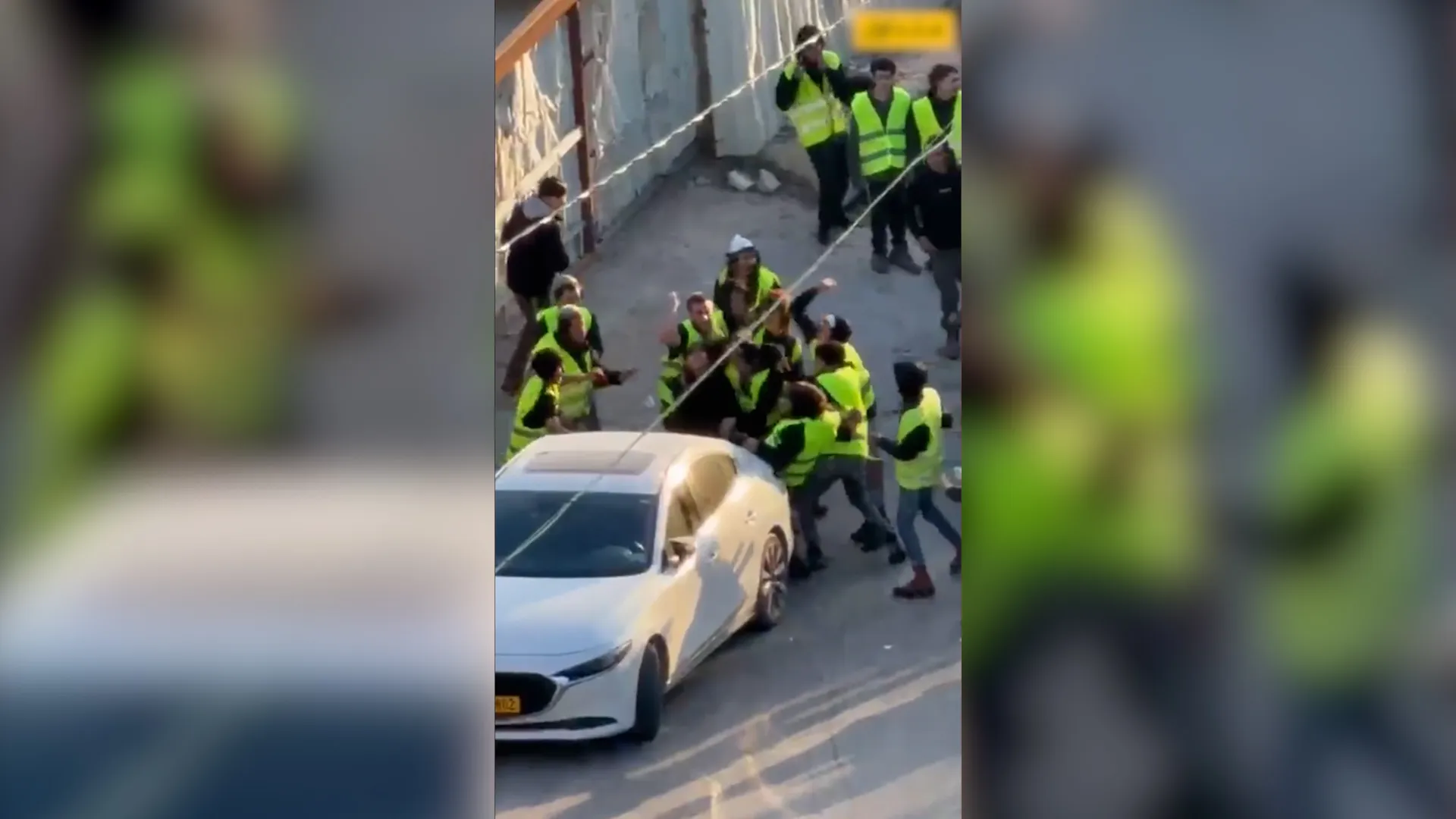
The Palestinian news agency Wafa reported that the infant suffered “moderate injuries to the face and head” in the attack that took place late on Wednesday involving “a group of armed settlers” who were throwing stones at homes and property in the town of Sair, north of Hebron.
Israeli police on Thursday said five settlers were arrested after they received reports of “stones being thrown by Israeli civilians toward a Palestinian home”.
Israeli settlements and outposts are Jewish-only communities built on Palestinian land that are illegal under international law. They can range in size from a single dwelling to a collection of high rises. About 700,000 settlers live in the West Bank and occupied East Jerusalem, according to the Israeli advocacy group Peace Now.
Elsewhere in the West Bank, a 17-year-old boy was shot and dozens of Palestinians suffered tear gas inhalation during an Israeli army raid in the town of Beit Furik, east of Nablus, Wafa reported.
The report added that “Israeli forces carried out a widespread incursion into the town, firing live bullets and tear gas canisters across its neighborhoods”.
Israeli forces also detained three Palestinians from Masafer Yatta, south of Hebron, after settler attacks.
Also in Masafer Yatta, Israeli forces raided homes and tents belonging to residents, searched them and vandalised their contents before detaining one resident.
Another Palestinian man was wounded in a settler attack in the town of Deir Jarir, east of Ramallah.
Local sources said armed settlers attacked homes near the village entrance, resulting in minor injuries to a young man.
Celebrated director of ‘Jenin, Jenin’ documentary leaves behind legacy of artistic resistance.
Published On 25 Dec 202525 Dec 2025
Share
Acclaimed Palestinian actor and filmmaker Mohammad Bakri has died in northern Israel, ending a five-decade career that established him as one of the most influential voices in Palestinian cinema.
Bakri died on Wednesday at Galilee Medical Centre in Nahariya after suffering from heart and lung problems, hospital officials said.
Recommended Stories
list of 2 itemsend of list
His passing removes a towering figure whose work directly challenged Israeli narratives and whose decades-long legal battles over censorship became a defining chapter in Palestinian cultural resistance.
The 72-year-old was best known for his 2002 documentary, Jenin, Jenin, which captured testimonies from Palestinian residents following a devastating Israeli military operation in the refugee camp that killed 52 Palestinians.
The film ignited years of controversy in Israel but elevated Bakri’s status as a creative and would overshadow the remainder of his life.
Israeli authorities banned the documentary from screening in 2021, with the Supreme Court upholding the prohibition in 2022, deeming it defamatory.
“I intend to appeal the verdict because it is unfair, it is neutering my truth,” Bakri told the Walla News website at the time.
Five soldiers sued Bakri, and courts eventually fined him hundreds of thousands of shekels while ordering all copies seized and online links removed.
In an interview with the British Film Institute earlier this year, Bakri said, “I don’t see Israel as my enemy … but they consider me their enemy. They see me as a traitor … for making a movie.”
Born in 1953 in the Galilee village of Bi’ina, Bakri was a Palestinian citizen of Israel who studied Arabic literature and theatre at Tel Aviv University. He made his striking film debut at age 30 in Costa-Gavras’s Hanna K, playing a Palestinian refugee attempting to reclaim his family’s home.
His role as a Palestinian prisoner in the 1984 Israeli film Beyond the Walls earned international acclaim and an Academy Award nomination for the production.
But it was Bakri’s commitment to telling Palestinian stories that defined his career. He appeared in more than 40 films and directed several documentaries examining the experiences of Palestinians living under occupation and within Israel.
His solo theatrical performance of The Pessoptimist, based on Emile Habibi’s novel about Palestinian identity, was performed more than 1,500 times worldwide and cemented his status as a cultural icon.
Bakri is survived by his wife Leila and six children, including actors Saleh, Ziad and Adam, who have followed him into cinema. His funeral was held the same day in Bi’ina.
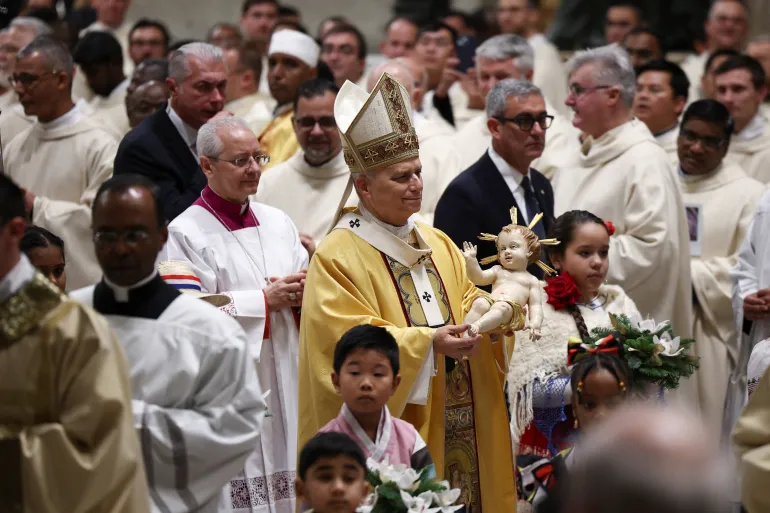
Pope Leo has decried conditions for Palestinians in Gaza in his first Christmas sermon as pontiff, in an unusually direct appeal during what is normally a solemn, spiritual service on the day Christians across the globe celebrate the birth of Jesus Christ.
Leo, the first American pope, said on Thursday that the story of Jesus being born in a stable showed that God had “pitched his fragile tent” among the people of the world.
Recommended Stories
list of 3 itemsend of list
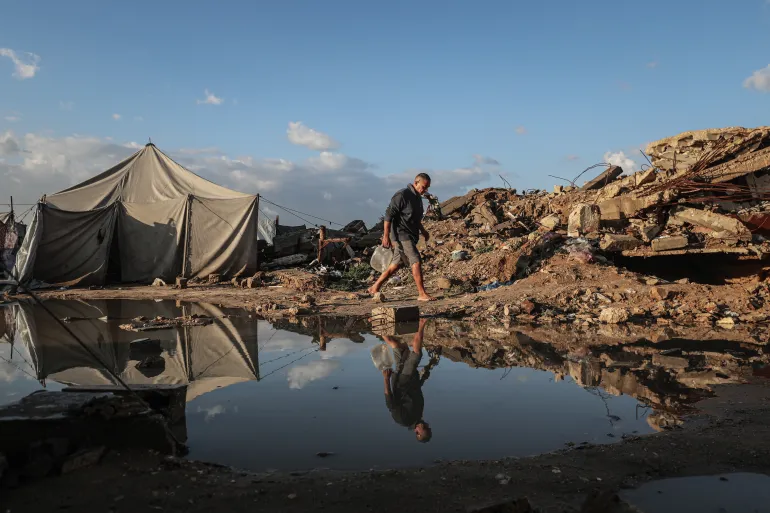
“How, then, can we not think of the tents in Gaza, exposed for weeks to rain, wind and cold?” he asked.
Leo, celebrating his first Christmas after being elected in May by the world’s cardinals to succeed the late Pope Francis, has a quieter, more diplomatic style than his predecessor and usually refrains from making political references in his sermons.
But the new pope has also lamented the conditions for Palestinians in Gaza several times recently and told journalists last month that the only solution in the decades-long conflict between Israel and Palestine must include a Palestinian state.
Israel and Hamas agreed to a ceasefire in October after two years of intense bombardment and military operations in Gaza, but humanitarian agencies say there is still too little aid getting into the largely destroyed Strip, where nearly the entire population is homeless after being displaced by Israeli attacks.
In Thursday’s service with thousands in St Peter’s Basilica, Leo also lamented conditions for the homeless across the globe and the destruction caused by the wars roiling the world.
“Fragile is the flesh of defenceless populations, tried by so many wars, ongoing or concluded, leaving behind rubble and open wounds,” said the pope.
“Fragile are the minds and lives of young people forced to take up arms, who on the front lines feel the senselessness of what is asked of them and the falsehoods that fill the pompous speeches of those who send them to their deaths,” he added.
In a later appeal during the “Urbi et Orbi” (to the city and the world) message and blessing given by the pope at Christmas and Easter, Leo called for an end to all global wars, lamenting conflicts, political, social or military, in Ukraine, Sudan, Mali, Myanmar, and Thailand and Cambodia, among others.
Pope Leo XIV holds a figurine of baby Jesus during Christmas Eve Mass in St Peter’s Basilica at the Vatican, December 24 [Guglielmo Mangiapane/Reuters]
‘The wounds are deep’
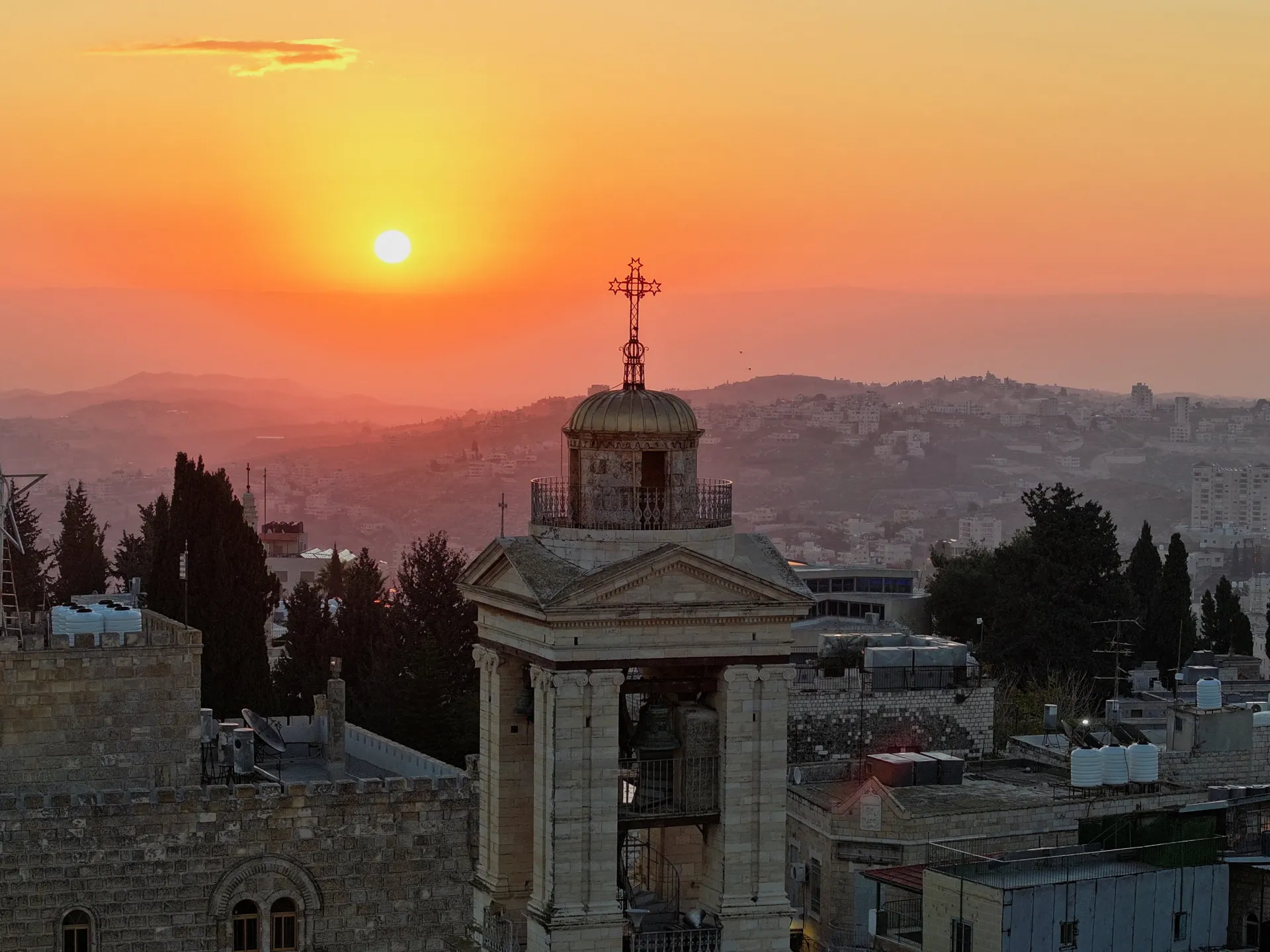
Ahead of the pope’s mass, in Bethlehem in the occupied West Bank, the Christian community began celebrating its first festive Christmas in more than two years, as the Palestinian city and biblical birthplace of Jesus emerges from the shadow of Israel’s genocidal war on Gaza.
Throughout the war, a sombre tone had marked Christmases in Bethlehem. But celebrations returned on Wednesday with parades and music. Hundreds of worshippers also gathered for mass at the Church of the Nativity on Wednesday night.
With pews filled long before midnight, many stood or sat on the floor for the traditional mass to usher in Christmas Day.
At 11:15 pm (21:15 GMT), organ music rang out as a procession of dozens of clergymen entered, followed by Jerusalem’s Latin Patriarch Pierbattista Pizzaballa, who blessed the crowd with signs of the cross.
In his homily, Pizzaballa urged peace, hope and rebirth, saying the Nativity story still held relevance in the turbulence of modern times.
He also spoke of his visit to Gaza over the weekend, where he said “suffering is still present” despite the ceasefire. In the Strip, hundreds of thousands of people face a bleak winter in makeshift tents.
“The wounds are deep, yet I have to say, here too, there too, their proclamation of Christmas resounds,” Pizzaballa said. “When I met them, I was struck by their strength and desire to start over.”
In Bethlehem, hundreds also took part in the parade down the narrow Star Street on Wednesday, while a dense crowd massed in the square. As darkness fell, multi-coloured lights shone over Manger Square and a towering Christmas tree glittered next to the Church of the Nativity.
The basilica dates back to the fourth century and was built on top of a grotto where Christians believe Jesus was born more than 2,000 years ago.
Bethlehem residents hoped the return of Christmas festivities would breathe life back into the city.
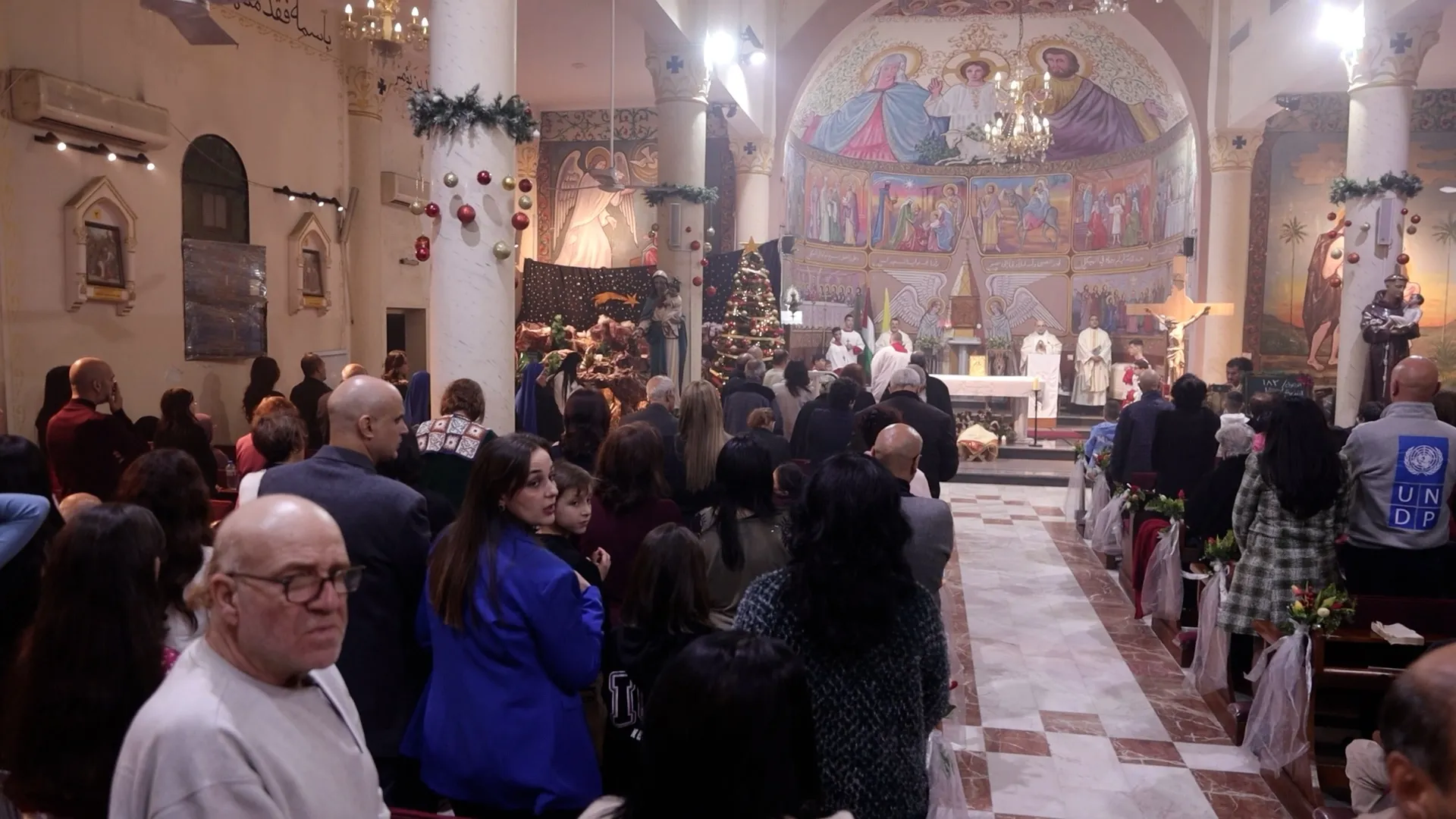
Gaza’s Christians reflected on the loss they’ve experienced after two years of Israel’s devastating war, as Palestinians marked the first Christmas since the fragile ceasefire deal.
From Israel’s genocide in Gaza and the Russia-Ukraine war to devastating global weather events – including floods, storms and earthquakes – this year was defined by turmoil and humanitarian crises.
Prolonged violence in Sudan, marked by attacks by the Rapid Support Forces (RSF), added to the mounting civilian toll and displacement across the country.
The year also saw heightened tensions between India and Pakistan, a deadly blaze in Hong Kong, United States and Israeli attacks on Iran, revelations from the Epstein files, and waves of “Gen Z” protest movements across multiple regions.
Together, these developments dominated international headlines, reflecting deepening political instability, social unrest and growing humanitarian needs worldwide.
View the gallery below for powerful photographs that documented and encapsulated these pivotal 12 months.
Christmas celebrations return to Bethlehem as thousands gather in Manger Square for the first time since 2022.
Thousands of people have gathered in Bethlehem on Christmas Eve for the first public celebrations since 2022 after the city cancelled or muted festivities for two years out of respect for the thousands killed during Israel’s genocidal war on Gaza.
Families filled Manger Square in the occupied West Bank city as a giant Christmas tree returned to the plaza, replacing a nativity display used during the war that showed baby Jesus amid rubble and barbed wire, symbolising the devastation in Gaza.
Recommended Stories
list of 3 itemsend of list
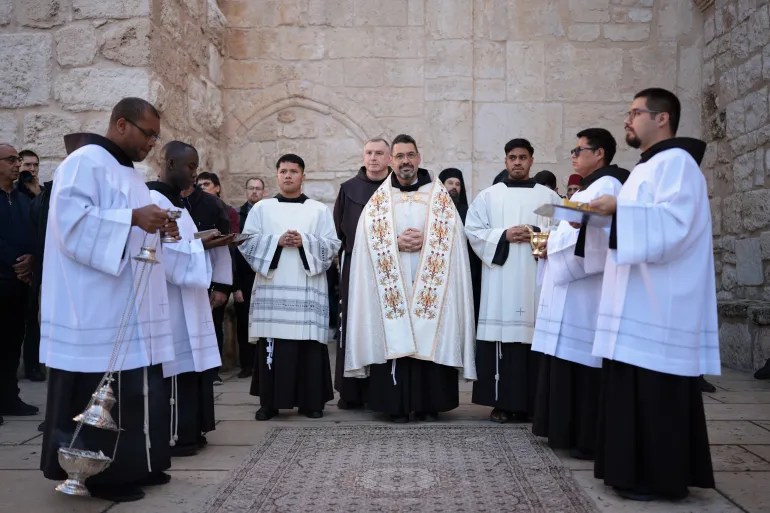
The celebrations were led by Cardinal Pierbattista Pizzaballa, the top Catholic leader in the Holy Land, who arrived in Bethlehem from Jerusalem in the traditional Christmas procession and called for “a Christmas full of light”.
Clergymen and alter boys wait ahead of Christmas service in the Manger Square outside the Church of the Nativity (R) in the biblical city of Bethlehem in the occupied West Bank on Christmas eve on December 24, 2025. (AFP)
Scout bands from towns across the West Bank marched through Bethlehem’s streets, their bagpipes draped with tartan and Palestinian flags.
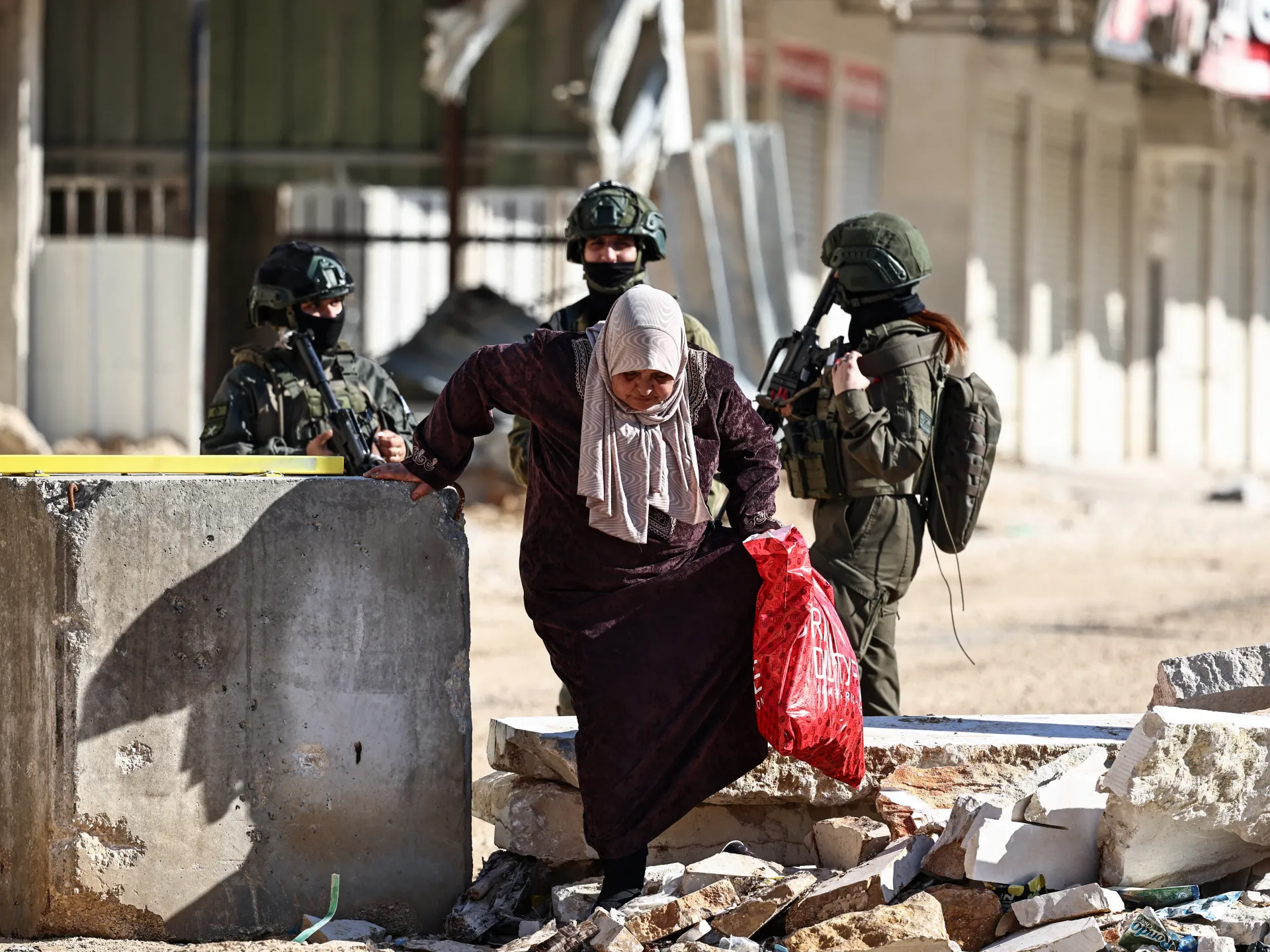
Since the start of Israel’s genocidal war on Gaza, its forces have carried out near-daily raids across the West Bank, arresting thousands of Palestinians and sharply restricting movement between cities.
Palestinians say the intensified military presence, road closures and checkpoint delays have deterred visitors, paralysing the tourism sector on which Bethlehem’s economy depends.
The vast majority of those celebrating were local residents, with only a small number of foreign visitors.
Unemployment in Bethlehem surged from 14 percent to 65 percent during the genocidal war on Gaza, Mayor Maher Nicola Canawati said earlier this month. As economic conditions deteriorated, about 4,000 residents left the city in search of work, he added.
Israeli raids and settler attacks
The return of Christmas celebrations comes despite continued raids and large-scale military incursions across the occupied West Bank, even after a fragile ceasefire in Gaza, which has been repeatedly violated by Israeli forces, took hold in October.
The raids often entail mass arrests of Palestinians, home searches and demolitions, as well as physical assaults that sometimes lead to deaths.
Attacks by Israeli settlers against Palestinians have reached their highest level since the United Nations humanitarian office began recording data in 2006. The attacks have involved killings, beatings and the destruction of property, often under the protection of the Israeli military.
Earlier on Wednesday, more than 570 Israeli settlers entered the Al-Aqsa Mosque compound in occupied East Jerusalem under police protection, the Palestinian news agency Wafa reported.
Palestinians say such incursions violate the longstanding status quo governing Islam’s third-holiest site.
Israel’s security cabinet has also signed off on plans to formalise 19 illegal settlements across the West Bank, in a move Palestinian officials say deepens a decades-long project of land theft and demographic engineering.
The United Kingdom, Canada, Germany and other countries condemned the move on Wednesday.
“We call on Israel to reverse this decision, as well as the expansion of settlements,” said a joint statement released by the UK, Belgium, Denmark, France, Italy, Iceland, Ireland, Japan, Malta, the Netherlands, Norway and Spain.
“We recall that such unilateral actions, as part of a wider intensification of the settlement policies in the West Bank, not only violate international law but also risk fuelling instability.”
Every December, much of the Christian world enters a familiar cycle of celebration: carols, lights, decorated trees, consumer frenzy and the warm imagery of a snowy night. In the United States and Europe, public discourse often speaks of “Western Christian values”, or even the vague notion of “Judeo-Christian civilisation”. These phrases have become so common that many assume, almost automatically, that Christianity is inherently a Western religion — an expression of European culture, history and identity.
It is not.
Christianity is, and has always been, a West Asian / Middle Eastern religion. Its geography, culture, worldview and founding stories are rooted in this land — among peoples, languages and social structures that look far more like those in today’s Palestine, Syria, Lebanon, Iraq, and Jordan than anything imagined in Europe. Even Judaism, invoked in the term “Judeo-Christian values”, is itself a thoroughly Middle Eastern phenomenon. The West received Christianity — it certainly did not give birth to it.
And perhaps nothing reveals the distance between Christianity’s origins and its contemporary Western expression more starkly than Christmas — the birth story of a Palestinian Jew, a child of this land who was born long before modern borders and identities emerged.
What the West made of Christmas
In the West, Christmas is a cultural marketplace. It is commercialised, romanticised and wrapped in layers of sentimentality. Lavish gift-giving overshadows any concern for the poor. The season has become a performance of abundance, nostalgia, and consumerism — a holiday stripped of its theological and moral core.
Even the familiar lines of the Christmas song Silent Night obscure the true nature of the story: Jesus was not born into serenity but into upheaval.
He was born under military occupation, to a family displaced by an imperial decree, in a region living under the shadow of violence. The holy family were forced to flee as refugees because the infants of Bethlehem, according to the Gospel narrative, were massacred by a fearful tyrant determined to preserve his reign. Sound familiar?
Indeed, Christmas is a story of empire, injustice and the vulnerability of ordinary people caught in its path.
Bethlehem: Imagination vs reality
For many in the West, Bethlehem – the birthplace of Jesus – is a place of imagination — a postcard from antiquity, frozen in time. The “little town” is remembered as a quaint village from scripture rather than a living, breathing city with actual people, with a distinct history and culture.
Bethlehem today is surrounded by walls and checkpoints built by an occupier. Its residents live under a system of apartheid and fragmentation. Many feel cut off, not only from Jerusalem – which the occupier does not allow them to visit – but also from the global Christian imagination that venerates Bethlehem’s past while often ignoring its present.
This sentiment also explains why so many in the West, while celebrating Christmas, care little about the Christians of Bethlehem. Even worse, many embrace theologies and political attitudes that erase or dismiss our presence entirely in order to support Israel, the empire of today.
In these frameworks, ancient Bethlehem is cherished as a sacred idea, but modern Bethlehem — with its Palestinian Christians suffering and struggling to survive — is an inconvenient reality that needs to be ignored.
This disconnect matters. When Western Christians forget that Bethlehem is real, they disconnect from their spiritual roots. And when they forget that Bethlehem is real, they also forget that the story of Christmas is real.
They forget that it unfolded among a people who lived under empire, who faced displacement, who longed for justice, and who believed that God was not distant but among them.
What Christmas means for Bethlehem
So what does Christmas look like when told from the perspective of the people who still live where it all began — the Palestinian Christians? What meaning does it hold for a tiny community that has preserved its faith for two millennia?
At its heart, Christmas is the story of the solidarity of God.
It is the story of God who does not rule from afar, but is present among the people and takes the side of those on the margins. The incarnation — the belief that God took on flesh — is not a metaphysical abstraction. It is a radical statement about where God chooses to dwell: in vulnerability, in poverty, among the occupied, among those with no power except the power of hope.
In the Bethlehem story, God identifies not with emperors but with those suffering under empire — its victims. God comes not as a warrior but as an infant. God is present not in a palace but in a manger. This is divine solidarity in its most striking form: God joins the most vulnerable part of humanity.
Christmas, then, is the proclamation of a God who confronts the logic of empire.
For Palestinians today, this is not merely theology — it is lived experience. When we read the Christmas story, we recognise our own world: the census that forced Mary and Joseph to travel resembles the permits, checkpoints and bureaucratic controls that shape our daily lives today. The holy family’s flight resonates with the millions of refugees who have fled wars across our region. Herod’s violence echoes in the violence we see around us.
Christmas is a Palestinian story par excellence.
A message to the world
Bethlehem celebrates Christmas for the first time after two years without public festivities. It was painful yet necessary for us to cancel our celebrations; we had no choice.
A genocide was unfolding in Gaza, and as people who still live in the homeland of Christmas, we could not pretend otherwise. We could not celebrate the birth of Jesus while children his age were being pulled dead from the rubble.
Celebrating this season does not mean the war, the genocide, or the structures of apartheid have ended. People are still being killed. We are still besieged.
Instead, our celebration is an act of resilience — a declaration that we are still here, that Bethlehem remains the capital of Christmas, and that the story this town tells must continue.
At a time when Western political discourse increasingly weaponises Christianity as a marker of cultural identity — often excluding the very people among whom Christianity was born — it is vital to return to the roots of this story.
This Christmas, our invitation to the global church — and to Western Christians in particular — is to remember where the story began. To remember that Bethlehem is not a myth but a place where people still live. If the Christian world is to honour the meaning of Christmas, it must turn its gaze to Bethlehem — not the imagined one, but the real one, a town whose people today still cry out for justice, dignity and peace.
To remember Bethlehem is to remember that God stands with the oppressed — and that the followers of Jesus are called to do the same.
The views expressed in this article are the author’s own and do not necessarily reflect Al Jazeera’s editorial stance.
Other countries, including Brazil, Colombia, Ireland, Mexico, Spain and Turkiye, have already joined the case in The Hague.
Published On 23 Dec 202523 Dec 2025
Share
Belgium has formally joined the case launched by South Africa at the International Court of Justice (ICJ) alleging Israel is committing genocide in the Gaza Strip.
In a statement on Tuesday, the ICJ – The Hague-based highest court of the United Nations – said Belgium had filed a declaration of intervention in the case.
Recommended Stories
list of 4 itemsend of list
Other countries, including Brazil, Colombia, Ireland, Mexico, Spain and Turkiye, have already joined the proceedings.
South Africa brought the case in December 2023, arguing that Israel’s war in Gaza violates the 1948 UN Convention on the Prevention and Punishment of the Crime of Genocide.
Israel has rejected the allegations and criticised the case.
While a final ruling could take years, the ICJ issued provisional measures in January 2024 ordering Israel to take steps to prevent acts of genocide in Gaza and to allow unimpeded access for humanitarian aid.
The court’s orders are legally binding although it has no direct mechanism to enforce them.
The ICJ also said Israel’s presence in occupied Palestinian territory is unlawful and its policies amount to annexation.
Israel has continued its assaults in Gaza and the occupied West Bank despite the rulings and growing international criticism while advancing plans to seize large parts of Palestinian territory.
Meanwhile, the United States and several of its European allies continue to provide military and financial support to Israel.
Washington has rejected the merits of South Africa’s case, and US lawmakers have criticised the country and issued threats against it.
The US has also imposed sanctions on members of the International Criminal Court (ICC), which has issued arrest warrants against Israeli Prime Minister Benjamin Netanyahu and former Defence Minister Yoav Gallant.
Belgium was also among a group of countries that recognised the State of Palestine in September. Nearly 80 percent of UN member states now recognise Palestine.
Since a ceasefire began on October 10, the Palestinian Ministry of Health in Gaza said, Israel has killed at least 406 Palestinians and injured 1,118 in the enclave. Since the start of the war on October 7, 2023, the ministry said, at least 70,942 Palestinians have been killed and 171,195 wounded.
Police say there is ‘insufficient evidence’ to bring charges after investigating comments made at Glastonbury festival.
Published On 23 Dec 202523 Dec 2025
Share
British police have said they will take no further action over comments made by punk-rap duo Bob Vylan about the Israeli military during a performance at the Glastonbury music festival in June.
Avon and Somerset Police said on Tuesday that the remarks did not meet the criminal threshold required for prosecution “for any person to be prosecuted”.
Recommended Stories
list of 4 itemsend of list
During the performance, the group’s lead singer – Pascal Robinson-Foster, known by his stage name Bobby Vylan – led chants of “death, death” directed at the Israeli military over its genocidal war in Gaza.
Police said there was “insufficient evidence to provide a realistic prospect of conviction”. The force added that it interviewed a man in his mid-30s and contacted about 200 members of the public as part of the investigation.
The chant, which was livestreamed by the BBC as part of its Glastonbury coverage on June 28, prompted a widespread backlash. The broadcaster later apologised for transmitting what it described as “such offensive and deplorable behaviour”, and its complaints unit found the BBC had breached editorial guidelines.
Avon and Somerset Police said it had considered the intent behind the words, the wider context, relevant case law and freedom of expression issues before concluding the investigation.
“We believe it is right this matter was comprehensively investigated, every potential criminal offence was thoroughly considered, and we sought all the advice we could to ensure we made an informed decision,” the statement said.
“The comments made on Saturday 28 June drew widespread anger, proving that words have real-world consequences.”
Following the performance, the United States revoked the visas of Bob Vylan, forcing the cancellation of a planned US tour scheduled to begin in October.
Bob Vylan have launched defamation proceedings against Irish broadcaster RTE, alleging it falsely claimed they led anti-Semitic chants during the Glastonbury performance.
In July, the British police also dropped an investigation into the Irish-language rap group Kneecap after chants of “Free Palestine” during a performance.
Detectives sought advice from the Crown Prosecution Service and decided to take no further action, citing “insufficient evidence to provide a realistic prospect of conviction for any offence”.
Commercial premises among buildings facing demolition as military incursions intensify near Qalandiya and Kafr Aqab.
Israeli forces have begun demolishing shops in the vicinity of the Qalandiya refugee camp, north of occupied East Jerusalem, as part of a wider military incursion across several Palestinian neighbourhoods, witnesses and medical officials say.
The raids, which began early on Tuesday, have extended into the nearby town of Kafr Aqab, where Israeli troops deployed in large numbers, carried out house searches and forcibly evicted residents from their homes, according to local media reports.
Recommended Stories
list of 3 itemsend of list
The Palestine Red Crescent Society said its medical teams treated at least three people injured during the raids in Qalandiya and Kafr Aqab. The injuries included a bullet wound to the thigh, wounds caused by shrapnel from live ammunition, and injuries resulting from physical assault.
The Jerusalem governorate reported that at least three Palestinians were injured by Israeli forces’ gunfire, in addition to dozens of cases of suffocation caused by the firing of tear gas and stun grenades, the Palestinian Wafa news agency reported.
Several Palestinians were detained during the large-scale incursion that was also accompanied by the deployment of military vehicles and bulldozers.
Among those arrested are Anan Mohammed Taha and his father, Mohammed Taha, residents of the Qalandiya refugee camp, Wafa said.
‘Intimidation’ and ‘anxiety’
Residents said Israeli forces ordered several families to evacuate their homes, with at least three houses converted into temporary military outposts in Kafr Aqab. Homeowners were reportedly told the operation would continue until at least Wednesday morning.
Israeli forces also stormed the youth club inside the Qalandiya refugee camp and turned the facility into a military base, according to Al Jazeera Arabic’s correspondent.
Journalists covering the operation were also targeted, including Al Jazeera Arabic reporters, with Israeli forces firing stun grenades and tear gas canisters in their direction during the raid in Kafr Aqab.
According to the Jerusalem governorate authorities, stun grenades were also fired directly towards students in the area as they were returning home from school, while private surveillance cameras were seized.
Al Jazeera’s Nida Ibrahim, reporting from Kafr Aqab, said Israeli forces are continuing to “intimidate” Palestinians.
“They have raided Palestinian stores, Palestinian shops, and they’ve destroyed some of the plaques, some of the advertisement billboards that were here”, in an attempt to further cripple the Palestinian economy, Ibrahim said.
“This is part of the anxiety that Palestinians live through day in and day out as these Israeli raids continue on a daily basis,” she added.
Israeli incursions across the West Bank average “60 raids per day”, Ibrahim said.
In addition to the demolitions, Israeli forces confiscated goods from commercial shops in the Qalandiya refugee camp, Kafr Aqab and parts of northern Jerusalem, citing alleged unpaid municipal taxes.
Most Palestinians living in these areas hold Jerusalem residency identification cards. Residents say they are subject to high municipal taxes while receiving few basic services.
Separately, confrontations were also reported in the town of Beit Furik, east of Nablus in the occupied West Bank, after Israeli forces stormed the area.
Israel Katz says military units will be established inside the Palestinian enclave, in contravention of the truce agreement.
Published On 23 Dec 202523 Dec 2025
Share
Israeli Defence Minister Israel Katz has said the Israeli military will never fully withdraw from the Gaza Strip and that an army unit will be established inside the Palestinian enclave.
Speaking on Tuesday, Katz said Israeli forces would remain deployed throughout Gaza, despite a United States-backed peace plan signed by Israel and Hamas in October that calls for a full Israeli military withdrawal and rules out the re-establishment of Israeli civilian settlements in the territory.
Recommended Stories
list of 4 itemsend of list
“We are located deep inside Gaza, and we will never leave all of Gaza,” Katz said. “We are there to protect.”
“In due course, we will establish Nahal [an Israeli infantry brigade] outposts in northern Gaza in place of the settlements that were uprooted,” Katz added, according to Israeli media.
Hours later, he issued a statement in English to the Reuters news agency, saying Nahal units would be stationed in Gaza “only for security reasons”. The Israeli media reported that US officials were displeased with Katz’s initial comments and demanded clarification.
Nahal units are military formations that combine civilian service with army enlistment and have historically played a role in the creation of Israeli communities.
Katz was speaking at a ceremony in the occupied West Bank marking the approval of 1,200 housing units in the illegal Israeli settlement of Beit El.
Addressing settlement expansion in the West Bank, Katz said: “Netanyahu’s government is a settlements government … it strives for action. If we can get sovereignty, we will bring about sovereignty. We are in the practical sovereignty era.”
“There are opportunities here that haven’t been here for a long time,” he added.
Israel is expected to head into an election year in 2026, with illegal settlement expansion a key political issue. Far-right and ultranationalist members of Prime Minister Benjamin Netanyahu’s coalition have repeatedly said they intend to reoccupy Gaza and expand illegal settlements in the West Bank.
Under international law, all Israeli settlements in the occupied West Bank are illegal. The transfer of an occupying power’s civilian population into occupied territory is considered a war crime under the Rome Statute of the International Criminal Court.
Meanwhile, violence by Israeli forces and settlers has continued across the West Bank, while killings continue in Gaza despite the ceasefire. Palestinian officials say more than 1,100 Palestinians have been killed, about 11,000 wounded and more than 21,000 arrested.
The Palestinian Ministry of Health said that since a ceasefire began on October 11, at least 406 Palestinians have been killed and 1,118 injured. Since the start of Israel’s war on October 7, 2023, the ministry said, 70,942 Palestinians have been killed and 171,195 wounded.
London, United Kingdom – Lawyers of imprisoned hunger-striking activists linked to the protest group Palestine Action have put the British government on notice as the justice secretary refuses to meet them.
Imran Khan & Partners, which represents the collective, wrote a pre-claim letter to the government on Monday, warning that they would seek a High Court case should officials fail to respond by Tuesday afternoon.
Recommended Stories
list of 4 itemsend of list
Eight activists, aged between 20 and 31, have participated in a rolling strike that began on November 2. There are rising fears that one or more of them could soon die in jail.
In recent days, their relatives and loved ones have told Al Jazeera of their deteriorating health and repeated hospital admissions.
Their lawyers have long called for a meeting with Justice Secretary David Lammy to discuss welfare and prison conditions, believing such an intervention could be life-saving.
But the government has so far refused, saying hunger strikes are not an unusual phenomenon in prisons and that policies to provide adequate medical care to anyone refusing food are being followed.
“Our clients’ food refusal constitutes the largest co-ordinated hunger strike in British history since 1981,” the lawyers wrote, referring to the Irish Republican inmates led by Bobby Sands. Sands and nine others died of starvation, one on day 46 of the protest.
“As of today’s date, [the current] strike has lasted up to 51 days, nearly two months, and poses a significant risk to their life with each passing day,” the lawyers wrote.
The detainees are being held in five prisons over their alleged involvement in break-ins at the United Kingdom’s subsidiary of the Israeli defence firm Elbit Systems in Bristol and a Royal Air Force base in Oxfordshire. They deny the charges against them, such as burglary and violent disorder.
Amu Gib, Heba Muraisi, Teuta Hoxha and Kamran Ahmed are on day 52, 51, 45 and 44 of their protests, respectively. Lewie Chiaramello, who is diabetic and refuses food every other day, began his protest 30 days ago.
Qesser Zuhrah, Jon Cink and Umer Khalid have ended their strike.
All eight will have spent more than a year in prison before their trials take place, well beyond the UK’s usual six-month pre-trial detention limit.
The hunger strikers’ five demands include immediate bail, the right to a fair trial and the de-proscription of Palestine Action, which accuses the UK government of complicity in Israel’s war crimes in Gaza. The UK government banned Palestine Action in July, branding it a “terror” group, a label that applies to groups such as ISIL (ISIS). The protesters have called for an end to alleged censorship in prison, accusing authorities of withholding mail, calls and books. They are also urging that all Elbit sites be closed.
‘Engage with each one’
Leading human rights barrister Michael Mansfield has backed calls for the government to intervene.
“It’s a simple proposition, engage with each one,” he told Al Jazeera. “That’s your job [as government], that’s what you’re there for. You are safeguarding people’s health, welfare and life.”
In a letter addressed to Lammy, he wrote, “Fundamental human rights in the United Kingdom are being destroyed in this quagmire of disinterest and populist politics, the most important being the presumption of innocence and the right to a fair trial by means of preparation and due process.
“There has to be an equality of arms which can hardly be achieved when a defendant is held in oppressive and lengthy periods of remand.”
Families of the prisoners have alleged mistreatment in prison, saying some detainees have been verbally abused and left without care in dangerous health conditions. The Ministry of Justice has denied these accusations and says it cannot comment on individual cases.
“Government takes action when it chooses to,” Mansfield wrote. “There could be no more appropriate time than now with the life-endangering protest by the hunger strikers. The delay is grotesque in some cases, up to two years with trial dates being set in 2027.”
Nida Jafri, a friend of hunger striker Amu Gib, plans to deliver Mansfield’s letter – and one of her own – in hand to the Ministry of Justice on Tuesday.
“These people are on remand – not convicted, still awaiting full legal process,” reads Jafri’s letter. “They are weak, in pain, and visibly wasting away. The absence of adequate medical observation or humane treatment under prison or hospital care is not only unacceptable; it breaches fundamental rights to health, dignity, and life.”
The protest was in support of Palestine Action prisoners on hunger strike
Greta Thunberg has been arrested at a demonstration in support of the Palestine Action protesters who are on hunger strike in prison, according to the Prisoners for Palestine protest group.
The 22-year-old activist was detained in the City of London after attending the scene of the early-morning demonstration on Fenchurch Street.
In a video shared by the group, she could be seen holding a sign reading “I support the Palestine Action prisoners” and “I oppose genocide”.
City of London Police said a 22-year-old woman was arrested for displaying a placard in support of a proscribed organisation, in this case Palestine Action, contrary to Section 13 of the Terrorism Act 2000.
The force said officers were called to the area at about 07:00 GMT after hammers and red paint were used to damage a building.
A man and a woman were also arrested on suspicion of criminal damage after they “glued themselves nearby”, police said. Specialist officers worked to release them before taking them into custody.
PA Media
Greta Thunberg was arrested on Fenchurch Street in the City of London
The Prisoners for Palestine protest group said it staged the demonstration outside the offices of Aspen Insurance, which it claimed provides services to Israeli-linked defence firm Elbit Systems.
Ms Thunberg, who first came to prominence as a child climate activist, has been involved in several demonstrations in support of the Palestinian cause.
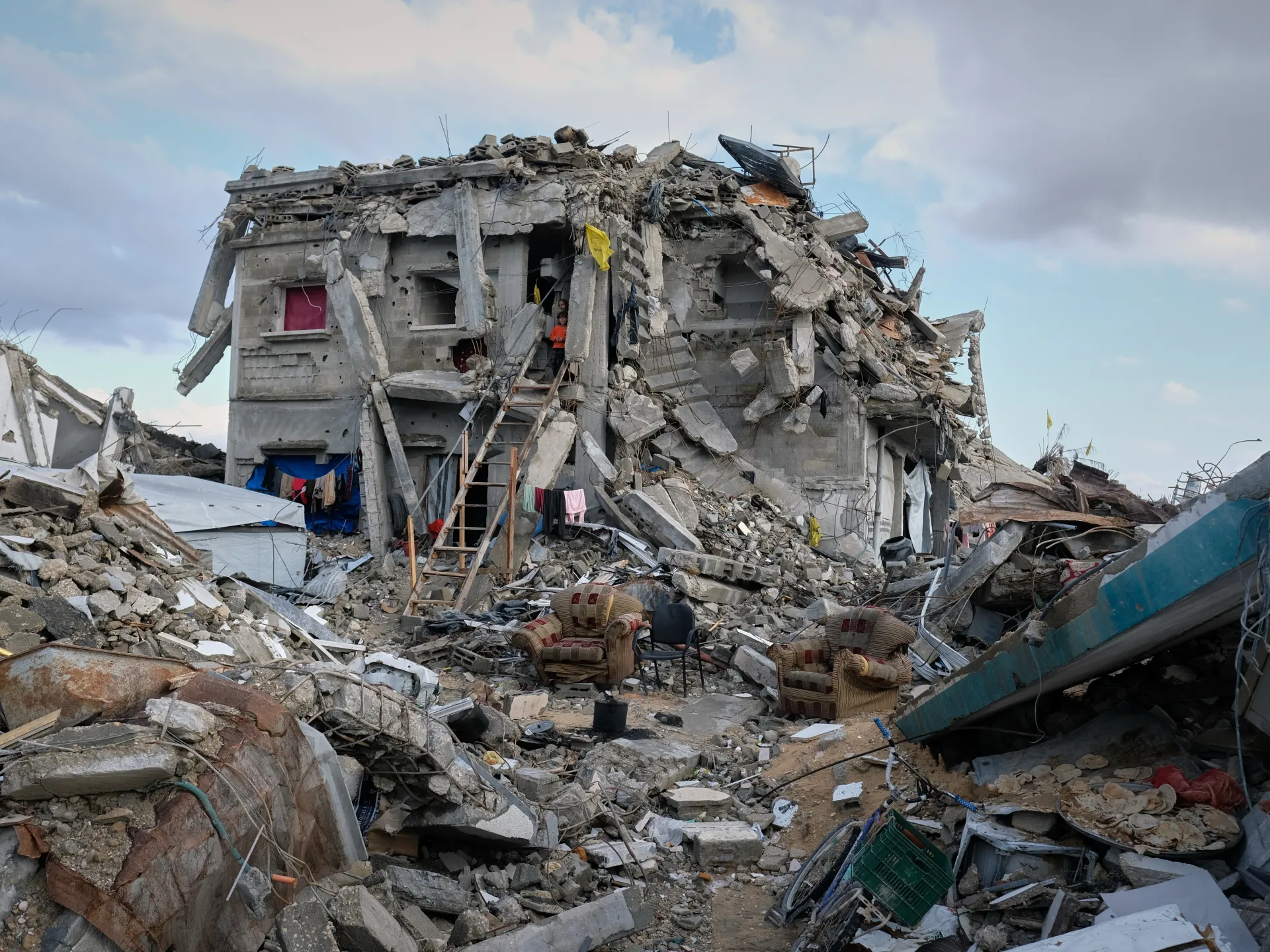
The Halawa family’s building still stands two storeys above the rubble in Gaza City, a rare survivor after two years of nonstop Israeli air attacks that levelled buildings across the besieged Palestinian enclave.
One section has collapsed, with bent metal rods protruding from where a roof once existed. The family built a narrow set of creaking wooden steps to access their home, though these makeshift stairs threaten to give way at any moment. Yet amid the destruction, it remains home.
Israel’s genocidal war on Gaza has killed more than 70,000 Palestinians, destroyed or damaged more than 70 percent of the buildings, and displaced most of the territory’s 2.3 million residents.
In October, Israel reached an agreement to cease fire, but its attacks have not stopped. It has killed more than 400 Palestinians since then, in violation of the truce agreement. It has also not allowed the full entry of aid.
Reconstruction has not begun and is projected to take years, as Israel has kept total control over what goes in and comes out of the enclave. This means families like the Halawas are struggling to rebuild their lives.
The family abandoned their home three months after the war began on October 7, 2023. They returned during the fragile calm established by the truce. Like many others, this family of seven found living in their damaged residence preferable to tent life, particularly as winter rains flooded tent shelters over the past weeks.
In one damaged room, Amani Halawa brewed coffee in a small tin over a fire while thin rays of light filtered through concrete fragments. Amani, her husband Mohammed, and their children have made repairs using concrete scraps, hanging backpacks from exposed metal rods and arranging pots and pans across the kitchen floor.
The home’s walls feature a painted tree and messages to family members separated by the conflict.
Throughout damaged apartments in Gaza City, daily life persists, even as families lie awake fearing their walls might collapse. Health officials report that at least 11 people died from building collapses in a single week in December.
In her home, Sahar Taroush swept dust from carpets placed over rubble. Her daughter Bisan’s face glowed in the light of a computer screen as she watched a movie beside gaping holes in the wall.
On another building’s cracked wall, a family displayed a torn photo of their grandfather on horseback from his time serving in the Palestinian Authority’s security forces during the 1990s. Nearby, a man reclined on a bed precariously balanced on a damaged balcony, scrolling through his phone above the devastated al-Karama neighbourhood.
Deadly attack comes as Gaza government media office says Israel violated ceasefire 875 times since it began in October.
Israeli forces have killed at least two Palestinians in the Gaza Strip as Israel continues to violate a ceasefire agreement and block desperately needed humanitarian aid to the war-ravaged coastal enclave.
The Palestinian news agency Wafa reported on Monday that two people were killed after Israeli troops opened fire in the Shujayea neighbourhood of eastern Gaza City.
Recommended Stories
list of 3 itemsend of list
Their deaths bring the total number of Palestinians reported killed in Gaza over the past 24 hours to at least 12, including eight whose bodies were recovered from the rubble in the territory.
The Gaza City attack is the latest in hundreds of Israeli violations of a United States-brokered ceasefire between Israel and Hamas, which came into effect on October 10.
Gaza’s Government Media Office on Monday condemned Israel’s “serious and systematic violations” of the truce, noting that the Israeli authorities had breached the ceasefire 875 times since it came into force.
That includes continued Israeli air and artillery attacks, unlawful demolitions of Palestinian homes and other civilian infrastructure, and at least 265 incidents of Israeli troops shooting Palestinian civilians, the office said in a statement.
At least 411 Palestinians have been killed and 1,112 others wounded in Israeli attacks on Gaza since the ceasefire began, it added.
Worsening shelter conditions
Meanwhile, hundreds of thousands of Palestinian families displaced by Israel’s genocidal war on Gaza continue to grapple with a lack of humanitarian supplies, including adequate food, medicine and shelter.
As the occupying power in Gaza, Israel has an obligation under international law to provide for the needs of Palestinians there.
But the United Nations and other humanitarian groups say it has systematically failed to allow unimpeded deliveries of aid into Gaza.
The situation has been worsened by a series of winter storms that have pummelled the Strip in recent weeks, with rights groups saying Israel’s refusal to allow tents, blankets and other supplies into Gaza is part of its genocidal policy and threatening Palestinian lives.
On Monday, the Gaza Government Media Office said that only 17,819 trucks entered the territory out of the 43,800 that were supposed to be allowed in since the ceasefire came into effect in October.
That amounts to an average of just 244 trucks per day – far below the 600 trucks that Israel agreed to allow into Gaza daily under the ceasefire agreement, the office said.
On Monday, a spokesperson for UN chief Antonio Guterres reiterated the call “for the lifting of all restrictions of the entry of aid into Gaza, including shelter material”.
“Over the past 24 hours, and despite the ceasefire, we have continued to receive reports of air strikes, shelling and gunfire in all five governorates of Gaza. This has resulted in reported casualties and disruptions to humanitarian operations,” Stephane Dujarric said.
He said that the UN’s humanitarian partners are working to address the significant shelter needs, particularly for displaced families living in unsafe conditions.
“Our partners continue to work to improve access to dignified shelter for approximately 1.3 million people in Gaza in the past week, about 3,500 families affected by storms are living in flood prone areas,” he said.
Dujarric said that aid deliveries have included tents, bedding sets, mattresses and blankets, as well as winter clothing for children, but the needs remain overwhelming.
Palestinians struggle with flooding after heavy rain hits the Bureij refugee camp in Gaza City [File: Moiz Salhi/Anadolu]
The appeals come a day after the Palestinian Ministry of Health in Gaza said that a lack of drugs and other healthcare supplies was making it difficult to provide care to patients.
Nearly all of Gaza’s hospitals and healthcare facilities were attacked during Israel’s two-year bombardment of the territory, damaging at least 125 facilities, including 34 hospitals.
The Israeli army has killed at least 70,937 Palestinians in Gaza, mostly women and children, and injured 171,192 others since its genocidal war began in October 2023.
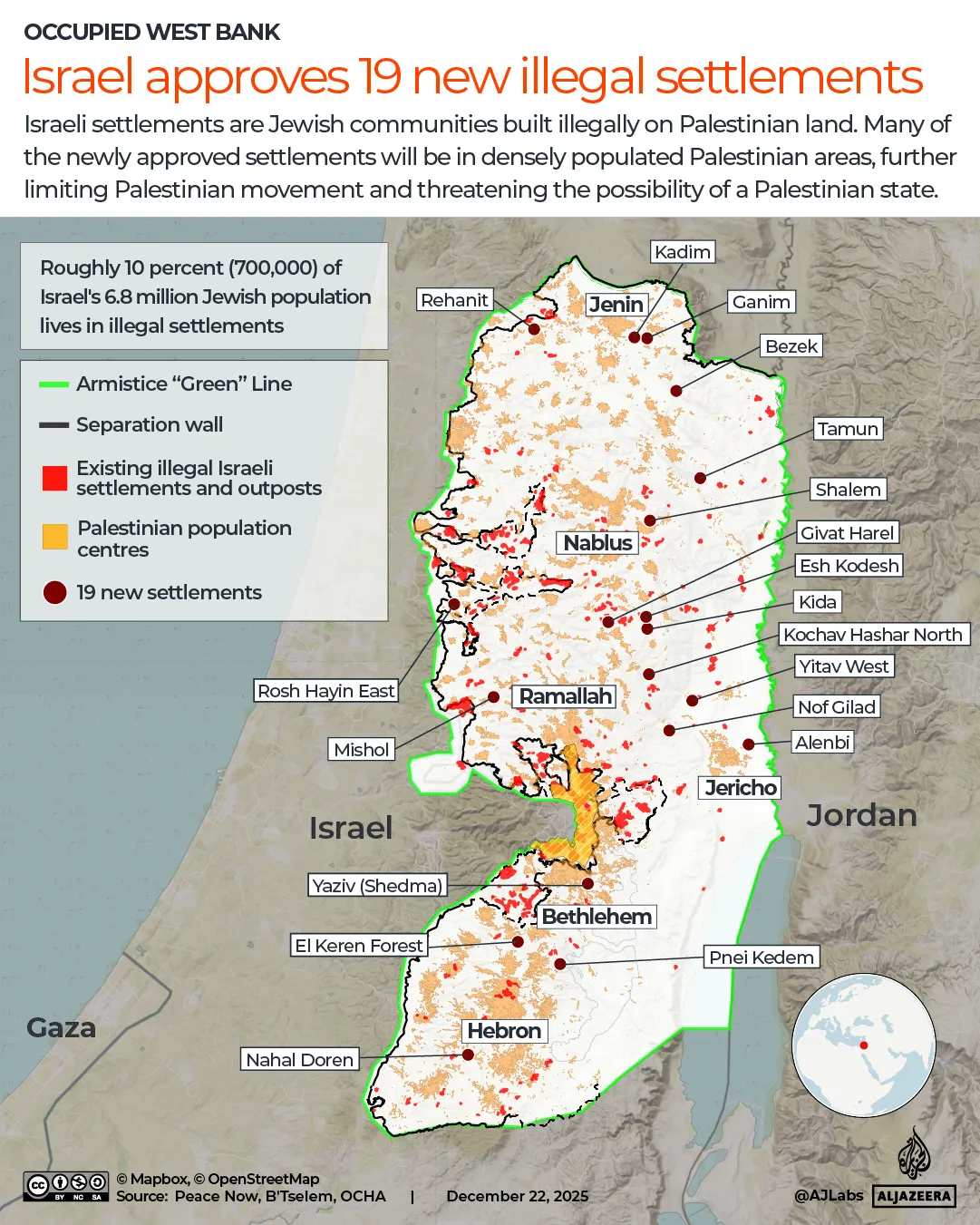
The Israeli security cabinet has approved 19 new settlement outposts in the occupied West Bank as the right-wing government headed by Prime Minister Benjamin Netanyahu moves to prevent the formation of a viable Palestinian state.
As Netanyahu’s government has made the annexation of occupied Palestinian territory a priority, the United Nations has said Israeli settlement expansions in 2025 have reached their highest level since 2017.
“These figures represent a sharp increase compared to previous years,” UN Secretary-General Antonio Guterres said, noting an average of 12,815 housing units were added annually from 2017 to 2022.
Under the current far-right government, the number of settlement and outposts in the West Bank and occupied East Jerusalem has risen by nearly 50 percent – from 141 in 2022 to 210 now. An outpost is built without government authorisation while a settlement is authorised by the Israeli government.
Nearly 10 percent of Israel’s Jewish population of 7.7 million people lives in these settlements, which are considered illegal under international law.
Here’s everything you need to know about the newly approved settlements and what they mean for the future of Palestinian statehood.
(Al Jazeera)
Where are the new settlements?
The new settlements are spread across the West Bank – home to more than three million Palestinians – from Jenin in the north to Hebron in the south.
Most of them are close to the densely populated Palestinian villages of Duma, Jalud, Qusra and al-Lubban Asharqiya in the Nablus governorate and Sinjil in the Ramallah and el-Bireh governorate, according to Peace Now, an antisettlement watchdog group based in Israel. Other locations identified by the watchdog for the new settlement areas are in the northwestern West Bank, in the Salfit governorate, near the Palestinian towns of Sa’ir and Beit Sahour, and other areas near Bethlehem and in the Jericho governorate.
Israel’s construction spree is entrenching the occupation and squeezing Palestinians out of their homeland. Settlements dot the West Bank and are often connected by Israeli-only highways while Palestinians face roadblocks and security checks, making their daily commutes harrowing experiences.
Israel has also built Separation Barrier that stretches for more than 700km (435 miles) through the West Bank restricting movement of Palestinians. Israel says the wall is for security purposes.
Under a dual legal system, Palestinians are tried in Israel’s military courts while crimes committed by settlers are referred to a civilian court.
Israel’s latest approval also includes settlements in Ganim and Kadim, two of the four West Bank settlements east of Jenin that were dismantled as part of Israel’s 2005 disengagement plan, a unilateral withdrawal ordered by then-Prime Minister Ariel Sharon.
Five of the 19 settlements already existed but had not previously been granted legal status under Israeli law, according to a statement from the office of Finance Minister Bezalel Smotrich.
Israel controls most of the West Bank and East Jerusalem, territory Palestinians want to be part of a future state along with Gaza. Israel captured East Jerusalem, the West Bank and the Gaza Strip in a 1967 war. It later annexed East Jerusalem, which Palestinians see as their future capital.
Israeli settlements and outposts are Jewish-only communities built on Palestinian land and they can range in size from a single dwelling to a collection of high-rises. About 700,000 settlers live in the West Bank and East Jerusalem, according to Peace Now.
The latest approval comes at a time when the United States has been working with Israel and Arab allies to move the Gaza ceasefire into a second phase. After a meeting on Friday of top officials from the US, Egypt, Turkiye and Qatar in the US city of Miami, Florida, Turkish Foreign Minister Hakan Fidan accused Israel of committing repeated violations of the ceasefire that began in October.
Israel still controls nearly half of Gaza’s territory since a ceasefire was announced on October 10 after more than two years of a genocidal war killed more than 70,000 Palestinians.
Palestinian farmers, left, scuffle with Israeli settlers during the olive harvest in the Palestinian village of Silwad,near Ramallah in the Israeli-occupied West Bank on October 29, 2025 [AFP]
Has settlement construction spiked in recent years?
The new settlements bring the total number approved over the past three years to 69, according to a statement from the office of Smotrich, who is a vocal proponent of settlement expansion and a settler himself.
In May, Israel approved 22 new settlements in the West Bank, the biggest expansion in decades.
The UN chief has condemned what he described as Israel’s “relentless” expansion of settlements in occupied Palestinian territory. It “continues to fuel tensions, impede access by Palestinians to their land and threaten the viability of a fully independent, democratic, contiguous and sovereign Palestinian state”, Guterres said this month.
Palestinians have also been facing increasing settler violence since Israel’s war on Gaza began.
According to data from the UN Office for the Coordination of Humanitarian Affairs (OCHA), settlers have attacked Palestinians nearly 3,000 times over the past two years.
Settler attacks often escalate during the olive harvest from September to November, a vital time of year that provides a key source of income for many Palestinian families.
Settlers are often armed and frequently accompanied or protected by Israeli soldiers. In addition to destroying Palestinian property, they have carried out arson attacks and killed Palestinian residents.
Every West Bank governorate has faced settler attacks over the past two years, data from OCHA shows.
(Al Jazeera)
Are the settlements legal under international law?
No. The UN, the International Court of Justice (ICJ) and the International Committee of the Red Cross all consider Israeli settlements as a violation of the Fourth Geneva Convention, which outlaws settler activity.
In a landmark judgement in July 2024, the ICJ, the UN’s top court, found that Israel’s occupation, settlement activity and annexation measures are illegal. In its nonbinding advisory opinion, the ICJ ruled that Israel’s continued presence in occupied Palestinian territory is unlawful and should come to an end “as rapidly as possible”.
The judges pointed to a wide list of policies – including the building and expansion of Israeli settlements in the West Bank and East Jerusalem, use of the area’s natural resources, the annexation and imposition of permanent control over lands and discriminatory policies against Palestinians – all of which it said violated international law.
Two months later, the UN General Assembly adopted a resolution demanding that Israel end its occupation of Palestinian territory within a year.
But Israel has defied the resolution by the global body backed by its ally – the United States. Washington has extended diplomatic cover to Israel against numerous UN resolutions.
Palestinians harvest olives near the occupied West Bank village of Turmus Aya near Ramallah on October 19, 2025 [Hazem Bader/AFP]
Since returning to power in January, US President Donald Trump has adopted a permissive stance towards Israeli settlement activity, breaking with longstanding US policy.
In 2019, he said Israeli settlements in the West Bank were not inherently illegal under international law. Trump also revoked his predecessor President Joe Biden’s sanctions on several settlers and groups accused of perpetrating violence against Palestinians in the West Bank.
US sanctions on settlers under Biden came under Washington’s long-held policy that settlements are the biggest impediments to the two-state solution to the conflict.
However, Trump and his officials have repeatedly said Israel cannot annex the West Bank. “It won’t happen because I gave my word to the Arab countries,” Trump told Time magazine in October. “Israel would lose all of its support from the United States if that happened.”
Israelis walk past soldiers standing guard during a weekly settlers tour in Hebron in the Israeli-occupied West Bank on December 13, 2025 [Mussa Qawasma/Reuters]
What will the new settlements mean for the future of a Palestinian state?
The growing settlements – together with other projects undertaken by Netanyahu’s government like the E1 settlement plan that will split the West Bank – are further squeezing Palestinians in occupied territory.
Settlement expansions have drawn criticism from the international community, including Israel’s European allies, who said the steps undermine prospects for a two-state solution.
But Netanyahu and his far-right cabinet, including Smotrich and National Security Minister Itamar Ben-Gvir, have doubled down on their rhetoric against a Palestinian state.
“On the ground, we are blocking the establishment of a Palestinian terror state,” Smotrich said in his statement on Sunday.
In June, the United Kingdom, Australia, Canada, New Zealand and Norway slapped sanctions on Smotrich and Ben-Gvir for inciting violence.
Several European nations, including the UK and France, as well as Australia recognised Palestinian statehood in September in a push for the two-state solution.
Israel condemned the move, and Netanyahu said he won’t allow a Palestinian state. He has previously boasted how he scuttled the 1993 and 1995 Oslo peace accords by boosting settlement expansion in occupied territory.
“It’s not going to happen. There will be no Palestinian state to the west of the Jordan River,” Netanyahu said in an address in September. “For years, I have prevented the creation of that terror state against tremendous pressure, both domestic and from abroad.”
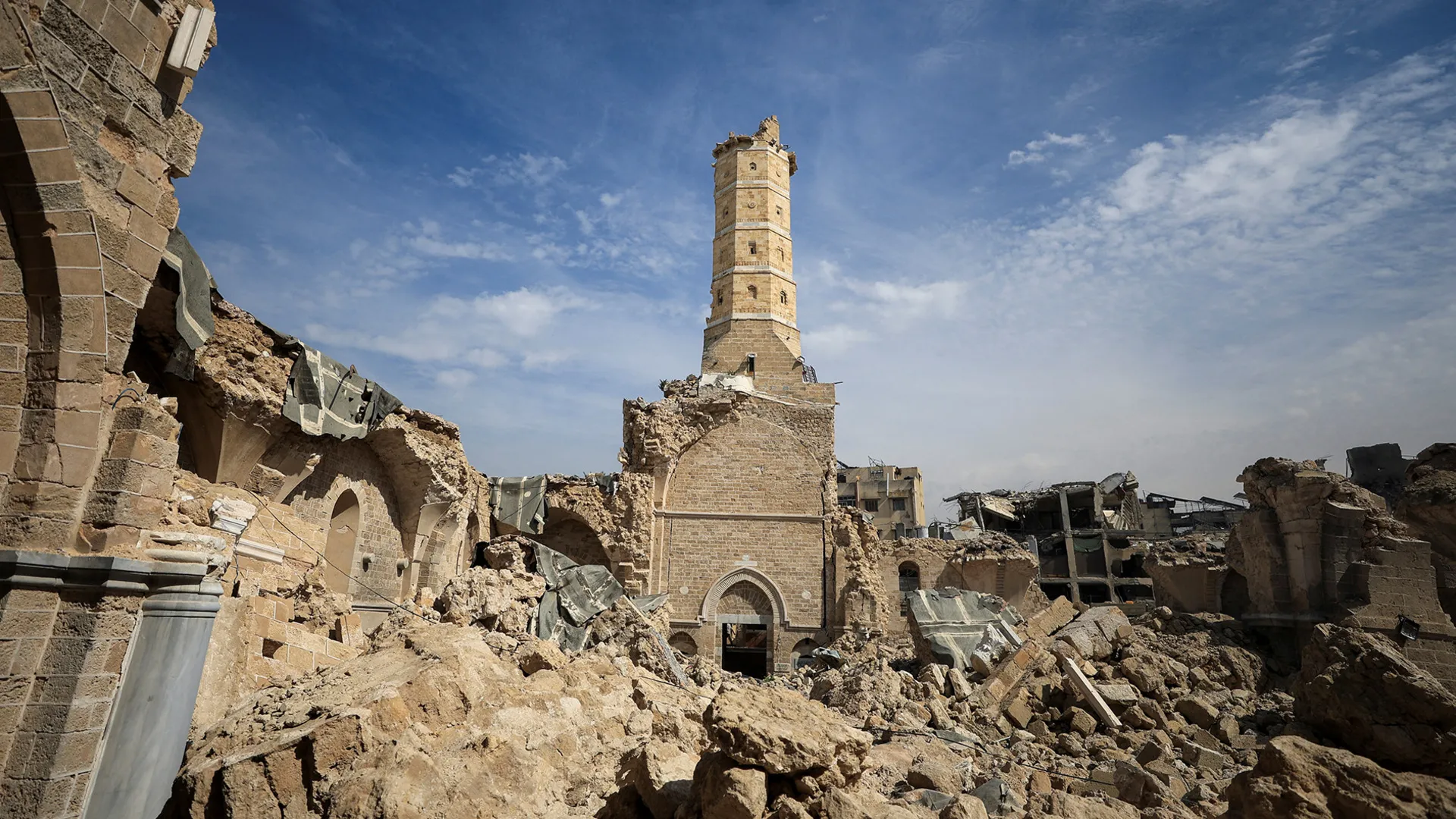
The Great Omari Mosque is one of Gaza City’s most significant landmarks, with origins dating back more than 2,000 years. It was destroyed in an Israeli strike in December 2023. Hatem Haniya, the mosque’s administrator, reflects on its history and its deep significance to the people of Gaza.
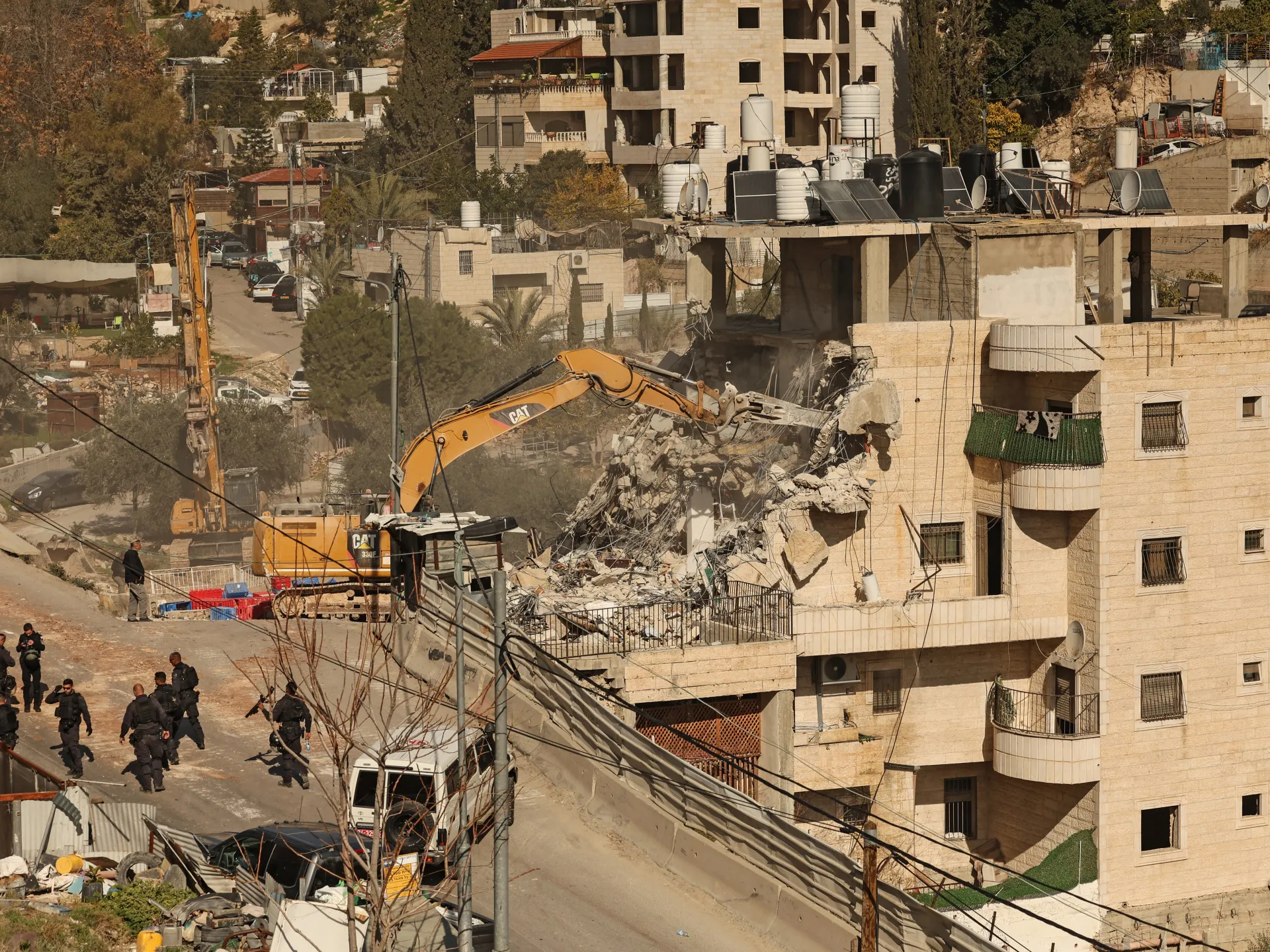
Israeli settlers attacked Palestinians who were forced out of their homes in occupied East Jerusalem, as Israeli forces demolished a four-storey residential building displacing around 100 people on Monday. It was the latest in a series of demolitions targeting Palestinian homes in the area.
Palestinian officials condemn the actions as part of a ‘systematic policy of displacement’ in the occupied territory.
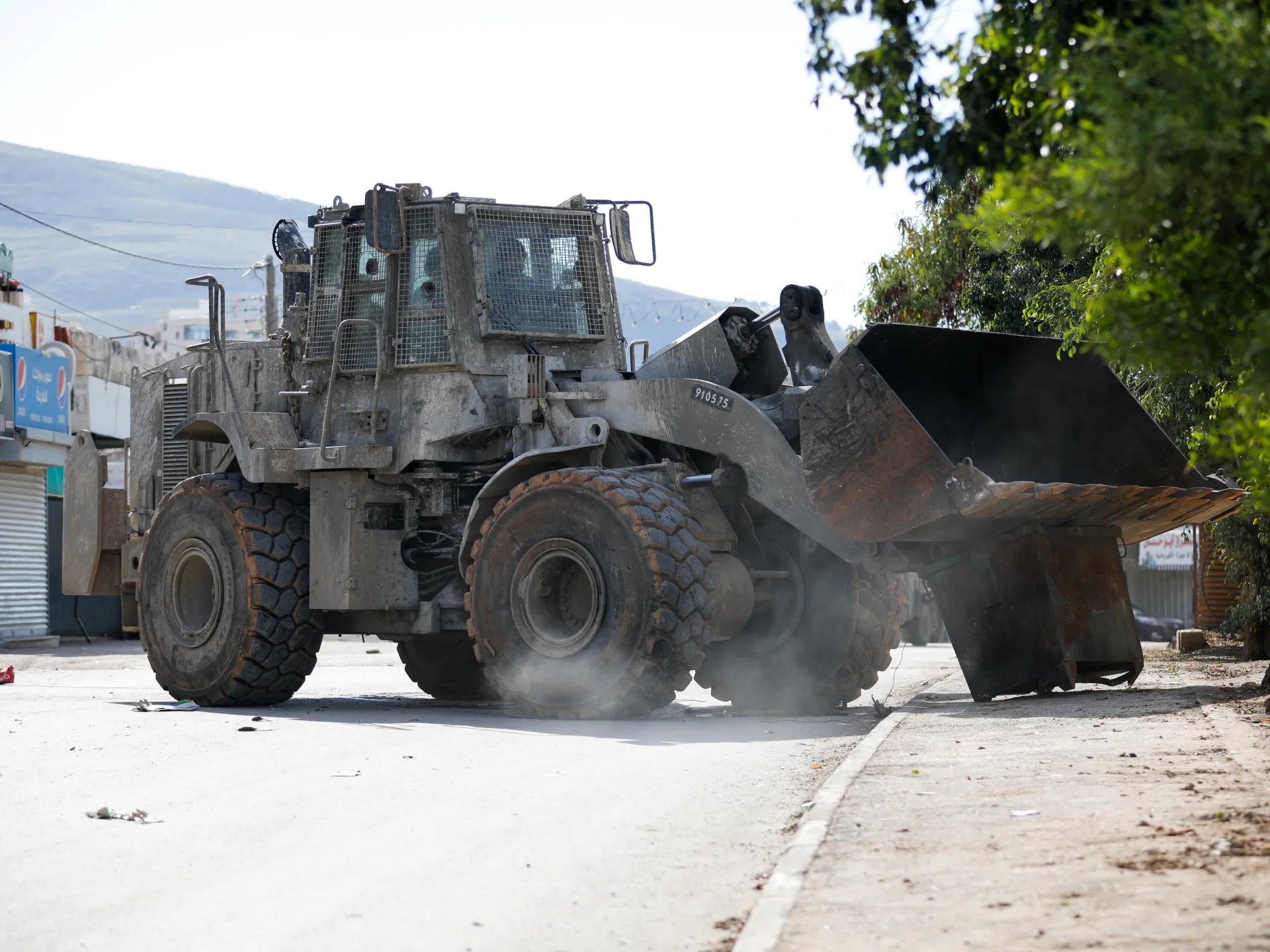
Israeli forces have stormed towns in the occupied West Bank and demolished a residential building.
Soldiers fired stun grenades and tear gas on Monday as they carried out the demolition in East Jerusalem. Palestinian officials accused Israel of a campaign of displacement in the city, saying the operation was part of a systematic attempt to ethnically cleanse Palestinians from their land.
Recommended Stories
list of 4 itemsend of list
Scores of Palestinians were displaced as Israeli bulldozers tore through a four-storey residential building. Activists called it the largest such demolition in the area this year.
Three bulldozers destroyed the building with 13 apartments in the Wadi Qaddum neighbourhood of the Silwan district, south of Jerusalem’s Old City, Al Jazeera Arabic correspondents reported.
Israeli forces cordoned off surrounding roads, deployed heavily across the area and positioned security personnel on the rooftops of neighbouring houses. During the operation, a young man and a teenage boy were arrested.
Residents were told the demolition order was issued because the building had been constructed without a permit.
Palestinians face severe obstacles in obtaining building permits due to Israel’s restrictive planning policies, activists say, a policy that they assert is part of a systematic attempt to ethnically cleanse Palestinians from their land.
Israel’s security cabinet has recently approved the recognition of 19 new settlements in the West Bank, expanding the total number approved this year to 69 as the government continues its settlement push.
‘Systematic policy of displacement’
The Jerusalem governorate, affiliated with the Palestinian Authority, condemned the demolition.
“The building’s destruction is part of a systematic policy aimed at forcibly displacing Palestinian residents and emptying the city of its original inhabitants,” the governorate said in a statement.
“Any demolition that expels residents from their homes constitutes a clear occupation plan to replace the land’s owners with settlers.”
The Jerusalem municipality, an Israeli authority whose jurisdiction over East Jerusalem is not recognised under international law, said the demolition was based on a 2014 court order.
Israeli human rights groups Ir Amim and Bimkom said the demolition was carried out without warning despite a scheduled meeting on Monday to discuss steps to legalise the building.
“This is part of an ongoing policy. This year alone, around 100 East Jerusalem families have lost their homes,” the groups said, calling Monday’s demolition the largest of 2025.
Escalated attacks
Elsewhere in the West Bank, Israeli forces damaged agricultural land and uprooted trees in the northern town of Silat al-Harithiya.
In the city of Halhul, north of Hebron, Israeli forces stormed several neighbourhoods with large numbers of military vehicles, deployed sniper teams and took up positions across the city.
Al Jazeera Arabic journalists reported that Israeli vehicles entered Halhul through multiple checkpoints, including Nabi Yunis, while closing the Halhul Bridge checkpoint linking the city to Hebron.
Since Israel launched its war on Gaza in October 2023, Israeli forces and settlers have also sharply escalated attacks across the West Bank.
More than 1,102 Palestinians have been killed in the territory, about 11,000 wounded and more than 21,000 arrested, according to Palestinian figures.
London, United Kingdom – Two Palestine Action-affiliated remand prisoners on hunger strike have been taken to hospital, according to a family member and a friend, adding to fears that the young Britons refusing food in protest could die at any moment.
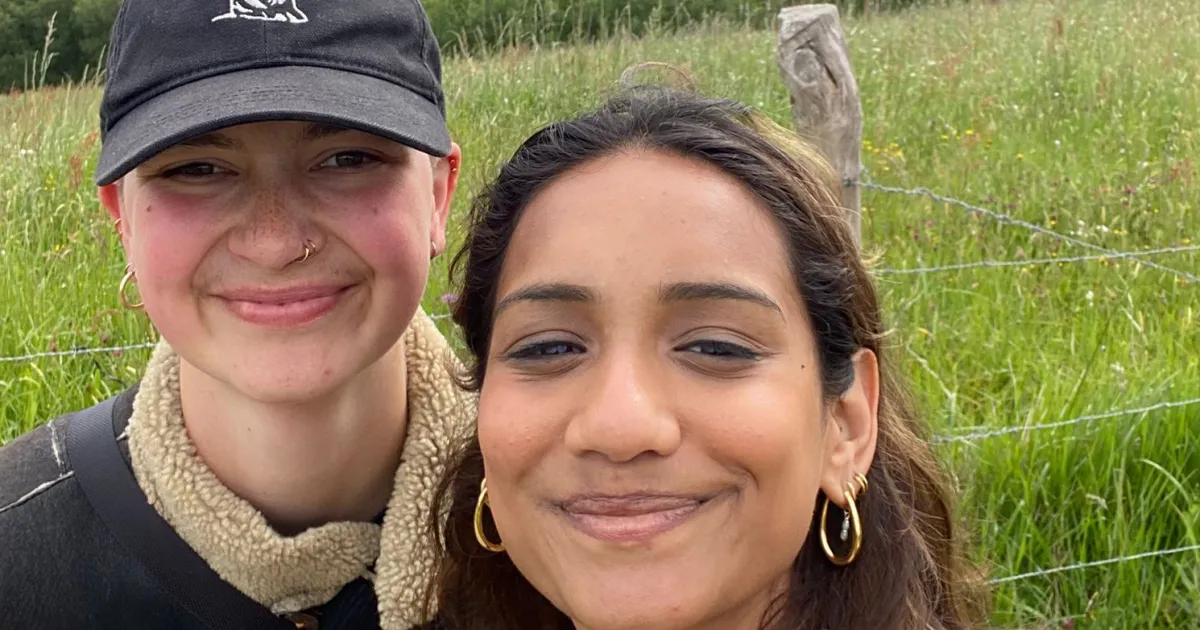
Twenty-eight-year-old Kamran Ahmed, who is being held at Pentonville prison in London, was hospitalised on Saturday, his sister, Shahmina Alam, told Al Jazeera.
Recommended Stories
list of 4 itemsend of list
Amu Gib, 30, who has not eaten food for 50 days at HMP Bronzefield in Surrey, was taken to hospital on Friday, said the Prisoners for Palestine group and friend Nida Jafri, who is in regular contact with them. Gib uses the pronoun they.
Ahmed and Gib are among six detainees protesting across five prisons over their alleged involvement in break-ins at the United Kingdom’s subsidiary of the Israeli defence firm Elbit Systems in Bristol and a Royal Air Force base in Oxfordshire.
They deny the charges against them, such as burglary and violent disorder.
“It’s day 42 [of Ahmed’s hunger strike], and at this point, there’s significant risk of organ damage,” said his sister, Alam. “We know that he’s rapidly been losing weight in the last few days, losing up to half a kilogram [1.1lbs] a day.”
Ahmed’s last recorded weight was 60kg (132lbs).
When Al Jazeera first interviewed Alam on December 12, Ahmed, who is 180cm (5′ 11”), weighed 64kg (141lbs), having entered prison at a healthy 74kg (163lbs). On Thursday, Alam told journalists at a news conference in London that he weighed 61.5kg (136lbs).
Ahmed’s speech was slurred in a call with the family on Friday, said Alam. He is said to be suffering from high ketone levels and chest pains.
“Honestly, I don’t know how he’s going to come out of this one,” said Alam.
It is the third time Ahmed has been hospitalised since he joined the hunger strike.
Shahmina Alam with her younger brother, Kamran Ahmed, a Palestine Action-linked hunger striker [Courtesy of the Alam family]
‘Critical stage’
The hunger strikers’ demands include immediate bail, the right to a fair trial and the de-proscription of Palestine Action, which accuses the UK government of complicity in Israel’s war crimes in Gaza. The UK government banned Palestine Action in July, branding it a “terror” group, a label that applies to groups such as ISIL (ISIS).
The protesters have called for an end to their alleged censorship in prison, accusing authorities of withholding mail, calls and books. They are also urging that all Elbit sites be closed.
The six are expected to be held for more than a year until their trial dates, well beyond the UK’s six-month pre-trial detention limit.
Qesser Zuhrah, a 20-year-old who has refused food for 50 days, is also in hospital, having lost 13 percent of her body weight, according to her lawyers. The other protesters are Heba Muraisi, Teuta Hoxha and Lewie Chiaramello, who is diabetic and refuses food every other day.
There was no immediate comment from either Pentonville or HMP Bronzefield.
‘I’m scared’
Gib called their friend, Jafri, on Thursday from prison, telling her they needed a wheelchair to attend a doctor’s appointment where their vital signs would be checked.
Prison staff at first “refused” to provide a wheelchair, and later, after offering one, “refused to push” it, Jafri said. “So they laid there with … no check of their vitals on day 47 of their hunger strike,” Jafri said.
When they are hospitalised, the prisoners are unable to call their loved ones, as they can from jail.
Jafri told Al Jazeera, “I’m scared they’re there alone with no phones and no calls allowed.”
Gib, who has lost more than 10kg (22lbs), is below the normal range for most health indicators, which is “highly concerning” for their immune system, their lawyers have said.
Prison officials have “failed to provide [Gib] with thiamine [a vitamin] consistently, and Amu is feeling the effects on their cognitive function”, the lawyers said.
Gib’s eyes are also “sore with the bright [prison] lights”, Jafri said.
Amu Gib (left) with their friend, Nida Jafri [Courtesy: Nida Jafri]
The lawyers have demanded a meeting with Secretary of State for Justice David Lammy, hoping his intervention could be life-saving. Thousands of everyday Britons, hundreds of doctors and dozens of MPs have urged Lammy to heed their call. But so far, he has refused, leading critics to accuse the UK government of wilfully ignoring the issue.
The UK media have also been accused of downplaying the protest and its dangers.
The protest is said to be the largest coordinated hunger strike in UK prisons since 1981, when Irish Republican inmates led by Bobby Sands refused food.
“In contrast to the robust media coverage of the Irish hunger strikes in the 1980s, the Palestine Action hunger strikes have been largely met with media silence,” wrote Bart Cammaerts, a professor of politics and communication at the London School of Economics.
“What will it take for the British media to pay attention to the plight of jailed pro-Palestinian activists? The death of an activist? Or the awakening of a moral conscience?”















![Shahmina Alam with Kamran Ahmed - Palestine Action linked hunger striker [Courtesy of Alam family]](https://i0.wp.com/www.aljazeera.com/wp-content/uploads/2025/12/WhatsApp-Image-2025-12-15-at-15.26.19-1-1765801678.jpg?w=640&ssl=1)
