With three key players out because of injury and USC in desperate need of depth, the Trojans are taking the rare step of adding reinforcements at the midseason mark.
Point guard Kam Woods, who last played at Robert Morris, was added to the Trojans’ roster and cleared to play on Thursday, despite the fact that USC is already a dozen games into the basketball season.
Woods could make an immediate impact for coach Eric Musselman, having averaged 14.9 points, 5.2 assists and 4.7 rebounds per game last year at Robert Morris, where he played alongside current Trojan, Amarion Dickerson. Woods is expected to step into the rotation right away with USC, after the Trojans lost starting point guard Rodney Rice for the season.
What’s not clear is why Woods was still in the transfer portal two months into the college basketball calendar. USC had shown some interest in Woods during the offseason, according to a person familiar with the program who is not authorized to speak publicly on the matter, but Woods never signed with a team, despite being a second-team All-Horizon League selection.
Since he was still in the transfer portal and because he has already graduated, Woods is the rare case, outside of an international player or junior college player, that qualifies to be a midseason addition.
Woods has played five years of college basketball, bouncing around between five schools in that span. He started at Troy in 2020-21, before taking the junior college route at Northwest Florida State Community College during the 2021-22 season. He then transferred to North Carolina State, where he played sparingly over 13 games.
Woods landed with Robert Morris last season and emerged as the Colonials’ leading scorer as they won the Horizon League and earned a bid to the NCAA tournament.
So, with this being his sixth year, how is Woods eligible to join another team? Eligibility-wise, he actually falls under the same category as the Trojans’ leading scorer, Chad Baker-Mazara, who is playing his sixth season of college basketball in 2025-26.
Due to the recent ruling in the Diego Pavia case, the season that Woods spent playing junior college does not count against his five years of eligibility. Plus, since Woods was a freshman during the 2020-21 season, he has an extra year of eligibility because of the pandemic.
Had Woods played for another team during the first two months of the season, he would not be eligible to join the Trojans in December.
For USC, that fit could be especially fortunate. Without Rice, USC has used a combination of Jerry Easter, Jordan Marsh and Ryan Cornish at point guard. Woods will be the most experienced of the group.
Five-star freshman Alijah Arenas is expected to enter that picture in the coming weeks, too. Arenas was set to rejoin practice this week and will presumably be cleared to play some time in January.
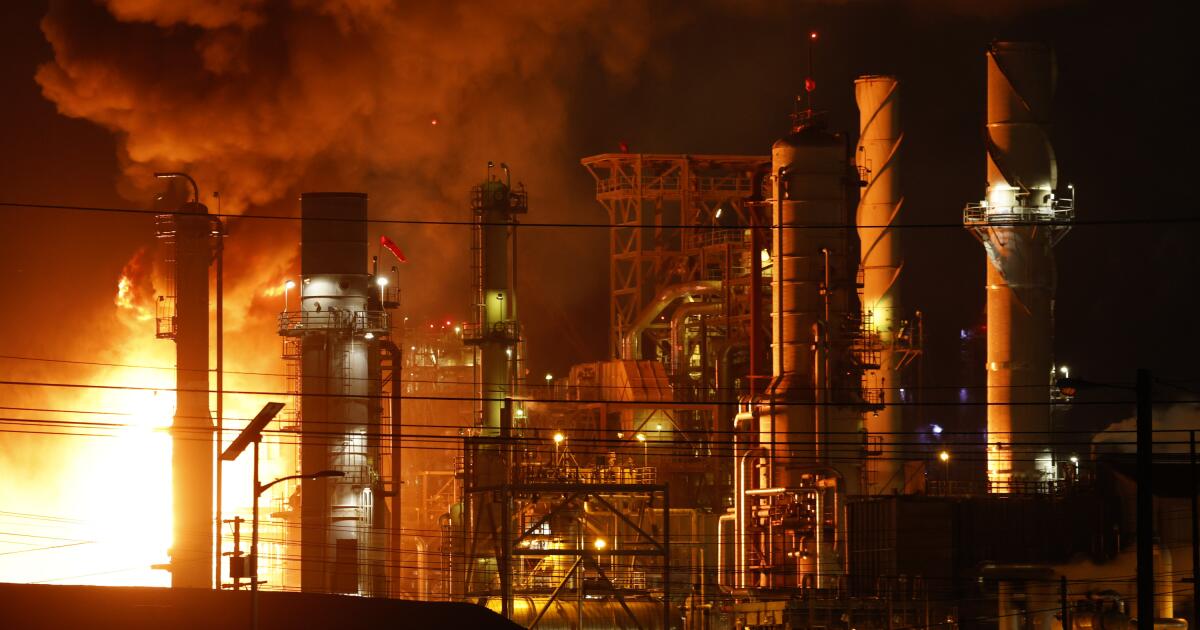
More than two months after an explosion erupted at the Chevron oil refinery in El Segundo, neither the company nor the regulators responsible for monitoring the facility have released details on the cause and the extent of the environmental fallout.
Here’s what we do know so far: Around 9:30 p.m.on Oct. 2, a large fire broke out in the southeast corner of the refinery, where Chevron turned crude oil into jet fuel. The resulting violent blast allegedly wounded several workers on the refinery grounds and rattled homes up to one mile away.
The refinery carried out emergency flaring in an effort to burn off potentially hazardous gases, as public officials told residents in neighborhoods nearby to stay indoors. That warning held until firefighters managed to extinguish the fire the following day.
You’re reading Boiling Point
The L.A. Times climate team gets you up to speed on climate change, energy and the environment. Sign up to get it in your inbox every week.
The South Coast Air Quality Management District — the agency responsible for regulating the refinery’s emissions — said Chevron would submit reports detailing the potential cause of the fire and any unexpected equipment failures within 30 days. But the preliminary reports were handed in nearly a month late — and without any significant updates from what was said in the days immediately following the fire.
In those reports, Chevron said the fire was “unexpected and unforeseeable.” The cause is still under an investigation that probably won’t conclude until next month, an air district spokesperson told me recently.
Company officials said the fire significantly damaged power supply, utilities and gas collection systems in that section of the refinery. Repairs are underway but could take months. Meanwhile, the majority of the 1,000-acre refinery is operational, distilling crude oil into gasoline and diesel.
At an air district meeting on Dec. 2, Chevron asked for leniency from conducting equipment testing at the damaged wing of the refinery that is now offline, and the air district obliged.
One member of the agency’s hearing board, Cynthia Verdugo-Peralta, said she understood that the investigation was “quite involved” but stressed the need for “some type of response” from Chevron on the cause.
“I’m hoping that this will never happen again,” she said. “Hopefully this repair will indeed be a full repair and there won’t be another incident like this.”
Environmental regulators like the South Coast Air Quality Management District often rely on the very industries that they oversee to arrange for monitoring and investigations into disasters. For obvious reasons, that’s not ideal. Experts say this system of self-reporting is somewhat inevitable, given that many government agencies lack the staffing, budget and access to provide adequate oversight.
But it often leaves the public waiting for answers — and skeptical of the findings, when they finally arrive.
For example, there are still serious questions surrounding the air monitoring systems at Chevron’s El Segundo refinery that were supposed to act as a safety net for the public nearby during emergencies like the October fire.
Under state law, refineries are required to install, operate and maintain real-time fence line air monitors. Indeed, over four hours after the Oct. 2 fire at El Segundo, Chevron’s fence line air monitors detected elevated levels of volatile organic compounds, a category of quickly vaporizing chemicals that can be harmful if inhaled.
However, at the time of the incident, the refinery’s monitors oddly did not detect any elevated levels of some of the most common types chemicals that experts say would have been likely to be released during such a fire, such as cancer-causing benzene, a typical byproduct of burning fossil fuels.
Experts are now asking whether those monitors were fully functioning at the time.
Earlier this month, the Bay Area Air Quality Management District fined Chevron’s refinery in Richmond $900,000 after the agency found 20 of the oil company’s fence line monitors were not properly calibrated to detect the full range of emissions, potentially allowing excessive air pollution to go undetected and unreported.
As for the El Segundo facility, neither the South Coast air district nor the refinery could confirm whether the air monitors were working properly on Oct. 2. A spokesperson said the air district is scheduled to audit Chevron’s fence line air monitoring network sometime next year.
But it may already be too late to warn nearby communities. Since October’s explosion, there have been more than a dozen reported incidents of unplanned flaring at Chevron’s refinery in El Segundo, according to air district data.
Each one raises the question: What happened?
More news on air pollution
The holiday season is associated with fragrant candles, incense and gathering around the fireplace. But health experts say these traditions should be done in moderation to avoid respiratory risks, according to Associated Press reporter Cheyanne Mumphrey.
That’s especially true in Southern California, where the air district continues to issueno-burn advisories, prohibiting burning wood to limit unhealthy levels of soot, per Pasadena Now.
Almost a year after the Eaton and Palisades fires, the health effects from breathing wildfire smoke are still coming into focus. L.A. Times science and medicine reporter Corrine Purtill writes thatemergency room visits rose 46% for heart attacks at Cedars-Sinai Medical Center in the 90 days after the fires. The findings suggest the death toll could be much higher than the 31 fatalities that have been linked with the fires.
California Atty. Gen.Rob Bonta sued the Trump administration — for the 50th time — after the suspension of $3 billion in federal funding that Congress approved for building more electric vehicle chargers, according to Times climate reporter Hayley Smith. California alone stands to lose out on $179.8 million in grants that could help reduce smog and greenhouse gases.
A few last things in climate news
The Trump administration announced it will dismantle the National Center for Atmospheric Research in Colorado, one of the world’s premier Earth science research institutions, per reporting fromthe New York Times. Scientists fear this could undermine weather forecasting in an age when global warming is contributing to more intense storms and other natural disasters.
A new analysis from Woods Hole Oceanographic Institution found the rate ofsea-level rise has more than doubled along U.S. coastlines over the last 125 years, according to Washington Post environmental reporter Brady Dennis. The research rebuts a controversial federal assessment published this summer that concluded there was no acceleration in rising ocean waters.
The U.S. and Europe continue toabandon their electric vehicle aspirations, ceding the clean car market to China, Bloomberg auto reporter Linda Lew writes. The European Commission recently scrapped an effective ban on combustion engine vehicles by 2035, and Ford Motor Co. walked away from plans to significantly overhaul its EV production — including the imminent demise of its all-electric Ford 150 Lightning truck.
This is the latest edition of Boiling Point, a newsletter about climate change and the environment in the American West. Sign up here to get it in your inbox. And listen to our Boiling Point podcast here.
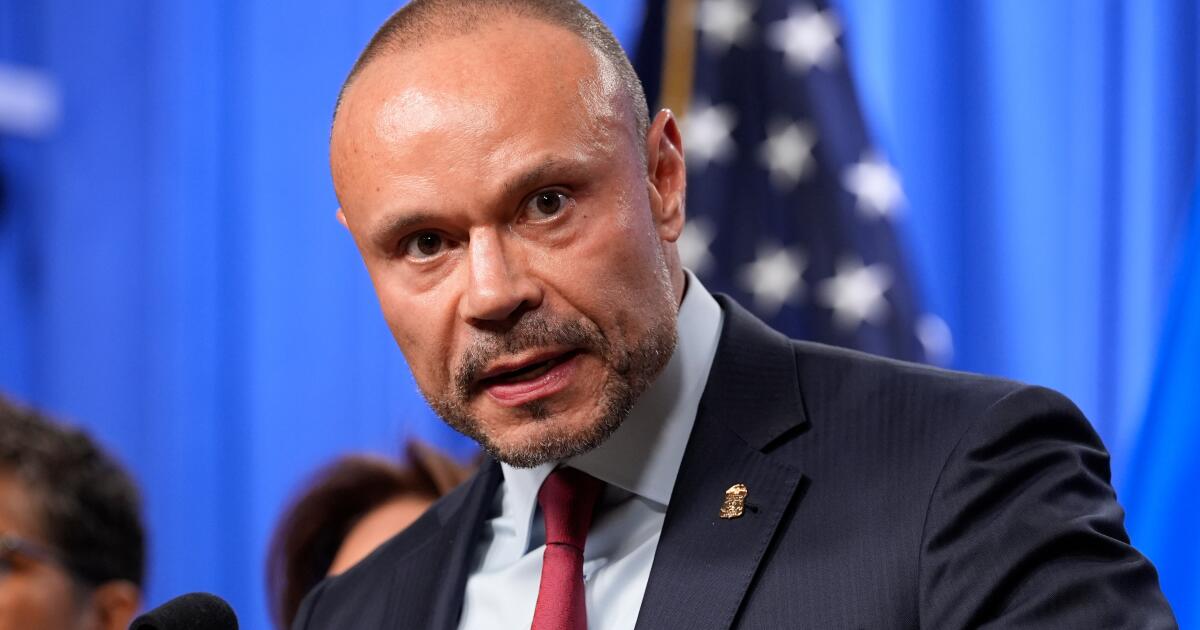
WASHINGTON — FBI Deputy Director Dan Bongino said Wednesday that he will resign from the bureau next month, ending a brief and tumultuous tenure in which he clashed with the Justice Department over the handling of the Jeffrey Epstein files and was forced to reconcile the realities of his law enforcement job with provocative claims he made in his prior role as a popular podcast host.
The departure, which had been expected, would be among the highest-profile resignations of the Trump administration. It comes as FBI leadership has been buffeted by criticism over Director Kash Patel’s use of a government plane for personal purposes and social media posts about active investigations.
Bongino announced his planned departure in a post on X in which he said he was grateful for the “opportunity to serve with purpose.” He did not say precisely when in January he would leave or detail his future plans.
President Trump said earlier Wednesday, in response to a question about Bongino’s fate: “Dan did a great job. I think he wants to go back to his show.”
Bongino was always an unconventional pick for the No. 2 job at the FBI, a position that historically has entailed oversight of the bureau’s day-to-day operations and typically has been held by a career agent. Though he had previously worked as a New York City police officer and Secret Service agent, neither he nor Patel had any experience at the FBI before being picked for their jobs.
Nonetheless, Bongino was installed in the role in March by Trump after years as a conservative podcast host, where he used his platform to repeatedly rail against FBI leadership and to encourage conspiracy theories related to the Epstein sex-trafficking case and pipe bombs discovered in Washington on Jan. 6, 2021.
Once in the position, Bongino struggled to placate elements of Trump’s base who expected him to quickly deliver the reform he had claimed was needed at the FBI and to uncover the truths he had said had been hidden by the federal government.
On the Epstein case, for instance, he had previously challenged the official ruling that the wealthy financier had taken his own life in a New York jail soon after his 2019 arrest. But once in the FBI, he said in a Fox News interview: “I’ve seen the whole file. He killed himself.”
Bongino had separately speculated as recently as last year that the pipe bombs placed on the eve of the Jan. 6 Capitol riot were an “inside job” and part of a “massive cover-up.” But after the FBI earlier this month arrested a 30-year-old Virginia man with no evident connection to the federal government, Bongino was pressed about his prior comments.
“I was paid in the past for my opinions,” Bongino said in a Fox News interview. “One day I will be back in that space, but that’s not what I’m paid for now. I’m paid to be your deputy director, and we base investigations on facts.”
It was supposed to be a speech with a clear message of hope for survivors of the Palisades fire.
In her State of the City address in April, Los Angeles Mayor Karen Bass called for a law exempting fire victims from construction permit fees — potentially saving them tens of thousands of dollars as they rebuild their homes.
Eight months later, the City Council is still debating how much permit relief the city can afford. Palisades residents have been left hanging, with some blaming Bass for failing to finalize a deal.
“This should have been pushed, and it wasn’t pushed,” said electrician Tom Doran, who has submitted plans to rebuild his three-bedroom home. “There was no motor on that boat. It was allowed to drift downstream.”
Since the Jan. 7 fire destroyed thousands of homes, Bass has been announcing recovery strategies with great fanfare, only for them to get bogged down in the details or abandoned altogether.
After two of the most destructive fires in the state’s history, The Times takes a critical look at the past year and the steps taken — or not taken — to prevent this from happening again in all future fires.
At one point, she called for the removal of traffic checkpoints around Pacific Palisades, only to reverse course after an outcry over public safety. She pushed tax relief for wildfire victims in Sacramento, only to abruptly pull the plug on her bill. Her relationship with Steve Soboroff, her first and only chief recovery officer, quickly unraveled over pay and other issues. He left after a 90-day stint.
Critics in and outside the Palisades say the mayor’s missteps have undermined public confidence in the rebuilding process. They have also made her more politically vulnerable as she ramps up her campaign for a second term.
1
2
3
1.Tom Doran poses for a portrait in the remains of his home in the Pacific Palisades. Doran, who has submitted plans to rebuild the home he lived in for decades, has said that Los Angeles Mayor Karen Bass should have done more to secure passage of a law giving residents relief from city rebuilding permits after the wildfires.(Kayla Bartkowski / Los Angeles Times)2.Statues are seen in an aerial of the remnants of Doran’s home.(Kayla Bartkowski / Los Angeles Times)3.An aerial of the remains of Doran’s home.(Kayla Bartkowski / Los Angeles Times)
Bass, seated in her spacious City Hall office earlier this month, said the recovery is happening at “lightning speed” compared to other devastating wildfires, in part because of her emergency orders dramatically cutting the time it takes to obtain building permits.
By mid-December, more than 2,600 permit applications had been filed for more than 1,200 addresses — about a fifth of the properties damaged or destroyed in the fire. Permits had been issued at about 600 addresses, with construction underway at nearly 400, according to city figures.
Still, Bass acknowledged that fire victims are feeling angry and frustrated as they enter the holiday season.
“I think people have a right to all of those emotions, and I wouldn’t argue with any of them,” she said.
Rebuilding a community after a natural disaster is a monumental task, one with no clear playbook. Many of the obstacles — insurance claims, mortgage relief — reach beyond the purview of a mayor.
Still, Bass has plenty of power. City agencies crucial to the rebuilding effort report to her. She works closely with the council, whose members have sharply questioned some of her recovery initiatives.
Perhaps the most disastrous narrative revolved around Soboroff, a longtime civic leader known for his blunt, outspoken style.
Mayor Karen Bass, right, and her disaster recovery chief, Steve Soboroff, during a news conference at Palisades Recreation Center on Jan. 27.
(Brian van der Brug / Los Angeles Times)
To many, the assignment made sense on paper. Soboroff had a background in home building, roots in the Palisades and extensive knowledge of City Hall.
Soboroff initially expected to receive a salary of $500,000 for three months of work as chief recovery officer, with the funds coming from philanthropy. After that figure triggered an outcry, Bass changed course, persuading him to work for free. Soon afterward, Soboroff told an audience that he had been “lied to” about whether he would be compensated. (He later apologized.)
Soboroff also voiced frustration with the job itself, saying he had been excluded from key decisions. At one point, Bass appeared to narrow his duties, telling reporters he would focus primarily on rebuilding the community’s historic business district and nearby public areas.
Bass told The Times that she does not view her selection of Soboroff as a mistake. But she acknowledged there were “challenges along the way” — and decisions where Soboroff was not included.
“In those first few months when everything was happening, I’m sure there were decisions he wanted to be in that he wasn’t in,” she said.
In April, amid Soboroff’s departure, Bass said she was searching for a new chief recovery officer. She repeated that assertion in July. Yet she never publicly announced a replacement for Soboroff, baffling some in the Palisades and providing fresh ammunition to her critics.
Real estate developer Rick Caruso, who ran against Bass in 2022 and founded the nonprofit SteadfastLA to speed the rebuilding process, said the recovery czar position is still desperately needed, given the size of the task ahead.
“You’ve got infrastructure that has to be rebuilt, undergrounding of power lines, upgrading of water mains. At the same time, you want to get people back in their homes,” said Caruso, who is weighing another run for mayor.
A Samara XL modular house is lowered into place at a project site in Culver City on March 21. Developer and former mayoral candidate Rick Caruso’s Steadfast L.A. nonprofit wants to raise $30 million in the hopes of providing between 80 and 100 Samara XL homes for fire victims.
(Myung J. Chun / Los Angeles Times)
Behind the scenes, Bass opted not to select a single person to replace Soboroff, going instead with a trio of consultants. By then, she had confronted a spate of other crises — federal immigration raids, a $1-billion budget shortfall, a split with county officials over the region’s approach to homelessness.
Soboroff declined to comment on Bass’ handling of the recovery. Early on, he pushed the mayor’s team to hire the global engineering giant AECOM to oversee the recovery. Bass went initially with Hagerty, an Illinois-based consulting firm that specializes in emergency management.
At the time, the mayor pointed out that Hagerty was already working with county officials on the Eaton fire recovery in Altadena and Palisades fire recovery in other unincorporated areas.
The city gave Hagerty a one-year contract worth up to $10 million to provide “full project management” of the recovery, Bass said at the time.
Hagerty quickly ran into trouble. At community events, the firm’s consultants struggled to explain their role in the rebuilding.
Two months after Soboroff stepped down, Bass announced she was hiring AECOM after all to develop a plan for rebuilding city infrastructure. Hagerty ended up focusing heavily on the logistics around debris removal, helping the city coordinate with the federal Army Corps of Engineers, which spearheaded the cleanup.
Hagerty quietly finished its work earlier this month, billing the city $3.5 million — far less than the maximum spelled out in the firm’s contract.
The confusion over Hagerty’s role created a major opening for Bass’ best-known challenger in the June 2 primary election: former L.A. schools Supt. Austin Beutner, a onetime high-level deputy mayor.
Beutner, whose home was severely damaged in the Palisades fire, called the selection of Hagerty a “fiasco,” saying it’s still not clear what the firm delivered.
“The hiring of Hagerty proved to be a waste of time and money while creating a false sense of hope in a community that’s dealing with a terrible tragedy,” he said.
Executives with Hagerty did not respond to multiple inquiries from The Times.
An aerial image of some homes being reconstructed and lots that remain empty in Pacific Palisades.
(Allen J. Schaben / Los Angeles Times)
AECOM joined the city in June, working to prepare reports on the rebuilding effort that dealt with infrastructure repairs, fire protection and traffic management. Those reports are now expected by the one-year anniversary of the fire.
Matt Talley, who spent part of the year as AECOM’s point person in the Palisades, praised Bass for her focus on the recovery, saying he watched as she took lengthy meetings with Palisades community members, then made sure her staff worked to address their concerns.
“I think the mayor gets a bad rap,” said Talley, who left AECOM in mid-November. “She takes a lot of incoming, but in her heart, she really does want to drive the recovery and do the right thing, and that’s evidenced by the meetings she’s having with the community.”
Bass, in an interview, said she eventually decided to have three AECOM staffers form a “recovery team,” instead of a single replacement for Soboroff.
“It didn’t make sense to go in the other direction,” she said. “We evaluated that for quite a while, met with a number of people, consulted many experts.”
By the time Bass announced AECOM’s hiring, she had also begun pursuing another initiative: relief from Measure ULA, the city’s so-called mansion tax, which applies to most property sales above $5.3 million.
Proponents argued that Palisades residents should not have to pay the tax if they sell their burned-out properties. For those who can’t afford to rebuild — either because they are on fixed incomes or have little insurance — selling may be the only option, they argued.
In June, Caruso sent Bass a proposal showing how Measure ULA could be legally suspended. By then, Bass had tapped former state Assembly Speaker Bob Hertzberg to work on a bill overhauling Measure ULA, not only to aid fire victims but to spur housing construction citywide.
Three months later, near the end of the legislative session in Sacramento, Bass persuaded some L.A.-based lawmakers to carry the bill, infuriating affordable housing advocates who accused her of attempting an end run around voters.
But right before a key hearing, Bass announced she was withdrawing the bill, which had been submitted so late that it missed the deadline for lawmakers to make changes.
Bass said city leaders are now working to identify other pathways for suspending ULA in the Palisades.
Meanwhile, her push for permit relief is also a work in progress.
Alice Gould, who lost her home in the Palisades fire, is rebuilding her home on Akron Street in Pacific Palisades. Gould, who has lived on the property for 28 years, is upset that Mayor Karen Bass has not yet secured passage of a law to exempt fire victims from city permit fees for rebuilding.
(Genaro Molina / Los Angeles Times)
In April, a few days after her State of the City speech, Bass issued an emergency order suspending the collection of permit fees while the council drafted the law she requested. If the law isn’t enacted, fire victims will have to pay the fees that are currently suspended.
Councilmember Bob Blumenfield, who sits on the council’s powerful budget committee, said Bass’ team did not contact him before she issued her order.
“When I read that, my first thought was: ‘That’s great. How are we gonna pay for that?’” he said.
Bass issued a second emergency order in May, expanding the fee waivers to include every structure that burned. By October, some council members were voicing alarms over the cost, warning it could reach hundreds of millions of dollars, depending on the details.
Palisades residents called that estimate grossly inflated. On Dec. 2, dozens of them showed up at City Hall to urge the council to pass legislation covering every residential building that burned — not just single-family homes and duplexes, a concept favored by some on the council.
Council members, still struggling to identify the cost, sent the proposal back to the budget committee for more deliberations, which will spill into next year because of the holiday break.
Bass defended her handling of the issue, saying she used her “political heft” to move it forward. At the same time, she declined to say how far-reaching the relief should be.
Asked whether the Palisades should be spared from permit fees for grading, pools or retaining walls, she responded: “I can’t say that,” calling such details “minutiae.”
“What I wanted to see happen was, all fees that were possible to be waived should be waived,” she said.
Hank Wright, against a backdrop of his neighbor’s home being built, walks on the property where he lost his four-bedroom home in the Palisades fire.
(Genaro Molina / Los Angeles Times)
Hank Wright, whose four-bedroom home on Lachman Lane burned to the ground, remains frustrated with the city, saying he doesn’t understand why Bass was unable to lock down the votes.
“She has not been the point person that I wanted her to be,” he said. “I don’t think she has been able to corral that bureaucracy.”
As the Palisades fire raged, then-Los Angeles Fire Department Chief Kristin Crowley went on a television blitz, calling out city leadership for systematically underfunding her agency.
The LAFD, she said, didn’t have enough firefighters, based at enough fire stations, to quench the wind-driven flames that were tearing through the hills.
“We need more. This is no longer sustainable,” she said in one interview Jan. 10.
Nearly a year after the fire destroyed much of the Palisades, LAFD officials continue to highlight financial concerns, with Crowley’s successor requesting a 15% budget increase and the firefighters union proposing a sales tax that could bring in an extra $300 million per year.
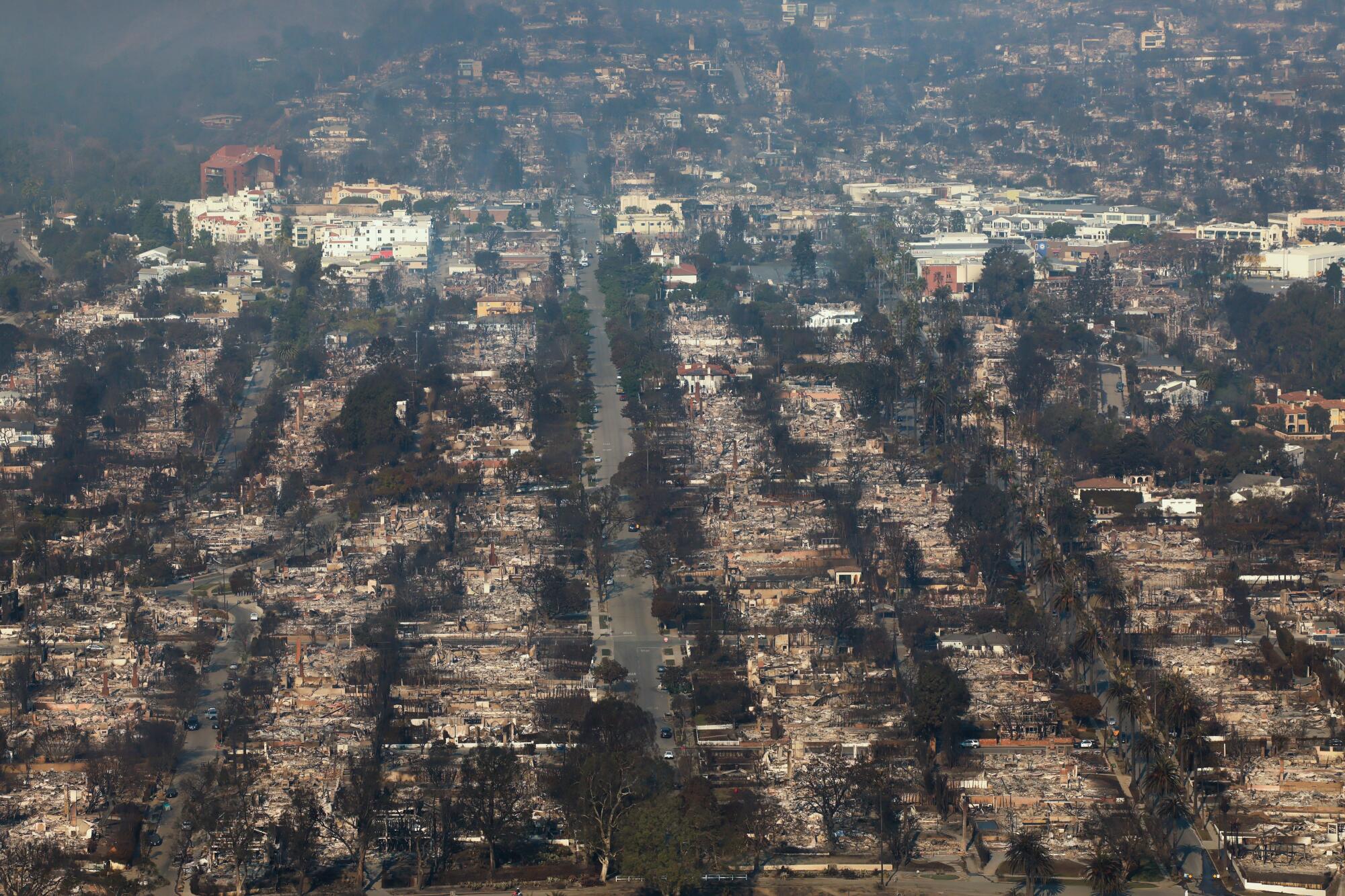
A Jan. 9 aerial view of neighborhoods destroyed by the Palisades fire.
(Robert Gauthier / Los Angeles Times)
But the LAFD’s hyper-focus on money obscures its leaders’ failures in managing the resources they had, beginning with a decision to leave the scene of a New Year’s Day fire despite signs it hadn’t been fully extinguished.
Days later, that fire reignited into the Palisades fire, which killed 12 people and destroyed thousands of homes. Despite forecasts of catastrophically high winds, LAFD officials didn’t pre-deploy engines in the area or increase manpower by ordering a previous shift of firefighters to stay on duty.
As the flames spread, the firefighting response was disorganized and chaotic, with the LAFD’s own after-action reportdescribing major failures by high-ranking commanders in communication, staffing and basic wildland firefighting knowledge.
City leaders have highlighted changes they have made since the fire, including appointing 30-year LAFD veteran Jaime Moore as chief and drafting new protocols for staffing on high hazard weather days.
But the question remains: Is Los Angeles prepared for the next major wildfire? Some city officials and fire experts don’t think so, pointing to an LAFD that hasn’t evolved with the times and an incomplete review of how the Palisades fire started.
Moore, who was appointed chief last month, declined to comment.
Mayor Karen Bass said in an interview earlier this month that the city is “on the path to be completely ready” for a major wildfire, with the LAFD now taking a more proactive approach to weather warnings.
“The Fire Department has been way more aggressive, has done pre-deployment, has been very visible, alerts going out early, trying to be very, very aggressive,” she said.
But Genethia Hudley Hayes, president of the Board of Fire Commissioners, said that the LAFD is still unprepared and that there hasn’t been enough time to make the necessary changes. She cited the LAFD’s technology, which she said is about two decades behind.
“I am not confident there would be a different result” if a similar disaster strikes, she said.
City Councilmember Traci Park, whose district includes Pacific Palisades and who has advocated for more Fire Department funding, agreed with Hudley Hayes.
Some essential changes have been made, such as requiring firefighters to stay for an additional shift during red flag warnings, Park said. But she said that too many fire engines are out of service, there are not enough mechanics, and most important, questions about the origin of the Palisades fire remain unanswered.
In October, after federal prosecutors charged a former Palisades resident with deliberately setting the Jan. 1 Lachman fire, The Times reported that a battalion chief ordered firefighters to roll up their hoses and leave the burn area on Jan. 2, even though they had complained that the ground was still smoldering and rocks remained hot to the touch. The Times reviewed text messages among firefighters and a third party, sent in the weeks and months after the fire, describing the crew’s concerns.
The LAFD’s after-action report, released in October, only briefly mentioned the Lachman fire. Critics have flagged this as a crucial lapse in the report, which prevents the department from figuring out what went wrong and avoiding the same mistakes.
Mayor Karen Bass, right, and then-Fire Chief Kristin Crowley speak during a news conference in January. Bass ousted Crowley less than two months after the Palisades fire.
(Allen J. Schaben / Los Angeles Times)
Bass had ousted Crowley less than two months after the Palisades fire, citing the LAFD’s failure to properly deploy resources ahead of the winds and potentially have a chance to extinguish the fire before it exploded out of control, an issue that was exposed by a series of reports in The Times.
Bass also countered Crowley’s financial complaints, saying that the budget did not affect the department’s ability to fight the fire. The LAFD’s 2024-25 budget had actually increased 7% from the previous year, due in part to generous firefighter raises.
More money won’t solve bad decision-making by top officials, said Marc Eckstein, an emergency physician who served as LAFD’s medical director and commander of its emergency medical services bureau until he retired in 2021.
He said that without transparency and accountability, “the fallback is always going to be what it has been: We need more of everything — more people, more money, more fire trucks, more fire stations.”
A modern fire agency needs the flexibility to surge its staff during a disaster, he said, while also addressing day-to-day needs. Most 911 calls are for medical problems, he said, yet the LAFD functions more or less the same as it did decades ago, when structure fires were more common.
He said a panel of outside experts should have been given access to the LAFD’s records to offer an unbiased look at how the department performed leading up to and during the Palisades fire.
“And it’s a playbook. OK, how do we prevent this from happening again?” he said. “And the fact that didn’t happen is a disgrace.”
How much the department transforms after the Palisades disaster will depend, in large part, on its new chief. Moore, who joined the LAFD in 1995 and most recently was deputy chief of the Operations Valley Bureau, was chosen by Bass to lead the department over a fire chief from a major city outside California.
At stations around L.A., firefighters told Bass that they wanted an insider for the job, which she said factored into her decision.
“Given that the Fire Department was under such scrutiny, such a difficult time, morale is in the toilet, infighting that’s going on, the last thing in the world they needed, in my opinion, was somebody from the outside,” Bass told The Times.
Moore had signaled before his appointment was confirmed last month that he was troubled by the LAFD’s missteps with the Lachman fire and was going to bring in an outside organization to investigate.
But the following week, he appeared to change course, alleging that the media was trying to “smear” firefighters while saying he still planned to investigate the Lachman fire.
Moore will be in charge of implementing the 42 recommendations in the after-action report, which range from establishing better communication channels to how to defend homes where hidden embers could ignite.
The report drew the conclusion that top LAFD commanders had startlingly little knowledge about combating wildfires, including “basic suppression techniques.” It suggested that all LAFD members undergo training on key skills such as structure defense and how to draw water from swimming pools when hydrants don’t work.
In an interview with ABC7, Moore said that the LAFD has adopted about three-quarters of the recommendations and is considering creating a division specializing in wildland fires.
Members of Crew 4, the department’s new full-time wildland hand crew, practice cutting fire lines near Green Verdugo Fire Road in Sunland.
(Myung J. Chun / Los Angeles Times)
Since the Palisades fire, the LAFD has hired a 26-member wildland hand crew that uses chainsaws and other tools to chop paths through brush to stop a fire from spreading. When they aren’t battling fires, they do brush clearance throughout the city.
Earlier this month, as hand crew members practiced cutting fire lines through the brush in Sunland, the crew’s leader, Supt. Travis Humpherys, declined to say whether they would have changed the outcome of the Palisades fire.
Travis Humpherys is the Crew 4 superintendent.
(Myung J. Chun / Los Angeles Times)
But they have already “made a dramatic impact” with brush clearance and fighting wildfires, including a 20-acre fire in Burbank in June, Humpherys said.
Moore’s requested budget of more than $1 billion for the coming year — a 15% increase over this year’s budget — includes money for a second wildland hand crew, as well as nearly 200 additional firefighter recruits and helitanker services to attack fires from the air. That amount could be pared down during the months-long city budgeting process, as the City Council and the mayor find ways to balance the overall budget amid financial headwinds.
Meanwhile, United Firefighters of Los Angeles City Local 112 is charting an ambitious course to reduce the department’s dependency on the city budget, pushing for a ballot measure that, if approved by voters in November 2026, would raise nearly $10 billion by 2050 through a half-cent sales tax. But after the LAFD’s failures in the Palisades fire, some voters may be reluctant to entrust its leaders with more money.
“It’s hard to believe that we are fully prepared for the next major emergency,” Doug Coates, the union’s acting president, said in a statement. “We desperately need more firefighters and paramedics, more trucks, engines, and ambulances and more wildfire resources and neighborhood fire stations.”
E. Randol Schoenberg, whose family lost four homes in the fire, including his in Malibu — along with documents that belonged to his grandfather, the composer Arnold Schoenberg — said he would be happy to pay more taxes for more services.
But Schoenberg, an attorney who is representing Palisades fire victims in a lawsuit against the city and the state, said he expects the LAFD to honestly examine its mistakes.
“If they don’t really grapple with the issues of how this happened, then no matter how much money we throw at it, it’s going to happen again,” he said.
Times staff writer David Zahniser contributed to this report.
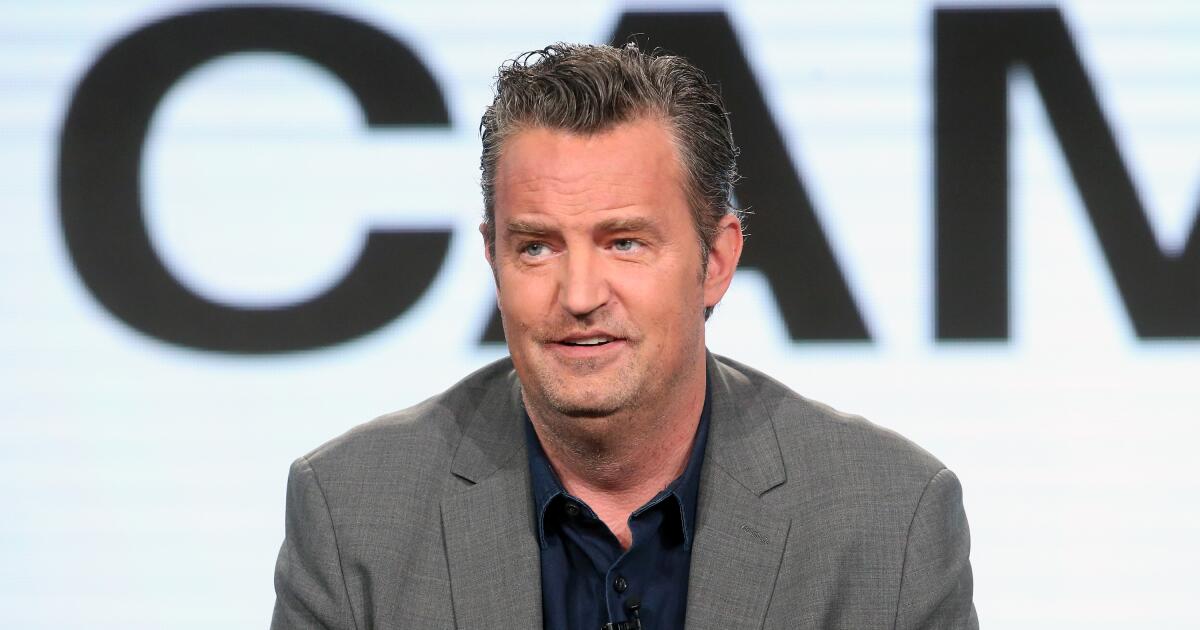
Another physician who played a role in providing ketamine to Matthew Perry weeks before the actor’s overdose death was sentenced to eight months of house arrest by a federal judge Friday.
Mark Chavez, a former doctor, pleaded guilty to one count of conspiracy to distribute ketamine last October. In his plea agreement, Chavez acknowledged that he and Salvador Plasencia — an ex-doctor sentenced to nearly three years in prison earlier this month — colluded to deceive medical ketamine suppliers and illegally distribute the drug to Perry for profit.
Chavez, 54, was also sentenced to three years of supervised release following his house arrest and must perform 300 hours of community service.
Chavez was one of five individuals charged last year for their alleged roles in Perry’s October 2023 death. The others include Perry’s acquaintance Erik Fleming, personal assistant Kenneth Iwamasa, and Jasveen Sangha, a North Hollywood woman allegedly known as the “Ketamine Queen.” All have pleaded guilty to federal charges and await sentencing in the coming months.
During the sentencing, U.S. District Judge Sherilyn Peace Garnett brought up concerns about sentencing disparities between Chavez and Plasencia. Assistant U.S. Attorney Ian Yanniello argued that the government’s recommended sentence of six months of house arrest was due to Chavez’s cooperation with investigators.
“As doctors, their conduct was egregious,” Yanniello said. “The difference was what they did when they got caught.”
Before charges were brought against the five alleged distributors, Chavez surrendered his medical license and sought a plea deal with the government.
According to an indictment, Plasencia contacted Chavez to purchase ketamine after learning Perry was interested in depression-related treatments in September 2023. Chavez then supplied Plasencia with ketamine vials and orally transmitted “lozenges” that were fraudulently obtained under another patient’s prescription, his plea agreement said.
“If today goes well we may have repeat business,” Plasencia texted Chavez less than a month before Perry’s death.
“Let’s do everything we can to make it happen,” Chavez responded, court records show.
Chavez had faced a potential maximum of 10 years in prison, prosecutors said.
Prosecutors argued that Chavez improperly obtained authorization from the Drug Enforcement Administration to prescribe and administer medical ketamine.
Chavez purchased 22 vials of liquid ketamine, ketamine lozenges and other medical supplies from wholesale distributors to provide to Plasencia, who would personally deliver them to Perry, the judge said before her ruling.
During his Dec. 3 sentencing hearing, a federal judge castigated Plasencia for his medical malpractice and for teaching Perry’s personal assistant to administer the drug at the actor’s Pacific Palisades home. Chavez never met with Perry in person, but allowed Plasencia to continue the treatments despite knowing that Plasencia had “little” experience with ketamine treatments, according to his plea agreement.
According to the plea agreement, Chavez called Plasencia on the day of Perry’s death to inquire whether he believed they distributed drugs that may have killed him. Prosecutors said that ketamine was not supplied by the physicians.
Chavez offered a brief apology immediately before his sentencing.
“As a doctor, I’ve had a wonderful opportunity to help people’s lives, but I’ve also had to deal with the tragedies,” Chavez said. “My heart goes out to the Perry family.”
Chavez’s attorney said that he would reside in Mexico with his father after serving his sentence.