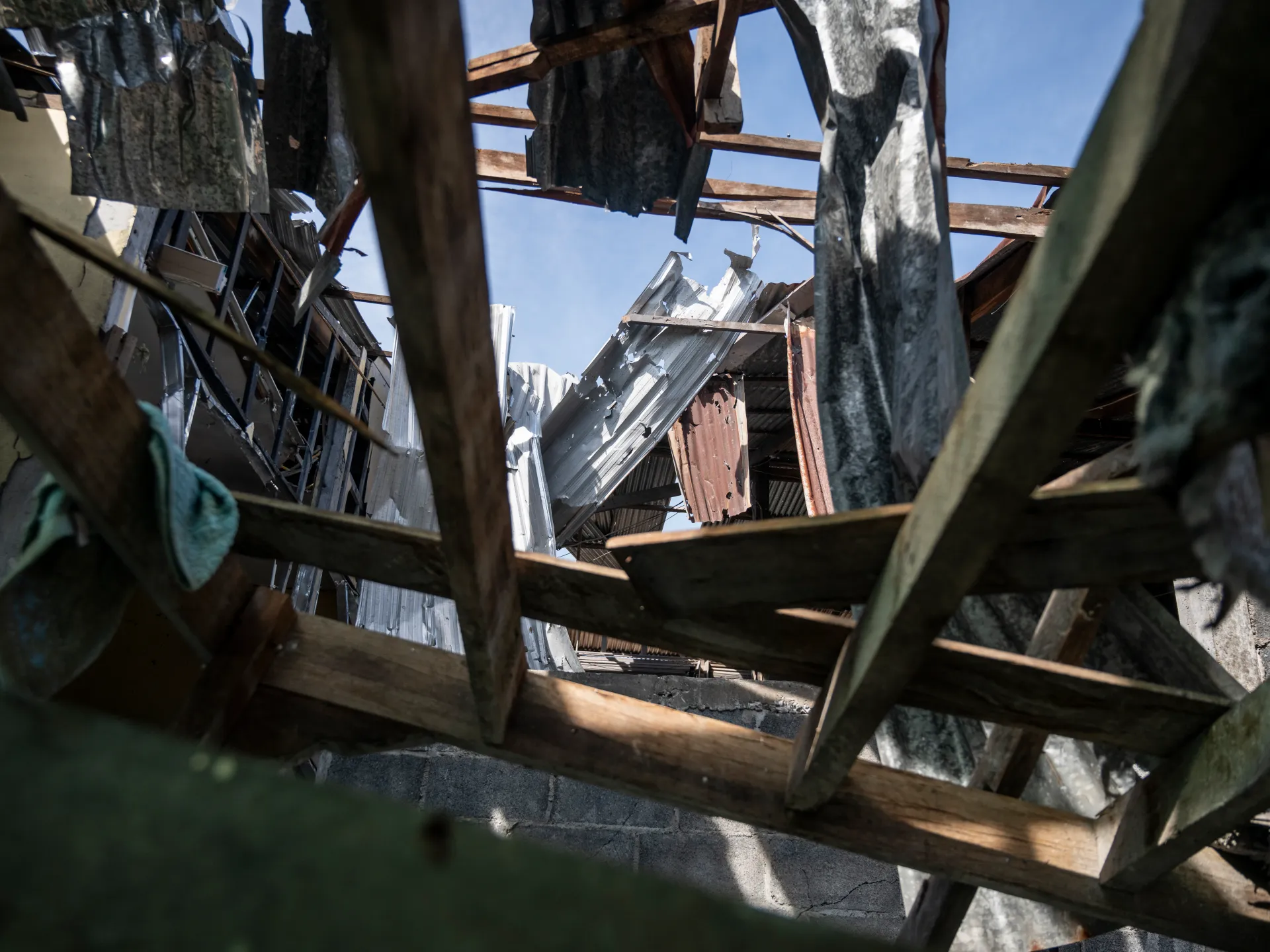
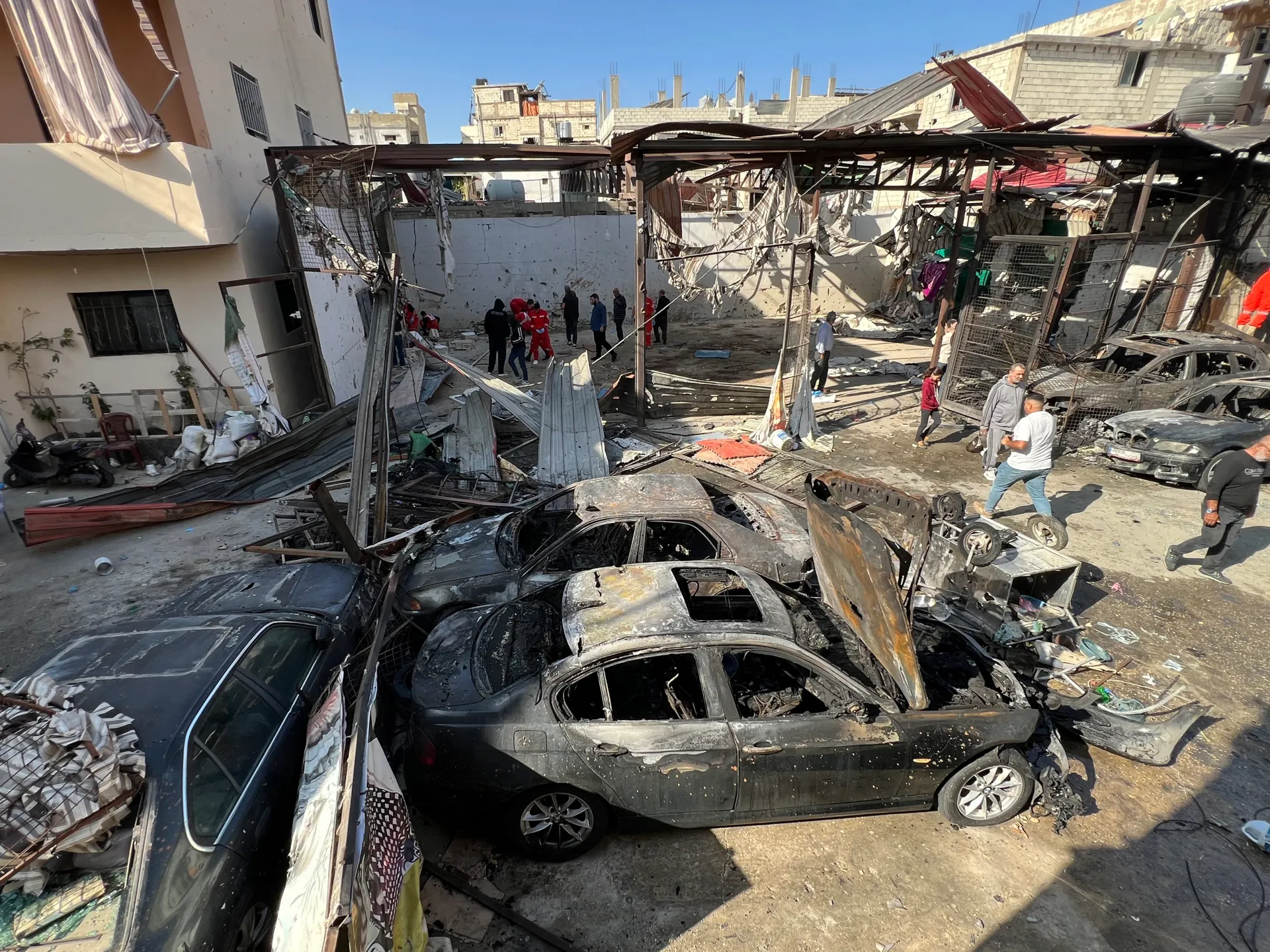
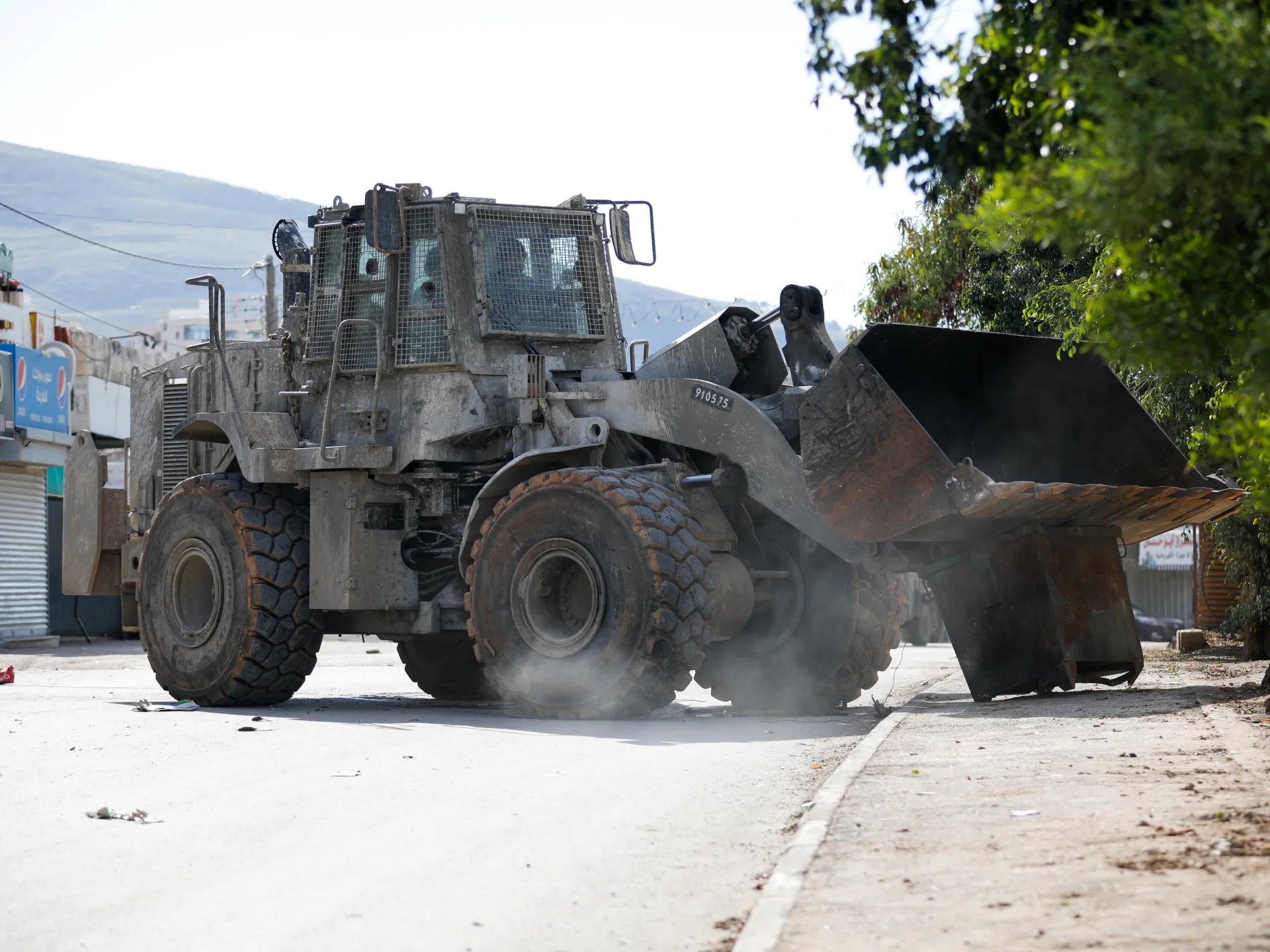
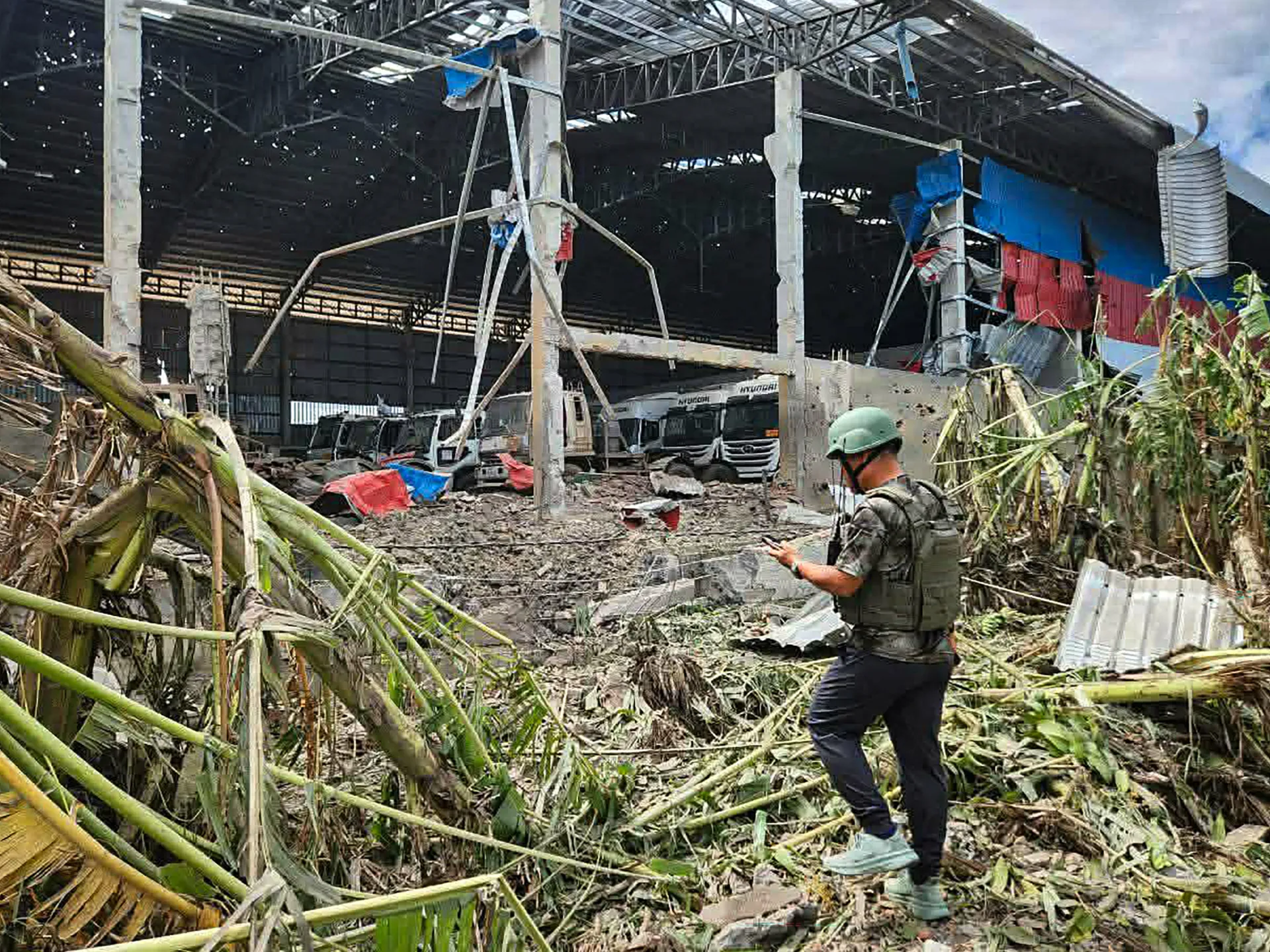
Interior Ministry says the raid killed Mohammed Shahadeh, describing him as one of ISIL’s senior commanders in Syria.
Published On 25 Dec 202525 Dec 2025
Share
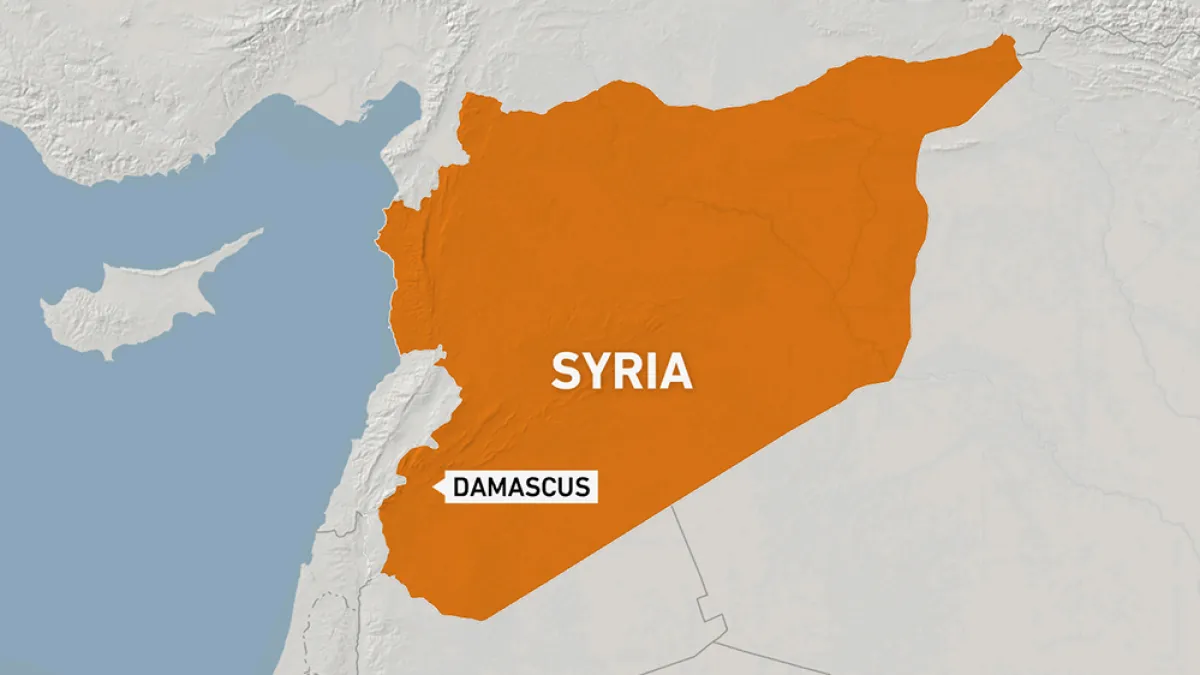
Syrian authorities say security forces have carried out a second operation against ISIL (ISIS) fighters near Damascus, killing a senior figure described as the group’s governor of Hauran.
In a statement on Thursday, the Ministry of Interior said the raid killed Mohammed Shahadeh, also known as Abu Omar Shaddad, calling him one of ISIL’s senior commanders in Syria and a direct threat to local security.
Recommended Stories
list of 3 itemsend of list
Officials said the operation followed verified intelligence and extensive surveillance and was carried out by specialised units, operating in the Damascus countryside, that conducted a targeted raid in the town of al-Buweida, near Qatana, southwest of the capital.
The operation also involved the General Intelligence Directorate and took place in coordination with international coalition forces, the ministry said.
‘Crippling blow’
The announcement came a day after Syrian internal security forces arrested another senior ISIL figure in a separate operation near Damascus, according to the state-run SANA news agency.
SANA reported that forces arrested Taha al-Zoubi during what it described as a “tightly executed security operation” in the Damascus countryside. The agency said officers seized “a suicide belt and a military weapon” during the arrest.
Brigadier General Ahmad al-Dalati, head of internal security in the Damascus countryside, told SANA that the raid targeted an ISIL hideout in Maadamiya, southwest of the capital.
ISIL, which considers the current authorities in Damascus illegitimate, has largely focused its remaining operations on Kurdish-led forces in northern Syria.
At the height of its power, the armed group controlled vast areas of Iraq and Syria, declaring Raqqa its capital.
Although ISIL suffered military defeat in Iraq in 2017 and in Syria two years later, its cells continue to carry out attacks in the region and beyond, including in parts of Africa and Afghanistan.
DNA testing delays funeral plans as investigators examine the wreckage of jet crash that killed Libyan army chief.
Published On 25 Dec 202525 Dec 2025
Share
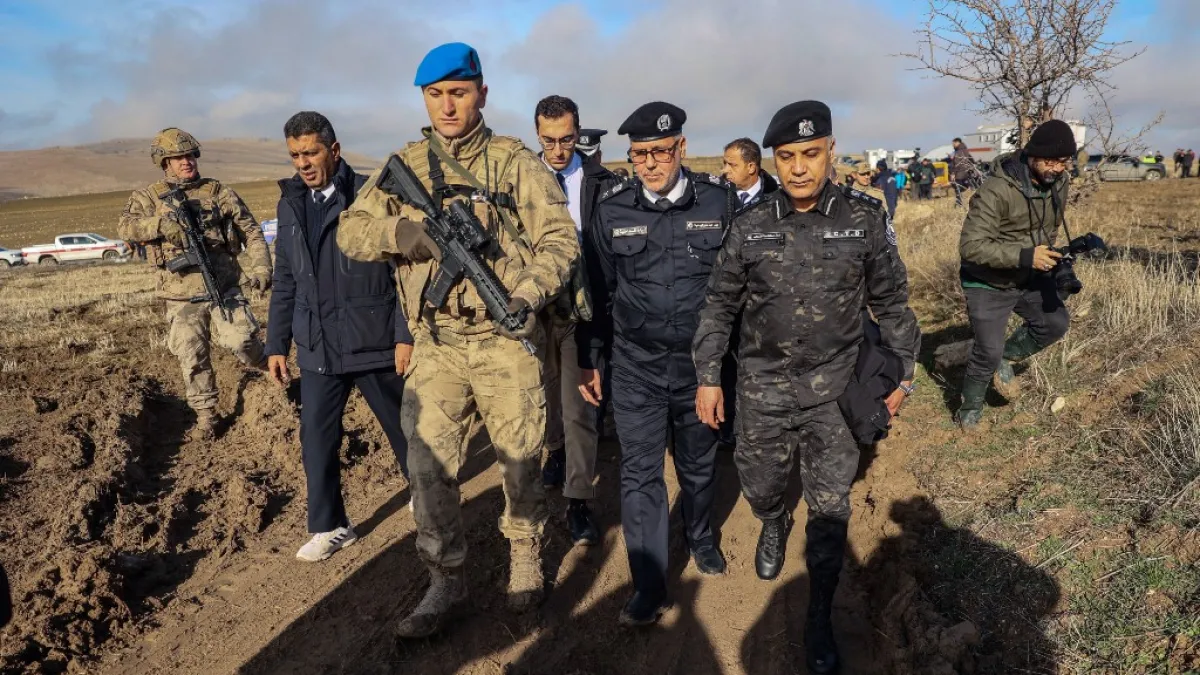
Officials from Libya and Turkiye have stepped up coordination over the investigation into a plane crash near Ankara that killed Libya’s army chief and seven other people as forensic work and preparations for repatriating the bodies are conducted.
Libya’s Criminal Investigation Department chief, Major General Mahmoud Ashour, led a delegation to the Ankara Chief Public Prosecutor’s Office on Thursday as part of the joint inquiry.
The visit followed discussions with Turkish prosecutors overseeing the case.
On Tuesday, a private jet carrying Libya’s army chief of staff, Mohammed Ali Ahmed Al-Haddad, reported an electrical malfunction shortly after taking off from Ankara Esenboga Airport.
According to Turkiye’s head of communications, Burhanettin Duran, the aircraft, bound for Tripoli, requested an emergency landing 16 minutes after takeoff.
Air traffic controllers redirected the Dassault Falcon 50 back towards Ankara’s airport, but radar contact was lost three minutes later as the jet descended.
The wreckage was found near the village of Kesikkavak in Ankara’s Haymana district. Eight people, including three crew members, were killed.
Search and rescue teams reached the site after Turkiye’s Ministry of Interior launched emergency operations while multiple authorities joined the investigation into the cause of the crash.
Funeral prayers delayed
Reporting from Misrata, Libya, Al Jazeera’s Malik Traina said preparations were under way for the return of Al-Haddad’s body although the timeline remains uncertain.
“Earlier today, we spoke to the minister of communications, and we were told the funeral prayer will be held tomorrow. That’s starting to change, now they’ve been receiving phone calls from government officials saying that it could likely be postponed till Saturday,” Traina said on Thursday.
Traina said the recovery process has taken longer due to the severity of the crash, which scattered remains across a wide area and necessitated DNA testing.
“There’s a lot of pressure for that process to finish as soon as possible. Whether or not that’ll happen, we’re gonna have to wait and see.
“He really was someone who tried to build up the military institutions, especially in western Libya, a place that is divided with powerful armed groups and militias controlling vast areas of land.”
‘Main reason for optimism’ is a belief that war in Ukraine will end in 2026 with Moscow’s ‘objectives’ achieved,’ pollster says.
Published On 25 Dec 202525 Dec 2025
Share
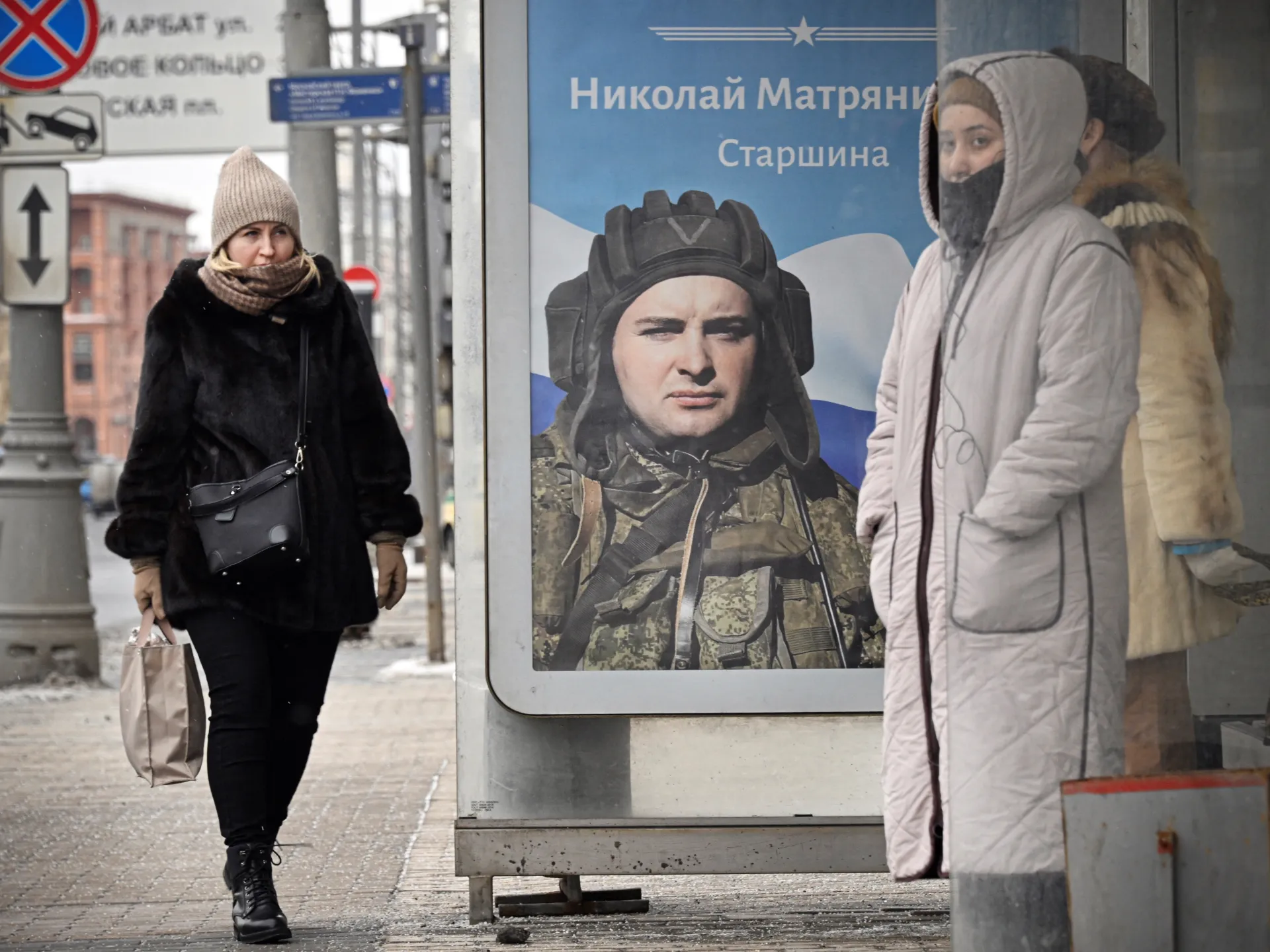
A majority of Russians expect the war in Ukraine to end in 2026, a state-owned research centre said, as Russian forces make advances on the battlefield and efforts intensify to reach a ceasefire deal between Kyiv and Moscow.
VTsIOM, Russia’s leading public opinion research centre, said on Wednesday that its annual survey of sentiment around the outgoing year and expectations for the coming year found Russians are viewing 2026 with “growing optimism”.
Recommended Stories
list of 4 itemsend of list
“Expectations for next year traditionally look much more optimistic … In other words, while the negative perception of the current situation persists, Russians have become more likely to accept (or believe, hope?) future improvements this year, but they still do so with caution,” the organisation said in a review of its survey findings released online.
In a year-end presentation, VTsIOM deputy head Mikhail Mamonov said 70 percent of 1,600 people surveyed viewed 2026 as being a more “successful” year for Russia than this year, with 55 percent of respondents linking hope for a better year to a possible end to what Russia officially calls its “special military operation” in Ukraine.
“The main reason for optimism is the possible completion of the special military operation and the achievement of the stated objectives, in line with the national interests outlined by the president,” Mamonov said at the presentation.
Mamonov pointed to the Russian military’s ongoing offensive in Ukraine, Washington’s reluctance to finance the Ukraine war and the European Union’s inability to fully replace the United States’ role in Ukraine – financially and militarily – as key factors behind the prospects for an eventual deal to end the fighting.
At the conclusion of the conflict, reintegration of Russian military veterans into society and the reconstruction of Russian-controlled regions of Ukraine, as well as Russian border areas, will be the main priorities, Mamonov added.
While the actual level of Russian public fatigue with the war is difficult to measure due to strict state controls on the media, expressions of public dissent as well as the prosecution of those who criticise Moscow’s war on its neighbour, approximately two-thirds of Russians support peace talks, according to independent pollster Levada, the highest number since the start of the war in 2022.
Ukrainian President Volodymyr Zelenskyy said in comments released on Wednesday that he would be willing to withdraw troops from Ukraine’s eastern industrial heartland as part of a plan to end the war, if Moscow reciprocated by also pulling back its forces and allowed the area to become a demilitarised zone monitored by international forces.
In comments to reporters about an overarching 20-point plan that negotiators from Ukraine and the US had hammered out in Florida in recent days, Zelenskyy also said that a similar arrangement could be possible for the area around the Zaporizhzhia nuclear power plant, which is currently under Russian control.
Russia has given no indication that it will agree to any kind of withdrawal from land it has seized in Ukraine and has long insisted that Kyiv must give up the remaining territory it still holds in the Donbas industrial area before any discussions on the cessation of fighting.
Russia has captured most of Luhansk and about 70 percent of Donetsk – the two regions that make up the Donbas.
Zelenskyy also said that figuring out the future control of the Donbas as part of the plan was “the most difficult point”, and creating a demilitarised economic zone in the region would require difficult discussions on how far troops would be required to move back and where international forces would be stationed.
Such discussions should be held at the leaders’ level, he said.
These are the key developments from day 1,400 of Russia’s war on Ukraine.
Published On 25 Dec 202525 Dec 2025
Share
Here is where things stand on Thursday, December 25:
Fighting
An explosion in Moscow killed three people, including two police officers, just days after a car bomb killed a high-ranking Russian general in the same area of the capital.
An official from Ukraine’s military intelligence, known as GUR, told The Associated Press news agency that the attack had been carried out as part of a Ukrainian operation and the two police officers were targeted for taking part in Russia’s war in Ukraine.
Russian air defence units downed 16 Ukrainian drones en route to Moscow throughout Wednesday, the capital’s Mayor Sergei Sobyanin said.
Sobyanin said the drones were repelled over a period of about 17 hours, and emergency crews were examining fragments where the drones hit the ground, but no damage was reported.
Two of four major airports servicing Moscow were forced to limit operations for a time due to the drone attacks, Russia’s civil aviation authority said on Telegram.
Russia’s Ministry of Defence said its aerial defence units destroyed 172 Ukrainian drones overnight, nearly half of them over regions bordering Ukraine.
Ukraine said its drones had struck the Yefremov synthetic rubber plant in Russia’s Tula region, south of Moscow, and a storage facility for marine drones in Russian-occupied Crimea.
Tula regional governor, Dmitry Milyaev, said debris from a downed Ukrainian drone ignited a fire at an industrial site, and Russian air defence units destroyed 12 Ukrainian drones over the region.
A sunflower oil spill, caused by Russian aerial bombardments, has contaminated the shoreline around the southern Ukrainian city of Odesa, killing wildlife and triggering warnings from conservationists, the AFP news agency reports.
“The cause was damage to sunflower oil tanks as a result of massive enemy attacks on port infrastructure, causing some of the oil to spill,” Odesa Governor Oleh Kiper said in a statement. The Pivdenny port in the region was temporarily closed on Wednesday to help with the cleanup.
A Russian-backed court in occupied Ukraine sentenced a Colombian man to 19 years in prison for fighting for Kyiv’s army.
Russia’s Prosecutor General said the Supreme Court in the Russian-controlled area of Ukraine’s Donetsk region sentenced Oscar Mauricio Blanco Lopez, 42, to 19 years in jail. The Colombian arrived in Ukraine in May 2024 to sign up with the Ukrainian army and had been “taken prisoner by Russian servicemen” in December 2025.
Ceasefire talks
Ukrainian President Volodymyr Zelenskyy revealed for the first time details of an agreement between the United States and Ukrainian negotiators on ending the war with Russia. The 20-point plan, agreed on by US and Ukrainian negotiators after marathon talks, is now being reviewed by Moscow.
As part of the plan, President Zelenskyy said Ukraine would be willing to withdraw troops from the country’s eastern industrial heartland if Moscow also pulled back and the area becomes a demilitarised zone monitored by international forces.
A similar arrangement could be possible for the area around the Zaporizhzhia nuclear power plant, which is currently under Russian control, Zelenskyy said. The Ukrainian leader said that any peace plan would need to be put to a referendum in Ukraine.
Asked about the latest development in ceasefire talks, Kremlin spokesperson Dmitry Peskov said Moscow would decide its position based on information received by Russian presidential envoy Kirill Dmitriev, who met with US envoys in Florida over the weekend.
Russia has given no indication that it will agree to any kind of withdrawal from land it has seized in Ukraine. Moscow has also insisted that Ukraine relinquish the remaining territory it still holds in the Donbas. Russia has captured most of Luhansk and about 70 percent of Donetsk – the two areas that make up the Donbas.
Politics and diplomacy
A majority of Russians expect the war in Ukraine to end in 2026, Russia’s state pollster VTsIOM said, in a sign that the Kremlin could be testing public reaction to a possible peace settlement as diplomatic efforts to end the conflict intensify.
During the pollster’s year-end presentation, VTsIOM Deputy Head Mikhail Mamonov said 70 percent of the 1,600 respondents saw 2026 as a more “successful” year for Russia than 2025, while for 55 percent that hope was linked to a possible end to Russia’s war in Ukraine.
A Russian court has scheduled the first public hearing in a criminal case against German sculptor Jacques Tilly, who is accused of discrediting the Russian military through his satirical Carnival floats depicting Russia’s President Vladimir Putin.
The court in Moscow said the trial will begin on December 30 and proceedings will be held in absentia, as Tilly – who faces up to 10 years in jail or a fine – is not in Russia.
Zelenskyy said in his Christmas address on Wednesday that despite marking the holiday at a “difficult” time, the nation’s unity remains intact. “Ukrainians are together tonight,” Zelenskyy said, adding the country had “without a doubt” been changed by the war. “It hardly matters what dishes are on the table – what matters is who is at the table,” he said.
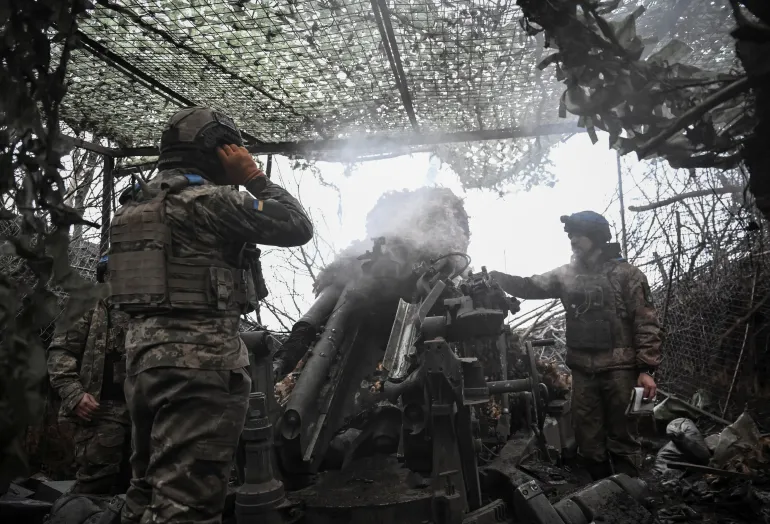
Artillerymen of the 44th Separate Artillery Brigade fire a M777 Howitzer towards Russian troops, amid Russia’s attack on Ukraine, in Dnipropetrovsk region, Ukraine, on December 24, 2025 [Reuters]
Regional security
France’s President Emmanuel Macron said he spoke with NATO chief Mark Rutte to discuss the situation in Ukraine and the work undertaken by the “coalition of the willing”. “Starting in January in Paris, we will continue the work begun within this framework to provide Ukraine with solid security guarantees, a prerequisite for a robust and lasting peace,” Macron said on social media.
Democratic senators in the US have urged President Donald Trump to reverse a recall of nearly 30 career ambassadors, warning the move leaves a dangerous leadership vacuum that allows adversaries like Russia and China to expand their influence. The Trump administration in recent days has ordered career diplomats serving across Europe, Asia, Africa and Latin America back to Washington to ensure US missions abroad reflect its “America First” priorities.
Economics
Kazakhstan’s exports of its flagship CPC Blend of oil will be their lowest in 14 months in December, as bad weather delays efforts to repair Russian loading infrastructure after Ukrainian drone strikes last month, two sources told the Reuters news agency.
On November 29, Ukrainian drones hit the Caspian Pipeline Consortium terminal located near Russia’s Black Sea port of Novorossiysk, leaving just one out of three jetties operational and prolonging export delays. Poor weather has added to the difficulty of carrying out maintenance work necessary to allow exports to recover.
Ukraine’s Ministry of Finance said it completed the settlement of a deal to restructure $2.6bn of growth-linked debt.
The Ukrainian military says its forces have withdrawn from the battle-scarred town of Siversk in the eastern Donetsk region after heavy fighting with Russian forces.
In a statement on Telegram on Tuesday, Ukraine’s General Staff said that Russian troops had a “significant advantage” in manpower and equipment and had exerted constant pressure on the defending Ukrainian troops by staging small-unit assaults in difficult weather conditions.
Recommended Stories
list of 4 itemsend of list
Ukraine’s decision to withdraw its forces was made to “preserve the lives of our soldiers and the combat capability of the units”, the General Staff said.
Heavy losses were inflicted on Russian forces before the order to retreat was given, and Siversk remains “under the fire control of our troops”, and “enemy units are being blocked to prevent their further advance,” the General Staff added.
Ukraine’s DeepState military monitoring site reported late on Tuesday that Russian forces had occupied Siversk as well as Hrabovske, a village in Ukraine’s Sumy region close to the border with Russia.
Russian Lieutenant General Sergei Medvedev had told Russian President Vladimir Putin on December 11 that troops had taken Siversk, where fighting has been fierce in recent months, but Ukrainian officials denied the Russian reports at the time.
Ukraine’s military said at the time that Russian troops were “taking advantage of unfavourable weather conditions” to launch attacks, but were mostly being “destroyed on the approaches”.
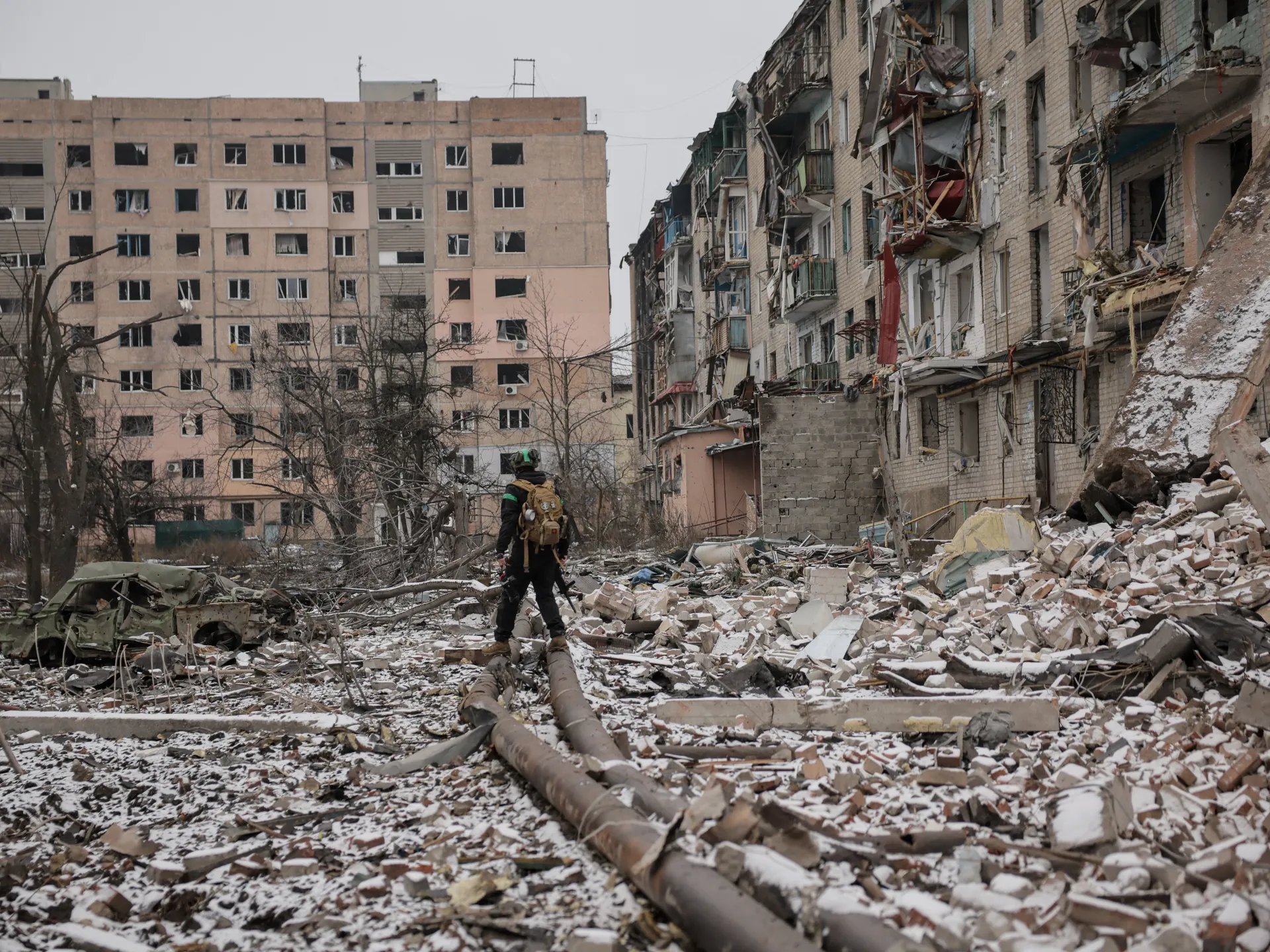
The Kyiv Independent news site said that, despite Siversk’s modest size – it had a pre-war population of 10,000, and now, just a few hundred civilians remain – the town was key to the defence of northern Donetsk.
The town had helped shield the larger Sloviansk and Kramatorsk areas, “the main bastions of Ukraine’s so-called ‘fortress belt’”, which Russia has been unable to conquer since the start of fighting, the Kyiv Independent said.
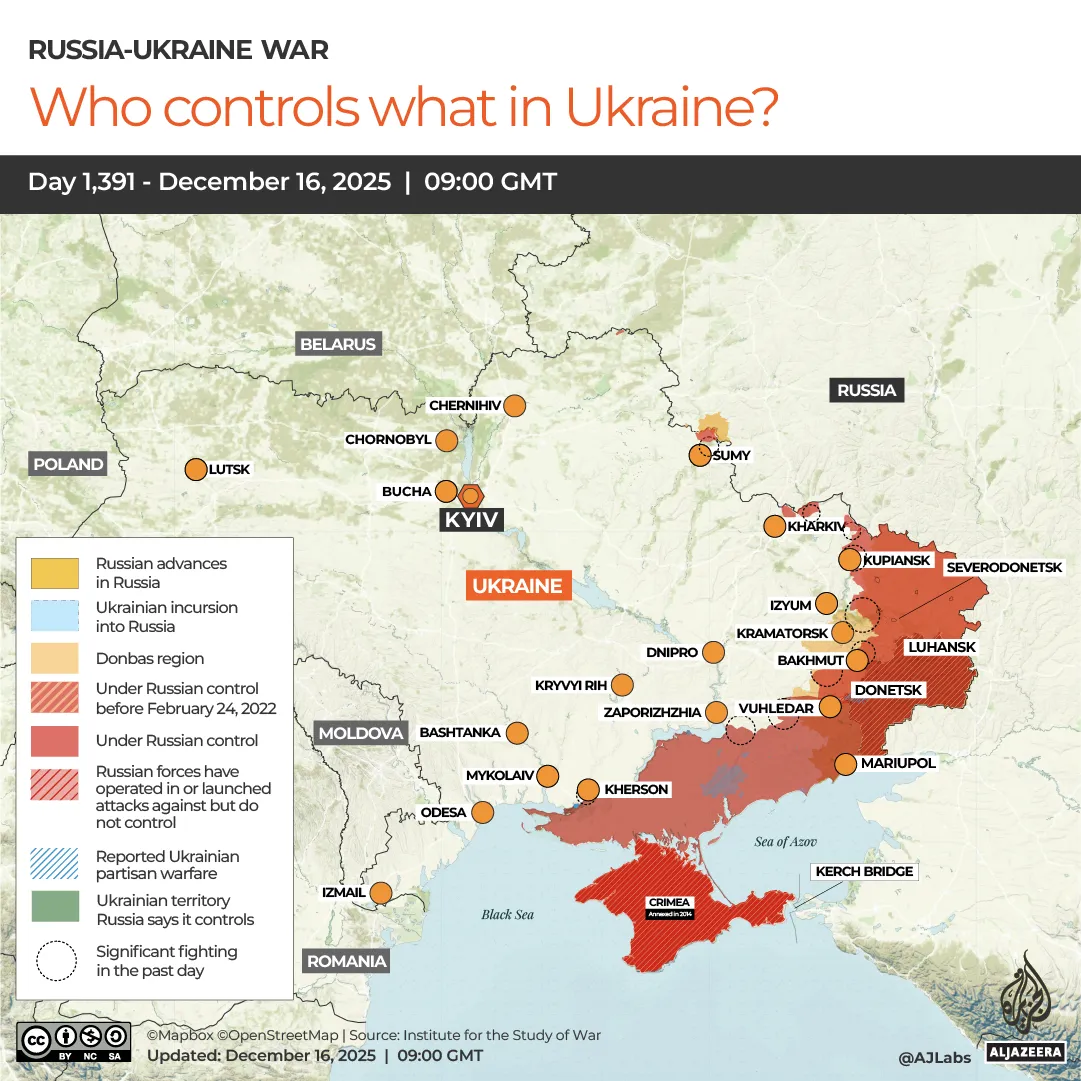
Donetsk is one of three Ukrainian regions at the centre of Russia’s territorial demands, which are the stumbling blocks to reaching an agreement on a ceasefire. Ukraine’s leaders have said they will not concede their country’s territory taken during Moscow’s invasion.
Russian forces had already seized an estimated 19 percent of Ukrainian territory as of early December, including Crimea, which Moscow annexed in 2014, all of the Luhansk region, and more than 80 percent of Donetsk, according to the Reuters news agency.
Russian forces also control about 75 percent of the Kherson and Zaporizhia regions, and small parts of the Kharkiv, Sumy, Mykolaiv and Dnipropetrovsk regions, according to Reuters.
A 28-point peace plan first put forward by the administration of US President Donald Trump last month says that a negotiated settlement would see Crimea, Luhansk and Donetsk “recognised as de facto Russian, including by the US”.
Ukrainian President Volodymyr Zelenskyy recently said that the United States is pushing for Ukraine to withdraw its forces from the Donetsk region to establish a “free economic zone” in the area, which he said the Russian side is referring to as a “demilitarised zone”.
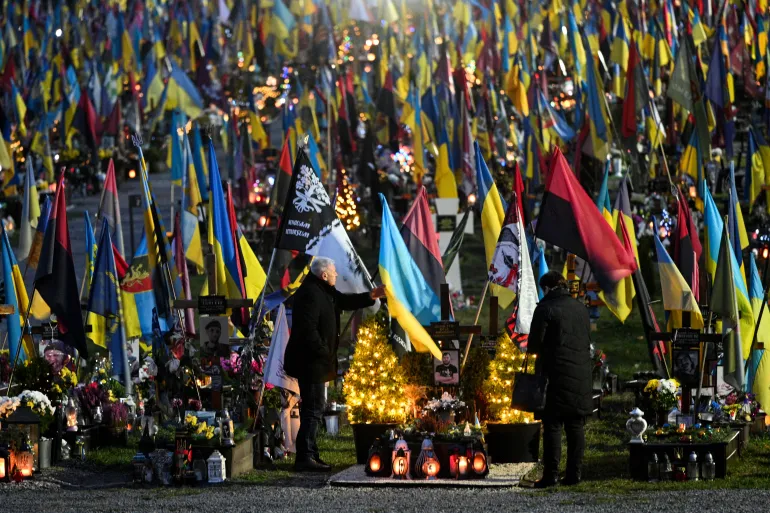
People visit the graves of fallen Ukrainian soldiers, decorated with Christmas trees and New Year’s decorations, at the Lychakiv Military Cemetery, in Lviv, Ukraine on Tuesday [Yuriy Dyachyshyn/AFP]
Pope saddened as fighting continues over Christmas
The latest setback for Kyiv on the battlefield came as Zelenskyy said on Tuesday that Russian forces had launched another “massive attack” on Ukraine on Monday night, killing at least three people, including a four-year-old girl, across 13 regions targeted with drones and missiles.
In Russia, Ukrainian drone attacks killed four people in the Belgorod region over the past two days, local officials said.
Pope Leo expressed disappointment on Tuesday that Russia had apparently refused to agree to a ceasefire on December 25, the date many Christians celebrate Christmas.
“I will make an appeal one more time to people of goodwill to respect at least Christmas Day as a day of peace,” Leo said, speaking to reporters outside his residence in Castel Gandolfo, Italy.
“Maybe they will listen to us, and there will be at least 24 hours, a day of peace, across the world,” he said.
While most people in Ukraine and Russia are Christians, many are Orthodox, meaning they observe Christmas on January 7.
Russian President Vladimir Putin announced an unexpected 30-hour unilateral truce a day before Easter this year, a rare pause in Russia’s war on Ukraine, which has now continued for close to three years, after Russia’s full-scale invasion in February 2022.
These are the key developments from day 1,399 of Russia’s war on Ukraine.
Published On 24 Dec 202524 Dec 2025
Share
Here is where things stand on Wednesday, December 24:
Fighting
Russian forces began a “massive attack” on Ukraine on Monday night, killing three people and targeting 13 regions with 650 drones and 30 missiles, Ukrainian President Volodymyr Zelenskyy said in a post on X.
Those killed in the overnight attack included a four-year-old girl in the central Zhytomyr region, Governor Vitalii Bunechko said on Telegram. “Doctors struggled to save the child’s life, but in the end, they were unable to save her,” Bunechko said, adding that five people were also injured in the attack.
Russian forces also launched drones and missiles at the Vyshhorod district of Ukraine’s Kyiv region, killing a woman and injuring three people, Governor Mykola Kalashnyk said.
In Ukraine’s western Khmelnytskyi region, one person was killed by Russian shelling, Governor Serhii Tiurin said.
Russian drone attacks on Kyiv’s Sviatoshynskyi district left five people injured, said Tymur Tkachenko, the head of the Kyiv City Military Administration.
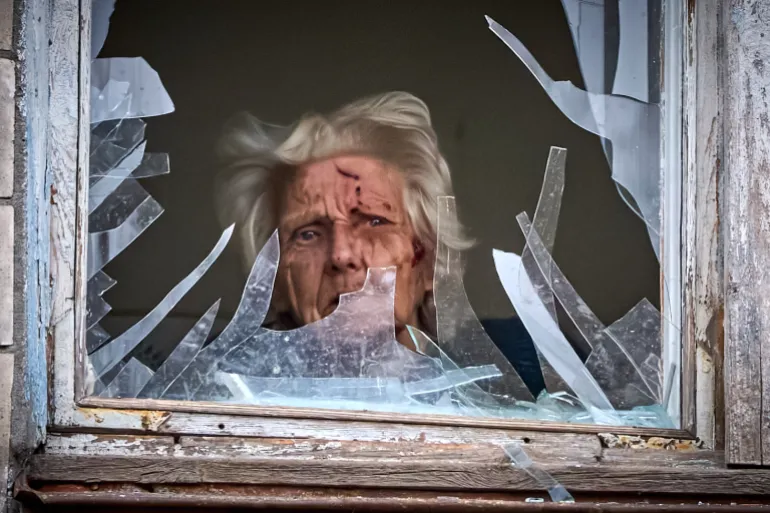
An injured elderly woman looks out of her broken window after an apartment building was hit by a Russian drone during an aerial attack in Kyiv, Ukraine, on Tuesday [Efrem Lukatsky/AP Photo]
Ukraine’s Ministry of Energy said that “emergency power outages” were introduced in several regions across the country due to Russian forces targeting energy infrastructure. The ministry said that it was working to restore electricity to the Rivne, Ternopil and Odesa regions. The ministry said that the situation was “most difficult” in the border regions, “as restoring electricity is complicated by continuous fighting”.
Ukraine’s General Staff said Ukrainian troops have withdrawn from the Donetsk region’s Siversk area after heavy fighting, noting that Moscow’s forces had a “significant advantage” there.
Ukraine’s Ministry of Foreign Affairs said that Ukrainian F-16 fighter pilots shot down 621 of 673 Russian “aerial targets” on Tuesday night, including 34 of 35 cruise missiles.
In Russia, a Ukrainian drone strike on a car killed three men in the Belgorod region on Monday, the region’s emergency response team reported.
Another Ukrainian drone attack in Belgorod on Tuesday killed one person and injured three, the region’s operational headquarters said on Telegram.
Russian forces shot down 56 Ukrainian drones in a day, as well as a guided bomb, Russia’s Ministry of Defence said, according to the state news agency TASS.
Ceasefire
Zelenskyy said in his nightly address, “We sense that America wants to reach a final agreement” to end the war in Ukraine, and that “there is full cooperation” from the Ukrainian side.
In an earlier post on X, Zelenskyy said that “several draft documents have now been prepared”, following talks in Miami. “In particular, these include documents on security guarantees for Ukraine, on recovery, and on a basic framework for ending this war,” he said.
Pope Leo said that Russia’s apparent refusal to agree to a ceasefire on December 25 is “among the things that cause me much sadness”.
“I will make an appeal one more time to people of goodwill to respect at least Christmas Day as a day of peace,” Leo told reporters outside his residence in Castel Gandolfo, Italy.
Talks held between Foreign Minister Asaad Hassan Al-Shaibani, Defence Minister Murhaf Abu Qasra and the Russian president.
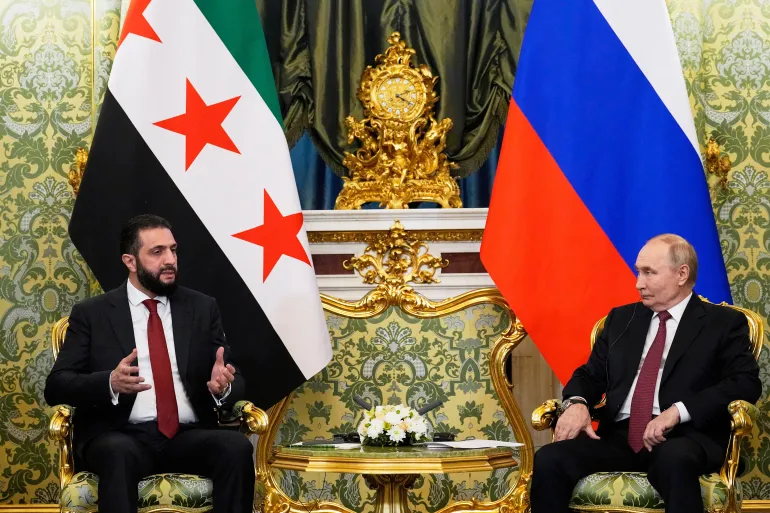
Syria’s foreign and defence ministers met Russian President Vladimir Putin in Moscow and held discussions on expanding “strategic cooperation in the military industries sector”, Syrian state media has reported.
The Syrian Arab News Agency (SANA) said that Putin’s meeting on Tuesday with Syrian Minister of Foreign Affairs Asaad Hassan Al-Shaibani and Minister of Defence Murhaf Abu Qasra focused on political, economic and military issues of “mutual interest”, but that “particular emphasis” was on defence.
Recommended Stories
list of 4 itemsend of list
According to SANA, Putin and the Syrian ministers discussed a range of defence-related matters, including developing military cooperation to strengthen the Syrian army’s capabilities and modernising its equipment, transferring expertise and cooperation in research and development.
“During the meeting, both sides reviewed ways to advance military and technical partnership in a manner that strengthens the defensive capabilities of the Syrian Arab Army and keeps pace with modern developments in military industries,” SANA reported.
The two sides also discussed political and economic issues, including the “importance of continued political and diplomatic coordination between Damascus and Moscow in international forums”, according to the news agency.
On the economic front, the talks addressed expanding Syrian-Russian cooperation, including in reconstruction projects, infrastructure development and investment in Syria.
Putin also reaffirmed Russian “steadfast support” for Syria and its territorial integrity, while renewing “Moscow’s condemnation of repeated Israeli violations of Syrian territory, describing them as a direct threat to regional security and stability”.
The ministers’ visit to Moscow is the latest by Syria’s new authorities since the removal from power last December of the country’s longtime ruler and Moscow’s former ally in Damascus, Bashar al-Assad.
Russia was a key supporter of al-Assad during Syria’s nearly 14-year civil war, providing vital military aid that kept the Assad regime in power, including Russian air support that rained air strikes on rebel-held areas.
Despite al-Assad and his family fleeing to Russia after the toppling of his regime, Moscow is eager to build good relations with the new government in Damascus.
Moscow, in particular, is hoping to secure agreements to continue operating the Khmeimim airbase and the Tartous naval base on Syria’s Mediterranean coast, where Russian forces continue to be present.
In October, Syria’s new president, Ahmed al-Sharaa, visited Russia, where he said his government would honour all the past deals struck between Damascus and Moscow, a pledge that suggested that the two Russian military bases were secure in the post-Assad period.
Putin said at the time of al-Sharaa’s visit that Moscow was ready to do all it could to act on what he called the “many interesting and useful beginnings” discussed by the two sides on renewing relations.
Russian state media on Tuesday quoted the country’s Ministry of Foreign Affairs spokeswoman, Maria Zakharova, as saying that Russian Foreign Minister Sergey Lavrov would also hold talks with his Syrian counterpart, Al-Shaibani, during the Syrian delegation’s visit.
During a visit to Moscow in July, Al-Shaibani said his country wanted Russia “by our side”.
“The current period is full of various challenges and threats, but it is also an opportunity to build a united and strong Syria. And, of course, we are interested in having Russia by our side on this path,” Al-Shaibani told Lavrov at the time.
Syrian President Ahmed al-Sharaa speaks during a meeting with Russian President Vladimir Putin at the Kremlin in Moscow, Russia, on October 15, 2025 [Pool: Alexander Zemlianichenko via Reuters]
WASHINGTON — The Supreme Court ruled against President Trump on Tuesday and said he did not have legal authority to deploy the National Guard in Chicago to protect federal immigration agents.
Acting on a 6-3 vote, the justices denied Trump’s appeal and upheld orders from a federal district judge and the 7th Circuit Court of Appeals that said the president had exaggerated the threat and overstepped his authority.
The decision is a major defeat for Trump and his broad claim that he had the power to deploy military forces in U.S. cities.
In an unsigned order, the court said the Militia Act allows the president to deploy the National Guard only if U.S. military forces were unable to quell violence.
“At this preliminary stage, the Government has failed to identify a source of authority that would allow the military to execute the laws in Illinois. The President has not invoked a statute that provides an exception to the Posse Comitatus Act,” the court said.
Conservative Justices Clarence Thomas, Samuel A. Alito Jr. and Neil M. Gorsuch dissented.
The 9th Circuit Court of Appeals had allowed the deployments in Los Angeles and Portland, Ore., after ruling that judges must defer to the president.
But U.S. District Judge Charles Breyer ruled Dec. 10 that the federalized National Guard troops in Los Angeles must be returned to the control of California Gov. Gavin Newsom.
Trump’s lawyers had not claimed in their appeal that the president had the authority to deploy the military for ordinary law enforcement in the city. Instead, they said the Guard troops would be deployed “to protect federal officers and federal property.”
The two sides in the Chicago case, like in Portland, told dramatically different stories about the circumstances leading to Trump’s order.
Democratic officials in Illinois said small groups of protesters objected to the aggressive enforcement tactics used by federal immigration agents. They said police were able to contain the protests, clear the entrances and prevent violence.
By contrast, administration officials described repeated instances of disruption, confrontation and violence in Chicago. They said immigration agents were harassed and blocked from doing their jobs, and they needed the protection the National Guard could supply.
Trump Solicitor Gen. D. John Sauer said the president had the authority to deploy the Guard if agents could not enforce the immigration laws.
“Confronted with intolerable risks of harm to federal agents and coordinated, violent opposition to the enforcement of federal law,” Trump called up the National Guard “to defend federal personnel, property, and functions in the face of ongoing violence,” he told the court in an emergency appeal filed in mid-October.
Illinois state lawyers disputed the administration’s account.
“The evidence shows that federal facilities in Illinois remain open, the individuals who have violated the law by attacking federal authorities have been arrested, and enforcement of immigration law in Illinois has only increased in recent weeks,” state Solicitor Gen. Jane Elinor Notz said in response to the administration’s appeal.
The Constitution gives Congress the power “to provide for calling forth the militia to execute the laws of the union, suppress insurrections and repel invasions.”
The Militia Act of 1903 says the president may call up and deploy the National Guard if he faces an invasion, a rebellion or is “unable with the regular forces to execute the laws of the United States.”
Trump’s lawyers said that referred to police and federal agents. But after taking a closer look, the court concluded it referred to the regular military forces. By that standard, the president’s authority to deploy the National Guard comes only after the military has failed to quell violence.
But on Oct. 29, the justices asked both sides to explain what the law meant when it referred to the “regular forces.”
Until then, both sides had assumed it referred to federal agents and police, not the military.
Trump’s lawyers stuck to their position. They said the law referred to the “civilian forces that regularly execute the laws,” not the military.
If those civilians cannot enforce the law, “there is a strong tradition in this country of favoring the use of the military rather than the standing military to quell domestic disturbances,” they said.
State attorneys for Illinois said the “regular forces” are the “full-time, professional military.” And they said the president could not “even plausibly argue” that the U.S. soldiers were required to enforce the law in Chicago.
California Atty. Gen. Rob Bonta and Newsom filed a brief in the Chicago case that warned of the danger of the president using the military in American cities.
“On June 7, for the first time in our Nation’s history, the President invoked [U.S. law] to federalize a State’s National Guard over the objections of the State’s Governor,” they said.
“President Trump and Defense Secretary Hegseth transferred 4,000 members of California’s National Guard — one in three of the Guard’s total active members — to federal control to serve in a civilian law enforcement role on the streets of Los Angeles and other communities in Southern California.”
That has proved to be “the opening salvo in an effort to transform the role of the military in American society,” they said. “At no prior point in our history has the President used the military this way: as his own personal police force, to be deployed for whatever law enforcement missions he deems appropriate.
“What the federal government seeks is a standing army, drawn from state militias, deployed at the direction of the President on a nationwide basis, for civilian law enforcement purposes, for an indefinite period of time,” they said.
Police say there is ‘insufficient evidence’ to bring charges after investigating comments made at Glastonbury festival.
Published On 23 Dec 202523 Dec 2025
Share
British police have said they will take no further action over comments made by punk-rap duo Bob Vylan about the Israeli military during a performance at the Glastonbury music festival in June.
Avon and Somerset Police said on Tuesday that the remarks did not meet the criminal threshold required for prosecution “for any person to be prosecuted”.
Recommended Stories
list of 4 itemsend of list
During the performance, the group’s lead singer – Pascal Robinson-Foster, known by his stage name Bobby Vylan – led chants of “death, death” directed at the Israeli military over its genocidal war in Gaza.
Police said there was “insufficient evidence to provide a realistic prospect of conviction”. The force added that it interviewed a man in his mid-30s and contacted about 200 members of the public as part of the investigation.
The chant, which was livestreamed by the BBC as part of its Glastonbury coverage on June 28, prompted a widespread backlash. The broadcaster later apologised for transmitting what it described as “such offensive and deplorable behaviour”, and its complaints unit found the BBC had breached editorial guidelines.
Avon and Somerset Police said it had considered the intent behind the words, the wider context, relevant case law and freedom of expression issues before concluding the investigation.
“We believe it is right this matter was comprehensively investigated, every potential criminal offence was thoroughly considered, and we sought all the advice we could to ensure we made an informed decision,” the statement said.
“The comments made on Saturday 28 June drew widespread anger, proving that words have real-world consequences.”
Following the performance, the United States revoked the visas of Bob Vylan, forcing the cancellation of a planned US tour scheduled to begin in October.
Bob Vylan have launched defamation proceedings against Irish broadcaster RTE, alleging it falsely claimed they led anti-Semitic chants during the Glastonbury performance.
In July, the British police also dropped an investigation into the Irish-language rap group Kneecap after chants of “Free Palestine” during a performance.
Detectives sought advice from the Crown Prosecution Service and decided to take no further action, citing “insufficient evidence to provide a realistic prospect of conviction for any offence”.
Israel Katz says military units will be established inside the Palestinian enclave, in contravention of the truce agreement.
Published On 23 Dec 202523 Dec 2025
Share
Israeli Defence Minister Israel Katz has said the Israeli military will never fully withdraw from the Gaza Strip and that an army unit will be established inside the Palestinian enclave.
Speaking on Tuesday, Katz said Israeli forces would remain deployed throughout Gaza, despite a United States-backed peace plan signed by Israel and Hamas in October that calls for a full Israeli military withdrawal and rules out the re-establishment of Israeli civilian settlements in the territory.
Recommended Stories
list of 4 itemsend of list
“We are located deep inside Gaza, and we will never leave all of Gaza,” Katz said. “We are there to protect.”
“In due course, we will establish Nahal [an Israeli infantry brigade] outposts in northern Gaza in place of the settlements that were uprooted,” Katz added, according to Israeli media.
Hours later, he issued a statement in English to the Reuters news agency, saying Nahal units would be stationed in Gaza “only for security reasons”. The Israeli media reported that US officials were displeased with Katz’s initial comments and demanded clarification.
Nahal units are military formations that combine civilian service with army enlistment and have historically played a role in the creation of Israeli communities.
Katz was speaking at a ceremony in the occupied West Bank marking the approval of 1,200 housing units in the illegal Israeli settlement of Beit El.
Addressing settlement expansion in the West Bank, Katz said: “Netanyahu’s government is a settlements government … it strives for action. If we can get sovereignty, we will bring about sovereignty. We are in the practical sovereignty era.”
“There are opportunities here that haven’t been here for a long time,” he added.
Israel is expected to head into an election year in 2026, with illegal settlement expansion a key political issue. Far-right and ultranationalist members of Prime Minister Benjamin Netanyahu’s coalition have repeatedly said they intend to reoccupy Gaza and expand illegal settlements in the West Bank.
Under international law, all Israeli settlements in the occupied West Bank are illegal. The transfer of an occupying power’s civilian population into occupied territory is considered a war crime under the Rome Statute of the International Criminal Court.
Meanwhile, violence by Israeli forces and settlers has continued across the West Bank, while killings continue in Gaza despite the ceasefire. Palestinian officials say more than 1,100 Palestinians have been killed, about 11,000 wounded and more than 21,000 arrested.
The Palestinian Ministry of Health said that since a ceasefire began on October 11, at least 406 Palestinians have been killed and 1,118 injured. Since the start of Israel’s war on October 7, 2023, the ministry said, 70,942 Palestinians have been killed and 171,195 wounded.
Planned talks come as Southeast Asian leaders urge both countries to show ‘maximum restraint’ and return to dialogue.
Published On 22 Dec 202522 Dec 2025
Share
Thailand and Cambodia have agreed to hold a meeting of defence officials later this week as regional leaders push for an end to deadly violence along the two countries’ shared border.
Thailand’s Foreign Minister Sihasak Phuangketkeow announced the planned talks on Monday after a special meeting in Kuala Lumpur of Southeast Asian foreign ministers, who were trying to salvage a ceasefire.
Recommended Stories
list of 3 itemsend of list
That truce was first brokered by Association of Southeast Asian Nations (ASEAN) chair Malaysia and United States President Donald Trump after cross-border fighting broke out in July.
Sihasak told reporters that this week’s discussions would be held on Wednesday in Thailand’s Chanthaburi, within the framework of an existing bilateral border committee.
But just hours after the regional crisis talks were held in Malaysia, Cambodia’s Ministry of Defence said the Thai military deployed fighter jets to bomb areas of Siem Reap and Preah Vihear provinces.
The Thai army said Cambodia had fired dozens of rockets into Thailand, with Bangkok’s air force responding with air strikes on two Cambodian military targets.
Thailand and Cambodia have engaged in daily exchanges of rocket and artillery fire along their 817km (508-mile) land border following the collapse of the truce, with fighting at multiple points stretching from forested regions near Laos to the coastal provinces of the Gulf of Thailand.
Despite the cross-border fire, Cambodia’s Ministry of Interior said it remains “optimistic that the Thai side will demonstrate sincerity” in implementing a ceasefire.
Thailand’s Sihasak, however, cautioned that the upcoming meeting may not immediately produce a truce. “Our position is a ceasefire does not come with an announcement, but must come from actions,” he said.
His ministry said the two nations’ militaries would “discuss implementation, related steps and verification of the ceasefire in detail”.
The planned meeting comes as ASEAN on Monday urged both countries to show “maximum restraint and take immediate steps towards the cessation of all forms of hostilities”.
In a statement after the talks in Kuala Lumpur, ASEAN also called on both Thailand and Cambodia to “restore mutual trust and confidence, and to return to dialogue”.
ASEAN members also reiterated their concerns over the ongoing conflict and “called upon both parties to ensure that civilians residing in the affected border areas are able to return, without obstruction and in safety and dignity, to their homes”.
Deadly Israeli air strike is latest in Israel’s near-daily violations of 2024 ceasefire agreement with Hezbollah.
At least three people have been killed in an Israeli attack near the southern Lebanese city of Sidon, the country’s National News Agency (NNA) is reporting, in the latest Israeli breach of a ceasefire agreement with Hezbollah.
Lebanon’s Ministry of Health said on Monday that the three people were killed in an Israeli air strike on a vehicle on Quneitra Road in the southern Sidon district, according to NNA.
Recommended Stories
list of 4 itemsend of list
The Israeli military said in a statement that it had targeted Hezbollah members in the Sidon area, without providing further details.
The deadly strikes come a day after another Israeli attack on southern Lebanon on Sunday killed one person and wounded two others. The Israeli army said it killed a Hezbollah member in that attack.
Israel has repeatedly violated the November 2024 ceasefire agreement with the Lebanese group, carrying out near-daily attacks across Lebanon, particularly in the south, that have drawn widespread condemnation.
Between January and late November, Israeli forces carried out nearly 1,600 strikes across Lebanon, according to data compiled by the Armed Conflict Location and Event Data Project (ACLED).
Late last month, the United Nations said at least 127 civilians had been killed in Israeli attacks on Lebanon since the ceasefire took effect, prompting a call from the United Nations human rights office for a “prompt and impartial” investigation.
Delegations meet in southern Lebanon
Israel’s attacks have continued despite the November 2024 ceasefire agreement, which includes provisions for Hezbollah’s disarmament in parts of southern Lebanon and the withdrawal of Israeli forces.
On Saturday, Prime Minister Nawaf Salam said Lebanon was close to completing the disarmament of Hezbollah in the area south of the Litani River.
That is a key provision of UN Security Council Resolution 1701, which designates the zone between the Litani River and the Israeli border as an area where only the Lebanese army and UN peacekeepers are permitted to operate.
Hezbollah has long rejected calls for full disarmament, saying its weapons are necessary to defend Lebanon against Israeli attacks and occupation.
Hezbollah leader Naim Qassem has consistently said the group will end its military presence south of the Litani River in line with the ceasefire, but insists it will retain its weapons elsewhere in Lebanon.
Under the 2024 ceasefire agreement, Israeli forces were also required to withdraw fully from southern Lebanon, south of the Litani River, by January. But Israeli troops have only partially pulled back and continue to maintain a military presence at five border outposts inside Lebanese territory.
Hezbollah officials have previously said the group would not fully implement its commitments under the ceasefire while Israeli forces remain deployed in southern Lebanon.
Meanwhile, a committee overseeing the ceasefire agreement continues to hold talks in southern Lebanon as Israel and the United States increase pressure on Hezbollah to disarm.
Civilian and military delegations from Israel and Lebanon met in the southern town of Naqoura on Friday in closed-door discussions.
Following the talks, Lebanese President Joseph Aoun met with diplomat Simon Karam, who has been appointed as Lebanon’s chief civilian negotiator.
Hezbollah has been critical of the appointment of Karam, who has previously served as the ambassador of Lebanon to the US.
In a statement, the Lebanese presidency said Aoun stressed that enabling tens of thousands of displaced Lebanese civilians to return to their villages and homes was “an entry point for addressing all other details” of the agreement.
Aoun said the committee’s next meeting is scheduled for January 7.
He also welcomed a separate diplomatic agreement reached in Paris between the US, France and Saudi Arabia to organise an international conference in early 2026 to support the Lebanese army and internal security forces.
Palestinian officials condemn the actions as part of a ‘systematic policy of displacement’ in the occupied territory.
Israeli forces have stormed towns in the occupied West Bank and demolished a residential building.
Soldiers fired stun grenades and tear gas on Monday as they carried out the demolition in East Jerusalem. Palestinian officials accused Israel of a campaign of displacement in the city, saying the operation was part of a systematic attempt to ethnically cleanse Palestinians from their land.
Recommended Stories
list of 4 itemsend of list
Scores of Palestinians were displaced as Israeli bulldozers tore through a four-storey residential building. Activists called it the largest such demolition in the area this year.
Three bulldozers destroyed the building with 13 apartments in the Wadi Qaddum neighbourhood of the Silwan district, south of Jerusalem’s Old City, Al Jazeera Arabic correspondents reported.
Israeli forces cordoned off surrounding roads, deployed heavily across the area and positioned security personnel on the rooftops of neighbouring houses. During the operation, a young man and a teenage boy were arrested.
Residents were told the demolition order was issued because the building had been constructed without a permit.
Palestinians face severe obstacles in obtaining building permits due to Israel’s restrictive planning policies, activists say, a policy that they assert is part of a systematic attempt to ethnically cleanse Palestinians from their land.
Israel’s security cabinet has recently approved the recognition of 19 new settlements in the West Bank, expanding the total number approved this year to 69 as the government continues its settlement push.
‘Systematic policy of displacement’
The Jerusalem governorate, affiliated with the Palestinian Authority, condemned the demolition.
“The building’s destruction is part of a systematic policy aimed at forcibly displacing Palestinian residents and emptying the city of its original inhabitants,” the governorate said in a statement.
“Any demolition that expels residents from their homes constitutes a clear occupation plan to replace the land’s owners with settlers.”
The Jerusalem municipality, an Israeli authority whose jurisdiction over East Jerusalem is not recognised under international law, said the demolition was based on a 2014 court order.
Israeli human rights groups Ir Amim and Bimkom said the demolition was carried out without warning despite a scheduled meeting on Monday to discuss steps to legalise the building.
“This is part of an ongoing policy. This year alone, around 100 East Jerusalem families have lost their homes,” the groups said, calling Monday’s demolition the largest of 2025.
Escalated attacks
Elsewhere in the West Bank, Israeli forces damaged agricultural land and uprooted trees in the northern town of Silat al-Harithiya.
In the city of Halhul, north of Hebron, Israeli forces stormed several neighbourhoods with large numbers of military vehicles, deployed sniper teams and took up positions across the city.
Al Jazeera Arabic journalists reported that Israeli vehicles entered Halhul through multiple checkpoints, including Nabi Yunis, while closing the Halhul Bridge checkpoint linking the city to Hebron.
Since Israel launched its war on Gaza in October 2023, Israeli forces and settlers have also sharply escalated attacks across the West Bank.
More than 1,102 Palestinians have been killed in the territory, about 11,000 wounded and more than 21,000 arrested, according to Palestinian figures.
These are the key developments from day 1,395 of Russia’s war on Ukraine.
Published On 20 Dec 202520 Dec 2025
Share
Here is where things stand on Saturday, 20 December :
Fighting
Russian attacks targeting ports in Ukraine’s Odesa killed seven people and wounded 15, Governor Oleh Kiper said in a post on Telegram.
Kiper described the attack as “massive” and said it involved Russian ballistic missiles, which targeted trucks that caught fire.
The Kyiv Independent news outlet reported that Odesa city has been suffering from chronic power outages since December 13, due to earlier Russian attacks.
Russian forces attacked Ukraine’s Dnipro region with artillery shelling and drones, damaging homes, power lines and a gas pipeline, Vladyslav Hayvanenko, acting head of the Dnipropetrovsk Regional State Administration, wrote on Facebook.
Ukraine has taken back control of almost all of its northern city of Kupiansk after isolating Russian forces and unending Russian claims to have seized the key urban centre.
Aid
European Union leaders agreed to provide a $105.5bn interest-free loan to Ukraine to meet the country’s military and economic needs for the next two years.
EU leaders decided to borrow cash on capital markets to fund Ukraine’s defence against Russia, rather than use frozen Russian assets, diplomats said.
Diplomacy
In his annual “results of the year” speech in Moscow on Friday, Russian President Vladimir Putin blamed Ukrainian President Volodymyr Zelenskyy for refusing to discuss giving up the Ukrainian Russia has seized, as part of truce negotiations.
“We know from statements from Zelenskyy that he’s not prepared to discuss territory issues,” Putin said.
The Russian president also attacked Europe’s handling of frozen Russian assets, labelling plans to use them to fund Ukraine as “robbery”, rather than theft, because it was being done openly.
“Whatever they stole, they’ll have to give it back someday,” Putin said, pledging to pursue legal action in courts that he described as “independent of political decisions”.
Ceasefire talks
US Secretary of State Marco Rubio said that progress has been made to end Russia’s war on Ukraine in a year-end address in Washington, DC.
“I think we’ve made progress, but we have a ways to go, and obviously, the hardest issues are always the last issues,” Rubio told reporters.
“We don’t see surrender any time in the near future, and only a negotiated settlement can end this war,” Rubio said, adding that any decision about ending the war will be up to Ukraine and Russia, and not the US.
Top Ukrainian negotiator Rustem Umerov, who is in the US for ceasefire discussions, said the US and Kyiv had agreed to continue their joint efforts to reach a ceasefire.
“We agreed with our American partners on further steps and on continuing our joint work in the near future,” Umerov wrote on Telegram, without providing further details. He added that he had informed Zelenskyy of the outcome of the talks.
Putin’s special envoy, Kirill Dmitriev, is heading to Miami for a meeting with Trump’s envoy, Steve Witkoff, and the US president’s son-in-law, Jared Kushner, a Russian source told Reuters.
The meeting in Miami this weekend comes after Witkoff and Kushner held talks in Berlin with Ukrainian and European officials earlier this week to try to reach a deal to end the war.
The Russian source said that any meeting between Dmitriev and Ukrainian negotiators currently in the US had been ruled out.
Regional Security
Turkiye’s Ministry of the Interior said that it found a Russian-made reconnaissance drone in the İzmit district of Kocaeli, in northwestern Turkiye, based on “initial findings” from an ongoing investigation.
An “unmanned aerial vehicle (UAV) believed to be of the Russian-made Orlan-10 type, used for reconnaissance and surveillance, was found,” the ministry said in a post on X.
Turkiye’s Ministry of National Defence said on Monday that it had shot down a drone over the Black Sea as it approached Turkish airspace, according to local reports, without providing further details.
Ukraine’s Ukrinform news site reported on Friday that after the drone was shot down, Turkiye had informed both Kyiv and Moscow “of the need to act cautiously” so as not to “negatively affect security in the Black Sea”.
Ukrainian military successes and Russian narratives clashed this week, as Moscow’s assertion of inevitable victory flew in the face of facts on the ground.
Ukraine steadily took back control of almost all of its northern city of Kupiansk after isolating Russian forces within it, belying Russian claims to have seized it.
Russian forces were also unable to dislodge Ukrainian defenders from the eastern city of Pokrovsk to back up Moscow’s claims of total control.
And Moscow attempted to deny Ukraine’s successful use of an underwater unmanned vehicle to severely damage a Kilo-class submarine, despite visual evidence.
Ukrainian forces operating in the northern Kharkiv region said they had cut Russian logistics to Kupiansk, surrounded a vanguard of 200 Russians inside it, and cleared Russian forces out of forests north of the city on December 12.
Geolocated footage showed Ukrainian forces advancing in the city the following day and taking back the southern suburb of Yuvileynyi, pushing Russian troops to the northern and western suburbs.
The Russian position had become more precarious by Monday. Ukrainian forces said they prevented reinforcements from entering the city through a gas pipeline, a tactic Russia had used in the siege of Chasiv Yar, and the isolated Russian troops were being supplied solely by drone. Ukraine’s General Staff said its forces were still repelling Russian attacks on Friday.
Russia’s Ministry of Defence insisted it had control of the situation. “Units of the Zapad Group of Forces exercise reliable control over all districts of liberated Kupiansk,” it said on Monday, claiming that Ukraine’s efforts to enter the city from the south were being suppressed.
“The only thing that can be said for sure is that the Russian Armed Forces are still holding part of the centre and north of Kupiansk, but most of it is already either in the grey zone or under the control of the Armed Forces of Ukraine,” wrote a Russian military reporter on the Telegram messaging app.
On Wednesday this week, Colonel General Oleksandr Syrskii, Ukraine’s Army commander-in-chief, told a Ramstein-format of Ukraine’s allies that his forces had taken back 90 percent of Kupiansk. At the same time in Moscow, Russian Defence Minister Andrei Belousov was telling Russian President Vladimir Putin that “the enemy is unsuccessfully trying to regain” the city.
“The Russian Defense Minister, Belousov, continues to lie that Russia controls Kupiansk,” wrote Andrii Kovalenko, head of Ukraine’s Center for Countering Disinformation, on Telegram. “In reality, most of the city is controlled by the Ukrainian Defense Forces, which are continuing to clear it of Russians. However, all of Putin’s officials, from [commander-in-chief Valery] Gerasimov, who was the first to lie about controlling the city, to Belousov, continue to lie in the presence of Putin himself.”
Contrary to the available evidence, Belousov also insisted that Russia had seized Pokrovsk, which Russia calls Krasnoarmeysk, and was on the cusp of vanquishing neighbouring Myrnohrad, which Russia calls Dimitrov. Both towns are in the eastern Donetsk region, and are almost surrounded by Russian forces to the north, south and east.
“Russian soldiers continue to inflict fire damage on Ukrainian troops in Dimitrov, the last stronghold of the Armed Forces of Ukraine in Krasnoarmeysk agglomeration,” Belousov told Putin.
But Syrskii told allies that Ukrainian forces had regained about 16 square kilometres (6 square miles) in the northern part of Pokrovsk and 56sq km (22sq miles) west of the city. “Logistics in Myrnograd are complex, but the operations continue,” he wrote.
Russia had claimed complete control over Pokrovsk on December 2 and was sticking to its story.
(Al Jazeera)
Submarine and oil refinery explosions
A third point of contention was Ukraine’s successful use of an underwater unmanned vehicle (UUV) to strike a Russian Kilo-class submarine on Monday (December 15), in what is considered the first such attack in military history.
Video of the Russian fleet at anchor in the port of Novorossiysk on the Black Sea shows a huge explosion in the stern section of the submarine.
Ukraine’s State Security Service later claimed credit for the attack.
However, Russia’s Defence Ministry said: “Not a single ship or submarine as well as the crews of the Black Sea Fleet stationed in the bay of the Novorossiysk naval base were damaged as a result of the sabotage.”
The ministry published footage of what it said was the attacked submarine, in which it appeared undamaged above the surface, but the video did not show the stern section.
Ukraine’s long-range strikes against Russia scored other successes, on which Russia did not comment.
Ukraine struck the oil refinery in Yaroslavl, northeast of Moscow, on December 12. On Sunday, Ukrainian drones struck the Afipsky refinery in Krasnodar Krai and the Uryupinsk oil depot in Volgograd, causing explosions in both locations. They also struck the Dorogobuzhskaya power plant in Smolensk.
A Ukrainian Presidential Press Service photo shows President Volodymyr Zelenskyy as he awards a serviceman of the 14th Separate Mechanized Brigade of the Armed Forces of Ukraine during his visit to the front-line town of Kupiansk on December 12, 2025 [Ukrainian Presidential Press Service/Handout via Reuters]
United States and Ukrainian negotiating teams met for two days in Berlin on Sunday and Monday. Russian officials said they would be briefed next week on the results of those talks.
But even as it claimed to be interested in ongoing peace negotiations, Russia clearly signalled that it plans to continue aggressive operations next year.
“The key task for the next year is to maintain and increase the pace of the offensive,” said Belousov in Putin’s presence on Wednesday, at an expanded meeting of the Defence Ministry Board.
“It wasn’t us who started the war in 2022; it was the destructive forces in Ukraine, with the support of the West – essentially, the West itself that unleashed this war,” Putin said. “We are only trying to finish it, to put an end to it.”
Putin said “the goals of the special military operation will certainly be achieved,” and “Russia will achieve the liberation of its historical lands by military means,” suggesting there was little room for compromise on Moscow’s side.
Putin’s Deputy Foreign Minister Sergey Ryabkov signalled the same thing in an interview with ABC on Tuesday. He said Europe and Ukraine expected a “deep and very wrong” revision of Russian peace proposals, and ruled out conceding seized Ukrainian land.
“We are not able in any form to compromise on this, because it would be, in our view, a revision of a very fundamental element of our statehood, set forth through our constitution,” Naryshkin said.
(Al Jazeera)
Russian losses outpace recruitments
Russia has attempted to give the impression that it has inexhaustible manpower with which to prosecute the war it started in Ukraine.
Belousov said almost 410,000 Russians volunteered for military service, exceeding expectations for 2025.
That translates to 32,800 per month. “Data from the Ukrainian General Staff on Russian losses indicate that Russian forces suffered an average of 34,600 casualties per month between January and November 2025 – suggesting that Belousov’s recruitment numbers are not quite replacing Russian losses,” wrote the Institute for the Study of War, a Washington-based think tank.
Ukrainian President Volodymyr Zelenskyy suggested most of these casualties were deaths. “[Putin] spends around 30,000 soldiers’ lives on the front every month. Not wounded – 30,000 killed each month… We have drone footage confirming these deaths,” he told Dutch parliamentarians.
Syrski also doubted Russian recruitment quotas were sufficient.
“The number of Russian troops has long been around 710,000,” he wrote on Telegram. “However, the enemy has not been able to increase this figure, despite active recruitment in Russia, because our soldiers are ‘reducing’ the number of occupiers by a thousand every day through deaths and injuries.”
These are the key developments from day 1,394 of Russia’s war on Ukraine.
Published On 19 Dec 202519 Dec 2025
Share
Here is where things stand on Friday, December 19:
Fighting
Three people, including two crew members of a cargo vessel, were killed in overnight Ukrainian drone attacks on the Russian port of Rostov-on-Don and the town of Bataysk in the country’s southern Rostov region, local governor Yury Slyusar said.
Russian strikes near Ukraine’s Black Sea port of Odesa killed a woman in her car and hit infrastructure. Odesa’s Governor Oleh Kiper said a Russian drone killed a woman crossing a bridge in her car, and three children were injured in the incident.
Kiper also asked residents whose homes have been affected by extended power outages to be patient and to end blocking roads in protest against the blackouts.
“As a result of enemy attacks, the energy infrastructure in Odesa region has suffered extensive damage,” Kiper said.
About 180,000 consumers have been left without electricity across five Ukrainian regions after Russian attacks, Ukraine’s acting energy minister, Artem Nekrasov, said.
Nekrasov said the southern regions of Mykolaiv and Zaporizhia, the central regions of Cherkasy and Dnipropetrovsk, and the northeastern region of Sumy have been impacted.
Russia fired the Oreshnik at Ukraine for the first time in November 2024, and Russian President Vladimir Putin has boasted that the missile is impossible to intercept and has destructive power comparable to that of a nuclear weapon.
Sanctions
European Union leaders have agreed in principle at a summit in Brussels to work on financing Ukraine in 2026 and 2027 through the use of frozen Russian assets rather than EU borrowing, Poland’s Prime Minister Donald Tusk said.
EU leaders were still trying to overcome differences over the plan, with talks in Brussels focused on seeking to reassure Belgium, which holds most of the frozen assets, and other concerned countries, that Europe would share the legal and financial risks resulting from the initiative.
A new draft of the deal offered Belgium and other countries unlimited guarantees for damages should Moscow successfully sue them for using Russian assets to finance Ukraine.
Diplomats said the deal could be a problem for some governments, who would need parliamentary approval. The new draft also offered EU countries and institutions, whose assets may be seized by Russia in retaliation, the possibility to offset such damages against Russian assets held by the EU.
The text of the draft deal also offered a mechanism of unconditional, irrevocable, on-demand guarantees that the EU would swiftly repay the Russian central bank assets in all circumstances should the need arise.
Russia’s central bank has said it will extend legal action beyond its lawsuit against Belgium-based depository Euroclear and sue European banks in a Russian court over attempts the EU’s plans to use frozen Russian assets as loans for Kyiv.
Britain has imposed more sanctions targeting Russian oil companies, including 24 individuals and entities, in what it described as a move against Russia’s largest remaining unsanctioned oil companies: Tatneft, Russneft, NNK-Oil and Rusneftegaz.
Peace talks
Ukrainian peace negotiators are en route to the United States and plan to meet Washington’s negotiating team on Friday and Saturday, Ukrainian President Volodymyr Zelenskyy has said.
US President Donald Trump said he believes talks to end the war in Ukraine are “getting close to something” as Trump envoys Steve Witkoff and Jared Kushner plan to meet a Russian delegation in Miami this weekend.
Aid
The Ukraine-US reconstruction fund, established as part of a Trump-pushed minerals deal the two countries signed in April, has approved its asset policies and is poised to begin reviewing its first investment opportunities in 2026, the US body overseeing the fund said.
The Development Finance Corporation (DFC) said the fund’s second meeting “reached final consensus necessary to bring the fund to full operational status”. Potential deals could focus on critical minerals extraction and energy development as well as on maritime infrastructure, the DFC said.
Ukraine is facing a foreign aid shortfall of 45-50 billion euros ($53-$59bn) in 2026, President Zelenskyy said, adding that if Kyiv did not receive a first tranche of a loan secured by Russian assets by next spring, it would have to cut drone production.
Ukraine has clinched a long-awaited deal to restructure $2.6bn of growth-linked debt, with creditors overwhelmingly accepting a bonds-and-cash swap offer – a key step for the country to emerge from the sovereign default it suffered in the wake of Russia’s full-scale invasion in 2022.
Politics and diplomacy
President Zelenskyy said he saw no need to change Ukraine’s constitution enshrining its aim to become a NATO member state. A block on Ukraine joining the military alliance has been a core Russian demand to end its war.
“To be honest, I don’t think we need to change our country’s constitution,” Zelenskyy said. “Certainly not because of calls from the Russian Federation or anyone else,” he said.
Earlier this week, Zelenskyy said Ukraine could compromise on NATO membership if given bilateral security guarantees with protections similar to NATO’s Article 5, which considers an attack on one member as an attack against all.
Ukraine’s Deputy Foreign Minister Sergiy Kyslytsya met Chinese foreign ministerial aide Liu Bin in Beijing, where the pair “discussed ways to strengthen trade and economic cooperation, and issues of co-operation within international organisations”, the Foreign Ministry said.
Russian affairs
Sergei Yeremeyev, a Belarusian man accused by Russia of blowing up two trains in Siberia for Ukraine, has been jailed for 22 years. Yeremeyev was found guilty of carrying out an act of terrorism and of planting explosives on two freight trains in 2023.
British man Hayden Davies, who fought for Ukraine against Russia, has been sentenced to 13 years in a maximum security prison camp after being convicted of being a paid mercenary, Russian prosecutors said. The 30-year-old was tried by a court in a part of Russian-controlled Donetsk.
Hyundai Rotem has made a deal to sell T 54 K2 main battle tanks like the one shown and 141 K808 armored personnel carriers to Peru with an expected value that exceeds $1.4 billion, File Photo by Yonhap
Dec. 18 (UPI) — Peru signed a strategic agreement with South Korean defense firm Hyundai Rotem for the future acquisition of tanks and armored vehicles — a deal that, if finalized, could become South Korea’s largest land-defense export to a Latin American country.
The agreement involves the sale of 54 K2 main battle tanks and 141 K808 armored personnel carriers, with an expected value that exceeds $1.4 billion, RPP Noticias reported. It would mark the first sale of this type of South Korean military equipment in the region.
Peru’s Ministry of Defense said in a statement that the agreement also includes technological cooperation, financing options and the promotion of industrial projects linked to the defense sector, in line with the country’s plans to modernize and strengthen its military capabilities.
Peruvian lawmaker and former admiral Jorge Montoya told UPI that military cooperation between the two countries began about a decade ago through contacts between Peruvian shipyards and Hyundai.
“For the past 40 years, Peru has acquired weapons from Germany. However, after a series of economic and technological assessments, the decision was made to change suppliers to Hyundai,” Montoya said. “A cooperation agreement has also been signed with them for the development of submarine units.”
Montoya said the goal of the agreement is to ensure a defense capability suited to the country’s realities.
“We are not seeking to compete with any country in the region, because other countries spend twice as much on defense as we do,” he said. “Peru allocates the smallest share of GDP to defense, just 0.8%. All countries are ahead of us, including Bolivia.”
He added that Peru’s extensive borders require modern capabilities for the armed forces.
The framework agreement sets the stage for deliveries beginning in 2026, with the possibility of local assembly starting in 2029. The plan includes joint industrial projects involving Peru’s Army Weapons and Ammunition Factory and Hyundai Rotem.
Maj. Gen. Jorge Arevalo, commander of the Army’s Logistics Command and a board member of the state-owned arms manufacturer, recently confirmed that South Korean partners are planning an initial $270 million investment to build an industrial complex in Peru where K2 tanks and armored vehicles would be assembled, Peru 21 reported.
Peru’s Prime Minister Ernesto Alvarez said the Army is recovering lost capacity to transport troops in armored vehicles, a process that also involves acquiring front-line tanks to replace Soviet-era T-55 models that he said no longer have deterrent capability.
Alvarez also confirmed that Peru this week received a second batch of three UH-60 Black Hawk helicopters donated by the United States under an agreement signed in October last year for a total of nine aircraft.
New plaques have been installed in US President Donald Trump’s ‘Presidential Walk of Fame’ at the White House that attack many of his predecessors and make questionable claims about his own achievements.
Huge US arms package for Taiwan includes HIMARS rocket systems, howitzer artillery, antitank missiles, and drones.
Published On 18 Dec 202518 Dec 2025
Share
The United States has approved $11.1bn in arms sales to Taiwan, one of Washington’s largest-ever weapons packages for the self-ruled island, which Beijing has promised to unify with mainland China.
The US State Department announced the deal late on Wednesday during a nationally televised address by President Donald Trump.
Recommended Stories
list of 4 itemsend of list
Weapons in the proposed sale include 82 High Mobility Artillery Rocket Systems, or HIMARS, and 420 Army Tactical Missile Systems, or ATACMS – worth more than $4bn – defence systems that are similar to what the US had been providing Ukraine to defend against Russian aerial attacks.
The deal also includes 60 self-propelled howitzer artillery systems and related equipment worth more than $4bn and drones valued at more than $1bn.
Other sales in the package include military software valued at more than $1bn, Javelin and TOW missiles worth more than $700m, helicopter spare parts worth $96m and refurbishment kits for Harpoon missiles worth $91m.
In a series of separate statements announcing details of the weapons deal, the Pentagon said the sales served US national, economic and security interests by supporting Taiwan’s continuing efforts to modernise its armed forces and to maintain a “credible defensive capability”.
Taiwan’s defence ministry and presidential office welcomed the news while China’s foreign ministry did not immediately respond to a request for comment from the Reuters news agency.
Washington’s huge sale of arms to Taiwan will likely infuriate China, which claims Taiwan is part of its territory and has threatened to use force to bring it under its control.
“The United States continues to assist Taiwan in maintaining sufficient self-defence capabilities and in rapidly building strong deterrent power,” Taiwan’s defence ministry said in a statement.
Taiwan presidential office spokesperson Karen Kuo said Taiwan would continue to reform its defence sector and “strengthen whole-of-society defence resilience” to “demonstrate our determination to defend ourselves, and safeguard peace through strength”.
China’s Taiwan Affairs Office said on Wednesday that it opposed efforts by the US Congress to pass bills “related to Taiwan and firmly opposes any form of military contact between the US and Taiwan”.
“We urge the US to abide by the one China principle and the provisions of the three Sino-US joint communiques : Stop ‘arming Taiwan’, stop reviewing relevant bills, and stop interfering in China’s internal affairs,” the office’s spokesperson Zhu Fenglian said in a statement.
Zhu said Taiwan’s political leaders were pursuing “independence”, and were “willing to let external forces turn the island into a ‘war porcupine’,” which could result in the population becoming “cannon fodder” and “slaughtered at will, which is despicable”.
Taiwan’s President William Lai Ching-te last month announced a $40bn supplementary defence budget, to run from 2026 to 2033, saying there was “no room for compromise on national security”.
Legislation reflects Democrats’ efforts to seek tighter oversight of Trump administration’s military action.
The United States Senate has passed a $901bn bill setting defence policy and spending for the 2026 fiscal year, combining priorities backed by President Donald Trump’s administration with provisions designed to preserve congressional oversight of US military power.
The National Defense Authorisation Act (NDAA) was approved in a 77-20 vote on Wednesday with senators adopting legislation passed by the House of Representatives last month. It now goes to Trump for his signature.
Recommended Stories
list of 4 itemsend of list
Several provisions in the bill reflect efforts by Democratic lawmakers, supported by some Republicans, to constrain how quickly the Trump administration may scale back US military commitments in Europe.
The bill requires the Pentagon to maintain at least 76,000 US soldiers in Europe unless NATO allies are consulted and the administration determines that a reduction would be in the US national interest. The US typically stations 80,000 to 100,000 soldiers across the continent. A similar measure prevents reductions in US troop levels in South Korea below 28,500 soldiers.
Congress also reinforced its backing for Ukraine, authorising $800m under the Ukraine Security Assistance Initiative with $400m allocated for each of the next two years. A further $400m per year was approved to manufacture weapons for Ukraine, signalling continued congressional support for Kyiv and cementing Washington’s commitment to Europe’s defence.
Asia Pacific focus, congressional oversight
The bill also reflects priorities aligned with the Trump administration’s national security strategy, which places the Asia Pacific at the centre of US foreign policy and describes the region as a key economic and geopolitical battleground.
In line with that approach, the NDAA provides $1bn for the Taiwan Security Cooperation Initiative, aimed at strengthening defence cooperation as the US seeks to counter China’s growing military influence.
The legislation authorises $600m in security assistance for Israel, including funding for joint missile defence programmes, such as the Iron Dome, a measure that has long drawn broad bipartisan support in Congress.
The NDAA increases reporting requirements on US military activity, an area in which Democrats in particular have sought greater oversight.
It directs the Department of Defense to provide Congress with additional information on strikes targeting suspected smuggling and trafficking operations in the Caribbean and the eastern Pacific, adding pressure on Defense Secretary Pete Hegseth to provide lawmakers with video footage of US strikes on alleged drug-smuggling boats operating in international waters near Venezuela.
Lawmakers moved to strengthen oversight after a September strike killed two people who had survived an earlier attack on their boat.
Some Democratic lawmakers said they were not briefed in advance on elements of the campaign, prompting calls for clearer reporting requirements.
Sanctions and America First
The legislation repeals the 2003 authorisation for the US invasion of Iraq and the 1991 authorisation for the Gulf War. Supporters from both parties said the repeals reduce the risk of future military action being undertaken without explicit congressional approval.
The bill also permanently lifts US sanctions on Syria imposed during the regime of President Bashar al-Assad after the Trump administration’s earlier decision to temporarily ease restrictions. Supporters argue the move will support Syria’s reconstruction after al-Assad’s removal from power a year ago.
Other provisions align more closely with priorities advanced by Trump and Republican lawmakers under the administration’s America First agenda.
The NDAA eliminates diversity, equity and inclusion offices and training programmes within the Department of Defense, including the role of chief diversity officer. The House Armed Services Committee claims the changes would save about $40m.
The bill also cuts $1.6bn from Pentagon programmes related to climate change. While the US military has previously identified climate-related risks as a factor affecting bases and operations, the Trump administration and Republican leaders have said defence spending should prioritise immediate military capabilities.