Korea

North Korea frames nuclear sub work as response to Seoul debate

Dec. 25 (Asia Today) — North Korea released images of Kim Jong-un inspecting what it called a nuclear-powered submarine construction project, a move analysts said was aimed at casting South Korea’s debate over nuclear-powered submarines as a security threat while justifying Pyongyang’s own push to strengthen its strategic nuclear forces.

The Korean Central News Agency reported Thursday that Kim described South Korea’s pursuit of nuclear-powered submarines as a threat that must be countered and offered remarks defending North Korea’s development of nuclear-powered submarines. Analysts said the message used Seoul’s discussion as a pretext to portray North Korea’s strategic weapons buildup as inevitable.

North Korea has previously unveiled undersea capabilities, including what it called a Sinpo C-class ballistic missile submarine, the “Kim Gun Ok Hero Submarine,” which it claimed was its first “tactical nuclear attack submarine” when it was introduced in September 2024, according to state media.

South Korean maritime defense experts, including Hanyang University professor Moon Geun-sik, said the latest disclosure appears intended to showcase parallel development of what North Korea described as an 8,700-ton nuclear-powered strategic guided missile submarine – believed by analysts to be a ballistic missile submarine – along with an underwater unmanned system, believed to be an underwater drone.

KCNA said Kim called for a “qualitative leap” in maritime nuclear forces and described nuclear-powered submarines as a core pillar of North Korea’s nuclear deterrent.

Experts said North Korea’s claims about a “threat” from South Korea diverge from how Seoul has described its own debate. Moon and Jeong Seong-jang, deputy director at the Sejong Institute, said South Korea’s discussion has not been framed around nuclear armament or preemptive strikes. They said it has been presented as a defensive option to support longer submerged operations and covert tracking to counter North Korea’s nuclear and submarine-launched ballistic missile threats.

North Korea experts also say Pyongyang has pursued sea-based missile capabilities in recent years, including efforts they describe as adapting the KN-23 short-range ballistic missile into a sea-based short-range submarine-launched ballistic missile and conducting an underwater test launch from a new 3,000-ton diesel-electric submarine.

Analysts said Kim’s remarks amount to political framing meant to discredit South Korea’s nuclear submarine discussion while rationalizing North Korea’s strategic weapons development. They said North Korea has steadily unveiled intercontinental ballistic missiles, submarine-launched ballistic missiles and tactical nuclear weapons and is now presenting nuclear-powered submarines as a further step in that progression, with an eye toward both internal cohesion and external pressure.

Attention has also focused on the suspected construction site. Experts reviewing the newly released video and images alongside past satellite analysis pointed to shipyard facilities in the Sinpo area of South Hamgyong Province as the most likely location.

Sinpo is widely viewed by analysts as North Korea’s primary hub for submarine and submarine-launched ballistic missile activity, with infrastructure and specialized personnel linked to construction and testing, including launch test facilities and underwater launch barges.

Some experts urged caution about North Korea’s technical capacity to field and operate an 8,700-ton nuclear-powered submarine, noting it would require reliable reactor miniaturization and shielding, radiation safety and a fuel cycle and maintenance system that can support long-term operations. Jeong and other analysts said it remains unclear whether North Korea has achieved those capabilities on a stable basis.

Still, analysts said the strategic impact can be felt regardless of the project’s maturity. Once North Korea publicly declares a nuclear-powered submarine program, they said, it reduces ambiguity and can heighten instability in the maritime environment around the Korean Peninsula.

Experts said Seoul should avoid being drawn into North Korea’s rhetorical framing while recognizing that sea-based nuclear and missile threats are becoming more entrenched. They said South Korea’s nuclear-powered submarine discussion should be refined as a defensive option within international norms and alliance cooperation and paired with broader maritime deterrence steps, including underwater surveillance, anti-submarine warfare and unmanned systems.

KCNA also reported Thursday that Kim reviewed the progress of what it described as newly developed underwater weapons and outlined plans tied to naval force reorganization and the creation of new units.

Analysts said that while Kim’s statement about South Korea’s nuclear submarine push was directed at Seoul, the broader objective was to justify North Korea’s own strategic weapons advancement. They said South Korea should separate principle from reality in its response and focus on capability building and international legitimacy rather than mirror rhetoric.

— Reported by Asia Today; translated by UPI

© Asia Today. Unauthorized reproduction or redistribution prohibited.
Source link

North Korea touts 8,700-ton nuclear sub as deterrence shift

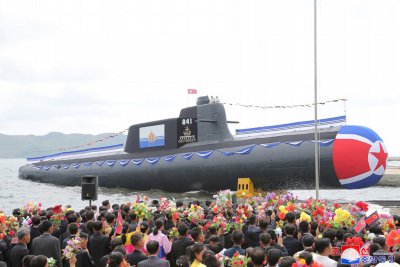
This image, released on September 8, 2023, by the North Korean Official News Service (KCNA), shows North Korean leader Kim Jong Un during the launch of the country’s first tactical nuclear attack submarine at Sinpho shipyard. According to state media, the tactical nuclear attack submarine, No. 841, the first of its kind, was transferred to the East Sea Fleet of the KPA Navy and named the “Hero Kim Kun Ok.” File Photo by KCNA/UPI | License Photo

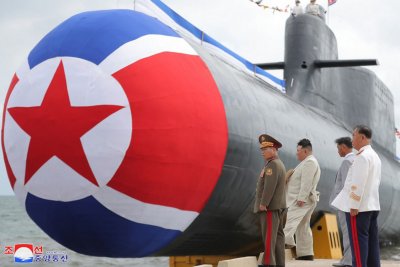
Dec. 25 (Asia Today) — North Korea’s Rodong Sinmun on Thursday showcased what it described as the construction site of an 8,700-ton “nuclear-powered strategic guided missile submarine,” calling it a “revolutionary change” in the country’s war deterrence capability.

Photos of the vessel suggest the exterior is close to completion and may already include a small reactor, which would be required for operations, analysts said. The conning tower also appeared to show what could be launch tubes for submarine-launched ballistic missiles, or SLBMs, similar in concept to North Korea’s existing 3,000-ton Kim Gun Ok submarine, the report said.

North Korea has pursued nuclear submarine development as a key defense goal since the ruling party’s 2021 congress, when it set out what it called five major tasks for strengthening national defense capabilities, Rodong Sinmun reported.

During the site visit, Kim Jong-un said North Korea had built a “nuclear shield” to safeguard national security and had secured the ability to expand it as much as necessary, according to the newspaper. He said the country would continue pursuing naval nuclear armament on both strategic and tactical levels.

Kim also said there would be no change in North Korea’s security policy and warned that if an adversary threatens what he called the country’s strategic sovereignty and security, it would “pay the price,” the report said.

The disclosure drew attention to whether North Korea can actually operate a nuclear-powered submarine of that size. The report noted questions about whether North Korea has mastered small reactor technology and large submarine construction even as it maintains uranium enrichment capabilities. It said some assessments link the possibility of technological support to North Korea’s closer ties with Russia since the Russia-Ukraine war, including speculation that North Korea could have acquired relevant technology from Russia.

The public rollout also comes as South Korea’s own debate over nuclear-powered submarines has gained momentum, and some analysts viewed North Korea’s disclosure as a show of force aimed at Seoul, the report said.

Cho Han-beom, a senior research fellow at the Korea Institute for National Unification, said the visible SLBM tubes on the conning tower indicate North Korea’s technology remains limited and suggested the disclosure may have been rushed in response to South Korea’s discussion. Yoo Yong-won, a People Power Party lawmaker, said the altered conning tower appears designed to accommodate as many as 10 SLBMs and resembles the Kim Gun Ok submarine, which he said has drawn criticism for its unusual shape.

Rodong Sinmun also reported on a congratulatory message that Russian President Vladimir Putin sent to Kim on Dec. 18, saying Putin praised North Korean troops’ “heroic participation” and highlighted expanded ties across politics, trade and the economy and other areas.

— Reported by Asia Today; translated by UPI

© Asia Today. Unauthorized reproduction or redistribution prohibited.

Source link

S. Korea sees N. Korea test new long-range air defense missile

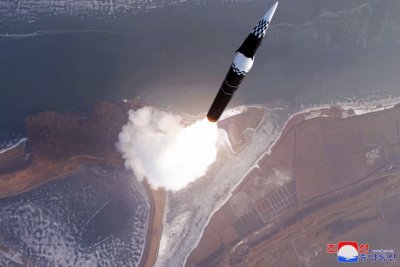
This image, released on January 7, 2025, by the North Korean Official News Service (KCNA), shows the test-fire of a new intermediate-range hypersonic ballistic missile on January 6. The launch, which was witnessed by North Korean leader Kim Jong Un, was meant to demonstrate that the country’s “hypersonic missile system will reliably contain any enemies in the Pacific region that can affect the security of our state.” File Photo by KCNA/UPI | License Photo

Dec. 25 (Asia Today) — North Korea said it conducted a first test launch of a high-altitude long-range surface-to-air missile system under development, but a South Korean defense expert said the launch appeared to be a flight test because no interception footage was released.

North Korea’s Korean Central News Agency said the Missile Bureau carried out the test Wednesday to evaluate the system’s tactical and technical characteristics. The agency said the missile hit and destroyed a simulated high-altitude target at a range of 200 kilometers.

The Missile Bureau said the test was part of routine work by the bureau and its research institutes to advance the country’s air defense capabilities. State media said Kim Jong-un observed the launch and praised the results.

The missile was first shown publicly at an event marking the 80th anniversary of North Korea’s air force last month, according to the report.

Shin Jong-woo, secretary general of the Korea Defense and Security Forum, said North Korea claimed it intercepted a simulated target but did not release footage of the intercept. He said that suggests the test focused on flight performance and reflects an effort to develop a new surface-to-air missile as North Korea’s SA-5 long-range system ages.

South Korea’s Joint Chiefs of Staff said it detected the launch Wednesday but did not disclose it publicly at the time.

The Joint Chiefs of Staff said it had detected indications of a launch in advance and was prepared. It said that around 5 p.m. Wednesday it detected multiple projectiles believed to be surface-to-air missiles launched from the Sondok area in South Hamgyong Province toward the East Sea.

The Joint Chiefs of Staff said it is closely monitoring North Korea’s activities under the South Korea-United States combined defense posture and remains ready to respond to any provocation.

— Reported by Asia Today; translated by UPI

© Asia Today. Unauthorized reproduction or redistribution prohibited.
Source link

S. Korea moves to rename North Korean defectors as migrants

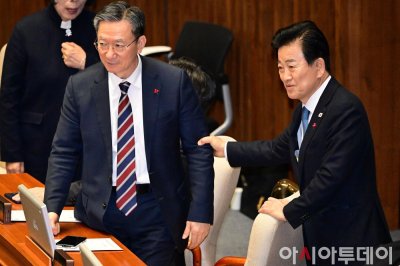
Justice Minister Chung Sung-ho and Unification Minister Chung Dong-young exchange greetings during a plenary session at the National Assembly on the 23rd. Photo by Asia Today

Dec. 23 (Asia Today) — South Korea’s Unification Ministry said Tuesday it will move quickly to decide and implement a change to the official term used for North Korean defectors, replacing it with “North Korean migrants.”

A Unification Ministry official told reporters the ministry plans to reach a conclusion and proceed “as soon as possible” on the terminology change.

The ministry previously said in a work briefing for President Lee Jae-myung on Friday that it would pursue revising the designation. During that briefing, Lee, Prime Minister Kim Min-seok and Unification Minister Chung Dong-young used the term “North Korean migrants” instead of “North Korean defectors,” according to the report.

Chung said at the meeting that defectors broadly reject the current term “defector,” but the report said a significant number are also voicing opposition to “North Korean migrants.”

The Unification Ministry publicly raised the idea of changing the designation in September and conducted opinion polling, but the results have not been released, the report said.

– Reported by Asia Today; translated by UPI

© Asia Today. Unauthorized reproduction or redistribution prohibited.

Source link

South Korea names top 100 R&D achievements, highlights K9 engine

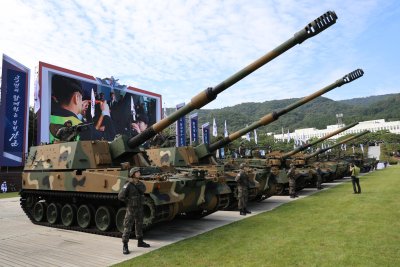
A K9 self-propelled howitzer is displayed during an Armed Forces Day media event in Gyeryong, South Korea, Sept. 29. File Photo by Yonhap News Agency

Dec. 22 (Asia Today) — South Korea’s science ministry said Monday it has selected its 2025 “Top 100 National R&D Achievements,” highlighting projects including a domestically produced 1,000-horsepower engine for the K9 self-propelled howitzer and a high-performance vanadium flow battery stack.

The Ministry of Science and ICT said the program marks its 20th year. Launched in 2006, the cross-government selection aims to raise public awareness of national research and development and recognize scientists and engineers.

The ministry said 970 candidate projects recommended by government bodies were reviewed by a selection committee of 105 experts from industry, academia and research institutes, followed by public verification. The final 100 were chosen across six categories: machinery and materials, life and marine, energy and environment, information and electronics, basic science and infrastructure and convergence.

Among the selections, STX Engine was cited for developing and commercializing a 1,000-horsepower engine for the K9, localizing a system and core components previously dependent on overseas imports. The ministry said the achievement helped address export approval hurdles and supported market expansion, including K9 exports to Egypt equipped with domestically produced engines.

In life sciences, IM Biologics was selected for work on treatments for autoimmune diseases including rheumatoid arthritis. The ministry said the company transferred related technology to U.S.-based Navigator Medicine and China’s Huadong Pharmaceutical in deals totaling 1.7 trillion won ($1.3 billion).

In energy and environment, H2 was cited for developing low-cost, high-power-density stack technology for vanadium flow batteries, a key component used in energy storage tied to solar and wind generation. The ministry said the technology contributed to South Korea’s first export of the stack technology to Germany.

Other selections included the Electronics and Telecommunications Research Institute’s demonstration of 6G wireless transmission technology and the Institute for Basic Science research group’s real-time observation of molecular ion formation and structural transitions, the ministry said.

The ministry said selected projects will receive certificates and plaques in the name of Deputy Prime Minister and Science and ICT Minister Bae Kyung-hoon. The ministry said projects and institutions may receive evaluation advantages under relevant rules and researchers may be recommended for national R&D awards.

Starting next year, the ministry said it will launch follow-up support aimed at boosting technology maturity and commercialization. Each selected project will be eligible for about 1.3 billion won (about $1.0 million) in support over three years, the ministry said.

Park In-gyu, head of the Science and Technology Innovation Headquarters, said the projects reflect sustained challenges and innovation by universities, research institutes and companies and pledged expanded support in coordination with other ministries.

– Reported by Asia Today; translated by UPI

© Asia Today. Unauthorized reproduction or redistribution prohibited.
Source link

South Korea seeks exemption as Canada tightens steel tariff-rate quotas

Dec. 21 (Asia Today) — South Korea’s industry ministry said Sunday it has raised concerns with Canada over strengthened tariff-rate quota measures on steel set to take effect Dec. 26 and asked Ottawa to consider steps including an exemption or expanded quota for South Korea.

A tariff-rate quota (TRQ) is a trade system under which a limited volume of steel imports can enter Canada at a lower or zero tariff, while shipments exceeding that quota face much higher duties. Under Canada’s revised measures, the amount of South Korean steel that can enter Canada at the lower tariff rate will be reduced, and shipments above that limit would face much higher tariffs.

The Ministry of Trade, Industry and Energy said Trade Negotiations Director General Yeo Han-gu met Canadian Minister of International Trade Maninder Sidhu and Canadian Deputy Minister of Foreign Affairs Ali Essassi in Toronto on Dec. 18 local time and conveyed the position of South Korean industry on the measures.

Canada plans to lower the TRQ utilization rate for free trade agreement partners including South Korea from 100% to 75% and for non-FTA countries from 50% to 20%, the ministry said. Imports exceeding the quota would face a 50% tariff and a new 25% tariff would be applied to certain steel derivative products, according to the ministry.

The ministry said Yeo traveled to Canada one week after a phone call with Sidhu on Dec. 11 to hold detailed discussions. It said he asked Canada to take favorable measures for South Korea, citing large-scale investments by South Korean companies in Canada including battery makers and cooperation potential in sectors such as steel, electric vehicles, batteries, energy and critical minerals.

Yeo also said some steel items, including pipelines used in Canada’s oilsands crude production, are difficult to produce domestically and are largely supplied through imports, including from South Korea. Tightening TRQ measures on South Korean steel could affect both South Korean exporters and Canadian industry, he said, according to the ministry.

The ministry said Yeo and Sidhu agreed to establish a new strategic sector dialogue channel between trade ministers under the Korea-Canada free trade agreement, which marks its 10th anniversary this year. They also agreed to set up a hotline for discussions on issues including steel, electric vehicles, batteries, energy and critical minerals, the ministry said.

Sidhu proposed using Canada’s duty drawback system, which the ministry said remains in operation through the end of January 2026 for certain steel items not produced domestically. The ministry said South Korea plans to continue consultations on steel TRQs through high-level and working-level channels.

The ministry said Yeo also met South Korean companies operating in the Toronto area in sectors including steel, autos, home appliances and minerals to hear concerns about trade uncertainty. It said he visited a battery plant backed by LG Energy Solution in Windsor on Dec. 19 and toured the facilities.

The ministry said Yeo later held a meeting in Detroit with South Korean auto parts companies and reviewed issues including Section 232 tariffs on automobiles, Mexico’s announced tariff increases on non-FTA countries and trends related to USMCA revisions. It said he also met potential foreign investors in the auto parts sector to discuss investment opportunities tied to South Korea’s smart factory and manufacturing AI capabilities.

Yeo said shifting trade conditions across the United States, Canada and Mexico pose challenges for South Korean firms operating locally, but also create opportunities tied to changes in North American supply chains, the ministry said.

– Reported by Asia Today; translated by UPI

© Asia Today. Unauthorized reproduction or redistribution prohibited.

Source link

President Lee says North Korea hostility reflects Seoul’s approach

South Korean President Lee Jae Myung delivers a speech during a ceremony to mark the 77th Armed Forces Day in Gyeryong, South Korea, 01 October 2025. File Photo by KIM HONG-JI /EPA

Dec. 19 (Asia Today) — President Lee Jae-myung said Friday that while North Korea’s “hostile two-state” line may reflect current realities, South Korea must “return to our proper place” and work to restore channels for contact, dialogue and cooperation.

Speaking at a joint work report by the Foreign Ministry and the Unification Ministry at the Government Complex Seoul, Lee pointed to what he described as an unprecedented buildup along the inter-Korean boundary.

“For the first time since the 1950s war, North Korea has erected triple fences along the entire demarcation line, severed bridges, cut off roads and built retaining walls,” Lee said. He added that North Korea may have acted out of concern that the South could invade, but said it was regrettable and appeared tied to “strategic desires.”

Lee said the moves could be part of Pyongyang’s strategy, but argued South Korea must respond with patience and sustained effort to improve what he described as a situation in which the North “fundamentally refuses contact itself.”

“As I’ve said before, we must find even the smallest opening,” Lee said. “We need to communicate, engage in dialogue, cooperate and pursue a path of coexistence and mutual prosperity between the North and South.”

He said there is currently “not even a needle’s eye of an opening,” repeating that the situation is “truly not easy.”

Lee also appeared to criticize the previous administration’s approach to North Korea, saying “one could call it a kind of karma.” He added that if a strategy contributed to the current impasse, “then we must change it now.”

Lee said the government should make proactive efforts to ease tensions and create conditions for trust to emerge, adding that the Unification Ministry should now take a leading role.

“It is certainly not an easy task, but it is equally clear that it is not something we should give up on,” he said.

– Reported by Asia Today; translated by UPI

© Asia Today. Unauthorized reproduction or redistribution prohibited.
Source link

North Korea increasingly uses Kim’s Workers’ Party title, report says

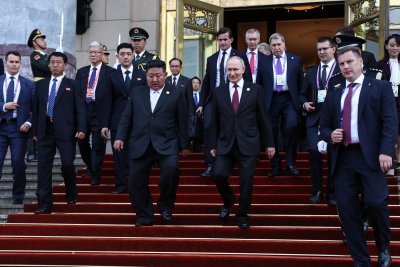
Russia’s President Vladimir Putin (center R) and North Korea’s leader Kim Jong Un (center L) leave after their meeting in Beijing, China, on Wednesday, September 3, 2025. File Photo by Kremlin Press Office/UPI | License Photo

Dec. 18 (Asia Today) — North Korean media increasingly refer to Kim Jong Un as general secretary of the ruling Workers’ Party rather than chairman of the State Affairs Commission, a shift a South Korean government-affiliated research report said reflects a further consolidation of party-centered rule.

The National Institute for Strategic Studies said in a report released Thursday that the 8th Central Committee, which has functioned as North Korea’s main decision-making body over the past five years, has reinforced a governance model centered on the Workers’ Party as the country prepares for its 9th Party Congress, expected in early 2026.

Senior research fellow Kim In-tae wrote that the committee’s efforts to regularize and institutionalize party leadership organs resemble Kim Il Sung-era governance from the 1960s through the 1980s. He said the policy decision-making structure shows a more pronounced concentration of the “single-leader system,” according to the report.

Kim said the increased use of the Workers’ Party title suggests the regime has further strengthened party-centered state management.

The report said the 8th Central Committee, launched in 2021, held 13 plenary meetings at an average interval of about 4.6 months, more than double the number held under the 7th Central Committee, which convened six plenary meetings.

It also said the volume of agenda items submitted for discussion rose sharply, from 14 items during the 7th term to 68 items during the 8th term.

The report contrasted Kim Jong Il’s “military-first” approach under the National Defense Commission during the economic crisis known as the “Arduous March” in the 1990s and 2000s with Kim Jong Un’s return to a Workers’ Party-centered governance structure, which it said has been further refined.

On the second five-year plan for national economic development expected to be presented at the next party congress, the report projected it would be framed as a stage of “qualitative development” aimed at advancing what it called “comprehensive socialist development” across the economy.

The report said the period leading up to a party congress, typically held every five years, is a crucial political season in North Korea’s system. It said Kim is likely to use the congress to reinforce his leadership structure while pursuing economic development goals, nuclear-centered military capabilities and international standing.

– Reported by Asia Today; translated by UPI

© Asia Today. Unauthorized reproduction or redistribution prohibited.

Source link

S. Korea calls for China’s role in fostering conditions to resume talks with N. Korea

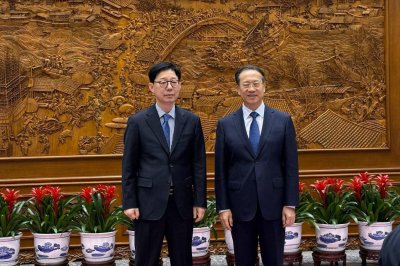
First Vice Foreign Minister Park Yoon-joo (L) poses with Chinese Executive Vice Foreign Minister Ma Zhaoxu during their strategic dialogue in Beijing on Thursday. South Korea called for China to play a role in resuming dialogue with North Korea. Photo courtesy of South Korea Foreign Ministry

South Korea on Thursday called on China to play a role in fostering conditions to resume dialogue with North Korea, with China reaffirming its commitment to ensuring stability on the Korean Peninsula, Seoul’s foreign ministry said.

First Vice Foreign Minister Park Yoon-joo made the call when he met with Ma Zhaoxu, China’s executive vice foreign minister, during the bilateral strategic dialogue in Beijing, the ministry said in a release.

The talks came as South Korea seeks to stably manage its ties with China, its largest trade partner and key economic benefactor of North Korea, amid the strategic rivalry between China and the United States, and Seoul’s drive to mend ties with Pyongyang.

“Vice Minister Park explained the government’s policy direction for peace and stability on the Korean Peninsula, and asked for China’s role in fostering conditions to resume dialogue with North Korea,” the ministry said in a release.

Ma reaffirmed that China will “continue its constructive role in ensuring peace and stability on the Korean Peninsula,” according to the ministry.

They also agreed to work together to enhance “political and friendly” mutual trust, continuing the positive momentum in bilateral relations to further develop their ties.

It marked the first such talks since the launch of the Lee Jae Myung government in June.

The two sides exchanged opinions on issues of mutual concern, including China’s steel structures built in the overlapping sea zone in the Yellow Sea. The steel towers have raised speculation that China has installed them to lay territorial claims to the area, as was done in the South China Sea.

Noting that bilateral relations have recovered with the recent summit talks between President Lee Jae Myung and Chinese President Xi Jinping in Gyeongju, they agreed to implement follow-up steps in a substantive manner, through robust exchanges both at the government and private sector levels.

They also discussed ways to revitalize cultural exchanges between the two countries in a way that will “narrow the emotional distance between their peoples,” the ministry said.

Although China has never officially confirmed it, it has restricted the inflow of Korean cultural content and exchanges between relevant industries, including K-pop concerts and Korean films.

Copyright (c) Yonhap News Agency prohibits its content from being redistributed or reprinted without consent, and forbids the content from being learned and used by artificial intelligence systems.

Source link

UNC objects to South Korea bill on civilian DMZ access

SEOUL, Dec. 17 (UPI) — The United Nations Command objected to a legislative effort in South Korea that would transfer authority over non-military access to the Demilitarized Zone from the UNC to Seoul, as debate grows over control of one of the world’s most sensitive border areas.

The UNC’s rare public statement follows renewed calls by Unification Minister Chung Dong-young and ruling party lawmakers for a bill that would allow the South Korean government to approve civilian entry into the DMZ without prior UNC authorization.

In a press release issued Tuesday, the U.S.-led UNC reiterated its authority to implement and enforce the 1953 Korean Armistice Agreement, including control over access to the DMZ.

“Since 1953, UNC has been the successful administrator of the Demilitarized Zone, a role that has been essential in maintaining stability, especially amid periods of heightened inter-Korean tensions,” it said.

Citing provisions that assign “civil administration and relief” within the zone to the UNC commander and grant the UNC Military Armistice Commission exclusive jurisdiction over entry approvals, the command stressed that no person, military or civilian, may enter the DMZ without specific authorization.

“Civil administration and relief in that part of the Demilitarized Zone which is south of the Military Demarcation Line shall be the responsibility of the Commander-in-Chief, United Nations Command,” the statement said.

The release added that the UNCMAC reviews access requests under established procedures designed to avoid actions that could be perceived as provocative or that could endanger safety.

The issue resurfaced earlier this month after Chung publicly backed legislation that would allow South Korea to grant access for “peaceful use” without UNC approval, arguing that current restrictions undermine Seoul’s sovereignty and the civilian use of the DMZ.

Chung cited recent cases in which Deputy National Security Adviser Kim Hyun-jong and Cardinal Lazzaro You Heung-sik were denied access to the buffer zone.

Seoul’s defense and foreign ministries have expressed reservations about the proposal, however, warning that separating civilian access from UNC procedures could complicate armistice maintenance and military coordination.

The UNC statement noted that the South Korean military already carries out “critical tasks such as policing, infrastructure support, medical evacuation [and] safety inspections,” highlighting what it described as Seoul’s sovereignty and primary role in its own defense.

In a follow-up release Wednesday, the UNC said it had granted Kim access to the DMZ for a briefing on North Korean military activities and South Korea’s response measures, as well as discussions on preventing accidental clashes.

“UNC is committed to maintaining peace and stability on the Korean Peninsula and actively supports measures that reduce the risk of miscalculation between military forces near the Military Demarcation Line,” it said.

Source link

South Korea ruling party leader calls for second special probe

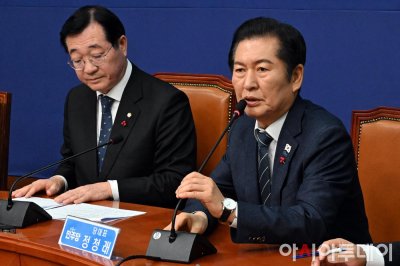
Jeong Cheong-rae, leader of the Democratic Party, speaks during the party’s fourth Central Committee meeting at the National Assembly in Seoul on Dec. 15. Photo by Asia Today

Dec. 15 (Asia Today) — Democratic Party leader Jeong Cheong-rae, whose party holds the presidency, on Monday called for a second, wide-ranging special investigation into an alleged insurrection case, raising questions about Supreme Court Chief Justice Cho Hee-dae after courts rejected arrest warrants for several figures tied to the probe.

Jeong made the remarks at a party Supreme Council meeting at the National Assembly in Seoul, as the mandate of a special prosecutor was set to end. He said the special prosecutor made progress byre-arresting former President Yoon Suk-yeol and referring 24 people to trial, but argued the investigation was constrained by court decisions, including warrant denials.

Jeong said the rejection of warrants for figures such as Choo Kyung-ho was “difficult to accept,” and claimed it fueled suspicions that the judiciary was blocking steps that could lead to broader legal consequences for the People Power Party. He also said the circumstances raised questions about whether Chief Justice Cho may have been involved, citing a meeting on Dec. 3, the day martial law was declared.

Jeong said the Democratic Party would work with the government and presidential office to push for what he called a “second comprehensive special investigation,” and urged a tougher approach without leniency. He said a follow-up probe should also examine allegations involving first lady Kim Keon-hee and issues the current special prosecutor did not fully resolve.

He additionally questioned court case assignment procedures, citing media reports that the treason-related trial was assigned through unusual in-person discussions rather than random distribution. He said the party would pursue legislation to create a specialized court for sedition-related cases.

Jeong also criticized the People Power Party’s use of filibusters, including on bills he said were bipartisan or originally proposed by the party, and said the Democratic Party would seek revisions to parliamentary rules governing the tactic. He offered condolences to victims of a collapse at a construction site at the Gwangju Central Library and called fora thorough investigation.

– Reported by Asia Today; translated by UPI

© Asia Today. Unauthorized reproduction or redistribution prohibited.
Source link

South Korea PPP floor leader Song Eon-seok Urges Special Prosecutor

1 of 3 | People Power Party floor leader Song Eon-seok holds a press briefing on current issues at the National Assembly on the 14th./Reporter Song Ui-joo

Dec. 15 (Asia Today) — Song Eon-seok, floor leader of South Korea’s ruling People Power Party, called Sunday for appointing a special prosecutor to investigate allegations that political figures received money and gifts linked to the Unification Church, while also urging a separate probe into special prosecutor Min Jung-ki over claims of politically biased investigations.

Speaking at a press briefing at the National Assembly, Song said a special prosecutor was needed “to restore judicial justice” and argued that Min’s team should fully examine allegations involving Unification Church-related political funds, including claims tied to the opposition Democratic Party that he said have not been adequately addressed.

Song criticized Min’s investigation as politically motivated, accusing the special prosecutor of abandoning neutrality and fairness and operating as a tool for retaliation against the opposition. He said the special prosecutor’s office should be disbanded and investigated.

On the scope of any Unification Church-related probe, Song said investigators should not draw distinctions between ruling and opposition parties.

Asked whether allegations involving People Power Party figures should also be covered, Song said any individual accused of receiving money or valuables from the Unification Church should be investigated regardless of party affiliation.

Song also suggested the ruling party could coordinate with the minor Reform Party on advancing the special prosecutor proposal, saying cooperation was possible with any political force that shares its vision. He added the People Power Party plans to discuss the issue after Reform Party floor leader Cheon Ha-ram returns to South Korea.

– Reported by Asia Today; translated by UPI

© Asia Today. Unauthorized reproduction or redistribution prohibited.

Source link