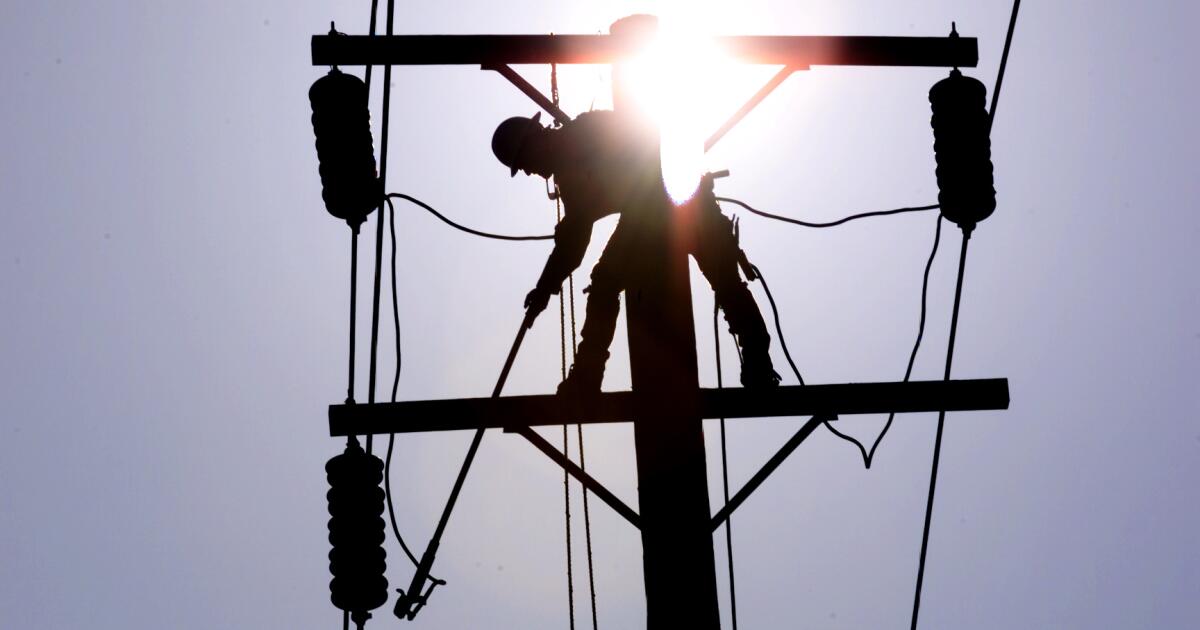
Despite complaints from customers about rising electric bills, the California Public Utilities Commission voted 4 to 1 on Thursday to keep profits at Southern California Edison and the state’s other big investor-owned utilities at a level that consumer groups say has long been inflated.
The commission vote will slightly decrease the profit margins of Edison and three other big utilities beginning next year. Edison’s rate will fall to 10.03% from 10.3%.
Customers will see little impact in their bills from the decision. Because the utilities are continuing to spend more on wires and other infrastructure — capital costs that they earn profit on — that portion of customer bills is expected to continue to rise.
The vote angered consumer groups that had detailed in filings and hearings at the commission how the utilities’ return on equity — which sets the profit rate that the companies’ shareholders receive — had long been too high.
Among those testifying on behalf of consumers was Mark Ellis, the former chief economist for Sempra, the parent company of San Diego Gas & Electric and Southern California Gas. Ellis estimated that the companies’ profit margin should be closer to 6%.
He argued in a filing that the California commission had for years authorized the utilities to earn an excessive return on equity, resulting in an “unnecessary and unearned wealth transfer” from customers to the companies.
Cutting the return on equity to a little more than 6% would give Edison, Pacific Gas & Electric, SDG&E and SoCalGas a fair return, Ellis said, while saving their customers $6.1 billion a year.
The four commissioners who voted to keep the return on equity at about 10% — the percentage varies slightly for each company — said they believed they had found a balance between the 11% or higher rate that the four utilities had requested and the affordability concerns of utility customers.
Alice Reynolds, the commission’s president, said before the vote that she believed the decision “accurately reflects the evidence.”
Commissioner Darcie Houck disagreed and voted against the proposal. In her remarks, she detailed how California ratepayers were struggling to pay their bills.
“We have a duty to consider the consumer interest in determining what is a just and reasonable rate,” she said.
Consumer groups criticized the commission’s vote.
“For too long, utility companies have been extracting unreasonable profits from Californians just trying to heat or cool their homes or keep the lights on,” said Jenn Engstrom at CALPIRG. “As long as CPUC allows such lofty rates of return, it incentivizes power companies to overspend, increasing energy bills for everyone.”
California now has the nation’s second-highest electric rates after Hawaii.
Edison’s electric rates have risen by more than 40% in the last three years, according to a November analysis by the commission’s Public Advocates Office. More than 830,000 Edison customers are behind in paying their electric bills, the office said, each owing a balance of $835 on average.
The commission’s vote Thursday was in response to a March request from Edison and the three other big for-profit utilities. The companies pointed to the January wildfires in Los Angeles County, saying they needed to provide their shareholders with more profit to get them to continue to invest in their stock because of the threat of utility-caused fires in California.
In its filing, Edison asked for a return on equity of 11.75%, saying that it faced “elevated business risks,” including “the risk of extreme wildfires.”
The company told the commission that its stock had declined after the Jan. 7 Eaton fire and it needed the higher return on equity to attract investors to provide it with money for “wildfire mitigation and supporting California’s clean energy transition.”
Edison is facing hundreds of lawsuits filed by victims of the fire, which killed 19 people and destroyed thousands of homes in Altadena. The company has said the fire may have been sparked by its 100-year-old transmission line in Eaton Canyon, which it kept in place even though it hadn’t served customers since 1971.
Return on equity is crucial for utilities because it determines how much they and their shareholders earn each year on the electric lines, substations, pipelines and the rest of the system they build to serve customers.
Under the state’s system for setting electric rates, investors provide part of the money needed to build the infrastructure and then earn an annual return on that investment over the assets’ life, which can be 30 or 40 years.
In a January report, state legislative analyst Gabriel Petek detailed how electric rates at Edison and the state’s two other biggest investor-owned electric utilities were more than 60% higher than those charged by public utilities such as the Los Angeles Department of Water and Power. The public utilities don’t have investors or charge customers extra for profit.
Before the vote, dozens of utility customers from across the state wrote to the commission’s five members, who were appointed by Gov. Gavin Newsom, asking them to lower the utilities’ return on equity.
“A profit margin of 10% on infrastructure improvements is far too high and will only continue to increase the cost of living in California,” wrote James Ward, a Rancho Santa Margarita resident. “I just wish I could get a guaranteed profit margin of 10% on my investments.”
STATESVILLE, N.C. — A business jet crashed Thursday while trying to return to a North Carolina airport shortly after takeoff, killing all seven people aboard, including retired NASCAR driver Greg Biffle and his family, authorities said.
The Cessna C550 erupted into a large fire when it hit the ground. It had departed Statesville Regional Airport, about 45 miles north of Charlotte, but soon crashed while trying to return and land, the North Carolina State Highway Patrol said.
Flight records show the plane was registered to a company run by Biffle. The cause of the crash wasn’t immediately known, nor was the reason for the plane’s return to the airport in drizzle and cloudy conditions.
Biffle was on the plane with his wife, Cristina, and children Ryder, 5, and Emma, 14, according to the highway patrol and a family statement. Others on the plane were identified as Dennis Dutton, his son Jack, and Craig Wadsworth.
“Each of them meant everything to us, and their absence leaves an immeasurable void in our lives,” the joint family statement said.
Biffle, 55, won more than 50 races across NASCAR’s three circuits, including 19 at the Cup Series level. He also won the Trucks Series championship in 2000 and the Xfinity Series title in 2002.
NASCAR said it was devastated by the news.
“Greg was more than a champion driver; he was a beloved member of the NASCAR community, a fierce competitor, and a friend to so many,” NASCAR said. “His passion for racing, his integrity, and his commitment to fans and fellow competitors alike made a lasting impact on the sport.”
The plane, bound for Florida, took off from the Statesville airport shortly after 10 a.m., according to tracking data posted by FlightAware.com.
Golfers playing next to the airport were shocked as they witnessed the disaster, even dropping to the ground at the Lakewood Golf Club while the plane was overhead. The ninth hole was covered with debris.
“We were like, ‘Oh my gosh! That’s way too low,’” said Joshua Green of Mooresville. “It was scary.”
The National Transportation Safety Board and the Federal Aviation Administration were investigating.
The Cessna plane, built in 1981, is a popular mid-sized business jet with an excellent reputation, aviation safety expert Jeff Guzzetti said. It has two engines and typically seats six to eight passengers.
In 2024, Biffle was honored for his humanitarian efforts after Hurricane Helene struck the U.S., even using his personal helicopter to deliver aid to flooded, remote western North Carolina.
“The last time I spoke with Cristina, just a couple of weeks ago, she reached out to ask how she could help with relief efforts in Jamaica. That’s who the Biffles were,” U.S. Rep. Richard Hudson, a Republican from North Carolina, said.
Wadsworth was Biffle’s friend and helped him with odd jobs, including delivering supplies to places hit by Hurricane Helene, roommate Benito Howell said.
“He didn’t know how to say no,” Howell said of Wadsworth, who had worked for several NASCAR teams. “He loved everybody. He always tried to help everybody.”
The joint family statement also spoke about Dutton and his son Jack, saying they were “deeply loved as well, and their loss is felt by all who knew them.”
With 2025 almost over, there have been 1,331 U.S. crashes this year investigated by the NTSB, from two-seat planes to commercial aircraft, compared to a total of 1,482 in 2024.
Major air disasters around the world in 2025 include the plane-helicopter collision that killed 67 in Washington, the Air India crash that killed 260 in India, and a crash in Russia’s Far East that claimed 48 lives. Fourteen people, including 11 on the ground, died in a UPS cargo plane crash in Kentucky.
A pair of blue and yellow earplugs dangle on Jose’s neck while waiting for work as a day laborer out of the Home Depot in Cypress Park.
They’ve been a necessity for laborers in the area since late November, when Home Depot installed three machines in the parking lot that emit a high-pitched tone. The noise, typically kept on all day, is a piercing sound that “penetrates your bones,” he said.
The Instituto de Educacion Popular del Sur de California (IDEPSCA), a nonprofit that supports day laborers, held a press conference at Home Depot Wednesday, calling for the company remove the machines and vocalize opposition to the ICE raids taking place in its parking lots, part of a growing number of protests targeting corporate cooperation with immigration enforcement.
Home Depot locations nationwide have been a prime target for ICE raids under President Donald Trump’s immigration crackdown. In early November, ICE agents detained a man at the Cypress Park location and then drove off with his toddler in the back of the vehicle.
Around 50 people have been detained at the Cypress Park location this year, said Maegan Ortiz, IDEPSCA’s executive director. The machines are an attempt to push day laborers off its lots, she said.
The machines were turned off by the company during the press conference, but were turned back on about an hour after it ended, according to workers. The noise is in earshot of the IDEPSCA’s day laborer center, one of five operated by the organization that have supported workers for over two decades.
“We have been here and remain open through global pandemics, providing services and creating community,” Ortiz said. “We’re not going to let sound machines, gates and intimidation get rid of us. Day laborers are here to stay. IDEPSCA is here to stay. The immigrant community is here to stay.”
Evelyn Fornes, a spokesperson for Home Depot, wrote to The Times that the company “has several initiatives we use to keep our stores safe, including human and technology resources.” The company did not address questions on why or when the machines were installed.
George Lane, a company spokesperson, previously told The Times that the company doesn’t coordinate with ICE or Border Patrol.
“We’re not involved in the operations. We aren’t notified that immigration enforcement activities are going to happen, and often, we don’t know operations have taken place until they’re over,” Lane wrote.
Jose’s earplugs, which IDEPSCA provided to workers, help muffle the sound, but aren’t enough to completely mask it, he said. The noise causes workers headaches, nausea and dizziness, said Jose and Andres Salazar, the center’s site coordinator.
Salazar said the noise often follows him home, still ringing in his ears long after he’s left the parking lot.
The machines were installed only days after the latest raid at the location in late November, during which day laborers were taken and IDEPSCA staff members were harmed, Ortiz said.
The machines were installed on light posts in the parking lot situated directly under the 5 freeway overpass. Hernandez and Ortiz said that portion of the parking lot is Caltrans property and not owned by Home Depot. They urged the city to look into the machine’s installations.
Home Depot also installed yellow barriers that close off access to the parking lot near IDEPSCA’s day labor center, located at the corner of the Cypress Park location.
The machines are “a deliberate choice by a multi billion dollar corporation that absolutely knew what it was doing and chose to weaponize sound literally,” said Councilwoman Eunisses Hernandez, who represents the city’s first district. “Devices like these are used as torture against our people.”
Home Depot relies on immigrant and Latino communities, Hernandez said, including customers who shop inside and day laborers, who seek work outside their storefronts.
The day laborer center is more than just a workplace, said Jose, who asked to withhold his last name for fear of retaliation by immigration agents. For many day laborers, it’s a second home, and for some, their only one. The center is bursting with greenery – plants that are cared for by the workers themselves.
“This space is something truly beautiful,” Jose said. “But, everything they’re doing with the noise and the barriers, it is affecting us…We’re here to help serve the community, not steal from the company.”
The noise is an added another layer of stress to day laborers, who are already struggling with less work opportunities and navigating lingering trauma from ICE raids. Jose was at the Home Depot when the last raid took place, only days before the company implemented the noise machines.
He watched in horror as coworkers were taken and volunteers were beaten.
“It made me angry, but I felt so impotent because, well, what do I do?” Jose said. “If I start fighting them, they’re going to knock me down, they’re going to take me.”
Southern California Edison did not spend hundreds of millions of dollars on maintenance of its aging transmission lines that it told regulators was necessary and began billing to customers in the four years before the Jan. 7 wildfires, according to a Times review of regulatory filings.
Edison told state regulators in its 2023 wildfire prevention plan that it believed its giant, high-voltage transmission lines, which carry bulk power across its territory, “generally have a lower risk of ignition” than its smaller distribution wires, which deliver power to neighborhoods.
After two of the most destructive fires in the state’s history, The Times takes a critical look at the past year and the steps taken — or not taken — to prevent this from happening again in all future fires.
While it spent heavily in recent years to reduce the risk that its smaller lines would ignite fires, Edison fell behind on work and inspections it told regulators it planned on its transmission system, where some structures were a century old, according to documents.
Edison’s transmission lines are now suspected of igniting two wildfires in Los Angeles County on the night of Jan. 7, including the devastating Eaton fire, which killed 19 people and destroyed more than 9,000 homes and other structures in Altadena.
Twenty miles away, in the San Fernando Valley, terrified Sylmar residents watched a fire that night burning under the same transmission tower where the deadly Saddleridge fire ignited six years before. Firefighters put out that Jan. 7 blaze, known as the Hurst fire, before it destroyed homes.
Roberto Delgado said the 2019 Saddleridge fire started at this powerline in the hillside behind his Sylmar house. He said the January 7 Hurst began with sparks at this and another nearby powerline. Photographed in Sylmar, CA on Wednesday, Aug. 20, 2025.
(Myung J. Chun/Los Angeles Times)
After the fires, Edison changed course, and began spending more on its transmission lines, according to executives’ recent comments and state regulatory documents.
The utility began installing more grounding devices on its old transmission lines no longer in service, like the one suspected of igniting the Eaton fire. The company says it believes the idle line, last used 50 years ago, may have momentarily reenergized from a surge in electricity on the live lines running parallel to it, sparking the blaze. The official investigation hasn’t been released.
Transmission work Edison failed to perform
Here are examples of work that Edison told regulators was needed and that it was authorized to charge to customers but did not perform. The amounts are for the four years before the Jan. 7 wildfires.
Transmission maintenance $38.5 million Transmission capital maintenance $155 million Fixing illegally sagging lines $270 million Substation transformer replacement $136 million Pole loading replacement $88 million* Transmission line patrols $9.2 million Intrusive pole inspections $1.4 million
Source: Edison’s “Risk Spending Accountability Report” filed in April 2025 *Edison said customers weren’t charged
The added devices give unexpected power on the old lines more places to dissipate into the earth.
A helicopter transports workers during the process of removing Southern California Edison’s tower 208, which is suspected of causing the Eaton Fire, on Monday, May 5, 2025, in Pasadena, Calif.
(William Liang/For The Times)
Edison also began replacing some aging equipment. Sylmar residents said they saw workers in trucks and helicopters replacing hardware on the transmission line where they had watched early flames of both the Hurst fire and the 2019 Saddleridge blaze.
“Not until this year did we see repairs,” said Roberto Delgado, a Sylmar resident who can see Edison’s transmission towers from his home. “Obviously the maintenance in the past was inadequate.”
Jill Anderson, the utility’s chief operating officer, told regulators at an August meeting that the company replaced components prone to failure on a certain transmission line after Jan. 7. Edison later confirmed she was referring to equipment on the line running through Sylmar.
In interviews, Edison executives disputed that maintenance on the company’s transmission lines suffered before Jan. 7.
A helicopter transports workers during the process of removing Southern California Edison’s tower 208, which is suspected of causing the Eaton Fire, on Monday, May 5, 2025, in Pasadena, Calif.
(William Liang/For The Times)
“I do not think that our inspections and maintenance in the years leading up to 2025 were at depressed levels,” said Russell Archer, a top Edison regulatory lawyer.
Scott Johnson, an Edison spokesman, said: “The 13,500 people at Southern California Edison show up every day committed to the safety of the communities where we live and work. There is no higher value than safety here.”
Johnson said the utility prioritized safety both before and after the fire. For example, he said, the company increased aerial and ground inspections of transmission lines in areas at high fire risk in 2022 — and kept them at that higher level in subsequent years.
Among the company’s increased spending this year was an expensive upgrade to a transmission line that the state’s grid operator said was required to more safely shut down five critical transmission lines in L.A. County including those running through Sylmar and Eaton Canyon. That work was expected to be finished by 2023 but was still in progress on Jan. 7.
Edison didn’t preventively shut down the lines in Eaton Canyon or Sylmar on Jan. 7, but said the delayed upgrade had nothing to do with that decision. The company said the wind that night combined with other factors didn’t meet its protocol at the time for the lines to be turned off.
Some proposed maintenance changes will take years.
Work crew dismantles a section of Southern California Edison’s tower 208 which will be removed for further examination on Wednesday, May 7, 2025. The idle transmission tower is suspected of sparking the Eaton fire.
(Myung J. Chun/Los Angeles Times)
For example, executives recently told regulators that next year they may begin determining whether some of its 355 miles of idle transmission lines in areas at high-risk of wildfire should be removed for safety reasons. The company said 305 miles of those dormant lines run parallel to energized lines, like the one in Eaton Canyon.
Regulators at the state Office of Energy Infrastructure Safety asked Edison this summer if any of those lines posed a risk of induction, where they become energized from nearby electrified lines. Edison told them it “has not done a line by line analysis.”
Pedro Pizarro, chief executive of Edison International, the utility’s parent company, acknowledged in a November interview that the company made changes after the fires, including by replacing a steel part called the y-clevis, which was found to have failed in the minutes before the 2019 Saddleridge fire.
“We saw some concerns with that so we accelerated a program to replace them,” he said.
Pizarro said he continued to back the company’s statements before Jan. 7 that it had decreased the risk that its lines would spark a wildfire by as much as 90% since 2018, including by spending billions of dollars for prevention work on its smaller distribution lines.
He called the Eaton fire “a black swan event” — one of “low probability, but high consequence.”
Aging equipment
About 13,000 miles of transmission lines carry bulk power through Edison’s territory. In comparison, it has nearly 70,000 miles of the smaller distribution lines, delivering power to homes.
Because the high-voltage transmission lines are interconnected, utilities must keep the system balanced, trying to prevent sudden increases or decreases in power. An abrupt jump in electricity flowing on one transmission line can cause surges and problems miles away.
In 2023, Edison said in a filing to the state Public Utilities Commission that the average age of its infrastructure was increasing as it replaced equipment less frequently than in previous times.
More than 90% of its transmission towers are at least 30 years old — the age when the first signs of corrosion appear, it said in a filing. Some transmission lines and pylons are nearing 100 years of service and have never had major overhauls, the company said.
Edison said it began looking for corroded transmission towers in 2020, but found so many that it temporarily stopped those evaluations in 2022 to focus on fixing those found unsafe.
In 2021, the commission’s Public Advocates Office warned that Edison wasn’t completing maintenance and upgrades that the utility said was “critical and necessary” and was authorized to bill to customers.
Edison had been under-spending on that work since 2018, staff at the Public Advocates Office wrote. They urged regulators to investigate, saying that “risks to the public are not addressed” and customers may be owed a refund.
That shortfall in spending continued through 2024.
According to a report Edison filed in April, the company did not spend hundreds of millions of dollars on transmission system work that regulators had authorized from 2021 to 2024.
Among the shortfalls was $270 million to fix thousands of deficiencies found more than a decade ago where its transmission lines hang too close to the ground, the report said. Also unspent was $38.5 million authorized for transmission operating maintenance and an additional $155 million for capital maintenance.
Edison planned to perform 57,440 detailed inspections of its transmission poles in those four years, the report said, but performed only 27,941, citing other priorities.
Edison said its inspection numbers still met state regulatory requirements.
A helicopter flies over the downtown Los Angeles skyline during a cloudy day on Monday, May 5, 2025, in Pasadena, Calif.
(William Liang/For The Times)
The utility also replaced 38% fewer substation transformers than it said it would. And while it was authorized to replace 14,280 transmission poles it restored just 10,031, the report stated.
Archer said some uncompleted work was for an inspection program using drones in areas at lower risk of fire. Instead the company focused those aerial inspections in high-risk areas, he said.
He said some shortfalls were for upgrade projects that were delayed for reasons beyond the company’s control.
Utilities are allowed to pass on the costs of approved maintenance projects to customers in the monthly rates they charge. State regulators also give them some flexibility to decide whether to spend the money on approved projects, or something else.
Archer said that most of the unspent money involved capital expenses like purchases of new transmission towers and upgrade projects. Once regulators authorize a capital project, he said, customers begin paying a small portion of the cost annually over the assets’ expected life, which is often decades. If the project is not completed, those annual payments stop, he said, adding that state regulations don’t allow Edison to issue refunds for most unspent funds.
Transmission lines known to spark deadly fires
Before Jan. 7, Edison told regulators in its wildfire mitigation plan that it had focused its prevention efforts on its smaller distribution system. It said transmission lines posed a lower threat because they were taller and had wires more widely spaced.
Yet the deadliest wildfire in state history was caused when equipment on a century-old Pacific Gas & Electric transmission tower failed. The 2018 Camp fire killed 85 people and destroyed most of the town of Paradise.
A year later, the Kincade fire in Sonoma County ignited when a steel part on a PG&E transmission line broke. Like Edison’s line in Eaton Canyon, that transmission cable was no longer serving customers.
Edison is now facing hundreds of lawsuits claiming it was negligent in maintaining its transmission lines in Eaton Canyon and for leaving the old unused line in place — allegations the company denies.
At 6:11 pm on Jan. 7, Edison recorded a fault — a sudden change in electricity flow — on a transmission line running from La Cañada Flintridge to Eagle Rock, according to its report to regulators.
Faults can be caused by lines slapping together, a piece of equipment breaking or other reasons. Edison said it did not know the cause.
The fault caused a momentary surge in current on the four live lines running through Eaton Canyon, the company said, which may have energized the idle line.
Investigators view the Edison electrical lines, transmission towers and surrounding area, which is a location that is being investigated as the possible origin of the Eaton fire in Eaton Canyon in Altadena Tuesday, Feb. 11, 2025.
(Allen J. Schaben/Los Angeles Times)
State regulations require utilities to remove old lines no longer in service. Edison says that even though it hasn’t used the line in decades it sees a need for it in the future.
Edison’s transmission manual dated December 20, 2024 states that it inspects idle lines every three years, while active ones are inspected annually.
Executives said they went beyond the manual’s requirements, inspecting the idle line in Eaton Canyon annually in the years before the fire.
Edison declined to provide records of those inspections.
Sylmar line suspected of two wildfires
Edison says it believes its transmission line running through the foothills above Sylmar was involved in the ignition of the Jan. 7 Hurst fire. But it denies the line ignited the 2019 Saddleridge fire.
The 2019 fire killed at least one and destroyed or damaged more than 100 homes and other structures.
This year, lawyers for victims of the 2019 fire argued in court the two fires started in the same way: steel equipment holding up the transmission lines broke, causing a sudden, massive surge in energy that triggered sparks and flames at two or more towers located miles away.
The lawyers say the line, constructed in 1970, is not properly grounded so that sudden increases in energy don’t disperse into the soil — a problem they say the company failed to fix.
Edison denies the claims, calling their description of the fire’s start an “exotic ignition theory…contrary to accepted scientific principles.”
A judge recently denied Edison’s request to dismiss the case.
A coalition of Eaton fire survivors and community groups called on Southern California Edison on Tuesday to provide immediate housing assistance to the thousands of people who lost their homes in the Jan. 7 wildfire.
The coalition says an increasing number of Altadena residents are running out of insurance coverage that had been paying for their housing since they were displaced by the fire. Thousands of other residents had no insurance.
“When a company’s fire destroys or contaminates homes, that company has a responsibility to keep families housed until they can get back home,” said Joy Chen, executive director of the Eaton Fire Survivors Network, one of the coalition members asking Edison for emergency assistance of up to $200,000 for each family.
At the coalition’s press conference, Altadena residents spoke of trying to find a place to live after the Jan. 7 fire that killed at least 19 people and destroyed more than 9,000 homes, apartments and other structures. Thousands of other homes were damaged by smoke and ash.
Gabriel Gonzalez, center, an Eaton Fire survivor, shown with Joy Chen, Executive Director of the Eaton Fire Survivors Network (EFSN), left, and other survivors at a press conference in Altadena. They urged Southern California Edison to provide urgent housing relief to keep Eaton Fire families housed this winter.
(Gary Coronado/For The Times)
Gabriel Gonzalez said he had been living in his car for most of the last year.
Before the fire, Gonzalez had a successful plumbing company with six employees, he said. He had moved into an apartment in Altadena just a month before the fire and lost $80,000 worth of tools when the building was destroyed.
His insurance did not cover the loss, Gonzalez said, and he lost his business.
Edison is now offering to directly pay fire victims for their losses if they give up their right to file a lawsuit against the utility.
But members of the coalition say Edison’s program is forcing victims who are most desperate for financial support to give up their legal right to fair compensation.
Andrew Wessels, Strategy Director for the Eaton Fire Survivors Network, speaks about Edison’s Wildfire Recovery Compensation Plan (WRCP).
(Gary Coronado/For The Times)
“If families are pushed to give up what they are owed just to survive, the recovery will never have the funds required to rebuild homes, restore livelihoods or stabilize the community,” said Andrew Wessels. He said he and his family had lived in 12 different places since the fire left ash contaminated with lead on and in their home.
In an interview Tuesday, Pedro Pizarro, chief executive of Edison International, the utility’s parent company, said the company would not provide money to victims without them agreeing to drop any litigation against the company for the fire.
“I can’t even pretend to understand the challenges victims are going through,” Pizarro said.
He said the company created its Wildfire Recovery Compensation Program to get money to victims much faster than if they filed a lawsuit and waited for a settlement.
“We want to help the community rebuild as quickly as possible,” he said.
Pizarro said Edison made its first payment to a victim within 45 days of the compensation program launching on Oct. 29. So far, he said, the company has received more than 1,500 claims.
The company has said a leading theory is that its century-old transmission line in Eaton Canyon, which it last used in 1971, briefly became energized from the live lines running parallel to it, sparking the fire.
The program offers to reimburse victims for their losses and provides additional sums for pain and suffering. It also gives victims a bonus for agreeing to settle their claim outside of court.
Pizarro said the program is voluntary and if victims don’t like the offer they receive from Edison, they can continue their claims in court.
Edison has told its investors that it believes it will be reimbursed for all of its payments to victims and lawsuit settlements by $1 billion in customer-paid insurance and a $21 billion state wildfire fund.
Zaire Calvin, of Altadena, a survivor who has lost his home and other properties, speaks.
(Gary Coronado/For The Times)
Gov. Gavin Newsom and lawmakers created the wildfire fund in 2019 to protect utilities from bankruptcy if their electric wires cause a disastrous wildfire.
State officials say the fund could be wiped out by Eaton fire damages. While the first $21 billion was contributed half by customers of the state’s three biggest for-profit utilities and half by the companies’ shareholders, any additional damage claims from the Jan. 7 fire will be paid by Edison customers, according to legislation passed in September.
Some Altadena residents say Edison’s compensation program doesn’t pay them fully for their losses.
Damon Blount said that he and his wife had just renovated their home before it was destroyed in the fire. They don’t believe Edison’s offer would be enough to cover that work.
Blount said he “felt betrayed” by the utility.
“They literally took everything away from us,” Blount said. “Do the right thing, Edison. We want to be home.”
At the press conference, fire victims pointed out that Edison reported nearly $1.3 billion in profits last year, up from $1.2 billion in 2023.
Last week, Edison International said it was increasing the dividend it pays to its shareholders by 6% because of its strong financial performance.
“Their stock is rising,” said Zaire Calvin, one of the Altadena residents calling on Edison for emergency relief. Calvin lost his home and his sister died in the fire. “They will not pay a penny when this is over.”
“While I have been concerned about WWE‘s close relationship with Donald Trump for several months — especially in light of his administration’s ongoing cruel and inhumane treatment of immigrants (and pretty much anyone who “looks like an immigrant”) — reading the President’s incredibly cruel comments in the wake of Rob Reiner’s death is the final straw for me,” Foley, 60, wrote Tuesday on Instagram.
“I no longer wish to represent a company that coddles a man so seemingly void of compassion as he marches our country towards autocracy. Last night, I informed @WWE talent relations that I would not be making any appearances for the company as long as this man remains in office.
“Additionally, I will not be signing a new Legends deal when my current one expires in June.”
WWE did not immediately respond to a request for comment from The Times.
Following the killings of Hollywood icon Reiner and wife Michele Singer Reiner, Trump wrote on social media that the couple died “reportedly due to the anger he caused others through his massive, unyielding, and incurable affliction with a mind crippling disease known as TRUMP DERANGEMENT SYNDROME.”
Trump added of Reiner, who had campaigned for liberal causes: “He was known to have driven people CRAZY by his raging obsession of President Donald J. Trump, with his obvious paranoia reaching new heights as the Trump Administration surpassed all goals and expectations of greatness, and with the Golden Age of America upon us, perhaps like never before. May Rob and Michele rest in peace!”
Nick Reiner, 32, has been arrested on suspicion of murdering his parents. Trump’s comments have drawn bipartisan backlash.
Foley won the WWF (as the company was then known) championship three times in the late 1990s in his Mankind persona. He has also won eight WWF tag team titles and also has wrestled as Cactus Jack, Dude Love and under his own name. He retired from the ring in 2012 but has appeared in various roles for the league since then.
Foley was inducted into the WWE Hall of Fame in 2013. So was Trump, as a celebrity inductee.
A longtime pro wrestling fan, Trump has hosted WWE events and has been an active participant, both in and out of the ring, in a number of storylines. Late last year, Trump named Linda McMahon — the former longtime WWE chief executive and president whose husband, Vince McMahon, is the company’s founder — as secretary of Education for his second term.