case

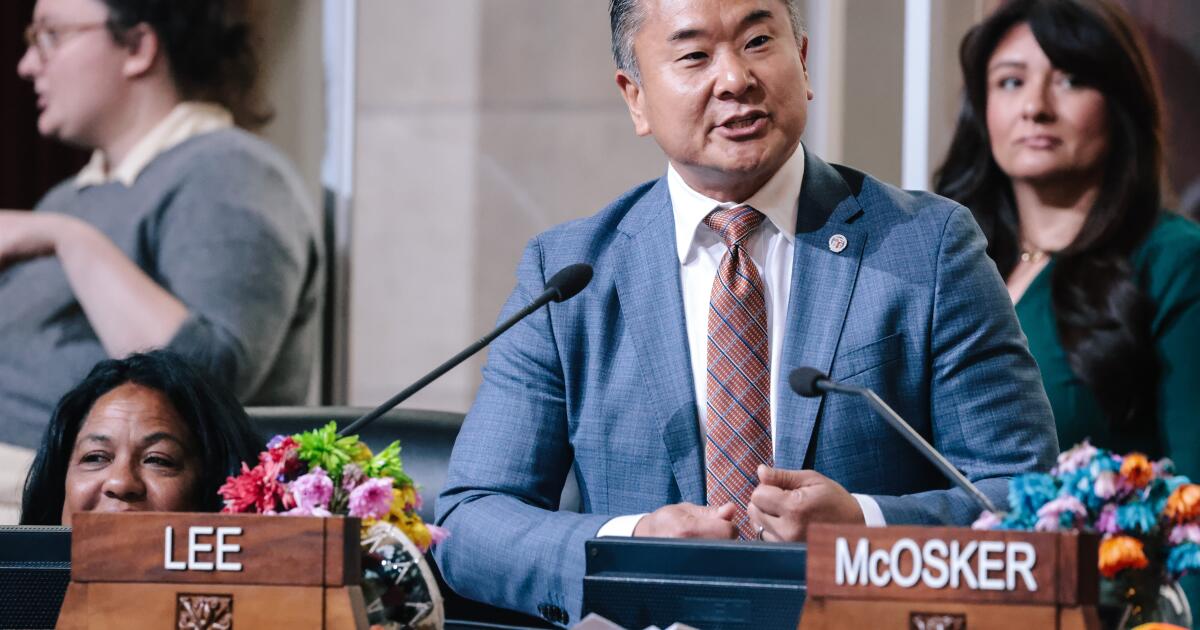
L.A. Councilmember John Lee hit with $138,000 fine in Las Vegas gift case

L.os Angeles City Councilmember John Lee is facing a steep fine for his notorious 2017 trip to Las Vegas, with the city’s Ethics Commission saying he must pay $138,424 in a case involving pricey meals and expensive nightclub “bottle service.”

On Wednesday, the commission decided 4 to 0 that Lee, who represents the northwest San Fernando Valley, committed two counts of violating the city’s gift law and three counts of violating a law requiring that such gifts be disclosed to the public.

By a 3-1 vote, the panel found that Lee violated five additional counts of misusing his city position or helping his boss at the time — Councilmember Mitchell Englander — misuse his position. After that, the commission voted unanimously to levy the maximum financial penalty, as recommended by city ethics investigators.

The commission went much further than an administrative law judge, who, after a multiday hearing, concluded that Lee violated five of 10 counts and recommended a fine of nearly $44,000.

Commission President Manjusha Kulkarni argued for the maximum fine, saying it would discourage others from violating ethics laws. She said Lee directly benefited from his decision not to report the gifts — which came from three men who sought business with City Hall — on his economic disclosure forms.

Lee, by failing to report those gifts, gained an unfair advantage during his 2019 and 2020 election campaigns, both of which he won by small margins, Kulkarni said.

“There was a concealment effort made there in order to win those two elections,” she said.

Commissioner Aryeh Cohen voted against the five additional ethics counts, saying he wasn’t convinced that the gift information would have made a difference. Last year, after city investigators accused Lee of violating gift laws, he won reelection handily.

“Voters knew, and he won by a larger margin” than in 2019 or 2020, Cohen said. “So I don’t think that that was a misuse of a position or gaining benefit from it.”

Brian Hildreth, an attorney representing Lee, had argued for a maximum fine of $10,000. Appearing before the commission, he said city investigators incorrectly calculated the value of the gifts and failed to take into account how much Lee had actually consumed at the food and drink venues.

Lee, in a statement, vowed to keep fighting the charges, calling the case “wasteful and political.” An appeal would need to be filed in Los Angeles County Superior Court.

“Today is but one step in the process of fighting these baseless charges,” he said. “I look forward to finally having an opportunity to have this matter adjudicated in a fair and impartial setting.”

The Lee case revolves around gifts — mostly meals and alcohol but also hotel stays, transportation and $1,000 in gambling chips — provided by the three businessmen: Andy Wang, who peddled Italian cabinets, “smart home” technology and facial recognition software; architect and developer Chris Pak; and lobbyist Michael Bai.

Lee, while working as Englander’s chief of staff, flew with his boss and several others — including Wang and Bai — to Las Vegas in 2017. Englander resigned from office the following year, after being contacted by FBI agents about the trip.

In 2020, federal prosecutors accused Englander of accepting $15,000 in cash from Wang, lying to FBI agents and obstructing their investigation. He eventually pleaded guilty to a single count of providing false information to the FBI and was sentenced to 14 months in prison.

In 2023, Englander agreed to pay $79,830 to settle an Ethics Commission case focused on his own gift law violations. That same year, the commission filed a case against Lee, saying he violated the gift law not just in Vegas but also at restaurants in downtown L.A. and Koreatown.

Lee repeatedly denied the allegations and argued that the statute of limitations had run out. The commission responded by scheduling a multiday hearing, held in June before Administrative Law Judge Ji-Lan Zang.

During those proceedings, Lee said he made a good faith effort to pay his own way and, in some cases, declined to eat during meals. For example, he testified that he did not remember eating during the meetings at Yxta Cocina Mexicana and Water Grill, both in downtown L.A.

Zang, in her written report to the commission, called those denials “not credible,” saying it “strains credulity” to believe that he would join the group at those restaurants without eating any food.

During the Las Vegas trip, Lee stayed at the Aria hotel, went to Blossom restaurant and spent an evening with the group at Hakkasan Nightclub.

At Blossom, Wang ordered a dinner worth nearly $2,500 that included shark fin soup, Peking duck and Kobe beef. Lee testified over the summer that he arrived at the restaurant in time for a dessert of bird’s nest soup, tasting it and deciding he did not like it.

At Hakkasan Nightclub later that night, Wang purchased three rounds of bottle service for the group for around $8,000 apiece, while Pak purchased a fourth round for $8,418.75.

Lee said he gave Wang $300 in cash as reimbursement for his drinks, withdrawing money from an ATM. Hildreth, his attorney, told the commission that drinks were served to a large number of nightclubgoers.

“The testimony and the evidence suggests that dozens and dozens of people were joining Councilmember Lee and others,” he said.

Kulkarni, before the vote, said she was especially troubled that Lee, after being contacted by FBI agents in 2017, sent Wang a backdated check for $442 to reimburse him for some of the Vegas trip. That act on its own, she said, constituted “a very serious offense.”

“That is not a mistake that one does. That is an affirmative act,” she said.

Hildreth said his client wrote a reimbursement check right away but that it was lost, necessitating a second, backdated check. He also noted that Lee cooperated with federal law enforcement and city ethics investigators.

“He sat for two interviews with the FBI,” Hildreth said. “That’s not something that deserves a punitive penalty.”
Source link

Judges quiz California and GOP attorneys in Prop. 50 redistricting case

A trio of federal judges questioned attorneys for Gov. Gavin Newsom and the California Republican Party on Wednesday in a legal case that will decide the fate of California’s new voter-approved congressional districts for the 2026 midterm elections.

Attorneys for the California Republican Party and the Trump administration’s Department of Justice during the hearing recapped the argument they made in their legal complaint, accusing Democratic legislators and redistricting experts of racial gerrymandering that illegally favored Latinos.

The state’s legal representatives, meanwhile, argued their primary goal was not racial but political — they worked to weaken Republicans’ voting power in California to offset similar gerrymandering in Texas and other GOP-led states.

But Wednesday was the first time the public got to hear the three federal judges of the Central District of California challenge those narratives as they weigh whether to grant the GOP’s request for a temporary injunction blocking the reconfigured congressional districts approved by voters in November under Proposition 50.

The GOP has repeatedly seized on public comments from Paul Mitchell, a redistricting expert for California’s Democratic-led Legislature who designed the Proposition 50 congressional districts, that “the No. 1 thing” he started thinking about was “drawing a replacement Latino majority/minority district in the middle of Los Angeles.”

On Wednesday, District Court Judge Josephine Staton suggested that GOP attorneys focused too much on the intent of Mitchell and Democratic legislators and not enough on the voters who ultimately approved Proposition 50.

“Why would we not be looking at their intent?” Staton asked Michael Columbo, an attorney for California Republicans. “If the relative intent is the voters, you have nothing.”

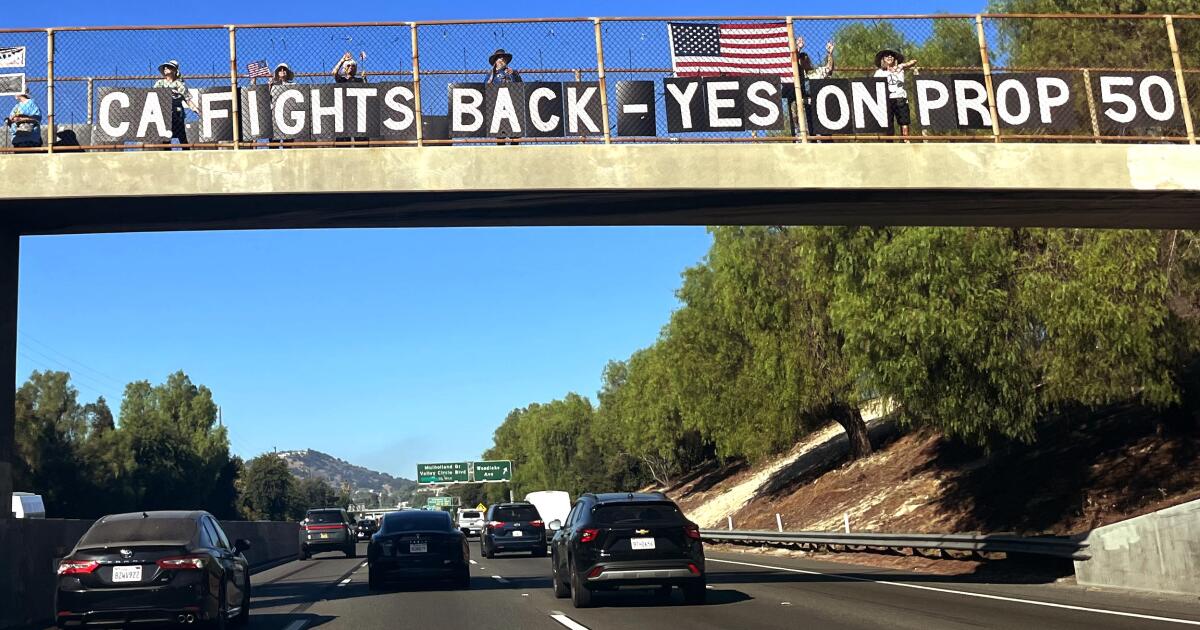
Nearly two-thirds of California voters approved the new Proposition 50 congressional district map in a Nov. 4 special election after Newsom pitched the idea as a way to counter partisan gerrymandering after President Trump pressed Texas to redraw maps to shore up the GOP’s narrow House majority.

The stakes for California and the nation are high.

If the new map is used for the 2026 midterms, it could give California Democrats up to five additional U.S. House seats. That could allow them to push back against the gains Republicans make due to redistricting in staunchly GOP states and increase Democrats’ chance of seizing the House and shifting the balance of power in Congress.

A win for Democrats could also boost Newsom’s national clout and help him pitch himself as the nation’s strongest and most effective Trump critic as he enters his final year as California governor and weighs a White House bid.

During closing arguments Wednesday, an attorney for the U.S. Department of Justice argued that the race-based aspect of the redrawn districts started with the drafting of the Assembly bill that led to Proposition 50 being placed on the ballot.

Staton, however, seemed unconvinced.

“These maps have no effect,” she said, “until the voters give them effect.”

The GOP cannot challenge the map on grounds of political gerrymandering: The Supreme Court decided in 2019 that such complaints have no path in federal court. That leaves them focusing on race.

But proving that race predominated over partisanship is a challenge, legal scholars say, and paying attention to race is not, in itself, prohibited under current law. To prove that race was the key motivation, plaintiffs have to show there is another way for map makers to achieve their desired political result without a racial impact.

During the hearing, Staton stressed that the burden was on the challengers of Proposition 50 to prove racial intent.

To that end, the GOP brought to the stand RealClearPolitics elections analyst Sean Trende, who said the new 13th Congressional District in the San Joaquin Valley had an “appendage” that snaked northward into Stockton. Such contorted offshoots, he said, are “usually indicative of racial gerrymandering.” Trende produced an alternative map of the district that he said retained Democratic representation without being driven by race.

But Staton questioned whether Trende’s map was substantially different from Mitchell’s, noting they both seemed to fall within a similar range of Latino representation.

U.S. District Judge Wesley Hsu lambasted Columbo over what he called the “strawman” attempt to pick out one district, the 13th Congressional District, to make the case that there was a race-conscious effort in the attempt to flip five seats in the Democrats’ favor.

Jennifer Rosenberg, an attorney for the state, also argued that Trende’s analysis was too narrow.

“Dr. Trende failed to conduct a district by district analysis,” Rosenberg said. “And as we can see, he only addressed two tiny portions of District 13 and really only focused on one of the subparts.”

U.S. District Judge Kenneth Lee questioned Rosenberg on how much she believed Mitchell’s public statements about wanting to create a Latino district in Los Angeles influenced his redrawing.

“He was talking to interested groups,” Rosenberg said. “He did not communicate that intent to legislators.”

However, Lee said that Mitchell’s closeness to Democratic interest groups was an important factor. Mitchell “delivered on” the “wants” of the Latino interest groups he interacted with, Lee said, based on his public statements and lack of testimony.

Lee also took issue with Mitchell not testifying at the hearing and the dozens of times he invoked legislative privilege during a deposition ahead of the hearing.

Abha Khanna, who represented the Democratic Congressional Campaign Committee, argued there was no racial predominance in Mitchell’s statements.

She showed judges the text of Proposition 50, an official voter guide and statements from Newsom, arguing they were overt declarations of partisan intent. She also pointed out instances in which Republican plaintiffs discussed Proposition 50 in exclusively partisan terms.

If the federal judges grant a preliminary injunction, California would be temporarily blocked from using the newly drawn map in the 2026 election. Attorneys for the state would probably appeal to the U.S. Supreme Court.

Just two weeks ago, the nation’s highest court allowed Texas to temporarily keep its newly drawn congressional districts — which also faced complaints of racial gerrymandering — after a federal court blocked the Texas map, finding racial considerations probably made it unconstitutional.

The U.S. Supreme Court indicated it viewed the Texas redistricting as motivated primarily by partisan politics. In its ruling, it explicitly drew a connection between Texas and California, noting that several states, including California, have redrawn their congressional map “in ways that are predicted to favor the State’s dominant political party.”

Source link

Trump sues BBC for $10 billion, accusing it of defamation over editing of president’s Jan. 6 speech

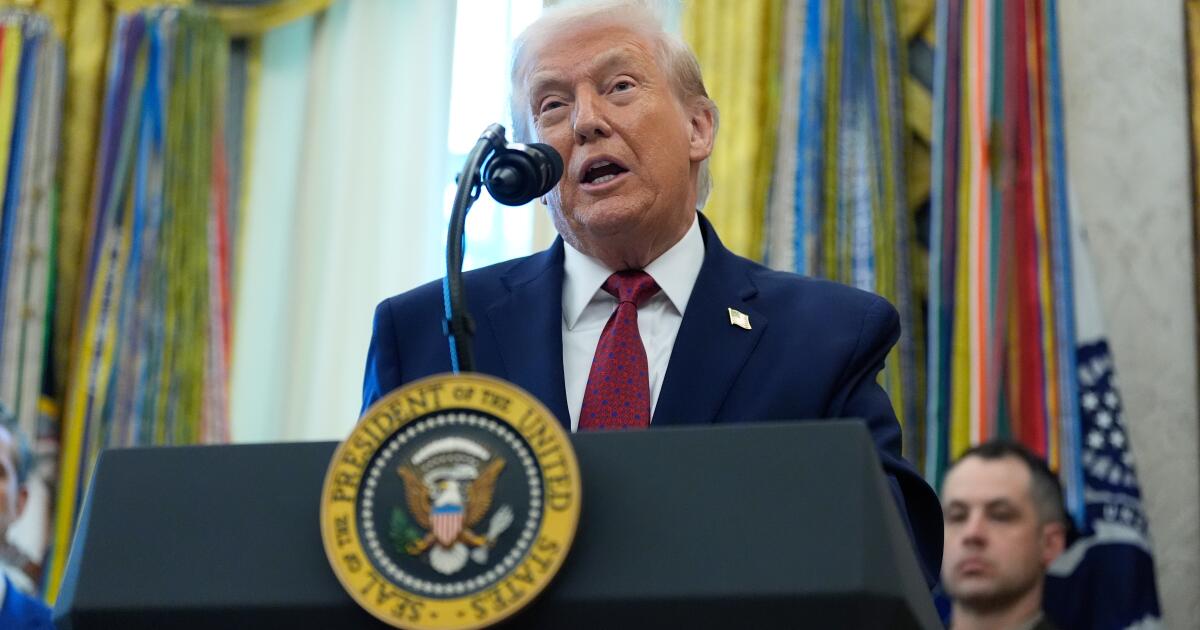
President Trump filed a lawsuit Monday seeking $10 billion in damages from the BBC, accusing the British broadcaster of defamation as well as deceptive and unfair trade practices.

The 33-page lawsuit accuses the BBC of broadcasting a “false, defamatory, deceptive, disparaging, inflammatory, and malicious depiction of President Trump,” calling it “a brazen attempt to interfere in and influence” the 2024 U.S. presidential election.

It accused the BBC of “splicing together two entirely separate parts of President Trump’s speech on January 6, 2021” in order to “intentionally misrepresent the meaning of what President Trump said.”

The lawsuit, filed in a Florida court, seeks $5 billion in damages for defamation and $5 billion for unfair trade practices.

The BBC said it would defend the case.

“We are not going to make further comment on ongoing legal proceedings,” it said in a statement.

The broadcaster apologized last month to Trump over the edit of the Jan. 6 speech. But the publicly funded BBC rejected claims it had defamed him, after Trump threatened legal action.

BBC chairman Samir Shah had called it an “error of judgment,” which triggered the resignations of the BBC’s top executive and its head of news.

The speech took place before some of Trump’s supporters stormed the U.S. Capitol as Congress was poised to certify President-elect Joe Biden’s victory in the 2020 election that Trump falsely alleged was stolen from him.

The BBC had broadcast the hourlong documentary — titled “Trump: A Second Chance?” — days before the 2024 U.S. presidential election. It spliced together three quotes from two sections of the 2021 speech, delivered almost an hour apart, into what appeared to be one quote in which Trump urged supporters to march with him and “fight like hell.” Among the parts cut out was a section where Trump said he wanted supporters to demonstrate peacefully.

Trump said earlier Monday that he was suing the BBC “for putting words in my mouth.”

“They actually put terrible words in my mouth having to do with Jan. 6 that I didn’t say, and they’re beautiful words, that I said, right?” the president said unprompted during an appearance in the Oval Office. “They’re beautiful words, talking about patriotism and all of the good things that I said. They didn’t say that, but they put terrible words.”

The president’s lawsuit was filed in Florida. Deadlines to bring the case in British courts expired more than a year ago.

Legal experts have brought up potential challenges to a case in the U.S. given that the documentary was not shown in the country.

The lawsuit alleges that people in the U.S. can watch the BBC’s original content, including the “Panorama” series, which included the documentary, by using the subscription streaming platform BritBox or a virtual private network service.

The 103-year-old BBC is a national institution funded through an annual license fee of 174.50 pounds ($230) paid by every household that watches live TV or BBC content. Bound by the terms of its charter to be impartial, it typically faces especially intense scrutiny and criticism from both conservatives and liberals.

Source link

Hong Kong court to deliver verdict in Jimmy Lai national security case

Jimmy Lai, founder of Apple Daily, is escorted by police after he was arrested at his home in Hong Kong in August 2020. File Photo by Vernon Yuen/EPA-EFE

Dec. 14 (UPI) — A Hong Kong court is scheduled to deliver its verdict Monday in the national security case against media founder and former publisher Jimmy Lai, one of the city’s most prominent pro-democracy figures and the founder of the now-defunct newspaper Apple Daily.

Lai, 78, whose Chinese name is Lai Chee-ying, is charged alongside several companies linked to Apple Daily, including Apple Daily Limited, Apple Daily Printing Limited and AD Internet Limited, according to the court’s docket.

Prosecutors allege that Lai conspired to collude with foreign forces, an offense punishable by as much as a life sentence in prison under Hong Kong’s national security law.

Court records show the case is listed for verdict at 10 a.m. local time in the Court of First Instance at the West Kowloon Law Courts Building.

The Hong Kong Judiciary issued special public seating and ticketing arrangements for the hearing, citing high demand. According to court notices, admission tickets will be distributed on a first-come, first-served basis beginning 45 minutes before the hearing, with overflow seating and live broadcasts provided in multiple courtrooms.

The case has also drawn international attention, with governments and press freedom groups warning that the prosecution reflects a broader erosion of civil liberties and press freedom in Hong Kong since the national security law was imposed in 2020.

Lai has pleaded not guilty to two counts of “conspiracy to collude with foreign forces” and a separate count of conspiracy to publish seditious material in Apple Daily, The New York Times reported. He has been jailed since his arrest five years ago.

Source link