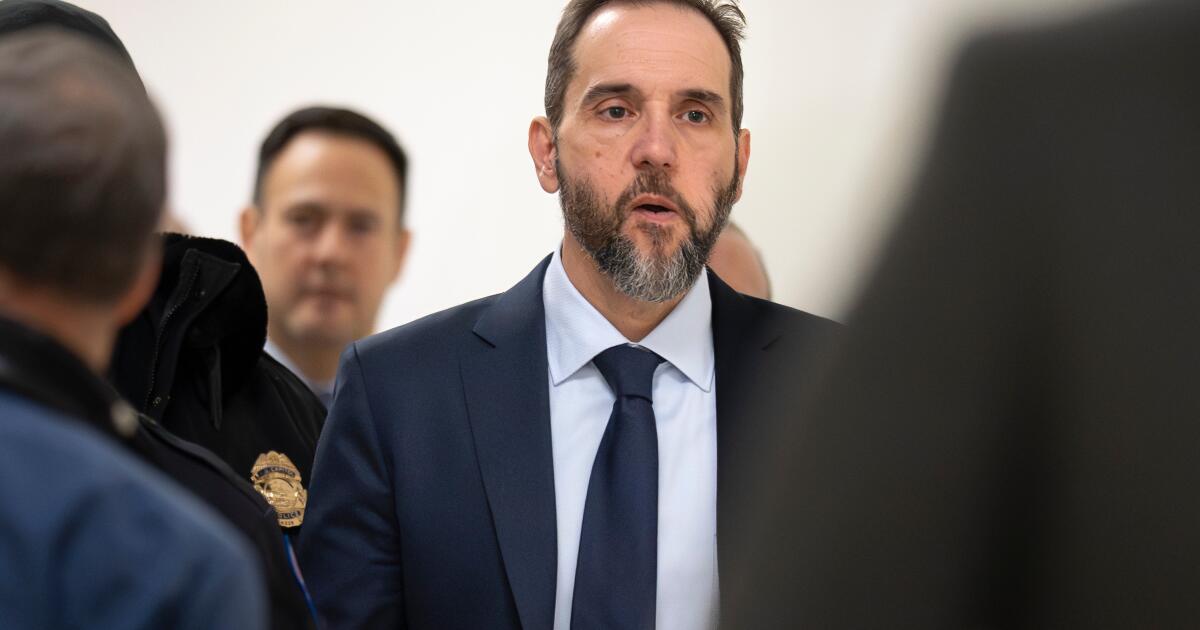
WASHINGTON — Former Justice Department special counsel Jack Smith told lawmakers in a closed-door interview on Wednesday that his team of investigators “developed proof beyond a reasonable doubt” that President Donald Trump had criminally conspired to overturn the results of the 2020 election, according to portions of his opening statement obtained by The Associated Press.
He also said investigators had accrued “powerful evidence” that Trump broke the law by hoarding classified documents from his first term as president at his Mar-a-Lago estate in Palm Beach, Florida, and by obstructing government efforts to recover the records.
“I made my decisions in the investigation without regard to President Trump’s political association, activities, beliefs, or candidacy in the 2024 election,” Smith said. “We took actions based on what the facts and the law required — the very lesson I learned early in my career as a prosecutor.”
He said that if asked whether he would “prosecute a former president based on the same facts today, I would do so regardless of whether the president was a Republican or Democrat.”
The private deposition before the House Judiciary Committee gives Smith his first chance to face questions, albeit behind closed doors, about a pair of investigations into Trump that resulted in since-abandoned criminal charges between the Republican president’s first and second terms in office. Smith was subpoenaed earlier this month to provide both testimony and documents as part of a Republican investigation into the Trump probes during the Biden administration.
The former special counsel cooperated with the congressional demand despite having volunteered more than a month earlier to answer questions publicly before the committee, an overture his lawyers say was rebuffed by Republicans.
“Testifying before this committee, Jack is showing tremendous courage in light of the remarkable and unprecedented retribution campaign against him by this administration and this White House,” one of Smith’s lawyers, Lanny Breuer, told reporters Wednesday. “Let’s be clear: Jack Smith is a career prosecutor, who conducted this investigation based on the facts and based on the law and nothing more.”
Trump told reporters at the White House that he supported the idea of an open hearing, saying: “I’d rather see him testify publicly. There’s no way he can answer the questions.”
Smith is expected to discuss both of his investigations of Trump but will not answer questions that call for grand jury materials, which are restricted by law, according to a person familiar with the investigation who insisted on anonymity to discuss the interview. He is also expected to correct what he regards as mischaracterizations from Republicans about his work, including about his team’s use of cellphone records belonging to certain GOP lawmakers, the person said.
Smith was appointed in 2022 to oversee the Justice Department investigations into Trump’s efforts to overturn his 2020 presidential election loss to Democrat Joe Biden and his hoarding of classified documents at Mar-a-Lago. Smith’s team filed charges in both investigations.
Smith abandoned the cases after Trump was elected to the White House again last year, citing Justice Department legal opinions that say a sitting president cannot be indicted.
Republicans who control Congress have sought interviews with at least some individual members of Smith’s team.
In recent weeks they have seized on revelations that the team, as part of its investigation, had analyzed the phone records of select GOP lawmakers from on and around Jan. 6, 2021, when pro-Trump rioters stormed the U.S. Capitol to try to halt the certification of Trump’s election loss to Biden. The phone records reviewed by prosecutors included details only about the incoming and outgoing phone numbers and the length of the call but not the contents of the conversation.
Tucker and Mascaro write for the Associated Press.
Southern California Edison did not spend hundreds of millions of dollars on maintenance of its aging transmission lines that it told regulators was necessary and began billing to customers in the four years before the Jan. 7 wildfires, according to a Times review of regulatory filings.
Edison told state regulators in its 2023 wildfire prevention plan that it believed its giant, high-voltage transmission lines, which carry bulk power across its territory, “generally have a lower risk of ignition” than its smaller distribution wires, which deliver power to neighborhoods.
After two of the most destructive fires in the state’s history, The Times takes a critical look at the past year and the steps taken — or not taken — to prevent this from happening again in all future fires.
While it spent heavily in recent years to reduce the risk that its smaller lines would ignite fires, Edison fell behind on work and inspections it told regulators it planned on its transmission system, where some structures were a century old, according to documents.
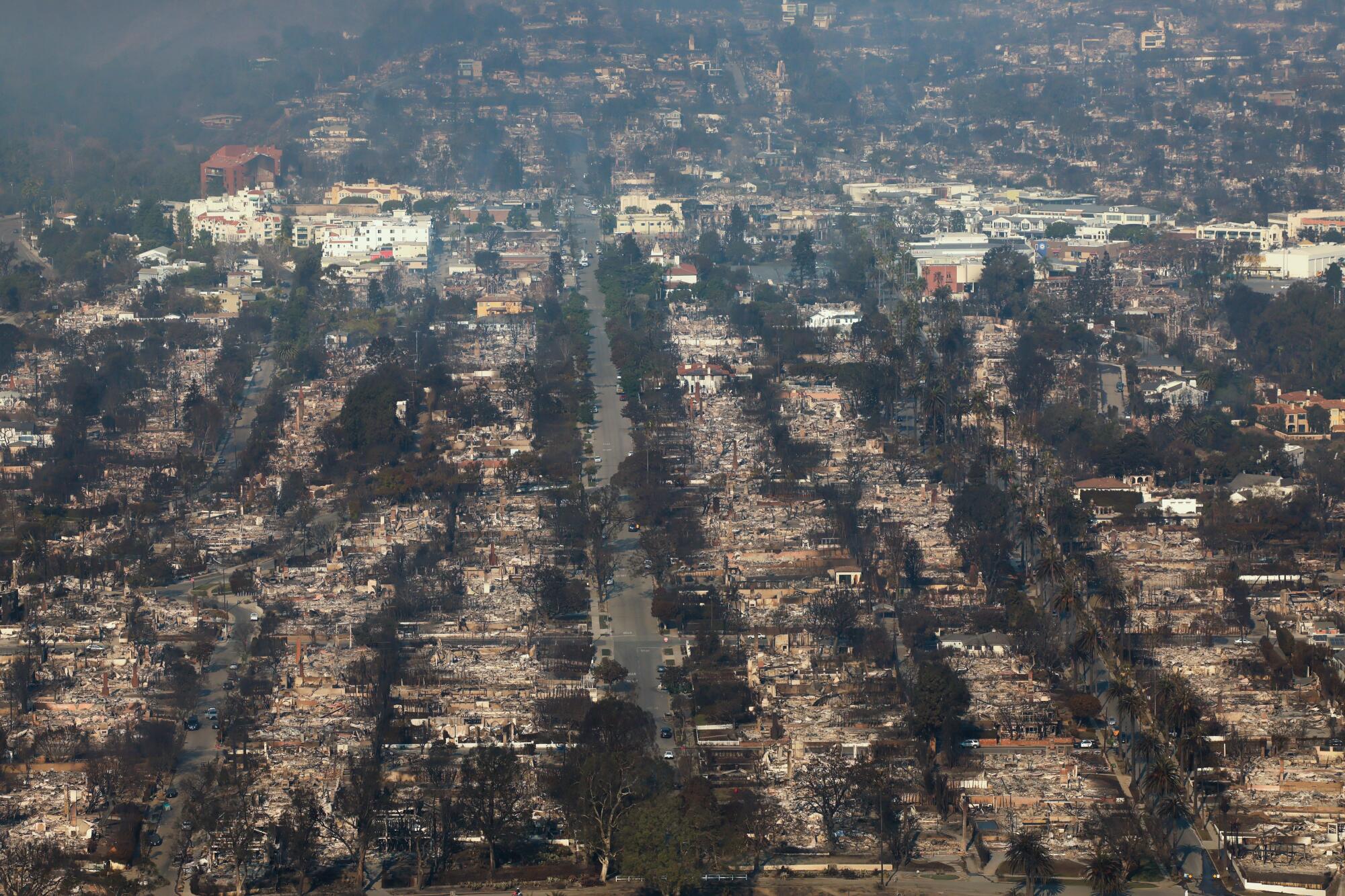
Edison’s transmission lines are now suspected of igniting two wildfires in Los Angeles County on the night of Jan. 7, including the devastating Eaton fire, which killed 19 people and destroyed more than 9,000 homes and other structures in Altadena.
Twenty miles away, in the San Fernando Valley, terrified Sylmar residents watched a fire that night burning under the same transmission tower where the deadly Saddleridge fire ignited six years before. Firefighters put out that Jan. 7 blaze, known as the Hurst fire, before it destroyed homes.
Roberto Delgado said the 2019 Saddleridge fire started at this powerline in the hillside behind his Sylmar house. He said the January 7 Hurst began with sparks at this and another nearby powerline. Photographed in Sylmar, CA on Wednesday, Aug. 20, 2025.
(Myung J. Chun/Los Angeles Times)
After the fires, Edison changed course, and began spending more on its transmission lines, according to executives’ recent comments and state regulatory documents.
The utility began installing more grounding devices on its old transmission lines no longer in service, like the one suspected of igniting the Eaton fire. The company says it believes the idle line, last used 50 years ago, may have momentarily reenergized from a surge in electricity on the live lines running parallel to it, sparking the blaze. The official investigation hasn’t been released.
Transmission work Edison failed to perform
Here are examples of work that Edison told regulators was needed and that it was authorized to charge to customers but did not perform. The amounts are for the four years before the Jan. 7 wildfires.
Transmission maintenance $38.5 million Transmission capital maintenance $155 million Fixing illegally sagging lines $270 million Substation transformer replacement $136 million Pole loading replacement $88 million* Transmission line patrols $9.2 million Intrusive pole inspections $1.4 million
Source: Edison’s “Risk Spending Accountability Report” filed in April 2025 *Edison said customers weren’t charged
The added devices give unexpected power on the old lines more places to dissipate into the earth.
A helicopter transports workers during the process of removing Southern California Edison’s tower 208, which is suspected of causing the Eaton Fire, on Monday, May 5, 2025, in Pasadena, Calif.
(William Liang/For The Times)
Edison also began replacing some aging equipment. Sylmar residents said they saw workers in trucks and helicopters replacing hardware on the transmission line where they had watched early flames of both the Hurst fire and the 2019 Saddleridge blaze.
“Not until this year did we see repairs,” said Roberto Delgado, a Sylmar resident who can see Edison’s transmission towers from his home. “Obviously the maintenance in the past was inadequate.”
Jill Anderson, the utility’s chief operating officer, told regulators at an August meeting that the company replaced components prone to failure on a certain transmission line after Jan. 7. Edison later confirmed she was referring to equipment on the line running through Sylmar.
In interviews, Edison executives disputed that maintenance on the company’s transmission lines suffered before Jan. 7.
A helicopter transports workers during the process of removing Southern California Edison’s tower 208, which is suspected of causing the Eaton Fire, on Monday, May 5, 2025, in Pasadena, Calif.
(William Liang/For The Times)
“I do not think that our inspections and maintenance in the years leading up to 2025 were at depressed levels,” said Russell Archer, a top Edison regulatory lawyer.
Scott Johnson, an Edison spokesman, said: “The 13,500 people at Southern California Edison show up every day committed to the safety of the communities where we live and work. There is no higher value than safety here.”
Johnson said the utility prioritized safety both before and after the fire. For example, he said, the company increased aerial and ground inspections of transmission lines in areas at high fire risk in 2022 — and kept them at that higher level in subsequent years.
Among the company’s increased spending this year was an expensive upgrade to a transmission line that the state’s grid operator said was required to more safely shut down five critical transmission lines in L.A. County including those running through Sylmar and Eaton Canyon. That work was expected to be finished by 2023 but was still in progress on Jan. 7.
Edison didn’t preventively shut down the lines in Eaton Canyon or Sylmar on Jan. 7, but said the delayed upgrade had nothing to do with that decision. The company said the wind that night combined with other factors didn’t meet its protocol at the time for the lines to be turned off.
Some proposed maintenance changes will take years.
Work crew dismantles a section of Southern California Edison’s tower 208 which will be removed for further examination on Wednesday, May 7, 2025. The idle transmission tower is suspected of sparking the Eaton fire.
(Myung J. Chun/Los Angeles Times)
For example, executives recently told regulators that next year they may begin determining whether some of its 355 miles of idle transmission lines in areas at high-risk of wildfire should be removed for safety reasons. The company said 305 miles of those dormant lines run parallel to energized lines, like the one in Eaton Canyon.
Regulators at the state Office of Energy Infrastructure Safety asked Edison this summer if any of those lines posed a risk of induction, where they become energized from nearby electrified lines. Edison told them it “has not done a line by line analysis.”
Pedro Pizarro, chief executive of Edison International, the utility’s parent company, acknowledged in a November interview that the company made changes after the fires, including by replacing a steel part called the y-clevis, which was found to have failed in the minutes before the 2019 Saddleridge fire.
“We saw some concerns with that so we accelerated a program to replace them,” he said.
Pizarro said he continued to back the company’s statements before Jan. 7 that it had decreased the risk that its lines would spark a wildfire by as much as 90% since 2018, including by spending billions of dollars for prevention work on its smaller distribution lines.
He called the Eaton fire “a black swan event” — one of “low probability, but high consequence.”
Aging equipment
About 13,000 miles of transmission lines carry bulk power through Edison’s territory. In comparison, it has nearly 70,000 miles of the smaller distribution lines, delivering power to homes.
Because the high-voltage transmission lines are interconnected, utilities must keep the system balanced, trying to prevent sudden increases or decreases in power. An abrupt jump in electricity flowing on one transmission line can cause surges and problems miles away.
In 2023, Edison said in a filing to the state Public Utilities Commission that the average age of its infrastructure was increasing as it replaced equipment less frequently than in previous times.
More than 90% of its transmission towers are at least 30 years old — the age when the first signs of corrosion appear, it said in a filing. Some transmission lines and pylons are nearing 100 years of service and have never had major overhauls, the company said.
Edison said it began looking for corroded transmission towers in 2020, but found so many that it temporarily stopped those evaluations in 2022 to focus on fixing those found unsafe.
In 2021, the commission’s Public Advocates Office warned that Edison wasn’t completing maintenance and upgrades that the utility said was “critical and necessary” and was authorized to bill to customers.
Edison had been under-spending on that work since 2018, staff at the Public Advocates Office wrote. They urged regulators to investigate, saying that “risks to the public are not addressed” and customers may be owed a refund.
That shortfall in spending continued through 2024.
According to a report Edison filed in April, the company did not spend hundreds of millions of dollars on transmission system work that regulators had authorized from 2021 to 2024.
Among the shortfalls was $270 million to fix thousands of deficiencies found more than a decade ago where its transmission lines hang too close to the ground, the report said. Also unspent was $38.5 million authorized for transmission operating maintenance and an additional $155 million for capital maintenance.
Edison planned to perform 57,440 detailed inspections of its transmission poles in those four years, the report said, but performed only 27,941, citing other priorities.
Edison said its inspection numbers still met state regulatory requirements.
A helicopter flies over the downtown Los Angeles skyline during a cloudy day on Monday, May 5, 2025, in Pasadena, Calif.
(William Liang/For The Times)
The utility also replaced 38% fewer substation transformers than it said it would. And while it was authorized to replace 14,280 transmission poles it restored just 10,031, the report stated.
Archer said some uncompleted work was for an inspection program using drones in areas at lower risk of fire. Instead the company focused those aerial inspections in high-risk areas, he said.
He said some shortfalls were for upgrade projects that were delayed for reasons beyond the company’s control.
Utilities are allowed to pass on the costs of approved maintenance projects to customers in the monthly rates they charge. State regulators also give them some flexibility to decide whether to spend the money on approved projects, or something else.
Archer said that most of the unspent money involved capital expenses like purchases of new transmission towers and upgrade projects. Once regulators authorize a capital project, he said, customers begin paying a small portion of the cost annually over the assets’ expected life, which is often decades. If the project is not completed, those annual payments stop, he said, adding that state regulations don’t allow Edison to issue refunds for most unspent funds.
Transmission lines known to spark deadly fires
Before Jan. 7, Edison told regulators in its wildfire mitigation plan that it had focused its prevention efforts on its smaller distribution system. It said transmission lines posed a lower threat because they were taller and had wires more widely spaced.
Yet the deadliest wildfire in state history was caused when equipment on a century-old Pacific Gas & Electric transmission tower failed. The 2018 Camp fire killed 85 people and destroyed most of the town of Paradise.
A year later, the Kincade fire in Sonoma County ignited when a steel part on a PG&E transmission line broke. Like Edison’s line in Eaton Canyon, that transmission cable was no longer serving customers.
Edison is now facing hundreds of lawsuits claiming it was negligent in maintaining its transmission lines in Eaton Canyon and for leaving the old unused line in place — allegations the company denies.
At 6:11 pm on Jan. 7, Edison recorded a fault — a sudden change in electricity flow — on a transmission line running from La Cañada Flintridge to Eagle Rock, according to its report to regulators.
Faults can be caused by lines slapping together, a piece of equipment breaking or other reasons. Edison said it did not know the cause.
The fault caused a momentary surge in current on the four live lines running through Eaton Canyon, the company said, which may have energized the idle line.
Investigators view the Edison electrical lines, transmission towers and surrounding area, which is a location that is being investigated as the possible origin of the Eaton fire in Eaton Canyon in Altadena Tuesday, Feb. 11, 2025.
(Allen J. Schaben/Los Angeles Times)
State regulations require utilities to remove old lines no longer in service. Edison says that even though it hasn’t used the line in decades it sees a need for it in the future.
Edison’s transmission manual dated December 20, 2024 states that it inspects idle lines every three years, while active ones are inspected annually.
Executives said they went beyond the manual’s requirements, inspecting the idle line in Eaton Canyon annually in the years before the fire.
Edison declined to provide records of those inspections.
Sylmar line suspected of two wildfires
Edison says it believes its transmission line running through the foothills above Sylmar was involved in the ignition of the Jan. 7 Hurst fire. But it denies the line ignited the 2019 Saddleridge fire.
The 2019 fire killed at least one and destroyed or damaged more than 100 homes and other structures.
This year, lawyers for victims of the 2019 fire argued in court the two fires started in the same way: steel equipment holding up the transmission lines broke, causing a sudden, massive surge in energy that triggered sparks and flames at two or more towers located miles away.
The lawyers say the line, constructed in 1970, is not properly grounded so that sudden increases in energy don’t disperse into the soil — a problem they say the company failed to fix.
Edison denies the claims, calling their description of the fire’s start an “exotic ignition theory…contrary to accepted scientific principles.”
A judge recently denied Edison’s request to dismiss the case.
It was supposed to be a speech with a clear message of hope for survivors of the Palisades fire.
In her State of the City address in April, Los Angeles Mayor Karen Bass called for a law exempting fire victims from construction permit fees — potentially saving them tens of thousands of dollars as they rebuild their homes.
Eight months later, the City Council is still debating how much permit relief the city can afford. Palisades residents have been left hanging, with some blaming Bass for failing to finalize a deal.
“This should have been pushed, and it wasn’t pushed,” said electrician Tom Doran, who has submitted plans to rebuild his three-bedroom home. “There was no motor on that boat. It was allowed to drift downstream.”
Since the Jan. 7 fire destroyed thousands of homes, Bass has been announcing recovery strategies with great fanfare, only for them to get bogged down in the details or abandoned altogether.
After two of the most destructive fires in the state’s history, The Times takes a critical look at the past year and the steps taken — or not taken — to prevent this from happening again in all future fires.
At one point, she called for the removal of traffic checkpoints around Pacific Palisades, only to reverse course after an outcry over public safety. She pushed tax relief for wildfire victims in Sacramento, only to abruptly pull the plug on her bill. Her relationship with Steve Soboroff, her first and only chief recovery officer, quickly unraveled over pay and other issues. He left after a 90-day stint.
Critics in and outside the Palisades say the mayor’s missteps have undermined public confidence in the rebuilding process. They have also made her more politically vulnerable as she ramps up her campaign for a second term.
1
2
3
1.Tom Doran poses for a portrait in the remains of his home in the Pacific Palisades. Doran, who has submitted plans to rebuild the home he lived in for decades, has said that Los Angeles Mayor Karen Bass should have done more to secure passage of a law giving residents relief from city rebuilding permits after the wildfires.(Kayla Bartkowski / Los Angeles Times)2.Statues are seen in an aerial of the remnants of Doran’s home.(Kayla Bartkowski / Los Angeles Times)3.An aerial of the remains of Doran’s home.(Kayla Bartkowski / Los Angeles Times)
Bass, seated in her spacious City Hall office earlier this month, said the recovery is happening at “lightning speed” compared to other devastating wildfires, in part because of her emergency orders dramatically cutting the time it takes to obtain building permits.
By mid-December, more than 2,600 permit applications had been filed for more than 1,200 addresses — about a fifth of the properties damaged or destroyed in the fire. Permits had been issued at about 600 addresses, with construction underway at nearly 400, according to city figures.
Still, Bass acknowledged that fire victims are feeling angry and frustrated as they enter the holiday season.
“I think people have a right to all of those emotions, and I wouldn’t argue with any of them,” she said.
Rebuilding a community after a natural disaster is a monumental task, one with no clear playbook. Many of the obstacles — insurance claims, mortgage relief — reach beyond the purview of a mayor.
Still, Bass has plenty of power. City agencies crucial to the rebuilding effort report to her. She works closely with the council, whose members have sharply questioned some of her recovery initiatives.
Perhaps the most disastrous narrative revolved around Soboroff, a longtime civic leader known for his blunt, outspoken style.
Mayor Karen Bass, right, and her disaster recovery chief, Steve Soboroff, during a news conference at Palisades Recreation Center on Jan. 27.
(Brian van der Brug / Los Angeles Times)
To many, the assignment made sense on paper. Soboroff had a background in home building, roots in the Palisades and extensive knowledge of City Hall.
Soboroff initially expected to receive a salary of $500,000 for three months of work as chief recovery officer, with the funds coming from philanthropy. After that figure triggered an outcry, Bass changed course, persuading him to work for free. Soon afterward, Soboroff told an audience that he had been “lied to” about whether he would be compensated. (He later apologized.)
Soboroff also voiced frustration with the job itself, saying he had been excluded from key decisions. At one point, Bass appeared to narrow his duties, telling reporters he would focus primarily on rebuilding the community’s historic business district and nearby public areas.
Bass told The Times that she does not view her selection of Soboroff as a mistake. But she acknowledged there were “challenges along the way” — and decisions where Soboroff was not included.
“In those first few months when everything was happening, I’m sure there were decisions he wanted to be in that he wasn’t in,” she said.
In April, amid Soboroff’s departure, Bass said she was searching for a new chief recovery officer. She repeated that assertion in July. Yet she never publicly announced a replacement for Soboroff, baffling some in the Palisades and providing fresh ammunition to her critics.
Real estate developer Rick Caruso, who ran against Bass in 2022 and founded the nonprofit SteadfastLA to speed the rebuilding process, said the recovery czar position is still desperately needed, given the size of the task ahead.
“You’ve got infrastructure that has to be rebuilt, undergrounding of power lines, upgrading of water mains. At the same time, you want to get people back in their homes,” said Caruso, who is weighing another run for mayor.
A Samara XL modular house is lowered into place at a project site in Culver City on March 21. Developer and former mayoral candidate Rick Caruso’s Steadfast L.A. nonprofit wants to raise $30 million in the hopes of providing between 80 and 100 Samara XL homes for fire victims.
(Myung J. Chun / Los Angeles Times)
Behind the scenes, Bass opted not to select a single person to replace Soboroff, going instead with a trio of consultants. By then, she had confronted a spate of other crises — federal immigration raids, a $1-billion budget shortfall, a split with county officials over the region’s approach to homelessness.
Soboroff declined to comment on Bass’ handling of the recovery. Early on, he pushed the mayor’s team to hire the global engineering giant AECOM to oversee the recovery. Bass went initially with Hagerty, an Illinois-based consulting firm that specializes in emergency management.
At the time, the mayor pointed out that Hagerty was already working with county officials on the Eaton fire recovery in Altadena and Palisades fire recovery in other unincorporated areas.
The city gave Hagerty a one-year contract worth up to $10 million to provide “full project management” of the recovery, Bass said at the time.
Hagerty quickly ran into trouble. At community events, the firm’s consultants struggled to explain their role in the rebuilding.
Two months after Soboroff stepped down, Bass announced she was hiring AECOM after all to develop a plan for rebuilding city infrastructure. Hagerty ended up focusing heavily on the logistics around debris removal, helping the city coordinate with the federal Army Corps of Engineers, which spearheaded the cleanup.
Hagerty quietly finished its work earlier this month, billing the city $3.5 million — far less than the maximum spelled out in the firm’s contract.
The confusion over Hagerty’s role created a major opening for Bass’ best-known challenger in the June 2 primary election: former L.A. schools Supt. Austin Beutner, a onetime high-level deputy mayor.
Beutner, whose home was severely damaged in the Palisades fire, called the selection of Hagerty a “fiasco,” saying it’s still not clear what the firm delivered.
“The hiring of Hagerty proved to be a waste of time and money while creating a false sense of hope in a community that’s dealing with a terrible tragedy,” he said.
Executives with Hagerty did not respond to multiple inquiries from The Times.
An aerial image of some homes being reconstructed and lots that remain empty in Pacific Palisades.
(Allen J. Schaben / Los Angeles Times)
AECOM joined the city in June, working to prepare reports on the rebuilding effort that dealt with infrastructure repairs, fire protection and traffic management. Those reports are now expected by the one-year anniversary of the fire.
Matt Talley, who spent part of the year as AECOM’s point person in the Palisades, praised Bass for her focus on the recovery, saying he watched as she took lengthy meetings with Palisades community members, then made sure her staff worked to address their concerns.
“I think the mayor gets a bad rap,” said Talley, who left AECOM in mid-November. “She takes a lot of incoming, but in her heart, she really does want to drive the recovery and do the right thing, and that’s evidenced by the meetings she’s having with the community.”
Bass, in an interview, said she eventually decided to have three AECOM staffers form a “recovery team,” instead of a single replacement for Soboroff.
“It didn’t make sense to go in the other direction,” she said. “We evaluated that for quite a while, met with a number of people, consulted many experts.”
By the time Bass announced AECOM’s hiring, she had also begun pursuing another initiative: relief from Measure ULA, the city’s so-called mansion tax, which applies to most property sales above $5.3 million.
Proponents argued that Palisades residents should not have to pay the tax if they sell their burned-out properties. For those who can’t afford to rebuild — either because they are on fixed incomes or have little insurance — selling may be the only option, they argued.
In June, Caruso sent Bass a proposal showing how Measure ULA could be legally suspended. By then, Bass had tapped former state Assembly Speaker Bob Hertzberg to work on a bill overhauling Measure ULA, not only to aid fire victims but to spur housing construction citywide.
Three months later, near the end of the legislative session in Sacramento, Bass persuaded some L.A.-based lawmakers to carry the bill, infuriating affordable housing advocates who accused her of attempting an end run around voters.
But right before a key hearing, Bass announced she was withdrawing the bill, which had been submitted so late that it missed the deadline for lawmakers to make changes.
Bass said city leaders are now working to identify other pathways for suspending ULA in the Palisades.
Meanwhile, her push for permit relief is also a work in progress.
Alice Gould, who lost her home in the Palisades fire, is rebuilding her home on Akron Street in Pacific Palisades. Gould, who has lived on the property for 28 years, is upset that Mayor Karen Bass has not yet secured passage of a law to exempt fire victims from city permit fees for rebuilding.
(Genaro Molina / Los Angeles Times)
In April, a few days after her State of the City speech, Bass issued an emergency order suspending the collection of permit fees while the council drafted the law she requested. If the law isn’t enacted, fire victims will have to pay the fees that are currently suspended.
Councilmember Bob Blumenfield, who sits on the council’s powerful budget committee, said Bass’ team did not contact him before she issued her order.
“When I read that, my first thought was: ‘That’s great. How are we gonna pay for that?’” he said.
Bass issued a second emergency order in May, expanding the fee waivers to include every structure that burned. By October, some council members were voicing alarms over the cost, warning it could reach hundreds of millions of dollars, depending on the details.
Palisades residents called that estimate grossly inflated. On Dec. 2, dozens of them showed up at City Hall to urge the council to pass legislation covering every residential building that burned — not just single-family homes and duplexes, a concept favored by some on the council.
Council members, still struggling to identify the cost, sent the proposal back to the budget committee for more deliberations, which will spill into next year because of the holiday break.
Bass defended her handling of the issue, saying she used her “political heft” to move it forward. At the same time, she declined to say how far-reaching the relief should be.
Asked whether the Palisades should be spared from permit fees for grading, pools or retaining walls, she responded: “I can’t say that,” calling such details “minutiae.”
“What I wanted to see happen was, all fees that were possible to be waived should be waived,” she said.
Hank Wright, against a backdrop of his neighbor’s home being built, walks on the property where he lost his four-bedroom home in the Palisades fire.
(Genaro Molina / Los Angeles Times)
Hank Wright, whose four-bedroom home on Lachman Lane burned to the ground, remains frustrated with the city, saying he doesn’t understand why Bass was unable to lock down the votes.
“She has not been the point person that I wanted her to be,” he said. “I don’t think she has been able to corral that bureaucracy.”
The setting looked almost cozy: Los Angeles Mayor Karen Bass and a podcast host seated inside her home in two comfy chairs, talking about President Trump, ICE raids, public schools and the Palisades fire.
The recording session inside the library at Getty House, the official mayor’s residence, lasted an hour. Once it ended, the two shook hands and the room broke into applause.
Then, the mayor kept talking — and let it rip.
Bass gave a blunt assessment of the emergency response to the Palisades and Eaton fires. “Both sides botched it,” she said.
“They didn’t tell people they were on fire,” she said to Matt Welch, host of “The Fifth Column” podcast.
The mayor’s informal remarks, which lasted around four minutes, came at the tail end of a 66-minute video added to “The Fifth Column’s” YouTube channel last month. In recent weeks, it was replaced by a shorter, 62-minute version — one that omits her more freewheeling final thoughts.
The exact date of the interview was not immediately clear. The video premiered on Nov. 25, according to the podcast’s YouTube channel.
Welch declined to say whether Bass asked for the end of the video to be cut. He had no comment on why the final four minutes can’t be found on the YouTube version of the podcast.
“We’re not going to be talking about any of that right now,” he told The Times before hanging up.
Bass’ team confirmed that her office asked for the final minutes of the video to be removed. “The interview had clearly ended and they acknowledged that when they took it down,” the mayor’s team said Tuesday in an email.
In the longer video, Bass also talked about being blamed for the handling of the Eaton fire in Altadena, which is in unincorporated Los Angeles County, outside of L.A. city limits. Altadena is represented by L.A. County Supervisor Kathryn Barger, not Bass.
“No one goes after the Board of Supervisors,” Bass said on the original 66-minute video. “I’m responsible for everything.”
Bass, in an interview with The Times, said she made those remarks after the podcast was over, during what she called a “casual conversation” — a situation she called “unfortunate.” Nevertheless, she stood by her take, saying she has made similar pronouncements about the emergency response “numerous times.”
In the case of the city, Bass said, the fire department failed to pre-deploy to the Palisades and require firefighters to stay for an extra shift, as The Times first reported in January. In Altadena, she said, residents did not receive timely notices to evacuate.
“The city and the county did a lot of things that we would look back at and say was very unfortunate,” she told The Times.
Bass was out of the country on a diplomatic mission to Ghana when the Palisades fire first broke out on Jan. 7. When she returned, she was unsteady in her handling of questions surrounding the emergency response.
Former L.A. schools superintendent Austin Beutner, who is running against Bass in the June 2 primary election, called the mayor’s use of the word “botched” a “stunning admission of failure on behalf of the mayor” on “the biggest crisis Los Angeles has faced in a generation.”
“She’s admitting that she failed her constituents,” Beutner said.
Bass isn’t the first L.A. elected official to use the word “botched” in connection with the Palisades fire, which destroyed thousands of homes and left 12 people dead. Last month, during a meeting on the effort to rebuild in the Palisades, City Councilmember Monica Rodriguez said that Bass’ office had mishandled the recovery, at least in the first few months.
“Let’s be honest,” she told one of the mayor’s staffers. “You guys have to be the first to acknowledge that your office has botched the first few months of this recovery.”
Bass has defended her handling of that work, pointing to an accelerated debris removal process and her own emergency orders cutting red tape for rebuilding projects. The recovery, she told Welch, is moving faster than many other major wildfires, including the 2023 Lahaina fire in Hawaii.
“It’s important to state the facts, especially because in this environment … there’s a number of people out there who have been very, very deliberate in spreading misinformation,” she said.
Bass, who formally launched her reelection campaign over the weekend, has been giving interviews to a growing list of nontraditional outlets. She recently fielded questions on “Naked Lunch with Phil Rosenthal + David Wild.” She also went on “Big Boy’s Off Air Leadership Series” to discuss the Palisades fire and several other issues.
On “Big Boy’s Off Air,” Bass said she was in conflict with then-Fire Chief Kristin Crowley over her handling of the fire. When she ousted Crowley in February, she cited the LAFD’s failure to properly deploy resources ahead of the fierce winds. She also accused Crowley of refusing to participate in an after-action report on the fire.
Bass told Big Boy, the host of the program, that firefighters “were sent home and they shouldn’t have been.”
She also called the revelation that the Jan. 1 Lachman fire reignited days later, causing the Palisades fire, “shocking.” The Times has reported that an LAFD battalion chief ordered firefighters to leave the burn area, despite signs that the fire wasn’t fully extinguished.
Bass said that had she known of the danger facing the region in early January, she wouldn’t have gone to Long Beach, let alone Ghana.
Asked where blame should be assigned, Bass said: “At the end of the day, I’m the mayor, OK? But I am not a firefighter.”
On “The Fifth Column,” Bass spent much of the hour discussing the effect of federal immigration raids on Los Angeles and the effort to rewrite the City Charter to improve the city’s overall governmental structure. She also described the “overwhelming trauma” experienced by fire victims in the Palisades and elsewhere.
“To lose your home, it’s not just the structure. You lost everything inside there. You lost your memories,” she said. “You lost your sense of community, your sense of belonging. You know, it’s overwhelming grief and it’s collective grief, because then you have thousands of people that are experiencing this too.”
In the final four minutes, Welch told Bass that he viewed the Palisades fire as inevitable, given the ferocious strength of the Santa Ana winds that day. “As someone who grew up here, that fire was going to happen,” he said.
“Right,” Bass responded.
Welch continued: “If it’s 100 mile an hour winds and it’s dry, someone’s going to sneeze and there’s going to be a fire.”
“But if you look at the response in Palisades and the county,” Bass replied, “neither side —”
The mayor paused for a moment. “Both sides botched it.”
Let the annals of this country show it was the murder of a Jewish couple on the first night of Hanukkah that showed how profoundly un-Christian Donald J. Trump is once and for all.
The prosecution rests, and there can no rebuttal: We are a nation led by President Meathead.
Except unlike the character of the same name famously played by Rob Reiner in “All In the Family,” our Meathead in chief lacks any sense of moral decency.
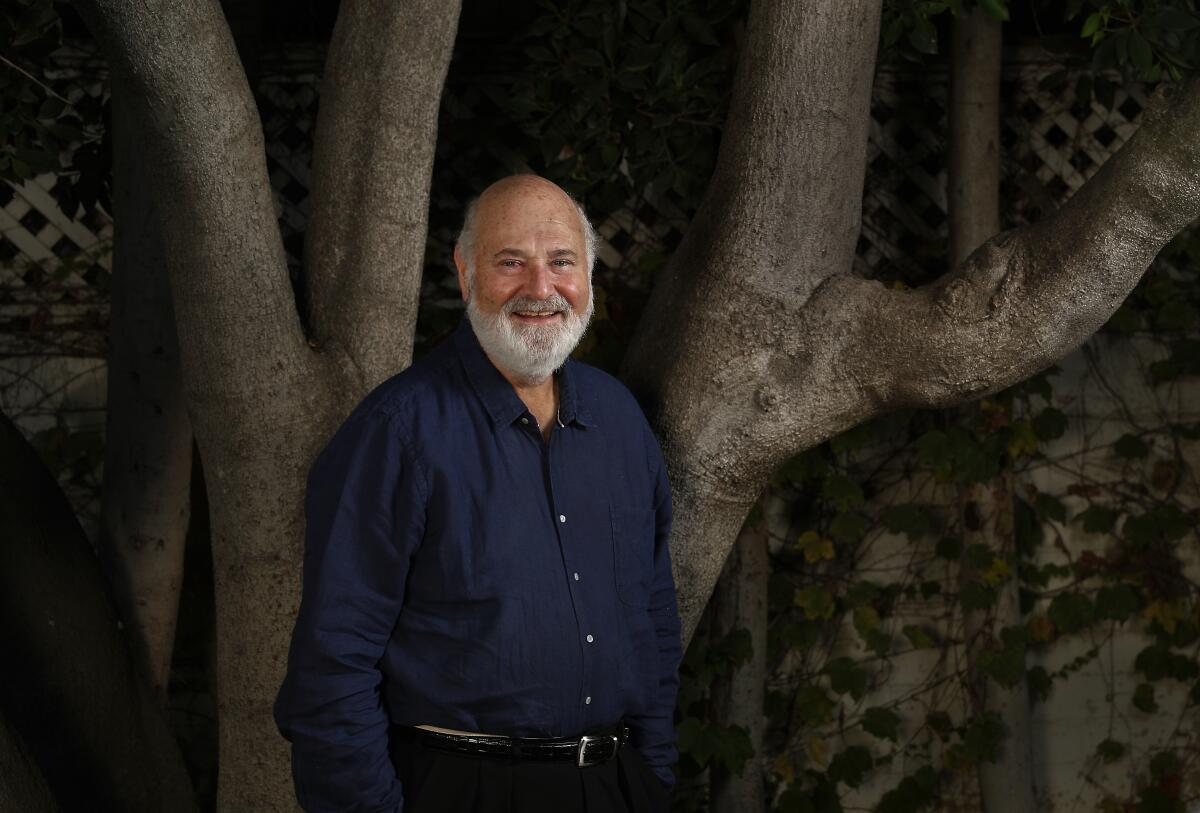
The weekend saw the tragic deaths of Hollywood legend Reiner and his wife, Michele. Their son, Nick Reiner, is currently in jail without bond and is facing murder charges. Normal people mourned the loss of a couple who delighted and improved the world with their creative and political work while trying to free Nick from the ravages of drug abuse and mental illness for most of his adult life.
Our president, of course, is not normal. He’s a weirdo who gets off on being mean. If there was a CruelHub, he’d be on it daily.
And so on the day after Romy Reiner found her parents’ bodies at their Brentwood home, Trump posted on social media that they died not due to stab wounds but “reportedly due to the anger [Rob] caused others through his massive, unyielding, and incurable affliction with a mind crippling disease known as TRUMP DERANGEMENT SYNDROME.”
The president doubled down on his crocodile tears to reporters at the Oval Office the day after, claiming Reiner “was very bad for our country” without offering any proof and describing the director of big-hearted film classics like “When Harry Met Sally…” and “The Princess Bride” as “deranged.”
We’re in the middle of the holiday season, a time when people traditionally slow down their lives to take stock of their blessings during the coldest and darkest time of the year and try to spread cheer to friends and strangers alike.
But goodwill is simply impossible for Trump. Where a moment calls for grace, he offers ethical filth. When tragedies inspire charity in the hearts of good people, the president makes it about himself.
While everyone is rightfully focusing on the ugly attacks Trump launched against Reiner and his wife, also telling about the president’s soul was the address he gave at a White House reception marking Christmas and the start of Hanukkah hours before news broke of the Reiners’ murder.
Trump offered lip service to those massacres before turning to the reason for the season:
Trump.
Actor, writer, director, producer and activist Rob Reiner photographed at his home in Brentwood in 2017.
(Mel Melcon / Los Angeles Times)
He insulted his predecessor, Joe Biden, and claimed his disastrous tariffs were paying off. He brought up Bryson DeChambeau so the U.S. Open golf champion could gush about how the president was a “great golfer [and] better human being.” The president plugged his planned arch for the nation’s capital that he claimed will “blow … away” the Arc de Triomphe in Paris. He bragged about winning over Latinos during the 2024 election — without mentioning that’s he’s already losing them, fast — and blasted the “fake news” for not appreciating the Christmas decorations of First Lady Melania Trump.
You would think Trump was running for president again instead of marking two important religious holidays. But Trump was being spiritual in a sense: he was practicing his true faith, which is smite.
The word and its conjugates appear hundreds of times in the Old Testament, spoken by an admittedly “jealous” God as he instructs the Israelites on how to treat their enemies, or used as a threat against the Israelites if they stray from his commands.
If Trump and his henchmen and henchwomen ever read the Bible, you might well bet they read only the parts that involved smiting.
Secretary of Defense Pete Hegseth — he of the medieval cross chest tattoo — continues to play Solomon as he authorizes the bombing of boats off the coasts of South America that he insists are carrying drugs while offering no justification other than his will that it be done. Immigration agents indiscriminately pick up citizens and noncitizens alike in pursuit of remigration, the far-right movement to make minority groups return to their ancestral countries in the name of white makes right.
Twice, the Department of Homeland Security has invoked the Book of Isaiah in social media campaigns to justify its scorched-earth approach to booting people from the country. Specifically, they have cited a verse where the prophet tells God “Here I am, send me” as Yahweh calls for a messenger to warn heretics of the hell he will rain down on them unless they repent. The most recent clip starred Border Patrol commander at large Gregory Bovino, he who has spread Trump’s fire-and-brimstone gospel of deportation.
Smiting and annihilation are the Gospel of Trump and they do play a big role in the Bible. But their ultimate redemption for Christians is what we’re gearing up to celebrate next week: the birth of Christ, the Son of God who came to the world to preach one should love thy enemy, bless the meek, renounce wealth and a whole bunch of other woke stuff.
Trump may not be the literal anti-Christ, but Trump sure is anti-Christian. He stands for and embodies everything that Jesus decried.
More and more Christian thought leaders are starting to understand this about Trump the more he rages. In the wake of Trump’s selfish sliming of the Reiners, Christianity Today editor at large Russell Moore slammed his “vile, disgusting, and immoral behavior” while conservative commentator and longtime Trump apologist Rod Dreher wrote “something is very, very wrong with this man.”
That’s a start. But more evangelical Christians, 80% of whom voted for him in the 2024 election, need to finally repent of blindly supporting him. They, more than any other group, have excused Trump’s sins.
They often compare him to major figures from the Bible and Christian heroes from the past — King David, Cyrus the Great, Constantine — who were imperfect but still did God’s will.
That’s laughable. This man isn’t just imperfect. We’re all that.
No, Trump is more than imperfect. He is a throbbing mass of malevolence, turned up — to reference Reiner’s “This Is Spinal Tap” — to 11.
Warner Bros. Discovery has sharply rejected Paramount’s latest offer, alleging the Larry Ellison family has failed to put real money behind Paramount’s $78-billion bid for Warner’s legendary movie studio, HBO and CNN.
Paramount “has consistently misled WBD shareholders that its proposed transaction has a ‘full backstop’ from the Ellison family,” Warner Bros. Discovery’s board wrote in a Wednesday letter to its shareholders filed with the Securities & Exchange Commission.
“It does not, and never has,” the Warner board said.
For Warner, what was missing was a clear declaration from Paramount that the Ellison family had agreed to commit funding for the deal. A Paramount representative was not immediately available for comment Wednesday.
The Warner auction has taken a nasty turn. Last week, Paramount launched a hostile takeover campaign for Warner after losing the bidding war to Netflix. Warner board members unanimously approved Netflix’s $72-billion deal for the Warner Bros. film and television studios, HBO and HBO Max.
In its letter, the Warner board reaffirmed its support for Netflix’s proposal, saying it represented the best deal for shareholders. Warner board members urged investors not to tender their shares to Paramount.
Board members said they were concerned that Paramount’s financing was shaky and the Ellison family’s assurances were far from ironclad. Warner also said Paramount’s proposal contained troubling caveats, such as language in its documents that said Paramount “reserve[d] the right to amend the offer in any respect.”
The Warner board argued that its shareholders could be left holding the bag.
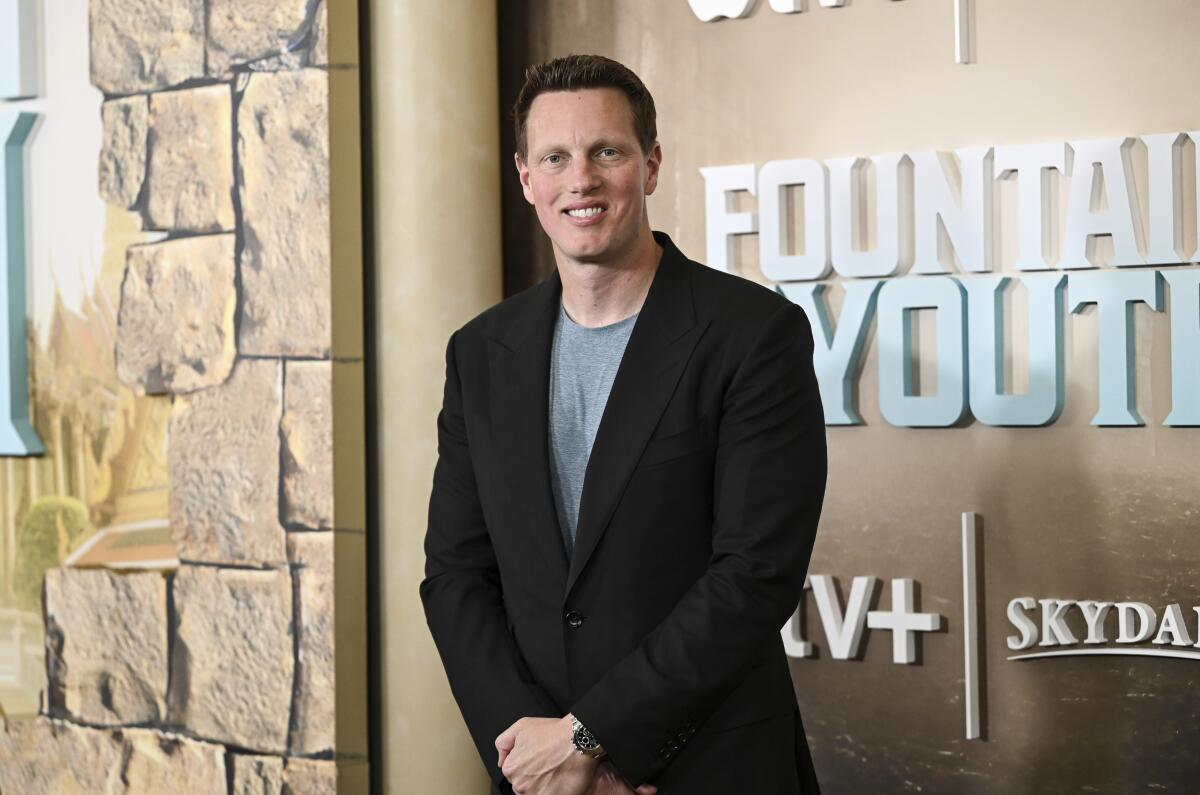
Paramount Chief Executive David Ellison has argued his $78-billion deal is superior to Netflix’s proposal.
(Evan Agostini / Evan Agostini/invision/ap)
Paramount Chairman David Ellison has championed Paramount’s strength in recent weeks saying his company’s bid for all of Warner Bros. Discovery, which includes HBO, CNN and the Warner Bros. film and television studios, was backed by his wealthy family, headed by his father, Oracle co-founder Larry Ellison, one of the world’s richest men.
In its letter last week to shareholders, asking for their support, Ellison wrote that Paramount delivered “an equity commitment from the Ellison family trust, which contains over $250 billion of assets,” including more than 1 billion Oracle shares.
In regulatory filings, Paramount disclosed that, for the equity portion of the deal, it planned to rely on $24 billion from sovereign wealth funds representing the royal families of Saudi Arabia, Qatar and Abu Dhabi as well as $11.8 billion from the Ellison family (which also holds the controlling shares in Paramount). This week, President Trump’s son-in-law Jared Kushner’s Affinity Partners private equity firm pulled out of Paramount’s financing team.
Paramount’s bid would also need more than $60 billion in debt financing.
Paramount has made six offers for Warner Bros., and its “most recent proposal includes a $40.65 billion equity commitment, for which there is no Ellison family commitment of any kind,” the Warner board wrote.
“Instead, they propose that [shareholders] rely on an unknown and opaque revocable trust for the certainty of this crucial deal funding,” the board said.
Throughout the negotiations, Paramount, which trades under the PSKY ticker, failed to present a solid financing commitment from Larry Ellison — despite Warner’s bankers telling them that one was necessary, the board said.
“Despite … their own ample resources, as well as multiple assurances by PSKY during our strategic review process that such a commitment was forthcoming – the Ellison family has chosen not to backstop the PSKY offer,” Warner’s board wrote.
Board members argued that a revocable trust could always be changed. “A revocable trust is no replacement for a secured commitment by a controlling stockholder,” according to the board letter.
David Ellison has insisted Paramount’s Dec. 4 offer of $30 a share was superior to Netflix’s winning bid. Paramount wants to buy all of Warner Bros. Discovery, while Netflix has made a deal to take Warner’s studios, its spacious lot in Burbank, HBO and HBO Max streaming service.
Paramount’s lawyers have argued that Warner tipped the auction to favor Netflix.
Paramount, which until recently enjoyed warm relations with President Trump, has long argued that its deal represents a more certain path to gain regulatory approvals. Trump’s Department of Justice would consider any anti-trust ramifications of the deal, and in the past, Trump has spoken highly of the Ellisons.
However, Warner’s board argued that Paramount might be providing too rosy a view.
“Despite PSKY’s media statements to the contrary, the Board does not believe there is a material difference in regulatory risk between the PSKY offer and the Netflix merger,” the Warner board wrote. “The Board carefully considered the federal, state, and international regulatory risks for both the Netflix merger and the PSKY offer with its regulatory advisors.”
The board noted that Netflix agreed to pay a record $5.8 billion if its deal fails to clear the regulatory hurdles.
Paramount has offered a $5 billion termination fee.
Should Warner abandon the transaction with Netflix, it would owe Netflix a $2.8 billion break-up fee.
Warner also pointed to Paramount’s promises to Wall Street that it would shave $9 billion in costs from the combined companies. Paramount is in the process of making $3 billion in cuts since the Ellison family and RedBird Capital Partners took the helm of the company in August.
As the Palisades fire raged, then-Los Angeles Fire Department Chief Kristin Crowley went on a television blitz, calling out city leadership for systematically underfunding her agency.
The LAFD, she said, didn’t have enough firefighters, based at enough fire stations, to quench the wind-driven flames that were tearing through the hills.
“We need more. This is no longer sustainable,” she said in one interview Jan. 10.
Nearly a year after the fire destroyed much of the Palisades, LAFD officials continue to highlight financial concerns, with Crowley’s successor requesting a 15% budget increase and the firefighters union proposing a sales tax that could bring in an extra $300 million per year.
A Jan. 9 aerial view of neighborhoods destroyed by the Palisades fire.
(Robert Gauthier / Los Angeles Times)
But the LAFD’s hyper-focus on money obscures its leaders’ failures in managing the resources they had, beginning with a decision to leave the scene of a New Year’s Day fire despite signs it hadn’t been fully extinguished.
Days later, that fire reignited into the Palisades fire, which killed 12 people and destroyed thousands of homes. Despite forecasts of catastrophically high winds, LAFD officials didn’t pre-deploy engines in the area or increase manpower by ordering a previous shift of firefighters to stay on duty.
As the flames spread, the firefighting response was disorganized and chaotic, with the LAFD’s own after-action reportdescribing major failures by high-ranking commanders in communication, staffing and basic wildland firefighting knowledge.
City leaders have highlighted changes they have made since the fire, including appointing 30-year LAFD veteran Jaime Moore as chief and drafting new protocols for staffing on high hazard weather days.
But the question remains: Is Los Angeles prepared for the next major wildfire? Some city officials and fire experts don’t think so, pointing to an LAFD that hasn’t evolved with the times and an incomplete review of how the Palisades fire started.
Moore, who was appointed chief last month, declined to comment.
Mayor Karen Bass said in an interview earlier this month that the city is “on the path to be completely ready” for a major wildfire, with the LAFD now taking a more proactive approach to weather warnings.
“The Fire Department has been way more aggressive, has done pre-deployment, has been very visible, alerts going out early, trying to be very, very aggressive,” she said.
But Genethia Hudley Hayes, president of the Board of Fire Commissioners, said that the LAFD is still unprepared and that there hasn’t been enough time to make the necessary changes. She cited the LAFD’s technology, which she said is about two decades behind.
“I am not confident there would be a different result” if a similar disaster strikes, she said.
City Councilmember Traci Park, whose district includes Pacific Palisades and who has advocated for more Fire Department funding, agreed with Hudley Hayes.
Some essential changes have been made, such as requiring firefighters to stay for an additional shift during red flag warnings, Park said. But she said that too many fire engines are out of service, there are not enough mechanics, and most important, questions about the origin of the Palisades fire remain unanswered.
In October, after federal prosecutors charged a former Palisades resident with deliberately setting the Jan. 1 Lachman fire, The Times reported that a battalion chief ordered firefighters to roll up their hoses and leave the burn area on Jan. 2, even though they had complained that the ground was still smoldering and rocks remained hot to the touch. The Times reviewed text messages among firefighters and a third party, sent in the weeks and months after the fire, describing the crew’s concerns.
The LAFD’s after-action report, released in October, only briefly mentioned the Lachman fire. Critics have flagged this as a crucial lapse in the report, which prevents the department from figuring out what went wrong and avoiding the same mistakes.
Mayor Karen Bass, right, and then-Fire Chief Kristin Crowley speak during a news conference in January. Bass ousted Crowley less than two months after the Palisades fire.
(Allen J. Schaben / Los Angeles Times)
Bass had ousted Crowley less than two months after the Palisades fire, citing the LAFD’s failure to properly deploy resources ahead of the winds and potentially have a chance to extinguish the fire before it exploded out of control, an issue that was exposed by a series of reports in The Times.
Bass also countered Crowley’s financial complaints, saying that the budget did not affect the department’s ability to fight the fire. The LAFD’s 2024-25 budget had actually increased 7% from the previous year, due in part to generous firefighter raises.
More money won’t solve bad decision-making by top officials, said Marc Eckstein, an emergency physician who served as LAFD’s medical director and commander of its emergency medical services bureau until he retired in 2021.
He said that without transparency and accountability, “the fallback is always going to be what it has been: We need more of everything — more people, more money, more fire trucks, more fire stations.”
A modern fire agency needs the flexibility to surge its staff during a disaster, he said, while also addressing day-to-day needs. Most 911 calls are for medical problems, he said, yet the LAFD functions more or less the same as it did decades ago, when structure fires were more common.
He said a panel of outside experts should have been given access to the LAFD’s records to offer an unbiased look at how the department performed leading up to and during the Palisades fire.
“And it’s a playbook. OK, how do we prevent this from happening again?” he said. “And the fact that didn’t happen is a disgrace.”
How much the department transforms after the Palisades disaster will depend, in large part, on its new chief. Moore, who joined the LAFD in 1995 and most recently was deputy chief of the Operations Valley Bureau, was chosen by Bass to lead the department over a fire chief from a major city outside California.
At stations around L.A., firefighters told Bass that they wanted an insider for the job, which she said factored into her decision.
“Given that the Fire Department was under such scrutiny, such a difficult time, morale is in the toilet, infighting that’s going on, the last thing in the world they needed, in my opinion, was somebody from the outside,” Bass told The Times.
Moore had signaled before his appointment was confirmed last month that he was troubled by the LAFD’s missteps with the Lachman fire and was going to bring in an outside organization to investigate.
But the following week, he appeared to change course, alleging that the media was trying to “smear” firefighters while saying he still planned to investigate the Lachman fire.
Moore will be in charge of implementing the 42 recommendations in the after-action report, which range from establishing better communication channels to how to defend homes where hidden embers could ignite.
The report drew the conclusion that top LAFD commanders had startlingly little knowledge about combating wildfires, including “basic suppression techniques.” It suggested that all LAFD members undergo training on key skills such as structure defense and how to draw water from swimming pools when hydrants don’t work.
In an interview with ABC7, Moore said that the LAFD has adopted about three-quarters of the recommendations and is considering creating a division specializing in wildland fires.
Members of Crew 4, the department’s new full-time wildland hand crew, practice cutting fire lines near Green Verdugo Fire Road in Sunland.
(Myung J. Chun / Los Angeles Times)
Since the Palisades fire, the LAFD has hired a 26-member wildland hand crew that uses chainsaws and other tools to chop paths through brush to stop a fire from spreading. When they aren’t battling fires, they do brush clearance throughout the city.
Earlier this month, as hand crew members practiced cutting fire lines through the brush in Sunland, the crew’s leader, Supt. Travis Humpherys, declined to say whether they would have changed the outcome of the Palisades fire.
Travis Humpherys is the Crew 4 superintendent.
(Myung J. Chun / Los Angeles Times)
But they have already “made a dramatic impact” with brush clearance and fighting wildfires, including a 20-acre fire in Burbank in June, Humpherys said.
Moore’s requested budget of more than $1 billion for the coming year — a 15% increase over this year’s budget — includes money for a second wildland hand crew, as well as nearly 200 additional firefighter recruits and helitanker services to attack fires from the air. That amount could be pared down during the months-long city budgeting process, as the City Council and the mayor find ways to balance the overall budget amid financial headwinds.
Meanwhile, United Firefighters of Los Angeles City Local 112 is charting an ambitious course to reduce the department’s dependency on the city budget, pushing for a ballot measure that, if approved by voters in November 2026, would raise nearly $10 billion by 2050 through a half-cent sales tax. But after the LAFD’s failures in the Palisades fire, some voters may be reluctant to entrust its leaders with more money.
“It’s hard to believe that we are fully prepared for the next major emergency,” Doug Coates, the union’s acting president, said in a statement. “We desperately need more firefighters and paramedics, more trucks, engines, and ambulances and more wildfire resources and neighborhood fire stations.”
E. Randol Schoenberg, whose family lost four homes in the fire, including his in Malibu — along with documents that belonged to his grandfather, the composer Arnold Schoenberg — said he would be happy to pay more taxes for more services.
But Schoenberg, an attorney who is representing Palisades fire victims in a lawsuit against the city and the state, said he expects the LAFD to honestly examine its mistakes.
“If they don’t really grapple with the issues of how this happened, then no matter how much money we throw at it, it’s going to happen again,” he said.
Times staff writer David Zahniser contributed to this report.
WASHINGTON — A Minneapolis jury’s conviction of former Minneapolis Police Officer Derek Chauvin in the murder of George Floyd has reignited debate about what policing should look like in the United States.
In the weeks following Floyd’s death and the ensuing outrage that caused millions of Americans to pour into the streets to protest in the midst of a pandemic, Congress promised fundamental change to policing.
There was legislation to standardize training across the country, to keep problem officers from moving between departments without their records following them, to ban the use of chokeholds and no-knock warrants.
Negotiations for a bipartisan deal on police reform continue informally on Capitol Hill, and the lead House sponsor, Rep. Karen Bass (D-Los Angeles), said on CNN’s “State of the Union” on Sunday that she is hopeful because those involved are “very sincere, and it’s a bipartisan group.”
Bass is working with Sens. Cory Booker (D-N.J.) and Tim Scott (R-S.C.). She told reporters on Capitol Hill on Tuesday that she is optimistic they will reach an agreement and get a bill to President Biden’s desk in the coming months.
“I believe that we want to make something happen,” Bass said.
Last month the House passed Bass’ George Floyd Justice in Policing Act by a 220-212 vote, with no Republican support and two Democrats voting no.
The legislation, which would ban chokeholds, end “qualified immunity” for law enforcement officers and create national standards for policing in a bid to bolster accountability, passed the House last summer but was not considered by the Republican-controlled Senate.
Democrats in turn blocked consideration of a Republican policing reform bill proposed by Scott last summer, saying though it was similar to their proposal in some ways, it did not go far enough because it did not modify so-called qualified immunity for police officers, which has made it harder for victims of brutality to file civil lawsuits over excessive force, or make it easier to prosecute police officers for criminal behavior.
Even now that Democrats control the Senate, hurdles remain for passing policing reform out of the Senate, where most legislation faces a 60-vote threshold, Bass said.
“It’s one thing to pass legislation in the House; it’s a super hurdle to get it passed in the Senate,” Bass said in the CNN interview. “But we are working.”
A coalition of Eaton fire survivors and community groups called on Southern California Edison on Tuesday to provide immediate housing assistance to the thousands of people who lost their homes in the Jan. 7 wildfire.
The coalition says an increasing number of Altadena residents are running out of insurance coverage that had been paying for their housing since they were displaced by the fire. Thousands of other residents had no insurance.
“When a company’s fire destroys or contaminates homes, that company has a responsibility to keep families housed until they can get back home,” said Joy Chen, executive director of the Eaton Fire Survivors Network, one of the coalition members asking Edison for emergency assistance of up to $200,000 for each family.
At the coalition’s press conference, Altadena residents spoke of trying to find a place to live after the Jan. 7 fire that killed at least 19 people and destroyed more than 9,000 homes, apartments and other structures. Thousands of other homes were damaged by smoke and ash.
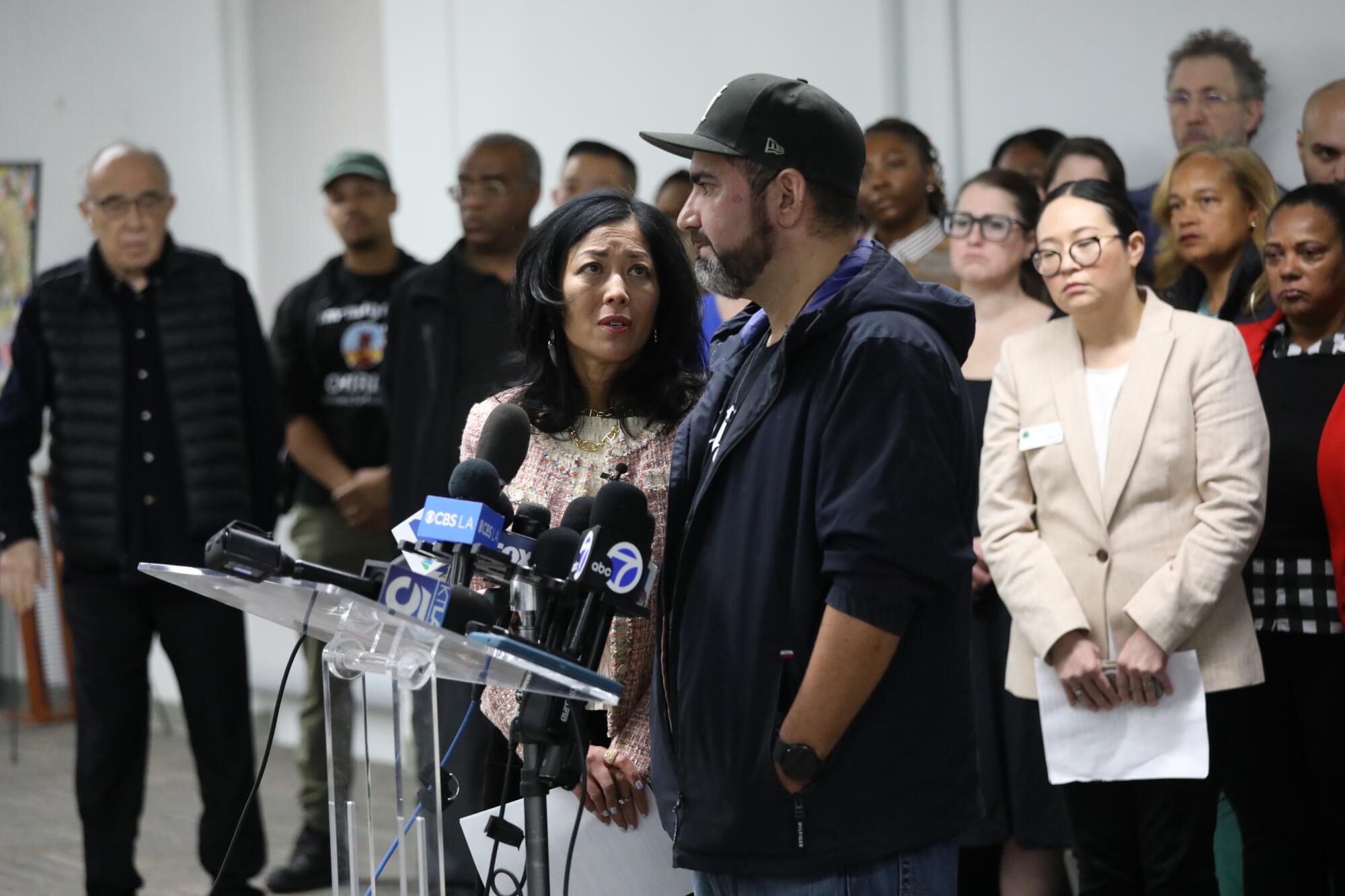
Gabriel Gonzalez, center, an Eaton Fire survivor, shown with Joy Chen, Executive Director of the Eaton Fire Survivors Network (EFSN), left, and other survivors at a press conference in Altadena. They urged Southern California Edison to provide urgent housing relief to keep Eaton Fire families housed this winter.
(Gary Coronado/For The Times)
Gabriel Gonzalez said he had been living in his car for most of the last year.
Before the fire, Gonzalez had a successful plumbing company with six employees, he said. He had moved into an apartment in Altadena just a month before the fire and lost $80,000 worth of tools when the building was destroyed.
His insurance did not cover the loss, Gonzalez said, and he lost his business.
Edison is now offering to directly pay fire victims for their losses if they give up their right to file a lawsuit against the utility.
But members of the coalition say Edison’s program is forcing victims who are most desperate for financial support to give up their legal right to fair compensation.
Andrew Wessels, Strategy Director for the Eaton Fire Survivors Network, speaks about Edison’s Wildfire Recovery Compensation Plan (WRCP).
(Gary Coronado/For The Times)
“If families are pushed to give up what they are owed just to survive, the recovery will never have the funds required to rebuild homes, restore livelihoods or stabilize the community,” said Andrew Wessels. He said he and his family had lived in 12 different places since the fire left ash contaminated with lead on and in their home.
In an interview Tuesday, Pedro Pizarro, chief executive of Edison International, the utility’s parent company, said the company would not provide money to victims without them agreeing to drop any litigation against the company for the fire.
“I can’t even pretend to understand the challenges victims are going through,” Pizarro said.
He said the company created its Wildfire Recovery Compensation Program to get money to victims much faster than if they filed a lawsuit and waited for a settlement.
“We want to help the community rebuild as quickly as possible,” he said.
Pizarro said Edison made its first payment to a victim within 45 days of the compensation program launching on Oct. 29. So far, he said, the company has received more than 1,500 claims.
The company has said a leading theory is that its century-old transmission line in Eaton Canyon, which it last used in 1971, briefly became energized from the live lines running parallel to it, sparking the fire.
The program offers to reimburse victims for their losses and provides additional sums for pain and suffering. It also gives victims a bonus for agreeing to settle their claim outside of court.
Pizarro said the program is voluntary and if victims don’t like the offer they receive from Edison, they can continue their claims in court.
Edison has told its investors that it believes it will be reimbursed for all of its payments to victims and lawsuit settlements by $1 billion in customer-paid insurance and a $21 billion state wildfire fund.
Zaire Calvin, of Altadena, a survivor who has lost his home and other properties, speaks.
(Gary Coronado/For The Times)
Gov. Gavin Newsom and lawmakers created the wildfire fund in 2019 to protect utilities from bankruptcy if their electric wires cause a disastrous wildfire.
State officials say the fund could be wiped out by Eaton fire damages. While the first $21 billion was contributed half by customers of the state’s three biggest for-profit utilities and half by the companies’ shareholders, any additional damage claims from the Jan. 7 fire will be paid by Edison customers, according to legislation passed in September.
Some Altadena residents say Edison’s compensation program doesn’t pay them fully for their losses.
Damon Blount said that he and his wife had just renovated their home before it was destroyed in the fire. They don’t believe Edison’s offer would be enough to cover that work.
Blount said he “felt betrayed” by the utility.
“They literally took everything away from us,” Blount said. “Do the right thing, Edison. We want to be home.”
At the press conference, fire victims pointed out that Edison reported nearly $1.3 billion in profits last year, up from $1.2 billion in 2023.
Last week, Edison International said it was increasing the dividend it pays to its shareholders by 6% because of its strong financial performance.
“Their stock is rising,” said Zaire Calvin, one of the Altadena residents calling on Edison for emergency relief. Calvin lost his home and his sister died in the fire. “They will not pay a penny when this is over.”
When word came of Rob Reiner’s senseless death, America fell into familiar rites of mourning and remembrance. A waterfall of tributes poured in from the twin worlds — Hollywood and politics — that the actor, director and liberal activist inhabited.
Trump’s response, fairly shimmying on Reiner’s grave as he wrongly attributed his death to an act of political vengeance, managed to plumb new depths of heartlessness and cruelty; more than a decade into his acrid emergence as a political force, the president still manages to stoop to surprise.
But as vile and tasteless as Trump’s self-pitying statement was — Reiner, he averred, was a victim of “Trump Derangement Syndrome” and, essentially, got what he deserved — it also pointed out a singular truism of his vengeful residency in the Oval Office.
Still, each acted as though he was a president of all the people, not just those who voted him into office, contributed lavishly to his campaign or blindly cheered his every move, however reckless or ill-considered.
As Trump has repeatedly made clear, he sees the world in black-and-white, red-versus-blue, us-versus-them.
By noteworthy contrast, when a gunman killed Minnesota’s Democratic former House speaker, Melissa Hortman, Trump couldn’t be bothered with even a simple act of grace. Asked if he’d called to offer his condolences to Minnesota Gov. Tim Walz, a personal friend of Hortman, Trump responded, “Why waste time?”
This is not normal, much less humane.
This is not politics as usual, or someone rewarding allies and seeking to disadvantage the political opposition, as all presidents have done. This is the nation’s chief executive using the immense powers of his office and the world’s largest, most resonant megaphone to deliver retribution, ruin people’s lives, inflict misery — and revel in the pain.
There were the usual denunciations of Trump’s callous and contemptuous response to Reiner’s stabbing death.
“I’d expect to hear something like this from a drunk guy at a bar, not the president of the United States,” said Republican Rep. Don Bacon of Nebraska, who is retiring rather than seeking reelection in 2026. (Which may be why he was so candid and spoke so bracingly.)
But this time, the criticisms did not just come from the typical anti-Trump chorus, or heterodox Republicans like Bacon and MAGA-stalwart-turned-taunter Marjorie Taylor Greene. Even some of the president’s longest and loudest advocates felt compelled to speak out.
“This is a dreadful thing to say about a man who just got murdered by his troubled son,” British broadcaster Piers Morgan posted on X. “Delete it, Mr. President.”
More telling, though, was the response from the Republican Party’s leadership.
“I don’t have much more to say about it, other than it’s a tragedy, and my sympathies and prayers go out to the Reiner family and to their friends,” Senate Majority Leader John Thune told CNN when asked about Trump’s response. House Speaker Mike Johnson responded in a similarly nonresponsive vein.
Clearly, the see-and-hear-no-evil impulse remains strong in the upper echelons of the GOP — at least until more election returns show the price Republicans are paying as Trump keeps putting personal vendettas ahead of voters’ personal finances.
One of the enduring reasons supporters say they back the president is Trump’s supposed honesty. (Never mind the many voluminously documented lies he has told on a near-constant basis.)
Honesty, in this sense, means saying things that a more temperate and careful politician would never utter, and it’s an odd thing to condone in the nation’s foremost leader. Those with even a modicum of caring and compassion, who would never tell a friend they’re ugly or call a neighbor stupid — and who expect the same respect and decency in return — routinely ignore or explain away such casual cruelty when it comes from this president.
Those who insist Trump can do no wrong, who defend his every foul utterance or engage in but-what-about relativism to minimize the import, need not remain in his constant thrall.
When Trump steps so egregiously over a line, when his malice is so extravagant and spitefulness so manifest — as it was when he mocked Reiner in death — then, even the most fervent of the president’s backers should call him out.
Do it, and reclaim a little piece of your humanity.
WASHINGTON — President Trump’s chief of staff is defending herself after granting an extraordinarily candid series of interviews with Vanity Fair in which she offers stinging judgments of the president himself and blunt assessments about his administration’s shortcomings.
The profile of Susie Wiles, Trump’s reserved, influential top aide since he resumed office, caused scandal in Washington and prompted a crisis response from the White House that involved nearly every single figure in Trump’s orbit issuing a public defense.
In 11 interviews conducted over lunches and meetings in the West Wing, Wiles described early failures and drug use by Elon Musk during his time in government, mistakes by Atty. Gen. Pam Bondi in her public handling of the Jeffrey Epstein files, and acknowledged that Trump had launched a retribution campaign against his perceived political enemies.
“I don’t think he wakes up thinking about retribution,” Wiles told Chris Whipple, the Vanity Fair writer who has written extensively on past chiefs of staff, “but when there’s an opportunity, he will go for it.”
Wiles also cited missteps in the administration’s immigration crackdown, contradicted a claim Trump makes about Epstein and former President Clinton and described Vice President JD Vance as a “conspiracy theorist.”
Within hours of the Vanity Fair tell-all publishing on Tuesday, Wiles and key members of Trump’s inner circle mounted a robust defense of her tenure, calling the story a “hit piece” that left out exculpatory context.
“The article published early this morning is a disingenuously framed hit piece on me and the finest President, White House staff, and Cabinet in history,” Wiles said in a post on X, her first in more than a year. “Significant context was disregarded and much of what I, and others, said about the team and the President was left out of the story.”
The profile was reported with the knowledge and participation of other senior staff, and illustrated with a photograph of Wiles and some of Trump’s closest aides, including Vance, Bondi and advisor Stephen Miller.
The profile revealed much about a chief of staff who has kept a discreet profile in the West Wing, continuing her management philosophy carried through the 2024 election when she served as Trump’s last campaign manager: She let Trump be Trump. “Sir, remember that I am the chief of staff, not the chief of you,” she recalled telling the president.
Trump has publicly emphasized how much he values Wiles as a trusted aide. He did so at a rally last week where he referred to her as “Susie Trump.” In an interview with Whipple, she talked about having difficult conversations with Trump on a daily basis, but that she picks her battles.
“So no, I’m not an enabler. I’m also not a bitch. I try to be thoughtful about what I even engage in,” Wiles said. “I guess time will tell whether I’ve been effective.”
Despite her passive style, Wiles shared concern over Trump’s initial approach to tariff policy, calling the levies “more painful than I had expected.” She had urged him, unsuccessfully, to get his retribution campaign out of the way within his first 90 days in office, in order to enable the administration to move on to more important matters. And she had opposed Trump’s blanket pardon of Jan. 6 defendants, including those convicted of violent crimes.
Wiles also conceded the administration needs to “look harder at our process for deportation,” adding that in at least one instance mistakes were made when Immigration and Customs Enforcement agents arrested and deported two mothers and their American children to Honduras. One of children was being treated for Stage 4 cancer.
“I can’t understand how you make that mistake, but somebody did,” she said.
In foreign policy, Wiles defended the administration’s attack on alleged drug boats in the Caribbean Sea and said the president “wants to keep on blowing up boats up until [Venezuelan President Nicolás] Maduro cries uncle,” suggesting the end goal is to seek a regime change.
As Trump has talked about potential land strikes in Venezuela, Wiles acknowledged that such a move would require congressional authorization.
“If he were to authorize some activity on land, then it’s war, then [we’d need] Congress,” she said.
In one exchange with Whipple, she characterized Trump, who abstains from liquor, as having an “alcoholic’s personality,” explaining that “high-functioning alcoholics, or alcoholics in general, their personalities are exaggerated when they drink.”
He “operates [with] a view that there’s nothing he can’t do. Nothing, zero, nothing,” she said.
But Trump, in an interview with the New York Post, defended Wiles and her comments, saying that he would indeed be an alcoholic if he drank alcohol.
“She’s done a fantastic job,” Trump said. “I think from what I hear, the facts were wrong, and it was a very misguided interviewer — purposely misguided.”
Wiles also blamed the persistence of the Epstein saga on members of Trump’s own Cabinet, noting that the president’s chosen FBI director, Kash Patel, had advocated for the release of all Justice Department files related to the investigation for many years. Despite Trump’s claims that Clinton visited the disgraced financier and convicted sex abuser’s private island, Wiles acknowledged, Trump is “wrong about that.”
Wiles added that Bondi had “completely whiffed” on how she handled the Epstein files, an issue that has created a rift within MAGA.
“First she gave them binders full of nothingness. And then she said that the witness list, or the client list, was on her desk. There is no client list, and it sure as hell wasn’t on her desk,” Wiles said.
Wiles added that she has read the investigate files about Epstein, and acknowledged that Trump is mentioned in them, but said “he’s not in the file doing anything awful.”
Vance, who she said had been a “conspiracy theorist for a decade,” said he had joked with Wiles about conspiracies in private before offering her praise.
“I’ve never seen Susie Wiles say something to the president and then go and counteract him or subvert his will behind the scenes. And that’s what you want in a staffer,” Vance told reporters. “I’ve never see her be disloyal to the president of the United States and that makes her the best White House chief of staff that the president could ask for.”
Russell Vought, the director of the Office of Management and Budget who Wiles described to Whipple as a “right-wing absolute zealot,” said in a social media post that she is an “exceptional chief of staff.” Karoline Leavitt, the White House press secretary, said the “entire administration is grateful for her steady leadership and united fully behind her.”
Wiles told Vanity Fair that she would be happy to stay in the role for as long as the president wanted her to stay, noting that she has time to devote to the job, being divorced and with her kids out of the house.
Trump had a troubled relationship with his chiefs of staff in his first term, cycling through four in four years. His longest-serving chief of staff, former Gen. John Kelly, served a year and a half.
When bidding farewell to the nation in January, President Obama urged perseverance in the face of political change.
“If you’re disappointed by your elected officials, grab a clipboard, get some signatures and run for office yourself,” he said.
Dozens of people who worked in his administration or on his presidential bids have taken that call to action to heart, with several top political aides, policy staff and ambitious millennials from the Obama era mounting campaigns of their own right here in California. All are Democrats, and some of their races could be tipping points in the 2018 midterms as the party attempts to win back control in Washington.
Among the former government officials is Ammar Campa-Najjar, who is seeking to oust Republican Rep. Duncan Hunter in San Diego County.
Born in the U.S. to a Mexican mother and a Palestinian father, Campa-Najjar recalls questioning if his fellow Americans would ever truly accept him in the aftermath of the Sept. 11 terrorist attacks.
He brooded and struggled, but his faith was renewed when another biracial man with a unique name and an absent father, Barack Obama, won the presidency of the United States.
“In 2008, the country said, ‘Yes, we can,’ and elected this skinny brown kid with a funny name. It really kind of inspired me,” said Campa-Najjar, 28.
In the short term, that resulted in Campa-Najjar interning at the White House, where he was assigned the task of reading the letters Americans sent the president about their heartbreak and their victories, and helping select the 10 that were sent to Obama for him to read himself daily. He later worked in the Department of Labor and on Obama’s 2012 reelection campaign.
Today, he is among the youngest congressional candidates in the nation. And he is one of several former Obama campaign and administration officials who are running for office across the nation at all levels of government.
It’s not unusual for political staffers to seek elected office, but the number of Obama alumni who have entered the field for the 2018 election is notable. In California alone, there are at least four congressional candidates who worked for Obama, as well as several others seeking legislative and statewide posts.
President Obama in his farewell address urged listeners unhappy with their representatives to “run for office yourself.” (Zbigniew Bzdak / TNS)
(Zbigniew Bzdak / TNS)
Ammar Campa-Najjar is trying to oust Republican Rep. Duncan Hunter in San Diego County. (Hayne Palmour IV / San Diego Union-Tribune)
(Hayne Palmour IV / San Diego Union-Tribune file)
Their campaigns are driven by the election of President Trump, fewer opportunities in Washington, D.C., with Republicans in control of the White House and Congress, and the desire to protect and build upon the former president’s legacy.
“Coming out of the Obama administration, people are particularly motivated by what Donald Trump has been trying to do to this country,” said Bill Burton, who served as a spokesman for Obama during the 2008 campaign and his first term in office and is now a Democratic operative in Southern California.
He added that early Obama supporters who signed on at a time when Hillary Clinton was perceived as the unstoppable nominee have already shown a natural willingness to take on long odds, a quality that can help them achieve their own political goals.
“When I started working for [Obama], the only person in America who thought he was going to win the Iowa caucuses was him,” Burton said.
The congressional candidates in California are all running in districts historically dominated by the GOP.
Sam Jammal is trying to defeat Rep. Ed Royce (R-Fullerton), who has represented Orange County in Congress for nearly 25 years. Jammal said his experience growing up in the district as the child of immigrants, attending law school and then working on Obama’s 2008 campaign and in the Department of Commerce proved to him that anything is possible.
Sam Jammal, a former staffer in President Obama’s Commerce Department, is now a congressional candidate in Orange County.
(Sam Jammal)
“Our story is the embodiment of that,” said Jammal, whose parents are from Jordan and Colombia. “The same day my dad landed here, he was working at a gas station …. For me, his youngest son, I was able to work for the president of the United States. My proudest moment in the administration was taking my parents to a White House naturalization ceremony where they were able to meet President Obama. It’s full circle.”
Others, including Eleni Tsakopoulos Kounalakis, said they expected Clinton to win the November 2016 election, giving them the opportunity to work for the first woman president. The experiences the Sacramento-area native had as Obama’s ambassador to Hungary cemented her desire to continue working in public life once he left office.
“It took me a few months after the election to recalculate how I could best serve,” said Kounalakis, who is one of two Obama alumni running for lieutenant governor. “It [became] clear: It was more important than ever that California lead the way on our values, whether it’s fighting for the climate or supporting and celebrating our immigrant community and our LGBT community.”
Trump’s actions since taking office, including trying to institute a travel ban on people from several Muslim-majority nations and withdrawing from the Paris climate accord, quickened the Obama alums’ resolve. But nearly all said Trump’s recent statements placing neo-Nazis and white supremacists who violently protested in Charlottesville on the same moral plane as those who protested against them exemplified why they decided to run.
“What has happened … with this presidency and what Donald Trump stands for and believes in is in such stark contrast to everything we worked on for eight years,” said Buffy Wicks, a grass-roots organizer who worked on Obama’s campaigns and as the White House deputy director of public engagement. She is now running for the California Assembly.
But an impressive political résumé is no guarantee of success.
Ultimately, the races will come down to how voters connect with the politicians and their policies, said Massachusetts state Sen. Eric Lesser, who went from shepherding luggage during the 2008 campaign to working steps from the Oval Office as the top aide to one of Obama’s must trusted advisors, David Axelrod.
“Show, don’t tell. You have to be elected on your own merits and your own vision, and ideas for your community,” he said.
While Lesser speaks reverently about his time working for Obama and Axelrod and the counsel he received from them during his 2014 campaign, he noted that voters want to hear how a candidate is going to address their needs, not about his time in Washington.
“Expecting people to suddenly be impressed or suddenly open doors because of a previous fancy job is not going to happen,” he said.
Expecting people to suddenly be impressed or suddenly open doors because of a previous fancy job is not going to happen.
— Eric Lesser, former Obama White House aide elected to the Massachusetts state Senate in 2014
Eleni Tsakopoulos Kounalakis, then the U.S. ambassador to Hungary, waves rainbow flags at a gay pride march in Budapest in 2012. She’s now running for lieutenant governor in California.
(Peter Kollanyi / Associated Press)
Lesser recalled that when he mounted his 2014 run, the best advice he received was from Obama, who told him to outhustle his rivals and connect with the people who would become his constituents.
“He asked, ‘How many people are in the district? How many households? How many doors?” Lesser said. “When I ran the numbers, he goes, ‘You can meet all those people.’ I haven’t quite met everyone, but I took his advice to heart.”
Reed Galen, who worked for President George W. Bush, said that while some administration posts could be particularly relevant to a race — one Obama administration official who worked on the auto industry bailout is now running for Congress in Michigan, for example — most candidates with such experience probably worked in a vast bureaucracy that few voters know or care about.
“My guess is most of these folks, the best thing they have going for them is a picture of them and the president [that shows] Barack Obama reasonably knows who I am,” said Galen, a former California GOP operative who worked on both of Bush’s campaigns and in his administration.
The greater advantages, he said, are the relationships forged with donors, leaders, strategists and the alumni network that remains tightly knit after their tenure ends.
Wicks’ fundraisingreport illustrates the political value of the connections that come from working for Obama. Axelrod, elected officials including former Rep. Gabby Giffords of Arizona, and scores of people from Washington, D.C., have donated to her campaign, names unlikely to appear on the donor list for most other California legislative candidates.
Buffy Wicks, center, who worked in the Obama White House and for the Obama and Hillary Clinton campaigns, is running for the state Assembly.
(Kirk McKoy / Los Angeles Times)
Wicks’ campaign also follows a grass-roots blueprint she helped craft for Obama when he was unknown, introducing himself to voters in diners and coffee shops and talking about their concerns.
“I’m doing house parties all over the district, really spending a lot of time in living rooms, 20 to 30 people at a time and having a really thoughtful conversation about what kind of community do we want to live in,” she said. “It’s a way to build relationships with voters, investing on the front end of that relationship and not just plying you with direct mail pieces and television ads.”
And for those who lack Wicks’ campaign experience, the connections to some of the top Democrats in the nation is invaluable.
“When you haven’t been an elected official before, you have a lot of questions .… You understand the policies, you know what your positions are, but the actual architecture of running a campaign is something that’s inherently new,” said Brian Forde, who worked on technology in the Obama administration and is now trying to topple Republican Rep. Mimi Walters in Orange County.
“What’s most helpful is being able to pick up the phone or send a text message to a friend who was a speechwriter for the president or the first lady, or someone who did work on communications who does understand all of these things because they worked on the campaign,” Forde said.
Get ready for what could be a consequential week in the effort by President Trump to get Judge Brett Kavanaugh confirmed to the United States Supreme Court.
Simply put: Does an allegation from the jurist’s high school days carry enough weight to sully — or perhaps derail — his nomination? Will the woman who has made the accusation bring her story to Washington?
On Sunday, a Palo Alto psychologist said she was the one who wrote the letter to Sen. Dianne Feinstein alleging sexual assault by Kavanaugh when they were both teenagers.
Kavanaugh has denied the accusation. But within hours, the story seemed to sharply change the dynamics of the nomination. A handful of Republicans said they wanted to hear more before the Senate Judiciary Committee voted on Kavanaugh, and the topic could spark a major battle less than two months before the midterm elections.
‘OUR OWN DAMN SATELLITE’
Climate change and a devastating storm both made political news over the past few days.
On climate, few dominated last week’s Global Climate Action Summit in San Francisco like Gov. Jerry Brown, the event’s co-host.
“He’s very good at drawing people together,” said Nicholas Stern, a climate change professor at the London School of Economics. “People want to talk to him because he’s so interesting to talk to.”
When Brown did emerge on stage on Friday, he made a bold promise about what California would do next in the face of climate inaction by the Trump administration.
(For keen political observers yes, this seems to bring Brown full circle. In the 1970s, he famously pledged to launch a satellite and earned the nickname “Governor Moonbeam” from a Chicago columnist as a result.)
FLORENCE HITS, TRUMP TALKS ABOUT MARIA
As the Carolinas braced for yet more rain from the massive but slow-moving Florence — downgraded from hurricane to tropical depression — the president seemed to rattle many by insisting the death count in Puerto Rico resulting from last year’s Hurricane Maria had been inflated.
When voters open their ballot pamphlet this fall and see that they’re being asked to decide whether ambulance company workers should get mandatory rest breaks, they may wonder how such a seemingly narrow topic ended up on the statewide ballot.
— Having fallen short in his recent campaign for governor, conservative state Assemblyman Travis Allen is weighing a run for chairman of the state GOP with the goal of “leading California Republicans back to statewide relevance.”
SACRAMENTO — Gov. Gavin Newsom unveiled a new state-run website Tuesday that tracks what his office calls the “criminal cronies” around President Trump — just the latest trolling tactic by the California governor that directly mirrors Trump’s own use of public resources for political score settling.
Newsom pegged the website’s rollout to recent crime statistics, which were released in early November showing falling rates of homicide and assault in California. The governor’s website catalogs what it calls the top 10 criminal convictions that were followed by pardons offered thus far by Trump — from Jan. 6 rioters to former politicians and business figures convicted of fraud, drug trafficking and financial crimes. The website calls Trump the “criminal in chief.”
The website features AI-generated portraits of such figues as Rod Blagojevich, the only Illinois governor to be impeached and removed from office; former Honduran President Juan Orlando Hernández, who was convicted of drug trafficking; and Ross Ulbricht, the founder of a dark-web drug marketplace who had been serving a life sentence without the possibility of parole. The images show the men standing in a lineup with the word “felon” stamped in red ink.
“With crime dropping — again — California is proving what real public safety leadership looks like,” read a statement from Newsom. “Meanwhile in D.C., Trump is a felon who surrounds himself with scammers and drug traffickers. We’re providing the public with a resource putting the facts in one place so Californians, and all Americans, can see who he elevates and who he protects.”
The launch is the latest escalation in Newsom’s increasingly aggressive digital campaign against Trump.
In recent months, the governor and his press office have turned social media into a near-daily forum for mocking and trolling the president by firing off all-caps posts, meme-style graphics and sharply worded rebukes aimed at Trump’s brash rhetoric, criminal record, policy proposals and political allies.
The crime data , which was released Nov. 3 by the Major Cities Chiefs Assn., found homicides across California’s major cities fell 18% year over year, robberies dropped 18% and aggravated assaults declined 9%. The association also found that violent crime decreased in every California city reporting data, with the steepest declines in Oakland, where violent crime fell 25%, and San Francisco, where it fell 21%.
Newsom’s new website highlights Trump’s sweeping use of presidential pardons to grant clemency to roughly 1,500 people charged or convicted for their roles in the Jan. 6, 2021, attack on the U.S. Capitol. The governor’s office said some of those individuals had prior criminal records and that others went on to be convicted of new crimes after receiving pardons.
The move mirrors tactics Trump and his administration have embraced. Most recently, Trump unveiled a website of “media offenders,” naming journalists and outlets he accuses of bias. Separately, the U.S. Department of Homeland Security under Secretary Kristi Noem has maintained a website highlighting what it calls the “worst of the worst” criminal immigrants arrested by U.S. Immigration and Customs Enforcement, framing the page as evidence that the administration is carrying out Trump’s promise of mass deportations.
The state’s website launch comes as Newsom seeks to cast California as a national leader in responsible governance of artificial intelligence.
Earlier Tuesday, the governor announced a slate of initiatives aimed at promoting ethical AI use in state government, including a new advisory council, partnerships with academic and nonprofit groups, and a generative AI assistant for state employees. Among the priorities outlined are strengthening safeguards for children online, countering image-based abuse and improving government operations.
“California is at the forefront of AI technology — and is home to some of the most successful and innovative companies and academic leaders in the world,” Newsom said in a statement. “We’re not going to sit on the sidelines and let others define the future for us. But we’re going to do it responsibly — making sure we capture the benefits, mitigate the harms, and continue to lead with the values that define this state.”
As governor of California, Ronald Reagan presided over a workfare program that was never fully implemented and was abandoned by the state soon after he left office.
WASHINGTON — Susie Wiles, President Trump’s understated but influential chief of staff, criticized Atty. Gen. Pam Bondi’s handling of the Jeffrey Epstein case and broadly defended the president’s aggressive second administration in a series of interviews published Tuesday in Vanity Fair.
Wiles told the magazine in a wide-ranging, revealing series of conversations that she underestimated the scandal involving Epstein, the disgraced financier, but sharply criticized how Bondi managed the case and the public’s expectations.
After the story was published, Wiles disparaged it as a “disingenuously framed hit piece on me and the finest President, White House staff, and Cabinet in history.”
“Significant context was disregarded and much of what I, and others, said about the team and the President was left out of the story,” she wrote in a social media post. “I assume, after reading it, that this was done to paint an overwhelmingly chaotic and negative narrative about the President and our team.”
Wiles did not deny the comments that were attributed to her.
In her rebuttal, Wiles argued that Trump had accomplished more in 11 months than any president had in eight years because of his “unmatched leadership and vision.”
“None of this will stop our relentless pursuit of Making America Great Again!” she said.
Press secretary Karoline Leavitt also rose to Wiles’ defense, writing on the X platform that, “President Trump has no greater or more loyal advisor than Susie. The entire Administration is grateful for her steady leadership and united fully behind her.”
In the interview, Wiles said Trump wants to keep bombing alleged drug boats in the waters off the coast of Venezuela until that country’s leader, Nicolas Maduro, “cries uncle.”
And at one point said she and Trump had a “loose agreement” that his retribution campaign would end before the first 90 days of his second term — but it continues well beyond the three-month mark.
Trump tapped Wiles after she managed his winning 2024 campaign. She is the first woman to ever serve as White House chief of staff and is known for shunning the spotlight. It is rare for her to speak as extensively and openly as she did about the president to the magazine, which published its lengthy interview with her — and other members of the White House staff and the Cabinet. Wiles has been speaking to Vanity Fair since just before Trump took office last January.
Asked about Epstein, Wiles said hadn’t really paid attention to “whether all these rich, important men went to that nasty island and did unforgivable things to young girls.”
She said she has read the Epstein file and that Trump is “not in the file doing anything awful.” He and Epstein were friends before they had a falling out.
The Justice Department is facing a Friday deadline to release everything it has on Epstein after Trump, after objecting to the release, signed legislation requiring that the papers be made public.
Wiles criticized Bondi’s handling of the case, going back to earlier in the year when she distributed binders to a group of social media influencers that included no new information about Epstein. That led to even more calls from Trump’s base for the files to be released.
“I think she completely whiffed on appreciating that that was the very targeted group that cared about this,” Wiles said of Bondi. “First she gave them binders full of nothingness. And then she said that the witness list, or the client list, was on her desk. There is no client list, and it sure as hell wasn’t on her desk.”
Wiles, over the series of interviews, described the president behind the scenes very much as he presents himself in public: an intense figure who thinks in broad strokes yet is often not concerned with the details of process and policy. She added, though, that he has not been as angry or temperamental as is often suggested, even as she affirmed his ruthlessness and determination to achieve retribution against those he considers his political enemies.
Trump, she said, has “an alcoholic’s personality,” even though the president does not drink. But the personality trait is something she recognizes from her father, the famous sports broadcaster Pat Summerall.
“High-functioning alcoholics or alcoholics in general, their personalities are exaggerated when they drink. And so I’m a little bit of an expert in big personalities,” she said, adding that Trump has “a view that there’s nothing he can’t do. Nothing, zero, nothing.”
On Venezuela, Wiles said Trump wants to keep the pressure on Maduro.
“He wants to keep on blowing boats up until Maduro cries uncle. And people way smarter than me on that say that he will.” Her comment, though, seemed to contradict the administration’s position that the strikes are about stopping drugs and saving American lives, not regime change.
She said the administration is “very sure we know who we’re blowing up.”
The continued strikes and mounting death toll have drawn scrutiny from Congress, which has pushed back and opened investigations.
Wiles described much of her job as channeling Trump’s energy, whims and desired policy outcomes — including managing his desire for vengeance against his political opponents, anyone he blames for his 2020 electoral defeat and those who pursued criminal cases against him after his first term.
“We have a loose agreement that the score settling will end before the first 90 days are over,” Wiles said early in his administration, telling Vanity Fair that she does try to tamp down Trump’s penchant for retribution.
Later in 2025, she pushed back. “I don’t think he’s on a retribution tour,” she said, arguing he was operating on a different principle: ”‘I don’t want what happened to me to happen to somebody else.’ And so people that have done bad things need to get out of the government. In some cases, it may look like retribution. And there may be an element of that from time to time. Who would blame him? Not me.”
Asked about the prosecution of New York Attorney General Letitia James for mortgage fraud, Wiles allowed: “Well, that might be the one retribution.”
Superville and Barrow write for the Associated Press. Barrow reported from Atlanta.
WASHINGTON — President Trump filed a lawsuit Monday seeking $10 billion in damages from the BBC, accusing the British broadcaster of defamation as well as deceptive and unfair trade practices.
The 33-page lawsuit accuses the BBC of broadcasting a “false, defamatory, deceptive, disparaging, inflammatory, and malicious depiction of President Trump,” calling it “a brazen attempt to interfere in and influence” the 2024 U.S. presidential election.
It accused the BBC of “splicing together two entirely separate parts of President Trump’s speech on January 6, 2021” in order to “intentionally misrepresent the meaning of what President Trump said.”
The lawsuit, filed in a Florida court, seeks $5 billion in damages for defamation and $5 billion for unfair trade practices.
The BBC said it would defend the case.
“We are not going to make further comment on ongoing legal proceedings,” it said in a statement.
The broadcaster apologized last month to Trump over the edit of the Jan. 6 speech. But the publicly funded BBC rejected claims it had defamed him, after Trump threatened legal action.
BBC chairman Samir Shah had called it an “error of judgment,” which triggered the resignations of the BBC’s top executive and its head of news.
The speech took place before some of Trump’s supporters stormed the U.S. Capitol as Congress was poised to certify President-elect Joe Biden’s victory in the 2020 election that Trump falsely alleged was stolen from him.
The BBC had broadcast the hourlong documentary — titled “Trump: A Second Chance?” — days before the 2024 U.S. presidential election. It spliced together three quotes from two sections of the 2021 speech, delivered almost an hour apart, into what appeared to be one quote in which Trump urged supporters to march with him and “fight like hell.” Among the parts cut out was a section where Trump said he wanted supporters to demonstrate peacefully.
Trump said earlier Monday that he was suing the BBC “for putting words in my mouth.”
“They actually put terrible words in my mouth having to do with Jan. 6 that I didn’t say, and they’re beautiful words, that I said, right?” the president said unprompted during an appearance in the Oval Office. “They’re beautiful words, talking about patriotism and all of the good things that I said. They didn’t say that, but they put terrible words.”
The president’s lawsuit was filed in Florida. Deadlines to bring the case in British courts expired more than a year ago.
Legal experts have brought up potential challenges to a case in the U.S. given that the documentary was not shown in the country.
The lawsuit alleges that people in the U.S. can watch the BBC’s original content, including the “Panorama” series, which included the documentary, by using the subscription streaming platform BritBox or a virtual private network service.
The 103-year-old BBC is a national institution funded through an annual license fee of 174.50 pounds ($230) paid by every household that watches live TV or BBC content. Bound by the terms of its charter to be impartial, it typically faces especially intense scrutiny and criticism from both conservatives and liberals.
As he has in three USC Dornsife/Los Angeles Times polls conducted in April, July and August, former Vice President Joe Biden leads the field of contenders for the Democratic presidential nomination.
Biden has the backing of 28% of Democratic voters, the latest poll found. Vermont Sen. Bernie Sanders, with 13%, and Massachusetts Sen. Elizabeth Warren, with 11%, come next and are basically tied given the poll’s margin of error of 2 percentage points.
Support for Biden has remained relatively steady, while Warren is the only candidate who has consistently gained support since April. Her steady growth in support since the spring has come through consolidating the backing of college-educated, white liberals.
Warren has managed to match many of Sanders’ positions without being perceived by voters as being as far to the left, the poll finds.
(Chris Keller / Los Angeles Times)
Support for California Sen. Kamala Harris has faded. She had threatened to break into the first tier of candidates after June’s debate, but instead in August she lost many of the supporters she had picked up in July. Likewise, South Bend, Ind., Mayor Pete Buttigieg hasn’t been able to turn his strength in fundraising into support in the polls and has joined New Jersey Sen. Cory Booker and former Texas Rep. Beto O’Rourke in the low single digits.
(Chris Keller / Los Angeles Times)
A third tier of candidates has not been able to build momentum and gain sizable support among eligible voters. This tier includes entrepreneur Andrew Yang, Minnesota Sen. Amy Klobuchar and Hawaii Rep. Tulsi Gabbard.
(Chris Keller / Los Angeles Times)
About 1 in 4 of the Democratic primary voters say they are undecided, a sizable segment. Ideologically, those undecided voters are closer to Biden than to any of his major rivals, the poll found. That could give the former vice president an additional cushion.
(Chris Keller / Los Angeles Times)
The August figures come from the USC Dornsife/Los Angeles Times poll conducted from Aug. 12 to Sept. 8 among 5,367 adult American citizens, including 2,462 who said they planned to vote in a Democratic primary. The margin of error is 2 percentage points in either direction for the full sample and for the Democratic sub-sample.
Respondents were drawn from a probability-based panel maintained by USC’s Center for Economic and Social Research for its Understanding America Study. The poll was conducted in partnership with, and funded by, the USC Dornsife Center for the Political Future. Responses among all eligible voters were weighted to accurately reflect known demographics of the U.S. population. A description of the methodology, poll questions and data, and additional information about the poll are posted on the USC website.
Whether you sat across the table from him or across the aisle, Rob Reiner left no doubt about what he cared about and was willing to fight for.
I had lunch with him once at Pete’s Cafe in downtown L.A., where he was far less interested in what was on his plate than what was on his mind. He was advocating for local investments in early childhood development programs, using funds from the tobacco tax created by Proposition 10 in 1998, which he had helped spearhead.
I remember thinking that, although political activism among celebrities was nothing new, Reiner was well beyond the easier tasks of making endorsements and hosting fundraisers. He had an understanding of public policy failures and entrenched inequities, and he wanted to talk about the moral duty to address them and the financial benefits of doing so.
“He was deeply passionate,” said Ben Austin, who was at that lunch and worked as an aide to Reiner at the time. “He was not just a Hollywood star … but a highly sophisticated political actor.”
Reiner, who was found dead in his Brentwood home over the weekend along with his wife, Michele, was also co-founder of the American Foundation for Equal Rights, which was instrumental in the fight to legalize same-sex marriage in California in 2008.
Michele Singer Reiner was her husband’s “intellectual partner” as an activist, Austin said, even though he was usually the one whose face we saw. But Michele made her voice heard, too, as she did when emailing me about the inexcusable crisis of veterans living on the street, including on the West L.A. veterans administration campus at a time when it was loaded with empty buildings.
I’d check on the progress and get back to her, and she’d check back again when little had changed. At one point, I told her I’d been informed that beds in a new shelter would be filled by the end of the year.
“And if you believe that,” she wrote back, “I’ve got a bridge for you.”
In choosing his causes, Austin said of Rob Reiner, the actor-director-producer “was not jumping on a train that was already moving.” Universal preschool education was barely a fringe issue at the time, Austin said, but Reiner was more interested in social change than making political points.
Reiner’s aggressive instincts, though, sometimes drew pushback. And not just from President Trump, who established a new low for himself Monday with his social media claim that Reiner’s death was a result of his disdain for Trump.
Reiner resigned in 2006 as chairman of California’s First 5 commission, an outgrowth of Prop. 10, after Times reporting raised questions about the use of tax dollars to promote Proposition 82. That Reiner-backed ballot measure would have taxed the rich to plow money into preschool for 4-year-olds.
In 2014, Reiner was at the center of a bid to limit commercial development and chain stores in Malibu, and I co-moderated a debate that seemed more like a boxing match between him and developer Steve Soboroff.
“Rob Reiner and Steve Soboroff came out with guns blazing Sunday night during a Measure R debate that’s sure to be one of the most memorable — and entertaining — Malibu showdowns in recent town history.”
Reiner threw an early jab, accusing Soboroff of a backroom deal to add an exemption to the measure. That’s a lie, Soboroff shot back, claiming he was insulted by the low blow. Reiner, who owned houses in both Brentwood and Malibu, didn’t care much for my question about whether his slow-growth viewpoint smacked of NIMBY-ism.
“I would say there’s a lot of NIMBY-ism,” Reiner snapped. “You bet. It’s 100% NIMBY-ism. Everybody who lives here is concerned about their way of life.”
But that’s the way Reiner was. He let you know, without apology, where he stood, kind of like his “Meathead” character in Norman Lear’s hit TV show “All in the Family,” in which he butted heads with the bigoted Archie Bunker.
Getting back to President Trump, he, too, unapologetically lets you know where he stands.
But most people, in my experience, work with filters — they can self-sensor when that’s what the moment calls for. It’s not a skill, it’s an innate sense of decency and human consideration that exists in the hearts and souls of normal people.
I did not know much about the history of Nick Reiner’s addiction issues and his temporary homelessness. But it became clear shortly after the bodies were found that the Reiners’ 32-year-old son might have been involved, and he was indeed booked a short time later on suspicion of murder.
What I do know is that with such an unspeakable horror, and with the family’s survivors left to sort through the madness of it all, a better response from the president would have been silence.
Anything but a grave dance.
The Reiners died, Trump said, “reportedly due to the anger he caused others through his massive, unyielding, and incurable affliction with a mind crippling disease known as TRUMP DERANGEMENT SYNDROME … .” The deaths occurred, Trump continued, “as the Trump Administration surpassed all goals and expectations of greatness …”
It was a reaction, Austin said, “that makes the case, better than Rob ever could have, about why Trump has no business being president of the United States.”
Dozens of California National Guard troops under President Trump’s command apparently slipped out of Los Angeles under cover of darkness early Sunday morning, ahead of an appellate court’s order to be gone by noon Monday.
Administration officials would not immediately confirm whether the troops had decamped. But video taken outside the Roybal Federal Building downtown just after midnight on Sunday and reviewed by The Times shows a large tactical truck and four white passenger vans leaving the facility, which has been patrolled by armed soldiers since June.
About 300 California troops remain under federal control, some 100 of whom were still active in Los Angeles as of last week, court records show.
“There were more than usual, and all of them left — there was not a single one that stayed,” said protester Rosa Martinez, who has demonstrated outside the federal building for months and was there Sunday.
Troops were spotted briefly later that day, but had not been seen again as of Monday afternoon, Martinez said.
The development that forced the troops to leave was part of a sprawling legal fight for control of federalized soldiers nationwide that remains ongoing.
The U.S. 9th Circuit Court of Appeals issued the order late Friday but softened an even more stringent edict from a lower court judge last week that would have forced the president to relinquish command of the state’s forces. Trump federalized thousands of California National Guard troops in June troops to quell unrest over immigration enforcement in Los Angeles.
“For the first time in six months, there will be no military deployed on the streets of Los Angeles,” California Atty. Gen. Rob Bonta said in a statement. “While this decision is not final, it is a gratifying and hard-fought step in the right direction.”
The ruling Friday came from the same three-judge panel that handed the president one of his most sweeping second-term victories this summer, after it found that the California deployment could go forward under an obscure and virtually untested subsection of the law.
That precedent set a “great level of deference” as the standard of review for deployments that have since mushroomed across the country, circumscribing debate even in courts where it is not legally binding.
But the so-called Newsom standard — California Gov. Gavin Newsom was the lead plaintiff on the lawsuit — has drawn intense scrutiny and increasingly public rebuke in recent weeks, even as the Trump administration argues it affords the administration new and greater powers.
In October, the 7th Circuit — the appellate court that covers Illinois — found the president’s claims had “insufficient evidence,” upholding a block on a troop deployment in and around Chicago.
“Even applying great deference to the administration’s view of the facts … there is insufficient evidence that protest activity in Illinois has significantly impeded the ability of federal officers to execute federal immigration laws,” the panel wrote.
That ruling is now under review at the Supreme Court.
In November, the 9th Circuit vacated its earlier decision allowing Trump’s Oregon federalization to go forward amid claims the Justice Department misrepresented important facts in its filings. That case is under review by a larger panel of the appellate division, with a decision expected early next year.
Despite mounting pressure, Justice Department lawyers have doubled down on their claims of near-total power, arguing that federalized troops remain under the president’s command in perpetuity, and that courts have no role in reviewing their deployment.
When Judge Mark J. Bennett asked the Department of Justice whether federalized troops could “stay called up forever” under the government’s reading of the statute at a hearing in October, the answer was an unequivocal yes.
“There’s not a word in the statute that talks about how long they can remain in federal service,” Deputy Assistant Atty. Gen. Eric McArthur said.
For now, the fate of 300 federalized California soldiers remains in limbo, though troops are currently barred by court orders from deployment in California and Oregon.
Times staff writers David Zahniser and Kevin Rector contributed to this report.
Let’s be candid about the controversy over whether film director Rob Reiner misspent public funds by raiding the child-development program created by his last ballot initiative, Proposition 10, for cash to promote his new Preschool for All ballot initiative.
Reiner’s not the only one taking advantage.
The supervisory standards set up by Proposition 10 in 1998 are scandalously lax. The program uses income from a tobacco surtax, including 50 cents per pack of cigarettes, to fund health, welfare and educational services for children up to age 5 — things like immunization and preschool.
But it has become a feeding trough for people flogging pet projects and for outside consultants of every stripe.
Proposition 10 bestowed a total lack of accountability on the bodies it established to disburse the money — the state Children and Families Commission (headed by Reiner until he took a leave of absence Feb. 24) and 58 county entities, known as “First5” commissions.
The initiative failed to provide guidance on rudimentary issues such as conflicts of interest, competitive bidding or how success should be measured. And each commission was given the responsibility to audit itself.
The sums involved aren’t trivial. The tobacco levy has produced $4 billion to date. Of this haul, 20% goes to the state commission. The rest is apportioned to the county commissions according to each county’s share of statewide live births.
For an example of how individual commissions disburse this money, let’s look at Orange County, the second-largest First5 in the state (after Los Angeles), which receives about $40 million a year. Its vice chairman, the right-wing political pundit Hugh Hewitt, is Reiner’s most vocal and persistent critic.
Back in 2003, the commission awarded a no-bid, $250,000 annual contract to a consulting firm called the White House Writers Group. What is this outfit, you ask? It’s a Washington-based gang mostly comprising former speechwriters and staff members in the Reagan and George H.W. Bush administrations. It was proposed for the contract by Hugh Hewitt, himself a former Reagan White House staffer and a personal friend of one of its principals.
Hewitt says he recommended the firm, which is essentially a high-powered PR outfit, to help the commission rectify what had become “four years of limited success in establishing the partnerships we need [in Washington] in the national health and philanthropy communities.” Whether the contract will put a single vaccine in a child’s arm he doesn’t say; I only know that $250,000 a year would buy a lot of vaccines.
Hewitt also says: “I don’t know and have never inquired about the political affiliation” of the firm’s partners and staff. Leaving aside the fatuous suggestion that a conservative Republican with his background could be unaware of the partisan coloration of such an obvious GOP nest, he doesn’t have to “inquire.” It’s trumpeted loudly on the firm’s website.
Hewitt observes that the OC commission also employs former Democratic assemblyman Phil Isenberg as its lobbyist in Sacramento, as though to prove that the commission is an equal-opportunity political piggy bank.
This got me thinking: Why in heaven’s name does a county commission, with a guaranteed revenue stream and representation in the capital by the statewide First5 commission and by a separate association of county First5 commissions, need its own Sacramento lobbyist?
Hewitt says it’s to keep the Legislature “mindful of the difference between the state commission and the local initiatives.”
What’s the cost of teaching legislators the difference between “state” and “county”? Since 2002, the OC commission has paid Isenberg’s current and former lobbying firms $340,762. That would probably cover the wages of a few school nurses.
Finally, let’s consider the OC commission’s featured new health initiative. This is an avian flu preparedness program, to which it allocated $2.3 million in November. Orange County is the only First5 commission that has established such a program, according to its executive director, Michael Ruane.
As it happens, the avian flu is an issue dear to the particular heart of Hugh Hewitt, who writes incessantly on his weblog about the imminent threat of an avian flu pandemic. Hewitt acknowledges that he “urged the Commission to consider and adopt” the avian flu plan. Reading between the lines, it sounds like his baby.
But at the moment, a large-scale threat to human health from the avian flu is entirely conjectural. Though the virus is spreading rapidly from Asia outward (it hasn’t reached North or South America), the threat is still largely to birds and, to a much smaller degree, farmers and other humans who come in direct contact with the infected animals.
The few known cases of human-to-human transmission — a prerequisite for a pandemic — resulted from extremely close contact with an infected person, such as between mother and child. Experts say the virus would have to mutate to become freely transmissible among humans, and although they don’t rule out the possibility, it hasn’t happened. The federal Centers for Disease Control don’t even recommend that Americans avoid travel to affected regions.
Hewitt defends the program by arguing that children will be “among the most vulnerable groups to the deadly virus.” But that can be said about almost any transmissible disease. Hewitt doesn’t explain why he believes that federal, state and local authorities will be so overmatched by the avian flu that the First5 commission, which has countless other ways to spend its money, needs to step up to the plate.
The irony is that spending on consultants and pet projects like these sends conservatives bouncing off the ceiling when they catch liberals at it. A Wall Street Journal editorial Hewitt quotes approvingly in his weblog commented pointedly, citing the Los Angeles Times, that First5 money “has found its way into the bank accounts of public relations and advertising firms, some of which are run by friends of Mr. Reiner.”
But sweetheart deals and personal hobbyhorses that divert money from children’s programs know no partisan boundaries. How are the friends of Mr. Hewitt doing?
Golden State appears every Monday and Thursday. You can reach Michael Hiltzik at golden.state@latimes.com and view his web log at latimes.com/goldenstateblog.
Hours after Rob Reiner and his wife, Michele, were found dead in their home in what is shaping up to be a heartbreaking family tragedy, our president blamed Reiner for his own death.
“A very sad thing happened last night in Hollywood. Rob Reiner, a tortured and struggling, but once very talented movie director and comedy star, has passed away, together with his wife, Michele, reportedly due to the anger he caused others through his massive, unyielding, and incurable affliction with a mind crippling disease known as TRUMP DERANGEMENT SYNDROME, sometimes referred to as TDS,” President Trump wrote on his social media platform. “He was known to have driven people CRAZY by his raging obsession of President Donald J. Trump, with his obvious paranoia reaching new heights as the Trump Administration surpassed all goals and expectations of greatness, and with the Golden Age of America upon us, perhaps like never before. May Rob and Michele rest in peace!”
Rest in peace, indeed.
It’s a message steeped in cruelty and delusion, unbelievable and despicable even by the low, buried-in-the-dirt bar by which we have collectively come to judge Trump. In a town — and a time — of selfishness and self-serving, Reiner was one of the good guys, always fighting, both through his films and his politics, to make the world kinder and closer. And yes, that meant fighting against Trump and his increasingly erratic and authoritarian rule.
For the last few months, he was laser-focused on the upcoming midterms as the last and best chance of protecting American democracy — which clearly enraged Trump.
“Make no mistake, we have a year before this country becomes a full on autocracy,” Reiner told MSNBC host Ali Velshi in October. “People care about their pocketbook issues, the price of eggs. They care about their healthcare, and they should. Those are the things that directly affect them. But if they lose their democracy, all of these rights, the freedom of speech, the freedom to pray the way you want, the freedom to protest and not go to jail, not be sent out of the country with no due process, all these things will be taken away from them.”
The Reiners’ son, Nick Reiner, has been arrested on suspicion of murder. Nick Reiner has struggled with addiction, and been in and out of rehab. But Trump seems to be saying that if Nick is indeed the perpetrator, he acted for pro-Trump political reasons — which obviously is highly unlikely and, well, just a weird and unhinged thing to claim.
But also, deeply hypocritical.
It was only a few months ago, in September, that Charlie Kirk was killed and Trump and his MAGA regime went nuts over anyone who dared whisper a critical word about Kirk. Trump called it “sick” and “deranged” that anyone could celebrate Kirk’s death, and blamed the “radical left” for violence-inciting rhetoric.
Vice President JD Vance, channeling his inner Scarlett O’Hara, vowed “with God as my witness,” he would use the full power of the state to crack down on political “networks” deemed terrorist. In reality, he’s largely just using the state to target people who oppose Trump out loud.
And just in case you thought maybe, maybe our president somehow really does have the good of all Americans at heart, recall that in speaking of Kirk, Trump said that he had one point of disagreement. Kirk, he claimed, forgave him enemies.
“That’s where I disagreed with Charlie,” Trump said. “I hate my opponent and I don’t want the best for them.”
There’s a malevolence so deep in Trump’s post about Reiner that even Marjorie Taylor Greene objected. She was once Trump’s staunchest supporter before he called her a traitor, empowering his goon squad to terrorize her with death threats.
“This is a family tragedy, not about politics or political enemies,” Greene wrote on social media. “Many families deal with a family member with drug addiction and mental health issues. It’s incredibly difficult and should be met with empathy especially when it ends in murder.”
But Trump has made cruelty the point. His need to dehumanize everyone who opposes him, including Reiner and even Greene, is exactly what Reiner was warning us about.
Because when you allow people to be dehumanized, you stop caring about them — and Reiner was not about to let us stop caring.
He saw the world with an artist’s eye and awarrior’s heart, a mighty combination reflected in his films. He challenged us to believe in true love, to set aside our cynicism, to be both silly and brave, knowing both were crucial to a successful life.
This clarity from a man who commanded not just our attention and our respect, but our hearts, is what drove Trump crazy — and what made Reiner such a powerful threat to him. Republican or Democrat, his movies reminded us of what we hold in common.
But it might be Michael Douglas’ speech in 1995’s “The American President” that is most relevant in this moment. Douglas’ character, President Andrew Shepherd, says that “America is advanced citizenship. You’ve got to want it bad, because it’s going to put up a fight.”
Shepard’s rival, a man pursuing power over purpose, “is interested in two things and two things only — making you afraid of ‘it’ and telling you who’s to blame for ‘it.’ ”
Sound familiar?
That our president felt the need to trash Reiner before his body is even buried would be a badge of honor to Reiner, an acknowledgment that Reiner’s warnings carried weight, and that Reiner was a messenger to be reckoned with.
Reiner knew what advanced citizenship meant, and he wanted badly for democracy to survive.
If Trump’s eulogy sickens you the way it sickens me, then here’s what you can do about it: Vote in November in Reiner’s memory.
Your ballot is the rebuke Trump fears most.
And your vote is the most powerful way to honor a man who dedicated his life to reminding us that bravery is having the audacity to care.