California joined 21 other states and the District of Columbia Monday in a lawsuit that seeks to prevent the federal Consumer Financial Protection Bureau from being defunded and closed by the Trump administration.
The legal action filed in U.S. District Court in Eugene, Ore. accuses Acting Director Russell Vought of trying to illegally withhold funds from the agency by unlawfully interpreting its funding statute. Also named as defendants are the agency itself and the Federal Reserve’s Board of Governors.
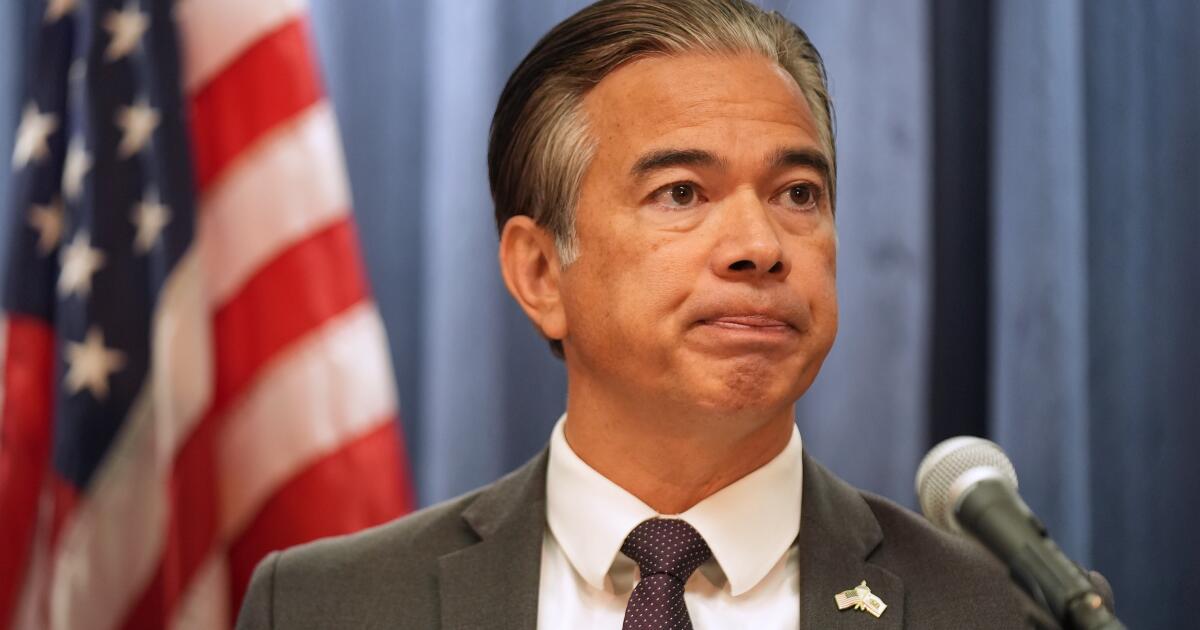
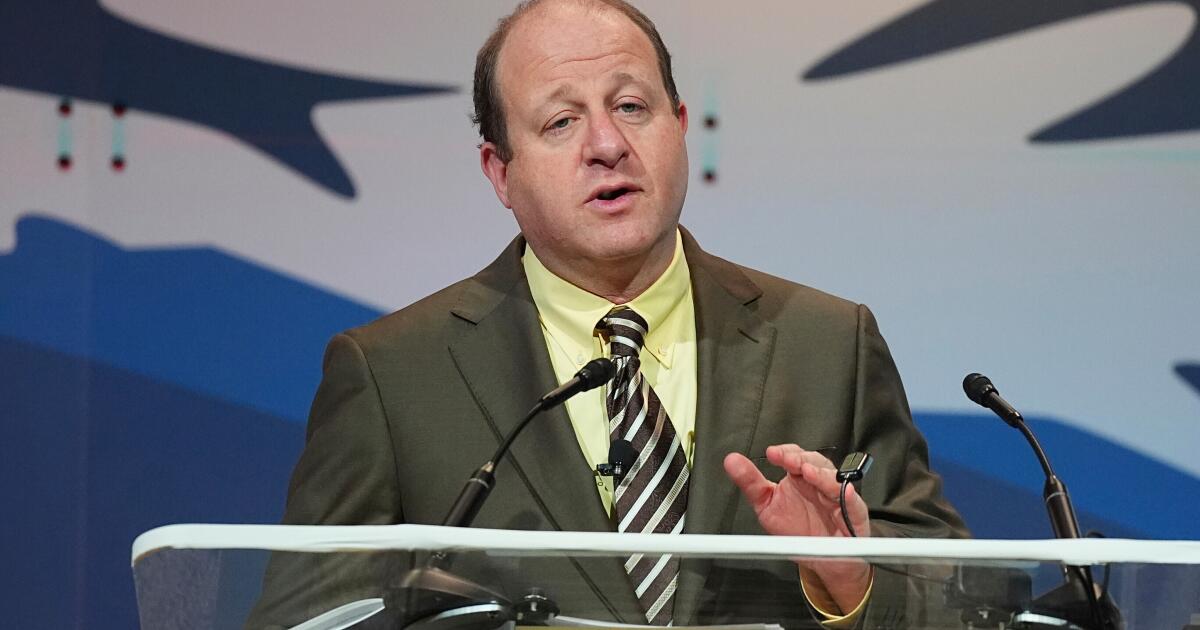
“For California, the CFPB has been an invaluable enforcement partner, working hand-in-hand with our office to protect pocketbooks and stop unfair business practices. But once again, the Trump administration is trying to weaken and ultimately dismantle the CFPB,” California Attorney General Rob Bonta said, in a press conference to announce the 41-page legal action.
The agency did not immediately respond to a request for comment.
Established by Congress in 2010 after the subprime mortgage abuses that gave rise to the financial crisis, the agency is funded by the Federal Reserve as a method of insulating it from political pressure.
The Dodd-Frank Act statute requires the agency’s director to petition for a reasonable amount of funding to carry out the CFPB’s duties from the “combined earnings” of the Federal Reserve System.
Prior to this year that was interpreted to mean the Federal Reserve’s gross revenue. But an opinion from the Department of Justice claims that should be interpreted to mean the Federal Reserve’s profits, of which it has none since it has been operating at a loss since 2022. The lawsuit alleges the interpretation is bogus.
“Defendant Russell T. Vought has worked tirelessly to terminate the CFPB’s operations by any means necessary — denying Plaintiffs access to CFPB resources to which they are statutorily entitled. In this action, Plaintiffs challenge Defendant Vought’s most recent effort to do so,” the federal lawsuit states.
The complaint alleges the agency will run out of cash by next month if the policy is not reversed. Bonta said he and other attorney generals have not decided whether they will seek a restraining order or temporary injunction to change the new funding policy.
It also dropped a lawsuit against Zelle that accused Wells Fargo, JP Morgan Chase, Bank of America and other banks of rushing the payments app into service, leading to $870 million in fraud-related losses by users. The app denied the allegations.
Monday’s lawsuit also notes that the agency is critical for states to carry out their own consumer protection mission and its closure would deprive them of their statutorily guaranteed access to a database run by the CFPB that tracks millions of consumer complaints, as well as to other data.
Vought was a chief architect of Project 2025, a Heritage Foundation blueprint to reduce the size and power of the federal bureaucracy during a second Trump admistration. In February, he ordered the agency to stop nearly all its work and has been seeking to drastically downsize it since.
The lawsuit filed Monday is the latest legal effort to keep the agency in business.
“It is deflating, and it is unfortunate that Congress is not defending the power of the purse,” said Colorado Attorney General Philip Weiser, during Monday’s press conference.
“At other times, Congress vigilantly safeguarded its authority, but because of political polarization and fear of criticizing this President, the Congress is not doing it,” he said.
WASHINGTON — Lawyers for former CIA Director John Brennan want the Justice Department to be prevented from steering an investigation of him and other former government officials to a “favored” judge in Florida who dismissed the classified documents case against President Trump.
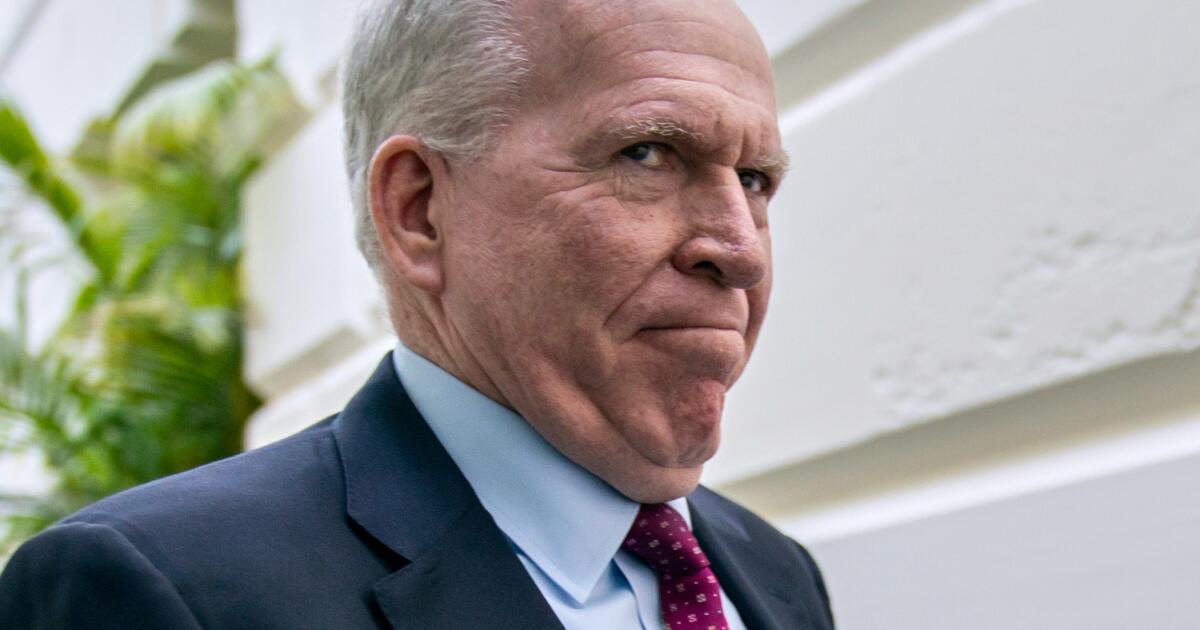
The request Monday is addressed to U.S. District Judge Cecilia Altonaga, the chief judge in the Southern District of Florida, where federal prosecutors have launched a criminal investigation related to the U.S. government assessment of Russian interference in the 2016 presidential election. Brennan and other officials have received subpoenas, and his lawyers say Brennan has been advised by prosecutors that he’s a target of the investigation.
Brennan’s lawyers say the Justice Department is engaged in “judge shopping” and trying to arrange for the case to be handled by U.S. District Judge Aileen Cannon, who issued favorable rulings to Trump during the classified documents case and dismissed it last year. The letter asks Altonaga to exercise her “supervisory authority” as chief judge to ensure that the Justice Department is unable to steer the current election interference investigation into her courtroom.
“In short, we are seeking assurance that any litigation arising out of this grand jury proceeding will be heard by a judge who is selected by the court’s neutral and impartial processes, not by the prosecution’s self-interested maneuvering contrary to the interests of justice,” wrote Brennan’s attorneys, Kenneth Wainstein and Natasha Harnwell-Davis. The New York Times earlier reported on the letter.
It remains unclear what crime prosecutors in Florida believe was committed, but the subpoenas issued last month to Brennan and other former law enforcement and intelligence officials sought documents related to the preparation of the Obama administration’s intelligence community assessment, made public in January 2017, that detailed how Russia waged a covert influence campaign to help Trump defeat Democratic nominee Hillary Clinton.
Trump was investigated but not charged during his first term over whether his campaign conspired with Russia to tip the outcome of the election. He has long sought retribution over the Russia investigation and the officials who played a key part in it.
His Justice Department in September secured a false-statement and obstruction indictment against James Comey, the FBI director at the time the Russia investigation was launched, though the case was dismissed and its future is in doubt because of a judge’s ruling that blocked prosecutors from accessing materials they considered to be key evidence.
Brennan’s lawyers say the Trump administration’s Justice Department tried to “forum-shop” the investigation into Brennan to multiple jurisdictions, including Pennsylvania, before settling in Florida. But they say prosecutors have been unable to answer basic questions about why Florida is a proper venue for the investigation given that the intelligence community assessment at issue was produced by officials in the Washington, D.C., area.
The grand jury investigation is based in the Miami division of the Southern District of Florida, but Brennan’s lawyers say they’re concerned that the Trump administration may be poised to transfer the case to the smaller Fort Pierce division, where Cannon is the only judge. They cited as a basis for that alarm a Justice Department decision to seek an additional grand jury in Fort Pierce even though there’s no apparent caseload need.
“The United States Attorney’s efforts to funnel this investigation to the judge who issued this string of rulings that consistently favored President Trump’s positions in previous litigations should be seen for what it is,” Brennan’s lawyers wrote.
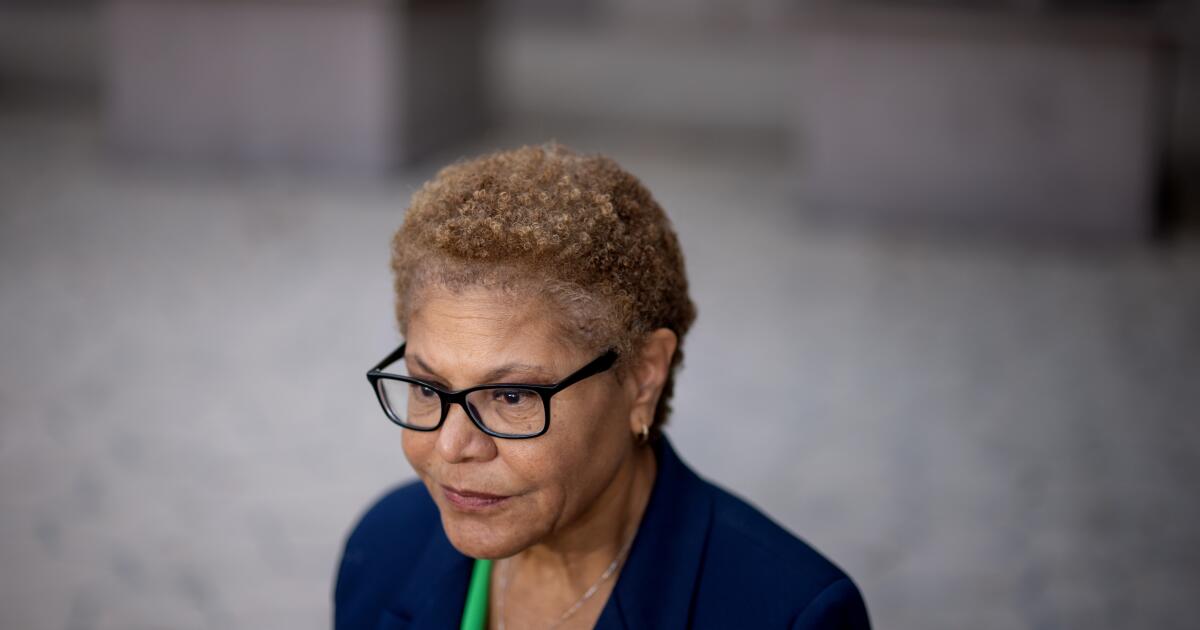
The year was already a debacle for the Los Angeles Fire Department and Mayor Karen Bass, with multiple stumbles before and after the epic January blaze that obliterated Pacific Palisades, so it was hard to imagine that things could get worse in the closing days of 2025.
But they have.
A blistering Times investigation found that the Fire Department cleaned up its after-action report, downplaying missteps.
In other words, there was a blatant attempt to mislead the public.
And Bass representatives said they requested that her comments in the final minutes of a video interview — in which she admitted that “both sides botched it” in the Eaton and Palisades fires — be edited out because she thought the interview had ended.
Please.
Together, these developments will echo through the coming mayoral election, in which Bass will be called out repeatedly over one of the greatest disasters in L.A. history. We’re a long way from knowing whether she can survive and win a second term, but Austin Beutner and any other legitimate contenders are being handed gifts that will keep on giving.
In the case of the altered report, kudos to Times reporters Alene Tchekmedyian and Paul Pringle, who have been trying all year to keep the LAFD honest, which is no easy task.
In the latest bombshell dropped by the two reporters, they dug up seven drafts of the department’s self-analysis, or after-action report, and found that it had been altered multiple times to soften damning conclusions.
Language saying LAFD did not fully pre-deploy all crews and engines, despite the forecast of extreme conditions, was removed.
Language saying some crews waited more than an hour for their assignments during the fire was removed.
A section on “failures” became a section on “primary challenges.”
A reference to a violation of national guidelines on how to avoid firefighter injury and death was removed.
The central role of the earlier Lachman fire, allegedly started by an arsonist, was also sanitized. A reference to that unchecked brushfire, which later sparked the inferno, was deleted from one draft, then restored in the final version. But only in a brief reference.
Even before the smoke cleared on Jan. 7, I had one former LAFD official telling me he was certain the earlier fire had not been properly extinguished. Crews should have been sitting on it, but as The Times has reported, that didn’t happen.
What we now know with absolute clarity is that the LAFD cannot be trusted to honestly and thoroughly investigate itself. And yet after having fired one chief, Bass asked the current chief to do an investigation.
Sue Pascoe, who lost her home in the fire and is among the thousands who don’t yet know whether they can afford to rebuild because their insurance — if they had any — doesn’t cover the cost of new construction. Pascoe, editor of the local publication Circling the News, had this reaction to the latest expose:
“To kill 12 people, let almost 7,000 homes/businesses burn, and to destroy belongings, memorabilia and memories stored in the homes — someone needs to be held accountable.”
But who will that be?
Although the altered after-action report seems designed to have minimized blame for the LAFD, if not the mayor, the Bass administration said it wasn’t involved.
“We did not red-line, review every page or review every draft of the report,” a spokesperson told the Times. “We did not discuss the Lachman Fire because it was not part of the report.”
Genethia Hudley Hayes, president of the Board of Fire Commissioners, told The Times she noticed only small differences between the final report and an earlier report she had seen.
“I was completely OK with it,” she said, adding that the final report “did not in any way obfuscate anything.”
Well I’m not OK with it, and I suspect a lot of people who lost everything in the fire feel the same way. As I’ve said before, the conditions were horrific, and there’s little doubt that firefighters did their best. But the evidence is mounting that the department’s brass blew it, or, to borrow a phrase from Bass, “botched it.”
As The Times’ David Zahniser reported, Bass said her “botched” comment came in a casual context after the podcast had ended. She also said she has made similar comments about the emergency response on numerous occasions.
She has made some critical comments, and as I mentioned, she replaced the fire chief. But the preparation and response were indeed botched. So why did her office want that portion of the interview deleted?
Let’s not forget, while we’re on the subject of botching things, that Bass left the country in the days before the fire despite warnings of catastrophic conditions. And while there’s been some progress in the recovery, her claim that things are moving at “lightning speed” overlooks the fact that thousands of burned out properties haven’t seen a hammer or a hardhat.
On her watch, we’ve seen multiple misses.
On the blunderous hiring and quick departure of a rebuilding czar. On the bungled hiring of a management team whose role was not entirely clear. On a failed tax relief plan for fire victims. On the still-undelievered promise of some building fee waivers.
In one of the latest twists on the after-action report, Tchekmedyian and Pringle report that the LAFD author was upset about revisions made without his involvement.
What a mess, and the story is likely to smolder into the new year.
If only the Lachman fire had been as watered down as the after-action report.
Editor’s note: We are at a historical moment in which much of the mainstream discussion about Venezuela centers on two extremes: countering MAGA narratives, often riddled with lies and half-truths, and warning about the dangers of military intervention; or, conversely, leaning into the idea that the US will not back down from Maduro & Co., and that military intervention is imminent. Writing in absolutes and taking the words of figures like Diosdado Cabello, Stephen Miller, or even María Corina Machado at face value—within a context where they are in constant dialogue with allies and supporters—can seriously mislead audiences. Especially when framed as professional analysis. Which is not the same as opinion (as a former lady editor of this prestigious blog used to say: opinions are like assholes, everybody has one). And that’s fine. We have nothing against opinion, these pages are riddled with it.
But, again, professional analysis is something different, which is why the writing in our Political Risk Report doesn’t look at all like what we post on the webpage. Some actors posing as serious analysts and rational players are, of course, capable of generating strong headlines and plenty of material for meaty feature stories. But now, more than ever, focus should be on avoiding simplistic narratives and to bridge political discourse with on-the-ground realities, voices, and data obscured by chavismo’s censorship regime. Intelligence analyst Daniel Blanco here offers advice on how to help you identify (and/or write) credible analysis.
1) Don’t play into politics, stick to facts
Your role as an analyst, whether you are a political consultant advising a senior leader or an economic analyst with corporate clients, is to provide informed judgments to your consumers to support decision-making. It does not matter if the assumptions presented are an ugly truth; they need to be as accurate as possible. Shaping ugly truths into pleasing narratives to score points with political factions or escalate positions as a pleasing analyst can lead to policy failures or operational setbacks. Furthermore, such behaviour may end up damaging trust between analysts and consumers, as well as weakening the public credibility of your persona.
2) Use estimative language to communicate nuance
Estimative language—using terms like likely, probable, possible, or unlikely—signals that your conclusions are based on judgments under uncertainty and prevents giving the false impression that you have absolute certainty. Consumers often come from non-technical backgrounds and may interpret analytical conclusions as statements of guarantees. Communicating the likelihood and percentages of different outcomes allows your consumers (including readers from the public in some cases) to understand that you are not presenting a black-and-white fact.
3) Keep up with the domestic context
Context refers to the broad framework within which a foreign decision-maker operates, or within which an event or process unfolds. It is both temporal and spatial in nature. Venezuela, in particular, has a context dynamic that shifts constantly, variables that could act as an indicator yesterday could be a nothingburger tomorrow. Keeping up with the context can be the difference between interpreting data as a critical bullet point or an outdated pattern. Take for example, the power outages or connectivity blackouts that some junior analysts assessed as a major alert, while in reality, it is a common occurrence in Venezuela over the last seven years.
4) Never assume actors are rational or cohesive
Venezuelan actors are not always rational, and this includes decision makers in the government and the opposition. Some may act based on emotion or ideology, while others could throw personal ambition into their calculations. Assuming rationality may cause analysts to overlook actions that appear illogical but are nonetheless likely or meaningful within the actor’s perspective. Second, any organisation of human beings will produce factions. Before you assess the statement of a single actor as the current intent of a whole side, you need to take into account whether it represents a faction’s interest or if it’s part of a wider trend.
5) Human contacts will always beat open source
Don’t get me wrong on this one, publicly available information can help you collect observable patterns or supporting evidence, but will only get you so far once you get knee-deep in assessing intentions. Venezuela runs heavily on informal power structures that are not visible on social media or tracking applications. Additionally, the civilian population, from community leaders to corporate figures, do not express their opinions or knowledge in public space due to the increasing internal repression. Developing ground contacts in different organisations is critical to collect and process information that will never be open to the public.
6) Never stop challenging your local sources
Speaking from experience, sources can have motives that shape their reporting. They may exaggerate their access level or withhold critical information for a variety of reasons that can range from pursuing personal agendas to avoiding political conflicts. Your responsibility to the consumer is to ensure that firsthand observation is distinguished from hearsay or speculation. Also, you need to clarify the collection method. Ask your source if they heard this in a meeting or if it is indirect information coming from a family member or a party friend. This needs to be presented in the most honest way possible in the body of your analysis.
7) Write disclaimers/statements on your analysis
Writing a statement of analysis forces the analyst to evaluate the quality of sources and identify analytical uncertainties. Often, we have to make calls on incomplete information, and the whole purpose of a statement on analysis is to let the report consumer know that there are some potholes along the road and things may turn out differently. Communicating your own level of confidence (low-medium-high) on a written report may be the difference between your decision maker acting with caution, knowing that we don’t have as much information as we like, or committing to a decision that will become a failure down the road.
Almost 30 years have passed, and I remember it as if it happened yesterday; such was the impact it had on me. In a large space at the Museum of Fine Arts in Caracas, in 1996, the artist Javier Téllez (Valencia, Venezuela, 1969) recreated a ward from the Bárbula psychiatric hospital, which operated near the main campus of the University of Carabobo. There were cots, electroshock machines, diagrams, and the floor was littered with confetti as if a carnival party had just ended. It was his exhibition “The Extraction of the Stone of Madness”, a monumental reflection on the problems of the concept of insanity, and Téllez was invoking his experiences as the son of psychiatrists who witnessed patients and doctors exchanging roles in Bárbula, during the carnivals.
Since then, Téllez has continued to build a body of work across various media, primarily film, revolving around the mysteries, politics, and complexity of the many ways we perceive reality. His work abounds with the voices of those we don’t want to hear, such as the mentally ill and the immigrants. This is why the director of the Pérez Art Museum Miami (PAMM), Franklin Sirmans, celebrated his practice, which “expands the possibilities of empathy, dignity, and community,” when that city’s largest art museum awarded Téllez the 2025 Pérez Prize, an unrestricted $50,000 grant, on November 15.
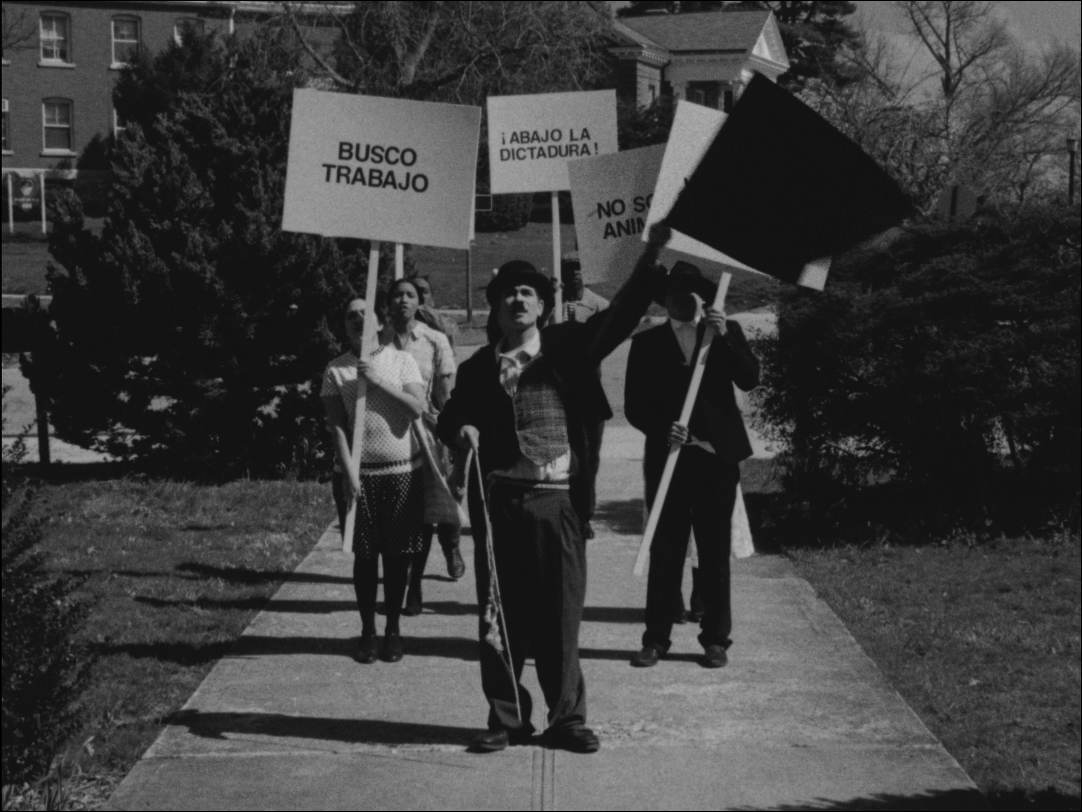
In his 2007 film Letter on the Blind for the Use of Those Who See, Téllez revives the Indian fable of the blind men and the elephant, a powerful metaphor these times in which we insist on seeing as wholes what are merely fragments of our surroundings. In Caligari and the Sleepwalker, he sought out a classic of German Expressionism to explore perceptions in the present. In Amerika, made last year, eight Venezuelan migrants watched a series of Chaplin films and identified with the Tramp to recreate that aesthetic in a collective representation of migration. All of them had crossed the Darién Gap. “This carnivalesque element allows people to talk about their situation without directly confronting the trauma,” says Téllez.
AMERIKA, 2024 Single-channel video installation, 16mm transferred to 4K video, color and black-and-white, 5.1 surround sound. Carpet, theater seating. 23:46 minutes. Variable dimensions. Produced by the Center for Artistic Alliances (CARA), 2024. Installation view. Photo: Kris Graves. Courtesy of the artist.
Téllez has participated in numerous artist residencies and has exhibited in many countries since the early 1990s. Besides film, he uses photography, artist’s books, installation, and sculpture. He has built aviaries and giant birds for his exhibitions that play with the anti-psychiatric novel One Flew Over the Cuckoo’s Nest, and in One Flew Over the Void (2005) he had the human cannonball David Smith fly from the US to Mexico over the border line, while patients at a psychiatric hospital in Mexicali played a march.
From New York City, Téllez talked to Caracas Chronicles about the purpose of his work.
How did your childhood and adolescence lead you to study art, to understand that you were an artist?
I was very fortunate to be born into a home with intellectual parents from very different cultural backgrounds. My parents, Teresa Pacheco Lugo and Pedro Téllez Carrasco, were psychiatrists. Our house contained the largest private library in the city, and there were books in every room. My father conducted his psychiatric consultations there. We grew up surrounded by patients, as we also visited the Bárbula Psychiatric Hospital, where he worked. This world was further enriched by our frequent visits to Turmero, where my aunts ran the Capitol Cinema, one of the first movie theaters in the country. I also saw films on the big screen before I learned to read. I think it was natural that, having been born into that environment, I decided from a very young age to dedicate my life to art, and especially to moving images and video installations.
For everyone else, “madness” is a category that associates danger, absurdity, and total marginalization with that “otherness” incarnated by psychiatric patients. But you were taught to see them differently.
Absolutely. The stigmatization of difference begins in childhood, and my siblings and I were immune to it from a young age, due to the liberal upbringing we received from our parents. The proximity, the familiarity we had with those considered “crazy” by society normalized mental illness and relativized the stability of the “normal” world. Our annual visits to the carnival held in Bárbula, where some patients and psychiatrists exchanged uniforms, were fundamental to this perception. The inversion of values that those carnivals represented is a memory that still stimulates my work as an artist. It’s no surprise, then, that today my older brother is a psychiatrist and that I work with psychiatric patients to pursue my artistic work.
The Ship of Fools, 2022 Single-channel video installation, 4K video, color, 5.1 surround sound. Variable dimensions. Produced by Kunstmuseum Thurgau, Ittingen. Still image. Courtesy of the artist.
In that small-town movie theater you had access to what ordinary moviegoers didn’t, to another kind of “otherness”: the machine behind the miracle. Am I to assume that this understanding of cinema as something that not only happens, but can be made, began there?
My passion for cinema began at the Capitol Cinema in Turmero. Having constant access to a cinema from the spectator’s point of view, but also being able to witness the spectacle behind the scenes and see the films projected from the projectionist’s booth, allowed me, from childhood, to dissect the components of the “cinematic apparatus” and understand cinema from its materiality. I remember the fascination I felt watching the stillness of the film frames, how they were “devoured” by the gigantic projector and activated by a blinding light capable of creating impossible universes. When I was nine or ten, my father gave me an 8mm camera, with which I made my first films. A little later, when I was barely 13, I bought a Super 8 camera, with which I made several surrealist films with my friends, which I edited on a small Moviola. I began studying the early 20th-century avant-garde movements and saw the films of Buñuel, Eisenstein, Vertov, Dreyer, Murnau, Vigo, and others for the first time. My first works at that time were drawings, collages, assemblages, and films.
In “The Extraction of the Stone of Madness” you offered a confluence of your explorations on media and on mental health. Which of those questions, issues, or themes continued in your later work?
The theme of mental illness is essential in my work; it is the thread that guides me through the labyrinth. The otherness inherent in madness permeates all my work. With “The Extraction of the Stone of Madness,” I began working with psychiatric institutions and discovered the importance of working in collaboration with people who had been diagnosed. I realized that it was impossible for me, who had never been diagnosed as mentally ill nor had I suffered institutionalization, to articulate a discourse on mental illness without the help of others who had experienced it. Since then, I have carried out more than twenty projects on mental illness in collaboration with patients in Asia, Europe, Australia, and the Americas. The questions are specific to each project, as they respond to unique situations defined by the individuals and their circumstances, but a group of questions emerges in almost every project: How is “normal” defined, and what is considered “pathological” or “abnormal,” and how do these definitions affect individuals? What does it mean to live with the stigma of mental illness or disability? Can society learn to exist inclusively, including those who have been marginalized for being different? These questions remain constant because they are fundamental to our society.
Every day we wake up to find a new incarnation of Ubu, that grotesque authoritarian king imagined by Alfred Jarry, be it Trump, Milei, Putin, or Maduro. We mustn’t confuse the paranoid madness of these individuals and the masses who follow them with the madness of the average citizen.
How has this work you describe, which explores and exposes the voices of psychiatric patients and questions the idea of normality and the representation of reality, helped you understand this golden age for those who create prefabricated realities and claim that everyone else is crazy?
In my video installations, I include the diverse voices of the participants, attempting to generate a collective voice that identifies those marginalized by their circumstances. I work with my collaborators—whether they are psychiatric patients, people with disabilities, or migrants seeking asylum—to develop fictional narratives akin to fables or myths, creating short films where they are also actors and can articulate a collective discourse that resists the hegemonic concepts with which some social groups try to mask reality. Undoubtedly, the 21st century presents us, as Guy Debord already warned, with a reality impossible to separate from the notion of spectacle. Every day we wake up to find a new incarnation of Ubu, that grotesque authoritarian king imagined by Alfred Jarry, be it Trump, Milei, Putin, or Maduro. We mustn’t confuse the paranoid madness of these individuals and the masses who follow them with the madness of the average citizen. It is from the latter that society can learn, for we must learn from madness.
To what extent can your work, or that of other artists with whom you identify, help to make sense of a reality that we feel we don’t understand… or at least make visible the meaninglessness, the nonsense of what they want to impose on us as meaning?
I have taken as my motto the definition of art given to us by Paul Klee: “art makes visible.” As visual artists we have an inescapable commitment to our reality, to the historical moment we are living through. I fervently believe that art has the power to change how we perceive reality and, therefore, can lead to its transformation. My generation, that emerged in the 1990s, has a critical view of the dominant power structures but also toward artistic discourses, and constantly questions the language of art. I view with dismay the output of many contemporary Venezuelan artists intent on resurrecting obsolete models. It is regrettable that the country’s meager art market continues to encourage geometric abstraction and landscape painting as defining genres of our visual identity. But fortunately, there is also the valuable work of some artists who have explored, through their art, the political and cultural context of our tragic reality after more than twenty-five years of chavismo. I hope that in the very near future these works will become better known outside the country.
One Flew Over the Void (Bala perdida), 2005 Single-channel video installation, HD video, 11 minutes. Variable dimensions. Produced by INSITE 05, 2005. Still image. Courtesy of the artist.
The US government, headed by a guy who came from reality TV, is threatening a dictatorship that invented a grand false narrative—the redemption of the poor—with its propaganda machine. Do you think it will become anything more than “good TV” featuring only extras dying at sea and being kidnapped in Venezuela?
This relationship between war, technology, and spectacle that you mention isn’t new; just remember the first Gulf War, the search for nonexistent “weapons of mass destruction” in Iraq, or the capture of Bin Laden. Our experience of armed conflict is increasingly affected by the media and technology, which irreversibly shape our vision and understanding of geopolitical conflicts. We are rapidly heading towards a new era that produces toxic wars as a spectacle, characterized by a sinister cocktail of paranoia, inequality, and authoritarianism, all seasoned by rampant technological development. It is true that the wars waged by empires resemble video games, but the dead in these conflicts are always real. In this case, the victims are Venezuelan, which should be even more unacceptable to us.
I believe it is regrettable that only chavismo and a minority of the opposition have denounced the deaths of the people aboard those boats, who were executed by the US military in a completely illegal manner without any proof of their guilt. The deaths of these people, like those who have died at the hands of the Maduro regime, should be outrageous regardless of one’s political stance. The right to life is the most fundamental and inherent right of all human beings. It’s disheartening to think of Venezuelans who dream of a US military intervention in Venezuela, because if this were to happen, it would be a profoundly tragic event for our country and the continent. It seems we haven’t learned anything from modern history and how lethal all US military interventions have been, from Vietnam to Iraq and Afghanistan. I firmly believe that the self-determination of peoples is essential. The worst thing that could happen to us is war.
AMERIKA, 2024 Single-channel video installation, 16mm transferred to 4K video, color and black-and-white, 5.1 surround sound. Carpet, theater seating. 23:46 minutes. Variable dimensions. Produced by the Center for Artistic Alliances (CARA), 2024. Installation view. Photo: Kris Graves. Courtesy of the artist.
A transgender employee of the National Security Agency is suing the Trump administration and seeking to block enforcement of a presidential executive order and other policies the employee says violate federal civil rights law.
Sarah O’Neill, an NSA data scientist who is transgender, is challenging President Trump’s Inauguration Day executive order that required the federal government, in all operations and printed materials, to recognize only two “immutable” sexes: male and female.
According to the lawsuit filed Monday in a U.S. District Court in Maryland, Trump’s order “declares that it is the policy of the United States government to deny Ms. O’Neill’s very existence.”
The White House did not immediately respond to a request for comment.
The order, which reflected Trump’s 2024 campaign rhetoric, spurred policies that O’Neill is challenging, as well.
Since Trump’s initial executive action, O’Neill asserts the NSA has canceled its policy recognizing her transgender identity and “right to a workplace free of unlawful harassment,” while “prohibiting her from identifying her pronouns as female in written communications” and “barring her from using the women’s restroom at work.”
O’Neill contends those policies and the orders behind them create a hostile work environment and violate Section VII of the Civil Rights Act. The U.S. Supreme Court ruled in 2020 that Section VII’s prohibition on discrimination based on sex applied to gender identity.
“We agree that homosexuality and transgender status are distinct concepts from sex,” the court’s majority opinion stated. “But, as we’ve seen, discrimination based on homosexuality or transgender status necessarily entails discrimination based on sex; the first cannot happen without the second.”
O’Neill’s lawsuit argued, “The Executive Order rejects the existence of gender identity altogether, let alone the possibility that someone’s gender identity can differ from their sex, which it characterizes as ‘gender ideology.’ ”
In addition to restoring her workplace rights and protections, O’Neill is seeking financial damages.
Trump’s order was among a flurry of executive actions he took hours after taking office. He has continued using executive action aggressively in his second presidency, prompting many legal challenges that are still working their way through the federal judiciary.
On September 1, at an international press conference convened in response to threats from the U.S. government, Nicolás Maduro declared: “The Miami mafia has seized political power in the White House and the State Department; they have imposed their extremist Miami-centric vision and have ‘Miamisized’ U.S. foreign policy toward all of Latin America and the Caribbean; because threatening Venezuela is threatening the entire continent.”
This statement fits with a script distributed through Siscom, the messaging system used by Venezuela’s Ministry for Communication and Information to send orders to media and digital activists. “The U.S. warmongering maneuver is driven by extremist sectors in South Florida, representing less than 10% of the U.S. population, who seek to impose their agenda on the entire country, ignoring the majorities who oppose wars and want the government to focus on internal problems,” reads a paragraph from the document.
La Hora de Venezuela obtained several of these scripts, distributed between March and September 2025 to 40,000 users participating in more than 600 Siscom groups. The main messages: the entire nation is enlisting as if it were Vietnam, while at the same time there is an atmosphere of calm and normalcy. But the scripts also aim to influence public discourse in the United States, by contrasting the “Miami lobby” with America First and MAGA, framing a military escalation against Venezuela as a useless cost in the face of its internal problems.
The propaganda apparatus takes phrases from U.S. politicians, analysts, and media outlets and amplifies to validate its propaganda and disinformation narratives.
On December 3, 2025, Democratic Representative Jim McGovern announced that he would introduce a resolution to force a vote in Congress against the Trump administration’s “crazy escalations” against Venezuela. “No one, except the president and his billionaire allies, wants this war,” McGovern stated.
A few hours later, Madelein García, a journalist for Telesur—the international propaganda channel dependent on the Venezuelan Ministry for Communication and Information—quoted and translated McGovern’s post. It wasn’t necessary for journalists, media outlets, or communicators allied to his government to claim that Washington was divided: it was enough to amplify the message of a congressman speaking from within the U.S. political system, while avoiding the sound of propaganda.
In general, McGovern’s statement echoed talking points included in an operational manual formatted as a slide presentation that had been circulated months earlier through Siscom, on August 29, by Johannyl Rodríguez, Venezuela’s vice minister of Communication and Information. Page 7 of that script includes, for example, phrases such as “Rubio does not speak for MAGA; he speaks for the war lobbies” and “His agenda does not respond to the popular movement that backed Trump, but rather to military corporations and extremist minorities.”
García’s quote of McGovern served as external validation for narratives that the Maduro administration is trying to position. There was no need for sympathetic journalists, outlets, or communicators to talk about divisions in Washington over Venezuela: amplifying a Democratic lawmaker from within the U.S. political system was enough to make the framing sound less like official propaganda.
Page 1 of Venezuela is not a threat presentationPage 7 of Venezuela is not a threat presentation
Days earlier, on November 29, 2025, Democratic Senator Chuck Schumer had also questioned the policy toward Venezuela, arguing that it didn’t align with the “America First” principle, alluding to the unnecessary expenditure of resources and internal priorities.
Schumer’s argument also resonated with ideas already laid out in the August 29 presentation: the split between America First and war, and the cost of escalation for ordinary citizens. Among the lines in the script sent by the Maduro Ministry of Communication official includes lines such as: “Trump promised to prioritize U.S. interests over military adventures,” “War impoverishes the people: trillions of dollars are lost in foreign conflicts while poverty, inflation, and the housing crisis persist at home,” and “Why fund interventions around the world when millions of citizens work two or three jobs just to survive?”
Venezuela News, an “unofficial” mouthpiece for pro-Maduro propaganda—and a frequent amplifier of disinformation—reported Schumer’s statements as further proof that figures in the Democratic leadership are questioning the coherence and legitimacy of an escalation against Venezuela.
On September 2, Juan González—former director for the Western Hemisphere at the Council of National Security during the Biden administration—questioned the logic of the military deployment in the Caribbean: “So the U.S. government is using false information to justify a terrorist designation and then spending at least $7 million a day to have a carrier strike group kill 11 traffickers…?” Days later, the Venezuelan News Agency (AVN) turned it into a headline (“Former Biden advisor denounces false information and million-dollar waste”). González’s comment was also reported by Venezuela News and Globovisión.
Once again, the framing was perfect for amplifying the script’s narratives, without the need to manufacture the message through Maduro’s propaganda apparatus.
Creating discord between Maga and Rubio
Alongside narratives about America First and the unnecessary use of U.S. public resources, the scripts distributed by Siscom also lay out another divisive line: portraying U.S. policy toward Venezuela as the result of an internal fracture, in which a minority—associated with Secretary of State Marco Rubio and several Florida Cuban politicians—drags the country into an escalation unwanted by the rest of the population.
These guidelines aim to intervene in the U.S. public conversation from within, seeking to sow discord by amplifying pre-existing tensions between the MAGA (Make America Great Again) movement and parts of Washington’s political apparatus.
The same script sent by Siscom on August 29, for example, defines staging guidelines for content that includes “short, direct material that connects with the MAGA audience.” Another section features “impact phrases” such as “Rubio does not speak for MAGA; he speaks for the war lobbies,” “Trump defends America First; Rubio puts his interests first,” or “Florida cannot impose a war in Latin America on the rest of the United States.”
Page 8 of Venezuela is not a threat presentationPage 9 of Venezuela is not a threat presentation
Extra News Mundo, another “unofficial” source of Venezuelan propaganda, and “Unleash Dracarys,” (pseudonym used by Dayra Rivas, Director of Digital Media at Information Ministry), published a video to multiply the reaction of right wing activist Laura Loomer -who opposes military action in Venezuela- against an interview to Cuban American congresswoman María Elvira Salazar, a supporter of Machado. The video reiterates the “MAGA vs. Florida” trope recommended in the Siscom script: Cuban politicians in Florida are trying to impose a war on Trump.
Everyone is happy
Regarding the story line of “everything is fine in Venezuela and nobody is afraid of Trump,” the Maduro propaganda took advantage of a December 4 photo essay in The New York Times, which opens with a video of a group of Caracas residents dancing salsa in a nightclub and showcases scenes of concerts, baseball games, and Christmas celebrations in a country seemingly at peace. At the same time, the piece warns that the surveillance by security forces has stifled open expression of dissent and concludes with a question: whether this tranquility can truly be believed.
A summarized version of the article, published on The New York Times’ Instagram account, received over a thousand comments, at least half of which were negative or dismissive. The carousel opened with the same video of Venezuelans dancing salsa, but the final point of the report—the question of whether this calm is real—was relegated to the background. Its celebratory tone resonated with several pieces of reassuring propaganda that began appearing more frequently.
Since mid-November, at least five videos of Venezuelans dancing and celebrating were shared through Nicolás Maduro’s official Telegram channel. In one of them, Maduro was seen dancing and calling for a party every day of the week. All of this content was massively and coordinatedly amplified by state media and digital activist networks, in line with the Street, Networks, Media, Walls, and Word of Mouth Method signed by Maduro, that broadly defines the government’s information operation.
That same approach also appears laid out as an operational line in another playbook circulated through Siscom. In a presentation sent on August 26, ahead of the launch of the #YoMeAlisto campaign, it explains: “Psychological warfare is defeated with images of peace, discipline, and normality,” and “Our response is to show that the country does not grind to a halt, that it continues producing, working, and moving forward.”
Page 1 of #YoMeAlisto presentationPage 3 of #YoMeAlisto presentation
Even more explicit was the exploitation of another New York Times article, published on November 26, 2025, which compiled criticisms from former diplomats, experts, and opposition figures regarding statements attributed to María Corina Machado. The article warns that, amid the Trump administration’s military deployment in the Caribbean, some voices fear that false claims are being exaggerated or disseminated to justify intervention, and mentions “debunked claims” on issues of drug trafficking and security.
The report also echoed propaganda lines included in government scripts that present the “war on drugs” as a pretext for continuing the escalation and militarization of the Caribbean. In the script sent on August 29, for example, one line appears particularly clear: “The Cartel of the Suns is a media fabrication to justify aggression,” along with others that maintain that the U.S. uses this framework to promote regime change and expand its presence in the region.
Screenshots of that New York Times article were quickly seized upon by a network of propaganda video creators. The campaign attempted to reinforce a line already present in Siscom documents: to discredit María Corina Machado, presenting her as a source of disinformation that is pushing the United States toward intervention. An opportune corollary to the more than 80 hoaxes and disinformation incidents directed against Machado from Maduro’s communications apparatus in 2024 and 2025.
Journalism in Venezuela operates in a hostile environment for the press, with dozens of legal instruments designed to punish speech, such as the laws “against hate,” “against fascism,” and “against the blockade.” This content was produced by journalists who are in Venezuela and is being published with full awareness of the threats and constraints that, as a result, have been imposed on the dissemination of information from within the country.
COPENHAGEN — The leaders of Denmark and Greenland insisted Monday that the United States won’t take over Greenland and demanded respect for their territorial integrity after President Trump announced the appointment of a special envoy to the semiautonomous territory.
Trump’s announcement on Sunday that Louisiana Gov. Jeff Landry would be the envoy prompted a new flare-up of tensions over Washington’s interest in the vast territory of Denmark, a NATO ally. Denmark’s foreign minister told Danish broadcasters that he would summon the U.S. ambassador to his ministry.
”We have said it before. Now, we say it again. National borders and the sovereignty of states are rooted in international law,” Danish Prime Minister Mette Frederiksen and her Greenlandic counterpart, Jens-Frederik Nielsen, said in a joint statement. “They are fundamental principles. You cannot annex another country. Not even with an argument about international security.”
“Greenland belongs to the Greenlanders and the U.S. shall not take over Greenland,” they added in the statement emailed by Frederiksen’s office. “We expect respect for our joint territorial integrity.”
Trump called repeatedly during his presidential transition and the early months of his second term for U.S. jurisdiction over Greenland, and has not ruled out military force to take control of the mineral-rich, strategically located Arctic island. In March, Vice President JD Vance visited a remote U.S. military base in Greenland and accused Denmark of under-investing there.
The issue gradually drifted out of the headlines, but in August, Danish officials summoned the top U.S. diplomat in Copenhagen following a report that at least three people with connections to Trump had carried out covert influence operations in Greenland.
On Sunday, Trump announced Landry’s appointment, saying on social media that “Jeff understands how essential Greenland is to our National Security, and will strongly advance our Country’s Interests for the Safety, Security, and Survival of our Allies, and indeed, the World.”
Landry wrote in a post on social media that “it’s an honor to serve you in this volunteer position to make Greenland a part of the U.S.”
Danish broadcasters TV2 and DR reported that in comments from the Faroe Islands on Monday, Danish Foreign Minister Lars Løkke Rasmussen said he summoned the U.S. ambassador in Copenhagen, Kenneth Howery, to his ministry.
Greenland’s prime minister wrote in a separate statement that Greenland had again woken up to a new announcement from the U.S. president, and that “it may sound significant. But it changes nothing for us here at home.”
Nielsen noted that Greenland has its own democracy and said that “we are happy to cooperate with other countries, including the United States, but this must always take place with respect for us and for our values and wishes.”
Earlier this month, the Danish Defense Intelligence Service said in an annual report that the U.S. is using its economic power to “assert its will” and threaten military force against friend and foe alike.
Denmark is a member of the European Union as well as NATO.
Anouar El Anouni, a spokesperson for the EU’s executive Commission, told reporters in Brussels on Monday that it wasn’t for him to comment on U.S. decisions. But he underlined the bloc’s position that “preserving the territorial integrity of the Kingdom of Denmark, its sovereignty and the inviolability of its borders is essential for the European Union.”
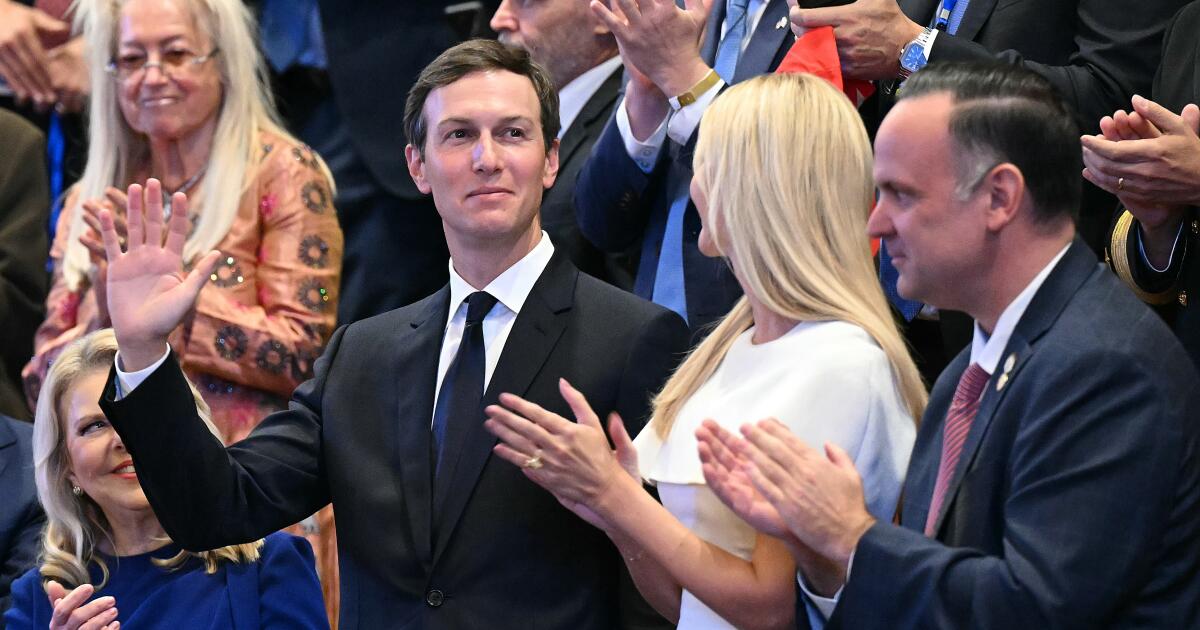
WASHINGTON — As the dawn rose on President Trump’s second term, one key figure from his first administration stood back, content to focus on his personal business interests and not retake a formal government role.
Now, nearly a year into Trump 2.0, Trump’s son-in-law Jared Kushner has been drawn back into the foreign policy fold and is taking a greater role in delicate peace negotiations. Talks had initially been led almost solo by special envoy Steve Witkoff, a real estate mogul who had no government experience before this year.
The shift reflects a sense among Trump’s inner circle that Kushner, who has diplomatic experience, complements Witkoff’s negotiating style and can bridge seemingly intractable differences to close a deal, according to several current and former administration officials who, like others, spoke on condition of anonymity to discuss the internal deliberations.
That role was on display this weekend as Kushner and Witkoff took part in a blitz of diplomacy in Miami.
On Sunday, they concluded two days of talks with Russian negotiator Kirill Dmitriev in Miami on the latest proposals to end Russia’s war in Ukraine.
The talks with Dmitriev came after they met on Friday in Florida with the Ukrainian negotiating team, led by Rustem Umerov, as well as senior British, French and German national security officials. The Ukrainians and European officials stuck around Florida for more talks with U.S. government officials facilitated by Trump’s envoys.
Witkoff and Kushner also squeezed in meetings on Friday with Turkish and Qatari officials to discuss the fragile truce between Israel and Hamas in Gaza as they look to implement the second phase of Trump’s ceasefire plan.
Kushner and Witkoff employ contrasting styles
Witkoff, a longtime pal of Trump’s, is seen by some inside the administration as an oversize character who has traveled the world for diplomatic negotiations on his private jet and does not miss an opportunity to publicly praise the president for his foreign policy acumen, the officials say.
Kushner has his own complicated business interests in the Middle East and a sometimes transactional outlook to diplomacy that has distressed some officials in European capitals, a Western diplomat said.
Still, Kushner is seen as a more credible negotiator than Witkoff, who is viewed by many Ukrainian and European officials as overly deferential to Russian interests during the war that began with Moscow’s invasion in February 2022, the diplomat said.
“Kushner has a bit more of a track record from the first administration,” said Ian Kelly, a retired career diplomat and former U.S. ambassador to Georgia who now teaches diplomacy at Northwestern University. Kelly stressed, however, that the jury is still out on Kushner’s intervention.
Trump views Kushner as a “trusted family member and talented adviser” who has played a pivotal role in some of his biggest foreign policy successes, said White House deputy press secretary Anna Kelly.
Trump and Witkoff “often seek Mr. Kushner’s input given his experience with complex negotiations, and Mr. Kushner has been generous in lending his valuable expertise when asked,” Kelly added.
State Department spokesman Tommy Pigott called Kushner “a world-class negotiator.” Pigott noted that Secretary of State Marco Rubio is grateful for Kushner’s “willingness to serve our country and help President Trump solve some of the world’s most complex challenges.”
In an interview with CBS’ “60 Minutes” in October, Kushner spoke about his unconventional approach to diplomacy.
“I was trained in foreign policy really in President Trump’s first term by seeing an outsider president come into Washington with a different school of foreign policy than had been brought in place for the 20 or 30 years prior,” he said.
But some Democrats and government oversight groups have expressed skepticism about Kushner’s role in shaping the administration policies in the Middle East while he manages billions of dollars in investments, including from Saudi Arabia and Qatar’s sovereign wealth funds through his firm, Affinity Partners.
Similarly, Witkoff has faced scrutiny for his and his family’s deep business ties to Gulf nations. Witkoff last year partnered with members of Trump’s family to launch a cryptocurrency company, World Liberty Financial, which received a $2 billion investment from a United Arab Emirates-controlled wealth fund.
“What people call conflicts of interests, Steve and I call experience and trusted relationships that we have throughout the world,” said Kushner, who is not drawing a salary from the White House for his advisory role.
White House counsel David Warrington said in a statement that Kushner’s efforts for Trump “are undertaken in full compliance with the law.”
“Given that Jared Kushner was a critical part of the efforts leading to the historic Abraham Accords and other diplomatic successes in the first Trump Administration, the President asked Mr. Kushner to be available as the President engages in similar efforts to bring peace to the world,” Warrington said in a statement, referring to Trump’s first-term effort that normalized relations between Israel and several Arab nations. “Mr. Kushner has agreed to do so in his capacity as a private citizen.”
Kelly and other veterans of U.S. diplomatic encounters with the Russians over many years are also skeptical about Kushner’s ability to secure a Russia-Ukraine deal because Witkoff technically remains in the lead.
“I don’t see that the Witkoff approach is going to work,” Kelly said. “He doesn’t really read the Russians well. He misunderstands what they say and reports the misunderstandings back to Washington and the Europeans.”
“They seem to have this idea that the magic key is money: investment and development,” Kelly said. “But these guys don’t care about that, they are not real estate guys except in the sense that they want the land, period.”
Kushner was out of the spotlight until he wasn’t
For the first half of the year, Kushner stayed out of the spotlight, even as he pushed, unsuccessfully in some cases, to install some former associates — those with whom he worked on negotiating the Abraham Accords — into powerful roles in the new administration, according to the current and former administration officials.
Kushner had told Trump and others that while he would not be joining the second-term White House, he stood ready to offer his counsel if it was desired. That is a role he also played on a few occasions during the Biden years as the Democratic administration tried, without success, to expand the Abraham Accords.
Although Kushner remained an informal sounding board for Trump and top advisers, he resisted getting directly involved, even as the president expanded his peacemaking pursuits, until it became clear to him and others that the job might be too much for Witkoff to seal on his own, the officials said.
As Trump’s efforts to forge an agreement to end the Israel-Hamas war in Gaza faltered over the summer, Kushner came in, trading on his experience and contacts in negotiating the Abraham Accords to help Witkoff push Trump’s plan over the finish line.
Agreed to in late September after frantic talks surrounding the annual U.N. General Assembly, the 20-point plan is still a work in progress, but its implementation is being coordinated by Kushner and numerous members of his Abraham Accords team.
“We always bring Jared when we want to get that deal closed,” Trump told Israel’s parliament, the Knesset, shortly after the agreement. “We need that brain on occasion.”
As soon as the Gaza plan was finalized, Kushner said he was returning to his family and day job in Miami, where he heads a multibillion-dollar private equity firm. His involvement in high-stakes peacemaking was only temporary, Kushner said, joking that his wife, Ivanka, might change the locks if he did not get home soon.
“I’m gonna try to help set it up, and then I’m gonna hopefully go back to my normal life,” Kushner said in October.
But within weeks of shepherding the Gaza ceasefire, Trump turned again to his fixer-in-law to dive into the Russia-Ukraine negotiations. They had been deadlocked for months despite persistent efforts by the White House to lure both Russian President Vladimir Putin and Ukraine’s Volodymyr Zelensky into an agreement.
Trump hinted then that he would continue to lean on Kushner when the stakes are highest, just as he has done.
Billionaire Larry Ellison has stepped up, agreeing to personally guarantee part of Paramount’s bid for rival Warner Bros. Discovery.
Ellison’s personal guarantee of $40.4 billion in equity, disclosed Monday, ups the ante in the acrimonious auction for Warner Bros. movie and TV studios, HBO, CNN and Food Network.
Ellison, whose son David Ellison is chief executive of Paramount, agreed not to revoke the Ellison family trust or adversely transfer its assets while the transaction is pending. Paramount’s $30-a-share offer remains unchanged.
Warner Bros. Discovery’s board this month awarded the prize to Netflix. The board rejected Paramount’s $108.4-billion deal, largely over concerns about the perceived shakiness of Paramount’s financing.
Paramount shifted gears and launched a hostile takeover, appealing directly to Warner shareholders, offering them $30 a share.
“We amended this Offer to address Warner Bros. stated concerns regarding the Prior Proposal and the December 8 Offer,” Paramount said in a Monday Securities & Exchange Commission filing. “Mr. Larry Ellison is providing a personal guarantee of the Ellison Trust’s $40.4 billion funding obligation.”
The Ellison family acquired the controlling stake in Paramount in August. The family launched their pursuit of Warner Bros. in September but Warner’s board unanimously rejected six Paramount proposals.
Paramount started with a $19 a share bid for the entire company. Netflix has offered $27.75 a share and only wants the Burbank studios, HBO and the HBO Max streaming service. Paramount executives have held meetings with Warner investors in New York, where they echoed the proposal they’d submitted in the closing hours of last week’s auction.
On Monday, Paramount also agreed to increase the termination fee to $5.8 billion from $5 billion, matching the one that Netflix offered.
Warner Bros. board voted unanimously to accept Netflix’s $72-billion offer, citing Netflix’s stronger financial position, the board has said.
Three Middle Eastern sovereign wealth funds representing royal families in Saudi Arabia, Qatar and Abu Dhabi have agreed to provide $24 billion of the $40.4-billion equity component that Ellison is backing.
The Ellison family has agreed to cover $11.8-billion of that. Initially, Paramount’s bid included the private equity firm of Jared Kushner, Trump’s son-in-law, but Kushner withdrew his firm last week.
Paramount confirmed that the Ellison family trust owns about 1.16 billion shares of Oracle common stock and that all material liabilities are publicly disclosed.
“In an effort to address Warner Bros.’s amorphous need for ‘flexibility’ in interim operations, Paramount’s revised proposed merger agreement offers further improved flexibility to Warner Bros. on debt refinancing transactions, representations and interim operating covenants,” Paramount said in its statement.
Paramount has been aggressively pursuing Warner Bros. for months.
David Ellison was stunned earlier this month when the Warner Bros. board agreed to a deal with Netflix for $82.7 billion for the streaming and studio assets.
Paramount subsequently launched its hostile takeover offer in a direct appeal to shareholders. Warner Bros. board urged shareholders to reject Paramount’s offer, which includes $54 billion in debt commitments, deeming it “inferior” and “inadequate.” The board singled out what it viewed as uncertain financing and the risk implicit in a revocable trust that could cause Paramount to terminate the deal at any time.
Paramount, controlled by the Ellisons, is competing with the most valuable entertainment company in the world to acquire Warner Bros.
Executives from both Paramount and Netflix have argued that they would be the best owners and utilize the Warner Bros. library to boost their streaming operations.
In its letter to shareholders and a detailed 94-page regulatory filing last week, Warner Bros. hammered away at risks in the Paramount offer, including what the company described as the Ellison family’s failure to adequately backstop their equity commitment.
The equity is supported by “an unknown and opaque revocable trust,” the board said. The documents Paramount provided “contain gaps, loopholes and limitations that put you, our shareholders, and our company at risk.”
Netflix also announced Monday that it has refinanced part of a $59 billion bridge loan with cheaper and longer-term debt.
NEW YORK — Mayor David N. Dinkins, battered by the budget crisis and seeking to project a message of personal accountability, invited ordinary citizens to his office Monday with suggestions on how to better life in the city.
Hundreds of people started lining up before dawn with complaints and ideas–including sending a squad of cowboys and cowgirls through poverty-stricken areas to preach AIDS-awareness and anti-drug messages, offering centralized computer access to municipal information, encouraging volunteerism and sacrificing a day’s pay a year to help the city.
After being pre-screened in front of City Hall, people in line were funneled through a metal detector to chat with the heads of appropriate agencies. A far smaller group met the mayor himself.
Was it a sincere search for innovation or a folksy public relations exercise? “I’d say it was 50-50,” said Michael Attisano, who emerged from the mayor’s office after suggesting a consolidation of the city’s separate housing and transit police forces. “I think he is going to get a lot of good ideas today.”
“Even now, there are those who see this as some sort of a gimmick,” Dinkins said. “It really is a desire to convey to the people of our city that this government really cares about them.”
The mayor’s invitation for ordinary citizens to meet with him came during a major televised address on July 30 that was designed to reassure both the city and the New York State Emergency Financial Control Board, created during the great fiscal crisis of the 1970s. The review board has the power under certain circumstances to seize financial control of the city.
In his speech, the mayor laid out a mixture of money-saving ideas, including ordering the heads of all city agencies, except for the police and fire departments, to give up their chauffeurs.
The mayor announced that he would not accept a pay raise for at least a year and set aside Monday as the day when New Yorkers with concerns and innovative ideas could come to see him.
And come they did. Coreen Brown of Brooklyn, arrived before dawn with a complaint about a sewer problem. When she emerged from the mayor’s office after waiting in line for hours, she admitted that she had broken into tears and Dinkins had given her a tissue.
“I forgot everything I wanted to say. I was going to invite him to my house,” Brown said.
Others remembered to deliver their messages.
Irving Scharf, a store owner from Brooklyn, suggested among other things that the mayor set up a lending-library system of math videotapes so children who miss classes because of illness or those who need extra credit can increase their learning skills.
“I am not here to berate the mayor. I am here to encourage him,” said Thelma Williams of the Bronx, who pushed for increased volunteerism and the sacrifice of a day’s pay by New Yorkers to help the city.
Carlos Foster, a rodeo producer who also lives in the Bronx, arrived wearing cowboy garb and proposed riding into poorer areas of the city with 10 cowboys and four cowgirls to preach against substance abuse and for safe sex.
Hulan Jack Jr., the son of a former Manhattan borough president in the 1960s, suggested putting all city data in central computer depositories for quick access.
Jack said that Dinkins listened and then had a municipal computer expert deliver a 30-second capsule of what already was being done. “Then we talked another minute and a half, and that was it,” he explained after leaving the mayor’s inner office.
The Dinkins invitation to New Yorkers brought out a summer Santa Claus, complete with red suit, and a woman dressed as the Easter Bunny. Police looked on bemusedly, except when Tasia Figueroa arrived with her 11-foot python, Shorty, draped around her neck.
The mayor’s staff, after quick consultation with police, asked that the snake be parked with Figueroa’s fiance while she went into City Hall to voice her municipal license complaint.
SACRAMENTO — I’ve got a wish list for Santa and it’s topped by this urgent request: a remodeled president with at least an ounce of humanity and humility.
Maybe a Ronald Reagan type. I’m not referring here to ideology or policies. Just common decency, someone who acts presidential.
I know, forget it. That’s beyond Santa’s reach. It would require a miracle. And that’s not likely to happen with President Trump, who seems increasingly to be auditioning for the devil’s disciple.
But you’d think as we approach our nation’s 250th birthday, America could be led by a president who at minimum doesn’t publicly trash the newly deceased.
Someone who follows the basic rules of good behavior and respect for others that our mothers taught us.
For Trump, the Golden Rule seems to be only about cheapening the historic Oval Office with tasteless gilded garnishments, turning it into an extension of his Mar-a-Lago resort. That’s what you’d expect from someone who would pave over the lovely Rose Garden.
But I’ve gotten off the point: the despicable way our unhinged president treats people he deems the enemy because they’ve criticized him, as we’ve got a right and often a duty to do in a democratic America.
What our president said about Rob Reiner after the actor-director-producer and his wife Michele were brutally stabbed to death in their Brentwood home, allegedly by their son Nick, should not have shocked us coming from Trump.
He also once mocked a disabled New York Times reporter at a campaign rally, saying: “The poor guy, you ought to see this guy.” Then Trump jerked his arms around imitating someone with palsy.
Recently, he called all Somali immigrants “garbage. … We don’t want them in our country.” As for Minnesota Rep. Ilhan Omar, a onetime Somalian refugee, “she’s garbage. Her friends are garbage.”
But even with Trump’s sordid history of insults and insensitivity, what he disrespectfully said about Reiner was stunning. He implied that the Hollywood legend was killed by someone angered by Reiner’s criticism of Trump. Again, everything’s all about him, in this egotistical president’s mind.
Trump said the Reiners died “reportedly due to the anger he caused others through his massive, unyielding and incurable affliction with a mind crippling disease known as TRUMP DERANGEMENT SYNDROME.”
Then the next day, he doubled down, telling reporters that Reiner “was a deranged person. … I thought he was very bad for our country.”
Topping off the holiday season for Trump, he orchestrated the renaming of Washington’s classy John F. Kennedy Center for the Performing Arts after himself. From now on, it’s to be called the Trump Kennedy Center.
What’s next? The Washington National Cathedral?
OK, next on my Santa’s wish list is a governor who spends his last year in office trying to improve California rather than his presidential prospects. Actually, he could do the latter by doing the former: making this state a better place to live and proving his ability to sensibly govern.
Too many of Gov. Gavin Newsom’s projects fall flat, collapse or are a waste of energy and dollars.
One recently announced Newsom venture particularly is questionable. He seems to be using state resources and tax money to expand his overdone war with Trump rather than helping Californians with their everyday lives.
Yeah, well, so what? I suppose some people may be interested in that. But at taxpayers’ expense? Will the information lower gas prices? Make it easier to buy a home? Pay for childcare?
Here’s just one example of a Newsom program that failed miserably:
Early in his administration the governor announced with great fanfare that he was increasing fees on telephone service to pay for upgrading California’s 911 emergency communication system. The state spent $450 million, couldn’t make the new stuff work and abandoned the project, the Sacramento Bee reported after a lengthy investigation. Now they’re apparently going to start all over.
A little hands-on supervision by the governor next time could help.
Also on my wish list: A Legislature that doesn’t hibernate through the winter and wait until late spring before starting to push bills.
They’d need to change legislative rules. But Democrats with their supermajorities could do practically anything they wanted — even work earnestly during the cold months.
Either that or just stay home.
Included in the gift package: Legislation focused more on quality and less on quantity. This year, the Legislature passed 917 bills. My guess is that 100 meaty measures would have sufficed.
There’s one more item on my Santa list that all of America needs: A new casual greeting to replace “How ya doing?”
Nobody really wants to hear how most people are doing and they probably don’t want to candidly say anyway — not in an elevator, on the sidewalk or in a restaurant.
“Bad stomach flu,” I might honestly answer. You really want to hear that while chomping on a hamburger.
Walking out of a Skid Row market, Harold Cook, 42, decides to play a game.
How long after opening YouTube will it take for him to see an ad asking him to join the latest wave of sex abuse litigation against Los Angeles County?
“I can literally turn my phone on right now, something’s going to pop up,” said Cook, opening the app.
Within a few seconds, a message blares: “They thought you’d never speak up. They figured you was too young, too scared, too Black, too brown, too alone. … L.A. County already had to cough up $4 billion to settle these cases. So why not you?”
Since the historic April payout to resolve thousands of claims of sex abuse in county-run facilities, law firms have saturated L.A.’s airwaves and social media with campaigns seeking new clients. For months, government officials have quietly questioned who is financing the wall-to-wall marketing blitz.
The ad Cook heard was from Sheldon Law Group, one of several law firms active in sex abuse litigation in California that receive backing from private investors, according to loan notices and SEC filings. The investors, which often operate through Delaware companies, expect to profit from the payouts to resolve the cases.
Sheldon, based in Washington, D.C., has been one of the most prolific L.A. advertisers. The firm has already gathered roughly 2,500 potential clients, according to a list submitted to the county. The lawsuits started being filed this summer, raising the prospect of another costly settlement squeezed out of a government on the brink of a fiscal crisis.
“We act in the best interests of our clients, who are victims in every sense of the word and have suffered real and quite dreadful injuries,” a spokesperson for Sheldon Law Group said in a statement. “Without financial and legal support, these victims would be unable to hold the responsible parties, powerful corporate or governmental defendants, accountable.”
The financing deals have raised alarms among lawmakers, who say they want to know what portion of the billions poised to be diverted from government services to victims of horrific sex abuse will go to opaque private investors.
Kathryn Barger, a member of the L.A. County Board of Supervisors, said she was contacted by a litigation investor who sought to gauge whether sex abuse litigation could be a smart venture. “This is so predatory,” Barger told The Times.
(Juliana Yamada/Los Angeles Times)
“I’m getting calls from the East Coast asking me if people should invest in bankrupting L.A. County,” Supervisor Kathryn Barger said. “I understand people want to make money, but I feel like this is so predatory.”
Barger said an old college friend who invests in lawsuits reached out this spring attempting to gauge whether L.A. County sex abuse litigation could be a smart venture. Barger said the caller referred to the lawsuits as an “evergreen” investment.
“That means it keeps on giving,” she said. “There’s no end to it.”
The county has spent nearly $5 billion this year on sex abuse litigation, with the bulk of that total coming from the $4-billion deal this spring — the largest sex abuse settlement in U.S. history.
The April settlement is under investigation by the L.A. County district attorney office following Times reporting that found plaintiffs who said they were paid by recruiters to join the litigation, including some who said they filed fraudulent claims. All were represented by Downtown LA Law Group, which handled roughly 2,700 plaintiffs.
Downtown LA Law Group has denied all wrongdoing and said it “only wants justice for real victims.” The firm took out a bank loan in summer 2024, according to a financing statement, but a spokesperson said they had no investor financing.
Lawyers who take the private financing say it’s a win-win. Investors make money on high-interest rate loans while smaller law firms have the capital they need to take on deep-pocketed corporations and governments. If people were victimized by predators on the county’s payroll, they deserve to have a law firm that can afford to work for free until the case settles. Money for investors, they emphasize, comes out of their cut — not the clients’.
But critics say the flow of outside money incentivizes law firms to amass as many plaintiffs as possible for the wrong reasons — not to spread access to justice, but rather ensure hefty profit for themselves and their financial backers.
“The amount of money being generated by private equity in these situations — that’s absurd,” said former state lawmaker Lorena Gonzalez, who wrote the 2019 bill that opened the floodgate for older sex abuse claims to be filed. “Nobody should be getting wealthy off taxpayer dollars.”
For residents of L.A.’s poorest neighborhood, ads touting life-changing payouts have started to feel inescapable.
Waiting in line at a Skid Row food shelter, William Alexander, 27, said his YouTube streaming is punctuated by commercials featuring a robotic man he suspects is AI calling on him to sue the county over sex abuse.
Across the street, Shane Honey, 56, said nearly every commercial break on the news seems to feature someone asking if he was neglected at a juvenile hall.
In many of the ads, the same name pops up: Sheldon Law Group.
Austin Trapp, a case worker in Skid Row, was among several people in the neighborhood who said ads seeking people to join sex abuse litigation against L.A. County have become increasingly common.
(Gina Ferazzi/Los Angeles Times)
Sheldon’s website lists no attorneys, but claims the firm is the “architect” behind “some of the largest litigations on Earth.” They list their headquarters online at a D.C. virtual office space, though the owners on their most recent business filing list their own addresses in New York. The firm’s name appears on websites hunting for people suffering from video game addiction, exposure to toxins from 9/11, and toe implant failure.
Sheldon Law Group was started by the founder of Legal Recovery Associates, a New York litigation funding company that uses money from investors including hedge funds to recruit large numbers of plaintiffs for “mass torts,” cases where many people are suing over the same problem, according to interviews with former advisers, court records and business filings.
Those clients are gathered for one of their affiliated law firms, including Sheldon Law Group, according to two people involved in past transactions.
Ron Lasorsa, a former Wall Street investment banker who said he advised Legal Recovery Associates on setting up the affiliate law firms, told The Times it was built to make investors “obscenely rich.”
“It’s extremely profitable for people who know what the hell they’re doing,” Lasorsa said.
The idea, he says, emerged from a pool cabana at a Las Vegas legal conference called Mass Torts Made Perfect in fall 2015.
A man visiting friends on Skid Row holds up his phone showing an ad recruiting clients for sex abuse case in Los Angeles County on December 11, 2025 in Los Angeles, California.
(Gina Ferazzi/Los Angeles Times)
Lasorsa had just amassed 14,000 clients for personal injury lawsuits in one year using methods that, he now says, were legally dubious. A favorite at the time: using call centers in India that had access to Americans’ hospital records and phoning the patients to see if they were feeling litigious.
Near the pool at a Vegas hotel, Lasorsa said Howard Berger, a former hedge fund manager barred by the SEC from working as a broker, asked if he could turbocharge the caseload of Legal Recovery Associates, where he worked as a consultant.
Lasorsa said he soon teamed up with the founders of LRA — Gary Podell, a real estate developer, and Greg Goldberg, a former investment manager — to create “shell” law firms based in Washington. The nation’s capital is one of the few places where non-lawyers can own a law firm, profiting directly from case proceeds.
Goldberg, who is not licensed to practice law in D.C., would become a partner in at least six D.C. law firms including Sheldon Law Group by 2017, according to a contract between Legal Recovery Associates and a hedge fund that financed the firms’ cases.
Sheldon, which said it was responding on behalf of Podell, said in a statement that all their partners are lawyers, though declined to name them. Goldberg did not respond to a repeated request for comment.
The Sheldon spokesperson said Legal Recovery Associates is a separate entity that engages in its “own business and legal activities.”
Investors typically make money on litigation by providing law firms with loans, which experts say carry interest rates as high as 30%, representing the risk involved. If the case goes south, investors get nothing. If it settles, they make it all back — and then some.
Lasorsa said he helped the company gather 20,000 claims using the same Indian call centers before a bitter 2019 split. He later accused the owners of unethical behavior, which led to a half-million dollar settlement and a non-disparagement agreement that he said he decided to breach, leading to a roughly $600,000 penalty he has yet to pay, according to a court judgment.
Lasorsa was also ordered to delete any disparaging statements he’d made, according to the judgment.
D.C. law firms with non-lawyers as partners must have the “sole purpose” of providing “legal services,” according to the district’s bar. Some attorneys have argued no such service was provided by the firms associated with Legal Recovery Associates.
Troy Brenes, an Orange County attorney who co-counseled with one of the firms over flawed medical devices, accused the company of operating a “sham law firm” as part of a 2022 court battle over fees.
“The sole purpose … appears to have been to allow non-lawyers to market for product liability cases and then refer those cases to legitimate law firms in exchange for a portion of the attorney fees without making any effort to comply with the D.C. ethics rules,” Brenes wrote.
A spokesperson for Sheldon and LRA noted in a statement that “no court or arbitration panel has ever concluded” that its business structure violates the law.
In the medical device cases, the affiliate firm, which was responsible for funding the marketing campaign, took 55% of recoverable attorney fees, according to an agreement between the two firms. The profit divide mirrors the 55/45 breakdown between Sheldon Law Group and James Harris Law, a two-person Seattle firm they have partnered with on the L.A. County sex abuse cases, according to a retainer agreement reviewed by The Times.
A person on Skid Row in downtown L.A. shows an ad on their phone seeking plaintiffs to joint a lawsuit over sexual abuse in juvenile halls.
(Gina Ferazzi/Los Angeles Times)
This summer, ads linking to a webpage with the name of James Harris appeared online, telling potential clients they could qualify in 30 seconds for up to $1 million. When a Times reporter entered a cell-phone number on one of the ads, a representative who said they worked for the firm’s intake department called dozens of times.
After The Times described these marketing efforts in a story, Harris emphasized in an email that he did not know about the ads or the persistent calls and said they were done by his “referring firm.” The landing page the ads led to was replaced with the name of Sheldon Law Group.
Harris said his firm and Sheldon, which he described as “functioning as a genuine and independent co counsel law firm,” have “been highly selective and have only prosecuted cases that we believe are legally and factually meritorious.”
“I continue to believe that lawyer advertising, when conducted ethically and without misleading claims, serves as a vital tool for raising public awareness about legal rights and available recourse, particularly for survivors of abuse seeking justice,” he said.
Over the last five years, experts say, the practice of funding big mass tort cases has boomed in the U.S.
Of the five main firms in L.A. County’s initial $4-billion sex abuse settlement, two took money from outside investors shortly before they began suing the county, according to public loan filings.
The loans to both Herman Law, a Florida-based firm that specializes in sex abuse cases, and Slater Slater Schuman, a New York-based personal injury firm, came from Delaware-registered companies. Deer Finance, a New York City litigation funding firm that connects investors with lawyers, is listed on business records for both companies.
The loan documents do not specify which of the firms’ cases were funded, but show each deal was finalized within months of the firms starting to sue L.A. County for sex abuse. Neither firm responded to questions about how the outside funding was used.
Slater, which received the loan in spring 2022, represents more L.A. County plaintiffs than any other firm, by far.
Slater’s caseload surged after the county signaled its plan to settle for $4 billion in October 2024. Several of the main attorneys on the case told The Times they stopped advertising at that point, reasoning that any new plaintiffs would now mean less money for the existing ones.
The next month, Slater Slater Schulman ran more than 700 radio ads in Los Angeles seeking juvenile detention abuse claims, according to X Ante, a company that tracks mass tort advertisements.
By this summer, the number of claims jumped from roughly 2,100 to 3,700, according to court records, catapulting Slater far beyond the caseload of any other firm.
This fall, another Delaware-registered company took out a lien on all of Slater’s attorney fees from the county cases, according to an Oct. 6 loan record. The law firm assisting with the transaction declined to comment.
“These are extraordinarily complex cases and litigating these cases effectively requires resources,” said an outside attorney representing Slater in a statement, responding to questions from The Times.
The firm, which also represents roughly 14,000 victims in the Boy Scouts sex abuse cases, was singled out by the judge overseeing the litigation this fall for “procedural and factual problems” among its plaintiffs. The firm was one of several called out by insurers in the litigation for using hedge fund money to “run up the claim number.”
The firm has said they’re working “tirelessly” to address the issues and justice for survivors is its top priority.
April Mannani, who says she was assaulted in the 1990s by an officer while she was housed at MacLaren Children’s Center, said she feels lawyers on the sex abuse cases are putting profits ahead of the best interests of clients.
(Jimena Peck/For The Times)
Many plaintiffs told The Times they were discouraged to see how much money stood to be made for others off their trauma.
April Mannani, 51, sued L.A. County after she said she was raped repeatedly as a teenager at MacLaren Children’s Center, a shelter now notorious for abuse. Mannani accepts that her lawyers are entitled to a cut for their work on the case, but said she was disheartened watching the numbers of cases suddenly skyrocket this year. With the district attorney investigating, a pall has been cast over the entire settlement.
“We’ve been made fools of and we were used for financial gain,” she said. “They all just see it as a money grab.”
That firm that represents her, Herman Law, has filed roughly 800 cases against L.A. County. Herman Law took out a loan in 2021 from a Delaware-registered company affiliated with Deer Finance, according to a loan notice. The firm said they use traditional bank loans for “overall operations.”
Herman Law is the most prolific filer of county sex abuse cases outside of L.A. County since the state changed the statute of limitations.
Herman Law has filed about half of these roughly 800 sex abuse lawsuits that have been brought outside of L.A. County, according to data reviewed by The Times.
Herman Law has sued several tiny counties, where public officials say they’ve been inundated with advertisements on social media and TV looking for plaintiffs. Some counties say they threw out relevant records long ago and have no way to tell if the alleged victim was ever in local custody.
A judge fined Herman Law about $9,500 last month for failing to dismiss Kings County from a lawsuit despite presenting no evidence the county ever had custody of the victim, calling the claim “factually frivolous” and “objectively unreasonable.” An attorney for Herman Law said in a court filing the client believed she’d been in a foster home there, and the lack of records didn’t conclusively establish anything.
“There are not records. There’s nothing that exists,” said Jason Britt, the county administrative officer for Tulare County, which has been sued at least eight times by Herman Law. “Counties at some point are not gonna be able to operate because you’re essentially going to bankrupt them.”
The firm said its clients are always its top priority.
“No lender or financial relationship has ever influenced, directed or played any role in legal strategy, client decisions or case outcomes, including any matters involving the Los Angeles County,” the firm said. “Herman Law’s work is driven solely by our mission to advocate for survivors in their pursuit of justice and healing.”
Joseph Nicchitta, L.A. County’s acting chief executive officer, said he believed the region’s social safety net was now “an investment opportunity.” In an October letter to the State Bar, he called out the “explosive growth” of claims, arguing a handful of firms were “competing to bring as many cases as possible” to the detriment of their existing clients.
He estimated that attorney fees in the lawsuit would amount to more than $1 billion. “It begs reform,” he wrote.
A “60 Minutes” story on the Trump administration’s imprisonment of hundreds of deported Venezuelan migrants to El Salvador was pulled by CBS News Editor-In-Chief Bari Weiss shortly before it was scheduled to air Sunday night.
The unusual decision drew a sharp rebuke from Sharyn Alfonsi, the correspondent for the piece.
Alfonsi said the decision was motivated by politics, according to an email she circulated to colleagues and viewed by the Times. Alfonsi noted that the story was ready for air after being vetted by the network’s attorneys and the standards and practices department.
“It is factually correct,” Alfonsi wrote. “In my view, pulling it now — after every rigorous internal check has been met is not an editorial decision, it is a political one.”
According to the CBS News press department’s description of the segment, Alfonsi spoke to released deportees who described “the brutal and torturous conditions they endured inside CECOT,” one of El Salvador’s harshest prisons.
In a statement, a representative for CBS News said the report called “Inside CECOT” will air in a future “60 Minutes” broadcast. “We determined it needed additional reporting,” the representative said.
Weiss viewed the segment late Thursday, according to people familiar with the matter who were not authorized to comment publicly. She had a number of issues with story and asked for additional reporting, which could not be completed in time for airing on Sunday. A press release promoting the story went out Friday.
Weiss reportedly wanted the story to have an interview with an official in President Trump’s administration.
But Alonsi said in her email the program “requested responses to questions and/or interviews” with the the Department of Homeland Security, the White House and the State Department.
“Government silence is a statement, not a VETO,” Alfonsi wrote. “Their refusal to be interviewed is a tactical maneuver designed to kill the story.”
Alfonsi’s email said she learned the story was pulled on Saturday and that she had not discussed the matter with Weiss.
Even if Weiss’ concerns might be valid, the sudden postponement of a “60 Minutes” piece after it has been promoted on air, on social media and through listings on TV grids is a major snafu for the network.
For Weiss, it’s perilous situation as her every move as a digital media entrepreneur with no experience in television is being closely scrutinized.
As the founder of the conservative-friendly digital news site who was personally recruited by Paramount Chief Executive David Ellison, journalists at CBS News and media industry observers are watching to see if Weiss’ actions are tilting its editorial content to the right.
Trump recently said “60 Minutes” is “worse” under Paramount’s new ownership following an interview with Rep. Marjorie Taylor Greene, in which she was highly critical of the president and his administration.
Paramount acquired the Free Press for $150 million as part of the deal to bring Weiss over. Her first major move was to air a highly sympathetic town hall with Erika Kirk, the widow of slain right-wing activist Charlie Kirk. Erika Kirk has taken over as head of Turning Point USA, the political organization her husband founded.
PHOENIX — Vice President JD Vance said Sunday that the conservative movement should be open to everyone as long as they “love America,” declining to condemn a streak of antisemitism that has divided the Republican Party and roiled the opening days of Turning Point USA’s annual convention.
After a long weekend of debates about whether the movement should exclude figures such as bigoted podcaster Nick Fuentes, Vance came down firmly against “purity tests.”
“I didn’t bring a list of conservatives to denounce or to de-platform,” Vance said during the Phoenix convention’s closing speech.
Turning Point leader Erika Kirk, who took the helm after the fatal shooting of her husband, Charlie Kirk, has endorsed Vance as a potential successor to President Trump, a helpful nod from an influential group with an army of volunteers.
But the tension on display at the four-day gathering foreshadowed the treacherous political waters that Vance, or anyone else who seeks the next Republican presidential nomination, will need to navigate in the coming years. Top voices in the “Make America Great Again” movement are jockeying for influence as Republicans begin considering a future without Trump, and there is no clear path to holding his coalition together.
Defining a post-Trump GOP
The Republican Party’s identity has been intertwined with Trump for a decade, but he’s constitutionally ineligible to run for reelection despite his musings about serving a third term. Tucker Carlson said people are wondering, “who gets the machinery when the president exits the scene?”
So far, it looks like settling that question will come with a lot of fighting among conservatives. The Turning Point conference featured arguments about antisemitism, Israel and environmental regulations, not to mention rivalries among leading commentators.
Ben Shapiro, co-founder of the conservative media outlet Daily Wire, used his speech on the conference’s opening night to denounce “charlatans who claim to speak in the name of principle but actually traffic in conspiracism and dishonesty.”
“These people are frauds and they are grifters and they do not deserve your time,” Shapiro said. He specifically called out Carlson for hosting Fuentes for a friendly interview on his podcast.
Carlson brushed off the criticism when he took the stage barely an hour later, and he said the idea of a Republican “civil war” was “totally fake.”
“There are people who are mad at JD Vance, and they’re stirring up a lot of this in order to make sure he doesn’t get the nomination,” he said. Carlson described Vance as “the one person” who subscribes to the “core idea of the Trump coalition,” which Carlson said was “America first.”
Turning Point spokesperson Andrew Kolvet framed the discord as a healthy debate about the future of the movement, an uncomfortable but necessary process of finding consensus.
“We’re not hive-minded commies,” he wrote on social media. “Let it play out.”
‘You don’t have to apologize for being white anymore’
Vance acknowledged the controversies that dominated the Turning Point conference, but he did not define any boundaries for the conservative movement besides patriotism.
“We don’t care if you’re white or black, rich or poor, young or old, rural or urban, controversial or a little bit boring, or somewhere in between,” he said.
Vance didn’t name anyone, but his comments came in the midst of an increasingly contentious debate over whether the right should give a platform to commentators espousing antisemitic views, particularly Fuentes, whose followers see themselves as working to preserve America’s white, Christian identity. Fuentes has a growing audience, as does top-rated podcaster Candace Owens, who routinely shares antisemitic conspiracy theories.
“We have far more important work to do than canceling each other,” he said.
Vance ticked off what he said were the accomplishments of the administration as it approaches the one-year mark, noting its efforts at the border and on the economy. He emphasized efforts to end diversity, equity and inclusion policies, drawing applause by saying they had been relegated to the “dustbin of history.”
“In the United States of America, you don’t have to apologize for being white anymore,” he said.
Vance also said the U.S. “always will be a Christian nation,” adding that “Christianity is America’s creed, the shared moral language from the Revolution to the Civil War and beyond.”
Those comments resonated with Isaiah White-Diller, an 18-year-old from Yuma, Ariz., who said he would support Vance if he runs for president.
“I have my right to be Christian here, I have my right to say whatever I want,” White-Diller said.
Turning Point backs Vance
Vance hasn’t disclosed his future plans, but Erika Kirk said Thursday that Turning Point wanted Vance “elected for 48 in the most resounding way possible.” The next president will be the 48th in U.S. history.
Turning Point is a major force on the right, with a nationwide volunteer network that can be especially helpful in early primary states, when candidates rely on grassroots energy to build momentum. In a surprise appearance, rapper Nicki Minaj spoke effusively about Trump and Vance.
Vance was close with Charlie Kirk, and they supported each other over the years. After Kirk’s killing on a college campus in Utah in September, the vice president flew out on Air Force Two to collect Kirk’s remains and bring them home to Arizona. Vance helped uniformed service members carry the casket to the plane.
Emily Meck, 18, from Pine City, N.Y., said she appreciated Vance making space for what she called a wide variety of views.
“We are free-thinkers, we’re going to have these disagreements, we’re going to have our own thoughts,” Meck said.
Trump has spoken highly of both Vance and Secretary of State Marco Rubio as potential successors, even suggesting they could form a future Republican ticket. Rubio has said he would support Vance.
Asked in August whether Vance was the “heir apparent,” Trump said, “Most likely.”
“It’s too early, obviously, to talk about it, but certainly he’s doing a great job, and he would be probably [the] favorite at this point,” he said.
Cooper and Govindarao write for the Associated Press.
DENVER — Colorado Gov. Jared Polis accused President Trump of playing “political games” Sunday after the federal government denied disaster declaration requests after wildfires and flooding in the state earlier this year.
Polis’ office said he received two denial letters from the Federal Emergency Management Agency late Saturday. The letters are in response to requests for major disaster declarations following wildfires and mudslides in August and what Polis had described as “historic flooding” across southwestern Colorado in October.
Polis and Colorado’s U.S. senators, fellow Democrats Michael Bennet and John Hickenlooper, decried the denials. Polis said the state would appeal.
“Coloradans impacted by the Elk and Lee fires and the flooding in Southwestern Colorado deserve better than the political games President Trump is playing,” he said in a statement.
Abigail Jackson, a White House spokesperson, said Trump responds to each request for federal disaster assistance “with great care and consideration, ensuring American tax dollars are used appropriately and efficiently by the states to supplement — not substitute — their obligation to respond to and recover from disasters.”
Jackson said there is “no politicization” in Trump’s decisions on disaster aid.
The Trump administration has also yet to act on California’s request for $33.9 million in long-term disaster assistance nearly a year after the Palisades and Eaton fires in Los Angeles. Gov. Gavin Newsom said FEMA officials refused his request for a meeting when he visited Washington a few weeks ago.
Trump has raised the idea of “phasing out” FEMA, saying he wants states to take more responsibility. States already take the lead in disasters, but federal assistance comes into play when the needs exceed what they can manage on their own.
The author of the Los Angeles Fire Department’s after-action report on the Palisades fire was upset about changes made to the report, without his involvement, that downplayed the failures of city and LAFD leaders in preparing for and fighting the disastrous Jan. 7 fire, according to two sources familiar with the matter.
The author’s complaints reached Mayor Karen Bass’ office in mid-November, after the LAFD had publicly released the report, said Clara Karger, a spokesperson for Bass.
“The Mayor has inquired with Chief Moore about the concerns,” Karger said last week, referring to LAFD Chief Jaime Moore.
The sources, who requested anonymity to protect their relationships with the LAFD and city officials, said the report by Battalion Chief Kenneth Cook was intended to be a final draft. Cook declined to comment.
The Times posted an article Saturday that analyzed seven drafts of the after-action report, obtained through a public records request. The most significant changes involved the LAFD’s deployment decisions before the fire, as the wind warnings became increasingly dire.
In one instance, LAFD officials removed language saying that the decision to not fully staff up and pre-deploy all available crews and engines ahead of the extreme wind forecast “did not align” with the department’s policy and procedures during red flag days.
Instead, the final report said that the number of engine companies rolled out ahead of the fire “went above and beyond the standard LAFD pre-deployment matrix.”
The deletions and revisions have drawn criticism from some who questioned the LAFD’s ability to acknowledge its mistakes before and during the blaze — and to avoid repeating them in the future.
In the months since the fire, residents who lost their homes have expressed outrage over unanswered questions and contradictory information about how top LAFD officials prepared for the dangerous weather forecast and how they handled a smaller New Year’s Day blaze, called the Lachman fire, which rekindled into the massive Palisades fire six days later.
On Saturday, after the report by The Times was published online, City Councilmember Monica Rodriguez issued a statement about the toning down of the after-action report.
“Today’s reporting makes clear that accountability is optional when after-action reports are conducted in-house with oversight by political appointees,” Rodriguez said. “If these reports are purposefully watered down to cover up failures, it leaves Angelenos, firefighters, and city officials without a full understanding of what happened and what needs to change. After-action reports must be independent to ensure honest assessments in order to avoid repeating disastrous errors and to protect our communities in the future.”
Former interim Fire Chief Ronnie Villanueva, who oversaw the completion of the report before it was made public in October, did not respond to requests for comment.
Karger, the Bass spokesperson, said this month that the report “was written and edited by the Fire Department.” Bass’ office did not demand changes to the drafts and asked the LAFD to confirm only the accuracy of items such as how the weather and the department’s budget factored into the disaster, Karger said in an email.
The LAFD has refused to answer questions about the revisions and Cook’s concerns, citing an ongoing federal court case. Federal prosecutors have charged a former Palisades resident with setting the Lachman fire.
David Loy, legal director of the First Amendment Coalition, said it’s “disingenuous” of LAFD officials to cite the investigation as a reason they can’t respond to The Times’ inquiries.
“There’s nothing about the existence of a federal investigation that prohibits them from commenting,” Loy said. “They just choose not to comment.”
Three of the seven drafts of the after-action report obtained by The Times are marked with dates: Two versions are dated Aug. 25, and there is a draft from Oct. 6, two days before the LAFD released the final report to the public.
Some drafts of the after-action report described an on-duty LAFD captain calling Fire Station 23 in the Palisades on Jan. 7 to report that “the Lachman fire started up again,” indicating the captain’s belief that the Palisades fire was caused by a reignition of the earlier blaze.
The reference was deleted in one draft, then restored in the public version, which contains only a brief mention of the Lachman fire. Some have said that the after-action report’s failure to thoroughly examine the Lachman fire reignition was designed to shield LAFD leadership and the Bass administration from criticism and accountability.
Weeks after the report’s release, The Times reported that a battalion chief ordered firefighters to roll up their hoses and leave the burn area on Jan. 2, even though they had complained that the ground was still smoldering and rocks remained hot to the touch. Another battalion chief assigned to the LAFD’s risk management section knew about the complaints for months, but the department kept that information out of the after-action report.
Moore, an LAFD veteran who became chief last month, has been tasked with commissioning the independent investigation that Bass requested.
Several key items were wholly deleted from the after-action report. The final version listed only 42 items in the section on recommendations and lessons learned, while the first version reviewed by The Times listed 74.
A section on “failures” was renamed “primary challenges,” and an item saying that crews and leaders had violated national guidelines on how to avoid firefighter deaths and injuries was scratched.
Another passage that was deleted said that some crews waited more than an hour for an assignment the day of the fire.
Two drafts contain notes typed in the margins with suggestions that seemed intended to soften the report’s effect and burnish the Fire Department’s image. One note proposed replacing the image on the cover page — which showed palm trees on fire against an orange sky — with a “positive” one, such as “firefighters on the frontline.” The final report’s cover displays the LAFD seal.
In addition to the mayor’s office, Cook’s concerns made their way to the president of the Board of Fire Commissioners, which provides civilian oversight for the LAFD. Genethia Hudley Hayes, president of the board, told The Times that she heard rumors that the author of the report was unhappy, but that she did not seriously look into the matter.
“If I had to worry about every rumor that comes out of LAFD, I would spend my entire day, Monday through Friday, chasing down rumors,” she said.
She said she raised concerns with Villanueva and the city attorney’s office over the possibility that “material findings” were or would be changed.
“I did not feel like they were lying about anything,” she said. “I didn’t feel like they were trying to cover up anything.”
OMAHA — The Federal Railroad Administration has sent letters to two railroad operators demanding they make sure that Mexican crews can speak English and don’t operate a train more than 10 miles inside the United States.
A number of Mexican train crews who recently hauled trains over the border to rail yards in Texas had trouble understanding important safety information in English during inspections the Trump administration ordered, U.S. officials said.
Railroads Union Pacific and CPKC routinely rely on foreign crews at times to bring trains over the border to their rail yards in the U.S. before switching to American engineers and conductors. The Brotherhood of Locomotive Engineers and Trainmen union said handoffs used to happen at the border. The engineers union has been worried about using foreign crews for some time because of safety, security and job concerns.
Union Pacific and CPKC said the railroads are committed to ensuring safety and security and will work to ensure they are complying with the rules.
The Trump administration has also been cracking down on truck drivers who don’t speak English, saying it seeks to make sure crews can communicate in an emergency and understand crucial instructions.
“Whether you’re operating an 80-ton big rig or a massive freight train, you need to be proficient in our national language — English,” Transportation Secretary Sean Duffy said. “If you aren’t, you create an unacceptable safety risk.”
The Transportation Department has withheld $40 million from California, which it accused of not enforcing the English proficiency requirement. Duffy has also threatened to sanction several other states that he says have improperly issued commercial driver’s licenses to unauthorized immigrants.
That became a key concern after several deadly crashes involving semitrucks driven by immigrants in the country illegally.
Inspectors cite problems
Federal Railroad Administration Administrator David Fink told both railroads they could face enforcement action if inspectors find additional occurrences of train crews operating in the U.S. without being proficient in English.
Inspectors found problems in Union Pacific’s Eagle Pass rail yard and CPKC’s facility in Laredo, Fink said.
Union Pacific had a interpreter on hand to help its Mexican crews, but Fink said the railroad might try to remove that person in the future, and inspectors said they worried about how well the crews understood operating rules and required brake tests.
At CPKC’s rail yard, Fink said, inspectors found numerous instances of train crews having a hard time understanding operating bulletins and U.S. regulations that require information about hazardous materials and emergency responses to be maintained in English.
Unions support the move
The engineers union and the SMART-TD union that represents conductors welcomed the Trump administration’s move because they say Mexican crews aren’t as well-trained and need to understand crucial safety information.
Earlier this year, the engineers union also highlighted two arrests of members of Mexican crews on suspicion of smuggling — one accused of helping migrants cross the border illegally and the other for allegedly trying to bring drugs into the U.S.
“The administration should be commended for standing up for border security, public safety and American jobs by creating stronger safety standards for crews that bring trains from Mexico to the United States,” Brotherhood of Locomotive Engineers and Trainmen National President Mark Wallace said. “It’s critical that locomotive engineers are able to speak to dispatchers and first responders in English when trains are moving on U.S. soil.”
Railroads’ response
“We have the same goals — a safe, secure border that keeps the supply chain fluid,” Union Pacific spokesperson Kristen South said. “Part of ensuring safe operations is good communication.”
CPKC spokesperson Patrick Waldron said the railroad — which operates one continuous network across Canada, the U.S. and Mexico — makes sure international crews at both borders do not travel more than 10 miles into the U.S.
“Safety is foundational to everything we do,” he said.
Union Pacific picks up and hands off trains to its partner, FerroMex railroad, at the border. It said changing out crews at its rail yard seven miles over the border in Eagle Pass helps keep freight moving, because previously the switch was done at a single-track bridge, forcing rail traffic to come to a halt. The railroad said it worked with U.S. Customs and Border Patrol to make the change.
NEW YORK — At least 16 files disappeared from the Justice Department’s public webpage for documents related to Jeffrey Epstein — including a photograph showing Donald Trump — less than a day after they were posted, with no explanation from the government and no notice to the public.
The missing files, which were available Friday and no longer accessible by Saturday, included images of paintings depicting nude women, and one showing a series of photographs along a credenza and in drawers. In that image, inside a drawer among other photos, was a photograph of Trump, alongside Epstein, Melania Trump and Epstein’s longtime associate and accomplice, Ghislaine Maxwell.
The Justice Department didn’t answer questions Saturday about why the files disappeared but said in a post on X that “photos and other materials will continue being reviewed and redacted consistent with the law in an abundance of caution as we receive additional information.”
Online, the unexplained missing files fueled speculation about what was taken down and why the public was not notified, compounding long-standing intrigue about Epstein and the powerful figures who surrounded him. Democrats on the House Oversight Committee pointed to the missing image featuring a Trump photo in a post on X, writing: “What else is being covered up? We need transparency for the American public.”
The episode deepened concerns that had already emerged from the Justice Department’s much-anticipated document release. The tens of thousands of pages made public offered little new insight into Epstein’s crimes or the prosecutorial decisions that allowed him to avoid serious federal charges for years, while omitting some of the most closely watched materials, including FBI interviews with victims and internal Justice Department memos on charging decisions.
Scant new insight in the disclosures
Some of the most consequential records expected about Epstein are nowhere to be found in the Justice Department’s initial disclosures, which span tens of thousands of pages.
Missing are FBI interviews with survivors and internal Justice Department memos examining charging decisions — records that could have helped explain how investigators viewed the case and why Epstein was allowed in 2008 to plead guilty to a relatively minor state-level prostitution charge.
The gaps go further.
The records, required to be released under a recent law passed by Congress, hardly reference several powerful figures long associated with Epstein, including Britain’s former Prince Andrew, renewing questions about who was scrutinized, who was not and how much the disclosures truly advance public accountability.
Among the fresh nuggets: insight into the Justice Department’s decision to abandon an investigation into Epstein in the 2000s, which enabled him to plead guilty to that state-level charge, and a previously unseen 1996 complaint accusing Epstein of stealing photographs of children.
The releases so far have been heavy on images of Epstein’s homes in New York City and the U.S. Virgin Islands, with some photos of celebrities and politicians.
There was a series of never-before-seen photos of former President Clinton but fleetingly few of Trump. Both have been associated with Epstein but both have since disowned those friendships. Neither has been accused of any wrongdoing in connection with Epstein, and there was no indication the photos played a role in the criminal cases brought against him.
Despite a Friday deadline set by Congress to make everything public, the Justice Department said it plans to release records on a rolling basis. It blamed the delay on the time-consuming process of obscuring survivors’ names and other identifying information. The department has not given any notice when more records might arrive.
That approach angered some Epstein accusers and members of Congress who fought to pass the law forced the department to act. Instead of marking the end of a years-long battle for transparency, the document release Friday was merely the beginning of an indefinite wait for a complete picture of Epstein’s crimes and alleged crimes and the steps taken to investigate them.
“I feel like again, the DOJ, the justice system is failing us,” said Marina Lacerda, who alleges Epstein started sexually abusing her at his New York City mansion when she was 14.
Redactions, lack of context
Federal prosecutors in New York brought sex trafficking charges against Epstein in 2019, but he killed himself in jail after his arrest.
The documents just made public were a sliver of potentially millions of pages of records in the department’s possession. In one example, Deputy Atty. Gen. Todd Blanche said Manhattan federal prosecutors had more than 3.6 million records from sex trafficking investigations into Epstein and Maxwell, though many duplicated material already turned over by the FBI.
Many of the records released so far had been made public in court filings, congressional releases or freedom of information requests, though, for the first time, they were all in one place and available for the public to search for free.
Ones that were new were often lacking necessary context or heavily blacked out. A 119-page document marked “Grand Jury-NY,” probably from one of the federal sex trafficking investigations that led to the charges against Epstein in 2019 or Maxwell in 2021, was entirely blacked out.
Trump’s Republican allies seized on the Clinton images, including photos of the Democrat with singers Michael Jackson and Diana Ross. There were also photos of Epstein with actors Chris Tucker and Kevin Spacey, and even Epstein with TV newscaster Walter Cronkite. But none of the photos had captions and was no explanation given for why any of them were together.
The meatiest records released so far showed that federal prosecutors had what appeared to be a strong case against Epstein in 2007 yet never charged him.
Transcripts of grand jury proceedings, released publicly for the first time, included testimony from FBI agents who described interviews they had with several girls and young women who described being paid to perform sex acts for Epstein. The youngest was 14 and in ninth grade.
One had told investigators about being sexually assaulted by Epstein when she initially resisted his advances during a massage.
Another, then 21, testified before the grand jury about how Epstein had hired her when she was 16 to perform a sexual massage and how she had gone on to recruit other girls to do the same.
“For every girl that I brought to the table he would give me $200,” she said. They were mostly people she knew from high school, she said. “I also told them that if they are under age, just lie about it and tell him that you are 18.”
The documents also contain a transcript of an interview Justice Department lawyers did more than a decade later with the U.S. attorney who oversaw the case, Alexander Acosta, about his ultimate decision not to bring federal charges.
Acosta, who was Labor secretary during Trump’s first term, cited concerns about whether a jury would believe Epstein’s accusers.
He also said the Justice Department might have been more reluctant to make a federal prosecution out of a case that straddled the legal border between sex trafficking and soliciting prostitution, something more commonly handled by state prosecutors.
“I’m not saying it was the right view,” Acosta added. He also said that the public today would probably view the survivors differently.
“There’s been a lot of changes in victim shaming,” Acosta said.
Jennifer Freeman, an attorney representing Epstein accuser Maria Farmer and other survivors, said Saturday that her client feels vindicated after the document release. Farmer sought for years documents backing up her claim that Epstein and Maxwell were in possession of child sexual abuse images.
“It’s a triumph and a tragedy,” she said. “It looks like the government did absolutely nothing. Horrible things have happened and if they investigated in even the smallest way, they could have stopped him.”
Sisak and Caruso write for the Associated Press. AP journalists Ali Swenson, Christopher L. Keller, Kristin M. Hall, Aaron Kessler and Mike Catalini contributed to this report.
WASHINGTON — Treasury Secretary James A. Baker III faced open hostility to the Reagan Administration’s tax revision proposal Tuesday as the Senate Finance Committee began what is expected to be at least three months of testimony on overhauling the current tax code.
“The best simplification this committee could do for the country would be just to adjourn,” Sen. Steven D. Symms (R-Ida.) complained.
Senate Republican leader Bob Dole of Kansas, a committee member, conceded that progress on tax revision could be slow. “Once the initial glow has faded,” Dole said, “there are a lot of questions this committee has to deal with.”
Warning of ‘Fiscal Disaster’
Meanwhile, Martin S. Feldstein, former chairman of President Reagan’s Council of Economic Advisers, warned that the Administration’s tax proposal could be a “fiscal disaster if tax reform became a deficit-enlarging tax cut.”
Feldstein, who left the White House last year after several disputes over Administration policy toward budget deficits, told the House Ways and Means Committee that the tax proposal “is at best revenue neutral and has a substantial risk of losing revenue.”
Other economists testifying before the House panel, which originates tax legislation, also expressed skepticism over the Administration’s contention that the tax plan would raise as much revenue as the current tax system. They contended that the package could exacerbate deficits that are now expected to remain larger than $170 billion annually well into the next decade, even if the package of spending cuts now working its way through Congress becomes law.
“I suspect that the President’s proposal is a revenue loser, particularly after 1990,” said John H. Makin, director of fiscal studies at the American Enterprise Institute.
But Baker, in defending the tax proposal to the Senate panel, insisted that Reagan’s plan would lose only $11.5 billion during the next five years, substantially less than 1% of the $4.7 trillion that the government estimates it will collect in total revenues during that period.
Contradictory Attacks
In grilling Baker, senators on the tax panel attacked the White House proposal on a wide variety of sometimes contradictory points.
Sen. William V. Roth Jr. (R-Del.) complained that the proposal “tends to soak the middle class,” but he worried also that the plan would be too generous to consumers at the expense of those who save.
Some senators argued that the plan would do little to help businesses facing the threat of foreign competition, but others suggested that individuals should receive a more generous tax break even if it means increasing taxes for corporations.
Most members of the Republican-controlled committee warned that they would attempt to restore certain tax breaks that would be eliminated by the White House package.
In particular, they criticized Reagan’s proposals to abolish the deductions for state and local taxes and for two-earner couples, to eliminate the investment tax credit and alternative energy tax credits and to tax growth in the cash value of insurance policies. But Sen. Bill Bradley (D-N. J.), author of a separate tax revision proposal, argued that the White House tax plan does not go far enough in eliminating special tax preferences. He told Baker that he would try to eliminate some tax breaks for the oil industry and wealthy investors.
Exemption Hike Opposed
Sen. George J. Mitchell (D-Me.) challenged Baker’s contention that the best way to help families living below the poverty line to escape income taxes is to increase the personal exemption from the current $1,040 to $2,000 next year.
Mitchell said that he would introduce a proposal to limit the increase in the personal exemption and grant a larger increase than Reagan recommended in the standard deduction, or zero-bracket amount, a proposal that would help only taxpayers who do not itemize their deductions. Mitchell said that his approach would concentrate tax relief more directly on middle-income and lower-income families than would the Administration’s plan.
Baker vigorously defended the Administration’s plan against the attacks. “We think our plan is very fair,” he said, pointing out that the majority of taxpayers at every income level would receive tax reductions and that the average tax cut would be 7%.
“Democrats have been relentless in their targeting of TINA PETERS, a Patriot who simply wanted to make sure our elections were fair and honest,” Trump said in a typically gaseous, dissembling post on social media.
“Tina is sitting in a Colorado prison for the ‘crime’ of demanding Honest Elections,” the president went on. “Today I am granting Tina a full pardon for her attempts to expose voter fraud in the rigged 2020 Presidential Election.”
That’s because Trump has precisely zero say over Peters’ fate, given the former Mesa County elections chief was convicted on state charges. The president’s pardon power — which Trump has twisted to a snapping point — extends only to federal cases. If we’re going to play make-believe, then perhaps Foo-Foo the Snoo can personally escort Peters from prison and crown her Queen of the Rockies.
That’s not to suggest, however, that Trump’s empty gesture was harmless. (Apologies to Foo-Foo and Dr. Seuss.)
Some extremists, ever ready to do Trump’s malevolent bidding, have taken up Peters’ cause, using the same belligerent language that foreshadowed the Jan. 6, 2021, attack on the U.S. Capitol. In fact, threats have come from some of the very same thugs whom Trump pardoned in one of the first shameless acts of his presidency.
“WE THE PEOPLE ARE COMING TO BREAK TINA PETERS OUT OF PRISON IN 45 DAYS,” Jake Lang, a rioter who was charged with attacking police with an aluminum baseball bat, said on social media. “If Tina M. Peters is not released from La Vista Prison in Colorado to Federal Authorities by January 31st, 2026; US MARSHALS & JANUARY 6ERS PATRIOTS WILL BE STORMING IN TO FREE TINA!!”’
(Capitalization and random punctuation are apparently the way to show fervency as well as prove one’s MAGA bona fides.)
Enrique Tarrio, the former head of the Proud Boys extremist group whom Trump also pardoned, shared a screenshot of the president’s social media post. “A battle,” Tarrio said, “is coming.”
Trump’s pretend pardon is not the first intervention on Peters’ behalf.
In March, the Justice Department asked a federal judge to free her from prison, saying there were “reasonable concerns” about the length of Peters’ sentence. The judge declined.
In November, the administration wrote the Colorado Department of Corrections and asked that Peters be transferred to federal custody, which would presumably allow for her release. No go.
Earlier this month, apparently looking to up the pressure, the Justice Department announced an investigation of the state’s prison system. (Perhaps Peters was denied the special “magnetic mattress” she requested at her sentencing, to help deal with sleep issues.)
Like any child, when Trump doesn’t get his way he calls people names. On Monday, he set his sights on Colorado’s Democratic governor, Jared Polis — “a weak and pathetic man” — for refusing to spring Peters from state prison.
“The criminals from Venezuela took over sections of Colorado,” Trump said, “and he was afraid to do anything, but he puts Tina in jail for nine years because she caught people cheating.”
While Trump portrays Peters as a martyr, she is nothing of the sort.
As Polis noted in response to Trump’s “pardon,” she was prosecuted by a Republican district attorney and convicted by a jury of her peers — a jury, it should be noted, that was drawn from the citizenry of Mesa County. The place is no liberal playpen. Voters in the rugged enclave on Colorado’s Western Slope backed Trump all three times he ran for president, by margins approaching 2-to-1.
If Peters’ sentence seems harsh — which it does — hear what the judge had to say.
Peters was motivated not by principle or a search for the truth but rather, he suggested, vanity and personal aggrandizement. She betrayed the public trust and eroded faith in an honestly run election to ingratiate herself with Trump and others grifting off his Big Lie.
“You are as privileged as they come and you used that privilege to obtain power, a following and fame,” Judge Matthew Barrett told Peters in a lacerating lecture. “You’re a charlatan who used and is still using your prior position in office to peddle a snake oil that’s been proven to be junk time and time again.”
Peters remains unrepentant.
In petitioning Trump for a pardon, her attorney submitted nine pages of cockamamie claims, asserting that Peters was the victim of a conspiracy involving, among others, voting-machine vendors, Colorado’s secretary of state and the Venezuelan government.
To her credit, Peters has rejected calls for violence to set her free.
“Tina categorically DENOUNCES and REJECTS any statements or OPERATIONS, public or private, involving a ‘prison break’ or use of force against La Vista or any other CDOC facility in any way,” a post on social media stated, again with the random capitalization.
Perhaps the parole board will take note of those sentiments when the 70-year-old Peters becomes eligible for conditional release in January 2029, a date that just happens to coincide with the end of Trump’s term.
Which seems fitting.
Keep Peters locked up until then, serving as an example and deterrent to others who might consider emulating her by vandalizing the truth and attacking our democracy.
ALLENTOWN, Pa. — When Idalia Bisbal moved to this Pennsylvania city synonymous with America’s working class, she hoped for a cheaper, easier life than the one she was leaving behind in her hometown of New York City.
About three years later, she is deeply disappointed.
“It’s worse than ever,” said the 67-year-old retiree, who relies on Social Security, when asked about the economy. “The prices are high. Everything is going up. You can’t afford food because you can’t afford rent. Utilities are too high. Gas is too expensive. Everything is too expensive.”
Bisbal was sipping an afternoon coffee at the Hamilton Family Restaurant not long after Vice President JD Vance rallied Republicans in a nearby suburb. In the Trump administration’s second high-profile trip to Pennsylvania in a week, Vance acknowledged the affordability crisis, blamed it on the Biden administration and insisted better times were ahead. He later served food to men experiencing homelessness in Allentown.
The visit, on top of several recent speeches from President Trump, reflects an increasingly urgent White House effort to respond to the economic anxiety voiced by people across the country. Those worries are a vulnerability for Republicans in competitive congressional districts like the one that includes Allentown, which could decide control of the U.S. House in next year’s midterms.
But in confronting the challenge, there are risks of appearing out of touch.
Only 31% of U.S. adults now approve of how Trump is handling the economy, down from 40% in March, according to a poll from the Associated Press-NORC Center for Public Affairs Research. Yet Trump has called affordability concerns a “hoax” and gave the economy under his administration a grade of “A+++++.” Vance reiterated that assessment during his rally, prompting Bisbal to scoff.
“In his world,” Bisbal, a self-described “straight-up Democrat,” responded. “In the rich man’s world. In our world, trust me, it’s not an ‘A.’ To me, it’s an ‘F,’ ‘F,’ ‘F,’ ‘F,’ ‘F,’ ‘F.’”
Agreement that prices are too high
With a population of roughly 125,000 people, Allentown anchors the Lehigh Valley, which is Pennsylvania’s third-largest metro area. In a dozen interviews last week with local officials, business leaders and residents of both parties, there was agreement on one thing: Prices are too high. Some pointed to gas prices while others said they felt the shock more at the grocery store or in their cost of healthcare or housing.
Few shared Trump’s unbridled boosterism about the economy.
Tony Iannelli, the president and CEO of the Greater Lehigh Valley Chamber of Commerce, called Trump’s grade a “stretch,” saying that “we have a strong economy but I think it’s not yet gone to the next stage of what I would call robust.”
Tom Groves, who started a health and benefits consulting firm more than two decades ago, said the economy was at a “B+,” as he blamed the Affordable Care Act, widely known as Obamacare, for contributing to higher health costs, and he noted stock and labor market volatility.
Joe Vichot, the chairman of the Lehigh County Republican Committee, referred to Trump’s grade as a “colloquialism.”
Far removed from Washington’s political theater, there was little consensus on who was responsible for the high prices or what should be done about it. There was, however, an acute sense of exhaustion at the seemingly endless political combat.
Pat Gallagher was finishing lunch a few booths down from Bisbal as she recalled meeting her late husband when they both worked at Bethlehem Steel, the manufacturing giant that closed in 2003.
Now retired, Gallagher too relies on Social Security benefits, and she lives with her daughter, which helps keep costs down. She said she noticed the rising price of groceries and was becoming exasperated with the political climate.
“I get so frustrated with hearing about the politics,” she said.
A front-row seat to politics
That feeling is understandable in a place that often gets a front-row seat to the national debate, whether it wants the view or not. Singer Billy Joel’s 1982 song “Allentown” helped elevate the city into the national consciousness, articulating simultaneous feelings of disillusionment and hope as factories closed.
In the decades since, Pennsylvania has become a must-win state in presidential politics and the backdrop for innumerable visits from candidates and the media. Trump and his Democratic rival in 2024, Kamala Harris, made several campaign swings through Allentown, with the then-vice president visiting the city on the eve of the election.
“Every race here, all the time,” Allentown’s mayor, Democrat Matt Tuerk, recalled of the frenzied race last year.
The pace of those visits — and the attention they garnered — has not faded from many minds. Some businesses and residents declined to talk last week when approached with questions about the economy or politics, recalling blowback from speaking in the past.
But as attention shifts to next year’s midterms, Allentown cannot escape its place as a political battleground.
Trump’s win last year helped lift other Republicans, such U.S. Rep. Ryan Mackenzie, to victory. Mackenzie, who unseated a three-term Democrat, is now one of the most vulnerable Republicans in Congress. To win again, he must turn out the Republicans who voted in 2024 — many of whom were likely more energized by Trump’s candidacy — while appealing to independents.
Mackenzie’s balancing act was on display when he spoke to the party faithful Tuesday, bemoaning the “failures of Bidenomics” before Vance took the stage at the rally. A day later, the congressman was back in Washington, where he joined three other House Republicans to rebel against the party’s leadership and force a vote on extending Obamacare subsidies that expire at the end of the year.
Vichot, the local GOP chairman, called Mackenzie an “underdog” in his reelection bid and said the healthcare move was a signal to voters that he is “compassionate for the people who need those services.”
A swing to Trump in 2024
Lehigh County, home to Allentown and the most populous county in the congressional district, swung toward Trump last year. Harris’ nearly 2.7-percentage-point win in the county was the tightest margin for a Democratic presidential candidate since 2004. But Democrats are feeling confident after a strong performance in this fall’s elections, when they handily won a race for county executive.
Retaking the congressional seat is now a top priority for Democrats. Gov. Josh Shapiro, a Democrat who faces reelection next year and is a potential presidential contender in 2028, endorsed firefighter union head Bob Brooks last week in the May primary.
Democrats are just a few seats shy of regaining the House majority, and the first midterm after a presidential election historically favors the party that’s out of power. If the focus remains on the economy, Democrats are happy.
The Uline supplies distribution factory where Vance spoke, owned by a family that has made large donations to GOP causes, is a few miles from the Mack Trucks facility where staff was cut by about 200 employees this year. The company said that decision was driven in part by tariffs imposed by Trump. Shapiro eagerly pointed that out in responding to Vance’s visit.
But the image of Allentown as a purely manufacturing town is outdated. The downtown core is dotted by row homes, trendy hotels and a modern arena that is home to the Lehigh Valley Phantoms hockey team and hosts concerts by major artists. In recent years, Latinos have become a majority of the city’s population, driven by gains in the Puerto Rican, Mexican and Dominican communities.
“This is a place of rapid change,” said Tuerk, the city’s first Latino mayor. “It’s constantly changing ,and I think over the next three years until that next presidential election, we’re going to see a lot more change. It’s going to be an interesting ride.”