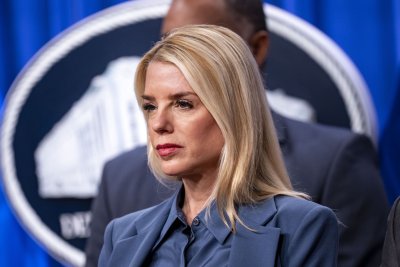
Police arrest three people outside insurer of Israeli arms maker Elbit, including Thunberg for holding placard.
British police have arrested Swedish activist Greta Thunberg and two other people at a pro-Palestine protest in central London, according to campaign group Defend Our Juries.
The group said Thunberg was arrested on Tuesday at the Prisoners for Palestine protest held in the heart of London’s Square Mile financial district outside the offices of Aspen Insurance, which provides coverage for Israeli defence contractor Elbit Systems.
Recommended Stories
list of 3 itemsend of list
The group said Thunberg had arrived after the protest began, and it shared video footage of the activist holding a sign reading, “I support the Palestine Action prisoners. I oppose genocide.” Thunberg has called Israel’s war in Gaza a genocide and has twice joined flotilla campaigns to try to break Israel’s siege of Gaza.
The City of London Police, which polices the financial district, confirmed that a 22-year-old woman, a description corresponding to Thunberg, was arrested for displaying a placard “in support of a proscribed organisation (in this case Palestine Action) contrary to Section 13 of the Terrorism Act 2000”.
This is the latest protest in solidarity with activists from the Palestine Action group, six of whom are currently on hunger strike in British prisons with two now hospitalised. The direct action group has been proscribed as a “terrorist organisation” by the United Kingdom’s government.
Defend Our Juries said Tuesday’s protest was held to draw attention to Aspen Insurance’s “complicity in genocide” and to express solidarity with prisoners affiliated with Palestine Action.
Thunberg is seen after her arrest for holding a placard expressing support for Palestinian Action prisoners and condemnation of Israel’s genocide [Handout/Defend Our Juries]
Two others, a man and a woman, were also arrested at the protest although they had “glued themselves nearby”, according to the City of London Police, which described damage with “hammers and red paint” to “a building on Fenchurch Street”, where the offices of Aspen Insurance are located.
Defend Our Juries confirmed the damage, saying in a news release that two activists “covered the front of the building with symbolic blood-red paint, using re-purposed fire extinguishers” before attaching themselves to the front of the building in the aim of “drawing attention to Aspen’s complicity in Genocide, disrupting their business, and closing down the building”.
The group said Aspen Insurance, a global insurer and reinsurer, was targeted because of its affiliation with Elbit Systems UK, a subsidiary of Elbit Systems, which is Israel’s largest arms producer. It describes its drones as “the backbone” of the Israeli military.
Palestine Action protesters had targeted one of the UK subsidiary’s operations in Bristol last year. Among their five key demands, the group’s hunger strikers want the manufacturer, which has several UK factories, to be shut down.
Defend Our Juries said in its news release that Deputy Prime Minister and Justice Minister David Lammy has “refused to speak to legal representatives of the hunger-strikers, or their families”.
A few days earlier, Thunberg had voiced solidarity with the hunger strikers on Instagram, saying: “It is up to the state to intervene, and put an end to this by meeting these reasonable demands that pave the way for the freedom of all those who choose to use their rights trying to stop a genocide, something the British state has failed to do themselves.”
A Palestine Action spokesperson said in relation to her arrest that it was not clear whether police had “made another one of their mistakes in interpreting the crazy ban on Palestine Action” or whether they had “turned anyone expressing support for prisoners locked up beyond the legal time limit for taking action to stop a genocide into alleged terrorists”.
The year was 1923, and thousands of people a month were flooding into Los Angeles in hopes of finding a job in the nascent film business.
Many planned to start as background actors, dreaming they’d be discovered by a director and finally get their big break. These behind-the-scenes actors would wander from studio lot to studio lot, lining up in hopes of being cast.
But the chaos of aspiring actors searching for jobs eventually became too much. Even silent screen star Mary Pickford took to warning wide-eyed newcomers that they should save enough money to survive for five years before coming out to Hollywood.
Out of calls to create safeguards around this fledgling business, and more order around background acting opportunities, emerged the Central Casting Corp.
Central Casting — now so eponymous that its name has become a cultural phrase — celebrated its 100th anniversary earlier this month.
I recently spoke with Mark Goldstein, president and chief executive of the Burbank-based company, to talk about changes in the industry, including the threat of artificial intelligence, runaway production and the role of a background actor in 2025.
Goldstein acknowledged the tough environment for background performers, also commonly known as extras, who populate restaurants, parks and other film and TV scenes to make the environment seem more realistic — all without saying a word.
After the lows of the pandemic, and then the explosion of content during the peak TV era, one of the main challenges for Central Casting’s members is just finding new roles, he said.
“There’s been a little bit of a pullback in production over the last year,” said Goldstein, who serves as president and CEO of Central Casting as well as production finance and management tools firm Entertainment Partners, which owns the agency. “It’s really just constantly finding the right roles for people.”
In Southern California, of course, jobs have been more scarce as production has flowed to other states and countries offering steeper film incentives.
Then there is the advent of computer-generated imagery, which has lessened the need for massive crowd scenes that were once standard.
“Before [CGI] technology, we may fill up an arena, like we may fill a 5,000-person shoot or a 10,000-person shoot,” Goldstein said.
Remember the long lines for casting calls?
No more.
More recently AI has been a key concern for background actors, though Goldstein said he doesn’t think the new digital tools and the rise of synthetic characters will eliminate the need for background actors.
“There’s a lot of conversation [about] is it human or technology? And we kind of view it as human and technology,” he said. “The consumer wants believability, and so there’ll be situations where it’s really important to have the human role involved, but there may be other situations where AI and technology can be helpful.”
He added: “We have legendary people that started their career because they wanted to follow their dream to become an actor in Hollywood,” he said, ticking off the names of famous alumni such as Clark Gable, Carole Lombard, Eva Longoria, Will Ferrell and Brad Pitt. “And we don’t see that changing.”
Despite the challenges, aspiring actors still register with Central Casting every day, Goldstein said. The company has 200,000 background actors in its database, with more than 20,000 new names added a year. About 3,000 are placed in roles each day, the company says.
One of those is Jaylee Maruk, 38, who signed up with Central Casting in 2009 and has worked steadily ever since.
Maruk works often on “Grey’s Anatomy” and has credits on Hulu’s “Paradise” and Apple TV’s “Shrinking.” She once stood in for Greta Lee in Apple TV‘s “The Morning Show.”
You’re reading the Wide Shot
Samantha Masunaga delivers the latest news, analysis and insights on everything from streaming wars to production — and what it all means for the future.
“What I love about doing background is it really gives a solid foundation about what it’s like to be on set and what the expectations are,” Maruk said.
But she worries about her future, especially with the rise of AI and the migration of production.
“Productions will pack up and leave,” she said. “They’ll go somewhere cheaper, and it’s becoming harder and harder for us. That’s really the biggest concern, trying to entice and support productions staying here.”
Towns in far-off countries like Hungary and Turkey can be made to look just like places in America, she says. And they can cast local residents instead of U.S.-based performers like Maruk. After all, background actors don’t have speaking roles, so not speaking English isn’t a problem.
“We want our work to be here,” said the Lake Balboa resident. “Our families are here, our lives are here.”
Last year, I got a glimpse into the world of background acting when I covered the annual Los Angeles Union Background Actors Awards. Though tongue-in-cheek at times — the awards themselves are called Blurries — the ceremony and winners’ speeches also highlighted these actors’ key roles in Hollywood.
I met background actors who had done the job for years, including one who got his first role as a 12-year-old in “Hello, Dolly!” Many talked about the difficulty of the last few years and the desire for respect for their professional work. Some were full-time background actors; others did the work part time. All were passionate about what they did.
“It really is just preparedness and luck, as they say,” Maruk said. “And also just having a lot of motivation and resilience.”
Stuff We Wrote
Film shoots
Number of the week
James Cameron’s “Avatar: Fire and Ash” brought in $89 million in the U.S. and Canada during its opening weekend. Globally, the film made $346 million, with big hauls in China and France.
That opening total came in at the lower end of box office analysts’ expectations and is also less than the massive opening weekend for its predecessor film, 2022’s “Avatar: The Way of Water,” which grossed $134 million in its domestic debut. But “Avatar” films tend to build momentum at the box office over subsequent weekends, so the Na’vi aren’t vanquished yet.
In addition to “Avatar,” this past weekend also saw strong performances from Angel Studios’ animated “David,” as well as Lionsgate’s thriller “The Housemaid,” pushing the year-to-date domestic box office total a slim 1% above the same time period last year. That’s helpful for theaters but doesn’t bode well for the box office’s overall performance this year.
Finally …
My colleague Josh Rottenberg looks at what movie stardom will mean in an age of AI. In that story, he has an interview with the creator of Tilly Norwood, the AI-generated character that recently sparked a furious debate in Hollywood about the role of synthetics in film and TV.
Dec. 23 (UPI) — The federal government is suing Washington, D.C., to ease its gun-ownership laws, which are the strictest in the nation.
The U.S. Department of Justice filed the suit Monday in federal court seeking to declare the laws unconstitutional and prevent the District from enforcing them. The laws ban most semiautomatic rifles and other firearms from being registered with the police department. This makes any possession of those guns illegal. AK-47s and AR-15s are among those that are illegal. Those owning those guns can face misdemeanor charges and fines.
The action “underscores our ironclad commitment to protecting the Second Amendment rights of law-abiding Americans,” Attorney General Pam Bondi said in a statement. “Washington, D.C.’s ban on some of America’s most popular firearms is an unconstitutional infringement on the Second Amendment — living in our nation’s capital should not preclude law-abiding citizens from exercising their fundamental constitutional right to keep and bear arms.”
The suit cites District of Columbia v. Heller, which was decided by the Supreme Court in 2008. Before Heller, the District made it illegal to carry unregistered firearms but it also banned the registration of handguns. The Heller decision said that people can have guns in their homes for self-defense.
After Heller, the District updated its gun laws and included a registry and training requirements. But it still makes assault rifles impossible to register.
The suit filed by the Justice Department argues the merit of the law.
“D.C.’s current semi-automatic firearms prohibition that bans many commonly used pistols, rifles or shotguns is based on little more than cosmetics, appearance, or the ability to attach accessories, and fails to take into account whether the prohibited weapon is ‘in common use today’ or that law-abiding citizens may use these weapons for lawful purposes protected by the Second Amendment. Therefore, the District’s restrictions lack legal basis,” the filing said.
D.C. Mayor Muriel E. Bowser, a Democrat, said in a statement Monday, reported by the Washington Post, that the District would “vigorously defend our right to make decisions that keep our city safe.”
“Gun violence destroys families, upends communities, and threatens our collective sense of safety. MPD has saved lives by taking illegal guns off our streets — efforts that have been praised by our federal partners,” Bowser said. “It is irresponsible to take any steps that would lead to more, and deadlier, guns in our communities, especially semi-automatic rifles like AR-15s.”
Lawyers from Everytown Law, a gun safety organization, said the city’s gun bans are legal.
“The legal consensus is clear: assault weapon bans are constitutional. Since the Supreme Court’s rulings in Bruen and Rahimi, federal courts have repeatedly affirmed that these laws are consistent with the Second Amendment,” Bill Taylor, deputy director of Second Amendment litigation at Everytown Law, said in a statement. “Assault weapons are designed for mass devastation, and we look forward to supporting D.C. as it defends this critical common-sense safety measure.”
District of Columbia U.S. Attorney Jeanine Pirro told prosecutors in August not to enforce felony charges for the city’s ban on openly carrying rifles and shotguns in public or the city’s ban on magazines that hold more than 10 bullets.
London, United Kingdom – Lawyers of imprisoned hunger-striking activists linked to the protest group Palestine Action have put the British government on notice as the justice secretary refuses to meet them.
Imran Khan & Partners, which represents the collective, wrote a pre-claim letter to the government on Monday, warning that they would seek a High Court case should officials fail to respond by Tuesday afternoon.
Recommended Stories
list of 4 itemsend of list
Eight activists, aged between 20 and 31, have participated in a rolling strike that began on November 2. There are rising fears that one or more of them could soon die in jail.
In recent days, their relatives and loved ones have told Al Jazeera of their deteriorating health and repeated hospital admissions.
Their lawyers have long called for a meeting with Justice Secretary David Lammy to discuss welfare and prison conditions, believing such an intervention could be life-saving.
But the government has so far refused, saying hunger strikes are not an unusual phenomenon in prisons and that policies to provide adequate medical care to anyone refusing food are being followed.
“Our clients’ food refusal constitutes the largest co-ordinated hunger strike in British history since 1981,” the lawyers wrote, referring to the Irish Republican inmates led by Bobby Sands. Sands and nine others died of starvation, one on day 46 of the protest.
“As of today’s date, [the current] strike has lasted up to 51 days, nearly two months, and poses a significant risk to their life with each passing day,” the lawyers wrote.
The detainees are being held in five prisons over their alleged involvement in break-ins at the United Kingdom’s subsidiary of the Israeli defence firm Elbit Systems in Bristol and a Royal Air Force base in Oxfordshire. They deny the charges against them, such as burglary and violent disorder.
Amu Gib, Heba Muraisi, Teuta Hoxha and Kamran Ahmed are on day 52, 51, 45 and 44 of their protests, respectively. Lewie Chiaramello, who is diabetic and refuses food every other day, began his protest 30 days ago.
Qesser Zuhrah, Jon Cink and Umer Khalid have ended their strike.
All eight will have spent more than a year in prison before their trials take place, well beyond the UK’s usual six-month pre-trial detention limit.
The hunger strikers’ five demands include immediate bail, the right to a fair trial and the de-proscription of Palestine Action, which accuses the UK government of complicity in Israel’s war crimes in Gaza. The UK government banned Palestine Action in July, branding it a “terror” group, a label that applies to groups such as ISIL (ISIS). The protesters have called for an end to alleged censorship in prison, accusing authorities of withholding mail, calls and books. They are also urging that all Elbit sites be closed.
‘Engage with each one’
Leading human rights barrister Michael Mansfield has backed calls for the government to intervene.
“It’s a simple proposition, engage with each one,” he told Al Jazeera. “That’s your job [as government], that’s what you’re there for. You are safeguarding people’s health, welfare and life.”
In a letter addressed to Lammy, he wrote, “Fundamental human rights in the United Kingdom are being destroyed in this quagmire of disinterest and populist politics, the most important being the presumption of innocence and the right to a fair trial by means of preparation and due process.
“There has to be an equality of arms which can hardly be achieved when a defendant is held in oppressive and lengthy periods of remand.”
Families of the prisoners have alleged mistreatment in prison, saying some detainees have been verbally abused and left without care in dangerous health conditions. The Ministry of Justice has denied these accusations and says it cannot comment on individual cases.
“Government takes action when it chooses to,” Mansfield wrote. “There could be no more appropriate time than now with the life-endangering protest by the hunger strikers. The delay is grotesque in some cases, up to two years with trial dates being set in 2027.”
Nida Jafri, a friend of hunger striker Amu Gib, plans to deliver Mansfield’s letter – and one of her own – in hand to the Ministry of Justice on Tuesday.
“These people are on remand – not convicted, still awaiting full legal process,” reads Jafri’s letter. “They are weak, in pain, and visibly wasting away. The absence of adequate medical observation or humane treatment under prison or hospital care is not only unacceptable; it breaches fundamental rights to health, dignity, and life.”
CHRISTINE McGuinness has taken a subtle swipe at ex Paddy in a post after taking off her wedding ring following their split.
Model Christine, 37, has unveiled a new gorgeous ring three years after her split from Radio 2 presenter Paddy.
Sign up for the Showbiz newsletter
Thank you!
Christine McGuinness wore her special ring in photos on InstagramShe revealed the ring wasn’t ‘a wedding ring’Credit: instagramPaddy and Christine McGuinness split in 2022Credit: Getty
Christine has now revealed she commissioned a bespoke ring featuring three huge diamonds to represent each of her kids, twins Leo and Penelope, 12, and 9-year-old Felicity.
The three diamonds are unique in shape and are connected via one silver band, with Christine sharing photos of the extraordinary jewellery on Instagram.
She wrote alongside the snaps: “Three diamonds, three babies, three reasons my heart shines.
But in an unexpected twist, it was ruled that Christine and their kids could continue living in the seven-bedroom Cheshire home, which has a gym and swimming pool.
Christine and their kids have autism, and she reportedly didn’t want to uproot their kids from the house they grew up in.
Asked if he and Christine spend Christmas Day together, Paddy, 52, replied: “Of course, because both of our families are our children’s relatives. Our children are always happy to see all of our family.
“Luckily for us it’s a nice vibe in our household so there’s never anything where the children feel anything negative whatsoever.
“I think most parents who have separated want what’s best for the children.”
Christine and their children live in the former couple’s £2.5million home, which Paddy still ownsCredit: Instagram / @mrscmcguinnessChristine last year revealed she found love with someone she met on her birthdayCredit: InstagramPaddy can come and go when he pleases from the houseCredit: Getty
Russian forces have struck Ukraine’s southern Black Sea port of Odesa, damaging port facilities and a ship, the region’s governor says.
The attack late on Monday followed another at the weekend when Moscow carried out a sustained barrage of drones and missile attacks on the wider area around Odesa, which is home to ports crucial to Ukraine’s overseas trade and fuel imports. They followed Russian threats to cut “Ukraine off from the sea”.
Recommended Stories
list of 4 itemsend of list
The escalation in Russia’s assault on Odesa, Ukraine’s biggest port city, has unfolded as Washington steps up diplomatic efforts to bring an end to the war. Ukrainian officials met members of a US delegation on Friday in Florida while US envoys held talks with Russian representatives on Saturday.
“The situation in the Odesa region is harsh due to Russian strikes on port infrastructure and logistics,” Ukrainian President Volodymyr Zelenskyy told reporters in Kyiv on Monday. “Russia is once again trying to restrict Ukraine’s access to the sea and block our coastal regions.”
What happened in the latest Russian attack on Odesa?
On Tuesday, the head of the Odesa Regional Military Administration, Oleh Kiper, said Russian strikes overnight had damaged a civilian cargo vessel and a warehouse in a district of Odesa while the roof of a two-storey residential building had caught fire.
Meanwhile, strikes on Saturday on the port of Pivdennyi near Odesa damaged storage reservoirs, Ukrainian Deputy Prime Minister Oleksii Kuleba said. Those came just one day after a ballistic missile strike, also in Pivdennyi, had killed eight people and wounded at least 30.
These are just the latest strikes in an escalation of hostilities in the area over the past few weeks.
Last week, Russia launched one of its largest aerial assaults of the war on the Black Sea region, damaging energy infrastructure and causing a power outage in Odesa, leaving hundreds of thousands of residents without electricity for several days.
Russia’s Ministry of Defence did not immediately comment on the strikes, but the Kremlin has previously described Ukraine’s economic infrastructure as a “legitimate military objective” during the nearly four-year war.
On the Telegram messaging app, Kuleba said on Friday that Russian forces were targeting power infrastructure and a bridge over the Dniester River near the village of Mayaky, southwest of Pivdennyi, which was struck five times in 24 hours.
That bridge links parts of the region separated by waterways and serves as the primary westbound route to border crossings with Moldova. It is currently out of operation. Kuleba said the route normally carries about 40 percent of Ukraine’s fuel supplies.
(Al Jazeera)
Why is Russia targeting Odesa?
“The focus of the war may have shifted towards Odesa,” Kuleba said, warning that the “crazy” attacks could intensify as Russia tries to weaken Ukraine’s economy.
Russian President Vladimir Putin has previously said Moscow wants to restrict Ukraine’s Black Sea access in retaliation for Kyiv’s recent drone attacks on Russia’s sanctions-evading “shadow fleet” of vessels, which carry a variety of commodities.
Ukraine said those vessels are used to illegally export sanctioned oil, which provides Russia with its main source of revenue for financing its full-scale invasion of its neighbour.
How important is the port of Odesa to Ukraine?
Odesa’s port has long been central to Ukraine’s economy. Called a “pearl by the sea”, Odesa is Ukraine’s third most populous city after Kyiv and Kharkiv.
Black Sea ports – including Odesa and two others close by, Pivdennyi and Chornomorsk – and Mykolaiv to the east handled more than 70 percent of Ukraine’s exports before the war.
But Odesa’s role as a trading hub has grown in recent years as ports in the Zaporizhia, Kherson and Mykolaiv regions have been occupied by Russia.
Since the war began in February 2022, Ukraine has continued to rank among the world’s top five exporters of wheat and corn – largely through Odesa.
By targeting Odesa’s shipping facilities with missiles and drones, Ukrainian officials said, Putin aims to destroy Ukrainian trade and business infrastructure.
Zelenskyy, who has previously accused Russia of “sowing chaos” on the people of Odesa, said: “Everyone must see that without pressure on Russia, they have no intention of genuinely ending their aggression.”
What would it mean for Ukraine if Odesa were destroyed?
If the port of Odesa were badly damaged, the economic impact for Ukraine would be severe. The city and its surrounding areas would suffer major job losses in the shipping and logistics industries, seriously squeezing local incomes. Meanwhile, port-dependent businesses would falter and investment would fall away.
Nationally, Ukraine’s export capacity would be hit hard. As a key gateway for grain and other commodities, disruptions there would raise transport costs, slow shipments and reduce export volumes, choking foreign currency earnings and piling pressure on the hryvnia, Ukraine’s currency.
Elsewhere, farmers would suffer from lower prices for their produce as well as storage bottlenecks with knock-on effects across rural economies. The government would also lose customs revenue just as reconstruction costs would rise, weakening the country’s overall economic resilience.
What other acts of maritime warfare have Ukraine and Russia engaged in during the war?
Over the past six months, maritime warfare between Ukraine and Russia has intensified. Both sides have targeted naval and commercial assets across the Black Sea and beyond.
Ukrainian forces have increasingly used underwater drones and unmanned surface vessels to strike ships tied to Russia’s shadow fleet.
Kyiv has expanded its reach elsewhere, claiming drone strikes in the Mediterranean on December 19 on the Qendil, a Russian-linked tanker, marking an expansion in Kyiv’s maritime operations.
At the same time, Russian forces have ramped up attacks on commercial targets, including a Turkish-flagged ship carrying trucks and other freight near Odesa with drone attacks on December 13.
These actions reflect a shift towards what is referred to as “asymmetric naval warfare”, in which drones and improvised systems play a growing role in disrupting each side’s economic and military support networks at sea, experts said.
The protest was in support of Palestine Action prisoners on hunger strike
Greta Thunberg has been arrested at a demonstration in support of the Palestine Action protesters who are on hunger strike in prison, according to the Prisoners for Palestine protest group.
The 22-year-old activist was detained in the City of London after attending the scene of the early-morning demonstration on Fenchurch Street.
In a video shared by the group, she could be seen holding a sign reading “I support the Palestine Action prisoners” and “I oppose genocide”.
City of London Police said a 22-year-old woman was arrested for displaying a placard in support of a proscribed organisation, in this case Palestine Action, contrary to Section 13 of the Terrorism Act 2000.
The force said officers were called to the area at about 07:00 GMT after hammers and red paint were used to damage a building.
A man and a woman were also arrested on suspicion of criminal damage after they “glued themselves nearby”, police said. Specialist officers worked to release them before taking them into custody.
PA Media
Greta Thunberg was arrested on Fenchurch Street in the City of London
The Prisoners for Palestine protest group said it staged the demonstration outside the offices of Aspen Insurance, which it claimed provides services to Israeli-linked defence firm Elbit Systems.
Ms Thunberg, who first came to prominence as a child climate activist, has been involved in several demonstrations in support of the Palestinian cause.
Princess Andre has revealed that neither her mum, Katie Price, or dad, Peter Andre, have watched her ITV series The Princess DiariesCredit: ITVPeter, who Princess has a close bond with, appeared on the first season of the ITV showCredit: GettyWhile Katie claimed she was shunned from the production and didn’t feature in itCredit: PA
And despite the show being a massive hit, Princess says her famous parents weren’t sitting down on the couch to give it a watch.
She told The Sun: “I actually don’t think either of my parents have watched the show.”
“I don’t think it’s my dad’s thing, it’s more, it’s a show for people my age to watch, I think,” explained Princess, who was speaking at the launch of 3D Refirm x Facebible in Windsor.
Exes Katie and Peter share Princess and her older brother Junior, 20. While Peter is also a dad to Theo, Amelia and Arabella, and Katie to Harvey, Jett and Bunny.
“I’ve finished for season two and then I’ve got season three to film. So, I’m really excited. I think people are going to love it,” she said.
A date for the show’s release has not yet been confirmed, with Princess simply telling fans last year: “See you in 2026”.
In a break from filming, Princess was speaking at The Fairmont in Windsor, where Dr Raj Arora was launching 3D refirm – non-surgical skin tightening procedures – at her clinic, Facebible.
The doctor is a close friend of Princess’s dad and stepmum, Emily Macdonagh, who were also in attendance at the event.
She is the first doctor to offer 3D refirm at a medical-grade in the UK, with the treatment now available to book at http://www.thefacebible.com.
Princess is currently filming for the second two seasons of her reality showCredit: SplashHer brother, Junior, also features in the show as the pair’s close relationship is displayedCredit: Getty
A mother and her teenage son died in fighting between the Syrian military and Kurdish-led SDF forces in Aleppo. The violence began shortly after talks in Damascus on integrating SDF forces into the army. Al Jazeera’s Ayman Oghanna is in Aleppo, where a truce has been called.
Weekly insights and analysis on the latest developments in military technology, strategy, and foreign policy.
President Donald Trump has rolled out plans for new Trump class large surface combatants for the U.S. Navy. These are to be armed with a wide array of missiles, including nuclear-armed and hypersonic types, as well as electromagnetic railguns, laser directed energy weapons, and more. Trump says the goal now is to build at least two of these vessels, the first of which will be named USS Defiant, but that the fleet size could grow to 10 hulls or more. The 30,000-to-40,000-ton displacement ships are the centerpiece of a larger naval shipbuilding initiative called the Golden Fleet.
Trump, flanked by Secretary of War Pete Hegseth, Secretary of State and acting National Security Advisor Marco Rubio, and Secretary of the Navy John Phelan, unveiled the Trump class at his Mar-a-Lago estate in Palm Beach, Florida. The vessels are currently being referred to as “battleships,” a term historically applied to large warships with gun-centric armament and heavily armored hulls. The Navy decommissioned its last true battleships, the World War II-era Iowa class USS Missouri and USS Wisconsin, between 1990 and 1992. By which time they had been heavily upgraded. TWZhad highlighted the possibility of the Navy pursuing a warship in the general vein of the design shown today after the president had first teased this plan back in September.
President Donald Trump at Mar-a-Lago just before unveiling the Trump class warship plan. Tasos Katopodis/Getty Images
“From [President] Theodore Roosevelt, [and] the Great White Fleet … to the legendary [Iowa class] USS Missouri, whose massive guns helped win World War II, America’s battleships have always been unmistakable symbols of national power,” Trump said. The Trump class “will be the flagships of the American naval fleet, and there has never been anything built like them.”
All four of the Iowa class battleships that were built seen sailing together. USN
“American strength is back on the world stage, and the announcement of the Golden Fleet, anchored by new battleships, the biggest and most lethal ever, … marks a generational commitment to American sea power across the entire department,” Secretary Hegseth said. “New and better ships will provide that deterrent today and for generations to come.”
“We’re going to make battle groups great again,” Secretary Phelan added. “The USS Defiant battleship will inspire awe and reverence for the American flag whenever it pulls into a foreign port. It will be a source of pride for every American.”
“As we forge the future of our Navy’s Fleet, we need a larger surface combatant and the Trump class Battleships meet that requirement,” Chief of Naval Operations Adm. Daryl Caudle also said in a separate Navy press release. “We will ensure continuous improvement, intellectually honest assessments about the requirement to effectively deter and win in the 2030s and beyond, and disciplined execution resulting in a Fleet unparalleled in lethality, adaptability and strength.”
If all goes to plan, “when a conflict arises, you [the president] are going to ask not one, but two questions, where are the carriers and where are the battleships,” Phelan said today.
A rendering of a Trump class warship as seen from the side. White House/USN
Otherwise, the salient details about the Trump class shared today at Mar-a-Lago, as well as in the Navy’s release, are as follows:
30,000 to 40,000 displacement (the Iowa class battleships had displacements of around 57,540 tons with a full load).
Renderings displayed at the event at Mar-a-Lago show a design with three large Vertical Launch System (VLS) arrays, two at the bow end and one at the stern.
One of the renderings, seen below, depicts the ship firing what looks to be an IRCPS missile, a Tomahawk cruise missile, and a member of the Standard Missile family.
This appears to be the first time a class of Navy ships has been named after a sitting U.S. president. The Navy has often drawn criticism in the past for naming ships after living individuals, in general. It is unusual for the lead ship in a class of U.S. Navy vessels not to bear the name of that class (USS Defiant here instead of something like USS Trump or USS Donald J. Trump), as well.
Major questions about the plans for the Trump class do remain, including when the USS Defiant might be launched, let alone enter service. What these ships might cost to produce, as well as operate and maintain, is another important open question.
Despite the comments at Mar-a-Lago today, the unveiling of the Trump class is still likely to prompt much new analysis and general discussion about the expected utility of these ships, including from TWZ. We already did a deep dive into the feasibility, as well as the operational relevance, of Trump’s “battleship” proposal after his remarks in September. As we noted at the time, a concept along the lines of what was shown today offers a compromise of sorts that could help justify its complexity and cost. Similar ‘arsenal ship’ concepts for the Navy have been put forward on several occasions over the past few decades. This includes a proposal from Huntington Ingalls Industries in the early 2010s for a derivative of the San Antonio class amphibious warfare ship with 288 VLS cells and otherwise optimized for the ballistic missile defense mission.
Artwork from the Defense Advanced Research Projects Agency showing a notional arsenal ship dating back all the way to the 1990s. DARPAA rendering of the proposed San Antonio class-derived ballistic missile defense ship. HII/MDA
At the same time, what capabilities the Trump class might truly be able to bring to bear will be dependent on a host of factors, especially if they are only ever fielded in relatively smaller numbers. And regardless of how capable any warship is, it can only ever be in one place at one time, which is more often than not in port.
On the other hand, there are concerning VLS cell gaps that are fast approaching on the horizon. The service is set to retire the last of its Ticonderoga class cruisers, each one of which has 122 VLS cells, at the end of the decade. The Navy will also need to make up for the impending loss of the huge missile launch capacity offered by its four Ohio class nuclear guided missile submarines, which are also set to be decommissioned before 2030. The Trump class will clearly feature a massive set of VLS arrays that could help offset some of this deficit.
The general length of time it takes to design and produce large warships creates additional uncertainty for any naval shipbuilding endeavor, as well. Since the end of the Cold War, the Navy has seen a number of major warship programs be severely truncated, or outright cancelled, for a variety of reasons. As one prime example, the service originally planned to acquire 32 Zumwalt class stealth destroyers before slashing that number to just three and drastically watering-down their capabilities. The Trump administration also just recently axed the Constellation class frigate program, which had turned into a major boondoggle, as you can read more about here.
The Trump class “battleship” announcement notably comes on the same day the Navy confirmed to TWZ that the first of its future FF(X) frigates will be delivered with the glaring omission of a VLS and are clearly meant to be produced as cheaply and quickly as possible. At least the first ships will have the same armament of the much-derided Littoral Combat Ship.
All this will prompt major debate about how the Navy is using its pool of resources that it constantly says is too small to meet its future obligations. Investing so much in a small number of hulls while stripping out capabilities of those ships that will be built in larger numbers will surely be a hot topic on Capitol Hill in the months to come.
BBC One’s new Christmas drama Stuffed has been branded “iconic” by fans
A hidden treasure of a comedy on the BBC, hailed as “brilliant” by viewers, is set to air tonight.
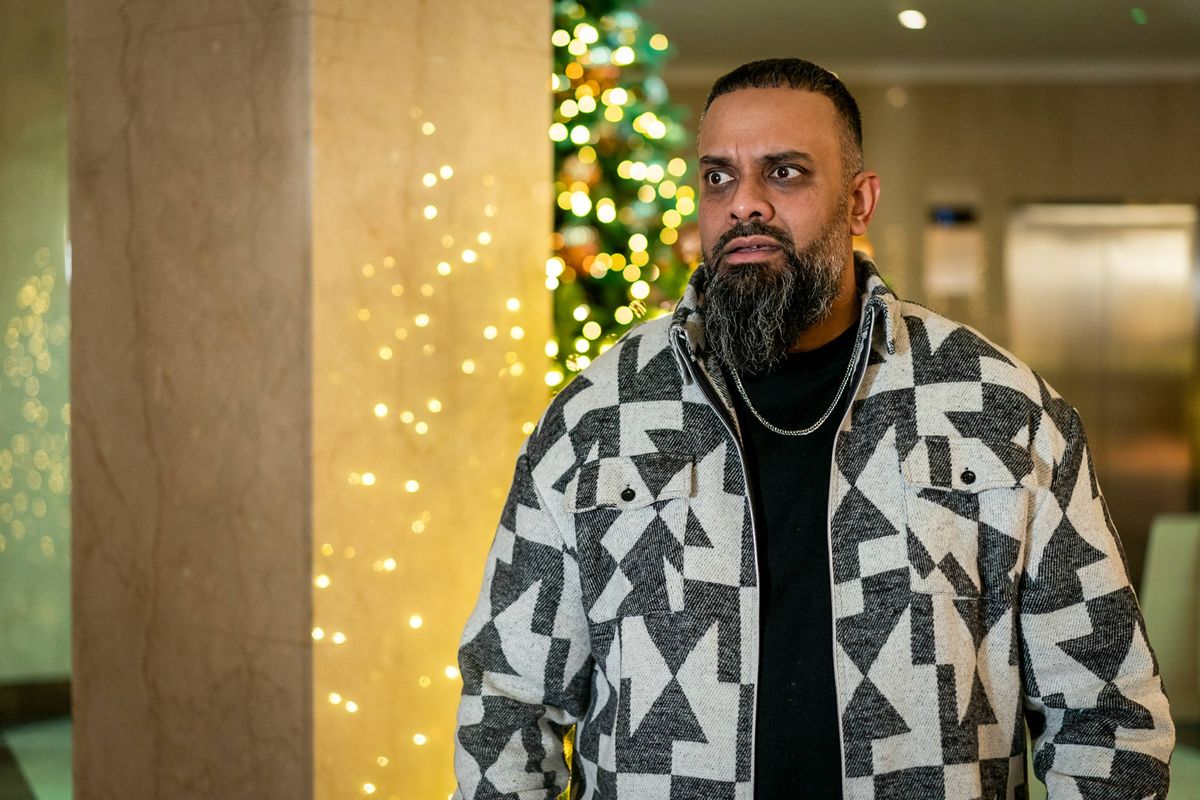
Stuffed, starring Guz Khan and Morgana Robinson, is a comedy-drama that follows a family embarking on a once-in-a-lifetime trip to Lapland.
Khan portrays Arslan Farooqi, who, after receiving an unexpected £8,000 Christmas bonus at work, decides to take his multi-faith family on this festive adventure.
Joined by his wife Hannah (played by Robinson), his two daughters, and brother-in-law Jamie, they trade Coventry for the enchantment of Christmas in Lapland.
However, their holiday soon descends into chaos when Arslan discovers that his bonus was given in error and needs to be returned, reports Wales Online.
The BBC’s synopsis teases: “Things go downhill fast when Arslan finds out the bonus was a mistake, and to make matters worse, they have already spent every penny of it.
“What ensues is one man’s quest to salvage a Christmas he doesn’t believe in, while ideally not losing his job, his family, and everything he has ever worked for. And surprise, surprise, it doesn’t go too smoothly.”
For the latest showbiz, TV, movie and streaming news, go to the new **Everything Gossip** website
The film can be streamed on BBC iPlayer and will also be broadcast on BBC One tonight at 9pm.
One enthusiastic fan recommended: “If you’ve not watched it yet, try Stuffed on the iPlayer. Brilliant new addition to the Christmas film list. Guz Khan is brilliant.”
Another viewer gushed: “Absolutely loved Stuffed on BBC iPlayer with my fav man @GuzKhanOfficial, him and Morgana are a dream team working together.”
Another viewer chimed in: “Loved it, hope some more will follow!” while a fourth echoed: “We need a regular series for this! Loved it made me laugh throughout.”
One enthusiastic fan declared: “This is iconic on tv I didn’t know what to watch during the Christmas holidays, same old home alone and polar express but this… is perhaps the best drama I’ve seen.”
Guz had previously shared his apprehensions about Stuffed’s release with The Guardian, saying: “You never know when you make something. I never thought we’d ever be in this kind of slot. There’s lots of things that come along with doing a Christmas special.”
He continued: “A lot of the work I get asked to do is like: ‘Come in and do your thing.’ I just did season two of The Gentlemen, and it was such a fun week. There’s no rules. You can go absolutely crazy.
“But this was a little bit different. You have to follow some guidelines. And so it was a really good challenge for me. Where I’d usually express myself with dialogue, I had to try and get the same feeling with an expression.”
Stuffed airs on BBC One tonight at 9pm and is available to watch on iPlayer.
The Africa Cup of Nations is more than a football tournament.
Hosted this year in Morocco, it brings together a global African audience. AFCON offers a rare glimpse of how nations connect with each other and the diaspora through football.
“This [killing in Moscow] is a mode of warfare which would be referred to as, quote-unquote, irregular.”
The killing of a top Russian general is a “direct message” to senior Russian military leaders from Ukraine, says Marina Miron, of King’s College London.
Fans are convinced that The Pussycat Dolls have “confirmed” they are reunitin (Jessica Sutta, Kimberly Wyatt, Nicole Scherzinger, Melody Thornton and Ashley Roberts pictured in 2008)Credit: GettyIt wouldn’t be the first time the band got back together, with an attempted reunion in 2019Credit: PA:Press AssociationNicole has had her fair share of trouble since leaving the band, including a highly-public feud and legal battleCredit: Getty
CAA music division head Rob Light and Paul Franklin – a specialist in reunion tours – are now set to manage the band in a telling move.
While Nicole teased the reunion this week by talking about “what’s to come” for the band.
Sharing a clip from their hit song Buttons, Nicole wrote: “From then to now… seeing this video hit 1 billion views on YouTube fills my heart with so much gratitude.
“For the PCD fans. For the memories. For what’s to come.”
At the time, a source said: “Kimberly has been open about the fact the girls have sorted out their issues.
“She also told pals they’ve been discussing a tour.
“The Pussycat Dolls certainly had their differences over the years, but a comeback would send fans wild.”
The Dolls started off as a burlesque troupe but in 2003 Nicole , Melody and Kaya joined Carmit, Ashley , Jessica and Kimberly to form the group.
They split in 2010.
This is not the first time a reunion has been on the cards, with multiple members of the band reuniting in 2019 before planning a 2020 tour, which was halted due to Covid-19.
It was later cancelled due to the pandemic and legal issues.
Robin claimed that Nicole was refusing to take part in the tour unless she received a larger share of the group’s joint firm.
She allegedly demanded her 49 per cent holding in the firm is increased to 75 per cent, giving her creative control of the group and “final decision-making authority”.
According to the lawsuit filed by Robin, Nicole said the “growth of her personal brand” and the “opportunities she would have to forego to engage in the partnership” was why she deserved an increased share.
However, in a fiery retaliation, former X Factor judge Nicole issued a statement through her lawyer, Howard King, in which she branded Robin’s claims as “ludicrous and false”.
Melody wasn’t involved in the last planned reunion after clashing with Nicole over singing the band’s lead vocals.
Robin Antin sued Nicole following the band’s 2019 reunion in what became a bitter legal battleCredit: GettyThe band originally rose to fame in 2003Credit: Getty
Liverpool manager Arne Slot says star forward Alexander Isak will be on the sidelines until at least late February.
Published On 23 Dec 202523 Dec 2025
Share
Alexander Isak is expected to be out of action for two months after fracturing his leg against Tottenham, with Liverpool manager Arne Slot accusing Tottenham’s Micky van de Ven of making a “reckless challenge”.
The Sweden striker was injured in a tackle from the defender in the act of scoring the opening goal in Saturday’s 2-1 victory and limped off the pitch.
Recommended Stories
list of 3 itemsend of list
Liverpool said in a statement on Monday that the forward had had an operation on an ankle injury that included a fibula fracture.
“It’s going to be a long injury, for a couple of months,” Slot told reporters on Tuesday, “So, yeah, that’s a big, big, big disappointment for him. And as a result, also of course for us.”
Slot described Van de Ven’s tackle as “reckless”.
“I think I said a lot about the tackle of Xavi Simons [sent off earlier in the game for Spurs], which for me was completely unintentional, and I don’t think you will ever get an injury out of a tackle like that.
“The tackle of Van de Ven, if you make that tackle 10 times, I think 10 times there’s a serious chance that a player gets a serious injury.”
Isak, centre, gets injured in a challenge with Tottenham Hotspur’s Dutch defender #37 Micky van de Ven at the Tottenham Hotspur Stadium in London, on December 20, 2025 [Justin Tallis/AFP]
Isak’s challenging year continues
Isak’s injury is the latest setback for the forward after he signed from Newcastle for a British record 125 million pounds ($168m) in September.
A dispute with Newcastle meant he did not have a proper preseason programme and arrived at Liverpool well behind his teammates in terms of fitness.
His season was then interrupted by a groin injury.
The 26-year-old has scored just three goals in 16 appearances since completing his protracted move to Anfield.
Isak’s absence will be a major blow for Reds boss Slot, with Mohamed Salah at the Africa Cup of Nations and Cody Gakpo not ready to return from a muscle injury until early in the new year.
It leaves Slot with Hugo Ekitike, who has five goals in his past four games, and the little-used Federico Chiesa as his only senior forwards.
Liverpool, whose Premier League title defence collapsed after a shocking run of results, have climbed to fifth in the table after extending their unbeaten league run to five games.
Isak’s injury raises the prospect of Liverpool moving to boost their attack in the January transfer window, with Bournemouth winger Antoine Semenyo linked with a move to Anfield.
It may also change the conversation around Salah, who had been linked with a move to Saudi Arabia following his recent claim that he had been thrown under the bus by the club and no longer had a relationship with Slot.
Salah’s rant, which came after he was left on the bench for three successive matches, prompted Liverpool to leave him out of the squad for a Champions League match at Inter Milan.
But he returned to action as a substitute against Brighton before leaving for international duty.
Kyiv, Ukraine – Have you been on a plane during severe turbulence, fearing that the shaking aircraft is about to fall apart and tumble down? Brief moments of weightlessness stop your breath, perhaps you whisper prayers and remember everyone you love.
That’s the feeling you get during a Russian air raid in Kyiv, Ukraine, and there have been more than 1,800 of them since Russia’s full-scale invasion began in 2022.
Recommended Stories
list of 4 itemsend of list
These days, they are bigger, scarier and longer than ever, because each one involves hundreds of drones and dozens of missiles.
They begin after dark and sometimes last in waves until dawn. Whooshing missiles tear up the night sky in two. Drones buzz like horror movie chainsaws or giant mosquitoes out of childhood flu nightmares.
What’s really harrowing is to hear two or three drones at once – I sardonically call it “stereo” and “Dolby surround” – while the arrhythmia of bass drum-like air defence explosions coincides with your heartbeat.
Each boom and thud chokes your body with adrenaline, and some shake your house, but after a couple of hours, your brain gives up, and you fall asleep processing the booms into nightmares.
And in the morning, you fall awake – feeling hungover and disoriented – and read about the consequences. You’re glad when no one is killed, and still sad because several people are usually wounded, and several apartment buildings are damaged.
People walk near a petrol-run generator, used to generate electricity for a medical clinic during a power blackout, after critical civil infrastructure was hit by Russian missile and drone attacks in Kyiv, Ukraine, October 10, 2025 [Gleb Garanich/Reuters]
Sometimes, I think about the people who operate the drones and launch the missiles. How they come back to their families after the night shift, what they tell their children and, most importantly, themselves.
But I prefer the memory of a crowd of high school graduates who walked past my house in June, at dawn, after their prom night that coincided with an especially long and loud air raid.
Their laughter and happiness about the sunrise, the clouds of blossoming trees around them, the rugs of flowers and grass under their feet, and the future ahead of them made them sound immortal. It was a sound that defied Russian President Vladimir Putin.
In recent months, blackouts have been the most inevitable part of each air raid. It feels as though keeping millions awake and horrified during the raids is only part of Moscow’s strategy of terrorising Ukraine.
Moscow’s logic appears simple: if you do not want to surrender, you will freeze. It methodically destroys power stations, transmission and central heating lines to keep millions without electricity, light and heat.
And then there are “planned outages”. There are usually three a day, lasting between two and eight hours.
You can hear an outage because even the sounds in your ears barely register, such as the fridge’s purring or the flow of hot water in the heating system, are gone. You can see an outage because the neighbourhood lights go out, making the stars in the night sky closer and brighter.
How to survive darkness
What saves you from darkness and disconnection is gadgets.
Apart from smartphones with energy-saving modes, wi-fi hotspots and flashlights, there are laptops, tablets, wireless speakers and vacuum cleaners running on batteries.
There are also inexpensive rechargeable lamps – I have 10 of them. Three are pint-sized and bright enough for my mother to read. Three more are motion-activated, which means she can safely use the bathroom any time, and the cat is perpetually amazed.
There is a cap lamp that makes me look like a miner and helps me cook or find something in the basement, and two tiny lamps that can be stuck into a power bank and just glow in a corner.
And there is a Christmas garland in the kitchen that makes each outage feel festive.
But the most important device, the symbolic hearth of my powerless house, is a $1,200, 20kg (40lbs) battery that can keep us warm and energised for up to 12 hours.
I live on the outskirts of Kyiv in a remodelled summer house that has its own pump and a natural gas-powered heating system. Both need electricity, along with the two 50-litre (13-gallon) water heaters.
But boiling water and microwaving meals is too energy-consuming, so we stick to frying pans and an old-fashioned whistling kettle that scares the cat.
And when the power is back on, there is no room for procrastination.
You need to recharge all the lamps and devices, start a washing machine, wash dishes, and go out for groceries without risking your life while crossing the road with the traffic lights off.
The electricity’s comeback may be deceptive – sometimes, it’s too weak. I recently tried to microwave a bowl of soup, twice, but it remained cold.
And for extreme emergencies, I have a gasoline-fuelled generator. It’s loud, shaky and stinky, and you need an entire canister of gas worth $30 for it to keep it going all night.
But such generators keep Ukraine running.
You can see them next to shops, offices and apartment buildings. Some are chained to trees or walls to prevent theft, and some are too huge and heavy to be carried away.
During a recent music festival celebrating Ukrainian composers, a giant diesel generator powered the concert hall.
My internet provider turns them on seconds after an outage begins, so I am online no matter what.
You also need to be prepared when you go out.
After covering the 2008 Russian war in Georgia, I used to drive everyone around me mad with my I-have-to-be-ready-for-any-emergency obsession.
Now, all of Ukraine feels the same obsession.
The phone has to be fully charged. There has to be a power bank in my backpack – along with a basic first aid kit, a lighter (I don’t smoke), extra batteries for the Dictaphone, pens and a pencil to take notes in subzero temperatures, when ballpen ink freezes.
A couple of months ago, I used the lighter at Kyiv’s Independence Square, dotted with hundreds of tiny Ukrainian flags next to photos of fallen soldiers.
I helped a man with a toddler light a tiny candle that he wanted to place next to the photo of his younger brother.
“He’s the toddler’s father,” the man said, and all I could utter was “God rest his soul” as I walked away, hiding tears and putting the lighter back.
BROOKLYN Beckham’s wife Nicola Peltz has taken to social media to celebrate her family in a new post – just days after her husband’s decision to block his entire family online.
Brooklyn, 26, allegedly made the decision after Victoria Beckham “liked” one of his Instagram posts about cooking a roast chicken, which caused a frenzy in the comments section.
Sign up for the Showbiz newsletter
Thank you!
Nicola posted a photo of her dad Nelson in a sweet family social media moment – days after Brooklyn reportedly blocked his on InstagramCredit: InstagramNicola is also no longer following the Beckham’s eitherCredit: GettyBrooklyn’s brother Cruz has been refuting the rumours of his parent’s unfollowing their sonCredit: instagram/cruzbeckham
But it appears Nicola has now broken her silence on the matter, sharing a post of her own about family.
The actress, 30, posted a snap of herself and her father beaming, celebrating Hanukah.
Her billionaire dad, Nelson Peltz, is standing behind the candles placed in their menorah.
Captioning the post: “Happy Hanukah from our family to yours,” Nicola appeared to gloss over ongoing tension with her parents-in-law, who she has also blocked online.
Nicola has reportedly blocked the rest of the Beckham clan as well, including Brooklyn’s 14-year-old sister, Harper.
Sources confirmed to The Sun that Nicola stands by Brooklyn’s decision wholeheartedly and as such followed his lead in blocking all of the family too.
One insider said to The Sun: “Brooklyn and Nicola have been and will always be a united front.”
Another source close to the couple says: “She will always back him so that’s why she’s done the same and blocked his family.”
After Victoria “liked” her son’s most recent cooking post, it led to a sea of comments from fans who noticed the potential olive branch, urging Brooklyn to make amends with his family.
It’s understood that this annoyed Brooklyn and created pressure, so he responded by cutting contact with all of the Beckham’s online.
Friends of the influencer have deemed Brooklyn’s family’s behaviour as “unacceptable”.
Meanwhile, a source told the Daily Mail: “David and Victoria will never stop loving Brooklyn.
“They will always be here for him and they always want him to know that, they are devastated at this fall out.
“So far from this being them, it appears that Brooklyn has blocked them to show them that’s it, this is final.
“It is very clear that this is a sign of his complete estrangement from his family.
“For David and Victoria it was their last connection to Brooklyn as he has made it very clear he doesn’t want to talk to them anymore, they haven’t spoken for months and months now.
“By following him it was a message to him that they still love him and still want to follow his life. Now they can’t do that, but it’s not their doing.”
Brooklyn’s younger brother Cruz, 20, refuted reports that his parents had unfollowed Brooklyn in an Instagram story post on Saturday, claiming David and Victoria had been ‘blocked’ by Brooklyn instead.
The feud between Brooklyn and Nicola and the Beckham’s first began in 2022 when there were reports that Nicola had refused to wear a wedding gown designed by Victoria.
Increasingly distancing himself from his family, Brooklyn has attended less family gatherings including David’s 50th birthday, mum Victoria’s Netflix docuseries premiere and his dad’s knighthood ceremony.
Brooklyn used to attend events with his famous familyCredit: GettyThe family used to be closeCredit: Getty
When Qatar helped secure a peace deal to end ongoing conflict between the M23 rebel group and Democratic Republic of the Congo’s (DRC) government last month, there was hope among many Congolese that a permanent ceasefire would soon emerge to end the fighting that has uprooted close to a million people in the country’s troubled east, and give war-racked communities some respite as the new year rolls in.
Since late 2021, the group, which the United States and the United Nations say is backed by Rwanda, has clashed with the Congolese army in heavy offensives that have killed at least 7,000 people this year alone. Several regional attempts at resolution have failed. Still, when M23 representatives and Congolese government officials met for negotiations in Doha and proceeded to sign a peace deal in November, exhausted Congolese dared to hope. This deal, some reckoned, could be different.
Recommended Stories
list of 3 itemsend of list
So when the rebels launched yet another offensive and temporarily seized the strategic city Uvira this month, hopes for lasting peace were painfully crushed, as some concluded that those at the helm of the talks were playing politics.
“It’s clear that they don’t have any will to end this conflict,” Congolese lawyer and political analyst Hubert Masomera told Al Jazeera from the M23-held eastern city of Goma, blaming both sides. “Despite the number of deaths and the extent of the destruction, there is still procrastination over the implementation of the peace agreements and compliance with the ceasefire. People here feel abandoned to their sad fate.”
Fears that the conflict will not only continue, but that it could soon take on a regional dimension, are deepening, too – a sensitive prospect in a DRC where two civil wars in the past were prompted by its neighbours.
Uvira, the newly captured city the rebels then withdrew from as a “trust-building measure” following US pressure last week, is a major transport and economic hub in the huge South Kivu province. It’s strategically located on the border with Rwanda and is just 30 kilometres from the Burundian capital, Bujumbura. The city was the last eastern stronghold of the Congolese army and its allies – local “Wazalendo” militias and about 3,000 Burundian soldiers. Early this year, M23 also seized control of South Kivu’s capital city, Bukavu, as well as Goma, the capital of North Kivu province.
Experts say M23’s advance on Uvira widens the group’s area of control significantly, puts it at the mouth of the mineral-rich Katanga region, and positions Rwandan proxies right at Burundi’s doorstep at a time when both governments are ramping up a war of words and accusing each other of backing rebels.
Rwanda, for its part, continues to distance itself from accusations that it backs M23.
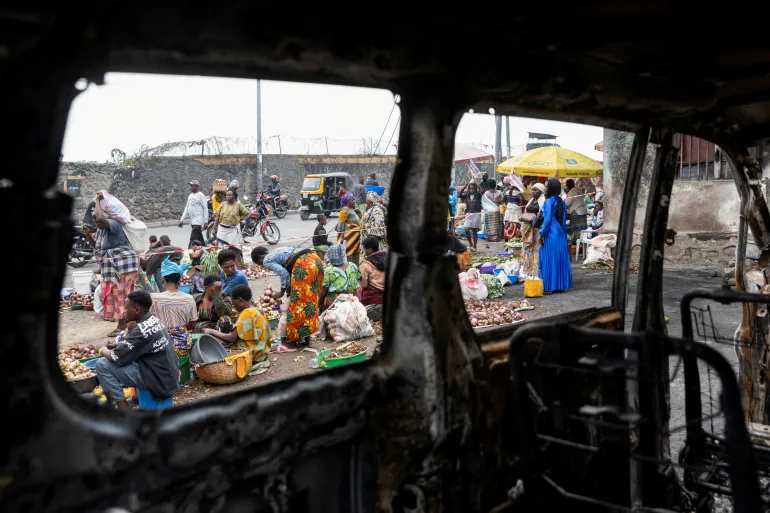
A view shows the remains of a vehicle hit by heavy and light weapons during the fighting in the town that led to the fall of Goma to M23 rebels, on February 5, 2025 [File: Arlette Bashizi/Reuters]
DRC conflict’s complex history
The recent scenes in eastern DRC appear like an eerie playback of a tragic tale, conflict monitors say.
Similar peace negotiations in late 2024, led by the African Union and Angola, seemed ready to deliver peace ahead of a new year. But they collapsed after a highly anticipated meeting between the presidents of Rwanda and DRC was called off. Both sides accused each other of foiling the talks.
“There’s a sense of deja vu,” Nicodemus Minde, East Africa analyst at the Institute for Security Studies (ISS), said. “It’s symbolic because we were exactly here last year … the prospects for peace are dire.”
Conflict in the DRC has long been mired in a complex mix of ethnic grievances, poor governance and interference from its much smaller neighbours. It goes back to the 1994 genocide of Tutsis and moderate Hutus in Rwanda, which displaced millions into neighbouring eastern DRC, making them a minority there. Rwanda has since viewed the DRC as a hiding place for Hutu genocidaires, however, and its hot pursuit of them toppled a government in Kinshasa and led to the first and second Congo wars (1996-2003). The UN also accused the Rwandan and allied Ugandan forces of looting the DRC’s vast mineral wealth, including gold, coltan and tin, during the conflict.
Scores of militias emerged as governments armed and counter-armed civilians in the wars, many of which are still active in the DRC. The M23 itself is only the latest iteration of a Tutsi militia that fought in the Congo wars, and whose fighters integrated into the DRC army. In 2012, these fighters revolted, complaining of poor treatment by the Congolese forces. Now, the M23 claims to be fighting the marginalisation of ethnic Tutsis, some of whom say they are systematically denied citizenship, among other complaints. The M23 and its allied Congo River Alliance (AFC) have not stated goals of taking Kinshasa, even though members of the group have at times threatened to advance on the capital. Officially, the rebels claim to be “liberating” eastern DRC communities.
In 2012, M23 initially emerged with enough force to take the strategic city of Goma, but was forced back within a year by Congolese forces and a special UN intervention force of troops from South Africa, Tanzania and Malawi. When the M23 resurfaced in late 2021, though, it was with much more ferocity, boosted by about 4,000 Rwandan troops in addition to its own 6,000 fighters, according to the UN. Lightning and intensely bloody offensives have since seen it control vast swaths of territory, including the major cities of Goma, Bukavu – and now, Uvira.
On the map, M23 appears to be eking out a slice of Congolese territory wedged between the DRC and neighbouring Rwanda, Uganda and Burundi. If it gains control of the two Kivus in their entirety, it would lord over a resource-rich area five times Rwanda’s size with easy access to Kigali and Kampala.
“They are trying to create some sort of buffer zone which the neighbouring countries, particularly Rwanda but also Uganda, have an interest in controlling,” analyst Paul-Simon Handy, also of the ISS, told Al Jazeera.
Kigali officially denies backing M23, but justifies its actions based on accusations that the DRC supports a Hutu rebel group, the Democratic Forces for the Liberation of Rwanda (FDLR). The FDLR did exist for many years in the DRC, but it simply no longer poses a significant threat to Kigali, analyst Minde said.
Rwanda’s tensions with Burundi have similar historic correlations, as Hutus who perpetrated the 1994 genocide similarly fled there, and Kigali alleges the government continues to back rebels. In 2015, Burundi accused Rwanda of sponsoring an abortive coup in Bujumbura. Kigali denies this.
US President Donald Trump hosts the signing ceremony of a peace deal with the president of Rwanda, Paul Kagame, left, and the president of the Democratic Republic of the Congo, Felix Tshisekedi, right, at the United States Institute of Peace in Washington, DC, on December 4, 2025 [Andrew Caballero-Reynolds/AFP]
Does the US deal have a chance?
Several African countries have attempted to help solve the crisis, militarily and diplomatically, but all have failed. The regional bloc, the East African Community, of which the DRC is a part, deployed about 6,500 Kenyan-led peacekeepers to stabilise eastern DRC, as Kenyan diplomats developed a Nairobi Peace Process in 2022 that was meant to see several rebel groups agree to a truce. The agreement collapsed only a year later, however, after Congolese President Felix Tshisekedi grew frustrated over the force’s refusal to launch offensives against M23.
Then, the Southern African Development Community (SADC), of which the massive DRC is also a part, deployed troops from South Africa, Tanzania and Malawi in May 2023. There was hope that the trio, which proved crucial in driving back the first M23 insurrection, would again record success. They appeared no match for the new M23, though, and withdrew this June.
Meanwhile, the Angola-led Luanda Peace Process collapsed after President Joao Lourenco stepped back in March, citing frustration with both sides amid constant finger-pointing.
Qatar and the US stepped in to broker peace in June this year, using a unique two-pronged approach. The Doha peace talks, on the one hand, have focused on negotiations between the DRC and M23, while the Washington talks focus on the DRC and the Rwanda governments. Some experts warned that Washington’s motivation – aside from President Donald Trump’s fixation on being a global peacemaker figure – was a clause in the deal that guarantees US extraction of rare earth minerals from both countries. The agreement was unlikely to hold on that basis, rights groups said.
After a few no-shows and wobbles, the M23 finally agreed to the Doha framework on November 15. The agreement includes eight implementation protocols, including one on ceasefire monitoring and another on prisoner exchange. On December 4, President Trump sat next to a smiling Paul Kagame and Tshisekedi as all three signed the US-peace deal in Washington, which mandated both Rwanda and DRC to stop supporting armed groups. There were pockets of fighting as the signatures were penned, but all was supposed to be largely peaceful from then on.
What happened in Uvira barely a week after was the opposite. The Congolese government said at least 400 people were killed and 200,000 others displaced as M23 fighters pressed on the city. Thousands more were displaced into Burundi, which already homes some 200,000 Congolese refugees. Fleeing Uvira residents shared accounts of bombed villages, summary killings and widespread sexual violence by both sides, according to medical group Doctors Without Borders (MSF).
Is there hope for peace?
Even though M23 began withdrawing from Uvira on Thursday, analysts are still scrambling to understand what the group was hoping to achieve by taking the city, shattering the peace agreements and angering Washington.
US Secretary of State Marco Rubio directly scolded Rwanda after Uvira’s capture, saying Kigali had violated the deal. Last week, Deputy Secretary of State Christopher Landau met with DRC Foreign Minister Therese Kayikwamba Wagner in Washington and promised that the US “is prepared to take action to enforce adherence” from Rwanda.
What that action looks like is unclear, but what’s certain, Minde said, was that the agreement seemed to favour Kigali more than Kinshasa.
“If you look at the agreement, the consequences [of either party breaching] were not forthright, and this points to the weakness of the deal,” he said, adding that there is much more at stake for DRC if there is a breach, including escalating conflict and mass displacement within the country. But that was not taken into account, the analyst explained.
Uvira’s fall, albeit on hold, is not only a blow to Trump’s peacemaker reputation but also sharpens tensions between Burundi and Rwanda, with analysts saying it could lead to direct clashes.
Bujumbura accuses Kigali of supporting the antigovernment Red Tabara rebels – a charge Rwanda and the rebels deny – and tensions between the two governments have led to border closures since last year. Last week, M23 announced that it captured hundreds of Burundian soldiers during the Uvira offensive.
Fears of a regional spillover also prompted the UN Security Council to extend the mandate of the MONUSCO peacekeeping mission for a year, ahead of its December 20 expiration. The 11,000 troop force has been in place since 1999, but has a complicated relationship with the DRC government, which says it has not done enough to protect civilians. MONUSCO forces initially began withdrawing in 2024, but then paused that move in July amid the escalating M23 offensive. Ituri, the force’s headquarters, is held by M23, meaning the troops are unable to do much.
Amid the chaos, the finger pointing, and the political games, it’s the Congolese people who are feeling the most despair at the turn of events so close to the new year, analysts say. After more than three decades of war that has turned the green, undulating hills of eastern DRC into a perpetual battlefield, Masameko in Goma said it’s locals, more than anyone else, with the most at stake.
“People have suffered enough and need to breathe, to sleep with the certainty that they will wake up tomorrow,” he said. “[They need] to live in their homes without fear of a bomb falling on them. That is all the people in this part of the republic need.”
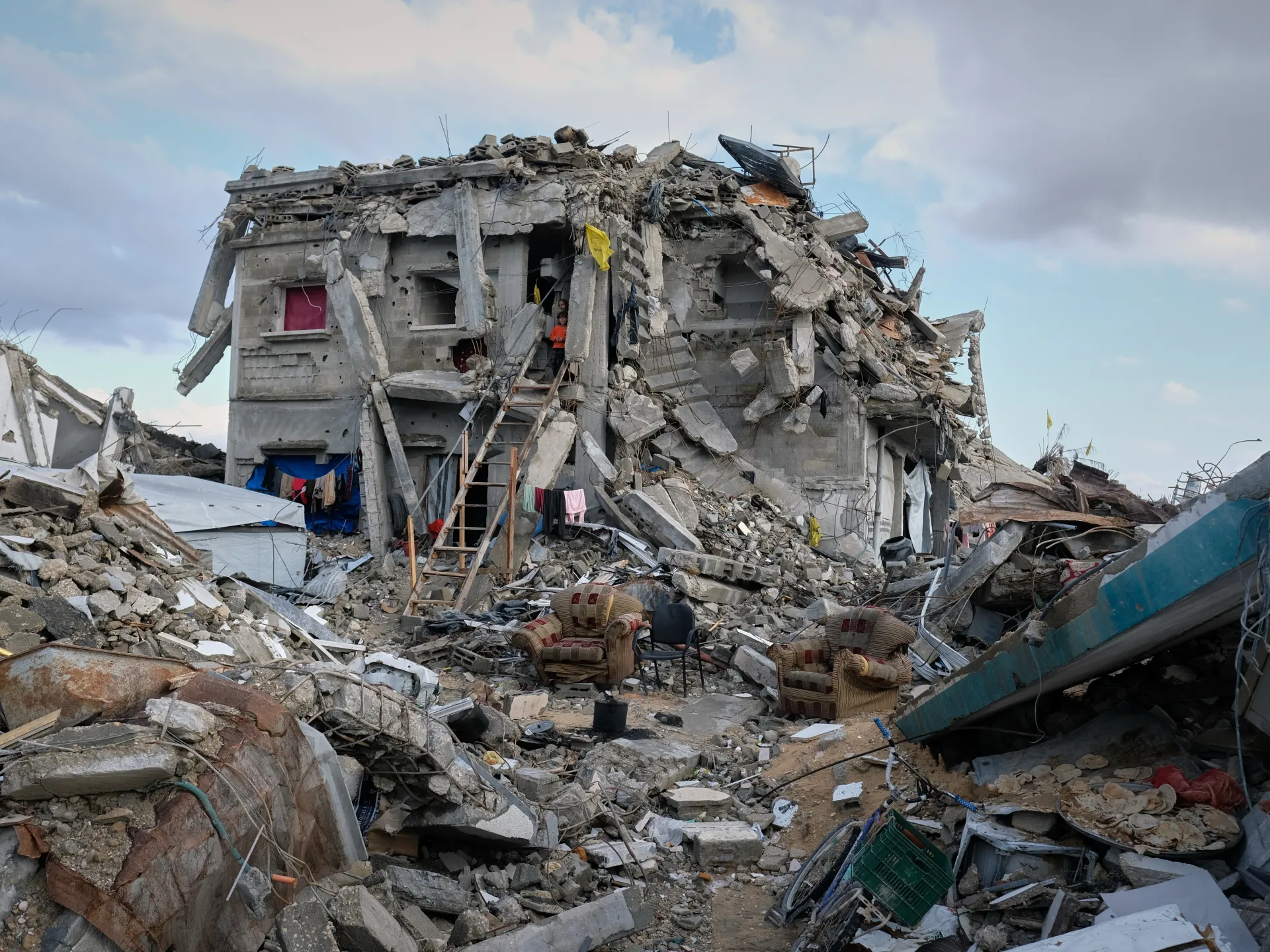
The Halawa family’s building still stands two storeys above the rubble in Gaza City, a rare survivor after two years of nonstop Israeli air attacks that levelled buildings across the besieged Palestinian enclave.
One section has collapsed, with bent metal rods protruding from where a roof once existed. The family built a narrow set of creaking wooden steps to access their home, though these makeshift stairs threaten to give way at any moment. Yet amid the destruction, it remains home.
Israel’s genocidal war on Gaza has killed more than 70,000 Palestinians, destroyed or damaged more than 70 percent of the buildings, and displaced most of the territory’s 2.3 million residents.
In October, Israel reached an agreement to cease fire, but its attacks have not stopped. It has killed more than 400 Palestinians since then, in violation of the truce agreement. It has also not allowed the full entry of aid.
Reconstruction has not begun and is projected to take years, as Israel has kept total control over what goes in and comes out of the enclave. This means families like the Halawas are struggling to rebuild their lives.
The family abandoned their home three months after the war began on October 7, 2023. They returned during the fragile calm established by the truce. Like many others, this family of seven found living in their damaged residence preferable to tent life, particularly as winter rains flooded tent shelters over the past weeks.
In one damaged room, Amani Halawa brewed coffee in a small tin over a fire while thin rays of light filtered through concrete fragments. Amani, her husband Mohammed, and their children have made repairs using concrete scraps, hanging backpacks from exposed metal rods and arranging pots and pans across the kitchen floor.
The home’s walls feature a painted tree and messages to family members separated by the conflict.
Throughout damaged apartments in Gaza City, daily life persists, even as families lie awake fearing their walls might collapse. Health officials report that at least 11 people died from building collapses in a single week in December.
In her home, Sahar Taroush swept dust from carpets placed over rubble. Her daughter Bisan’s face glowed in the light of a computer screen as she watched a movie beside gaping holes in the wall.
On another building’s cracked wall, a family displayed a torn photo of their grandfather on horseback from his time serving in the Palestinian Authority’s security forces during the 1990s. Nearby, a man reclined on a bed precariously balanced on a damaged balcony, scrolling through his phone above the devastated al-Karama neighbourhood.
TATE McRae has been spotted on a cozy date with NHL star Jack Hughes hours after attending his hockey game.
The couple sparked rumors they might have struck up a romance after Tate, 22, supported Jack, 24, from the stands at the New Jersey Devils vs. Buffalo Sabres game in Newark, New Jersey, on Sunday.
Sign up for the Showbiz newsletter
Thank you!
Tate McRae sparked romance rumors after being spotted out with NHL star Jack HughesCredit: TheImageDirect.comThe pair were photographed taking a stroll in New York City on MondayCredit: TheImageDirect.comTate dressed casually in jeans, a long trench coat, and a baseball cap, while Jack rocked pants and a black jacketCredit: TheImageDirect.com
Several photos and videos circulated on social media, showing Tate at the game, leading many to wonder if she was there to cheer on Jack, who returned to the ice after an over-a-month-long recovery from a hand injury.
Further fueling chatter of a possible romance, the pair were seen taking a stroll on Monday in New York City.
Photos obtained by The U.S. Sun show the pop star rocking baggy blue jeans, a navy blue shirt, and a long black trench coat for the chilly outing.
She kept the look casual, accessorizing with white sneakers, a small tan handbag, and a yellow baseball cap while carrying a small coffee cup.
Jack wore blue pants, a tan sweater, and a dark blue jacket, paired with white sneakers and a navy baseball cap.
His right hand was in a cast, seemingly due to the hand injury he endured off the ice last month.
They each appeared to be enjoying the other’s company as they smiled and laughed throughout the walk.
Tate most recently dated Australian rapper The Kid LAROI, who is widely believed to be the subject behind her new track, Tit for Tat.
The former couple broke up in July, but it wasn’t until her Rolling Stone cover story earlier this month that Tate confirmed their split.
Tate admitted that “it was really scary and overwhelming” at first to write and release the track about her relationship.
“I would never talk that way, even about my friends’ lives. I didn’t realize how much it would affect me, the public knowing my private life—because no one knows the full story of anything, ever,” the Canadian singer said, adding that the media coverage about their breakup made the heartbreak even harder to bear.
“I also hate people painting a situation that’s worse than it is.”
Tate also shared that she expects songs will be written about her, just like she writes about her experiences, because that’s often how artists process their emotions.
“What I’ve had to realize is that he’s going to write songs and I’m going to write songs, and that’s our way of expressing ourselves,” the So You Think You Can Dance alum explained.
“That’s our art, that’s our job. And once it’s out there, it’s not mine anymore.”
Tit for Tat is rumored to be in response to The Kid LAROI’s song A COLD PLAY, which seemingly details their split, although he hasn’t explicitly confirmed the speculation.
The couple appeared to be enjoying each other’s company as they smiled and laughed throughout the walkCredit: TheImageDirect.comHours earlier, Tate cheered on Jack from the stands of the New Jersey Devils vs. Buffalo Sabres gameCredit: X/notsoickyvicki
Democratic Party of Korea leader Chung Cheong-rae and floor leader Kim Byeong-gi confer during a Supreme Council meeting at the National Assembly in Seoul on Dec 22. Photo by Asia Today
Dec. 22 (Asia Today) — South Korea’s presidential office said Monday it “respects the National Assembly’s decision” after the ruling Democratic Party backed the opposition’s call for a special prosecutor to investigate matters linked to the Unification Church.
A senior presidential official said the office has consistently supported a thorough investigation regardless of party or religion and described the move as consistent with that stance.
“The presidential office has consistently advocated for a strict investigation regardless of party or religion, so a special prosecutor aligning with that stance is only natural,” the official said, adding that the party’s shift should be seen as reflecting the presidential office’s position.
Democratic Party floor leader Kim Byung-ki said during a Supreme Council meeting at the National Assembly that he supports a special probe that would include politicians from both the ruling and opposition parties.
He said the People Power Party appears to believe the Democratic Party is avoiding a special investigation and urged proceeding with a special prosecutor focused on the Unification Church.
Democratic Party leader Chung Cheong-rae also said there was no reason not to accept the proposal and called for a full accounting that includes any People Power Party figures involved.
US President Donald Trump warned Nicolas Maduro to ‘not play tough’ and to step down on Monday, while the Venezuelan leader said Trump should focus on the issues in his own country. Trump told reporters the US will keep 1.9 million barrels of oil that were seized near Venezuela in December.