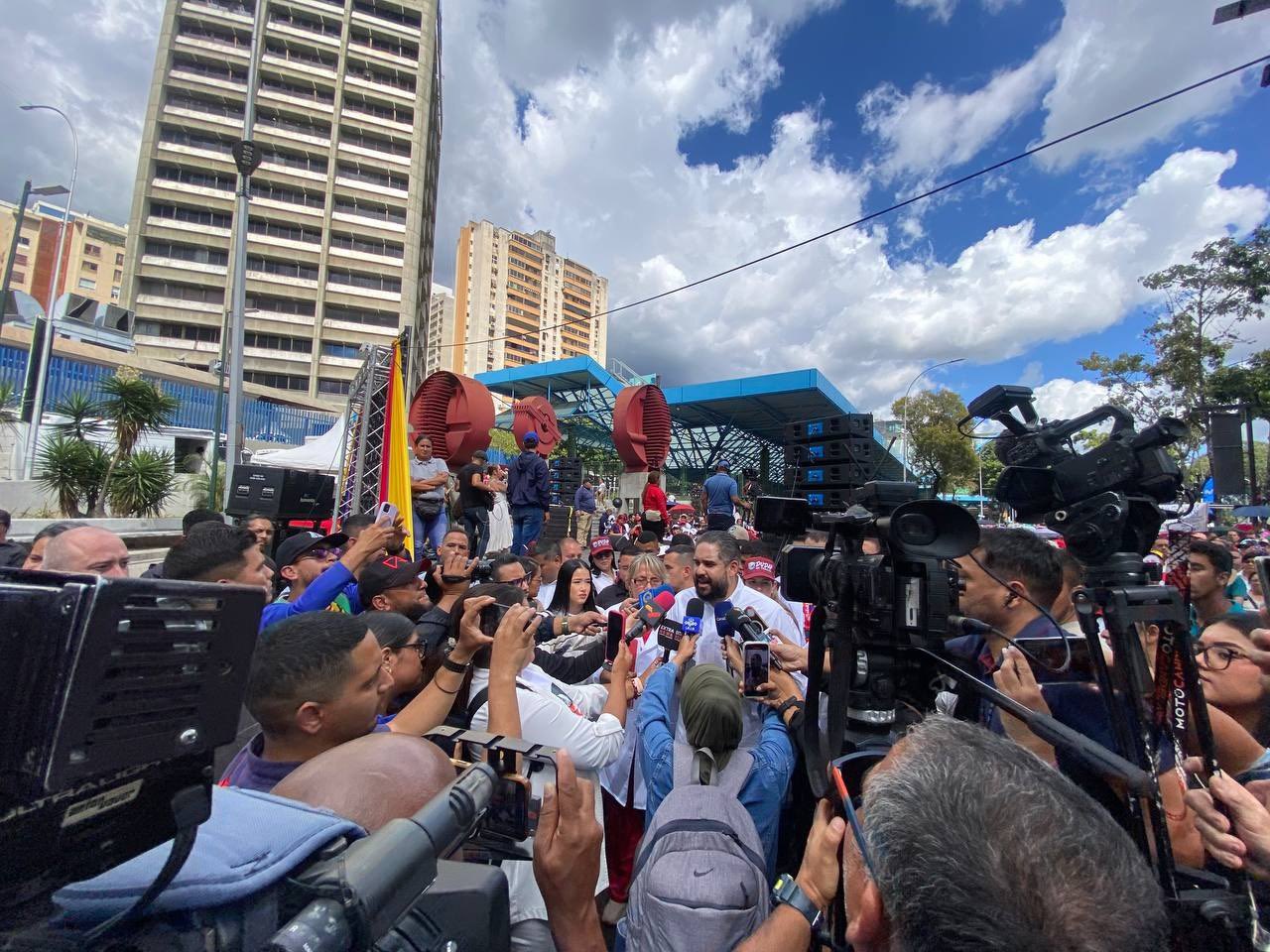
Nicolás Maduro Guerra has called for international condemnation of the US’ January 3 attacks and presidential kidnapping. (Archive)
Caracas, January 23, 2026 (venezuelanalysis.com) – Venezuelan healthcare workers marched to the United Nations (UN) headquarters in Caracas on Thursday to demand the release of President Nicolás Maduro and First Lady Cilia Flores following their kidnapping by US forces on January 3.
During the march, nurse Betsy Caraballo emphasized her desire for the president’s return “to continue with his public policies,” particularly those focused on the healthcare sector.
“The empire must release him because this was a kidnapping. He is a constitutional president and the people are calling for his return,” she told reporters. Multiple grassroots and sectoral organizations have staged marches in recent weeks to support Maduro and Flores while condemning their kidnapping.
Upon reaching the United Nations Development Programme (UNDP) office, the demonstrators, accompanied by Nicolás Maduro Guerra, the president’s son and National Assembly deputy, delivered a letter addressed to the UN High Commissioner for Human Rights, Volker Türk.
The letter urged the UN official to publicly condemn both the violation of international law principles and the infringement of Maduro and Flores’ personal immunity and integrity. It also demanded the immediate release of both officials by the United States government.
A day earlier, renowned Argentine professor and Nobel Peace Prize laureate Adolfo Pérez Esquivel requested that UN Secretary-General António Guterres urgently establish a commission to investigate the conditions of detention and treatment of the Venezuelan president and the first lady, who is also an elected legislator.
In his communication, Pérez Esquivel stressed that this expert human rights commission must safeguard the well-being of Maduro and Flores following their “kidnapping” in an operation that “violated Venezuela’s sovereignty.”
Washington’s January 3 attacks saw military and civilian sites bombed in Caracas and surrounding areas, killing over 100 people. Maduro and Flores were indicted on charges including drug trafficking conspiracy, and both pleaded not guilty in their arraignment hearings on January 5. The trial will resume on March 17.
US officials have never presented evidence of the involvement of high-ranking Venezuelan officials in narcotics activities, while specialized agencies have consistently found the Caribbean nation to play a marginal role in global drug trafficking.
Diplomacy for resolving “differences”
US officials followed the January 3 military operation by imposing conditions on the Venezuelan oil industry and vowing to control crude sales for an indefinite period. Simultaneously, Caracas and Washington have moved forward in the reestablishment of diplomatic ties.
Venezuelan Acting President Delcy Rodríguez has repeatedly defended the importance of diplomacy. During a televised broadcast on Wednesday, Rodríguez pledged to engage with US counterparts with “no fear.”
“We are in a process of dialogue with the US, with no fear of facing our differences, from the most sensitive to the least sensitive ones, through diplomacy,” she stated. Venezuelan leaders have sought to highlight the legacy of independence hero Simón Bolívar as a guiding principle for diplomatic efforts.
For his part, US President Donald Trump praised the ongoing relationship with the Venezuelan authorities on Thursday aboard Air Force One, hailing Rodríguez for demonstrating “very strong leadership.”
Trump’s comments followed a Wednesday White House announcement that Rodríguez is expected to make an official visit to the US, although “no date has been set.” The purported official trip would be the first by a Venezuelan president to the US in over a quarter-century.
At the same time, the White House continued its Venezuela policies with the appointment of diplomat Laura Dogu as chargé d’affaires at the US Venezuela Affairs Unit, based in Colombia. This unit has been responsible for managing relations between the two countries since the suspension of diplomatic relations in 2019.
Dogu, who is lined up to take over as ambassador if ties are restored, began her diplomatic career in the 1990s. She has served as an ambassador to various Latin American countries over the last decade and succeeds John McNamara, who had held the post since February 2025. McNamara traveled to Venezuela earlier this month to discuss the potential reopening of the US embassy with Venezuelan authorities.
Venezuela suspended diplomatic relations with the US in 2019 after the Trump administration recognized the self-proclaimed “interim government” led by Juan Guaidó as the country’s legitimate authority. Embassies and consulates have remained closed since then. Venezuelan Interior Minister Diosdado Cabello recently stated that efforts to reopen the embassies are “progressing.”
The Trump administration’s January 3 attacks drew domestic criticism and renewed congressional efforts to curtail the White House’s use of military force abroad. However, a War Powers Resolution failed to garner a majority in the House of Representatives on Thursday. A previous initiative was likewise narrowly defeated in the Senate.