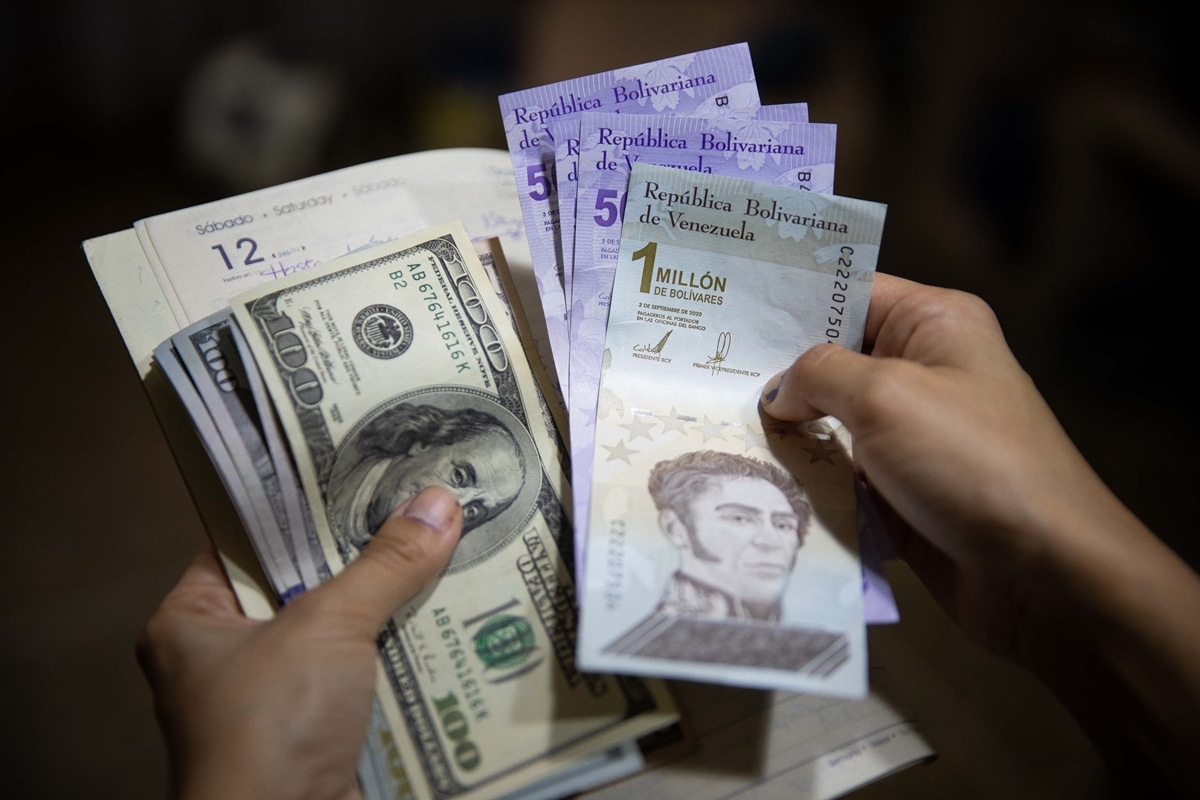
The funds were injected in Venezuelan banks to be offered to private sector importers. (Archive)
Caracas, January 21, 2026 (venezuelanalysis.com) – Four Venezuelan private banks received a reported US $300 million from an initial US-administered sale of Venezuelan crude.
According to Ecoanalítica, Banesco, BBVA Provincial, Banco Mercantil, and Banco Nacional de Crédito offered a combined $150 million to customers on Tuesday via foreign exchange auctions, with the rest of the funds expected to be made available by the end of the week.
Unofficial reports suggested that private sector importers in the food and healthcare sectors would be given priority. Analyst Alejandro Grisanti stated that the dollars were purchased slightly below 400 bolívars (BsD) per USD. Unlike in prior exchange tables, the banks were not obliged to use the official exchange rate set by the Central Bank, which stands currently at 347 BsD per USD.
The $300 million comprises a portion of the recently announced $500 million sale of Venezuelan crude that had been in storage due to a US naval blockade since early December, with proceeds reportedly deposited in US government-run accounts in Qatar.
Since the January 3 bombings and kidnapping of Venezuelan President Nicolás Maduro and First Lady Cilia Flores, US President Donald Trump and senior officials have vowed to take control of the Venezuelan oil industry and defend the interests of Western energy conglomerates.
The initial agreement involved around 50 million barrels of Venezuelan crude with an estimated return of over $2 billion. Tankers from commodity traders Vitol and Trafigura began moving oil cargoes to Caribbean storage hubs last week.
The allocation of the remaining $200 million from the already executed sales is presently unknown. US officials previously claimed that Venezuela would only be allowed to import from US manufacturers while also floating the possibility of swap deals involving diluents and spare parts for the oil sector and electric grid.
Venezuelan Acting President Delcy Rodríguez confirmed the $300 million received by private banks and identified protecting workers’ incomes as the government’s priority at this moment.
“$300 million has entered the country, to cover the incomes of our workers, protecting their purchasing power from inflation and from foreign exchange instability,” she said during a televised broadcast on Tuesday.
Rodríguez likewise stressed the importance of stabilizing the forex market, with constant devaluations eroding the Venezuelans’ purchasing power. The highly speculative parallel market exchange rate skyrocketed to 900 BsD/USD in early January before expectations of foreign currency injections brought it down under 500.
Amid the initial US-enforced oil deals, the interim Rodríguez administration and National Assembly are moving forward with a reform of the country’s Hydrocarbon Law to expand conditions for foreign investment.
Former President Hugo Chávez overhauled energy legislation in 2001 to establish state control over the oil industry. The Hydrocarbon Law, which was later amended in 2006, mandated that state oil company PDVSA hold majority stakes in all joint ventures and raised royalties and income tax to 33 and 50 percent, respectively.
On Thursday, National Assembly President Jorge Rodríguez argued that the oil reform is aimed at adapting to the country’s “economic reality” and should not be “a cause for fear or concern.” A first debate on the bill is scheduled for Thursday.
“It is essential to find optimal conditions for investments in so-called green oilfields that are yet to be explored,” he said during a meeting with deputies. “As such, we have to ensure that this foreign investment is protected and profitable.”
The parliamentary leader, who also discussed other upcoming legislative projects, highlighted the so-called Productive Participation Contracts (CPP) as key instruments for oil sector growth that will be included in the reformed legislation.
The CPP models were introduced under the 2020 Anti-Blockade Law. According to industry sources, they are concession-type deals that grant private partners increased control over operations and sales and faster returns on investment through lower taxes and royalty exemptions.
Since 2017, Venezuela’s oil industry has been hard hitby US unilateral coercive measures, including financial sanctions, an export embargo, and secondary sanctions, which aimed at strangling the Caribbean nation’s most important revenue source. US officials have announced a selective flexibilization of sanctions in the immediate future to facilitate oil deals.
The recent naval blockade had an immediate impact on crude output, forcing PDVSA to shut down wells as it ran out of storage. US Secretary of State Marco Rubio referred to the blockade as “leverage” to impose conditions on the Venezuelan government.
US forces reportedly seized a seventh oil tanker on Tuesday. According to the US Southern Command, the Liberia-flagged Sagitta had loaded crude in Venezuela and is on the US Treasury’s blacklist. US authorities did not disclose whether they took control of the vessel or if it will turn over its cargo.