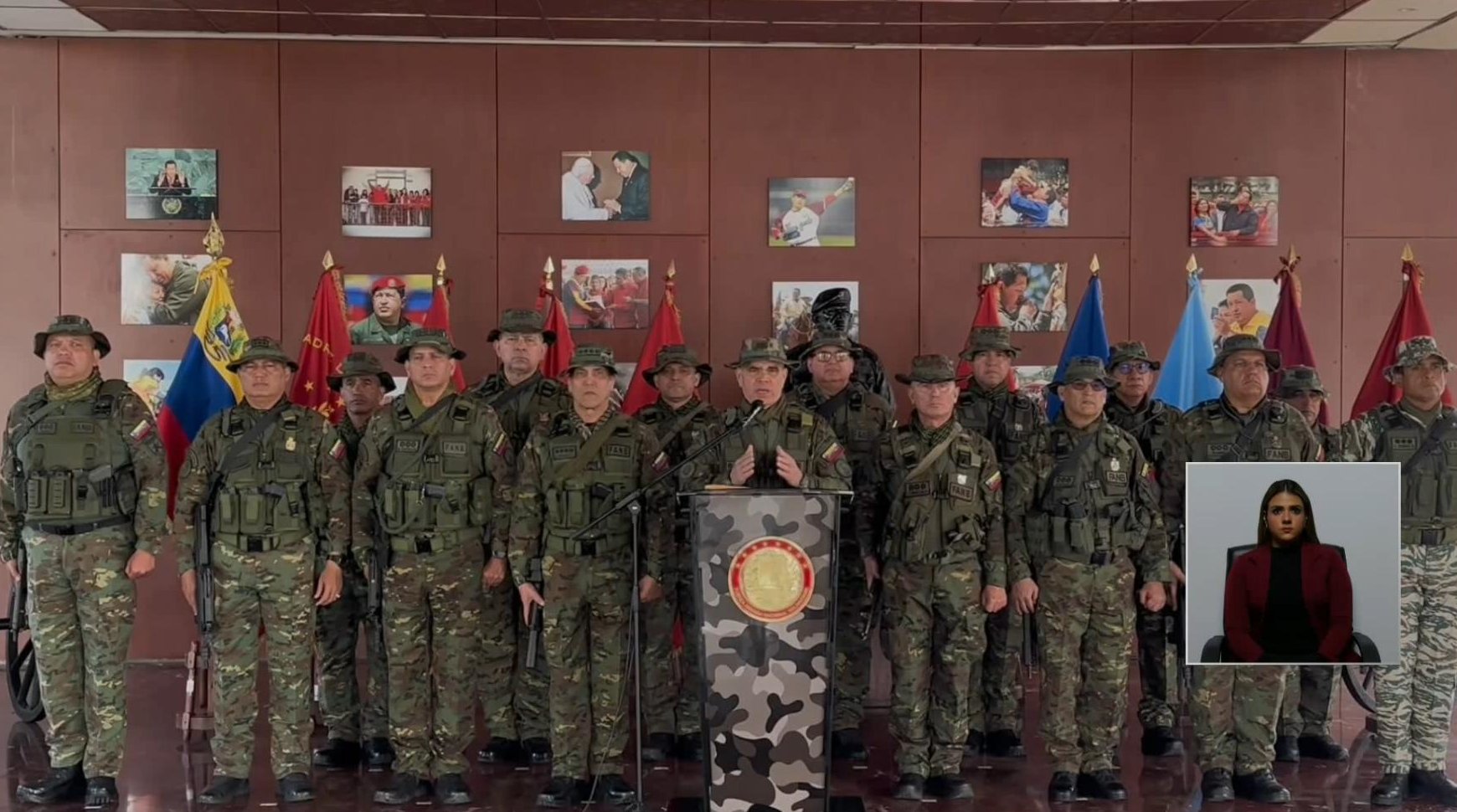
The Venezuelan armed forces expressed readiness to maintain peace and internal order in the country. (Archive)
Caracas, January 4, 2025 (venezuelanalysis.com) – The governments of Brazil, Chile, Colombia, Mexico, Uruguay, and Spain issued a joint statement Sunday rejecting “unilateral US actions in Venezuelan territory.”
“These actions contravene basic principles of international law and represent a very dangerous precedent for peace and regional security,” the communique read.
The joint statement followed widespread regional and global condemnation of Washington’s January 3 strikes against Venezuelan military sites and kidnapping of President Nicolás Maduro and First Lady Cilia Flores.
The countries went on to issue calls for dialogue and urged the United Nations secretary general and member states to help “de-escalate tensions and preserve peace.”
In response to US President Donald Trump’s claim that he would “run” Venezuela, the signatories expressed concern over “attempts at foreign government control or seizure of natural resources.” However, the declaration made no mention of Maduro nor called for his release.
The diplomatic response to the US attacks also included an emergency summit of the Community of Latin American and Caribbean nations (CELAC), held on Sunday, January 4. Venezuelan Foreign Minister Yván Gil decried the US actions as blatant violations of international law and the United Nations Charter.
“The US has violated the personal immunity of a sitting head of state,” Gil told regional leaders in the conference call. “Kidnapping a president is kidnapping a people’s sovereignty.”
Venezuela’s top diplomat urged CELAC member-states to “take a step forward,” warning that silence would amount to acceptance of Washington’s unilateral acts.
A number of countries, including Venezuelan allies Russia and China, have forcefully denounced the US military operation. In a Sunday statement, Beijing charged Washington with a “clear violation of international law” and called for Maduro and Flores’ “immediate release.”
The UN Security Council is scheduled to hold an emergency session on Monday.
For her part, Venezuela Vice President and now acting Interim President Delcy Rodríguez reiterated demands for Maduro’s release and vowed that the country would not submit “to any empire.” Rodríguez held a press conference Saturday afternoon and confirmed the enactment of a decree establishing a “state of external commotion.” The instrument grants the executive additional tools, including the ability to mobilize troops or restrict civil liberties, for a period of 90 days that can be extended.
On Saturday night, the Venezuelan Supreme Court ruled that Maduro’s kidnapping and rendition to US soil constituted a temporary absence and that Rodríguez was mandated to take over the presidency on an interim basis.
Footage surfaced Saturday evening showing Maduro being walked out of an airplane in New York. He was later taken to a DEA facility before being moved, along with Flores, to the Metropolitan Detention Center in Brooklyn. He made no statements but greeted DEA officers and appeared upbeat in photos, making a peace sign and holding his thumbs up.
The Venezuelan president was indicted by a New York district court on Saturday, with charges including “narcoterrorism conspiracy” and “possession of machine guns.” A hearing is reportedly scheduled for Monday.
For their part, Venezuela’s National BolivarianArmed Forces (FANB) likewise issued a communique on Sunday, rejecting the “cowardly kidnapping” of Maduro and Flores and reiterating its mission to “confront imperial aggression.”
The FANB voiced support for Rodríguez taking over the presidency on an acting basis and vowed to maintain readiness to preserve “peace and internal order.”
The Defense Ministry has yet to provide a report on damages and casualties from the US strikes, though Sunday’s communiqué condemned the “cold-blooded murder” of members of Maduro’s security detail. Unconfirmed reports have put forward a figure of 80 deaths.
Venezuelan popular movements and political parties took to the streets for a second consecutive day on Sunday, holding marches and rallies in Caracas and other cities. Public transportation and retail functioned to a greater degree than on Saturday.
The US attacks also spurred numerous international solidarity demonstrations over the weekend. Crowds gathered in dozens of Latin American, European and US cities. A demonstration was called for Sunday outside the Brooklyn detention center where Maduro is being held.
The January 3 operation came on the heels of the largest ever US Caribbean military build-up, with Trump having previously ordered dozebs of strikes against small boats accused of carrying drugs, killing over 100 civilians. The US president has repeatedly expressed intentions of using military threats to extract favorable oil deals for US corporations.
In a Sunday interview, Secretary of State Marco Rubio warned the acting government in Caracas to “make the right decisions” and affirmed that the US retained “leverage” mechanisms, including a naval blockade stopping oil exports.