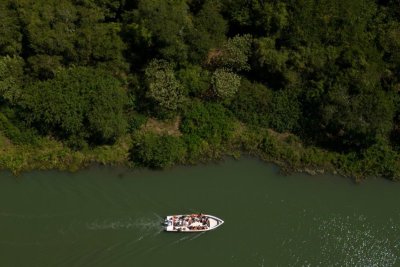

A boat navigates the Uruguay River in the Province of Entre Rios, Argentina, in 2023. File Photo by Juan Ignacio Roncoroni/EPA
Jan. 15 (UPI) — U.S. philanthropist Gilbert Butler has emerged as a major private donor shaping conservation policy in Latin America by financing the purchase and then donating six islands in Uruguay and Argentina to create the first binational park on the Uruguay River.
Butler donated the islands of Chala, Inga and Pinguino to the Uruguayan state. The islands lie on the river in Rio Negro department, an administrative division similar to a county.
Together, the three islands cover 1,270 acres and were incorporated into Uruguay’s National System of Protected Areas, known by its Spanish acronym SNAP, according to statements from the Presidency of Uruguay and the Ministry of Environment.
Uruguayan authorities described the donation as unprecedented, marking the first time the country has added land to SNAP through a direct donation of property purchased by a private person for conservation purposes.
“Nothing like this has been seen for decades,” President Yamandu Orsi said Thursday during the ceremony accepting the islands.
According to Uruguayan officials, at least two of the islands include basic public-use infrastructure, such as docks, shelters and restrooms designed for low-impact ecotourism and environmental education.
The project aims to promote restorative economies and strengthen local communities under a model based on conservation and ecological connectivity.
The Uruguay initiative is linked to a project already underway in Argentina. On the Argentine side of the river, Butler previously acquired the islands of Dolores, San Genaro and Campichuelo in Entre Rios province. Together they span about 6,425 acres and are slated to be donated to creates a provincial nature park.
Provincial authorities plan to add about 3,459 acres of public land to that core area, bringing the total protected surface to about 9,884 acres. All six islands are part of the same cross-border conservation scheme.
In a speech, Butler said his goal is to create a binational park, contending that using the land solely for eucalyptus and soybean plantations “is an ecological disaster.”
The six islands make up the project known as Green Islands and Channels of the Uruguay River, which seeks to establish a continuous transboundary ecological corridor along one of the Southern Cone’s most important freshwater basins.
The initiative focuses on protecting wetlands, riverine biodiversity and ecological connectivity, while supporting sustainable tourism.
The donation has reopened public debate in Uruguay over the ownership of river islands.
Under current regulations and legal analyses reported locally, river islands are registered parcels that may be publicly or privately owned regardless of the owner’s nationality and may be incorporated into the protected areas system even if they were previously private.
Records and local media reports show the donated islands had been privately owned since the 1990s after being transferred as part of the settlement of a commercial debt.
Previous attempts at productive use failed because of recurring floods linked to the river’s hydrological cycle.
Local authorities in Rio Negro and Entre Rios said the binational project presents coordination challenges, but agreed it could position the Uruguay River region as a regional example for shared environmental conservation.