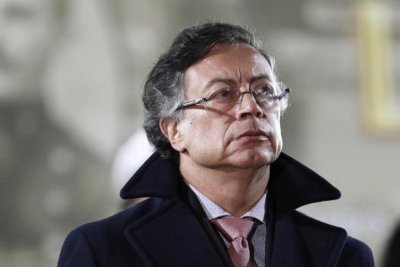

Hours after the call with President Donald Trump, , Colombian President Gustave Petro addressed a rally in Bogotá’s Plaza de Bolívar, convened “in defense of sovereignty,” and acknowledged that he softened a previously tougher attitude toward the American president. Photo by Carlos Ortega/EPA
Jan. 8 (UPI) — U.S. President Donald Trump and Colombian President Gustavo Petro held their first phone call Wednesday since the U.S. leader started his second term — a conversation described as “constructive” that could open a path to rebuilding a historically close relationship shaped by decades of cooperation on security and a fight against drug trafficking.
The more-than-40-minute conversation followed months of verbal escalation and administrative sanctions between the two governments and against a regionally tense backdrop after a U.S. operation led to the Jan. 3 capture in Caracas of Venezuelan President Nicolás Maduro.
Hours after the call, Petro addressed a rally in Bogotá’s Plaza de Bolívar, convened “in defense of sovereignty,” and acknowledged that he softened a previously tougher attitude after speaking with Trump.
“If there is no dialogue, there is war. Colombian history has taught us that,” Petro said, announcing he had requested the restoration of formal communication channels between Colombia’s Foreign Ministry and the U.S. State Department.
During his remarks, the Colombian president said the call covered counternarcotics cooperation and rejected accusations linking him to drug trafficking, stating that for more than two decades, he has confronted criminal organizations and allied politicians, according to Colombian outlet Noticias Caracol.
Petro said he presented Trump with official government figures, including drug seizure levels that he said reached 2,800 metric tons by year’s end, as well as the extradition of hundreds of narcotics leaders.
He also argued that, unlike previous administrations, his government halted the growth of coca crops, which he said doubled under former President Iván Duque, while increasing by no more than 10% during his tenure. Coca leaves are used to make cocaine.
Petro defended voluntary crop substitution over forced eradication, contending the latter increases violence in rural areas.
The Colombian leader added that he briefed Trump on coordination experiences with Venezuela in the fight against drug trafficking in border regions such as Catatumbo, one of the main illicit trafficking corridors, where guerrillas, dissidents and criminal gangs operate.
In a message posted on social media, Trump said it was “a great honor” to speak with Petro and that he looks forward to meeting him “soon.”
In the same message, he said Secretary of State Marco Rubio and Colombia’s foreign minister, Rosa Villavicencio, already are working on arrangements for a White House meeting.
Colombia’s ambassador to the United States, Daniel García-Peña, told Noticias RCN that the communication was facilitated by Republican Sen. Rand Paul, R-Ky., and that Trump extended the invitation to meet in Washington.
The diplomat described the exchange as “an extraordinary call” and said both leaders focused on issues of shared interest.
The conversation took place amid heightened domestic political tension in Colombia, marked by growing polarization and public confrontation on social media, fueled by earlier statements from Trump.
In the preceding days, the U.S. president suggested that an operation similar to the one carried out in Venezuela also “sounds good” for Colombia — rhetoric that drew strong official rebukes in Bogotá.
Petro has been a persistent critic of U.S. operations in the Caribbean Sea and the eastern Pacific, where U.S. forces have intercepted and sunk boats suspected of carrying drugs.
He has questioned that approach for its human cost, citing deaths reported during such operations.
In September, the U.S. government revoked Petro’s visa, and the Treasury Department later placed him, along with people in his inner circle, on the Office of Foreign Assets Control’s sanctions list, known as the “Clinton List,” following accusations made by Trump that the Colombian government rejected and that were not accompanied by public evidence.
Despite recent friction, bilateral ties rest on a solid historical foundation. Colombia has for decades been one of Washington’s main partners in Latin America on security and counternarcotics.
In the early 2000s, cooperation was consolidated under Plan Colombia with an initial U.S.-approved aid package of $1.3 billion in 2000, and in 2022 Washington designated Colombia a “Major Non-NATO Ally,” a status reserved for strategic partners outside the alliance.
Under Petro’s government, that partnership has faced political strain, particularly over differences on counternarcotics policy and bilateral rhetoric in a more volatile regional environment.