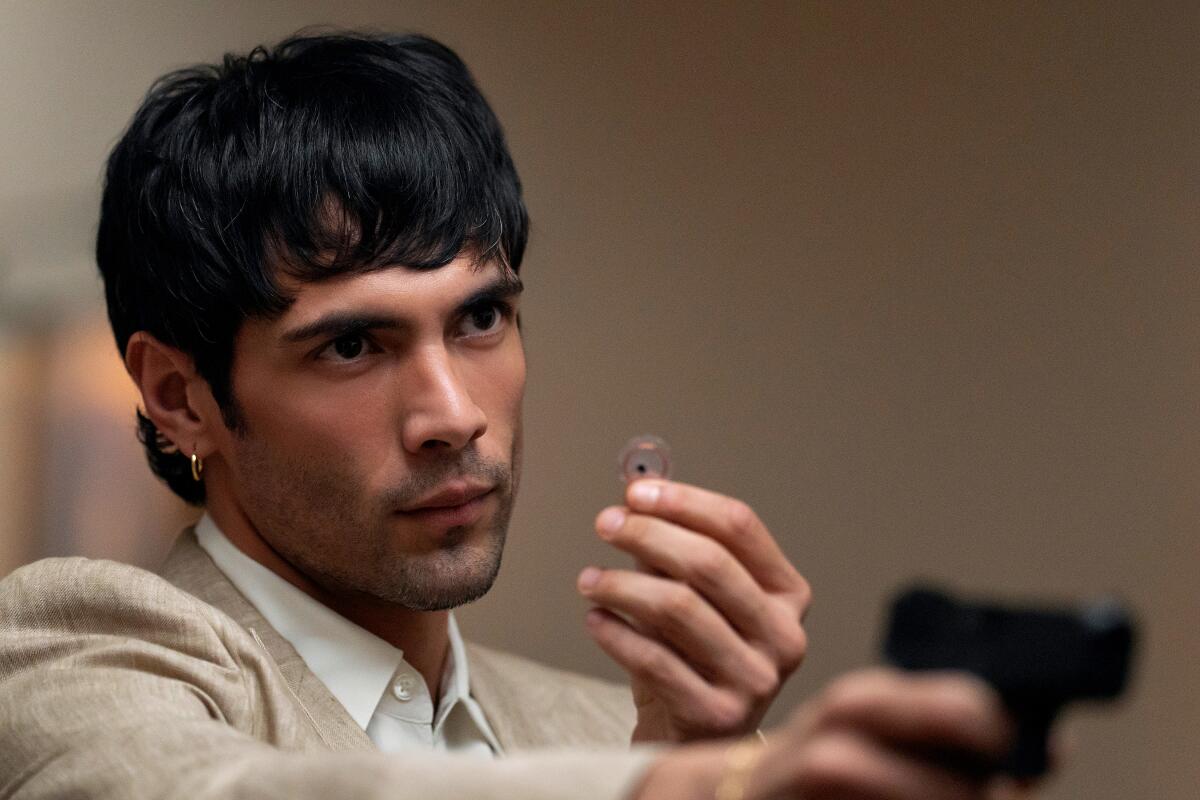
This article contains spoilers for the first three episodes of “The Night Manager” Season 2.
It wasn’t inevitable that “The Night Manager,” an adaptation of John le Carré’s 1993 spy novel, would have a sequel. Le Carré didn’t write one and the six-episode series, which aired in 2016, had a definitive ending.
But after the show’s debut, fans clambered for more. They loved Tom Hiddleston’s brooding, charismatic Jonathan Pine, a hotel manager wrangled into the spy game by British intelligence officer Angela Burr (Olivia Colman). And at the heart of the series was the parasitic dynamic between Pine and his delightfully malicious foe, an arms dealer named Richard Onslow Roper (Hugh Laurie).
The show was so good that even the story’s author wanted it to continue. After the premiere of Season 1 at the Berlin International Film Festival, Le Carré sat across from Hiddleston, a twinkle in his eye, and said, “Perhaps there should be some more.”
“That was the first I’d heard of it or thought about it,” Hiddleston says, speaking over Zoom alongside the show’s director, Georgi Banks-Davies, from New York a few days before the U.S. premiere of “The Night Manager” Season 2 on Prime Video, which arrived Sunday with three episodes, 10 years after the first season. “But it was so extraordinary and inspiring to come from the man himself. That’s when I knew there might be an opportunity.”
Time passed because no one wanted a sequel of less quality. Le Carré died in 2020, leaving his creative works in the care of his sons, who helm the production company the Ink Factory. That same year, screenwriter David Farr, who had penned the first series, had a vision.
“We didn’t want to rush into doing something that was all style and no substance that didn’t honor the truth of it,” Farr says, speaking separately over Zoom from London. “There was this big gap of time. But I had this very clear idea. I saw a black car crossing the Colombian hills in the past towards a boy. I knew who was in the car and I knew who the boy was.”
That image transformed into a scene in the second episode of Season 2 where a young Teddy Dos Santos (Diego Calva) is waiting for his father, who turns out to be none other than Roper. From there, Farr fleshed out the rest of the season, as well as the already-announced third season. He was interested in the relationship between fathers and sons, an obsession of Le Carré’s, and in how Jonathan and Roper would be entangled all these years later.

Teddy Dos Santos (Diego Calva) is revealed to be Roper’s son.
(Des Willie / Prime Video)
“Teddy crystallized very quickly in my head,” Farr says. “All of the plot came later — arms smuggling and covert plans for coups in South America. But the emotional architecture, as I tend to call it, came to me quite quickly. That narrative of fathers and sons, betrayal and love is what marks Le Carré from more conventional espionage.”
“There was enormous depth in his idea,” Hiddleston adds. “It was a happy accident of 10 years having passed. They were 10 immeasurably complex years in the world, which can only have been more complex for Jonathan Pine with all his experience, all his curiosity, all his pain, all his trauma and all his courage.”
Farr sent scripts to Hiddleston in 2023 and planning for Season 2 began in earnest. The team brought Banks-Davies on in early 2024, impressed with her vision for the episodes. Hiddleston was especially attracted to her desire to highlight the vulnerability of the characters, all of whom present an exterior that is vastly different than their interior life.
“Every character’s heart is on fire in some way, and they all have different masks to conceal that,” Hiddleston says. “But Georgi kept wanting to get underneath it, to excavate it. Explore the fire, explore the trauma. She came in and said, ‘This show is about identity.’ ”
“I’m fascinated with how the line of identity and where you sit in the world is very fragile,” Banks-Davies says. “I’m fascinated by the strain on that line. In the heart of the show, that was so clearly there. I’m also always searching for what brings us together in a time, particularly in the last 10 years, that’s ever more divisive. These characters are all at war with each other. They’re all lying to each other. They’re deceiving each other for what they want. But what brings them together … instead of pushes them apart?”
The new season opens four years after the events of Season 1 as Jonathan and Angela meet in Syria. There, she identifies the dead body of Roper — a reveal that suggests his character won’t really be part of Season 2. After his death, Pine settles into a requisite life in London as Alex Goodwin, a member of an unexciting intelligence unit called the Night Owls.

Angela (Olivia Colman) and Jonathan (Tom Hiddleston) meet in Syria, four years after the events of Season 1.
(Des Willie / Prime Video)
“He’s half asleep and he lacks clarity and definition,” Hiddleston says. “His meaning and purpose have been blunted and dulled. He is only alive at his greatest peril, and the closer his feet are to the fire, the more he feels like himself. He’s addicted to risk, but also courageous in chasing down the truth.”
That first episode is a clever fake-out. Soon, Jonathan is on the trail of a conspiracy in Colombia, where the British government appears to be involved in an arms deal with Teddy. It quickly becomes the globe-trotting, thrill-seeking show that captivated fans in Season 1. There are new characters, including Sally (Hayley Squires), Jonathan’s Night Owls’ partner, and Roxana Bolaños (Camila Morrone), a young shipping magnate in league with Teddy, and vibrant locations. Jonathan infiltrates Teddy’s organization, posing as a cavalier, rich businessman named Matthew Ellis. He believes Teddy is the real threat. But in the final moments of Episode 3 there’s another gut-punching fake-out: Roper lives.
“The idea was: We must do the classic thing that stories do, which is to lose the father in order that he must appear again,” Farr says. He confirms there was never an intention to make “The Night Manager” Season 2 without Laurie. “What makes it work is this feeling that you are off on something completely new,” Farr says. “But that’s not what I want this show to be.”
Hiddleston compares it to the tale of St. George and the dragon. “They define each other,” he says. “At the end of the first series, Jonathan Pine delivers the dragon of Richard Roper to his captors. But after that, he is lost. The dragon slayer is lost without the presence of the dragon to define him. And, similarly, Roper is obsessed with Pine.”
Jonathan realizes the truth as he sneaks up to a hilltop restaurant to listen in on a meeting. Banks-Davies opted to shoot the entire series on location, and she kept a taut, quick pace during filming because she wanted the cast to feel the tension all the way through. She and Hiddleston had a shared motto on set: “There’s no time for unreal.” Thanks to her careful scene-setting, Roper’s arrival and Jonathan’s reaction were shot in only 10 minutes.
“I felt everything we talked about for months and everything we’d shot up until that point and everything we’d been through was in that moment,” Banks-Davies says. “There are so many emotions going on, so much being expressed, and it’s just delivered like that. But it was hard to get us there.”
Farr adds, “It is the most important moment in the show in terms of everything that then follows on from that.” He wrote into the script that Roper’s voice would be heard before Laurie was seen on camera. “It’s more frightening when something is not instantly fully understood and seen,” he says. “You hear it and you think, ‘Oh, God, I know that [voice].’ ”
Hiddleston wanted to play a range of emotions in seconds. He describes it as a “moment of total vitality.” Right before the cameras rolled, Banks-Davies told Hiddleston, “The dragon is alive.”
“After all the work, that’s all I needed to hear,” he says. “This moment will be memorable to him and he’ll be able to recall it in his mind for the rest of his life. He is wide awake, and reality is re-forming around him. His sense of the last 10 years, his sense of what he can trust and who he can trust, the way he’s tried to evolve his own identity — the sky is falling. There is a mixture of shock, grief, disenchantment, disillusionment, surprise and perhaps even relief.”
As soon as Jonathan arrives in Colombia and meets Teddy, a calculating live-wire dealing with his own sense of isolation, he becomes more himself. Hiddleston expresses him as a character desperate to feel the edge. Despite his layered duplicity, Jonathan understands and defines himself by courting risk.


Teddy (Diego Calva), Jonathan (Tom Hiddleston) and Roxana (Camila Marrone) get close. “This is a character who pushes his body to the limit and sacrifices enormous parts of himself at great personal cost to his body and soul,” Hiddleston says of Jonathan. (Des Willie/Prime Video)
“This is a character who pushes his body to the limit and sacrifices enormous parts of himself at great personal cost to his body and soul,” Hiddleston says. “He goes through a lot of pain, but also there’s great courage and resilience and enormous vulnerability. That’s what I relish the most, these are heightened scenarios that don’t arise as readily and in my ordinary life.”
“I could feel that shooting moments like this,” Banks-Davies adds. “Like, ‘It’s right there. Are we going to get it?’ Our whole show exists in that space between safety and death.”
Roper’s presence sends a ripple effect across the remaining three episodes. As much as Jonathan and Teddy are in opposition, they are parallel spirits, both with complicated relationships to Roper. Hiddleston describes them as “a mirror to each other,” although they can’t quite figure out what to be to each other. And neither knows who the other person really is.
“It is interesting, isn’t it, that my first image of him was 7 years old and that stays in him all the way through,” Farr says. “This sense of this boy who is seeking something — an affirmation, a place in the world. And he’s done terrible things, as he says to Pine in Episode 3. All of that was present in that first image I had.”
Hiddleston adds, “There is a competition, too, because Roper is the father figure, and they both need him in very different ways. Teddy is a new kind of adversary because he’s a contemporary. He’s got this resourcefulness and this ruthlessness, but also this very open vulnerability, which he uses as a weapon. They recognize each other and see each other.”
The characters’ dynamic is at the root of what drew Banks-Davies to the series. “It’s not about where they were born, it’s not about their economic status or their religion or their cultural identity,” she says. “It’s about two men who are lost and alone and solitary, and see a kinship in that. They are pulled together on this journey.”
Season 2, which will release episodes weekly after the first drop, will lead directly into Season 3, although no one involved will spill on when it can be expected. Hopefully they will arrive in less than a decade.
“It won’t be as long, I promise,” Farr says. “I can’t tell you exactly when, because I don’t know. But definitely nowhere as long.”
“That was the thrill for us, of knowing that when we began to tell this story, we knew we had 12 episodes to tell it inside, rather than just six,” Hiddleston says. “So we can be slightly braver and more rebellious and more complex in the architecture of that narrative. And not everything has to be tied up neatly in a bow. There’s still miles to go before we sleep, to borrow from Robert Frost, and that’s exciting. It’s exciting for how this season ends, and it’s exciting for where we go next.”