‘Goat’ review: Young viewers deserve more-inspiring sports movies
We’ve seen animated animals belt out tunes in the “Sing” movies. We’ve learned about “The Secret Life of Pets” (twice). And we’ve visited them in “Zootopia” (also on two occasions). Now we get to see them play basketball. “Goat,” produced by Golden State Warriors prodigy Stephen Curry, is yet another underdog story about following your dreams wrapped in a by-the-numbers sports movie. It feels utterly unoriginal on multiple fronts.
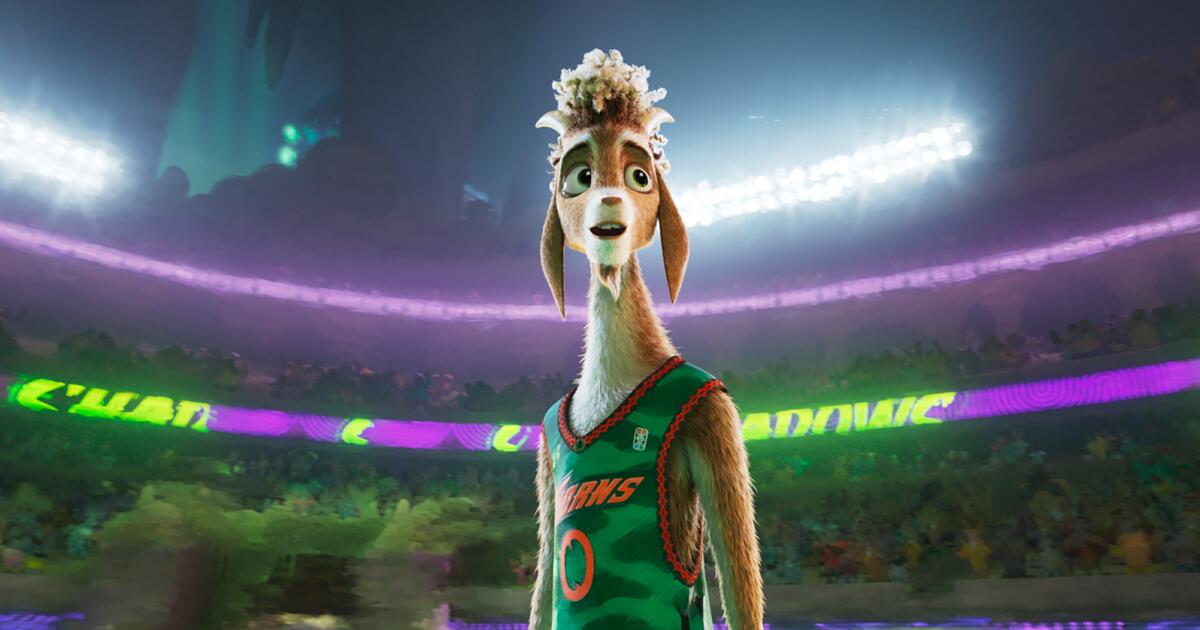
Taking the popular acronym GOAT (Greatest of All Time) to its most literal form, the first feature by TV animation veteran Tyree Dillihay — from a screenplay by Aaron Buchsbaum and Teddy Riley — follows an anthropomorphic young goat who aspires to become the GOAT.
A lifelong fan of roarball (this film’s version of basketball), Will, who is voiced by Caleb McLaughlin, dreams of playing for his hometown team, Vineland. His admiration for the sport is embodied by Jett Fillmore (Gabrielle Union), Vineland’s most accomplished player, who carries the entire team on her back — she wants all the glory of victory for herself.
The world of “Goat” is divided between “smalls” and “bigs” (unlike “Zootopia” where the separation is between predators and prey). Will considers himself a “medium” but in the eyes of professional roarball players, he’s tiny. Still, after going viral for bravely challenging Mane Attraction (Aaron Pierre), one of the sport’s major stars who is double his size, Will lands a chance to play in the big leagues.
To the credit of the writers, roarball is a rather inclusive sport. There are no gendered teams, nor any discrimination based on species. Will might be the first “small” to make it big, but that stems from the public’s prejudice, not from rules that ban animals like him from playing.
Desperate for instant relevancy (like plenty of animated features these days), “Goat” is steeped in vapid internet references, from crypto to online memes. Sports fans, however, will find specific allusions, like contentious press conferences and even the kiss cam. Rowdy and kinetic from start to finish, “Goat” does in fact reflect the fast-paced dynamism of basketball, but it soon reveals itself a sugar rush without much substance.
Once Will joins the team, a “never meet your heroes” lesson ensues, since Jett feels like he’s usurping her position. Animosity on her part creates tension until Will opens up about his personal reason for playing. The emotions are not complex here, but they are heartfelt, thanks to how McLaughlin and Union conjure up larger-than-life personalities via their voice performances.
Meanwhile, Will’s other teammates — a rhinoceros, a giraffe (played by Curry himself), an ostrich and a Komodo dragon — don’t feel distinct enough from the ensemble casts of other animated projects like “Sing.” Each member of the assortment has their quirks, some of which occasionally yield a chuckle: Archie (David Harbour), the rhino, has two comically violent kid daughters.
There’s no denying “Goat” has a vibrant aesthetic, but that alone can’t overwrite its defects. Back in 2018, Sony Pictures Animation dazzled the industry when “Spider-Man: Into the Spider-Verse” introduced an approach that mixed 3D CGI with traditional hand-drawn animation. This combination of techniques doesn’t make “Goat” particularly unique anymore.
What’s most impressive, visually, about “Goat” is the way the natural world blends with the urban settings. Vineland, Will’s neighborhood, is indeed covered in vines and yet the vegetation appears organically integrated into the infrastructure. Each game takes place in a different ecosystem. The finale, for example, unfolds amid cracked volcanic rocks and lava. There’s visible handcraft and care in creating these backdrops for the action.
A mixed bag of eye-catching imagery and formulaic writing, “Goat” disappoints because it follows every expected path toward a triumphant conclusion. Its premise could have offered up a kid-friendly reading on failure that doesn’t simplify a way out of adversity. If talking animals will continue to be used as surrogates for human experiences — especially for young viewers — some nuance would be appreciated.
‘Goat’
Rated: PG, for some rude humor and brief mild language
Running time: 1 hour, 40 minutes
Playing: Opens Friday in wide release