zohran mamdani

Michigan Senate victory boosts progressives as Democrats wrestle with party’s direction

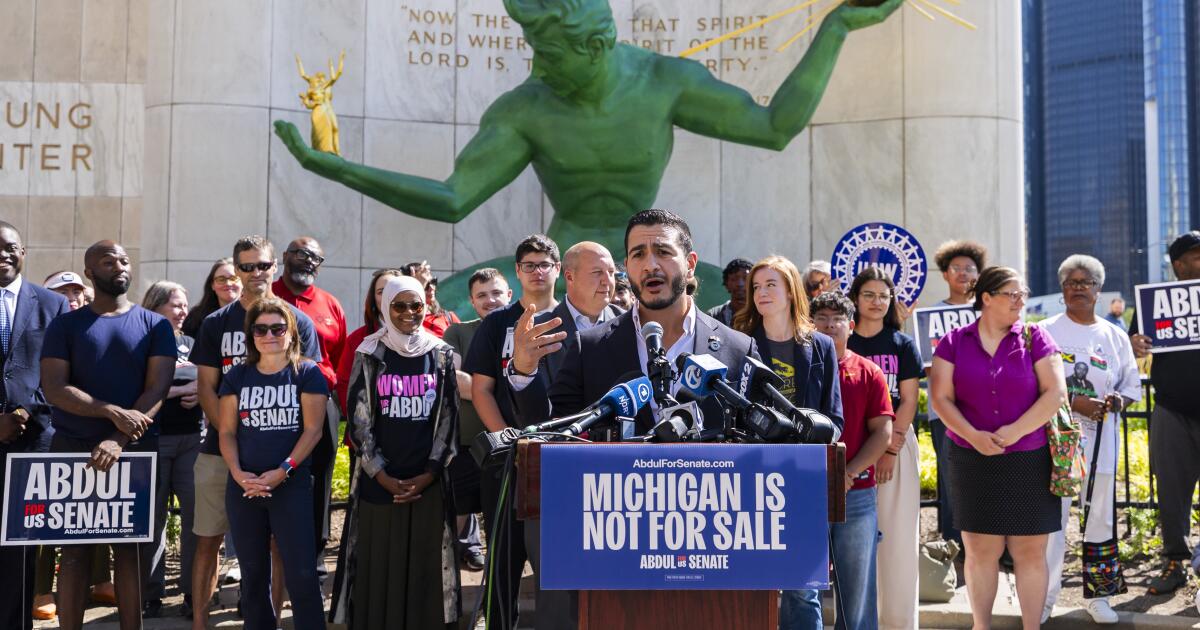
The narrow victory of progressive doctor Abdul El-Sayed in Michigan’s bitterly fought Democratic Senate primary sets up a defining test of the party’s progressive wing in one of the highest-stakes U.S. Senate contests of the midterms.

Whether El-Sayed, a former public health official, can carry swing voters in a battleground state could both determine the outcome of a Senate seat viewed as crucial to determining control of Congress and have broader ramifications on the Democratic Party’s struggle for its identity.

El-Sayed, a 41-year-old epidemiologist, defeated U.S. Rep. Haley Stevens, a moderate Democrat, by a narrow margin Wednesday after a long and intense campaign that was seen as a proxy for the party’s fissures.

The race was far closer than some polls had indicated. El-Sayed was leading Stevens by 15,000 votes, about 1 percentage point, with 99% of votes counted Wednesday, according to the Associated Press.

El-Sayed will face former Rep. Mike Rogers, a Republican, in the general election. The winner will succeed retiring Democratic Sen. Gary Peters, whose seat Democrats see as critical to retain for the party to have a chance at flipping the Senate.

“We’ve got an opportunity to bring ourselves back together, to come together around a movement, to take our democracy back,” El-Sayed said Wednesday on MS NOW’s “Morning Joe.”

El-Sayed’s victory will put to the test in a swing state the broader strength of the progressive movement, which has found success in deep-blue places like New York City, where Zohran Mamdani was elected mayor last year, and Los Angeles, where City Councilmember Nithya Raman is locked in a tight race mayoral contest with incumbent Karen Bass. Both Mamdani and Raman are democratic socialists.

As Democrats struggle over the party’s post-2024 identity and grapple with how to win back voters, the divide between the party’s progressive and centrist wings has been on display in primary fights. Both camps have notched victories: Many of the leftist wins have come in intensely blue districts, such as in New York, while more moderate districts have chosen centrists, as in Iowa.

On Tuesday, two progressive congressional candidates in Michigan beat out establishment Democrats in House races — in one case, ousting an incumbent. But in Missouri, democratic socialist and former Rep. Cori Bush lost to incumbent Rep. Wesley Bell, a moderate, for a key House seat.

In California, a handful of progressive candidates are on the November ballot, including the challengers to Rep. Doris Matsui (D-Sacramento) and Rep. David Valadao (R-Hanford). In the Aug. 18 runoff to fill the vacant seat of former Democratic Rep. Eric Swalwell, progressive state Sen. Aisha Wahab is battling it out with fellow Democrat and BART board president Melissa Hernandez.

Progressive leaders celebrated El-Sayed’s win on Wednesday. Sen. Bernie Sanders (I-Vt.), who backed El-Sayed, argue that his working-class-centered politics are more likely to have mass appeal.

“If you’re a working-class Republican in Michigan, I think you’re going to listen to what El-Sayed says,” Sanders told NBC’s “Meet the Press” on Sunday. “I think many of them will end up voting for him, independents as well, of course.”

Throughout the campaign, Stevens argued that El-Sayed would not be able to defeat Rogers, a refrain some moderates repeated Wednesday. El-Sayed vowed to unite Democrats around defeating Rogers, who previously served seven terms in Congress, saying that he and Stevens would be focused on “bringing the party back together.”

Rogers on Wednesday portrayed El-Sayed as an “extremist,” saying in a statement that the election is “about deciding whether Michigan has a future built on common sense — or whether we hand the keys to the most fringe extremists in the nation.”

El-Sayed, a former city and county health official, focused on opposing money in politics and pushing for Medicare for All, among other issues. His opposition to Israel’s war in Gaza and Stevens’ support for Israel became a major issue in the campaign. AIPAC, the pro-Israel lobbying group, spent millions in support of Stevens.

Early in the primary race, El-Sayed sought to temper some of the concerns around his progressive agenda by presenting himself as a Michigan-first, working-class-focused candidate, said John Barry Ryan, a University of Michigan professor of political science.

But as excitement over his campaign began to mount among progressives on a national level, Ryan said, El-Sayed’s public posture swung to a middle ground.

“The signal he’s trying to send is, I’m not a moderate, but I’m also not an extremist,” Ryan said.

Whether El-Sayed can effectively sell his message to undecided voters against Rogers now becomes a key question of the general election, said Corwin Smidt, a politics professor at Michigan State University.

“[Rogers] has experience. He has credentials,” Smidt said. “El-Sayed doesn’t have that. But I do think he’s got the skill and the right language to get him over.”

At least two key Michigan Democrats signaled a desire to move past the primary’s fights. Late Tuesday, Mallory McMorrow, a Michigan state senator who launched her own bid for the seat but suspended her campaign in early July, released an endorsement of El-Sayed.

“Whatever differences there were between the candidates in this race, those differences are nothing compared to the contrast in November,” McMorrow wrote on X. “The only way we get there is together.”

After conceding, Stevens sent a similar signal in a statement:

“We need to win this Senate race,” she said.
Source link

Democratic socialists surge in mayoral races across the country as anti-Trump fervor rises

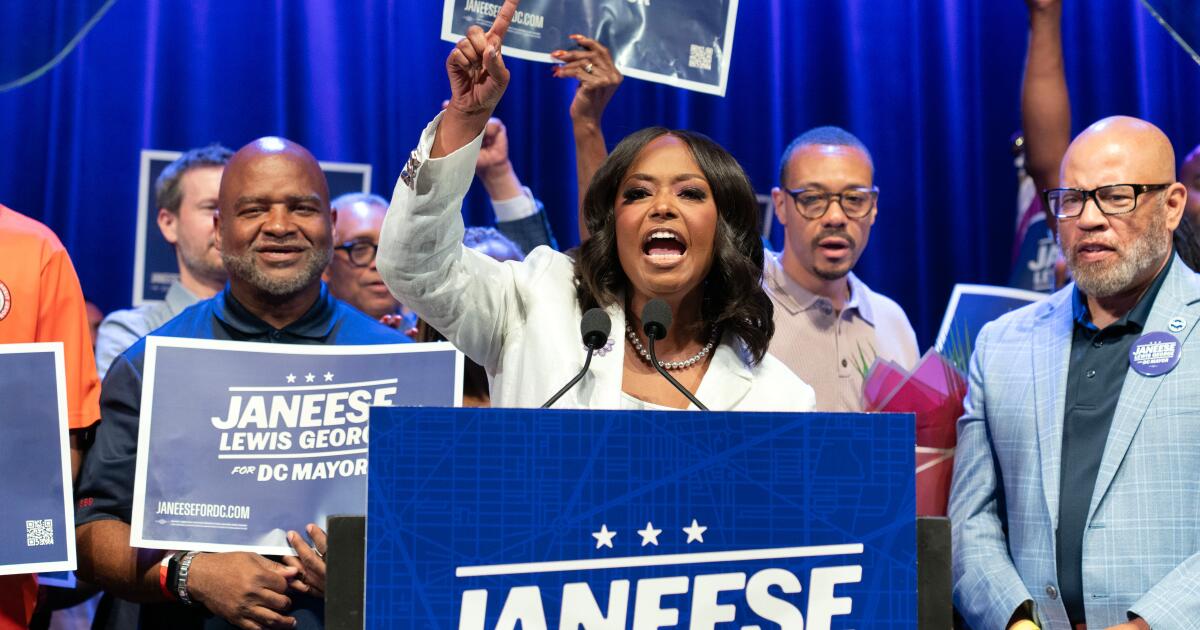
As Janeese Lewis George paves a path to the mayor’s office in Washington, D.C., she’s told voters they could have it all.

Her unapologetically expansive, left-wing agenda includes subsidized or even free childcare, increased down payment assistance for homebuyers and community resources to reduce crime, plus a promise to aggressively confront President Trump’s attempts to reshape the nation’s capital.

“People are tired of hearing what government can’t do. They want to hear what government can do,” Lewis George said in an interview before the city’s primary, where she defeated her Democratic opponents and positioned herself to win the general election in November in a city dominated by Democrats.

Lewis George’s victory signals a break with a quarter-century of centrist governance in Washington, and it puts her in the vanguard of democratic socialists who have ascended in urban politics over the last year. Zohran Mamdani toppled Andrew Cuomo, the scion of a political dynasty, on his way to becoming New York City mayor. Katie Wilson won an upset victory to lead Seattle last fall. And this month, Nithya Raman clinched a spot in the November runoff against Los Angeles Mayor Karen Bass.

All of them are members of the Democratic Socialists of America, or DSA. The political organization has seen its membership ranks swell from a few thousand to more than 100,000 nationwide over the last decade after an influx of younger Americans joined following the presidential bids of Vermont Sen. Bernie Sanders, also a self-described democratic socialist.

There’s little sign of national coordination among the candidates, and it’s unclear whether voters are gravitating toward their promises of improved government services, their vows to fight the Trump administration or their critiques of capitalism.

But from coast to coast, confrontational progressives are advancing in mayoral races. City leaders can draw outsized attention for their successes and failures, and democratic socialists will be under pressure from residents to deliver on their vows for a new kind of governance. Whether that translates to national politics is a next test for their movement.

“They are all channeling a displeasure with a status quo and a serious desire for economic populism that the establishment Democratic Party hasn’t been preaching,” said Eric Stern, a Democratic strategist with Fight Agency, a political consulting firm that strategized Mamdani’s mayoral campaign.

Stern added that Democratic voters appeared more willing to support the most progressive candidate in mayoral races rather than in contests for the U.S. House. Candidates like Mamdani and Raman, Stern said, are “daring voters to dream and fall in love not just with the individual candidates but also the political process as a whole.”

A rising left navigates America’s urban challenges

The trend of progressives surging in urban areas may have limits for its broader impact on Democratic politics. Democratic mayors in cities including Atlanta, Houston, Miami and San Francisco won on relatively moderate platforms in recent years.

Progressive have also faced noteworthy challenges. Chicago Mayor Brandon Johnson was endorsed by the city’s DSA chapter during his 2023 mayoral run but has since faced criticism from both moderate and liberal local leaders on issues such as immigration, the local budget and public safety. Recalls and public pressure ousted progressives elected to district attorney offices in multiple jurisdictions over the last five years, when criminal justice reform efforts ran into dissatisfaction over public disorder following the COVID-19 pandemic.

Trump’s hardline immigration and law enforcement tactics have also become a challenge for liberal cities. The president’s agenda poses an especially serious threat to Washington, D.C., because of its status as a federal territory.

“Maybe we take back Washington and run it on a federal basis,” Trump told reporters this month when asked about the potential election of a democratic socialist as the district’s mayor. “We won’t put up with it.”

But progressives hope the current wave of anti-Trump furor in deep blue cities across the country will help buoy the chances of those on the hard left.

“It’s not folks looking for the leftmost option so much as looking for a candidate who’s gonna be on their side,” said Ravi Mangla, speaking for the left-wing Working Families Party. The party often endorses the same candidates as the DSA and is readying to target more mayoral offices in the country’s biggest metropolises this fall and in 2028.

“It’s less about whether you are on the right or on the left so much as whether you are willing to punch up at the powerful,” he added.

Mamdani and Lewis George are both self-described “sewer socialists” who emphasize the need for responsive government services rather than critiques of market economics. The phrase recalls the socialist Gilded Age mayors whom critics derided as too preoccupied with managing public works projects.

The term’s revival is partly a strategic move to align leftist ideas with concerns over affordability and the economy, voters’ top concern in the midterm elections, and shift the public perception of democratic socialists from firebrands who support radical policies to independent-minded public servants.

“This is absolutely a change election and I’m excited to bring the change that people want, which is really putting people first in the city and having the moral clarity and courage to stand up to Trump,” Lewis George said.

For voters the ‘socialist’ label did not seem to matter

While conservatives have used the “socialist” label to attack Democrats as extreme or incompetent, some D.C. voters appeared ambivalent before Tuesday’s primary.

Several lifelong residents said they believed Lewis George was a “fighter” but didn’t think she’d have much of an impact on the local economy, given the city’s status as a federal district.

“I go back and forth on my own labels and whether I am supportive of that movement or not, but I am supportive of making D.C. more affordable,” Owen Fitzgerald, a University of Maryland graduate student, said of his support for democratic socialism.

Fitzgerald voted for Lewis George because she would stand up to Trump and said he’d first learned of her campaign from friends in his neighborhood. But he didn’t know she was a democratic socialist until he saw news reports describing her with the label.

“It sends a cultural message to this administration that the people who are surrounding them in the capital are opposed to their platform, opposed to their political agenda, and I think that it will send a message, both nationally and internationally,” Fitzgerald said.

Brown writes for the Associated Press.

Source link