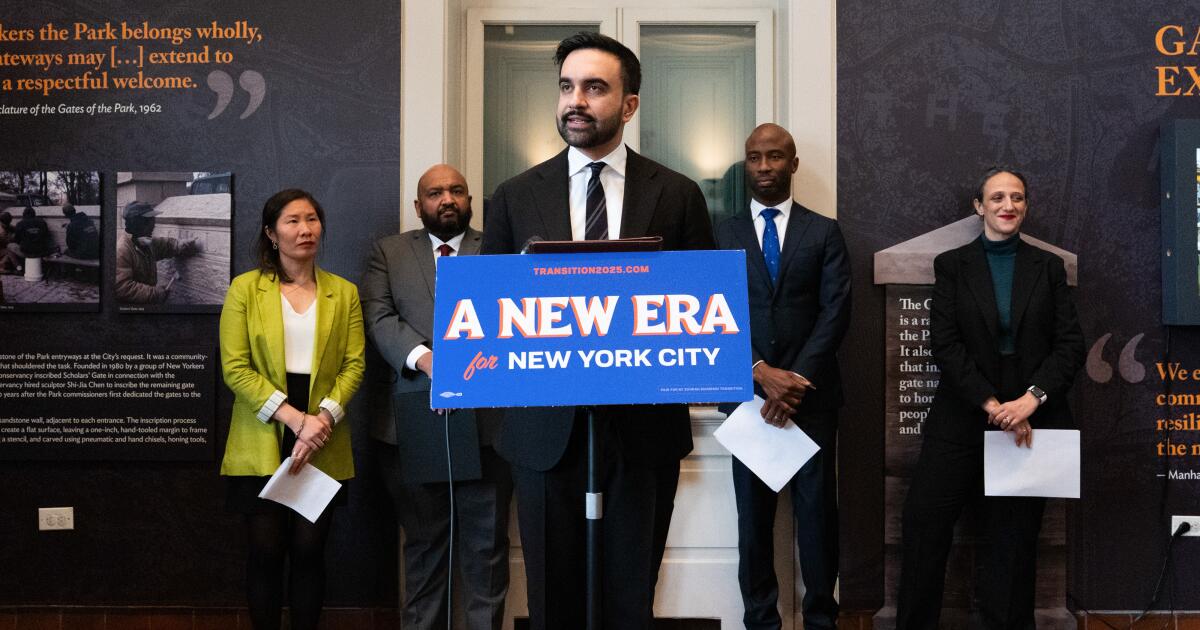
zohran mamdani

California D.A. retweets 9/11 attack images as he slams Mamdani

A California district attorney reposted on social media 9/11 images along with comments blasting the election of Zohran Mamdani as New York City’s first Muslim mayor. Despite the gory images and strong denunciation of Mamdani, Dan Dow insists that he has no issues with the Muslim community in San Luis Obispo County, where he is the top prosecutor.

He has “strong ties” with the community, Dow said in an emailed statement Thursday to The Times.

But his posts have drawn backlash, and a Muslim advocacy organization is demanding an apology and an investigation.

On Wednesday, Dow retweeted a post on X from a popular right-wing account that appeared to show a snapshot moments after flames jutted from the South Tower, the second of the twin towers struck by a plane on Sept. 11, 2001.

A second visual tweet, more graphic than the first, displayed footage from two angles of a plane barreling into one of the towers. That was posted by the leader of an activist organization, described as a hate group by some, that claims to “combat the threats from Islamic supremacists, radical leftists and their allies.”

Each was posted in the aftermath of the New York City mayoral election won by 34-year-old, self-described democratic socialist Mamdani.

The posts were retweeted and subtweeted days later and 3,000 miles away by Dow, drawing rebuke from some locals, in a story first broken by the San Luis Obispo Tribune.

Dow responded to a Times email for comment saying his issue was not with the county’s Muslim population, which numbers around 500, according to the Assn. of Religion Data Archives.

“I shared the posts because, in my opinion, Mamdani is going to destroy New York being a self-proclaimed socialist,” Dow responded. “I support the Muslim community and have strong ties to our Muslim community in San Luis Obispo.”

The first post Dow retweeted came from the account @EndWokeness, which vows to its nearly 4 million followers that it’s “fighting, exposing, and mocking wokeness.”

The second post came from Amy Mekelburg, founder of Rise, Align, Ignite and Reclaim (RAIR) Foundation, which is listed as a hate organization by the Council on American-Islamic Relations.

The council’s Los Angeles office demanded Thursday evening that Dow apologize and “retract his recent anti-Muslim social media posts.” CAIR-LA is also asking for an independent investigation into Dow’s conduct and “his fitness to continue to serve as DA.”

The organization is incensed at his retweeting of Mekelburg, whom they describe as “a known anti-Muslim extremist.”

Mekelburg wrote a sizable message on the video post, saying she’d “given my entire self” to warn the world “about the threat of Islam after 9/11.”

“And now … to see New York — my city — stand in this moment, where someone like Zohran Mamdani could even be elected,” she wrote. “My God, New York, what have you done?”

CAIR-LA said that Mekelburg “falsely equated the election of Mamdani with 9/11, reinforcing the harmful stereotype that Muslims are inherently tied to terrorism simply because of their faith.”

Dow subtweeted that specific post with a message that began by highlighting his 32 years of service in the U.S. Army and his four tours overseas.

“I remember like it was yesterday our nation being attacked by Islamic extremists on 9/11/2001,” he wrote. “I love this country and I do not in any way share the same views as the 33-year-old socialist Zohran Mamdani.”

He added in the tweet: “I am very sad to see the Big Apple torn apart by electing an un-American socialist who wants to trample on the values and freedoms that millions of Americans have fought and died for.”

“Dow’s decision to repost content that weaponizes bigotry and baselessly ties an elected Muslim official to terrorism is appalling and reflects the deeply rooted dehumanization and fearmongering in this country that American Muslims have had to endure for decades,” CAIR-LA Executive Director Hussam Ayloush said in a statement.

Dow’s posts also struck a nerve with one of his Muslim allies in San Luis Obispo, Dr. Rushdi Cader, who referred to the district attorney as “a personal friend” to the San Luis Obispo Tribune.

Cader told the Tribune the posts were “highly incendiary and puts Muslims at risk for harm, especially hijab-wearing Muslim women like my wife Nisha, whom Dan has himself described as ‘a kind and gentle lady’ who he ‘prayed would be blessed with peace.’”

Cader added he thought Dow’s “ugly post” was borne “out of disagreement with Mamdani’s politics” rather than any direct attack on Islam.”

Dow’s tweets drew other rebukes.

San Luis Obispo County Second District Supervisor Bruce Gibson called Dow a “Christian nationalist.”

He “occupies a powerful public office that requires decency and discipline,” Gibson said of Dow. “This post is yet another example that he has neither.”

San Luis Obispo Mayor Erica Stewart emailed The Times to say that the city was welcoming to all community members.

“Dan Dow, as the county’s District Attorney, by definition, should be objective and fair,” she wrote. “For someone in his position to express racism is unacceptable.”

Dow had his defenders too.

Orange County Dist. Atty. Todd Spitzer serves with Dow on the California District Attorneys Assn. Spitzer is the organization’s secretary-treasurer while Dow is the president.

Spitzer found no fault with Dow’s social media posts.

“Elected officials have a platform to share their views and be judged by their constituents,” he wrote in an email. “It is heartbreaking to see someone who has expressed such anti-public safety and anti-Semitic sentiments elected as mayor of New York, and we as the elected protectors of public safety have a right to express that.”

Source link

‘Badhai!’ In India, a celebration for Zohran Mamdani’s New York mayoral win and his roots

Indians lit up social media on Wednesday to celebrate Zohran Mamdani’s election win as New York City mayor after he thanked his Indian-born parents, quoted a historic speech by India’s first prime minister and turned the victory rally into a Bollywood-style street party.

“We are proud of him. He has done a great job,” Mamdani’s maternal uncle Vikram Nair told the Associated Press. He said he was flooded with requests from friends and families to throw celebratory parties.

“We will plan it soon,” he said, adding that the family would love to have Mamdani take part.

The 34-year-old, Ugandan-born Mamdani is set to be New York’s youngest mayor in more than a century — and the first Muslim one — when he takes office on Jan. 1.

At a boisterous victory rally late Tuesday, Mamdani addressed supporters with a speech inspired by Jawaharlal Nehru’s iconic “Tryst with Destiny” address, delivered on the eve of India’s independence in 1947.

“Standing before you, I think of the words of Jawaharlal Nehru: ‘A moment comes, but rarely in history, when we step out from the old to the new, when an age ends and when the soul of a nation long suppressed finds utterance.’ Tonight, we have stepped out from the old into the new,” Mamdani said.

The title track of 2004 Bollywood blockbuster “Dhoom” played as Mamdani concluded his speech, flanked by his parents and wife Rama Duwaji.

Mamdani’s mother, Mira Nair, is an award-winning Indian filmmaker whose credits include “Monsoon Wedding,” “The Namesake” and “Mississippi Masala” and whose work has been nominated for an Academy Award. His father, Mahmood Mamdani, is an anthropology professor at Columbia University.

After his victory, Nair shared Bollywood film maker Zoya Akhtar’s Instagram story that was captioned “Zohran you beauty,” with heart emojis.

Winking references to his Indian heritage figured in Mamdani’s buzzy campaign videos, with many social media posts using dialogues from classic Bollywood movies.

While there was no official Indian government reaction to Mamdani’s win, Shashi Tharoor, a senior leader of the opposition Congress party, hailed his “spectacular victory,” calling it “wonderfully apt!” in his post on social media.

Mamdani’s multi-racial outreach and embrace of his Indian and Muslim identity won him support, but his past remarks about Indian Prime Minister Narendra Modi, whom he publicly called a “war criminal,” had many expressing concern and anger.

Rights groups have accused Modi’s government of widespread attacks and discrimination against India’s Muslims and other minorities. As chief minister of the state of Gujarat, Modi was accused of not acting to stop communal violence during 2002 anti-Muslim riots that left more than 1,000 people dead. An investigation approved by the Indian Supreme Court later absolved him.

Not everyone in India was enthused Wednesday by Mamdani’s historic win, which made headlines.

“It’s that season again, when India’s self-proclaimed urban intelligentsia will obsess over Zohran Mamdani’s New York mayoral win, yet have no clue who their own city’s mayor is!,” Indian lawmaker Milind Deora wrote on social media.

Roy writes for the Associated Press.

Source link

Contributor: Voters want both ‘tough on crime’ and compassionate reform

Zohran Mamdani, the progressive standard-bearer who could become New York City’s next mayor after Tuesday’s election, faces a public-safety trap that has entangled progressives nationwide: Voters want less cruelty, not less accountability. Confuse the two, and even progressives will vote you out.

Even before he has taken office, Mamdani is already fending off attacks from opponents, including former Gov. Andrew Cuomo and other political adversaries. They seek to brand him as a radical by tying him to the national Democratic Socialists of America’s most controversial criminal justice planks, such as declining to prosecute misdemeanor offenses.

Yet, in distancing himself from those specific policies, Mamdani is cleverly navigating a political minefield that has doomed other reformers. His strategy demonstrates a crucial lesson for the broader progressive movement: voters want a less inhumane justice system, not one that is unenforced. If progressives are perceived as abandoning accountability for offenses like shoplifting and public drug usage, they invite a political backlash that will not only cost them elections (or reelections) but also set back the cause of reform nationwide.

Americans across the political spectrum support reducing extremely harsh punishments. They want shorter sentences, alternatives to incarceration and rehabilitation over punishment. The moral case against excessive punishment resonates with voters who see our system as unnecessarily cruel. The evidence is overwhelming: 81% of Americans believe the U.S. criminal justice system needs reform, and 85% agree the main goal of our criminal justice system should be rehabilitation.

But when it comes to deciding which behaviors deserve prosecution, the politics shift dramatically. Mamdani has previously aligned with the Democratic Socialists of America, an organization that calls for ending the enforcement of some misdemeanor offenses.

This is precisely the kind of stance that can trigger backlash. The 2022 recall of San Francisco’s progressive district attorney shows why. About 1 in 3 “progressive” voters cast a ballot to remove the progressive DA from office. It wasn’t because they disagreed with his policies; in fact, these same voters supported his specific reforms when his name wasn’t attached to them. Their opposition was rooted in a fear that declining to prosecute low-level crimes would create a deterrence vacuum and incentivize lawlessness.

In Los Angeles, George Gascón’s trajectory offers a cautionary tale. As Los Angeles County district attorney, he survived two recall attempts before losing his 2024 reelection bid by 23 points. L.A. voters hadn’t abandoned reform — they’d supported it just four years earlier. But Gascón’s categorical bans on seeking certain harsher sentences or charging juveniles as adults triggered a revolt from his own rank-and-file prosecutors, creating the perception that entire categories of misconduct would go unaddressed. When prosecutors publicly sued him, arguing his directives violated state law, the deterrence vacuum became tangible. By the time Gascón walked back some policies, voters’ trust had evaporated.

This pattern repeats across the country. In Boston, DA Kevin Hayden has distanced himself so forcefully from predecessor Rachael Rollins’ “do not prosecute” list that he bristles at reporters even mentioning it. Yet Hayden’s office is still diverting first-time shoplifters to treatment programs — the same approach Rollins advocated. The difference? Hayden emphasizes prosecution of repeat offenders while offering alternatives to first-timers. The policy is nearly identical; the politics couldn’t be more different.

Critics are right to argue that the old model of misdemeanor prosecution was a failure. It criminalized poverty and addiction, clogged our courts and did little to stop the revolving door. But the answer to a broken system is not to create a vacuum of enforcement; it is to build a new system that pairs accountability with effective intervention.

Mamdani has already shown political wisdom by declaring, “I am not defunding the police.” But the issue isn’t just about police funding — it’s about what behaviors the criminal justice system will address. As mayor, Mamdani would not control whether the prosecutors abandon prosecution of misdemeanors, but what matters are his stances and voters’ perception. He should be vocal about how we thinks prosecutors should respond to low-level offenses:

  • First-time shoplifters: Restitution or community service.
  • Drug possession: Treatment enrollment, not incarceration.
  • Quality-of-life violations: Social service interventions for housing and health.
  • DUI offenders: Intensive supervision and treatment.

To be clear, this isn’t about ignoring these offenses; it’s about transforming the response. For this to work, the justice system must use its inherent leverage. Instead of compelling jail time, a pending criminal case becomes the tool to ensure a person completes a treatment program, pays restitution to the store they stole from, or connects with housing services. This is the essence of diversion: Accountability is met, the underlying problem is addressed, and upon successful completion, the case is often dismissed, allowing the person to move forward without the lifelong burden of a criminal record.

Mamdani’s proposed Department of Community Safety is a step in the right direction. But it must work alongside, not instead of, prosecution for lower-level offenses, and Mamdani must frame it as a partner to prosecution. If voters perceive it as a substitute for accountability, his opponents will use it as a political weapon the moment crime rates fluctuate.

New York deserves bold criminal justice reform. But boldness without pragmatism leads to backlash that sets the entire movement back. The future of the criminal justice progressive movement in America will not be determined by its ideals, but by its ability to deliver pragmatic safety. For the aspiring mayor, and for prosecutors in California and beyond, this means understanding that residents want both order and compassionate justice.

Dvir Yogev is a postdoctoral researcher at the Criminal Law & Justice Center at UC Berkeley, where he studies the politics of criminal justice reform and prosecutor elections.

Source link