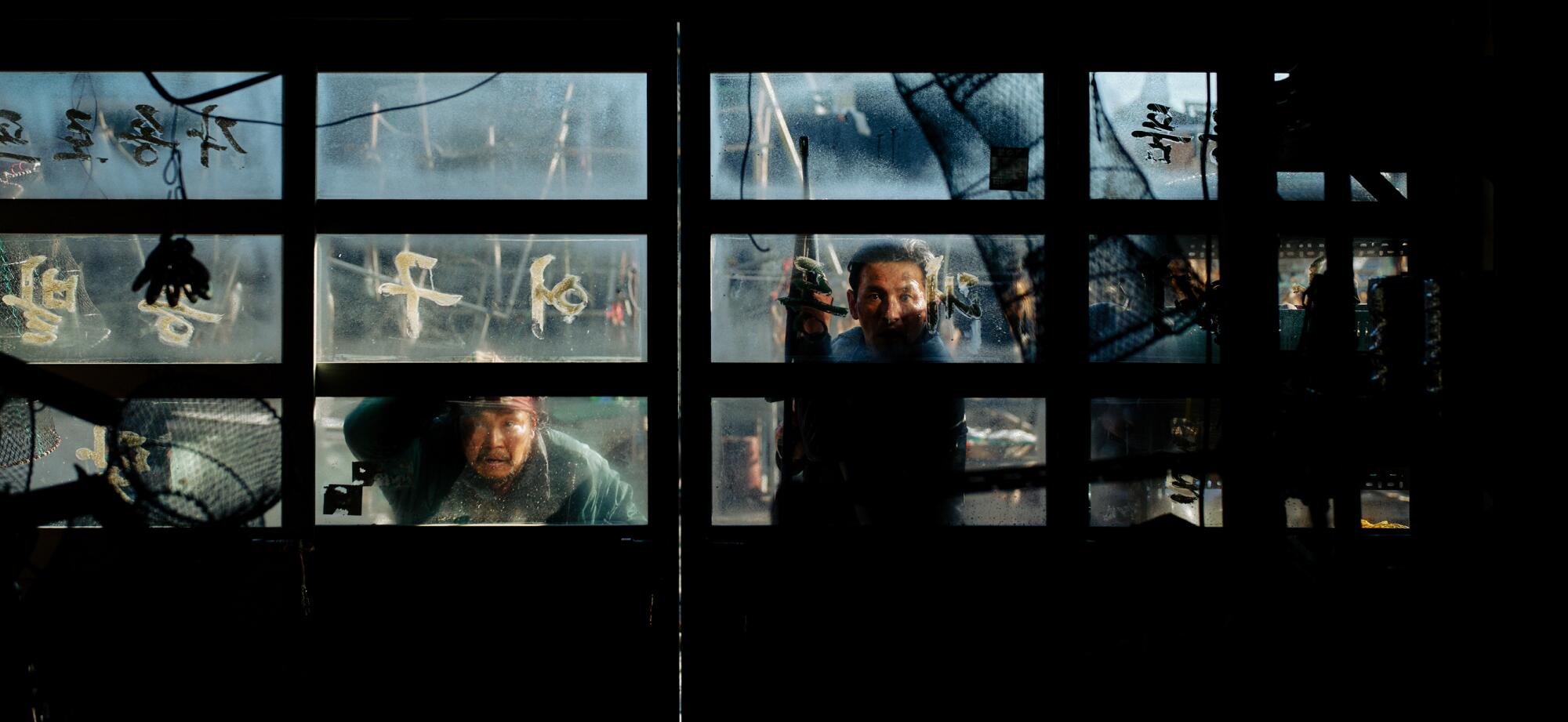
world premiere

Comedian John Early makes his directorial debut in ‘Maddie’s Secret’

To laugh or to cry? It’s a question that feels a little too familiar of late — one confronted often while watching “Maddie’s Secret,” the debut as writer-director from comedian and performer John Early.

Playing the title role with an unnerving sincerity and startling sense of vulnerability, Early stars as Maddie Ralph, a young woman climbing the ranks as a Los Angeles food influencer while secretly hiding her struggle with bulimia.

Early’s performance is a truly remarkable highwire act, all the more so for the wig, padding and prosthetics he wears to play the character. Made in the earnest style of a disease-of-the-week television movie without ever tipping over into winking irony, the film is both funny and tender.

“That, to me, is Maddie’s true secret,” says Early, 38, on a recent video interview from the apartment he is renting in New York City while appearing onstage in Wallace Shawn’s new off-Broadway play “What We Did Before Our Moth Days.”

“The secret of the movie — the real twist of the movie — is not any kind of trope-y reveal,” Early says. “The twist is actually a tonal twist. What I hope is then that becomes funny: the sheer commitment to the stakes of it.

“At any given moment, you can experience it as totally sincere, you can absorb it genuinely and be moved by it,” Early continues, “or you can take a little break and step out of it and find it uproariously funny that we’re even doing this to begin with.”

A woman looks at herself in the mirror, embraced by her boyfriend.

John Early, front, and Eric Rahill in the movie “Maddie’s Secret.”

(Magnolia Pictures)

Early’s skillfully wrought psychodrama, which had its world premiere at last fall’s Toronto International Film Festival, is now the opening-night selection for this year’s Los Angeles Festival of Movies, playing Thursday at Eagle Rock’s Vidiots with members of the cast present for a Q&A, and then again on Friday at 2220 Arts + Archives in Historic Filipinotown.

“Maddie’s Secret,” which opens in theaters June 12, makes for a fitting kickoff for this year’s event. Though the programming includes movies from all over the world, organizers ended up leaning heavily into films made in Los Angeles.

“This year it really does feel like a homegrown festival,” said Sarah Winshall, LAFM’s co-founder and festival director. “What it ended up doing is making us think about L.A. as a small town as a result.”

“I think the movie is an incredible accomplishment,” said Micah Gottlieb, LAFM co-founder and artistic director. “It’s made by somebody who’s not just a great comedian but also is a cinephile, knows the history of cinema, is trying to make something that fits within that lineage, while also just making an all-out entertaining movie.”

“Maddie’s Secret” was shot in the same workaday, creative-class neighborhoods where LAFM unspools. (Maddie’s house in the movie is Early’s own home.) The actor and filmmaker describes it as a “very Echo Park, Silver Lake, Eagle Rock, Frogtown, Glassell Park, Highland Park, Los Feliz movie.”

The story is also rooted in Early’s own complicated feelings about the L.A. food scene.

“It’s completely born out of my time in L.A. and my initial shock when I was confronted with a burgeoning restaurant scene,” says Early, who grew up in Nashville and moved to L.A. from New York in 2016.

“Not to always be talking about millennials, but it seemed very much of my generation,” he says, “specifically these kinds of restaurants where the food is really expensive but you’re sitting on a milk crate, eating lots of Middle Eastern food made by white people. There was just something very funny about all of it to me, even though I completely also sincerely loved it and still do.”

The film’s supporting cast is drawn largely from Early’s own circle of friends, including his most frequent collaborator, the comedian and writer Kate Berlant, along with Conner O’Malley, Claudia O’Doherty, Eric Rahill and Vanessa Bayer. The film’s production designer Gordon Landenberger is his ex-boyfriend and Early is excited that a number of other key collaborators, including costume designers Kimme Aaberg and Izzy Heller and cinematographer Max Lakner, are working on a feature for the first time, just as he is as writer-director.

A man in a polo shirt sits on a couch and stares at the lens.

“I think I wanted to force myself at gunpoint into a place of innocence and naivete,” says Early. “I think this movie is a strange mutation of the camp tradition.”

(Justin Jun Lee / For The Times)

Berlant plays Maddie’s best friend in the film. She and Early have worked together on shorts, live performances and their 2022 Peacock special “Would It Kill You to Laugh?” The two always share what they are developing and so Berlant first heard about “Maddie’s Secret” when it was just percolating as an idea.

“It was a very wild proposition,” she recalls with a laugh while driving down L.A.’s Beverly Boulevard. “He’s like, ‘I’m going to play a woman who’s struggling with bulimia.’ I was like, ‘Good luck.’ I was astonished that he totally pulled it off and he’s such a true filmmaker. It was kind of miraculous.”

Berlant describes their shared sensibility, the ability to simultaneously play comedy and pathos, as a kind of freedom. “Just the underlying absurdity or joke really gives you the ability to go to these really intense emotional places,” she says. “It gives you the permission to go to places that otherwise would be too unbearably saccharin.”

For Early it was also a chance to fulfill his longtime desire to play an old-school ingénue.

“I think I wanted to force myself at gunpoint into a place of innocence and naivete,” says Early. “I think this movie is a strange mutation of the camp tradition.”

A man lies on the floor of an apartment next to the shadow of a plant.

“I was astonished that he totally pulled it off and he’s such a true filmmaker,” says Kate Berlant, Early’s longtime collaborator. “It was kind of miraculous.”

(Justin Jun Lee / For The Times)

He references Susan Sontag’s famous essay “Notes on Camp” to say there are two kinds of camp humor, one that is unknowing and another that is knowing. It is near impossible now to genuinely create the first kind, but the process of making “Maddie’s Secret” was in a sense about being the second and striving for the first.

“In the age of the internet and in the kind of crumbling, depressing world we live in, it’s almost impossible to be the first kind of camp,” says Early, “to feel innocent and naive and to twirl. But obviously there is a part of me, there’s a part of all of us, that is very childlike and innocent and has hope. So I think this movie, it knows itself to be camp but it’s aching to be more like the first kind of camp. It’s aching to be pure and naive.”

Though it may be easy to place what Early is doing in the tradition of drag performers such as Divine’s work with filmmaker John Waters, to Early his performance in “Maddie’s Secret” sits outside of it.

“Drag is often obviously about a certain kind of extravagance and fabulousness and Maddie is very humble,” he says. “And so I don’t really see it as drag. It didn’t feel like drag doing it, whatever that means. It honestly just felt like acting to me.”

In dealing with the serious topic of bulimia, Early was careful never to make the eating disorder the joke. He points to a trio of TV movies — 1986’s “Kate’s Secret,” starring Meredith Baxter Birney; 1997’s “Perfect Body,” starring Amy Jo Johnson; and 1981’s “The Best Little Girl in the World,” starring Jennifer Jason Leigh — along with Lauren Greenfield’s 2006 documentary “Thin” as key influences on how he approached the film’s depiction of the illness. (Other non-bulimia influences include Alfred Hitchcock’s “Marnie,” Paul Verhoeven’s trashy “Showgirls” and Adrian Lyne’s “Flashdance.”)

“I don’t find bulimia itself funny,” says Early. “The genre of these movies — that’s what’s funny. It’s the emotional pitch of those movies and the way that they’re made and the acting style and the kind of moralistic quality while being totally pervy. All that was funny to me. And then also putting contemporary life — young, gentrified L.A. food-content influencer culture — putting all that through a melodrama-style filter, that was funny to me.”

While writing the screenplay, Early says he often found himself weeping, overtaken by the emotions of what he was creating. “I guess I’m not above the genre at all,” he admits.

But playing the part was another matter, having sold everyone involved in the production on a very specific tone and conception of what they would do together.

“I was like, ‘I am so stupid, I can’t believe I have put myself in this position,’” Early says, laughing at the memory. “I had set myself up to do the thing that I really had no proof that I could do, which is to play an almost Juliet kind of character who’s going through these extreme things. And I was the one that promised everyone that we would take it seriously. And then suddenly I was like ‘OK, well you have to do it. You actually have to do it.’”

Even if Early was uncertain in the moment, the result is undeniable: a dizzying, disarming blend of humor and emotion — and one of the year’s boldest performances.

Source link

In the coming-of-age documentary ‘Agridulce,’ the kids are keeping bachata alive

Before becoming a global phenomenon in the 2000s thanks to artists like Aventura, Monchy y Alexandra and Prince Royce, and before being declared an “intangible cultural heritage of humanity” by UNESCO in 2019, bachata was — and continues to be — the soundtrack of the Dominican Republic.

The importance of the genre to the people of the Caribbean nation is at the heart of “Agridulce,” a music documentary that had its world premiere at this month’s South by Southwest Film Festival in Austin, Texas. Filmed over the course of five years, the feature follows four young students at Academia de Bachata, a music conservatory in the beachside resort town of Cabarete. It’s the only school of its kind in the world.

Academia de Bachata was founded in 2013 by music producer Benjamin De Menil. After traveling to the Dominican Republic to record for nearly three decades, De Menil says he wanted to create something that would ensure that the next generation continues the traditions of bachata.

“One of the things I loved about the bachata musicians I was working with early on is that they were such natural musicians. There was never any sheet music, so whenever we were going to record I would say, ‘Let’s do this song and it goes like this,’ and they would listen to it for a little bit before they figured it out and they were playing it,” he said. “I thought that we could somehow harness that energy in a more organized and educational format and make a school where we’re helping young children become professional musicians within this genre that has a lot of opportunity.”

De Menil partnered with DREAM Project, a nonprofit organization that did work in Cabarete, and launched Academia de Bachata in 2013. Since then, the school has provided hundreds of children with a free musical education.

“There were a lot of things we were trying to figure out along the way about what the best way to teach this music was because this wasn’t your typical conservatory. We were focusing on the traditions passed on rather than some style of music that there are already textbooks for.”

To make “Agridulce,” De Menil, who produced the film, reached out to Frank Pavich, director of the 2013 “Jodorowsky’s Dune,” the cult classic documentary about avant-garde filmmaker Alejandro Jodorowsky’s quixotic and failed attempt to adapt Frank Herbert’s 1965 sci-fi novel “Dune.” It didn’t take much to bring him on onboard.

“Ben contacted me and told me about the project. I responded with what’s Bachata?,” the Croatian American director said. “I had never even heard of the musical genre. And then he sent me some music. He sent me footage that he had shot of [Cabarete] and of the school. And it was unlike anything I’d ever seen. It was so colorful and so incredible that I just wanted to jump on right away. I was like, ‘Great, when can we go down there and start shooting? It was really that fast.”

Pavich says now he hears bachata everywhere.

“I live between Switzerland and Croatia and now that I know how to pick it up, I hear it in cars passing by a cafe in Geneva and in Croatia,” he said. “It’s everywhere, it’s infiltrated everything in the best way possible.”

“Agridulce” is an ethnomusicological documentary — it captures the music of a specific place and people and shows how the tradition is kept alive — that also doubles as a coming of age story. The film follows students of varying ages — Edickson, Frandy, Orianny and Yerian — out of the classroom, showing us moments of intimacy with their families and friends while also giving us a slice of quotidian life in Cabarete.

As such, “Agridulce” doesn’t shy away from the political tensions of the beachside resort. Much like in the U.S., immigration is a contentious topic in the Dominican Republic — the country shares the island of Hispaniola with Haiti, which has seen an exodus of its people over the decade.

De Menil and Pavich said that nearly a third of Academia de Bachata’s student body is of Haitian descent, and that they would have had to go out of their way to not include one of them in the film.

This tension plays out in the storyline of Frendy, a magnetic student of Haitian descent who uses bachata to fit in.

“Many young people are in that position of being made to feel they don’t belong at that time in life when a person most wants to find their place,” De Menil said. “We see that music can help kids, particularly immigrant kids, find belonging.”

“The film ultimately speaks to the way that culture and shared history contribute to the development of authentic, lived creativity,” said South by Southwest consulting programmer Jim Kolmar. “It’s something innate and inevitable, and ‘Agridulce’ really explores that beautifully. Obviously it’s full of incredible music, but the deeper cultural context is essential, and seeing it through the perspective of the students at Academia de Bachata helps us connect the dots.”

Source link