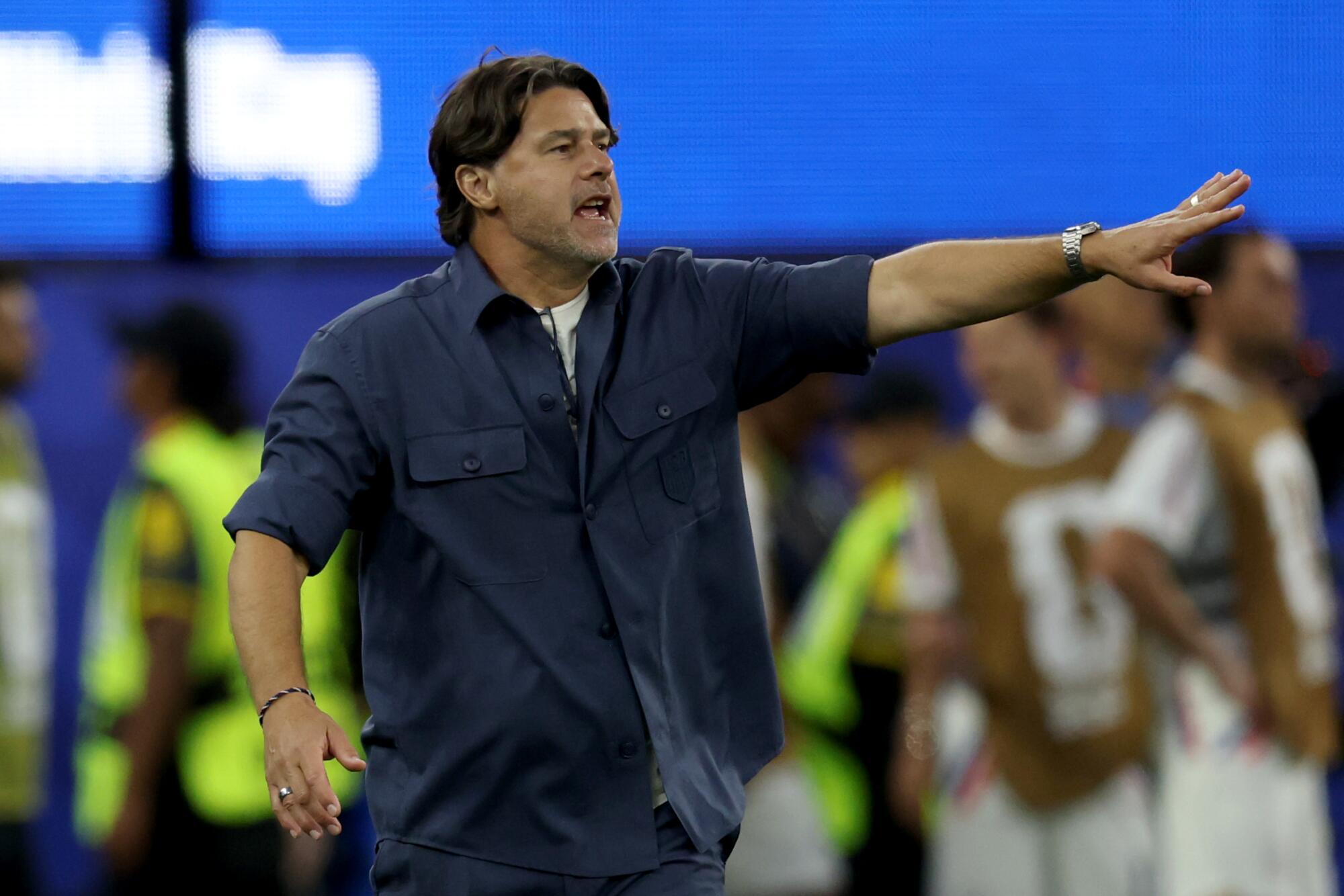
How Mauricio Pochettino taught his team to win World Cup games
A bowl of lemons sits on a table in the conference room Mauricio Pochettino has turned into an office at the U.S. men’s soccer team’s beachfront resort in south Orange County. The citrus fruit, the coach believes, has the spiritual ability to absorb negative energy. On the corner of another table, the flame from a candle flickers.
“I like candles,” says Pochettino, who believes they release therapeutic fragrances and create a calming environment.
But it is the massive, blood-red mural covering the entire south side of the room that truly reveals what Pochettino believes. In the center of the wall, just behind the coach’s desk, white block letters spell out “Why Not” above a script “U.S.,” which, despite the periods, is meant to be read as “us.”
Pochettino has turned the question in a mantra for a World Cup team that has answered it with two wins in as many games and has a chance to win a third match in the tournament for the first time when it meets Turkey at SoFi Stadium on Thursday.
The idea came to him during a team meeting last November when he sensed his players had doubts about their upcoming World Cup run. So Pochettino turned those doubts into a question. If South Korea could come from nowhere and make the semifinals of the 2002 World Cup, and if Morocco could do the same four years ago in Qatar, why not the U.S.?
Why not us?
“Hey, come on, guys, are you listening to me?” Pochettino said he asked the group. “We need to believe.”
Before he could convince his players, however, he had to convince himself. And that might have been the hardest part.
The 54-year-old Pochettino is a benevolent Svengali with a whistle; Ted Lasso with an Argentine accent. Belief isn’t so much a concept for him as it is a way of life. But when he and his coaching staff took over the U.S. team in the fall of 2024, following its disastrous performance in the Copa América, he said he inherited a demoralized, dispirited group.
“We received a big bang,” Pochettino said, mimicking a punch to the face. “We were knock[ed] out for a while.”
“We were so naive,” he continued. “The situation was way worse than we really believed.”
Pochettino refused to change the system that has brought him success at European clubs Tottenham, Paris Saint-Germain and Chelsea. So he set out to change the players instead. That would take time, something he had very little of since he took over with the World Cup just 20 months away.
“It’s difficult to analyze the process, you know,” Pochettino said during an informal, 40-minute discussion at his team’s Dana Point hotel, the sun setting over the ocean through the open patio doors of his office.
“When you put the seed on the soil, [the] first seed, you don’t see nothing. Then you start to grow the tree. It was difficult to explain the plant because it’s not easy.”
The seed Pochettino planted with the national team took time to sprout. He lost five of his first 10 games, including a disastrous four-game stretch that included Nations League losses to Panama and Canada in the spring of 2025. The team’s supporters revolted, but Pochettino rejoiced.
“What happened, that was [a] good crash,” he said. “When we detect all the problems, we go for the solution. And we knew that the solution will arrive. The object is to challenge people.”

U.S. men’s soccer coach Mauricio Pochettino during the second half of his team’s World Cup match vs. Paraguay at SoFi Stadium.
(Robert Gauthier / Los Angeles Times)
So he stayed the course.
“That was the process. Now is not a coincidence,” he said of the team’s success.
Pochettino has long believed that building a roster isn’t about picking the best players, but picking the right players. Players who fit his tactical approach, players who get along with one another, players who contribute to the team chemistry.
For him, the human connection, human respect is as important — if not more important — than the ability to dribble through tight spaces. And those traits are particularly important in a World Cup since the team will spend every day together for six weeks or more.
Although Pochettino’s team includes 13 holdovers from the 2022 World Cup roster, it also includes five players who made their national team debuts in the last 18 months.
Sometimes, he concluded, it is easier to simply change the player than it is to change what the player thinks or believes. And the newbies have totally bought in.
“We’re all in total belief. We’re all totally supportive and have faith in the process that he’s been outlining,” said goalkeeper Matt Freese, who made his first appearance for the national team more than 12 months ago and now is starting in a World Cup. “Our task was to keep believing, keep working hard and keep trusting. And we did that. We fully bought into the process.”
That process has made Pochettino the first U.S. coach to win a group stage in 16 years while his two victories in as many games match Bruce Arena, the most successful World Cup coach in U.S. history, who managed eight games over two tournaments.
The lemons and candles Pochettino keeps in his office are manifestations of energia universal or universal energy, a foundational concept common to many Eastern philosophies that believe a fundamental life force connects all things. Pochettino said he has long felt this connection and it has been a foundational part of his coaching.
But it doesn’t stop with the candles and citrus fruit. Pochettino also has filled the mural behind his desk with inspirational sayings.
“The talent has brought us here, but it is heart, effort and unity that will make us unforgettable,” one reads.
“If I dream of touching the moon, maybe I can get close to it. If I only dream of getting close, I’ll stay on Earth,” another says.
Each ends with the coach’s initials, similar to the way a painter signs his portraits.
Pochettino’s faith in the power of fruit and candles and his penchant for penning aphorisms hasn’t taken away from the ferociousness of his approach to soccer. Many players say the training sessions under Pochettino — which are intricate, focused and highly physical — are frequently more intense than the games. But most also are punctuated with laughter.
“Training is still very competitive, it’s very intense,” said midfielder Max Arfsten, who made his national team debut under Pochettino last year. “That’s the culture that the coaches created. Everyone’s still trying to prove something.”
Although Pochettino has spent his life in Argentina and Europe and still splits his time between houses in Barcelona and London, flying to the U.S. for matches and training camps, he’s been a quick study in this country’s culture and quirks.
“One of the things that we really like, and we learn from you, is in the way that you approach life. It’s more casual than formal,” said the coach, whose English is still a work in progress. “People are very approachable and make you feel comfortable. That, for me, was a massive surprise. You always want to welcome people.
“Even the music, even the food. People say ‘no, Americans have crazy food.’ Yes, you have crazy food. But also you have Whole Foods. In Europe, you don’t have a Whole Foods.”
And Pochettino has adopted it all. He’s become a big fan of country artist Lainey Wilson, went to hear Teddy Swims, a uniquely American genre-blending singer, last winter in New York, and is learning the words to John Denver’s “Take Me Home, Country Roads,” the unofficial victory anthem of the World Cup team.
Perhaps more important, at times he’s taken his lemons and his candles and pushed them aside, replacing them with another distinctly American trait: the in-your-face confidence to will yourself to victory from the most hopeless situations.
It’s how Americans won at Valley Forge even before they were Americans and how they won on the beaches of Normandy when the concept of America was threatened. It’s how Americans went to the moon and invented the internet.
And it’s how Pochettino’s team has remained perfect two games into the World Cup.
“We’re American. We don’t take s—,” midfielder Sebastian Berhalter said Pochettino told the team during one meeting. “Even though he’s Argentinian, he has that mindset of, ‘Look, this is what we do. This is who we are. This is what America’s about.’ Even from an outside perspective, he showed us Americans what we’re about.
“He really drills that into us.”
For decades Americans have measured World Cup success in advancing beyond the group stage. Pochettino entered this summer’s tournament predicting a run to the semifinals, runs like South Korea and Morocco made.
“When people believe in each other, impossible dreams become possible,” reads another message the coach has scratched onto the wall of his office.
Why not us?