world cup

Advocates concerned city has not reviewed LA28 plan for homeless, human trafficking

A report on how Olympic organizers will tackle civil rights, homeless and human trafficking ahead and during the 2028 Games has not been made public by the city more than two months after it was filed and no date for its release has been set, leaving human rights advocates fearing the issues will not get the attention and funding they deserve.

Council president Marqueece Harris-Dawson, who chairs the ad-hoc committee on the LA28 Games, has not included the human rights report on the committee’s agenda. His office did not respond to requests for comment and Sharon Tso, the city’s chief legislative analyst, and Matthew Szabo, the city’s administrative officer, both said they have not seen the report and “nothing appears on the council file,” according to Tso.

The delay is limiting discussion on an important topic, said Stephanie Richard, a clinical professor who leads the Sunita Jain Anti-Trafficking Initiative at Loyola Law School, which released its own comprehensive report on human trafficking and the 2026 World Cup and 2028 Olympics in December.

“From an anti-trafficking perspective, this is a historic moment” she said. “Yet the public has no access to the draft.

“Without transparency, Los Angeles cannot responsibly prepare, and advocates cannot provide informed guidance. LA28 is setting a global precedent — one that currently lacks public accountability.”

LA28, the private nonprofit organizing committee for the 2028 Summer Olympic and Paralympic Games in Los Angeles, was responsible for developing a human rights strategy around the Games. Its report was due Dec. 31, a deadline it met, according to a spokesperson for the group. LA28 is not allowed to release the report publicly until the city does.

“As per our Games Agreement with the City, LA28 completed the Human Rights Strategy at the end of 2025,” said Jacie Prieto Lopez, the group’s vice-president of communications and public affairs, in LA28’s first public statement on the report. “We are now working closely with city leaders on next steps.”

What those next steps are and when they’ll be taken, no one seems to know.

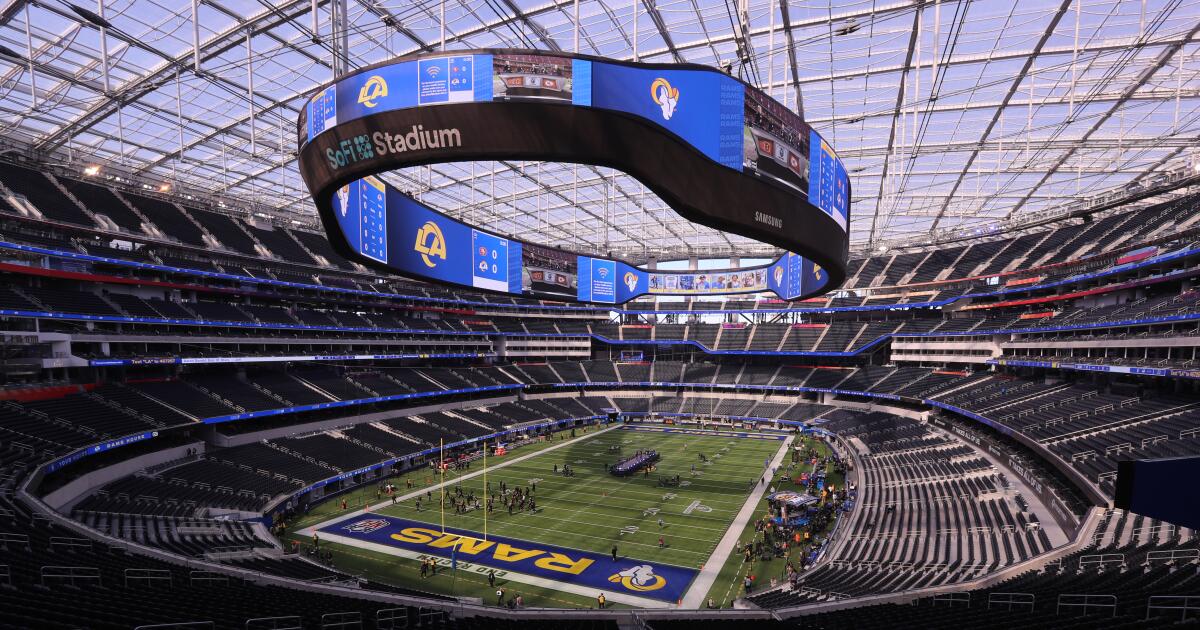
FIFA is producing its own report on human rights and human trafficking around this summer’s World Cup, which will feature eight games at SoFi Stadium in Inglewood.

“In each host city, human rights teams are working towards tailored FIFA World Cup Human Rights Action Plans in consultation with local human rights stakeholders and in line with FIFA guidance,” a FIFA spokesperson said in a written statement. “Plans will be published ahead of the tournament. This work reflects a sustained and consistent commitment by FIFA to embed human rights considerations throughout the planning and delivery of the tournament.”

The FIFA report for Los Angeles isn’t expected to be released until May, according to sources close to the process not authorized to speak publicly, about a month before the tournament kicks off. Some of the other 11 U.S. host cities, among them Seattle and Houston, have already rolled out their own initiatives addressing the issue.

Richard, who was invited by the city to consult with LA28 on its study, said the release of both the Olympic and World Cup reports is important for Los Angeles because it allows for public comment and oversight.

Richard’s group has called on LA28 and FIFA to allocate between $2.75 and $3.1 million specifically for anti-trafficking implementation; to fund a public-awareness campaign and independent audits to ensure accountability and transparency; and to invest in long-term programs that extend beyond the two sporting events.

“One of the things our report starts from is the only evidence-based data connected to major sporting events is that labor trafficking increases,” Richard said. “Major sporting events requires an influx, a large influx, of workers, a lot of time immigrant workers who are highly vulnerable in the construction industry..

“Presumably a lot of these workers are brought in months ahead of time to do some of this work.”

Richard said the continued presence of federal immigration officers in Los Angeles adds another layer of complexity to the human trafficking mix.

In mid-February, nine state legislators signed a letter calling for LA28, FIFA and local officials to incorporate the recommendations made by Richards’ group into their own plans and to release the report publicly as “a critical step toward accountability.”

But when asked about the letter this month, the signatories contacted refused to comment. A spokesperson for assemblywoman Celeste Rodriguez, who represents the eastern San Fernando Valley, said Rodriguez was “unavailable to talk on this issue.”

Source link

FIFA has discretion deciding how to replace Iran in the World Cup

Iran’s sports minister said his nation will not participate in this summer’s World Cup following the attacks on the country by the U.S., one of the tournament’s hosts.

The U.S. bombing campaign against Iran, which began two weeks ago, has triggered a region-wide conflict and killed more than 1,300 Iranians including Ayatollah Ali Khamenei, the country’s supreme leader, according to Iran’s U.N. ambassador Amir Saeid Iravani.

“Considering that this corrupt regime has assassinated our leader, under no circumstances can we participate in the World Cup,” sports minister Ahmad Donyamali said on state television Wednesday.

“Our players do not have security, and fundamentally the conditions for participation do not exist.”

Donyamali’s statement came just hours after FIFA president Gianni Infantino said he had received assurances from President Trump that Iran would be allowed to participate in the tournament, which will be played in the U.S., Mexico and Canada.

“President Trump reiterated that the Iranian team is, of course, welcome to compete in the tournament in the United States,” Infantino wrote in an Instagram post. “We need an event like the FIFA World Cup to bring people together now more than ever, and I sincerely thank the President of the United States for his support.”

Last year President Trump signed an executive order suspending visa issurance to nationals of 19 countries, including Iran, although the State Department can make exceptions for “participants in certain major sporting events” such as the World Cup.

Iran, which has played in the last three World Cups, earned its place in this summer’s tournament by dominating its group in the Asian confederation tournament. However it did not send a representation to a World Cup planning summit last week in Atlanta.

Iran was drawn into Group G for the World Cup and is scheduled to begin play June 15 against New Zealand at SoFi Stadium in Inglewood. Iran’s second group-stage game, against Belgium, is also scheduled for SoFi Stadium before the team finishes the first stage of the tournament against Egypt in Seattle.

According to The Athletic, no country has withdrawn from a World Cup after qualifying since the 1950 tournament in Brazil, when India, Scotland, France and Turkey pulled out, mostly over costs and logistical issues.

Donyamali did not say whether he has begun the formal process or withdrawing Iran from the World Cup but FIFA could be facing a time crunch if it had to replace Iran in the 48-team field. Article 6.7 of FIFA’s 2026 World Cup regulations states: ‘If any Participating Member Association withdraws and/or is excluded from the FIFA World Cup 26, FIFA shall decide on the matter at its sole discretion and take whatever action is deemed necessary. FIFA may decide to replace the Participating Member Association in question with another association.”

The most likely replacement scenario would have Iraq, the top non-qualifier from the Asian confederation, taking Iran’s place. Iraq is scheduled to play the winner of a Suriname-Bolivia playoff in Mexico later this month for a final World Cup berth but with airspace over the Middle East closed because of the war, the Iraqis are unsure how they will get to Mexico. Giving them Iran’s berth would solve that problem but it would create another; who would replace Iraq in the playoff against the Suriname-Bolivia winner? Based on the Asian qualifying tournament, the UAE would be the most likely candidate but it, too, would face travel concerns in getting to Mexico.

FIFA could leave those playoffs untouched and give Iran’s spot to Italy, which is ranked 13th in the world but must win a four-team UEFA playoff later this month to qualify for the World Cup. Basically FIFA can do whatever it wants.

FIFA regulations say that any team that withdraws from the tournament “no later than 30 days before the first match” will be fined and could face other “disciplinary sanctions” including expulsion from subsequent FIFA competitions. This summer’s World Cup kicked off June 11 in Mexico City and Toronto. The U.S. opener is scheduled for June 12 in Inglewood.

Earlier this week six members of Iran’s delegation to the Women’s Asian Cup were granted humanitarian visas and allowed to remain in Australia rather than return to Iran where they feared persecution for not singing the national anthem during the tournament.

Source link

With U.S. at war with Iran, political upheaval could hit World Cup

Twelve days ago the U.S., a World Cup host country, launched a full-scale bombing campaign against Iran, a country that has qualified to play in the tournament. That’s never happened before.

Five days later, that same World Cup host began military operations inside the borders of Ecuador, another World Cup qualifier, half a world away. That’s never happened before either.

With the tournament scheduled to kick off in three months, those events have soccer scholar Jonathan Wilson questioning whether it’s wise for the World Cup to go on at all.

“It seems to me, for each passing day, it’s less and less likely that the World Cup can happen,” he said.

That take seems unduly alarmist said David Goldblatt, a British sportswriter and sociologist who is a visiting professor at Pitzer College in Claremont. Anything short of a full-scale war inside the U.S. would not be enough to pull the plug on the tournament now, he said. Especially with FIFA expecting revenues of as much as $11 billion.

“I mean, it’s not a good look,” Goldblatt conceded. “And certainly when set against FIFA’s official pronouncements on its role in encouraging world peace and cosmopolitan celebrations of a universal humanity, none of that sits terribly easily.

“But in terms of actually running the World Cup, I don’t think it’s going to make very much difference at all.”

However, with the Trump administration open to engaging in more international conflicts, there’s little doubt this World Cup, the largest and most complex in history, will also be the most political in history as well.

Complicating things further is the fact the current conflict in the Middle East hasn’t been limited to just the U.S. and Iran. Iranian missiles have hit both Qatar and Saudi Arabia, among other countries, and Jordan has fired on U.S. assets.

Those three countries are World Cup qualifiers as well.

The fate of a soccer tournament pales in importance to the death and destruction the conflagration in the Middle East has produced, of course. But the need for unity is the very reason there’s a World Cup in the first place.

When French soccer administrator Jules Rimet founded the tournament 96 years ago, he believed soccer could be a tool for international peace. And in the early years of the tournament, Rimet, FIFA’s longest-serving president and a talented diplomat, was able to limit the impact of geopolitics on the World Cup, watering down Mussolini’s influence on the 1934 World Cup, for example, and steering the 1938 tournament away from Hitler’s Germany.

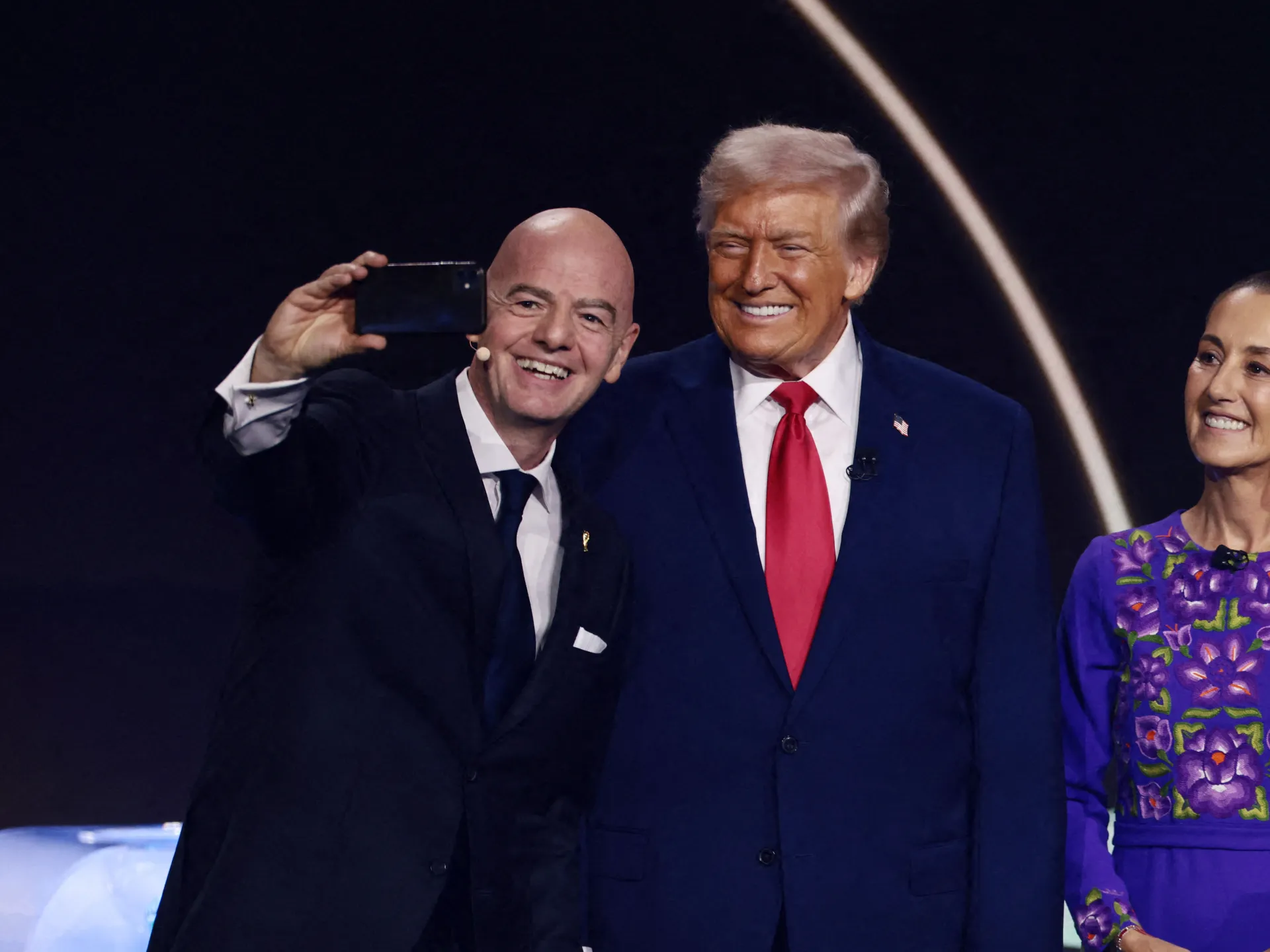
FIFA President Gianni Infantino has taken a far different approach, courting President Donald Trump’s support despite his growing number of global conflicts.

A week before bombs began falling on Iran, Infantino appeared at the inaugural meeting of Trump’s Board of Peace wearing a red cap with ‘USA’ on the front and the numbers ‘45-47’ — a reference to Trump’s non-consecutive presidencies. That act was so blatantly partisan, IOC president Kirsty Coventry said her organization would investigate whether Infantino, an IOC member, breached the terms of the group’s charter, which requires members to act independent of political interests.

FIFA president Gianni Infantino holds up a USA hat as he attends the inaugural meeting for the Board of Peace.

FIFA president Gianni Infantino holds up a USA hat as he attends the inaugural meeting for the Board of Peace at the Institute of Peace in Washington on Feb. 19.

(Chip Somodevilla / Getty Images)

“Infantino has absolutely breached every FIFA protocol on neutrality,” said Wilson, author of “The Power and Glory: The History of the World Cup.”

“Absolute neutrality is always impossible and not desirable, but it has clearly gone way, way, way beyond. The peace prize looked grotesque at the time. It looks even worse now. And I can’t see how the future will look kindly on Infantino. I think Infantino has to some extent legitimized Trump.”

This is hardly new behavior from Infantino, who had close relationships with Vladimir Putin ahead of the 2018 tournament played in Russia and Qatar’s leaders ahead of the 2022 tournament despite their well-known human rights violations.

The list of countries Infantino is asking to overlook poor relations with the country hosting the majority of World Cup games this summer is growing.

Consider that Denmark, which administers Greenland, an autonomous territory Trump has also threatened to invade, can qualify for the tournament in a European playoff that will take place later this month. Then there’s World Cup qualifiers Haiti, Ivory Coast and Senegal, who aren’t at war with the U.S. but whose citizens have been banned from entering the country to cheer for their teams. That completely contradicts a promise from Infantino, who said “everybody will be welcome” at the 2026 World Cup.

“If I had a crystal ball I could tell you now what is going to happen,” Heimo Schirgi, the World Cup chief operating officer for FIFA, said Monday. “But obviously the situation is developing. It’s changing day by day and we are monitoring closely. [But] the World Cup will go on right? The World Cup is too big and we hope that everyone can participate that has qualified.”

Goldblatt, the Pitzer professor, said Infantino’s action are understandable since he has few cards to play against Trump.

President Trump speaks as he receives the FIFA Peace Prize while FIFA president Gianni Infantino applauds Friday.

President Trump speaks as he receives the FIFA Peace Prize as FIFA president Gianni Infantino applauds on Dec. 5 the Kennedy Center in Washington.

(Patrick Smith / Getty Images)

“What’s Infantino going to do? What levers can you pull?” he asked. “You can threaten to take it away. That’s not happening. Moral admonishment? Who’s going to take that from FIFA? It is a farcical idea that anybody thinks that the president of FIFA has any kind of collective moral authority or any role as a spokesperson for the progressive part of the world.

“They may fantasize that this is the case. But it is morally and politically absurd that any of us should expect that of these people. So if you are Infantino and that is the case, you know what works with Trump? What works is flattery. So of course he’s gone down that path.”

The games, Goldblatt said, will go on even if bombs are still falling. And that may not be an entirely bad thing.

“Football’s a great distraction. That’s partly why it’s so popular,” he said. “It will be virtually impossible, if the war continues, for that not to be a central element of like, the meaning and the purpose of what we’re all doing here.

“How we’ll feel and what it will look like, I don’t know. It will be very strange. Football is unpredictable and extraordinary. Something will happen that will warm our souls.”

You have read the latest installment of On Soccer with Kevin Baxter. The weekly column takes you behind the scenes and shines a spotlight on unique stories. Listen to Baxter on this week’s episode of the “Corner of the Galaxy” podcast.

Source link

Galaxy’s Champions Cup foe may be short 10 players due to visa woes

The State Department has denied visas for members of a Jamaican soccer team scheduled to play the Galaxy on Wednesday in the round of 16 of the CONCACAF Champions Cup, raising concerns that the Trump administration could bar players from traveling to the U.S. for this summer’s World Cup as well.

A CONCACAF source with knowledge of the issue not authorized to discuss it publicly said the organization was aware of the problem and working with the team to appeal the decision. The Champions Cup is the most prestigious club tournament in CONCACAF, the 41-nation FIFA confederation that governs soccer in North America, Central America and the Caribbean.

Mount Pleasant FA, champion of last year’s CONCACAF Caribbean Cup and runner-up in the last two Jamaican Premier League tournaments, is playing in the Champions Cup for the first time. The team has six Haitian players on its roster, and Haiti is one of 19 countries whose citizens have been banned from entering the U.S by the Trump administration. Citizens from an additional 20 countries faced partial restrictions.

“This decision raises serious concern about the administration’s willingness to abide by its own agreement and statements regarding the issuance of visas for the World Cup,” said David J. Bier, director of immigration studies at the Cato Institute. “The President’s proclamation clearly exempts athletes and necessary support personnel for ‘major sporting events.’ But apparently, this exception is not being applied in all cases.”

The State Department has the ability, under the Presidential Proclamation exception, to grant entry to “athletes, coaches and essential support staff” from any country traveling to the U.S. for “the World Cup, Olympics or other major sporting event as determined by the secretary of state.”

Despite that, eight members of Cuba’s delegation to the World Baseball Classic — among them federation president Juan Reinaldo Pérez Pardo and pitching coach Pedro Luis Lazo — had their visa requests denied. Under the Trump administration’s rules, Cuban citizens are subject to the same travel restrictions as Haitians.

However, Haiti and Jamaica were able to play in last summer’s Gold Cup soccer tournament in the U.S. without issue. The State Department did not respond to requests for comment.

The CONCACAF source said the confederation hopes to reach an agreement with the State Department but added that Mount Pleasant’s game with the Galaxy will go forward either way. The club, which is scheduled to depart Sunday, told a Jamaican newspaper that up to 10 players have been denied visas and coming to Los Angeles without them would require it to rely on seven or eight players from the team’s youth academy to fill out the roster.

“We don’t want to just show up for the game, we want to be able to compete, but we are not being given the opportunity to be at our best,” Paul Christie, the team’s sporting director, told the Jamaica Observer.

The teams will meet in the second and deciding leg of the two-game playoff March 19 at National Stadium in Kingston, Jamaica. Mount Pleasant is expected to be at full strength for that game.

The State Department’s approach to the visa requests for the Cuban baseball delegation and Jamaican soccer team raise questions about how the Trump administration will handle visa requests ahead of this summer’s World Cup. Four tournament qualifiers are impacted by the administration’s travel restrictions, with citizens of Iran — a country with which the U.S. is at war — and Haiti facing a total ban, and those from Senegal and Ivory Coast subject to severe restrictions.

Members of Iran’s delegation were refused entry to the U.S. for December’s World Cup draw in Washington, during which FIFA president Gianni Infantino presented President Trump with the FIFA Peace Prize. And last summer, Senegal’s women’s basketball team was forced to cancel a 10-day training camp in the U.S. when visa requests for five players, six staff members and a ministerial delegation were rejected.

Source link

Iran soccer federation says participation in World Cup in doubt

The president of Iran’s soccer federation says he does not know if the national team can play World Cup matches in the United States following the surprise U.S. and Israeli bombardment of his country.

“What is certain is that after this attack, we cannot be expected to look forward to the World Cup with hope,” Mehdi Taj told sports portal Varzesh3 as Iran traded strikes with Israel as part of a widening war prompted by the bombardment.

The U.S.-Israeli strikes on Iran continued for a second day on Sunday after the killing of Iranian Supreme Leader Ayatollah Ali Khamenei threw the future of the Islamic Republic into uncertainty and raised the risk of regional instability.

Iran has been drawn in Group G at the World Cup and is scheduled to play in Los Angeles — where it faces New Zealand and Belgium on June 15 and 21, respectively at SoFi Stadium — before it plays Egypt in Seattle on June 26.

The United States is hosting the tournament with Canada and Mexico from June 11-July 19.

Fans from Iran were already banned from entering the U.S. in the first iteration of the travel ban announced by the Trump administration.

FIFA did not immediately reply to an email from The Associated Press over the current situation regarding Iran’s participation in the World Cup.

Source link