Proponents of the measure say Los Angeles is falling short in providing basic services, including street and sidewalk maintenance, upkeep of streetlights and trees and other services administered by the Department of Public Works.
The measure is intended to streamline public works decision-making to improve city services and add new sources of revenue by leveraging existing resources such as underutilized city land.
Measure LA’s perhaps most controversial element is the proposal to increase the power of the director of public works while reducing the sway of the Board of Public Works or potentially eliminating it.
The director would be able to manage public works projects, including construction, buying or leasing property, exercising eminent domain with City Council approval, granting street permits, regulating parking and recommending budgets for the department.
An opponent of the measure, Rodriguez said the Board of Public Works was established to provide independent review of city contracting, with commissioners’ decisions made in public meetings.
“Removing this important check and balance would reduce public scrutiny and weaken accountability over billions of taxpayer dollars for public projects,” Rodriguez said in her ballot argument against the measure.
Commissioners are appointed by the mayor. They work full-time on the board for five-year terms administering the Public Works Department while assisted by several bureau heads and the director of public works.
Proponents of the measure say the current system of overseeing public works is ineffective because responsibility is spread among multiple officials, commissions, agencies and bureaus.
“Angelenos see the results in crumbling streets, buckled sidewalks and streetlights that stay dark,” proponents said in their ballot argument.
Another key element of the measure is establishing a two-year budget cycle for the city, which currently adopts its budget annually. Under Measure LA, the mayor would be required to submit a proposed two-year budget to the City Council by April 1. A two-year budget would enhance planning for infrastructure improvements under another new requirement that the city adopt a Capital Infrastructure Plan.
Most major U.S. cities rely on multiyear capital improvement plans to schedule spending on roads, bridges, parks and buildings.
A long-term infrastructure plan administered with two-year budgeting “sets clear priorities, identifies the projects that need to get done, and plans how to fund them over time,” proponents said.
Currently, the charter prohibits the city from mortgaging city-owned property and prevents it from operating purely commercial or industrial businesses. The measure would remove these restrictions to raise new revenue.
Easing restrictions on operating a business also would allow the city to use its intellectual property to sell merchandise with city logos, as is done in other cities including New York, Yaroslavsky said.
To capitalize on growing demand for products developed for sensitive skin, Bath & Body Works (BBWI) launched Essentials, a new line of hypoallergenic body washes and lotions developed exclusively for sensitive skin.
While Maryland has not compiled a winning conference record since 2010, UCLA will face one of the most refined pure passers in the Big Ten when the Bruins and Terrapins face off Saturday at SECU Stadium in College Park, Md. If the Bruins prevail, Bob Chesney will be the first UCLA head coach to start his tenure 4-0 since Henry Russell “Red” Sanders in 1949.
Maryland signal-caller Malik Washington is the fourth consecutive returning starting quarterback the Bruins have faced, with five left on the schedule, and his play could pose problems for the UCLA defense.
“You can’t leave any stones unturned because he can make all the throws, and he’s got the ability to extend plays with his feet or make plays with his feet,” Hitschler said.
While Washington tied for third in the conference last season in interceptions with nine, the signal-caller set school records for freshman completions and passing yards, throwing for 2,963 yards and 17 touchdowns.
With new Maryland offensive coordinator and quarterbacks coach Clint Trickett at the helm, the Terrapins’ quarterback has taken a leap in Year 2 running the offense.
Through three games, Washington has thrown for 892 yards and six touchdowns with no turnovers.
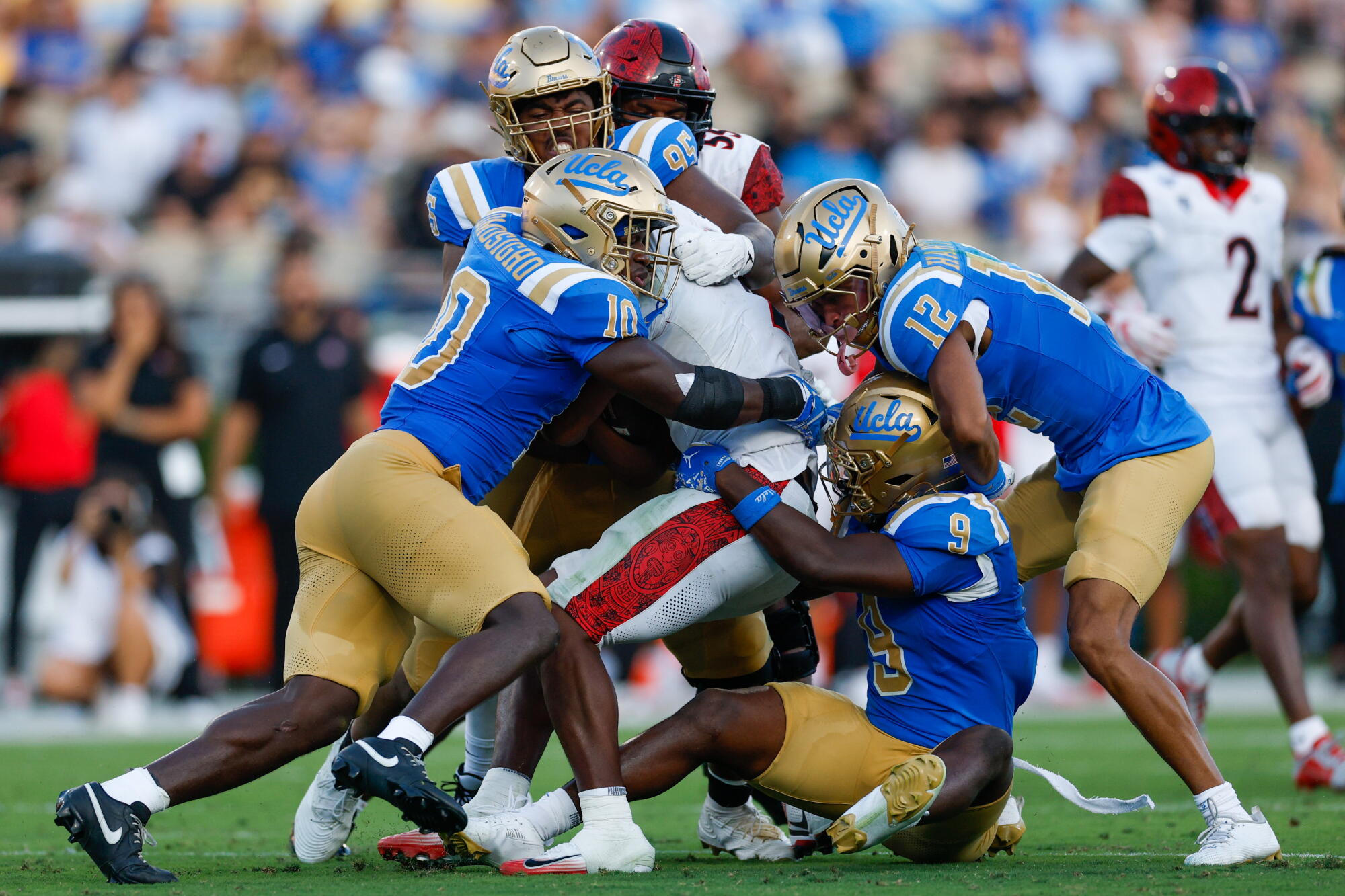
UCLA defenders bring down San Diego State running back Lucky Sutton at Rose Bowl on Sept. 12.
(Ronaldo Bolanos/Los Angeles Times)
“He’s an entirely different quarterback right now,” Chesney said. “He’s an exciting-to-watch player, and he’s got some legit dudes out at receiver right now that are phenomenal. The offensive line is stout. They’ve been playing together for a little while. There’s a lot of things that they do to protect him, and he has a chance to deliver footballs. He’s getting hit sometimes, and just flicking this ball out there. He has a giant arm, and he’s as accurate as can be.”
Washington has benefited from a revamped receiver group after Maryland ranked among the national leaders in drops last season. Maryland coach Mike Locksley added Chris Durr Jr. and Na’eem Abdul-Rahim Gladding, who have become Washington’s top targets.
“Na’eem can play inside, he can play outside. He’s got the ability to separate,” said Hitschler, who faced Gladding when he played for Old Dominion last season against James Madison. “He’s got the ability to run, great routes, get in and out of breaks, and he’s got great hands. And now he’s making plays in the return game too.”
Hitschler’s secondary will be challenged by Washington, who led the conference in pass attempts last season with 473 and leads the Big Ten thus far with 116.
Maryland’s reliance on the passing game could pose problems for a secondary that was picked apart by Purdue quarterback Ryan Browne last week and is still without free safety Tao Johnson.
“There’s obviously plays you would love to have back, obstacles that you overcame and throughout the game they improved and started to figure it out,” Hitschler said of the UCLA defense. “But at the same time, we can’t put ourselves behind the eight ball in moments and we have to execute at a higher level. This game’s fun because you have the opportunity to lose every week. If it was easy, it wouldn’t be fun.”
Offensively, the Bruins have the chance to build off their most productive game yet, scoring 52 points and accumulating 645 yards against the Boilermakers. But, UCLA will have to work to protect senior quarterback Nico Iamaleava, who was hit often and battled multiple injuries against Purdue.
Maryland edge rushers Zahir Mathis and Sidney Stewart combined for 13 sacks last season. And though Mathis was ruled because of an injury, the Terrapins can turn to five-star edge Zion Elee, the highest ranked recruiting prospect in program history.
Given Iamaleava’s fearlessness with his legs and the Terrapins’ effective pass rush, it may be difficult to keep the signal-caller on his feet.
ONE train station that sees over 167,000 passengers each day will completely close next week.
Due to essential works, no trains will run to or from Amsterdam Centraal on October 3 – this includes Eurostar services to and from St Pancras.
Amsterdam Centraal railway station will be disrupted over a weekendCredit: GettyThe busy train station will undergo important works that means it will closeCredit: Getty
The train station that serves the city of Amsterdam in the Netherlands is about to undergo ‘vital’ rail works.
As a result it will be closed for one full day on October 3 with schedules significantly reduced on the two following days between October 4-5.
Sign up for the Travel newsletter
Thank you!
The upgrades include connecting new tracks around Amsterdam Centraal to the rail network.
ProRail’s construction manager Wai Ko explained: “We are adapting the station step by step so that there will be more space for passengers and trains in the future.
“Over the weekend of October 3, together with contractor Dura Vermeer, we will connect track 11a to the rail network. We will also disconnect track 14a.
“That involves a great deal of visible work, such as physically joining the tracks, as well as a great deal of work that passengers never see.”
Other works taking place will be ‘invisible’, held within the signalling systems in technical rooms and at the traffic-control center.
It’s likely to cause major disruption over the weekend considering that Amsterdam Centraal is the second-busiest railway station in the Netherlands and one of the busiest in Europe.
As a result of the engineering works, Eurostar has said that there will be no trains between St Pancras and Amsterdam between October 3-5.
On its website, Eurostar apologised for the disruption.
From the UK there will be no Eurostar services to Amsterdam between October 3-5Credit: Getty
On Saturdays there are typically three direct Eurostar routes to Amsterdam Centraal and 15 indirect routes from London St Pancras.
There are also the same number of services between Amsterdam and London.
On Sundays there are usually four direct routes and nine indirect journeys with the same from Amsterdam to London.
Eurostar usually has five direct Amsterdam services on Monday and nine indirect services – on the return are typically five direct trains and six indirect.
Eurostar’s services to Rotterdam will remain unaffected.
If you were due to travel to Amsterdam on these dates – these are the options provided by Eurostar…
Eurostar has provided the following options for those affected by Amsterdam Centraal’s closure between October 3-5…
• Use your ticket to get on or off your train at the station before or after your cancelled stop if your planned journey is only partially disrupted.
• Exchange your booking for free to travel in the same travel class at a different time or date. It only takes a minute to rearrange your trip.
• Cancel your booking and get a refund. You’ll receive a refund for the value of your ticket but not for any booking or exchange fees. We’ll process your request within 28 days.
You have three months from the date you were due to travel to claim your preferred option.
The broadcaster has been accused of ‘classic overkill’ after it removed 11 sketches from the comedy duo’s BAFTA-winning television show amid concerns of racism and racial stereotyping
Rachel Vickers-Price UK and World News Reporter and Rachel Vickers-Price
03:01, 21 Sep 2026Updated 03:01, 21 Sep 2026
Removed material included scenes featuring war re-enactors in blackface, a joke about Jimmy Savile and a sketch about a contestant on a makeover show wearing a burka(Image: Channel 4)
The BBC has removed several sketches from That Mitchell and Webb Look on iPlayer after deciding some of the comedy show’s material “no longer works today”.
To celebrate the sketch comedy programme’s 20th anniversary, the national broadcaster added four seasons of the smash-hit show onto iPlayer for fans to enjoy – but with a few notable omissions.
A total of 11 sketches have been edited out amid fears of racism and ethnic stereotyping.
“That Mitchell and Webb Look has been made available on BBC iPlayer,” the British broadcaster said in a statement. “This is a 20-year-old sketch show; in consultation with the programme makers, we have included the ones that still work today and not the ones that don’t.”
As per The Times, material removed from the programme included scenes featuring war re-enactors in blackface, a joke about Jimmy Savile, and an indigenous tribe living in a garden centre.
One now-deleted sketch sees Mitchell play a woman in a burka in a scene sending up reality TV programming.
The sketch then cuts to the pair – as themselves – discussing whether or not the sketch itself is actually offensive.
“I’m not sure we quite know what we’re trying to say,” Webb suggests, asking: “Aren’t we just taking the piss out of people’s sincerely held beliefs?”
Mitchell says: “I think you can worry too much about this kind of thing. I mean, what’s offensive to one person is just good, clean fun to another.”
He then pulls off the burqa to reveal he is wearing blackface underneath.
Comedian Dom Joly told The Times: “I totally get it if the BBC is putting out something really racist, which is laughing at and encouraging other people to feel that it’s OK to do that.”
He dubbed the decision to cut the scenes as “classic BBC overkill” and an act of “hysterical censorship”.
“But it’s so clear that Mitchell and Webb are not doing that. Their intent was not to be racist.”
As a possible alternative solution, broadcasters could put trigger warnings on older programmes if they believed they were necessary, he told The Times.
A smash-hit in its day, the three-season skit show began in 2003, starring David Walliams and Matt Lucas, who also wrote the gags.
But it was later pulled from the BBC’s Player in 2020 due to its offensive content, such as the use of blackface, homophobic jokes, and ablesit humour. The series did return to iPlayer in late 2022, but in an edited format, complete with removed scenes and a trigger warning for audiences.
The outage marks at least the sixth one this year after a United States-imposed energy blockade went into effect.
Published On 19 Sep 202619 Sep 2026
Cuba has worked to restore power after suffering a significant blackout that left many parts of the country in the dark.
The state-run company in charge of operating the country’s electrical system, Union Electrica (UNE), said nearly half of its customers in the capital of Havana had regained power on Saturday.
Recommended Stories
list of 3 itemsend of list
“The re-establishing is being done gradually, as conditions permit,” UNE posted on social media.
The latest blackout, at least the 12th since late 2024, first affected five of Cuba’s eastern provinces, including Havana, before spreading across the whole island. It is at least the sixth this year alone.
Cuban authorities told the Reuters news agency on Friday the collapse was the result of a failure in high-voltage transmission lines in the central part of the country. UNE said “unstable weather conditions” also played a role.
For years, Cuba’s ageing infrastructure and fuel shortages have led to sporadic blackouts. But power outages have become more frequent after the United States, in a bid to put political and economic pressure on the country’s government, imposed an energy blockade in January.
United Nations human rights experts have condemned the US oil blockade, calling it a violation of international law and warning that Cuba risks becoming a “silent Gaza” as shortages and blackouts grow ever more critical.
Some of the island’s residents said they were already out of power when Friday’s blackout happened.
“Yesterday, I’d gone without power for 24 hours. They turned the lights on for an hour, and then the grid collapsed,” Havana resident Frank Lorenzo, 23, told Reuters.
Others, like Lidia Fernandez, told the news agency AFP that a lack of fuel makes it difficult to power backup generators, which run on imported diesel.
“It’s one thing after another: no water, no gas for cooking, no electricity,” the 36-year-old teacher said.
Fernandez added, “Honestly, I don’t know how we haven’t gone crazy.”