Spectrum owner Charter Communications is nearing the finish line in its long-awaited $34.5-billion purchase of Cox Enterprises to form the nation’s largest internet and cable television company.
California’s Public Utilities Commission is scheduled to vote next week to approve the merger that would bolster Southern California’s dominant provider with more than 5 million customers. Securing the approval of California regulators — the deal’s final hurdle — has been a slog as federal officials gave Charter their consent months ago.
Customers of privately held Cox, the Atlanta-based company that serves Rancho Palos Verdes, Rolling Hills Estates, Las Vegas and large parts of Orange and San Diego counties, would be switched to Spectrum service. Charter is the industry leader, providing Spectrum internet, phone and cable TV packages for Los Angeles, Riverside, San Bernardino and Ventura counties.
It’s been more than a year since the companies unveiled their proposed union, and they hope to combine operations this month. But flaps have flared up in the last lap.
Public interest groups have argued that the PUC’s proposed settlement with Charter doesn’t go far enough to ensure long-term affordable internet for low-income residents or accommodations for customers reeling from natural disasters such as last year’s Eaton and Palisades fires.
In addition, advocates have asked utilities commissioners to demand that Charter commit to fostering workplace diversity, equity and inclusion among its proposed 9,000-member workforce in California. Such programs have been under siege since President Trump returned to the White House.
“State regulators like the CPUC have an important role to play — they have a voice and leverage if they choose to use it,” said Jason Solomon, director of the National Institute for Workers’ Rights, a Bay Area group that is lobbying for Charter to renew its commitment to a diverse workplace.
“It’s important that California stand up for its own laws, policies and values,” Solomon said.
A Spectrum truck in New York City.
(Star Max/IPx)
The five-member commission is set to vote on the Charter-Cox merger Thursday. The panel will consider two competing proposals; both would allow the merger to go through with various conditions.
Charter years ago pledged to create a diverse workplace but scaled back its public statements amid Trump’s vocal demands that companies dump DEI programs. Trump’s Federal Communications Commission chairman, Brendan Carr, also has championed eliminating diversity programs, saying they are discriminatory.
The FCC in February approved Charter’s proposed purchase of Cox’s residential cable, commercial fiber, cloud and information technology businesses. To win Carr’s approval, Charter agreed to “new safeguards to protect against DEI discrimination,” according to the FCC.
Charter is in a bind. It disavowed diversity efforts to win the FCC’s blessing but now is facing calls in California to embrace such commitments.
“In a state as diverse as California we should protect diversity in the workplace,” said Jessica J. González, co-chief executive of advocacy group Free Press. “We have a responsibility to stand up to what’s been going on in the federal government, and in the Trump administration, to force companies to roll back their policies.”
In its public filings, Charters said it would reach out to diverse suppliers and work with business groups, including the Women’s Business Development Council, the California LGBTQ Chamber of Commerce, the African American Chamber, the California Hispanic Chamber and the Cal Asian Chamber.
“This transaction will be good for consumers, community leaders, and businesses across California as it will provide them with lower prices, greater value, better service, and support from Spectrum’s 100% U.S.-based employees,” the Stamford, Conn. company said in a statement.
Concerns heightened among activists after one of the two proposed settlements, hashed out between Charter and Commissioner Matthew Baker, the commission’s Public Advocates Office and the California Emerging Technology Fund, failed to include diversity efforts.
Advocates viewed Baker’s proposal as weaker on broadband access provisions too, including commitments to provide low-cost internet for disadvantaged residents and communities that lack service.
“For us, it’s really about making sure everyone in Cox’s and Charter’s service territory benefits from this transaction,” said Paul Goodman, counsel for the Berkeley-based Center for Accessible Technology.
“We want to make sure that communities that have been historically overlooked get the same benefits from the transaction as everyone else,” Goodman said.
For example, a coalition of advocacy groups is seeking to prevent Spectrum from tacking on equipment charges for customers on low-income plans.
Commissioners will be asked to select from Baker’s draft decision or last month’s proposal from the agency’s administrative law judge, Jamie Ormond. Advocates are urging the panel to adopt Ormond’s version because it contains more compliance conditions, including mechanisms to foster an inclusive workplace.
Commissioners have “a statutory duty” under the state’s utilities code “to deny the transaction outright rather than approve a weaker deal,” the advocates argued in a recent filing.
Solomon’s group is pushing for an “organizational infrastructure for equal opportunity compliance,” including reporting compensation and promotion data for Charter’s California workforce and pay equity audits.
The state has required diversity measures before — despite such initiatives being out of favor in Washington. In January, the commission approved Verizon Communications’ purchase of Frontier Communications.
In that proceeding, Verizon pledged to “further California’s public policy goals of diverse supply chains and workforces, including a $10 million partnership with the California State University system,” the PUC said.
Under both Ormond’s and Baker’s proposals, Charter would be required to offer affordable broadband to low-income residents, including California LifeLine service tiers. It would have to sell stand-alone broadband plans for five years, although advocates would like to see that extended to 10 years.
The company has agreed to spend at least $275 million to upgrade its California network and complete its 1-gigabit service capability across its legacy service areas within three years.
Charter also agreed to invest at least $30 million in customer outreach initiatives, such as digital literacy training and device access for low-income communities. The company also is being asked to provide free broadband and Wi-Fi service for about 50 eligible institutions, including schools, libraries and community centers for several years.
Charter was criticized after the January 2025 fires for charging fees for equipment that burned, said Natalie Gonzalez, director of Digital Equity Los Angeles, one of the advocacy groups that is asking for Charter to “improve disaster response and customer service standards … during life’s most challenging moments.”
Charter pushed back on that contention, saying it helped residents in the burn areas.
“We opened all our wifi hot spots to anyone (non Spectrum customers) and were deeply involved in the restoration efforts,” the company said in its documents.
The advocates, including Digital Equity LA and the California Alliance for Digital Equity, compiled evidence to help commissioners determine whether the merger was in the public interest.
Should the deal go through, Cox subscribers will soon see changes. Charter plans to roll out its Spectrum products and fees to Cox customers next month.
Subscribers can opt for their existing pricing or switch to a Spectrum bundle that includes such apps as Disney+, Hulu, ESPN and Paramount+.
Charter has also said it would offer Cox subscribers a year of free service when they switch their cellphone carrier to Spectrum.
The Charter name will be dropped in one year and the combined company will become Cox, although consumer products will keep the Spectrum brand.
The switch is because the Cox family — descendants of an Ohio press baron who bought his first newspaper in 1898, began acquiring cable systems in 1962 — will become the firm’s largest shareholder group, with about 23% of the stock.
In a recent earnings call, Charter Chief Executive Chris Winfrey told investors the combined company would have nearly 37 million customers nationwide.
It expects to generate $67 billion a year in revenue and about $28 billion in earnings before interest, taxes, depreciation and amortization.
TikTok said Wednesday it will close its Nashville office in October, laying off 250 workers.
The move is a retrenchment from the social video company’s expansion into Nashville in 2024 and comes as many tech companies are reevaluating their workforce amid the growth of artificial intelligence.
“We have decided to close our Nashville office to streamline our operations and better align our teams for long-term growth,” said TikTok USDS Joint Venture LLC, which oversees TikTok’s U.S. operations. “We remain fully committed to providing secure, safe and positive experiences for the 200 million Americans that create, discover and connect with what they love on TikTok.”
The decision was specific to the Nashville office to bring its teams closer together, according to a TikTok USDS Joint Venture spokesperson.
TikTok‘s U.S. operator notified the State of Tennessee Department of Labor and Workforce Development about the number of layoffs and the office closure on Wednesday. The WARN notice did not detail what roles were at the office, but some jobs were related to content moderation, according to Nashville Metro Councilmember Terry Vo.
“I’m disappointed for all the Nashvillians who are waking up to this reality,” Vo said.
TikTok did not respond to questions on what types of roles were at the Nashville office or whether artificial intelligence was a factor for the layoffs.
TikTok in 2024 signed a 143,610 square foot lease at the Moore Building in the Music Row area, having spent several million dollars to build out the space, according to the Tennessean. The lease also roughly tripled its office space in Nashville, the Tennessean reported.
The social media company has its U.S. headquarters in Culver City.
In 2024, Sen. Marsha Blackburn (R-Tenn.) expressed disapproval of the TikTok office opening in Nashville because at that time, TikTok’s parent company was Chinese tech giant ByteDance.
“When TikTok’s CEO was in Washington, I made it clear to him that Tennesseans are extremely concerned about China’s influence,” Blackburn said in a statement in 2024, adding there were concerns about how the company would handle U.S. user data and whether it would push for the Chinese government’s interests.
Since then, the U.S. government, TikTok and ByteDance came to an agreement last year to establish a separate entity called TikTok USDS Joint Venture overseeing TikTok’s operations and data protection in the U.S. that is majority American owned.
A spokesperson for Blackburn did not immediately return a request for comment on TikTok’s office closure in Nashville.
Rob Enderle, principal analyst at Oregon-based Enderle Group, said he expects more layoffs at other TikTok U.S. office locations due to the new ownership.
“When a new ownership takes over a company, they make adjustments to the staffing levels,” Enderle said.
BuzzFeed is cutting roughly 35% of its workforce in its first major restructuring since media mogul Byron Allen bought a majority stake in the firm two months ago.
The layoffs, outlined in a Securities and Exchange Commission filing on Monday, will affect about 180 staff and contract positions across BuzzFeed and its sister brands HuffPost and Tasty.
“We’ve been actively managing costs for some time, working through scenarios to save as many jobs as possible,” BuzzFeed’s leadership team said in the memo. “Unfortunately, the elimination of certain roles is still required.”
The company, which maintains a Hollywood office, said the changes are necessary to “put our business on a path to profitable and sustainable growth.”
Through the restructuring, BuzzFeed’s leaders said, the company will aim to grow its audience and bolster its positon in free streaming content.
The BuzzFeed purchase is the latest in a series of business moves Allen has made in recent years to build his entertainment empire. The former stand-up comedian recently purchased a portion of CBS’s late-night block earlier this year, taking over the time slot for the 2026-2027 season. The slot once belonged to “The Late Show with Stephen Colbert,” which was canceled last year and aired its final episode in May.
Allen’s company holds a slate of network-affiliate stations and owns the Weather Channel network. The company bought a 10.7% stake in cable channel Starz for $25 million in March.
Allen could not be reached for a comment on the new layoffs at BuzzFeed.
In its own statement, BuzzFeed said “We are extremely fortunate that Byron has enormous confidence in our management team and moved very quickly to reposition this company and unlock its value.”
BuzzFeed was founded in 2006. The website became known as a pop culture hub, where readers could indulge in the latest celebrity gossip or discover a unique cooking recipe. But over the years, the company has declined and faced mounting financial struggles. BuzzFeed reported a $15-million net loss in the first quarter of the year. The company generated $31.6 million in revenue, a 12.4% decline compared to the year-ago period. Ad revenue fell nearly 20% year-over-year to $17.1 million. However, content revenue grew roughly 69% to $7.5 million. The company is expected to release its second-quarter results Aug. 4.
Times Staff Writers Meg James and Stacy Perman contributed to this report.
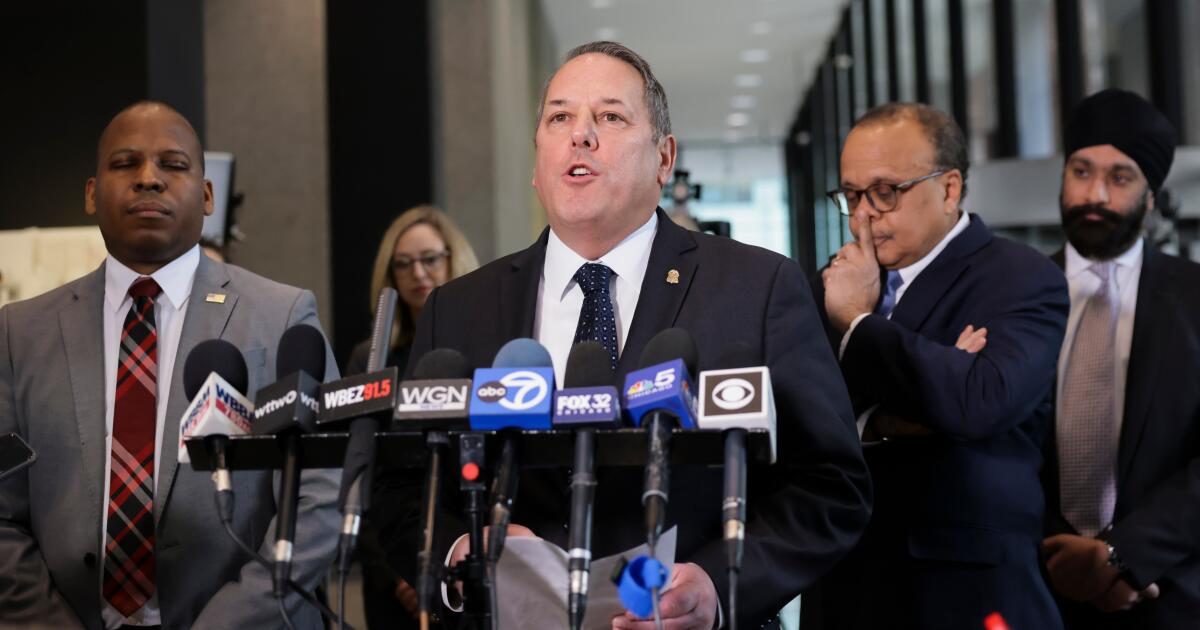
WASHINGTON — The head of the FBI’s Chicago field office is abruptly leaving his position, according to a resignation message he sent to colleagues and multiple people familiar with the situation who said he was told to retire.
Douglas DePodesta has served as special agent in charge in Chicago, one of the FBI’s largest offices, for nearly two years and has been with the bureau since 2002.
He told colleagues that his last day would be Monday, according to a message seen by the Associated Press. Multiple people familiar with the matter, speaking on condition of anonymity to discuss a personnel move, said DePodesta had been pushed to retire.
The events leading up to his departure were not immediately clear, but DePodesta alluded in his farewell note to a conflict that he suggested had precipitated it.
“I’ve never backed down from a fight, as long as it meant our personnel could continue serving the FBI’s mission,” DePodesta wrote in the message. “Unfortunately, that has proved unpopular over time and my departure is a consequence of that.”
The move is part of a broader upheaval in the FBI’s workforce as Director Kash Patel has sought to force out line agents and supervisors alike who are perceived as not supporting the Trump administration’s agenda. It also comes amid prolonged tumult in the law enforcement community in Chicago, whose top federal prosecutor, Andrew Boutros, described this week a sweeping review of more than 1,000 grand jury presentations made by Illinois prosecutors following the dismissal of a high-profile case over misconduct.
The FBI declined to comment Thursday, but the bureau’s “rapid response” social media account on X responded to a separate post about DePodesta’s departure by saying: “It’s simple: Anyone who is not on board with THIS FBI under the leadership of President Trump — which has achieved the lowest murder rate ever — is free to leave.”
DePodesta also quoted in his note from a farewell message from Patel’s predecessor, former Director Chris Wray, who reminded the workforce that “you have been who the American people have turned to in their darkest moments” and praised them for having “stayed true to the values that define who we are, and to the qualities for which we stand: Fidelity, Bravery and Integrity.”
DePodesta joined the FBI in Chicago in 2002 and worked drug investigations. He later held senior roles at FBI headquarters in Washington and in Detroit and Memphis before being named top agent in Chicago in August 2024.
“We delivered strong overall results this quarter with Q3 revenue growing 10% as we made significant progress executing on our AI-driven expert platform strategy.” (CEO, President & Chairman Sasan Goodarzi)
Seeking Alpha’s Disclaimer:This article was automatically generated by an AI tool based on content available on the Seeking Alpha website, and has not been curated or reviewed by humans. Due to inherent limitations in using AI-based tools, the accuracy, completeness, or timeliness of such articles cannot be guaranteed. This article is intended for informational purposes only. Seeking Alpha does not take account of your objectives or your financial situation and does not offer any personalized investment advice. Seeking Alpha is not a licensed securities dealer, broker or US investment adviser or investment bank.