Orange County Museum of Art highlights uncredited Hollywood artists
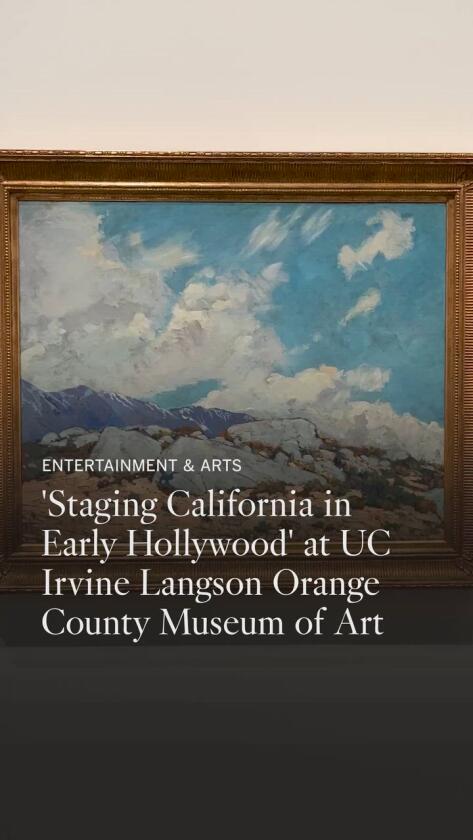
A dull yellow light peeks through a brooding sky looming over rolling Southern California hills. The oil painting “Approaching Storm” captures the kind of picturesque scene that would get fine artist Paul Grimm work in early Hollywood. Known for his plein air landscapes and masterful depictions of clouds, he turned to studio work to make money during the Great Depression.
He is one of many artists on display at a new UC Irvine Langson Orange County Museum of Art exhibition about set painters whose work would go uncredited or overlooked.

-
Share via
“They weren’t making their living selling their paintings, but they were making their living working for the studios,” said museum director Kathryn Kanjo. “The artist would lose their individual credit and recognition, to be at the service of what was needed by the studio.”
Elsewhere in the “Staging California in Early Hollywood” exhibition, hangs an 18-by-25-foot painted backing for “The Sound of Music” (1965), a project led by the then-art director of 20th Century Pictures’ special effects department, Emil J. Kosa Jr. He’d be the only one to get credit at the time, not the five other contributing artists, including celebrated plein air artist Arthur Grover Rider, who are also noted in the museum description.
“In general, at the studios, they systematized the production design, so that it was fast,” Kanjo said, describing the rigid process as militaristic. “Five artists at a time work day after day to get these things done.”
It’s the museum’s first exhibition since UC Irvine acquired the Orange County Museum of Art last September, building a 9,000-piece collection dating back to the 19th century.
The exhibition, with about 50 pieces, is the first since Kanjo’s appointment in December. It’s a love letter to the film industry’s anonymous and little-known artists, whose works were vital to movies.

The exhibition opens with Paul Grimm’s Untitled, 1974, left, and “Approaching Storm,” 1974, right, which capture the essence of the Southern California landscape.
(Allen J. Schaben / Los Angeles Times)
Take two of the most prolific set artists of the mid-20th century: Warren Newcombe and George Gibson. Newcombe was a Massachusetts-born, well-educated artist who started working on sets as early as 1920. He’d eventually join the MGM art department, where he perfected a visual effect technique called “matte painting.” For a time, it was simply referred to as the “Newcombe shot.”
Gibson was also at MGM around the same time. When the studio first hired the Scottish artist, he’d routinely miss shifts to paint plein air in Southern California. He and Newcombe would help craft “The Wizard of Oz” (1939), but when the credits rolled, both their names were missing.
Newcombe and Gibson would go on to be recognized and celebrated for their work. About a decade after “The Wizard of Oz,” Newcombe won two Oscars for special effects, for “Thirty Seconds Over Tokyo” (1944) and “Green Dolphin Street” (1947).
“He was really instrumental in the professionalization of artists at MGM,” assistant curator Michaëla Mohrmann said of Gibson. “His insistence on color saturation is something that really informs his work for ‘The Wizard of Oz,’ and it’s really that movie that cements his reputation as one of the masters of scenic art.”
Meanwhile, artists like Arthur Beaumont hardly got their due. Raised by a military family in England, the California transplant was particularly captivated by naval vessels. By 1933, he had painted maritime art for most of the U.S. Naval fleet. As a result of his work, he was commissioned as a lieutenant in the U.S. Navy and recognized as its fleet’s official artist.
He also began producing promotional materials and storyboards for Paramount Studios’ naval films as early as 1935, first for a movie titled “Mutiny on the Bounty.” In 1942, he would do the same for “Wake Island” in the midst of World War II. His work was later etched into metal plates and used to mass-produce publicity prints.

Museum director Kathryn Kanjo stands between Arthur Grover Rider’s “Ortega Highway” (1974), left, and Emil J. Kosa Jr.’s “How Marvelous Thy Works” (1928).
(Allen J. Schaben / Los Angeles Times)
“They were participating [in the military and war] in different functions and not always credited for that kind of work,” Mohrmann said. “I think there was an act of generosity [during wartime] in general — everyone was really patriotic.”
The exhibition also features a silent film titled “The Life and Death of 9413: a Hollywood Extra,” a 1928 short highlighting the plight of a background actor known as “9413.”
“Staging California in Early Hollywood”
Where: UCI Langson Orange County Museum of Art
When: Friday to Oct. 4, 2026
Cost: Free
Info: langson.uci.edu
“It’s all like him being shoveled around and underappreciated and not even given a name, right?” Kanjo said. “Everybody thought it was funny because it was kind of meta, but it was pointing out real issues.”
Beyond giving credit where credit’s due, the exhibition aims to uplift background art.
“Back then as well as now, people question the artistic merits of these works because they were made for films that were for profit,” Mohrmann said. “When in reality there was a ton of talent and artistry and critical thinking.”
Quincy Bowie Jr. contributed to this report.