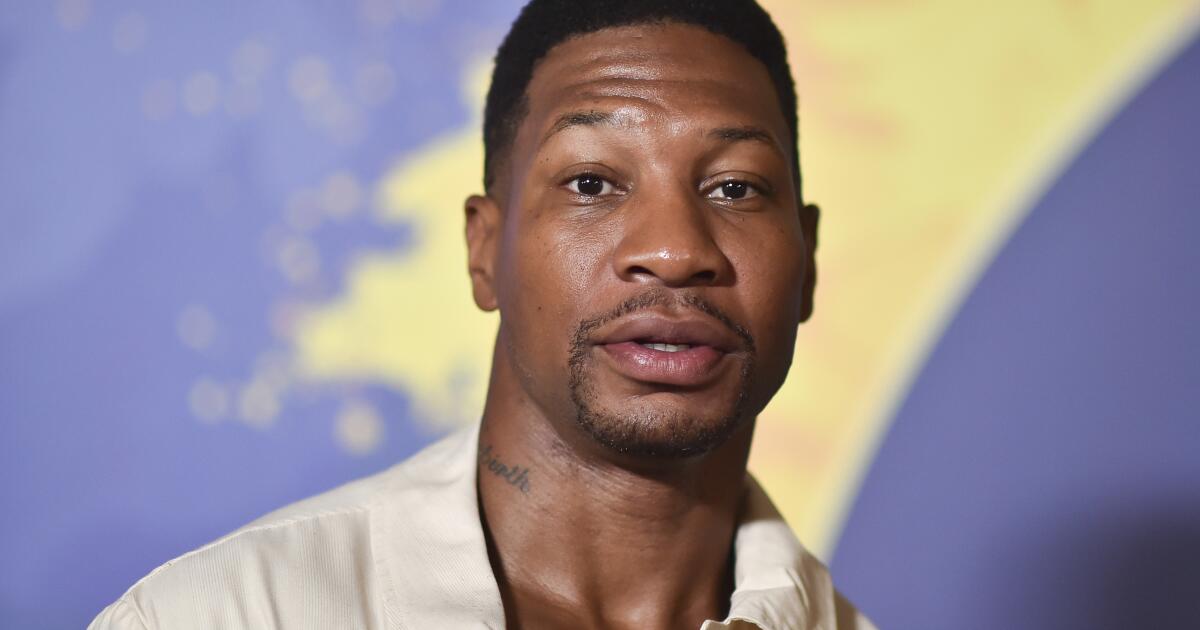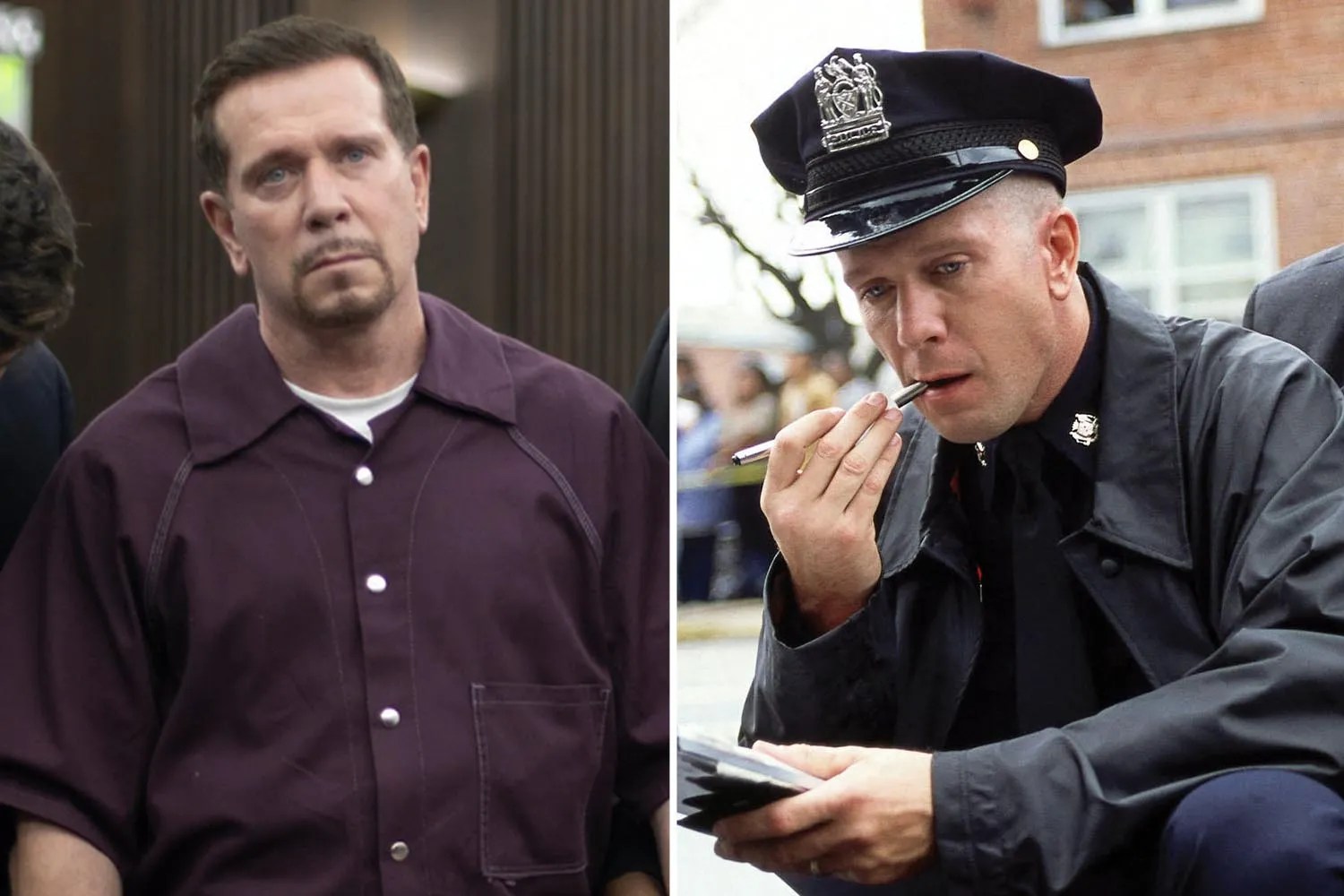
Michael B. Jordan feared he’d never work again after being killed off The Wire at 15
MICHAEL B. Jordan has been dreaming of landing Oscars glory since he was 15-years-old, but there were fears his career was over before it began.
In-demand Jordan heads to the Academy Awards on Sunday in line to land the coveted Best Actor award for supernatural horror movie Sinners, which has been nominated for a record-breaking 16 gongs.
But in an exclusive interview with The U.S. Sun, childhood pal JD Williams — who starred alongside a teenage Jordan in HBO’s iconic cop drama The Wire — says his bloody exit in the show had the young actor doubting his future.
Williams played local dealer and gang member Bodie, taking Jordan’s unassuming, drug-running character of Wallace under his wing.
Yet when the bosses, led by Hollywood star Idris Elba as the notorious Stringer Bell, suspected Jordan was speaking to cops, Williams was told to execute him.
With the actors only given their scripts days before a shoot, the Creed star had no idea his breakout role was soon to be over.
It was a heartbreaking end to the first season, and left a young Jordan worried about his career ending abruptly.
“None of us knew where the story was going,” Williams told The U.S. Sun. “You only get your scripts week to week. When he saw that he was getting killed off, he literally thought he wasn’t going to work again.
“I told him, ‘Look, everybody loves you already. When this happens, people are going to look up Wallace’s real name. When they find out it’s Michael B. Jordan, they’re going to look for you in everything.’”
Williams, 48, and Jordan, 39, grew up in Newark, New Jersey, and both attended Arts High School.
Most read in Entertainment
While many of the actors in The Wire were cleverly drawn from the gritty streets of Baltimore, trained actors such as Elba, the late Michael K. Williams, who played hustler Omar, as well as Jordan and his pal Williams, helped elevate the five-series masterpiece to the next level.
Jordan came into the show off the back of the 2001 sports drama Hardball, starring Keanu Reeves.
He was very much learning his trade when he met Williams and his fellow co-stars for the first time.
Yet going up against the A-listers Timothee Chalamet and Leonardo DiCaprio for an Oscar illustrates just how far Jordan has come since those early, nervy days.
“I had already heard about him because he had done Hardball, and I was proud of him for that,” Williams recalled. “Then to find out he was on the same series I was doing, I was like, ‘Wow — a kid from exactly where I’m from and we’re doing this together.’”
The two actors quickly formed a bond on set.
They hung out together, playing PlayStation and traveling to Las Vegas and Miami when not filming.
Their friendship has remained strong ever since.
“I would say he’s probably the most organic actor — star actor — out there,” Williams, a prominent and memorable character in The Wire who was eventually killed off himself after 34 episodes, said. “There’s minimal fakeness in him, minimal shade.”
If Jordan wins the best actor award, he will become the first character from writer David Simon’s critically acclaimed show to be crowned by the Academy.
“Someone from our class had to get it, if Michael K. Williams were still alive, I think he would have been in this position too, but I’m so proud it’s Mike,” said his old friend. “There’s no scandal with him. It’s deserved.”
Williams went on to star in prison drama Oz, is working on numerous independent projects, has also appeared in Starz drama BMF, and now relishes helping guide the next generation of actors.
Jordan, meanwhile, has steadily built one of the most successful careers of his generation, starring in films like Creed and portraying villain Killmonger in Marvel’s Black Panther.
Crucially, his longtime creative partnership with director Ryan Coogler, who was also behind Creed in 2015, has become one of the most influential collaborations in modern Hollywood.
No film has ever received more nominations than Sinners, in which Jordan masterfully plays a dual role as twin brothers Elijah and Elias.
The movie stormed this year’s Academy Awards with a record-breaking 16 nominations, surpassing the previous record of 14 shared by All About Eve, Titanic and La La Land.
Its dominance spans the biggest categories, including Best Picture, Best Director and Best Original Screenplay for Coogler — along with a Best Actor nomination for Jordan, his first at the Oscars.
The apocalyptic drama also earned acting nods for Delroy Lindo and Wunmi Mosaku, while racking up recognition across major craft categories including cinematography, editing, costume design and visual effects.
The record-setting 16th nomination came in the Academy’s brand-new Best Casting category, recognizing Francine Maisler’s work assembling the film’s ensemble.
Williams says he worked on a series of scripts and ideas with Jordan over the years, but admits the partnership with Coogler has helped his friend evolve as an actor and is why he now stands on the brink of greatness.
“Him and Ryan getting together is the perfect combination,” he said. “Having a director that is great to collaborate with is exactly what was needed.
“If you have a vision and you’re part of a class of actors coming up together, that’s what happens. They are the perfect combination.”
Jordan’s ability to deliver the performances his directors want is also key.
“If you give Mike direction, he gets it straight away,” Williams said. “He can go exactly where you need him to go and be what you need him to be in that moment.
“That’s the essence of acting — delivering the message to the audience.
“And he’s not just there to be handsome and pretty. Mike is writing, producing, directing. He understands the whole business.”
Biggest Oscar Nominees of 2026 Academy Awards

Everyone in Hollywood hopes to snag a nod on the industry’s biggest night but only few get that honor. Here are the nominees from the major categories of the 2026 Academy Awards:
Best Picture
- Bugonia
- F1
- Frankenstein
- Hamnet
- Marty Supreme
- One Battle After Another
- The Secret Agent
- Sentimental Value
- Sinners
- Train Dreams
Best Director
- Chloé Zhao — Hamnet
- Josh Safdie — Marty Supreme
- Paul Thomas Anderson — One Battle After Another
- Joachim Trier — Sentimental Value
- Ryan Coogler — Sinners
Best Actor (Leading Role)
- Timothée Chalamet — Marty Supreme
- Leonardo DiCaprio — One Battle After Another
- Ethan Hawke — Blue Moon
- Michael B. Jordan — Sinners
- Wagner Moura — The Secret Agent
Best Actress (Leading Role)
- Jessie Buckley — Hamnet
- Rose Byrne — If I Had Legs I’d Kick You
- Renate Reinsve — Sentimental Value
- Emma Stone — Bugonia
- Kate Hudson — Song Sung Blue
Best Supporting Actor
- Benicio Del Toro — One Battle After Another
- Jacob Elordi — Frankenstein
- Delroy Lindo — Sinners
- Sean Penn — One Battle After Another
- Stellan Skarsgård — Sentimental Value
Best Supporting Actress
- Teyana Taylor — One Battle After Another
- Wunmi Mosaku — Sinners
- Amy Madigan — Weapons
- Elle Fanning — Sentimental Value
- Inga Ibsdotter Lilleaas — Sentimental Value
Best Original Screenplay
- Bugonia — Yorgos Lanthimos & Will Tracy
- Marty Supreme — Josh Safdie & Ronald Bronstein
- One Battle After Another — Paul Thomas Anderson
- Sentimental Value — Joachim Trier & Eskil Vogt
- Sinners — Ryan Coogler
Best Adapted Screenplay
- Blue Moon — Richard Linklater & Glen Powell
- Frankenstein — Guillermo del Toro
- Hamnet — Chloé Zhao
- The Secret Agent — Kleber Mendonça Filho
- Train Dreams — Clint Bentley & Greg Kwedar
Best Animated Feature
- Arco
- KPop Demon Hunters
- The Magnificent Life of Marcel Pagnol
- Zootopia 2
- The Night Gardener
Best International Feature Film
- The Secret Agent — Brazil
- Sentimental Value — Norway
- It Was Just an Accident — Iran
- Universal Language — Canada
- Sujo — Mexico
Best Documentary Feature
- The Alabama Solution
- Come See Me in the Good Light
- Four Daughters
- No Other Land
- The Perfect Neighbor
More than two decades after their time on The Wire, Williams says watching Jordan’s continued rise is deeply personal.
Their families remain close.
“I’m proud of my brother,” he said. “He’s been growing as an actor his entire life. But he’s deeper than that — he writes, he produces, he directs. He’s built himself into this system.
“I can’t explain how proud I am. Thinking back to us just sitting on my parents’ steps at my little sister’s birthday party — and now seeing where he is. The vision is unfolding exactly the way it was supposed to.”
But will he watch his old friend’s moment of destiny on Sunday night?
“When I don’t watch my team, they win. When I watch my team, it’s 50-50. And I don’t — I just don’t know, man,” he said with a huge smile.
“If it’s not this time, it’s going to be the next time. But of course I am behind my brother. I always will be.
“Chalamet is a great actor, but this is Mike’s year. If he wins, I’m going straight to his house. I don’t know if I’ll hug him or punch him in the stomach, but it’ll be a great feeling. He’s a great dude and I love him to death.
“We talked about this stuff while playing PlayStation years ago. Seeing it unfold meticulously — not as a fluke, but as a plan — is beautiful.”