wilson

British Open: Wu Yize to face Kyren Wilson in second round

World champion Wu Yize set up an intriguing second-round tie against former Crucible winner Kyren Wilson at the British Open after both won their opening matches.

China’s Wu beat compatriot Liu Hongyu 4-3 in Cheltenham, while 2024 world champion Wilson was a 4-1 winner against Austria’s Florian Nuessle.

Last year’s British Open champion Shaun Murphy was joined by Ding Junhui, Barry Hawkins, Judd Trump and John Higgins in progressing to the second round.

However, three-time world champion Mark Williams lost 4-0 to David Gilbert, world number two Neil Robertson fell 4-1 to Pang Junxu, and 2023 world champion Luca Brecel fell 4-3 to Chris Wakelin.

Mark Joyce, who replaced Ronnie O’Sullivan after the seven-time world champion withdrew because of medical reasons, beat Poland’s Mateusz Baranowski 4-1.

New world number one Zhao Xintong, the first Chinese player to become world champion in 2025, will play his opening-round match against England’s Oliver Brown on Tuesday.

Zhao reached the final of the Wuhan Open last week, securing the top ranking spot in the process, only to lose 10-7 to countryman Chang Bingyu in the title match.

The British Open uses a random draw for each round, with no seeds, meaning high-profile names can face each other early in the tournament.

Source link

Dreams’ Angel Reese breaks WNBA record for double-doubles

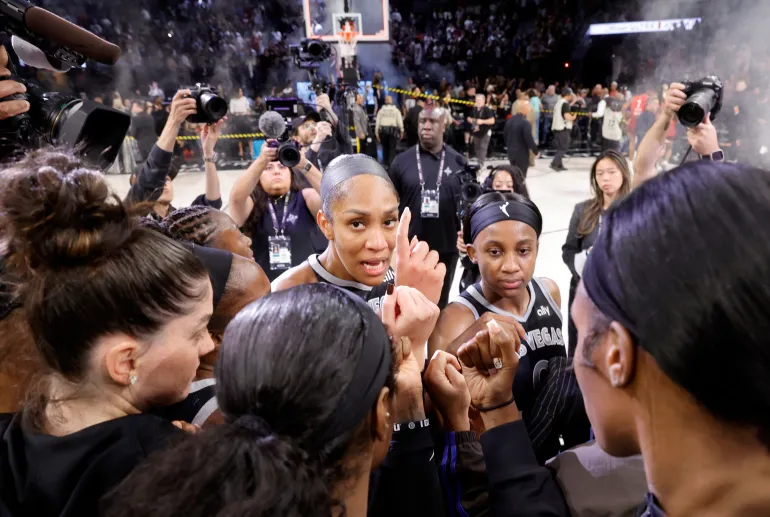
Angel Reese has broken another WNBA record with her 29th double-double of the season.

The Atlanta Dream forward had 15 points and 11 rebounds in the team’s 89-81 victory against the Minnesota Lynx on Sunday, surpassing the previous mark for most double-doubles in a single season set by Alyssa Thomas in 2023. (Thomas had set that record while playing for the Connecticut Sun during a 40-game regular season.)

The three-time All Star has already broken multiple rebounding records this season. During the Dream’s 78-71 victory over the Sparks on Aug. 24, Reese grabbed 26 boards, setting a new record for total rebounds in a single game. Chamique Holdsclaw previously held the record with 24 rebounds, which she had set on May 23, 2003, while playing for the Washington Mystics.

Reese also set the records for most rebounds in a single season during that match-up. She now has 485 rebounds on the season, with four regular-season games remaining. Reigning WNBA MVP A’ja Wilson held the previous record of 451 total rebounds, which she had set during the 38-game regular season in 2024. Reese surpassed Wilson’s mark in 37 games.

“I’m just in awe watching her rebound,” teammate Allisha Gray said after Reese’s record-setting performance in L.A. “That’s a talent.”

The third-year player — also known to fans as ATL Barbie — heads into the FIBA World Cup break averaging 16.1 points and 12.4 rebounds this season. Reese has led the league in rebounds in each of her first two seasons and is on track to do so again.

Reese and Dream teammate Rhyne Howard will be among the players representing the U.S. at the 2026 FIBA Women’s Basketball World Cup in Berlin, Germany. The tournament kicks off Sept. 4 and is scheduled to conclude Sept. 13.

On Monday, USA Basketball announced that Wilson and Kelsey Plum, who had previously been announced as members of the team, will miss the World Cup for heath reasons. The pair will be replaced by All Star Washington Mystics duo Sonia Citron and Kiki Iriafen.

The announcement did not include further details about why Wilson and Plum will be missing the World Cup, but Plum has been dealing with a lower leg injury for most of the WNBA season.

“I did everything I could to be back on the court, but just ran out of time,” the Phoenix Mercury guard said in a statement posted to her Instagram story on Monday. “After careful consideration and conversations with my family, team doctors, coaching staff, and front office, the decision has been made to shut it down through [the] remainder of the season and focus on getting my body back to 100% … This is not an easy decision as I love to compete, but I know it’s the right one for the long term.”

Plum was a key piece to Team USA’s victory over France in the gold medal game at the Paris Olympics in 2024.

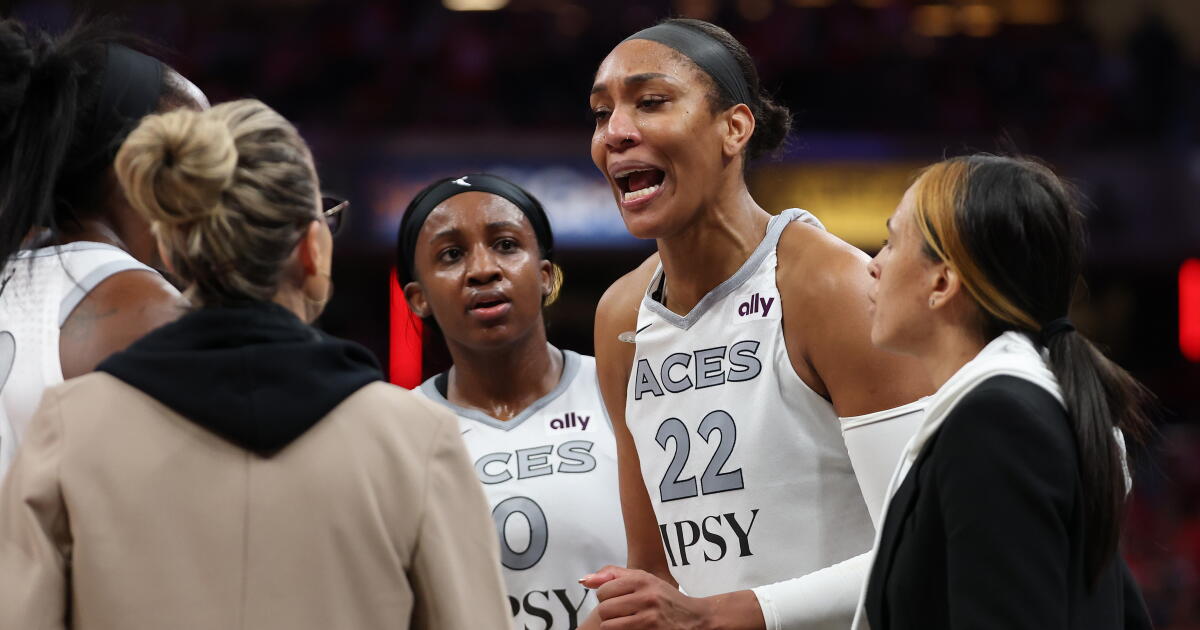
Four-time MVP Wilson, meanwhile, has been having another MVP-calibur season with the Las Vegas Aces. She was recently listed as questionable due to a back injury ahead of a game against the Toronto Tempo, but started both games against the expansion team last week. Wilson was named most outstanding player of the 2024 Paris Games and the 2022 World Cup.

The WNBA will resume play on Sept. 17.


Source link

Jacob Wilson shatters MLB record for errorless games in a row at SS

Two outcomes that scream failure on a baseball diamond are striking out and making an error. Jacob Wilson avoids both.

The third-year Athletics shortstop played his 111th consecutive game without an error Sunday, setting a major league record at his position.

Wilson, 24, also ranks among the top 5% of MLB players most difficult to strike out, making contact in more than 90% of his at-bats during his three-year career. The shortstop was a first-round draft pick out of Grand Canyon University in 2023 and played for Thousand Oaks High.

Failure is even more infrequent when he puts on his glove. Wilson surpassed Mike Bordick’s 2002 mark with the Baltimore Orioles for consecutive games played at shortstop without an error.

No wonder the A’s signed him to a seven-year, $70 million contract before the season.

Wilson, whose last error occurred July 6, 2025, credits his dad with prioritizing defense. Jack Wilson was a shortstop with elite range and a powerful arm during a 12-year MLB career from 2001-12, yet he never played a full season with fewer than 10 errors.

“He’s a very defensive-first guy for me growing up by teaching me defense first before the hitting side of things and making sure you’re always prepared to play defense every day,” Wilson told reporters after the Athletics beat the Boston Red Sox 4-3 on Sunday at Fenway Park.

Based on advanced metrics, Jacob doesn’t have the range of his father, but so far he has been more consistent. He made only eight errors in 124 games last season and none in 27 games after being called up from the minors in 2024. That’s a total of eight errors in 216 career games and 1,899 innings at shortstop.

“He definitely has the consistency side of things down pat,” fellow A’s infielder Tommy White told reporters. “The stats don’t lie. He really takes in the second half of the play. Everyone sees the glove, but it’s the accuracy of the arm.”

Putting the bat on the ball is also a Wilson trademark. He was the toughest player to strike out in NCAA Division I, whiffing just 12 times in 438 at-bats as a Grand Canyon sophomore and junior. At Thousand Oaks High, where his dad was head coach, Jacob struck out a mere five times in 343 plate appearances.

Likely out of reach is the MLB record for consecutive games without an error at any position, held by outfielder Robbie Grossman at 440 games, a streak that ended in 2022.

Meanwhile, Wilson plans to focus on staying healthy: He missed a month earlier this season with a dislocated left shoulder after diving for a ball, and missed a few more games when the shoulder flared up again in late June.

Making plays and putting the bat on the ball should continue as long as he’s on the field. Wilson was an American League All-Star last season and finished second in voting for Rookie of the Year to teammate Nick Kurtz after batting .311 and striking out only 39 times in 523 plate appearances.

Before this season, Wilson told Foul Territory that his focus was on improving areas he considered deficient — a quicker first step toward the ball on defense and putting on 10 pounds of muscle to increase his power at the plate.

As for avoiding errors and strikeouts, that should continue to come naturally.

“I know how to stay in my lane, do what I do and help this team win,” he said.

Source link

CALIFORNIA ELECTIONS / OAKLAND MAYOR : Wilson Faces His Toughest Political Race

Mayor Lionel Wilson, a fixture in this city’s politics for three decades, was fighting off a nasty cold as he took his campaign for reelection to a hall filled with real estate agents recently.

In past years, Wilson could have stayed home to nurse his ailment. He long ago endeared himself to Oakland business leaders by presiding over a boom in downtown building that brought a glistening skyline to the city. As he seeks a fourth term, however, the soft-spoken mayor finds he can take no group for granted.

Concluding his speech to the agents, he pleaded, “Give me a chance to complete the job I started.” But on this day, in a city beset by a continuing drug crisis, crime, a troubled school system and the aftermath of last October’s earthquake, the applause for the mayor was polite, and nothing more.

At 75, Wilson is facing the toughest campaign of his career, challenged by politicians who barely were teen-agers when he began his government career in 1960. The most likely outcome is that no candidate will win more than 50% of the vote in the nonpartisan June 5 election, and the two leading vote-getters will face off in November. But a recent Oakland Tribune-Gallup Poll confirmed what local politicos have been saying for weeks: Wilson may not make it to the runoff.

Only 18% of the likely voters backed Wilson. Assemblyman Elihu Harris, a Democrat who is giving up the legislative seat he has held for 12 years to mount a well-heeled effort to unseat Wilson, led with 32%, the poll showed.

Harris’ closest rival was veteran City Councilman Wilson Riles Jr., liberal son of the former state superintendent of schools, who was supported by 22%. Five other candidates had lesser support. And 22% were undecided.

In a sign of Wilson’s past impact on Oakland, candidates Harris, Riles and City Councilman Leo Bazile all have been labeled his protege in the past. Now, though, they depict him as a figure whom time has passed by.

“It is sad,” Riles said of the sinking political fortunes of the city’s first black mayor. “He was probably the right person to break the color barrier. (But) I don’t know whether he should have gotten a second term, and certainly not a third term. . . . People are saying it is time for a change.”

The campaign has been mean even by Oakland’s fractious standards. Candidate forums routinely are interrupted by demonstrators, and campaign rhetoric frequently has been downright nasty.

At a recent candidates forum, Bazile, a city councilman since 1983, ignored a thoughtful question about the future of downtown and accused Harris of a cavalier attitude toward crack cocaine use because he has broached the prospect of legalizing drugs.

Harris restrained himself, answered the question about downtown, and waited until after the debate to respond. He said he did not advocate that crack be made legal, though he added that in the fight against drugs, “We should not be afraid to discuss all of the options.”

Such asides notwithstanding, the issues in Oakland are considerable. Last October’s earthquake hit the city hard; repairs to city-owned buildings may cost $250 million. Officials must negotiate with Caltrans over a replacement for the collapsed Nimitz Freeway.

Meanwhile, thousands of blue-collar workers could lose their jobs if a federal study recommending closure of Oakland-area Navy bases becomes reality.

Crack use is epidemic, straining the health care system and fueling crime. A city of 360,000 people, Oakland had a record 148 homicides last year. The murder rate was third-highest in the state last year for cities with populations of more than 100,000, and the overall crime rate was second-worst.

Oakland schools, though not the mayor’s responsibility, are a major campaign topic. A state trustee has been appointed to oversee the Oakland Unified School District, and a criminal investigation has led to the arrests of 13 district employees for theft and embezzlement.

“The solutions to those problems are going to have to come at a quickened pace,” said Alameda County Supervisor Don Perata, who is neutral in the race. “Rhetoric won’t get by. You’re going to have to have some very adroit leadership.”

Then, there’s football.

After initial reluctance, Wilson backed an ambitious plan to lure the Los Angeles Raiders back to Oakland with an unprecedented $600-million-plus package of loans, grants, guaranteed profits and a promise to rebuild the Oakland Coliseum, all to suit team owner Al Davis.

Politicians quickly discovered that while Oakland football fans may pine for the Raiders, they don’t miss Davis. This is the man who spurned them by moving the team to Los Angeles after the 1981 football season. The thought that the city would guarantee him profits angered so many that 31,000 residents signed petitions to place the plan to bring the Raiders back on the ballot. The referendum was put on hold after Wilson withdrew his support of the deal; city officials and the Raiders have reopened negotiations.

Wilson conceded that the proposal has been “a negative” for him. He added, “I got caught in the middle.”

Even Councilman Riles, who scored big by opposing the deal, was shocked at the reaction. The deal elicited more angry calls than any municipal issue Riles could recall. “I lucked out,” he said.

Riles, long Wilson’s nemesis, tried to unseat the mayor in 1985. An ally of liberal Rep. Ron Dellums (D-Berkeley), Riles battles the moderate Wilson on such issues as rent control and development. He contends that more should be spent on the city’s poor neighborhoods and less on big downtown projects.

Wilson encouraged interest in his job by strengthening the office. Under a 1988 City Charter change that he engineered, the next mayor will make $80,000 a year, up from the previous $30,000.

He also supported moving local elections to even-numbered years. For the first time, the mayoral campaign is being held in conjunction with major state races. Turnout could hit 50%; in the last two mayoral elections, it was less than 28%.

At the time the changes were being debated, Wilson was leaning against running. He changed his mind last summer, saying he concluded that no other candidate could see through to completion development of a major downtown retail center.

However, as many voters apparently see it, Wilson’s day is over.

Clinton O’Keefe Killian, a 32-year-old lawyer and Harris supporter, talks of Oakland’s “tremendous potential,” but points to opportunities lost under Wilson. He extols the lifestyle in his ethnically diverse city, though he has complaints with faulty city services and frets about sending his children to Oakland schools.

“Oakland could be the town in California where blacks and other minorities can show they bring something to the table,” Killian said. But for all its promise of becoming “Atlanta-West,” Oakland won’t “go any further unless somebody is pushing it.”

Harris has tailored his message to such voters. While Wilson proved to any skeptics that “blacks could run the city,” Harris said, there’s a need now to move “beyond presence and become more aggressive.”

Harris has built his campaign around high-quality public schools. In some ways, it’s an odd issue to champion, given that the mayor has no say over the schools, which are run by an independently elected school board.

Still, Harris made a name for himself last year by pushing state legislation that led to the naming of a trustee to oversee the school district. The bill came after years of poor academic performance by students, studies critical of district management, and, finally, the criminal investigation.

Harris won popular support with the bill, but has taken his share of hits over it. Wilson charged that he pushed it merely to gain needed name identification.

The move also angered members of a black neighborhood group called the People’s Democratic Uhuru Movement. Using a variety of disruptive tactics, Uhuru adherents have been hounding Harris.

Their point: Harris backs “white colonialists” and “the U.S. government’s war against the black community” with his support of the school trustee.

Source link

THE CAMPAIGN FOR GOVERNOR : ROBOPOL : Nobody Runs–or Works–Harder than Pete Wilson. But Can He Ever Win the Hearts of Californians?

Ronald Brownstein is a Times national correspondent. Times researchers Doug Conner and Scott Fischer also contributed to this story

ON A COLD February morning in San Diego, a slim blond man wearing a suit as gray as the weather stands behind a podium outside City Hall. Around him bustle younger men carrying folders and boxes stuffed with papers. Blue and white balloons rise from the podium and quiver in the stiff breeze. Reporters stand on the edge of the square with notebooks poised.

For Republican Sen. Pete Wilson, the man behind the microphone, this is in many respects a triumphant homecoming. On the third official day of his campaign for the governorship of California–a job he has coveted for more than a decade–he has returned to the city that he led as mayor from 1971 through 1982. All around him are reminders of his achievements over that long reign. New office buildings spike into the skyline. Local officials mill behind him deferentially.

All that is missing this morning is an audience.

Not more than a dozen people, including reporters, are listening as Wilson begins his speech. There are more police officers than spectators present. Trolleys run by; people step off, look for a moment at the podium, slow their step and then pass on. One man in a wheelchair looks quizzically at the balloons, the amplifier and the police and asks, “Is that Pete Wilson?” Then he rolls away without waiting for an answer.

If Wilson notices that he is speaking to an empty courtyard, he betrays no sign of it. He does not vary his delivery. No disappointment colors his voice. The subject for the morning is transportation, and Wilson sticks to it as stubbornly as if he were before a room of rapt highway engineers.

His remarks are reasonable, well-informed and entirely unarresting. Here in this empty courtyard a continent away from the capital, Wilson sounds as though he is still on the Senate floor. His is the cool and insular language of government, of official declarations and distant decisions.

This is Pete Wilson’s natural vernacular, for he is, above all, a creature of government. Except for a brief period as a young lawyer 25 years ago, Wilson has spent his entire adult life in politics–as a local Republican operative in San Diego, state assemblyman, mayor of San Diego and, since 1982, as a U.S. Senator.

That resume marks Pete Wilson as a pioneer among the new generation of career politicians who have come to dominate American public life during the era of the permanent campaign–the unflappable, technocratic young men so common in Congress and state houses today. In Wilson are evident all of this generation’s characteristic strengths. He is efficient at moving the levers of government, comfortable before the television camera, conversant with campaign media strategy, prodigiously successful at raising money. Extremely sensitive to the political center of gravity, he is difficult to box into an ideological corner and disciplined enough to avoid the mistakes that in this day of 30-second negative advertisements can end a political career overnight. With a loyal and efficient staff around him, he is the skilled and savvy manager of a diversified bicoastal enterprise: the political career of Peter Barton Wilson.

But if Wilson possesses all the skills of the modern politician, he shares the breed’s great weaknesses. Like so many of his contemporaries, Wilson has enormous difficulty capturing the voters’ imagination with bold initiatives or forging emotional bonds with his constituents, a point painfully dramatized in his adopted home town by the steady flow of people who push by him indifferently on this winter morning.

THERE IN MICROCOSM is the dilemma Pete Wilson faces as he begins his campaign for the state’s highest political office. After two decades in elected office, Wilson remains for many Californians an indistinct figure, a name on a ballot but little more, a blond blur. “People have intellectual knowledge of him,” says one California Republican political consultant, “but they don’t have emotional knowledge. You can’t win the governor’s race without both.”

Pete Wilson begins this campaign with formidable assets. While Attorney General John K. Van de Kamp and former San Francisco Mayor Dianne Feinstein flay each other with negative advertisements, Wilson has no opposition for the Republican nomination. Though some conservatives carp about his support for a woman’s right to abortion and his tolerant views toward homosexuality, Wilson has behind him an enthusiastic party desperate to maintain control of the governor’s mansion during the redrawing of state legislative and congressional districts that will follow this year’s census. He is stockpiling one of the largest campaign treasuries ever accumulated in California.

But one rule in modern campaigns is that the higher politicians ascend, the more voters expect to know about them–not only about what they have done, but why they have done it; not only about their program, but their values and the experiences that shaped them. These are not mysteries that Pete Wilson, a man who prizes discipline over passion, spends much time pondering, even with close friends, even alone. But they may be the most important questions he faces on the road to Sacramento.

AT 56, WILSON offers himself as evidence that the unexamined life may be worth living after all. “This is not a man,” says his wife, Gayle, “who wakes up in the morning and says ‘How do I feel?’ He wakes up and says, ‘What do I have to do today?’ ” From boyhood, he has been brisk, efficient, directed, reluctant to inspect his own motivations and feelings, as though fearing that would slow him down. “I tried introspection once,” he says, “and I didn’t like it.”

Amid the chaos of the campaign trail, Wilson is smooth and cool and opaque, like a stone in a river. In speeches and during interviews, he is friendly and approachable, often witty in a dry way, but still fundamentally reserved. He always seems to choose his words carefully, even the profanity with which he occasionally underlines a point. Whether remembering his boyhood or analyzing economic policy, his voice is invariably level, his phrasing clipped and precise; even discussing his own life, at times he can sound like a neutral observer.

Wilson’s face reveals little about his thoughts. He has the bland good looks of a talk-show host. Behind a microphone, with his suit jacket typically buttoned and a deadpan delivery for one-liners, he is vaguely reminiscent of another Midwesterner, Johnny Carson. Wilson gives the impression of a man who never sweats. Emotionally, he is the rarest of men: a serene Type A.

Even as a young man, Wilson was serious, stolid, studious. He was born in Illinois and grew up in St. Louis, the son of James and Margaret Wilson. His mother, in her younger years, had been a model; his father, after selling fraternity jewelry, became an advertising account executive.

By the time he was in his teens, the family was prosperous enough to send him to the exclusive Saint Louis Country Day School, in whose intimate surroundings he excelled. In his senior year, Wilson served as president of the student council and literary editor of the yearbook, played on the varsity soccer and football teams (as an undersized offensive lineman nicknamed “Trapper”), acted and sang in class performances and won the school’s top prize for overall achievement. He was “just kind of an all-American Midwestern private-school type,” says classmate Richard Burgheim, now an editor at People magazine. “There was a certain student council type you’d resent, but that wasn’t Pete. He was gritty and popular, bright, but I can’t think of escapades. There was a sense of decorum about him.”

At the dinner table, Wilson, who has one older brother, learned lessons of engagement and service. From his father, who voted for FDR during the Depression but had since moored himself in the Republican Party, Wilson heard the local political debates and absorbed a conservative outlook without ever passing through a stage of rebellion against the older man’s ideals. “By and large,” Wilson says, sitting in the quiet of the bar at the Westgate Hotel in San Diego on a recent evening, “I thought he made pretty good sense.”

As a young man, Wilson cut the grooves that guide him to this day. His father often told him–perhaps a bit too pointedly, for the son remembers the words vividly decades later–that he had been endowed “with a reasonably good mind,” and through his career Wilson has worked with the special intensity of someone unsure he would measure up. (“My father was very gentle, but he was also pretty damn clear,” Wilson says now. “If he thought I had done something, whether it was at school or elsewhere, that really probably was not as good as it could have been, he would say, ‘Why didn’t you do better?’ ”)

Early on, Wilson put his faith in perseverance and effort, not flash or guile. As a junior high school student, he read condensed biographies of famous men and women night after night, “intrigued by people who had amounted to something,” looking for the secret of their success–and when he had finished his reading, what he concluded was that success came not from ephemeral sparks of brilliance or creativity but from the unglamorous work of setting goals and working to meet them.

That boy has grown into a man whose preferred form of exercise is the treadmill, who meticulously lays out his clothes every night for the next day, who pursues his agenda with a bruising single-mindedness and whose capacity for work is apparently bottomless. Other politicians may be smarter or more dynamic, but no one will outwork Pete Wilson.

ALMOST ANY MEAL with Wilson begins late–with him rushing in from the office–and if the dinner begins with talk about art or theater, it invariably winds back to politics and policy, the air he breathes. He mainlines paper and briefings. “Nothing will make him more unhappy,” says his former legislative director Ken Carpi, “than not to be prepared intellectually.”

Work does not entirely encompass Wilson’s interests: He likes to watch movies, browse in men’s stores (he is fastidious about his clothes), attend theater, perform on stage himself. In San Diego he sang creditably at charity events; in Washington, he and Gayle organize parties where friends gather behind a rented piano to belt out their favorite show tunes. The Wilsons live in a small townhouse on a quiet street a few blocks from the Capitol. In California, he lives in hotels; he maintains a condominium in San Diego but rents it out. At home, he stubbornly barbecues chicken for guests year-round, even if he has to stoke the coals in a ski jacket. His drink is gin with a twist, though he also has a taste for good wines. The bookshelves in his living room are filled with volumes of history and biography. On his refrigerator, someone has taped (and slightly misquoted) the Spinoza aphorism: “All excellent things are as difficult as they are rare.”

Wilson’s pleasures are urban: Friends say it is difficult to imagine him spending a week somewhere watching the sun set over the mountains. His idea of high life is a movie with friends such as U. S. Court of AppealsJudge Laurence H. Silberman and his wife or a small dinner party with Dan Quayle (a friend from his Senate days) and former Arms Control and Disarmament Agency director Kenneth Adelman and their wives. His perfect vacation would probably be a week in London. (“He’s an Anglophile,” says one old friend.)

Not that he has much time for these pursuits. For Wilson, his work–the making of public policy, the political jostling– has always had an overpowering allure. “He’s been a workaholic ever since I’ve known him,” says San Diego County Supervisor Susan Golding, who served on the city council near the end of Wilson’s tenure as mayor. “He lives his job. I don’t know when he isn’t working.”

Wilson’s private life has had to fit in the margins of his public life. In 1968, he married the former Betty Robertson, a woman 12 years older than he, with two children from a previous marriage. In 1981, they were divorced, and Wilson later told an interviewer that “the most important thing I learned (from my first marriage) is that I had a tendency toward spending too much time on the job.”

But rather than change priorities, Wilson found someone who would more willingly share them. In 1983, in a chapel in the Capitol building, he married the former Gayle Graham, an activist in civic and charitable affairs in San Diego, who also had two children from a previous marriage. (Wilson has no children of his own.) Friends say that Gayle Wilson enjoys the campaign grind as much as Betty Wilson disliked it; Gayle calculates that 90% of the couple’s time revolves around Wilson’s work.

If there is a touch of obsession in this punishing schedule, it springs from the restlessness of the perfectionist, not the zealotry of the ideologue. Unlike, say, Ronald Reagan, who entered politics fired by a sweeping ideological agenda, Wilson has never been powered by such combustible fuel. A desire to serve and be part of his times put him on the track, and a hunger for solving problems has kept him on it.

As a young man, politics did not seem like an obvious career to Wilson. When he graduated from Country Day, he choose Yale on the recommendation of his father and a teacher. He took a heavy course load in English literature and worked himself to exhaustion (his roommates would occasionally find him asleep in the library in the middle of the night), but he was an unremarkable student, although his performance picked up enough for him to make the dean’s list as a junior and senior.

Trapped in the library with his poets and novelists, Wilson took no interest in student government and seemed to want of his time at Yale mostly to be through with it. “I was eager to get out,” Wilson says. “I wanted to get out and do things. I wasn’t quite sure what, but I wanted to do them.”

Advertising, the law or even literature appeared the most likely choices. When he graduated, he wrote a semi-autobiographical novel–a love story involving a young Marine–imagining that he might make his living with his typewriter. At least, “That was my thought at the beginning,” he remembers. “I was less inclined to think that by the time I neared the end.” He decided the book was “thin on plot” and shelved it without sending it to publishers.

His father had always stressed to Wilson the importance of giving something back to the community. But it was not until after he served as an infantry officer in the Marines to fulfill his ROTC scholarship to Yale and enrolled, without much enthusiasm, in law school at the University of California at Berkeley that he began to feel confined by the course he’d set for himself.

“It could be very exciting to be a good trial lawyer,” Wilson says, recalling his deliberations. “What was missing, it seemed to me, was a sense of doing something for other people and a sense of doing something important. Not for the history books. I had no illusions on that score. Anybody who chooses public life does so without the illusion that in most cases he is going to make any lasting difference. You do it for yourself. . . . It is just a sense of satisfaction.”

The vague sense that the law alone could not fill his life led Wilson to join in Young Republican activities at Berkeley. After graduating in 1962, he went to work for the gubernatorial campaign of recently defeated Presidential candidate Richard M. Nixon. After Nixon lost to Pat Brown, the father of the man Wilson humbled two decades later, the young advance man moved to San Diego, where several of his best friends from law school had settled.

Almost effortlessly, Wilson was absorbed into the local Republican hierarchy. In his early 30s, Wilson was the sort of diligent young man–witty but not disrespectful, hard-working but not cutthroat–who reminded older men of themselves at that age, or at least what they imagined themselves to have been.

When Gordon Luce, the chairman and chief executive of Great American Bank, interviewed Wilson for a job as assistant director of Republican Associates of San Diego, an organization that recruited young professional men and women into the GOP, he found the fledgling lawyer “a studious young man, but a very interesting one. You knew that he had knowledge and was studying the issues and was a measured person in terms of the approaches he would take. You could see this was a person who did not shoot from the hip. There was substance to him.”

Wilson’s path opened before him. He ran the county Republican committee during the 1964 campaign. Finally passing the bar exam on his fourth try, he joined a law firm headed by the father of John G. Davies, a friend from law school, and began the grinding work of building a practice.

In 1966, when State Assemblyman Clair W. Burgener decided to run for a new state Senate seat created by redistricting, it seemed to him logical to encourage the “serious-minded” young attorney to seek the seat he was vacating. Wilson campaigned tirelessly and won.

Wilson swiftly learned his new business in the State Assembly, quickly moving into the Republican leadership; when the mayor’s job opened in San Diego in 1971, he saw opportunity in what had been an ineffectual and ceremonial post. He debated his opponent in the general election 46 times (by the end, Wilson says, “he was almost starting to give my lines, and I was starting to give him signals that would have been inappropriate in a crowd or on television”), won the job going away and skillfully built alliances on the City Council that gave him more influence over the city than any mayor in memory.

In 1978, after winning a convincing reelection as mayor, Wilson ran for the Republican gubernatorial nomination. But he was hampered by his opposition to the tax-cutting Proposition 13 as well as bitter feelings left by his support of President Gerald Ford over Ronald Reagan in the struggle for the GOP presidential nomination in 1976. He finished a distant fourth. He recovered quickly enough to win a third term in San Diego in 1979, but by then he was aching for center court. Three years later, after taking a hard look at another race for the state house, he overcame a crowded primary field and then faced outgoing Gov. Edmund G. (Jerry) Brown Jr. for a seat in the U.S. Senate. As a candidate, Brown was the hare to Wilson’s tortoise: bold, controversial, unpredictable and inveterately interesting. But by then, Brown was for most Californians interesting in the way a car wreck is. Wilson brushed past him.

THE SENATE has long styled itself as the world’s most exclusive club. But the label is an anachronism. Senators now are far too busy to spend much time together strategizing or thinking, much less socializing. Today the Senate is less a club than a switching yard with 100 separate tracks.

Even in that atomized environment, Wilson is more of a loner than most. Personality explains part of that. In the Senate, Wilson has been “somewhat distant,” says Mitchell E. Daniels Jr., a former Senate Republican leadership aide and now president of the Hudson Institute, a conservative policy research company in Indianapolis. “He is controlled, and he is not into, oh, gratuitous affability.” One high-ranking White House official describes Wilson more succinctly as “a cold fish.”

But Wilson is set apart, too, by his solitary commitment to his own political agenda–even to the discomfort of his colleagues, his party or the White House, as demonstrated by his recent spat with presidential Chief of Staff John Sununu over Wilson’s breaks from the Administration on votes concerning trade policy and relations with China. Friends describe that doggedness as principled independence; critics see in it a pattern of calculated opportunism.

To the dismay of his colleagues, for example, Wilson perennially introduces legislation that would eliminate funding for the mass mailings senators send to their constituents and transfer the funds to an unimpeachably worthy purpose, such as the treatment of babies born addicted to cocaine. Most senators want to keep their newsletters but hate voting against crack babies; many of his colleagues consider it the worst form of grandstanding for Wilson to try to compel them to choose between the two.

In his defense of specific California interests, Wilson has been no less tenacious. That became apparent one gray morning in April as the senator careened through his crowded schedule. His day had a strong California bent–from his 8:25 a.m. appearance before a delegation of officials from California waterways and ports to his late-afternoon meeting with a group of visiting California farmers. In between, Wilson testified on behalf of California water projects before the Senate Appropriations Committee, introduced legislation to provide federal funding for trauma-care centers burdened by the cost of caring for illegal immigrants and carried the flag for California growers in the opening markup session for the 1990 farm bill at the Agriculture Committee.

Wilson went to the committee’s hot and crowded meeting room for a specific purpose–one that symbolizes the political strategy that has governed his time in the Senate. Wilson was there to defend something called the Targeted Export Assistance program. In the overall picture of the multibillion-dollar farm bill, the $200-million program merits barely a footnote. Its purpose is to help American farmers who have been injured by unfair foreign-trade barriers to market their products abroad. But that narrow purpose is of wide interest to California growers of everything from wine grapes to almonds.

Wilson’s major committee assignments–Armed Services and Agriculture–provide him with many opportunities to protect influential California constituencies. He lets few pass. His staunch support of the Strategic Defense Initiative and high defense budgets reflects his conservatism on national security matters–but it is also good politics in a state that receives more than 18% of all defense expenditures.

On the Agriculture Committee, where Wilson’s ideological compass is less clear, his parochial purpose has been even more distinct. Soon after Wilson attended his first meeting and sat at the end of the long table, years in seniority away from the seats close to power, he went to see then-committee chairman, North Carolina Republican Jesse A. Helms.

“He came to us and said, ‘It’s very important to me that California agricultural interests are well attended to. What can I do to get to the top of the table?’ ” says George S. Dunlop, the committee’s chief of staff at the time. And Helms, Dunlop recalls, gave Wilson the facts of committee life: If he supported the leadership agenda on the key votes, “the trade-off was that the chairman would deliver for California agriculture.” Wilson never became a major player in agricultural policy, but he supported Helms on the key votes–and for his loyalty won approval of the export-assistance program.

At the same time, Wilson reached out shrewdly to traditionally Democratic constituencies. In his successful 1988 reelection campaign against Lt. Gov. Leo T. McCarthy, Wilson received extraordinary financial help from normally Democratic executives in Hollywood, whose cause he carried against the three major networks in a legislative battle over control of lucrative syndication rights for television programs. Likewise, liberal Jews gave him an unusual degree of financial support–for Israel has few stauncher allies in the Senate. By the time the 1988 race began, Wilson’s skillful positioning during his six years in Washington had put him in a virtually impregnable electoral position.

FOR MCCARTHY’S advisers, the defections of Jewish and Hollywood donors were maddening. So was the campaign’s inability to persuade voters that Wilson’s hard-line views on national defense and support for the Reagan Administration’s budget cuts put him to the right of the state.

Wilson’s success in avoiding any ideological label has been frustrating his opponents for 20 years. Two decades ago, in the state Legislature, Wilson was usually considered a reliable conservative vote. But he saw the environmental wave cresting and broke with most conservatives by introducing legislation to create a commission to regulate development of the California coastline. Though environmentalists, according to contemporary accounts, considered his bill “the weaker” one under consideration because it left too much authority with local officials, Wilson eventually compromised with Democrats on a stronger measure that paved the way for the 1972 ballot initiative that created the California Coastal Commission.

When he ran for mayor in San Diego, Wilson displayed the same sense for emerging issues. Though he was the clear choice of the Republican establishment, which included the most powerful pro-development forces in the city, he accepted no contributions larger than $300 from developers and based his first mayoral campaign largely on a platform of controlling growth.

Wilson held to that policy against protests from construction unions and a spirited reelection challenge in 1975 largely financed by development interests. But his instincts gradually pulled him back from sustained confrontation with such a powerful constituency–just as, critics noted, he began courting support for the leap to statewide office. “He was with us (on the growth issue) in the beginning,” says U. S. Rep. Jim Bates (D-San Diego), who served on the San Diego City Council while Wilson was mayor, “but then when he began running for governor (in 1978), he moved the other way.” By the end of Wilson’s second term, the San Diego League of Conservation Voters accused him of “desert(ing) the environmentalists and managed-growth supporters who elected him last election.”

In Washington, Wilson has presented an equally complex profile. With surprising ideological fervor, Wilson quickly emerged as one of the Senate’s leading hawks. His skepticism of social spending was dramatically underlined when he was wheeled in on a hospital gurney while recovering from an appendectomy to cast the deciding vote on a 1986 budget bill mandating large cuts in domestic programs, including Social Security–a vote that inspired negative ads from McCarthy during Wilson’s reelection campaign in 1988.

But on other votes, Wilson resumed his characteristic search for the center. His hard line on defense, taxes and crime has been balanced by moderate positions on some social issues, and those dissents from Republican dogma have been balanced, in turn, by support of the White House on many of the toughest partisan votes. While supporting abortion rights and the Equal Rights Amendment, Wilson also voted to confirm former U. S. Court of Appeals Judge Robert H. Bork to the Supreme Court when partisans of those causes bitterly opposed him.

On environmental issues, Wilson receives only mediocre overall ratings from national conservation groups. But he has resisted all efforts from the Reagan and Bush administrations to open the California coastline to offshore oil drilling. In March, he co-sponsored an amendment to the Clean Air bill that would have tightened auto-emission standards and encouraged greater use of clean-burning alternative fuels. The amendment, which some conservation groups considered the key environmental vote of the year, narrowly failed. But Wilson’s performance won high marks from green lobbyists.

Likewise, Wilson was the only one of the three gubernatorial candidates to support the 1989 Los Angeles ballot initiative to stop Occidental Petroleum Corp. from drilling for oil under the Pacific Palisades. “If it hadn’t been for Pete Wilson,” says Democratic Los Angeles City Councilman Zev Yaroslavsky, one of the initiative’s principal sponsors, “we wouldn’t have won. It’s just as simple as that.”

And yet Wilson failed to endorse the Clean Water ballot initiative in 1986, has angered environmentalists by resisting legislation to declare millions of acres of California desert as protected wilderness and opposes the “Big Green” environmental measure on the ballot this year.

So far in the gubernatorial race, Wilson has held to the same eclectic pattern. He has reinforced his conservative credentials by backing a criminal-justice ballot initiative that would speed trials, increase sentences for murder and create a new crime of “torture” that would be punished with life imprisonment. Typically, Wilson balances that with support for drug education, a new proposal welcomed by educators to deliver medical and mental health services to young people through the schools, a promise of expanded prenatal care and a call for the state to organize a volunteer effort to provide adult mentors to inner-city children.

But Wilson has been unclear on how he would pay for these initiatives other than to say that if voters approve the ballot measure loosening the Gann limit on state spending, economic growth would produce enough revenue to meet the needs.

Revenue is not the only subject on which Wilson has been tight-lipped. In these opening stages of the campaign, Wilson has given little attention to the issues just beyond the headlines: He has offered no thoughts on the challenges of integrating a state where minorities are growing into a majority of the population, for example, or on how the end of the Cold War may reshape California.

These broad questions about the state’s future, and others like them, have been overshadowed in Wilson’s campaign by the immediate–primarily the hammering sound bites on crime that have dominated all three of the candidates’ early dialogue with the voters. For all Wilson’s fascination with the details of public policy, many of his early appearances have given less a sense of a creative intelligence grappling with problems than of a politician reaching for applause lines.

IN MOST RESPECTS, Wilson presents a difficult political target. With his tough stance toward crime and taxes and more moderate positions on social issues and funding for education, even Democrats agree that Wilson is a good match for the state ideologically.

But in the exacting scrutiny of the governor’s race, Democrats believe Wilson may fall short on what George Bush calls “the vision thing.” As Bush did in succeeding Reagan, Wilson promises modest change but essential continuity with the administration of Gov. George Deukmejian. If voters want a sharper shift in course, and if the Democratic nominee appears to offer it, Wilson’s carefully crafted balance may seem inadequate.

As in the 1988 Senate race, whoever wins the Democratic primary will try to paint Wilson as a man who acts out of political expediency and is too close to the economic interests, such as agriculture, that have supported his campaigns. Wilson raised and spent almost $15 million to hold his Senate seat in 1988 and will probably raise a similar amount in the gubernatorial race. And though special-interest political action committees provided only one-sixth of Wilson’s overall campaign treasury in 1988, he received more money from PACs than all but one other Senator facing election that year.

Wilson, who bristled when McCarthy accused him of bending toward corporate contributors on environmental issues, insists that those donations have affected his votes “not at all.” But, he adds, “You can’t put yourself in a position where you are penalizing people because they supported you.” As scandals in Sacramento and Washington inspire more cynicism about elected officials, Democrats are certain to pointedly ask, “Who does Pete Wilson represent?” as Paul Maslin, a pollster for Attorney General Van de Kamp, puts it.

Wilson’s record in San Diego is also certain to receive more intense scrutiny than ever before. Most local observers agree that Wilson’s overall impact on the city was positive, but there were controversies, such as his shifting attitude toward growth.

More emotional was a tragedy in the suburban neighborhood of Tierrasanta, where a large private housing development was built in the early 1970s on the land previously used as an artillery range by both the Marines and the Navy.

In 1973, a resident of the area warned Wilson’s office that her children had found old bombs while playing in the canyons around the homes. A few weeks later, Wilson wrote the Army asking them to “sweep . . . the area.” Several months later, the Army informed Wilson by letter that it had recovered several dozen rounds of spent ammunition but urged “that due caution still be taken in the area, as earth movement (either by heavy equipment or natural erosion) may possibly bring further ordnance to the surface.”

Over the next decade, residents continued to find shells near their homes. But no additional cleanup was undertaken. Then in December, 1983, two young boys were killed when an old artillery shell they had found went off. The families of both boys brought suit against the developers and the city, which eventually settled for $2.5 million, the largest liability payment it had ever made.

In November, 1987, Wilson was called to give a deposition in one of the cases, testifying that he thought that because of the sweep, “the danger had been eliminated.” Mostly, though, Wilson testified that he could not recall almost all details about the case; 34 times he responded that he could not remember specific actions or decisions.

Today, Wilson says of the case, “I would have to say in hindsight, because a child died, not enough was done, I suppose. But at the time, I think that the mayor and the City Council, who had asked that the survey be undertaken, were probably entitled to rely on the assurance that was given.”

But Democrats may question that defense and use the case to challenge Wilson’s portrayal of his years in San Diego as an unblemished success.

EVEN THOUGH Pete Wilson is not a man who openly discusses his hopes and aspirations, he leaves no doubt that he very badly wants to be governor. After his drubbing in the 1978 GOP primary, he quickly began preparing for another run in 1982–only to switch to the Senate race when Deukmejian entered the gubernatorial field. And even on the morning after his election to the Senate, he wistfully told a group of reporters that if he had more than one life to live, he would want to spend one of them as governor of California.

Wilson has enjoyed many things about the Senate, and could probably stay there for many years if he does not become governor. But the demands of a collegial body–the unpredictable schedule, the chaotic barrage of disparate issues–constantly frustrate this orderly man. As governor, Wilson anticipates, he would have far more control over his personal schedule and political agenda. “Even in the much more limited circumstances of being mayor of San Diego, when I was presiding over the City Council–which was damn time-consuming–even then the rest of your time was yours to do with as you choose,” Wilson says. “If you wanted to have a daylong briefing on something, by God, you just did it.”

That freedom, friends say, provides one powerful incentive for Wilson to trade in Washington for Sacramento. Many political observers note also that almost any future Republican presidential nominee would welcome on the ticket the governor of a state that could have as many as 54 electoral votes after the next reapportionment. It is, in fact, not difficult to imagine that if Wilson wins the governorship, he could eventually envision himself playing more than a supporting role. “There are three jobs that are sort of parallel to him,” says Otto Bos, Wilson’s longtime aide; “mayor, governor and President.”

Those may be good reasons for Wilson to seek the governorship, but they are not necessarily reasons for the voters to reward him with it. No matter whom the Democrats nominate, they are bound to argue that only ambition is driving Wilson to seek this job just two years after the state returned him to Washington to perform another.

Wilson’s friends insist it is not personal ambition impelling him so much as the belief that he could shape the state more in Sacramento than in the Senate. Wilson recently told one interviewer that a senator may be just one of 100, but “as governor, you are one of one. The buck does stop with you.”

For this confident man who has always been drawn to solving problems, that is an enormously attractive prospect. “I have never seen any arrogance in him,” says his friend Judge Silberman, “but neither is there self-doubt.” Spending time with Pete Wilson, you get the sense that, issues aside, he wants to be governor because he believes he would be better at it than anyone else around. “Part of vision is being realistic,” he says. “Anyone can have sugarplums dancing in their head, but you’ve got to make it happen. And to make it happen, you’ve got to be tough-minded and realistic.”

That kind of steady, dependable competence–the faith in sweat over vision–has always been Wilson’s strength. But the experience in the 1988 presidential race of another quietly competent politician, Michael S. Dukakis, shows the risk of offering the public only competence without burning conviction. Some Republicans fear that Wilson could stumble on that same terrain–particularly if he faces Feinstein, who more easily displays emotion than either of the men in the race. “Pete is very smart,” says one Republican congressman nervous about the race, “but when you’ve been in politics this long, if you’re not passionate about anything, you come off as just rote.”

For any politician, that perception could be fatal. If Pete Wilson is to avoid it, he must persuade the voters that he has a vision of where California must go–that his campaign is propelled by a purpose more urgent than his personal advancement. In this race, Wilson will have to show endurance, fund-raising skill, political savvy, timing and cool; but all that may be less important than showing his passions.

Source link

Yes, Emily Wilson, Odysseus has been changed for the movie. Deal with it

In the spirit of Zeus’ law to be generous toward guests, I’m honored to welcome classics professor Emily Wilson to the land of film criticism. As she’s recently learned, it’s an adventure that sails smack into islands of musky internet trolls and clashes with cinematic and literary titans like Christopher Nolan and Joyce Carol Oates.

Nolan credits the opening line of Wilson’s 2017 translation of Homer’s “The Odyssey” — “Tell me about a complicated man” — as partly inspiring his adaptation of the ancient epic, which, nearly a month into its release, is soldiering toward a billion-dollar box office gross. Symbiotically, Wilson’s edition is now the No. 2 bestselling book in the country. That Wilson’s incendiary essay in the London Review of Books revealed she doesn’t think much of Nolan’s blockbuster struck some as hubris, including Oates, who took to social media to decry the scholar’s “tone of dismissal” and “haughty superiority.”

If you haven’t been following the controversy, Wilson felt that Nolan had flattened the saga by mostly erasing the Greek gods and Odysseus’ wit, lust and thorny contradictions. Oates likened the tone of Wilson’s critique to the “crude language of MAGA folks.” In short: Wilson snuck a 2,700-year-old poem through the gates of mainstream taste — and after that victory, her arrogance left her marooned.

Sounds familiar if you’ve read Homer. Less so if you’ve only seen the film. Wilson is right that Nolan’s movie lacks Odysseus’ egomaniacal brilliance.

I’m here to play peacemaker. Wilson adores Odysseus so much that she has his bow tattooed on her right leg. Frankly, Nolan doesn’t seem to like the wily, libidinous and violent trickster-veteran of the poem — half Rhett Butler, half Rambo in “First Blood” — as much as Wilson or I do. Because if he did, that Odysseus would be onscreen.

spot illustration of Odysseus cut out from the background and tinted blue

But having seen his movie twice, it’s obvious that Nolan is less interested in Wilson’s first line than her fifth: “Tell the old story for our modern times.” That, he’s done. His take on Homer is, as I wrote in my original review, “a moralistic ‘Oppenheimer’ prequel.” For the record, I like it anyway.

Film critics and translators start work in the same place. Step one: What is the artist’s intent? Wilson considered the entirety of Homer’s tale and decided the right word for polytropos was “complicated.” I weighed what Nolan chose to protect, tweak and abandon in his own version and concluded that he wanted to make an action-tragedy about societal decline.

Movies must be measured against their own ambitions. A stoner comedy can’t be graded like a Shakespearean drama (and vice versa). Here’s where Wilson runs aground. She wants to allow Nolan creative freedom, knowing that the Greek playwrights rebooted figures like Odysseus and Medea just like Marvel treats Spider-Man. There’s even a spinoff of the original poem in which Odysseus has kids with Circe.

Yet, storytellers have to protect the core of their characters. Medea must be angry, Spider-Man must be helpful and Odysseus, dang it, must have swagger. Damon doesn’t.

This is why Wilson deserves empathy even if she can’t bring herself to grant Nolan the same grace. As a professor of classics at the University of Pennsylvania, she’ll be on the front line of academics condemned to unteach Nolan’s heavily altered screenplay to students who will arrive quoting it chapter and verse. For decades to come, high school kids — probably even a few high school teachers — are just going to pop in his Blu-ray and call it a day.

Nolan does hit his target, eventually. Yet his script wobbles. He’s made a movie about Odysseus’ remorse for inventing the Trojan horse without a crucial scene: the moment he invents it. We see Odysseus silently stroll the beach outside Troy, but not the pride he must have felt running back to base to pitch an idea that will finish the war and let his allies go home. The emotional arc Nolan wants to trace should start there. The beat’s absence is confounding since Odysseus also needs to appear clever (and never does).

This is what it means to measure a film against its ambitions. Only after we accept that Nolan is solely interested in human mistakes can we gauge his disregard for the Greek gods. I dig that choice — it’s bold — yet still think he flubs it by not replacing the magical powers of Charlize Theron’s Calypso and Zendaya’s Athena with, say, a personality. What a waste of two terrific actors. It’s no wonder Oates stuck up for him. Her novel “Blonde” also stripped the agency from love goddess Marilyn Monroe and its own 2022 movie adaptation launched a thousand hot takes.

There will never be a faithful modern film version of “The Odyssey.” No, not even whatever AI slop Elon Musk claims he’s green-lighted, a project I’m sure will come to fruition as fast as his any-year-now claim that he’s landing on Mars.

The issue isn’t just the poem’s length. It’s that today’s audiences have zero stomach for happy endings about horrible wrongs. We can barely rationalize the slaughter of the suitors. No one wants to watch Homer’s gory scene after that, when Telemachus cruelly orders a dozen enslaved girls to clean up the mess and then executes them too.

Only a seven-and-a-half hour Italian miniseries produced by Dino de Laurentiis in 1968 dares mention that second bloodbath and even in that, the women are hung offscreen after we’ve been assured (fictitiously) that the maids tried to kill them first. (Side note: Dino’s Penelope, played by the mighty Irene Papas, is my favorite.)

Previous movie adaptations of “The Odyssey” soft-pedal or ignore the hero’s postwar PTSD. You catch a glimpse of it in the two-part NBC special from 1997 in which Armand Assante’s Odysseus rescues a Trojan toddler. But mainly, he spends more time hot-tubbing with Vanessa Williams’ Calypso.

That’s not a knock. The ’90s “Odyssey” is as tacky as Caesars Palace but Assante’s smooth-talking horndog is closer to my ideal Odysseus than Damon’s neutered mope. He sleeps with both Calypso and Circe and still earns his tender reunion with Penelope by choosing her beloved wrinkles over those gods’ immortal perfection. (For what it’s worth, Oates is a fan of it too. Wilson has yet to comment.)

Only the two most recent versions — Nolan’s and Uberto Pasolini’s 2024 “The Return,” starring a sinewy Ralph Fiennes — center on Odysseus’ culpability for the carnage of the Trojan War. Damon’s Odysseus is numbed by the massacre of Troy’s civilians; Fiennes’ hates himself for leading the best men of Ithaca to their death, gutting his own community in the heedless destruction of another. I’m tempted to diagnose the current gloom as the result of our own post-9/11 forever wars.

The 21st century has seen enough genocide for Homer to compose a hundred sequels. Only those stubbornly ignorant to the human cost of actual combat would be psyched to bring on more of it. (Just ask the veterans in my family how they feel things are going in Iran.) At the end of “The Return,” when Fiennes stands entrail-smeared before his beloved Penelope, she recoils from the horror of the battlefield brought right into their home.

That interpretation has its flaws too. The middle stretch has a concocted outdoor chase sequence that feels like a clumsy campground slasher. Wilson applauded its “stylish sparseness.” Fair enough. I’d still love to invite her and Nolan and even Oates to a banquet of wine and roasted fowl and have a blast agreeing to disagree. No weapons allowed.

Source link

Kelly Osbourne’s ex-fiance Sid Wilson ‘permanently kicked out of Slipknot’

KELLY Osbourne’s ex-fiancé Sid Wilson has been “permanently kicked out of Slipknot”.

It comes just four months after Sid, 49, and Kelly, 41, broke up in March after he popped the question in July last year, shortly before her beloved father Ozzy died.

Kelly Osbourne’s ex has reportedly been ‘kicked out of Slipknot’ Credit: Getty
Kelly and Sid split in March, not long after they got engaged Credit: AFP

Today, it’s being reported that the keyboardist has been faced with more bad news, and that he is no longer a member of Slipknot according to TMZ.

A source close to the heavy metal band, who are known for performing in grotesque masks, told the outlet: “Sid was notified late Friday afternoon that he’s been permanently kicked out of the band.”

Sid shot to fame in 1999 as one of Slipknot’s nine original members.

The musician joins other OGs from the group who have also left the band in recent years including Craig Jones, 54, and Chris Fehn, 53.

READ MORE ON KELLY OSBOURNE

ONE YEAR ON

Kelly Osbourne says ‘part of her died’ with Dad one year since Ozzy’s death


TOTAL PIN UP

Kelly Osbourne fans praise star as she poses in plunging white swimsuit

Slipknot has also been plagued by tragedy, with Joey Jordison passing away in his sleep in 2021, while Paul Gray died from a drug overdose in 2010.

Meanwhile, Sid and Kelly, who share three-year-old son Sidney, ended their romance in March.

Sid was one of the original members of Slipknot Credit: Getty
Slipknot are known for wearing grotesque masks – Sid seen here at a gig in Milan in 2020 Credit: Getty

It came not long after Kelly’s dad Ozzy sadly passed away, leaving her grief stricken.

“Kelly and Sid have decided to call off their engagement,” a source told the Mail at the time.

“Kelly has been struggling following the loss of her father.

“The grieving process has been incredibly difficult, and she’s been doing everything she can to cope.

Sid proposed to Kelly in front of her parents at Ozzy’s final ever show with Black Sabbath Credit: instagram/kellyosbourne
Kelly and Sid share three-year-old son Sidney Credit: Getty

“In truth, she and Sid have been facing challenges in their relationship for some time, and things were not as they appeared.

“They tried to make it work, particularly for the sake of their child, but ultimately decided that separating is the best path forward.”

Just seven months before their split, Kelly was left emotional as she agreed to marry Sid following a sweet proposal, at her dad’s last ever gig.

Kelly and Sid first met in 1999 at Ozzfest, a music festival founded by her parents.

They were friends for over two decades before their relationship turned romantic at the end of 2021.

Source link

Susan Orlean calls Emily Wilson ‘a bit of a jerk’ for ‘Odyssey’ take

In a book nerd battle that’s become so epic, even The Onion has satirized the saga, acclaimed author Susan Orlean has grabbed the mic, and Emily Wilson is admitting she has one regret in her review of “The Odyssey.”

Earlier this week, Joyce Carol Oates panned Wilson’s critique of Christopher Nolan’s big-screen adaptation, and now acclaimed author and journalist Susan Orlean has entered the chat.

“I loved The Odyssey (saw it twice) and love any piece of art that gets people talking and reading and thinking,” she posted on Threads on Thursday. “Emily Wilson is being a bit of a jerk.”

Choice words from Orlean, but she knows a thing or two about film adaptations: her 1998 book “The Orchid Thief” inspired Spike Jonze’s 2002 film “Adaptation” starring Nicolas Cage and Meryl Streep (who played Orlean), and her 1998 article “Life’s Swell” was brought to screen as “Blue Crush,” also in 2002.

“Why can’t things be the things they are and if they’re different from their source material that’s their new form and their own thing and I SAY THIS FROM EXPERIENCE,” she added in a separate post.

The ire stems from a biting 4,200-word takedown of “The Odyssey” penned by classicist Wilson, who translated Homer’s poem in 2017.

In early interviews discussing the film, Nolan referenced Wilson’s translation, which subsequently skyrocketed in sales. A representative for Audible told The Times on Wednesday that, year over year, purchases of Wilson’s “Odyssey” translation were up by more than 600% across Audible’s U.S., U.K. and Canadian marketplaces.

Wilson’s review, published in the London Review of Books, essentially dubbed Nolan’s film a dud for academics with taste and a blockbuster hit for virgins who like special effects that go “Boom!”

“Nolan’s Odyssey lacks many of the elements that make the poem great. It has nothing convincing to say about time, memory, history, war, or about the relationship between one warrior’s glorious return and the lives of his family, adversaries, comrades, friends and neighbours,” she wrote. “It lacks psychological, emotional, political and ethical depth. Its narrative structure is gimmicky. The writing is abysmal. None of the characters has convincing motivation for their actions or words. There are no sex scenes, and all the food looks horrible.”

Pulitzer Prize finalist Oates, like Orlean, is also team Nolan. “Her tone of dismissal & haughty superiority strike a sour note,” Oates said of Wilson’s review in a post on X. Oates added that rather than Wilson disagreeing with “interpretations of Homer in a collegial manner,” she benefited from Nolan’s film and then attacked it.

Wilson’s review went so viral it crashed the London Review of Books website for a few hours on Monday. On the heels of the missive’s publication, Wilson posted on Bluesky that an earlier draft of the essay was actually more cutting than the version that went live.

“Was I too mean? Or not mean enough? I went through my first draft and tried to take out the snark,” she wrote. “To quote the great poet: ‘Though much is taken, much remains… That which we are, we are.’”

She added in the same thread: “The oddest thing about the response to this essay is people who say it’s ‘personal’. You can disagree about some or all of it! I may well be wrong! But it’s not ‘personal’ to analyze a film or other work of art, even negatively. Criticism is more than ‘Hurray!’ or ‘Hiss!’”

One criticism Wilson admits she regrets in retrospect is her take on Nolan’s race-neutral casting. In the review she wrote that while the casting launched a culture war, it wasn’t actually progressive. She likened the characters portrayed by Zendaya, Lupita Nyong’o, Himesh Patel, Corey Antonio Hawkins and Travis Scott to “versions of the Black best friend, whose only role in the drama is to provide aid to the white protagonist.”

On Bluesky, she wrote, “In this piece, I regret the paragraph about the uses of the POC actors – who are all great, but IMO under-utilized (and why couldn‘t Himesh Patel be Odysseus instead?) I still think the film largely wastes its strong cast, but I framed it badly.”

Source link

Joyce Carol Oates slams Emily Wilson over viral ‘Odyssey’ takedown

Days after a classicist who translated Homer’s “The Odyssey” in 2017 eviscerated the Christopher Nolan film based on the poem, Joyce Carol Oates has entered the debate.

She’s Team Nolan.

The National Book Award-winning author is known for her (sometimes controversial) hot takes on social media, and on Wednesday, she stepped up to the plate in opposition of translator Emily Wilson’s brutal takedown of Nolan’s big-screen adaptation of “The Odyssey.” Nolan had previously said Wilson’s translation inspired him in making the film. But Wilson wrote that she would be ashamed to have written any part of the script.

“Her tone of dismissal & haughty superiority strike a sour note,” Oates said of Wilson’s review in a post on X. “Rather than disagreeing with interpretations of Homer in a collegial manner, this person, who has benefited enormously from Nolan’s film, speaks in the crude language of MAGA folks attacking someone with ideas that differ from hers.”

Wilson’s biting missive, published in the London Review of Books this week, went so viral that it reportedly crashed the outlet’s website for a few hours Monday. The British American classicist’s take on the film was especially notable because, last fall, Nolan quoted Wilson’s translation when telling Empire magazine why he was drawn to the story. “I think it’s the Emily Wilson translation that begins, ‘Tell me about a complicated man,’” he said.

Wilson’s version of “The Odyssey” subsequently spiked in sales. A representative for Audible told The Times on Wednesday that, year over year, purchases of Wilson’s “Odyssey” translation were up by more than 600% across Audible’s U.S., U.K. and Canadian marketplaces. Daily global title sales rose nearly sixfold during the week the movie premiered. And in the nine days following wide release, daily global sales averaged around 20 times more than the rate before the premiere, showing sustained demand for Wilson’s translation.

Oates, who penned the Pulitzer Prize-nominated “Blonde,” said that, within the world of translators, Wilson’s review “seems all the more surprising since all translations are, presumably, subjective & not equivalent to the original text.”

“One would expect a translator, of all people, beholden to a text, in service to a text, to be just a wee bit more thoughtful & respectful of others who are acting in good faith just as (she would claim) she is,” Oates wrote.

In separate posts on the social platform, Oates said she highly recommended Nolan’s adaption and that she wasn’t a fan of Wilson’s translation. “What I’d read of Emily Wilson’s translation was not for me,” she wrote, adding that she assumes it was “deliberately written to appeal to an audience comfortable with YA (young adult) directness & spareness of vocabulary — that is, with the intention of being marketable, adopted by high school classes.

“With a more poetic, elevated speech, you are naturally limiting your audience,” continued the author, who further noted that there was nothing wrong with a direct, commercial approach. “Why not profit from a classic work not protected by copyright?”

In the viral review by Wilson, who also translated Seneca and Euripides, as well as Homer’s “Iliad,” she likened Nolan’s nearly three-hour epic to Peter Jackson’s “Lord of the Rings” trilogy and “Game of Thrones.”

Her sharpest critiques were aimed at Nolan’s rendering of Homer’s female characters, of which she said there were more than in his other films “thanks to the source material” but that, in contrast to the poem, none of them “had much to say.” Wilson said Nolan’s race-neutral casting was essentially a wash as “[m]ost of the non-white actors — Zendaya, Lupita Nyong’o, Himesh Patel, Corey Antonio Hawkins, Travis Scott — play versions of the Black best friend, whose only role in the drama is to provide aid to the white protagonist.”

And don’t get her started on the whole point of the poem — the cost of war — of which Wilson quipped, “We are not shown that war or killing are bad, only that good men sometimes feel bad about it — a very different point.”

Source link

‘Odyssey’ translator Emily Wilson rips apart Nolan’s film adaptation

Emily Wilson, whose translation of Homer’s “The Odyssey” published in 2017 served as inspiration to Christopher Nolan when crafting his blockbuster adaptation of the nearly 2,800-year-old poem, has some thoughts on the film.

In a biting missive for the London Review of Books, the British American classicist dissected Nolan’s work with a scalpel so sharp that he may need to borrow some of Matt Damon’s armor to read it all the way through. Last fall, the acclaimed director quoted Wilson’s translation when telling Empire magazine why he was drawn to the story. “I think it’s the Emily Wilson translation that begins, ‘Tell me about a complicated man,’” he said. “The genius of the character, the cleverness, the inventiveness of him, that was a huge part of what interested me. He’s not just a soldier. He’s an amazing strategist, a very wily person.”

Wilson, although admittedly “humbled” by the nod from the filmmaker, wrote: “But I would be ashamed to have written any part of this script.”

A professor of classical studies at the University of Pennsylvania, Wilson has also translated Seneca and Euripides, as well as Homer’s “Iliad.” In her takedown of the film, she likens Nolan’s nearly three-hour epic to Peter Jackson’s “Lord of the Rings” trilogy and “Game of Thrones” and says that, by the end, she “almost expected everyone to break into Elvish.”

Earlier this month, The Times’ film critic, Amy Nicholson, wrote that “Nolan has sacrificed Odysseus himself to serve his own needs, scrapping the character’s prickly personality to Trojan-horse a message about how empires collapse. … Aghast at the ways of men, he’s dug his own Circe-like fingers into Homer to manipulate the tale into a moralistic ‘Oppenheimer’ prequel.”

Wilson appears to share the sentiment.

“Unlike some of Nolan’s other films,” she wrote, “‘The Odyssey’ is not boring, thanks to the source material, which is impossible to mess up entirely. It’s a family-friendly audiovisual spectacle, like an elaborate Fourth of July fireworks display — and with about the same level of narrative and emotional depth.”

When casting was announced for the film, it was no surprise that culture wars broke out over the choice of Oscar-winning actor Lupita Nyong’o to play Helen of Troy, with Elon Musk leading the charge.

Nolan responded, telling the Telegraph earlier this month before the film hit theaters, “These conversations that happen before people see the film — they’re always irrelevant, because no one having them knows what the film actually is yet.”

According to Wilson, Nolan’s race-neutral casting had “nothing progressive about it.”

“Most of the non-white actors — Zendaya, Lupita Nyong’o, Himesh Patel, Corey Antonio Hawkins, Travis Scott — play versions of the Black best friend, whose only role in the drama is to provide aid to the white protagonist,” she wrote.

Wilson zeroes in on the portrayal of Homer’s female characters in another major critique: “There are more female characters than in most Nolan movies, thanks to the source material. But none of them has much to say, in contrast to the [characterizations] in the poem.”

Where Charlize Theron’s Calypso ought to have been angry, funny, skilled in rhetoric and libidinous, according to Wilson, she’s “an unpaid therapist.” On Anne Hathaway’s Penelope, Wilson writes that the script “gives her nothing to do except yearn for Matt Damon, for reasons unknown.” And Zendaya’s Athena “turns out to be a vulnerable victim of war, or perhaps a projection of Odysseus’ conscience — not a scheming and bloodthirsty war goddess.”

And then there’s the human cost of war — the central theme of the film, and one that Wilson says contradicts Homer’s poem.

“The representation of Odysseus as a reluctant warlord makes a nonsense of the movie’s imagined world,” she writes. “We are not shown that war or killing are bad, only that good men sometimes feel bad about it — a very different point. Any serious depiction of violence, ancient or modern, must show the perspectives of the victims as well as the perpetrators, and the Homeric poems easily clear the bar — but Nolan doesn’t.

“The film asks us both to be horrified at war and to celebrate the action-movie sequences in which the reluctant warrior finally gets his hands on his bow and the blood starts flowing.”

Since Nolan announced “The Odyssey” back in December 2024, various versions of the poem have been in high demand at bookshops and libraries — especially the only English version written by a woman: Wilson’s 2017 translation. Louise Brockett, spokeswoman and head of communications at W.W. Norton, told USA Today that domestic sales of Wilson’s translation surpassed a million copies this year.

Concluding her critique of Nolan’s “Odyssey,” Wilson says the release of the movie is “still an event to celebrate.”

“In what we are told is the streaming era, this epic is bringing audiences back to cinemas. In what we are told is a time of declining literacy and the ‘death of the humanities,’ translations of The Odyssey, including mine, are flying off the shelves.”

Nolan spent $250 million making “The Odyssey,” and on opening weekend the film brought in a total of $264.1 million worldwide, according to studio estimates.

Source link

Luke Wilson welcomes first baby with Kendall Yates

Luke Wilson has reportedly welcomed his first child with girlfriend Kendall Yates.

The new parents were spotted with their baby at a Tuesday press event for Wilson’s upcoming Netflix series, “The Hawk,” according to People and Page Six. The “Bottle Rocket” actor and his partner brought their newborn daughter in a carrier to the Newport Beach reception and introduced her to Wilson’s castmates and other attendees, per the outlets’ sources.

Representatives for Wilson did not immediately respond on Thursday to The Times’ request for comment.

Wilson, 54, and Yates, 24, have reportedly been linked since at least 2023. They have mostly kept their relationship away from the spotlight, but attended an afterparty for the Los Angeles premiere of Kevin Costner’s “Horizon: An American Saga — Chapter 1” together in 2024.

The “Idiocracy” actor has addressed his desire to have kids and his role as an uncle over the years. In a 2007 People interview, Wilson — then single — mentioned he “definitely want[ed] [kids] at some point.” In 2023, while promoting “Merry Little Batman,” Wilson spoke about being “a pretty good uncle” to brother Owen Wilson’s kids.

“They’re great little kids,” Wilson said of his nephews in an interview with Conan O’Brien in 2020. “The kind that make me want to have some kids of my own, which I should get on sooner rather than later.”

“I just don’t want to be one of those dads that has to pay somebody in the neighborhood to throw the football with his kid because I can’t,” he joked.

Source link

The Bolt of Lightning From Beyond That Has Wilson Quaking : Primary: Religious Right has fielded and funded candidates against the governor’s in 13 Assembly races. If turnout is low, watch out.

Sherry Bebitch Jeffe, a contributing editor to Opinion, is a senior associate of the Center for Politics and Policy at the Claremont Graduate School

When Vice President Dan Quayle tarred Murphy Brown as a symbol of the “poverty of values” that he claims helped fuel the Los Angeles riots, it was more than another bizarre turn in an already screwball political ride. His attack on “lawless social anarchy” resonates with the rhetoric of the Religious Right. That is no accident. This group assumes great importance as the Bush-Quayle campaign faces the tricky dynamics of a three-way race in the fall.

Quayle’s scolding also exposed a common theme in GOP legislative primaries throughout California, particularly in Orange and San Diego counties. How Republican voters respond could define the soul of the state GOP, the political future of Gov. Pete Wilson and the direction of public policy and spending.

Four years ago, the Religious Right mobilized around the politics of evangelists like Pat Robertson. Now the Robertson crowd has joined with other pro-life groups in stealth campaigns to capture low-visibility local offices.

This strategy has quietly surfaced in California. In GOP primaries in 13 legislative districts, a statewide coalition of Christian fundamentalists is fielding and financing right-wing candidates against moderates backed by Wilson loyalists. Among the more prominent contests:

— Conservative fundamentalist Barbara Alby, of Sacramento’s Capitol Christian Center, is challenging incumbent B.T. Collins (R-Carmichael), the governor’s hand-picked candidate, for the 5th Assembly District nomination.

— In Pasadena, Bill Hoge, running for the GOP nomination in the 44th A.D., enjoys the backing of several fundamentalist Christian groups. Former La Canada-Flintridge Mayor Barbara Pieper, a pro-abortion rights Republican with long-time ties to Wilson, is the moderate candidate.

— Redondo Beach Mayor Brad Parton is the Right’s man in the South Bay’s 53rd Assembly District. Campaign literature from opponent Dan Walker, a Torrance City Council member, blasts Parton for his “attempts to impose his fundamentalist religious views on others.”

On economic issues, there’s little difference among GOP contenders. Most are fiscal conservatives who oppose new taxes and support pro-business agendas. The split comes over social issues. Couched in terms of “traditional family values,” the Right’s agenda is relentlessly anti-gay, anti-choice and anti-Wilson.

Since Wilson took office last year, he’s made it clear he wants to remake the California Legislature into an instrument of his moderate political will. To do that, he has to break the grip of conservatives in the GOP Assembly caucus. That’s what the 1992 primaries were supposed to accomplish. But caucus hard-liners, whose goal is to dump Wilson allies from leadership posts, have joined with the Religious Right to take on Wilsonistas.

The most intense battles are being fought in the governor’s back yard–San Diego. A string of right-wing victories there could be fatal to Wilson’s policy agenda and to his political viability.

For a while, the governor’s people worked to keep this unhappy political prospect suppressed. But when Wilson learned how well organized the conservatives were, he dropped his neutrality and endorsed four GOP moderates running for the Assembly in the San Diego area. Since all four districts lean Republican, the GOP nominee should have the advantage in the general election.

In the 75th, right-wing candidate Connie Youngkin, head of San Diego’s Operation Rescue, trumpets herself as a “Pro-Family Tax Fighter.” She has downplayed her anti-abortion rights activism in the face of attacks from Wilson’s candidate, Poway Mayor Jan Goldsmith.

The nomination battle in the 77th pits political consultant Steve Baldwin, and his army of Christian activists, against former Chula Vista Mayor Greg Cox. Baldwin, who helped engineer Religious Right victories in 1990 races for local offices, opposes abortion and gun control. Wilson-endorsed Cox does not.

In the 78th, former Assemblyman Jeff Marston, a pro-choice moderate, faces Dan Van Tieghem, executive director of the Christian Coalition of California. And in the 76th, Wilson likes former Del Mar Mayor Ronnie Delaney against anti-abortion conservative Dick Daleke.

Conservatives Youngkin, Baldwin and Van Tieghem have all been targeted by the California Abortion Rights Action League as “Enemies of Choice.” Their nominations could assume added importance if the U.S. Supreme Court, as expected, tosses the abortion-rights issue to the state legislatures. These religious conservatives would also likely wield long budget knives, first and most deeply, at health and social welfare programs.

What’s all this got to do with California’s primary?

Religious fundamentalists have boosted their voting numbers by “in-pew” registration drives. Add to this the fact that conservatives tend to be better organized, more motivated and more ideologically committed than middle-of-the-road voters. They turn out.

And with so many competitive races, turnout will likely determine many a political race.

If turnout is low, the extremes of both parties–liberal Democrats and conservative Republicans–will benefit, which means that the Legislature will likely remain factionalized and frozen.

The U.S. Senate races might be affected as well, particularly the tight contests for the six-year seat. On the GOP ballot, a low turnout could help conservative commentator Bruce Herschensohn. But if moderate Republican women come out to support pro-choice candidates running for the Legislature and Congress, pro-choice Rep. Tom Campbell might benefit.

In any case, despite the whining of press and pundits, the California primary is not irrelevant. The stakes are high this year. They include the definition of this state’s goals and priorities. And the selection of leaders capable–or incapable–of moving toward them.

California voters won’t be conned to the polls just to protest or confirm presidential nominees. But they can’t stay home, if they care at all about the future of their communities and state.

Here, too, turnout will tell the tale.

Source link