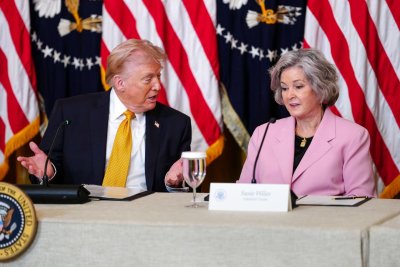
Wiles

White House defends chief of staff Wiles after tell-all profile

President Trump’s chief of staff is defending herself after granting an extraordinarily candid series of interviews with Vanity Fair in which she offers stinging judgments of the president himself and blunt assessments about his administration’s shortcomings.

The profile of Susie Wiles, Trump’s reserved, influential top aide since he resumed office, caused scandal in Washington and prompted a crisis response from the White House that involved nearly every single figure in Trump’s orbit issuing a public defense.

In 11 interviews conducted over lunches and meetings in the West Wing, Wiles described early failures and drug use by Elon Musk during his time in government, mistakes by Atty. Gen. Pam Bondi in her public handling of the Jeffrey Epstein files, and acknowledged that Trump had launched a retribution campaign against his perceived political enemies.

“I don’t think he wakes up thinking about retribution,” Wiles told Chris Whipple, the Vanity Fair writer who has written extensively on past chiefs of staff, “but when there’s an opportunity, he will go for it.”

Wiles also cited missteps in the administration’s immigration crackdown, contradicted a claim Trump makes about Epstein and former President Clinton and described Vice President JD Vance as a “conspiracy theorist.”

Within hours of the Vanity Fair tell-all publishing on Tuesday, Wiles and key members of Trump’s inner circle mounted a robust defense of her tenure, calling the story a “hit piece” that left out exculpatory context.

“The article published early this morning is a disingenuously framed hit piece on me and the finest President, White House staff, and Cabinet in history,” Wiles said in a post on X, her first in more than a year. “Significant context was disregarded and much of what I, and others, said about the team and the President was left out of the story.”

The profile was reported with the knowledge and participation of other senior staff, and illustrated with a photograph of Wiles and some of Trump’s closest aides, including Vance, Bondi and advisor Stephen Miller.

The profile revealed much about a chief of staff who has kept a discreet profile in the West Wing, continuing her management philosophy carried through the 2024 election when she served as Trump’s last campaign manager: She let Trump be Trump. “Sir, remember that I am the chief of staff, not the chief of you,” she recalled telling the president.

Trump has publicly emphasized how much he values Wiles as a trusted aide. He did so at a rally last week where he referred to her as “Susie Trump.” In an interview with Whipple, she talked about having difficult conversations with Trump on a daily basis, but that she picks her battles.

“So no, I’m not an enabler. I’m also not a bitch. I try to be thoughtful about what I even engage in,” Wiles said. “I guess time will tell whether I’ve been effective.”

Despite her passive style, Wiles shared concern over Trump’s initial approach to tariff policy, calling the levies “more painful than I had expected.” She had urged him, unsuccessfully, to get his retribution campaign out of the way within his first 90 days in office, in order to enable the administration to move on to more important matters. And she had opposed Trump’s blanket pardon of Jan. 6 defendants, including those convicted of violent crimes.

Wiles also conceded the administration needs to “look harder at our process for deportation,” adding that in at least one instance mistakes were made when Immigration and Customs Enforcement agents arrested and deported two mothers and their American children to Honduras. One of children was being treated for Stage 4 cancer.

“I can’t understand how you make that mistake, but somebody did,” she said.

In foreign policy, Wiles defended the administration’s attack on alleged drug boats in the Caribbean Sea and said the president “wants to keep on blowing up boats up until [Venezuelan President Nicolás] Maduro cries uncle,” suggesting the end goal is to seek a regime change.

As Trump has talked about potential land strikes in Venezuela, Wiles acknowledged that such a move would require congressional authorization.

“If he were to authorize some activity on land, then it’s war, then [we’d need] Congress,” she said.

In one exchange with Whipple, she characterized Trump, who abstains from liquor, as having an “alcoholic’s personality,” explaining that “high-functioning alcoholics, or alcoholics in general, their personalities are exaggerated when they drink.”

He “operates [with] a view that there’s nothing he can’t do. Nothing, zero, nothing,” she said.

But Trump, in an interview with the New York Post, defended Wiles and her comments, saying that he would indeed be an alcoholic if he drank alcohol.

“She’s done a fantastic job,” Trump said. “I think from what I hear, the facts were wrong, and it was a very misguided interviewer — purposely misguided.”

Wiles also blamed the persistence of the Epstein saga on members of Trump’s own Cabinet, noting that the president’s chosen FBI director, Kash Patel, had advocated for the release of all Justice Department files related to the investigation for many years. Despite Trump’s claims that Clinton visited the disgraced financier and convicted sex abuser’s private island, Wiles acknowledged, Trump is “wrong about that.”

Wiles added that Bondi had “completely whiffed” on how she handled the Epstein files, an issue that has created a rift within MAGA.

“First she gave them binders full of nothingness. And then she said that the witness list, or the client list, was on her desk. There is no client list, and it sure as hell wasn’t on her desk,” Wiles said.

Wiles added that she has read the investigate files about Epstein, and acknowledged that Trump is mentioned in them, but said “he’s not in the file doing anything awful.”

Vance, who she said had been a “conspiracy theorist for a decade,” said he had joked with Wiles about conspiracies in private before offering her praise.

“I’ve never seen Susie Wiles say something to the president and then go and counteract him or subvert his will behind the scenes. And that’s what you want in a staffer,” Vance told reporters. “I’ve never see her be disloyal to the president of the United States and that makes her the best White House chief of staff that the president could ask for.”

Russell Vought, the director of the Office of Management and Budget who Wiles described to Whipple as a “right-wing absolute zealot,” said in a social media post that she is an “exceptional chief of staff.” Karoline Leavitt, the White House press secretary, said the “entire administration is grateful for her steady leadership and united fully behind her.”

Wiles told Vanity Fair that she would be happy to stay in the role for as long as the president wanted her to stay, noting that she has time to devote to the job, being divorced and with her kids out of the house.

Trump had a troubled relationship with his chiefs of staff in his first term, cycling through four in four years. His longest-serving chief of staff, former Gen. John Kelly, served a year and a half.

Source link

Susie Wiles, White House chief of staff, criticizes Bondi and opines on Trump in Vanity Fair

Susie Wiles, President Trump’s understated but influential chief of staff, criticized Atty. Gen. Pam Bondi’s handling of the Jeffrey Epstein case and broadly defended the president’s aggressive second administration in a series of interviews published Tuesday in Vanity Fair.

Wiles told the magazine in a wide-ranging, revealing series of conversations that she underestimated the scandal involving Epstein, the disgraced financier, but sharply criticized how Bondi managed the case and the public’s expectations.

After the story was published, Wiles disparaged it as a “disingenuously framed hit piece on me and the finest President, White House staff, and Cabinet in history.”

“Significant context was disregarded and much of what I, and others, said about the team and the President was left out of the story,” she wrote in a social media post. “I assume, after reading it, that this was done to paint an overwhelmingly chaotic and negative narrative about the President and our team.”

Wiles did not deny the comments that were attributed to her.

In her rebuttal, Wiles argued that Trump had accomplished more in 11 months than any president had in eight years because of his “unmatched leadership and vision.”

“None of this will stop our relentless pursuit of Making America Great Again!” she said.

Press secretary Karoline Leavitt also rose to Wiles’ defense, writing on the X platform that, “President Trump has no greater or more loyal advisor than Susie. The entire Administration is grateful for her steady leadership and united fully behind her.”

In the interview, Wiles said Trump wants to keep bombing alleged drug boats in the waters off the coast of Venezuela until that country’s leader, Nicolas Maduro, “cries uncle.”

And at one point said she and Trump had a “loose agreement” that his retribution campaign would end before the first 90 days of his second term — but it continues well beyond the three-month mark.

Trump tapped Wiles after she managed his winning 2024 campaign. She is the first woman to ever serve as White House chief of staff and is known for shunning the spotlight. It is rare for her to speak as extensively and openly as she did about the president to the magazine, which published its lengthy interview with her — and other members of the White House staff and the Cabinet. Wiles has been speaking to Vanity Fair since just before Trump took office last January.

Asked about Epstein, Wiles said hadn’t really paid attention to “whether all these rich, important men went to that nasty island and did unforgivable things to young girls.”

She said she has read the Epstein file and that Trump is “not in the file doing anything awful.” He and Epstein were friends before they had a falling out.

The Justice Department is facing a Friday deadline to release everything it has on Epstein after Trump, after objecting to the release, signed legislation requiring that the papers be made public.

Wiles criticized Bondi’s handling of the case, going back to earlier in the year when she distributed binders to a group of social media influencers that included no new information about Epstein. That led to even more calls from Trump’s base for the files to be released.

“I think she completely whiffed on appreciating that that was the very targeted group that cared about this,” Wiles said of Bondi. “First she gave them binders full of nothingness. And then she said that the witness list, or the client list, was on her desk. There is no client list, and it sure as hell wasn’t on her desk.”

Wiles, over the series of interviews, described the president behind the scenes very much as he presents himself in public: an intense figure who thinks in broad strokes yet is often not concerned with the details of process and policy. She added, though, that he has not been as angry or temperamental as is often suggested, even as she affirmed his ruthlessness and determination to achieve retribution against those he considers his political enemies.

Trump, she said, has “an alcoholic’s personality,” even though the president does not drink. But the personality trait is something she recognizes from her father, the famous sports broadcaster Pat Summerall.

“High-functioning alcoholics or alcoholics in general, their personalities are exaggerated when they drink. And so I’m a little bit of an expert in big personalities,” she said, adding that Trump has “a view that there’s nothing he can’t do. Nothing, zero, nothing.”

On Venezuela, Wiles said Trump wants to keep the pressure on Maduro.

“He wants to keep on blowing boats up until Maduro cries uncle. And people way smarter than me on that say that he will.” Her comment, though, seemed to contradict the administration’s position that the strikes are about stopping drugs and saving American lives, not regime change.

She said the administration is “very sure we know who we’re blowing up.”

The continued strikes and mounting death toll have drawn scrutiny from Congress, which has pushed back and opened investigations.

Wiles described much of her job as channeling Trump’s energy, whims and desired policy outcomes — including managing his desire for vengeance against his political opponents, anyone he blames for his 2020 electoral defeat and those who pursued criminal cases against him after his first term.

“We have a loose agreement that the score settling will end before the first 90 days are over,” Wiles said early in his administration, telling Vanity Fair that she does try to tamp down Trump’s penchant for retribution.

Later in 2025, she pushed back. “I don’t think he’s on a retribution tour,” she said, arguing he was operating on a different principle: ”‘I don’t want what happened to me to happen to somebody else.’ And so people that have done bad things need to get out of the government. In some cases, it may look like retribution. And there may be an element of that from time to time. Who would blame him? Not me.”

Asked about the prosecution of New York Attorney General Letitia James for mortgage fraud, Wiles allowed: “Well, that might be the one retribution.”

Superville and Barrow write for the Associated Press. Barrow reported from Atlanta.

Source link