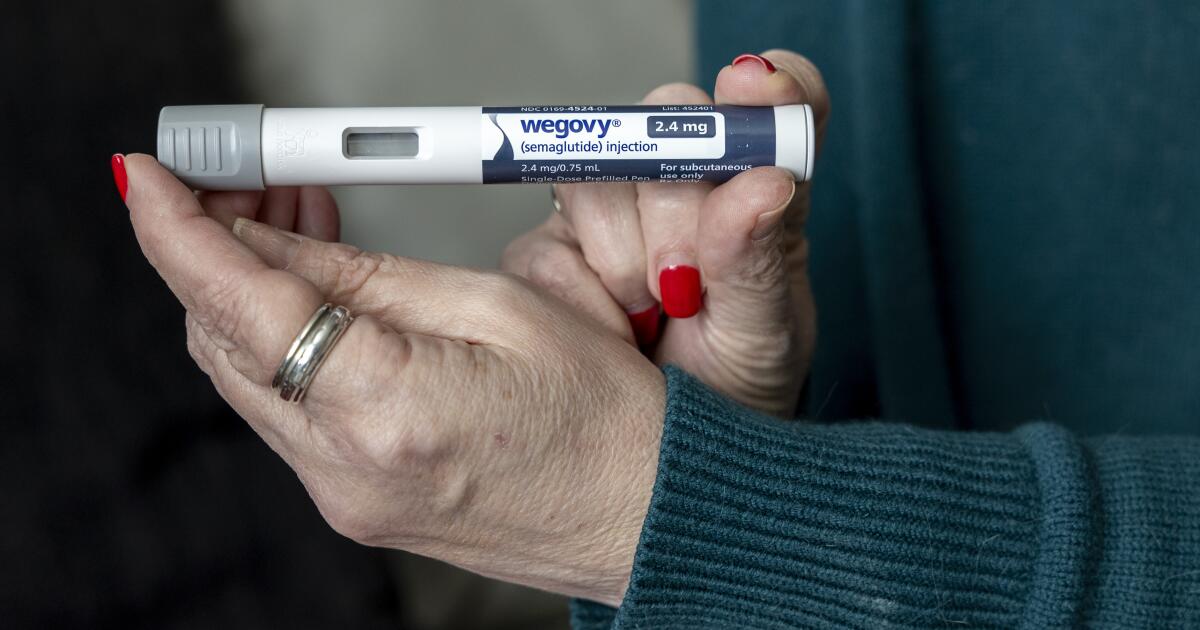
California is ending coverage for weight loss drugs, despite TrumpRx
SACRAMENTO — Many low-income Californians prescribed wildly popular weight-loss drugs will lose their coverage for the medications in the new year.
Health officials are recommending diet and exercise as alternatives to heavily advertised weight-loss drugs like Wegovy and Zepbound, advice that experts say is unrealistic.
“Of course he tried eating well and everything, but now with the medications, it’s better — a 100% change,” said Wilmer Cardenas of Santa Clara, who said his husband lost about 100 pounds over two years using GLP-1s covered by Medi-Cal, California’s version of Medicaid.
California is joining several other states in restricting an option they say is no longer affordable as they confront soaring pharmaceutical costs and steep Medicaid cuts under the Trump administration, among other financial pressures. Despite negotiated price reductions announced in November that the White House said would “dramatically lower cost to taxpayers” for the drugs and enable Medicaid to cover them, states are going ahead with the cuts, which providers say may undermine patient health.
“It will be quite negative for our patients” because data show people typically regain weight after stopping the drugs, said Diana Thiara, medical director of the UC San Francisco Weight Management Program.
Although California and New Hampshire will not cover GLP-1 prescriptions for obesity beginning Jan. 1, they will continue to cover the drugs for other health issues, such as type 2 diabetes, cardiovascular disease and chronic kidney disease.
Michigan, Pennsylvania, Rhode Island, South Carolina and Wisconsin are planning or considering restrictions, according to the Kaiser Family Foundation’s most recent survey of state Medicaid programs.
That reverses a trend that saw 16 states covering the medications for obesity as of Oct. 1. Interest in providing the coverage “appears to be waning,” the survey found, probably because of the drugs’ cost and other state budget pressures. North Carolina pulled back GLP-1 coverage in October, but Gov. Josh Stein reinstated it in December, bowing to court orders despite a lingering budget shortfall.
Catherine Ferguson, vice president of federal advocacy for the American Diabetes Assn. and its affiliated Obesity Assn., said it’s unclear how states will adjust to the White House plan to lower the cost of several of the most popular GLP-1s through TrumpRx, an online portal for discounted prescription drugs. The price of Wegovy, for example, will be $350 per month for consumers, versus the current list price of nearly $1,350, and Medicare and Medicaid programs will pay $245, according to the plan.
“Many states are facing budgetary challenges, such as deficits, and are working to address the impacts of the changes to Medicaid and SNAP,” Ferguson wrote, referring to the Supplemental Nutrition Assistance Program. “As more details become available for the Administration’s agreements, we will see how state Medicaid responds.”
The Department of Health and Human Services referred questions to the White House, which did not respond to requests for comment on states’ termination of Medicaid coverage for the weight-loss drugs.
California projected its costs to cover GLP-1s for weight loss would have more than quadrupled over four years to nearly $800 million annually if it didn’t end Medi-Cal coverage for that use. Medi-Cal has covered weight-loss drugs since 2006, but use of GLP-1s soared only in recent years. By 2024, more than 645,000 prescriptions were covered by Medi-Cal across all uses of the medications. The California Department of Health Care Services could not readily provide a breakdown of whether the drugs were for weight loss or other conditions.
When asked whether the state would reconsider its plans in light of the announced price cuts, Department of Finance spokesperson H.D. Palmer said it had no plans to do so. California’s cut is written into the state’s budget law.
California officials would not say how much it could save under the TrumpRx plan, citing federal and state restrictions on disclosing rebate information.
Healthcare providers don’t expect the Trump administration’s negotiated price cuts to make much difference to consumers, because pharmaceutical companies already offer discounts.
“The out-of-pocket costs will still be very cost-prohibitive for most, especially individuals with Medicaid insurance,” Thiara said.
New Hampshire will also end its coverage Jan. 1. Officials with the New Hampshire Department of Health and Human Services did not respond to requests for comment.
About 1 in 8 adults are taking a GLP-1 drug for obesity, disease or both, up 6 percentage points from May 2024, according to KFF poll results released in November. More than half of users said their GLP-1s were difficult to afford, and many who had stopped the treatment cited the cost.
Public and private payers have been trying to wean patients off of the drugs to save costs. California health officials said Medi-Cal members and their healthcare providers should consider “other treatment options that can support weight loss, such as diet changes, increased activity or exercise, and counseling.” That echoes advice from the New Hampshire Medicaid program.
California Department of Health Care Services spokesperson Tessa Outhyse said in an email that the official advice to try those other approaches now “is not meant to dismiss any past efforts, but to encourage Medi-Cal members to take a renewed, proactive, and medically supported approach with their healthcare provider that may appropriately include these additional options.”
But that may be unrealistic, said Kurt Hong, founding director of the Center for Clinical Nutrition at Keck School of Medicine of USC.
“We definitely want patients to do their part with the diet and exercise, but unfortunately, and from a practical standpoint, that itself frequently is not enough,” Hong said, adding that usually by the time patients see doctors, they have failed at achieving results through those means.
Hong understands why Medicaid programs, as well as private providers, want to cut back on covering the drugs, which can cost thousands of dollars per patient per year. However, they can produce twice the weight loss as the medications typically used previously, he said.
A school of medical thought supports people gradually ending their use, but Hong said obesity is generally considered a chronic condition that requires indefinite treatment.
“Once they reach their target weight, a lot of people will try to see whether or not they can wean off,” Hong said. “We do see a lot of patients — when they try to get off, unfortunately, then the weight comes back.”
Medi-Cal members younger than 21 will remain covered for purposes including weight loss, California officials said, citing a federal requirement.
Medi-Cal members will be able to keep their GLP-1 coverage if they can demonstrate it is medically necessary for purposes other than weight loss, the Department of Health Care Services said. Members who are denied coverage can seek a hearing, the department said in a letter to members.
Members will still be able to pay for the prescriptions out of pocket and may be able to use various discounts to lower costs. Another option is new pills to treat obesity, which will be cheaper than their injectable counterparts. The Food and Drug Administration approved a pill version of Wegovy on Dec. 22, which probably will cost $149 a month for the lowest dosage, and similar weight-loss pills are expected to be available in the first half of the year.
Although Cardenas said his husband, Jeffer Jimenez, 37, uses GLP-1s primarily for weight loss, Jimenez’s prescription is for diabetes, so the couple hoped to continue receiving coverage through Medi-Cal.
“He tried a thousand medications, pills, natural teas, exercise program, but it doesn’t work like the injections,” Cardenas said. “You need both.”
Thompson writes for KFF Health News, a national newsroom that produces in-depth journalism about health issues and is one of the core operating programs at KFF.