Chelsea chairman Todd Boehly and director Mark Walter have sold their stakes in the club to majority owner Clearlake Capital.
Swiss billionaire Hansjorg Wyss has also sold his stake, meaning Clearlake – led by co-founders Behdad Eghbali and Jose E. Feliciano – have now acquired full control of the club.
Boehly, Walter and Wyss each had a 12.8% stake, with Clearlake previously owning 61.5% of the Blues.
American Boehly will leave his role as chairman, a position he has held since 2022, when the consortium bought the club for £2.3bn from Roman Abramovich, who was sanctioned by the UK government in March 2022 over alleged links to Russian president Vladimir Putin – something he has denied.
Multiple sources said talks started within Chelsea‘s ownership group after a rift, first apparent in 2024, led both sides to explore buying each other out.
Boehly, who is a co-owner of baseball franchise the Los Angeles Dodgers, said it had been an “honour” to serve as Chelsea chairman.
“I would like to thank the many who helped secure a bright future for the club, including the English Premier League, the coaches and players, the talented leadership and staff at Chelsea, and the legions of dedicated fans,” he added.
“I have valued my partnership with Clearlake and the wider ownership group, and the collective decisions and investment we have made to support the immediate and long-term success of the club. I am confident that Chelsea is well positioned for continued success under Clearlake’s leadership.”
A few months after Mark Walter became the chairman and majority owner of the Dodgers, he was told a fan in one of Dodger Stadium’s upper decks was upset about a mix-up with his tickets.
On most days, that would be an issue for an usher to handle. Not on this day.
Walter and team president Stan Kasten decided to address the problem, climbing the narrow stairwell to the top level where they found the fan and listened to his complaint.
“Obviously the guy was floored just to see me, let alone to see Mark,” Kasten said. “Mark, he’s incredibly comfortable around people. Not just his peers, but average fans. Because he considers himself an average fan.”
The Dodgers’ billionaire owner, hardly an average fan, is under intense scrutiny these days, following the sale of his controlling interest in the Lakers and a federal investigation into his business dealings. The drama has come as a surprise to some who know Walter, who has earned respect for his financial acumen and, despite his purchases of high-profile sports teams, has tended to dodge publicity.
He put together the ownership group that bought the Dodgers in 2012. Since the purchase, the team has played in five World Series, winning three, and finished first in the National League West 12 times in 14 seasons. It’s the greatest sustained run of excellence in baseball in more than a generation.
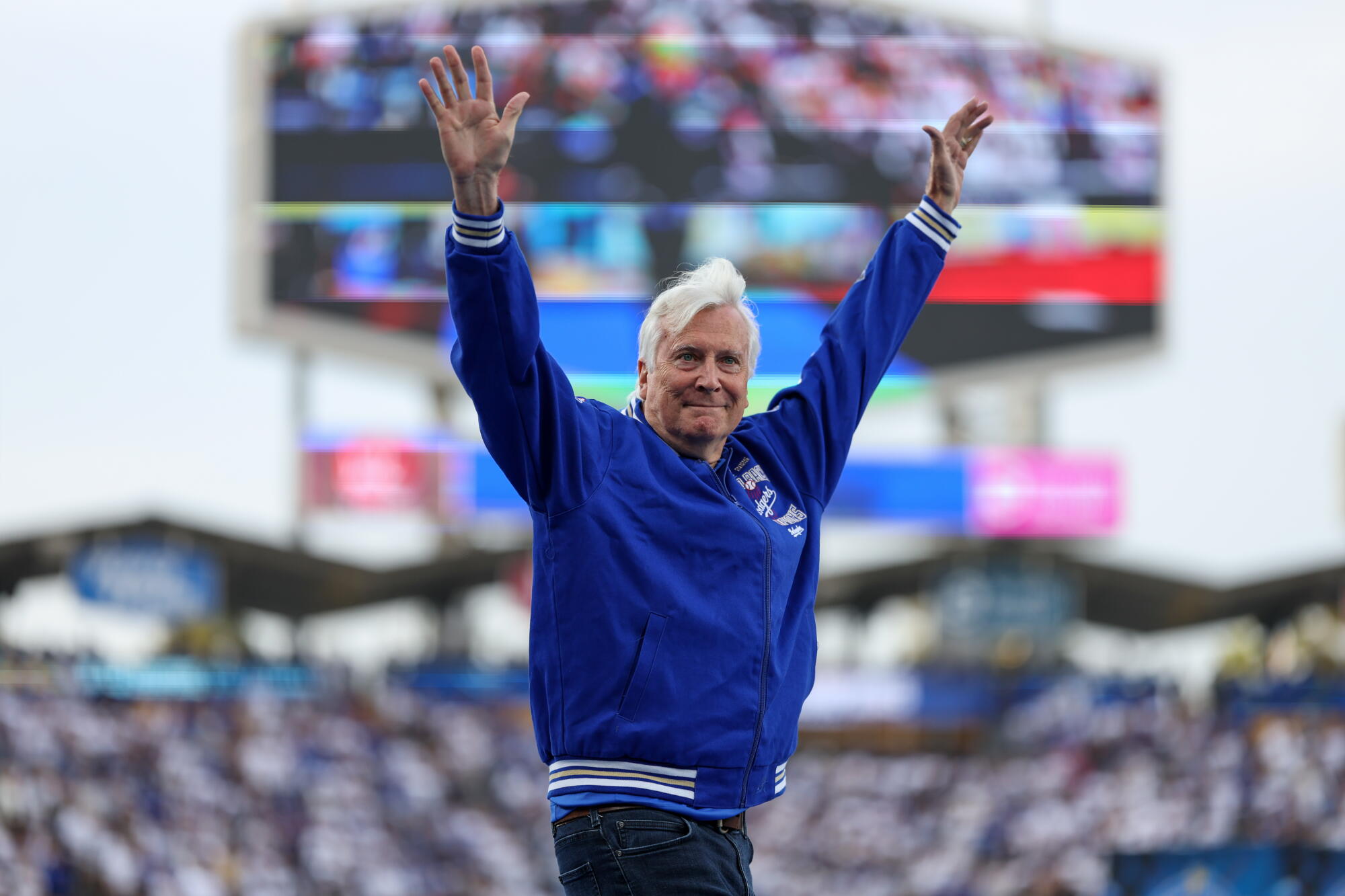
Walter waves to the crowd during the Dodgers’ ring ceremony in March.
(Jessie Alcheh/MLB Photos via Getty Images)
If the Dodgers win a third straight World Series this fall, they will become the first team to three-peat this century. And much of the credit for that would go to Walter, who has funded a front office that consistently has outspent the rest of Major League Baseball, signing seven players to contracts worth more than $2 billion combined in the last six years alone.
Now Walter faces questions about his future owning the Dodgers. Last month, his companies became the focus of two federal inquiries and a Delaware insurance regulatory review.
He is helping pay off some of his companies’ loans and sold the Lakers at a record valuation of $12.5 billion, a deal Walter’s holding company, TWG Global, says was not forced by the inquiries. Still, the sale raised questions about whether he will sell his ownership stakes in other sports properties, including English soccer club Chelsea, the Cadillac Formula One racing team, the WNBA’s Sparks and the Professional Women’s Hockey League.
Walter declined to comment for this article.
Kasten insists Walter has no plans to divest from the Dodgers. “The sports portfolio is going to remain intact,” Kasten said. “It’s important to Mark. I can’t tell you how important the Dodgers are to him.”
Still, Kasten acknowledges the decision to sell the Lakers to former Disney chief executive Bob Iger and venture capitalist Joshua Kushner just 14 months after agreeing to buy the team “was not a planned thing,” either.
Walter hoists the World Series trophy next to MLB Commissioner Rob Manfred last November.
(Rob Tringali/MLB Photos via Getty Images)
Like most of the middle-class kids in the class of 1978 at Jefferson High in Cedar Rapids, Iowa, Walter worked in high school.
“He pumped gas and he played golf,” recalled Cathy Boland Polito, Walter’s date for the senior prom who is now a retired medical technologist living in Oro Valley, Ariz.
Walter hardly stood out in his graduating class of about 350 students. He was athletic but not a stud. He was a good student, especially in math, but not a nerd.
“He was friendly. He was nice,” Polito said. “Everybody sort of knew him.”
Walter talks with Dodgers president Stan Kasten during the playoffs last year. “I can’t tell you how important the Dodgers are to him,” Kasten says.
(Michael Reaves / Getty Images)
Walter went to Creighton University , where he studied accounting and business while playing intramural sports and participating in the philosophy society. Three years later, he earned a law degree from Northwestern.
Walter met his wife, Kimbra, in Chicago, where they raised their daughter, Samantha.
After a decade split between a Chicago law firm and First Chicago Capital Markets, a financial services and securities brokerage, Walter founded an investment firm, Liberty Hampshire Co., in 1996. While there he met J. Todd Morley, who connected him with the Guggenheim family fortune. The introduction quickly led to the formation of Guggenheim Partners, an investment and advisory financial services firm that works with insurance services, among other assets, and one that has a Wall Street reputation for being low-key but aggressive.
Before the COVID-19 pandemic closed Guggenheim’s offices, the lobby of the firm’s Chicago headquarters on the 49th floor of the AT&T Center boasted one of Monet’s “Water Lilies” paintings, which hung behind the receptionist’s desk inside a glass case with an alarm. A Picasso brightened another office upstairs.
Walter with Guggenheim Baseball Management partners Peter Guber, left, Stan Kasten and Magic Johnson at Dodger Stadium in 2012 after the group bought the Dodgers for $2 billion.
(Damian Dovarganes / Associated Press)
A company insider not authorized to speak publicly told The Times in 2012 that Walter was a disciplined, focused and careful investor.
“He is a guy with one of the great financial minds of our time,” the person said.
For Walter, 66, who grew up playing youth baseball about 50 miles from the Iowa cornfield that became Kevin Costner’s “Field of Dreams,” that financial success was all well and good. But the longtime Chicago Cubs season-ticket holder really was a die-hard baseball fan whose dream was to own a sports franchise.
Walter first explored a purchase of the Houston Astros, who eventually were sold to Houston businessman Jim Crane for $615 million ahead of the 2012 season. So Walter pivoted and formed Guggenheim Baseball Management, a group that included Kasten, Lakers Hall of Famer Magic Johnson, movie producer Peter Guber and investors Bobby Patton and Todd Boehly, to buy the Dodgers for $2.15 billion, a record at the time, in March 2012. Part of the money Walter invested in the deal came from the insurers he controlled, although that deal was vetted by state insurance regulators.
MLB engineered the sale of the Dodgers after previous owner Frank McCourt filed for bankruptcy.
“The market drove the price,” Walter told The Times after the sale closed, calling the investment “a multigenerational thing my daughter’s granddaughters will own.” Walter’s daughter, who grew up joining family trips to Los Angeles for Dodgers games, is a marketing manager at TWG Global.
1
2
1.WASHINGTON, DC – JULY 02: U.S. President Joe Biden (C) holds the jersey given to him by Los Angeles Dodgers Chairman Mark Walter during an event with the 2020 World Series champions in the East Room of the White House on July 02, 2021 in Washington, DC. The Dodgers defeated the Tampa Bay Rays to win the championship series at the end of an abbreviated season due to the coronavirus. (Photo by Chip Somodevilla/Getty Images)(Chip Somodevilla / Getty Images)2.WASHINGTON, DC – APRIL 07: (L-R) Los Angeles Dodgers pitcher Clayton Kershaw, U.S. President Donald Trump, and Los Angeles Dodgers Owner and Chairman Mark Walter pose with a jersey presented to Trump as he hosts the 2024 World Series champions in the East Room of the White House on April 07, 2025 in Washington, DC. The Los Angeles Dodgers defeated the New York Yankees with a 7-6 victory in Game 5. (Photo by Kevin Dietsch/Getty Images)(Kevin Dietsch / Getty Images)
Today, the team is the most lucrative in the sport and is on pace to become just the second this century to draw more than 4 million fans in consecutive seasons. The Dodgers could be sold for a valuation of $10 billion to $13 billion — at the higher end, three times as much as the record sale price for a major league team — an industry source told The Times on the condition of anonymity.
Through it all, Walter mostly has shunned attention. The exception is participating in on-field championship celebrations and joining the team for trips to the White House during the Trump and Biden administrations.
His smooth run was interrupted during the Dodgers’ run to the 2024 World Series when Walter suffered a stroke that kept him from the victory celebration. His recovery reportedly was arduous; Walter struggled to speak clearly for months and didn’t return to public view until the Dodgers’ season-opening series in Japan the following spring.
Walter didn’t publicly step down from any roles after the stroke, holding on to control of a vast portfolio. Since buying the Dodgers, he has invested in European soccer, women’s hockey and basketball, squash and auto racing. He also bought several historic buildings in the resort town of Crested Butte, Colo., where he and his philanthropist wife own a home. In 2013, the couple purchased the Wild Oak Plantation, a 17,000-acre wildlife preserve in northeast Florida, where the Walters now spend most of their time.
Kimbra has served on the boards of Chicago’s Lincoln Park Zoo, OneGoal nonprofit and Goodman Theatre and is active in the family’s charitable organization, TWF Causes, which focuses on social impact and conservation work, including owning or supporting several major conservation and private reserve properties in Africa.
The family has a limited political footprint, with Walter donating to the Democratic National Committee and the campaigns of then-presidential candidate Barack Obama and then-Chicago mayoral candidate Rahm Emanuel. The majority of their donations, however, run through their family foundation and the Dodgers Foundation.
“For us, my wife and I, and all of my partners believe that corporations have to be corporate citizens, and individuals who benefit from them, or who have built them, need to give back,” Walter told ESPN soon after buying the Dodgers. “You can’t take it with you, and you ought to do something philanthropic with it.”
But while he’s put money into charitable projects, he’s invested his heart and soul in the Dodgers, Kasten said.
“He cares deeply about it,” the Dodgers president said. “He’s living through every play, every out, every at-bat.”
However much longer Walter remains invested in the Dodgers — financially, at least — could come down to math.
Justice Department prosecutors, the Securities and Exchange Commission and a Delaware insurance regulator are investigating whether Walter funneled as much as $21 billion from the portfolios of two insurance companies he owns into private credit for loans to other companies he also controls while reporting just a fraction of the loans’ value. The Wall Street Journal and the Athletic reported Walter used billions of dollars of those insurance premiums to buy sports teams.
Such “related party transactions” are legal, within limits, but are required to be reported to guard against conflicts of interest and to protect clients.
In Walter’s case, the related-party loans f initially were reported at between $1 billion and $1.4 billion when the true total actually was between $16 billion and $21 billion. The reclassification meant the affiliated investments jumped from 2% of one insurer’s portfolio to about 40%, according to Fitch Ratings.
No formal charges have been filed, and TWG Global, the multinational holding company led by Walter, is cooperating in the investigation. Walter has declined to be interviewed or to respond to written questions about the investigation, but his representatives have strongly denied any improper behavior, describing reports of the probe as “substantial speculation and misinformation” advanced by “unnamed sources and self-serving interests.”
“It does not inspire confidence to know that this kind of wild understatement happened,” said Andrew Granato, a law professor at the University of Texas at Austin who specializes in corporate finance and insurance. “It also doesn’t inspire very much confidence in the system of insurance regulation we have, that there could be this big of a mess that was not caught for years.”
Walter hired veteran Goldman Sachs lawyer David Markowitz to be his chief legal officer and reportedly is exploring the sale of his 12.8% stake in the Chelsea soccer club to Clearlake Capital, a Santa Monica-based private-equity firm whose Puerto Rican-born co-founder, José E. Feliciano, recently bought the San Diego Padres.
A source close to Walter not authorized to discuss it publicly told The Times he has an interest in selling Chelsea if the terms are right but insisted there is no desire to sell the Sparks, the PWHL, his investment in professional squash or, more prominently, his stake in the Dodgers.
While Kasten and TWG Global officials insist the Dodgers aren’t for sale, uncertainty likely will linger at least until all investigations are completed.
Times staff writer Mirjam Swanson contributed to this report.
In June of last year, 66-year-old Walter and one of his holding companies, TWG Global, purchased a controlling interest in the Lakers for $10 billion, only to sell the franchise to Joshua Kushner and Bob Iger for $12.5 billion this month.
Since then, questions have swirled about whether Walter will put other assets on the market in his fundraising bid, including the Dodgers, which he purchased as chief executive of Chicago investment firm Guggenheim Partners for $2.15 billion in 2012. Sources close to Walter say he’s not likely to sell.
To better understand this tangled story, we spoke with Times sports reporter Steve Henson about why he thinks Walter won’t put the Dodgers up for sale.
You’re reading the Essential California newsletter
Sign up to start every day with California’s most important stories.
By continuing, you agree to our Terms of Service, which include arbitration and a class action waiver. You agree that we and our third-party vendors may collect and use your information, including through cookies, pixels and similar technologies, for the purposes set forth in our Privacy Policy such as personalizing your experience and ads.
These dealings are “between entities with business or personal ties, including loans, sales and other transactions that can have legitimate reasons but pose potential conflicts of interest and typically require extra scrutiny,” Darmiento wrote.
More than $1 billion in financing to buy the Dodgers in 2012 came from insurance companies managed by Guggenheim Partners. The purchase was later vetted by state insurance regulators.
More on the related-party transactions
Investigators are checking whether billions of dollars’ worth of similar loans made by Walter’s companies were properly disclosed and that insurance companies were not over-leveraged.
Approximately $21 billion in loans not disclosed to state insurance regulators were made by two Delaware insurers Walter owns, according to ratings agency Fitch. The loans reportedly were made to companies with ties to Walter or his TWG Global holdings company.
The issue with these loans is they raise suspicions, according to Bruce Dubinsky, a forensic accountant who spoke with Darmiento. Dubinsky worked on the Enron and Madoff cases.
Dubinsky said that from an audit standpoint, these types of transactions “are always more suspect to fraud” and manipulation since repayments can be delayed indefinitely.
The insurance industry’s tight regulations for money collected from premiums exists so that money is available for future claims. Regulators believe related-party transaction are a threat to that guarantee.
Henson reported that Walter owns a broad series of sports interests: English soccer Premier League team Chelsea, the Los Angeles Sparks WNBA team, the Cadillac Formula 1 racing team; a premier women’s tennis competition, the Billie Jean King Cup, and the entire Professional Women’s Hockey League.
He already sold the Lakers and Henson noted that there have been reports he’s putting his shares of Chelsea on the market.
So, why keep the Dodgers?
“No MLB team has ever been run as boldly as this team,” Henson said. “And the revenue from the Dodgers is relentless, from ticket sales, to international merchandise and including friendly [player] salary deferments that help keep money in-house.”
Since Walter and Co.’s takeover, the Dodgers have won three of the last six World Series and 12 division titles after he and partners rescued the franchise from bankruptcy.
Walter noted that a sale of the Lakers, a franchise he’d barely owned for more than a year, was easier than one he’s already helmed for nearly 15 years.
“His identity is totally wrapped up with the Dodgers and this success saga,” Henson said. “It’s dear to his heart and having them to sell them would just tear him up.”
Amid all of this speculation, the boys in blue are attempting to become the first National League team (and third overall) to win three consecutive World Series titles this year.
The week’s biggest stories
(Carolyn Cole/Carolyn Cole/Los Angeles Times)
Trump administration policies and pushback
Artist and concert news
A final tribute
Television, advertising entertainment news
More news
Editor’s pick
More picks
Things to do
(Melody Xu/Los Angeles Times)
Today’s recipe
The San Juan Islands off Washington state has a much-loved clam chowder served at La Conner Brewing Co. in the tiny picturesque town of La Conner, Wash. The dish is spicy enough and not so thick with cream or flour and is a standout in the clam chowder world, according to Times reader Mary Ann Mollenkamp.
Have a great day, from the Essential California team
Jack Dolan, investigative reporter Hugo Martín, assistant editor, fast break desk Kevinisha Walker, multiplatform editor Andrew J. Campa, weekend writer Karim Doumar, head of newsletters
Mark Walter doesn’t need to sell the Sparks. It said so in a release from his company Wednesday: “TWG is not looking to sell its sports assets at ‘fire sale’ prices to raise capital for its insurance operations.”
Not because of the investigations into allegations that insurance companies under Walter’s umbrella failed to properly disclose and conduct transactions between other companies he controls.
But for the sake of the storied WNBA franchise, which hasn’t won a championship in a decade and is about to miss the playoffs for the sixth consecutive season — something that would have been unthinkable six seasons ago.
Sell for the sake of the Sparks, who have long deserved an owner who wants seriously to run the team like Walter’s group runs, well, the Dodgers.
With passion and pride, foresight and smarts.
A steel beam is raised as the final structuarl piece of the Sparks’ $150-million training facility in El Segundo on Wednesday.
(Ronaldo Bolanos / Los Angeles Times)
And, yes, the new $150-million training facility that’s going to open in El Segundo next year is a better-late-than-never step in that direction.
It’s not too little; the 64,000-square-foot space, which will be tremendous in a prime location near the beach and shopping.
But it’s very late. Wednesday’s topping-out ceremony, when a construction crew lifted the final structural beam into place, doesn’t change that.
While so many of the Sparks’ rivals have had the upper hand in recruiting and retaining talent with state-of-the-art private practice spaces for the past few years, the Sparks have been — to use star forward Nneka Ogwumike’s word — “nomads.”
The Sparks have always offered fans a famously fun game-day experience, but their players had to continually get familiar with facilities all over Southern California, from L.A. Southwest and El Camino College to Academy USA in Glendale to Jump Beyond Sports in Torrance, from Windward School and Galen Center to JR286, the gym in Torrance where they practice now.
Starting next season, they’ll have a home.
A rendering of the Sparks’ new training facility in El Segundo.
(Ronaldo Bolanos / Los Angeles Times)
But it’s not because the Sparks’ ownership wanted to do what Mark Davis did with the Las Vegas Aces when he was the first owner to provide fancy new digs in 2023.
Not because they were resolute about giving the Sparks a first-class experience, like Joe Tsai did when he chartered flights for New York Liberty before the league said it was legal, getting himself fined $500,000.
But because the Sparks would fall further behind if they didn’t.
Because now “it’s the bare minimum,” said forward Dearica Hamby, whose input — dedicated spaces for family and naps — was incorporated into the building’s design.
It also will include two regulation basketball courts, a performance and training environment, hydrotherapy and recovery rooms and a player sanctuary.
“It represents a belief in our players,” said Stacy Johns, the team’s president. “It represents a belief in the future of the Sparks. And it represents a belief in where women’s basketball and women’s sports are going.”
Members of the media and guests gather with the Sparks’ front-office staff for the topping-out ceremony in El Segundo on Wednesday.
(Ronaldo Bolanos / Los Angeles Times)
Where’s that? Up.
Valuations are growing. In May, CNBC reported that the WNBA’s current teams were worth an average of $460 million — 84% more than the league’s most recent expansion fee of $250 million.
The Sparks — without taking the new facility, the largest investment to date in the history of women’s sports, into account — were valued at $415 million, seventh among the WNBA’s 15 teams.
The Golden State Valkyries, an expansion team in 2025, were valued at a record $1 billion, more than any women’s sports team in history.
That’s because the Valkyries — who are owned by the Golden State Warriors’ Joe Lacob and Peter Guber — have been innovative and imaginative, run more like the Dodgers than the Sparks, who are owned mostly by the same folks as the Dodgers.
The Dodgers instituted a private player-only plane and added Japanese-style toilets after then-recruit Roki Sasaki asked. The Valkyries established a 30-plus network of area bars for fans to gather to watch games and they helped a player with sleeping problems by offering everything from a different comforter to a sleep study.
Rendering of the inside the contrition of the Sparks’ new training facility, including a dining area.
(Ronaldo Bolanos / Los Angeles Times)
The Dodgers gave the keys to Andrew Friedman and Dave Roberts. The Valkyries’ GM is Ohemaa Nyanin, formerly an assistant GM with the WNBA champion New York Liberty, and their coach is former UCLA Bruin Natalie Nakase, before an assistant on Aces championship teams and an NBA assistant for years with the Clippers.
The Sparks have for the past several seasons cycled through unproven coaches and GMs, or fired experienced ones. Unable to pick a lane and drive it, they keep ricocheting between preaching patience and acting impatiently. And at the moment, they don’t even have a GM after firing Raegan Pebley in July.
Johns, who was brought on to oversee the team’s business in April, said things are changing. And change takes time.
The Sparks are 13-25, behind the expansion Portland Fire in the standings and having lost twice to the expansion Toronto Tempo. But they’ve tripled their sports staff this year, adding performance and mental health therapists and additional basketball data people — who apparently aided in the construction of an old, uncompetitive roster.
“I couldn’t tell you what happened or who woke up one day and decided,” said Johns, who worked for the MLS champion LAFC and Super Bowl champion Indianapolis Colts. “But when I was recruited … I was explicitly told like, ‘This is changing,’ and like, ‘We’re hiring you because we want to signal change.’”
The biggest change that could help the Sparks? At the top, with someone who wants to push the envelope instead of compensate and play catchup.
Rendering of the inside the contrition of the Sparks’ new training facility, including a basketball court.
TWG Global — the holding company of Dodgers owner Mark Walter — rejected allegations of financial impropriety in the purchase and operation of the Dodgers and reiterated the team is not for sale.
At a time insurance regulators and federal investigators are looking into allegations that insurance companies under Walter’s umbrella did not properly disclose and conduct transactions between other companies he controls, and after Walter sold his controlling interest in the Lakers at a record $12.5 billion valuation, potential bidders have monitored whether the Dodgers might be sold as well.
In a statement Tuesday, TWG Global decried “multipronged attacks against TWG … by unnamed sources with self-serving interests” and said no insurance policyholder has been hurt as a result of the company’s financial transactions.
“There is no victim here,” the statement said. “No one has been harmed, and no one has claimed they were harmed.”
In 2012, when Walter and his partners bought the Dodgers for $2 billion, The Times reported the use of $1.2 million from Guggenheim Partners insurance funds into the deal. At the time, rival bidders expressed concern over the unusual financing, but state insurance regulators cleared the deal and Major League Baseball approved it.
“The transaction was subject to a full investigation conducted by an outside law firm on behalf of insurance regulators from multiple states,” the statement said, “which identified no irregularities and resulted in no further action.”
Even with the Dodgers issuing over a billion dollars in deferred contracts and amid whatever transactions might have been conducted between TWG-related insurance companies and the Dodgers’ affiliates — including ones that hold the team’s television rights and ticket revenues — the Dodgers’ ability to fund player contracts is not at risk, according to the statement.
“The Dodgers have the highest revenue in baseball, and it significantly exceeds the team’s obligations to its players,” the statement said.
The statement reiterated that, as Dodgers president Stan Kasten has said, “the team is not being sold and no sale process has been initiated.”
The Dodgers, if sold, could likely command a price in the range of $10 million to $13 million, industry analysts have told The Times.
The Lakers sold at a record price for a North American sports franchise, although industry analysts have said a competitive bidding process likely would have resulted in an even higher sale price.
Said the statement: “Mr. Walter was approached by Josh Kushner and his team about this transaction and the agreement represents a 25% premium to the price paid by Mr. Walter less than a year ago (and an even higher premium to the $5.0 billion valuation Mr. Walter paid in 2021) — hardly a ‘fire sale.’”
The statement added: “TWG is not looking to sell its sports assets at ‘fire sale’ prices to raise capital for its insurance operations.”
TWG said it is “working cooperatively and in partnership with the Delaware Department of Insurance” to resolve the regulatory issues and “is committed to working with the U.S. Department of Justice and the Securities and Exchange Commission to resolve their inquiries.”
“TWG stands firmly behind the integrity of its business,” the statement read. “Despite what has been reported, there has been no fraud.”
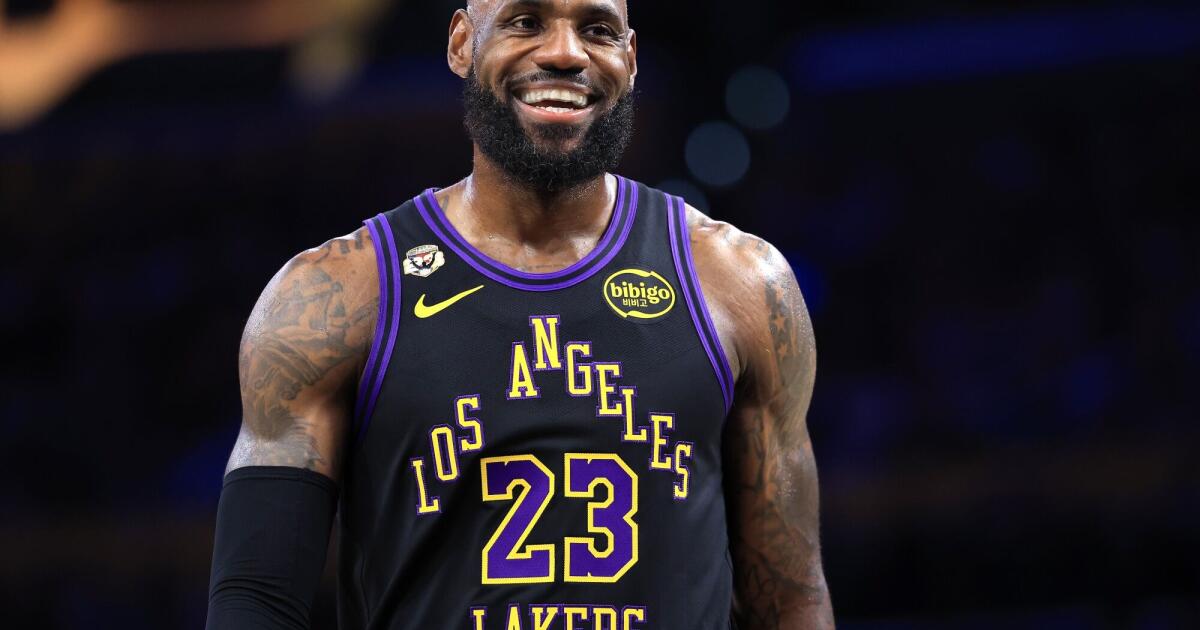
When LeBron James signed up to lead the Los Angeles Lakers to NBA glory with a $154 million contract in 2018, it wasn’t the biggest deal he did that year.
Just months before he joined, a limited liability company he controls borrowed almost $300 million from a pair of Midwestern life insurers advised by an arm of Guggenheim Partners, according to insurance industry records reviewed by Bloomberg.
The previously unreported bonds, which are due in 2049, were structured to provide immediate cash to James and backed by a stream of future revenue tied to his earnings outside basketball such as a lifetime Nike Inc. sponsorship, people with knowledge of the matter said.
The burst of lending began before Guggenheim leader Mark Walter started acquiring the storied basketball team. In an abrupt turn this month, the billionaire mogul agreed to sell the Lakers amid a federal probe into parts of his business empire. There’s no indication that the loans to James have anything to do with those inquiries.
Athletes and artists are increasingly using future earnings like royalties and licensing deals to structure deals that help them unlock immediate capital. David Bowie was famously the first recording artist to go to Wall Street to tap the future earnings of his music, paving the way for a thriving market for esoteric securities.
But James’ deal offers another look at how Walter and fellow Wall Street money managers have tectonically shifted the once-boring business of life insurance, steering policyholder premiums into more unusual investments. Guggenheim has moved insurers’ money deeper into private credit, sports franchises and — with James — financing for a star player. That’s far outside the industry’s traditional focus on plain-vanilla assets to reliably pay out future claims.
The two insurers — North American Company for Life and Health Insurance and Midland National Life Insurance Co. — are both owned by Sammons Financial Group. During a call with investors this week, Sammons said Guggenheim was the sole manager in charge of picking assets for the firm’s portfolios until 2021, according to people who heard the remarks and, like others in this story, asked not to be identified describing confidential dealings.
Sammons has been distancing itself from Guggenheim recently. Walter’s firm had long counted Sammons’ parent company among its biggest investors. During the call, though, Sammons’ representatives said it has been selling down that stake, the people said.
The “transactions were a securitization done by Mr. James with his personal, non-NBA salary, assets and income which is a very common financial structure for an individual with this level of earnings and assets,” a spokesperson for James said.
Spokespeople for Sammons and Guggenheim declined to comment.
The scrutiny of Walter’s empire by the Justice Department and Securities and Exchange Commission has turned up the spotlight on the intermingling of asset managers and insurers.
Wall Street power players have used insurance balance sheets to pursue their quest for higher returns, steering the savings of everyday Americans into more opaque and complex investments. The approach lets asset managers originate and structure deals, and then find uncomplaining buyers by parking such investments on the balance sheets of insurers they influence.
King James Funding
James’ borrowing from the two Midwestern insurers — structured as sales of asset-backed bonds — began when he was at the Cleveland Cavaliers and his career was poised for new heights.
The two companies bought almost $300 million bonds issued by an LLC he controlled called King James Funding, the records show. Within a few years, the LLC paid down some of that debt, then sold more bonds to the insurers, leaving them with about $245 million on their books by the end of last year, the records show.
The initial bonds from 2018 had a 4.8% interest rate and aren’t due until late 2049, the industry filings show. Terms are otherwise scant in the records reviewed by Bloomberg.
A few months after the deal, James started looking for another team as a free agent, ultimately picking the Lakers. In an oft-retold moment, he received a visit at home from Walter’s longtime business partner Magic Johnson, then a top executive for the Lakers. James ultimately signed a four-year contract.
Then in mid-August 2022, James signed a $97 million contract extension with the Lakers. Around that same time, the same Midwestern insurers provided his LLC with more cash, buying almost $60 million of 34-year bonds with a 5.75% interest rate, the insurers’ records show.
“Both transactions were independently credit rated by a third party and the 2022 transaction was fully approved by NBA,” James’ spokesperson said, noting the athlete had no affiliation with Guggenheim, Sammons, North American Co. or Midland National beyond their participation in the transactions.
Guggenheim also got involved in some of James’ other personal ventures. As the Covid pandemic took hold in 2020, he and his childhood friend and business partner, Maverick Carter, announced that they had raised $100 million for their media venture called SpringHill Co. Guggenheim was listed among investors in that company.
Leaving the Lakers
For more than a decade, Walter has mixed money from insurers with investments in sports. His 2012 acquisition of the Los Angeles Dodgers with business partners including Johnson relied heavily on the insurance industry.
Afterward, the new team’s owners ramped up spending on players to turn the franchise into a jewel of professional baseball, appearing in five of the past nine World Series. But that playbook isn’t as feasible in the NBA, which has stricter caps on team salaries.
Walter’s acquisition of the Lakers began in 2021 when he purchased a minority stake, granting him rights that paved the way for him to take a majority stake last year.
The sale of the team came as Walter has been reshaping his empire to unwind more than $20 billion of loans on his insurers’ books that should have been marked as funding affiliated businesses, but weren’t. While regulations allow insurers to lend money to such parties, they require that the dealings be disclosed.
James, meanwhile, announced that he’s leaving the Lakers and he signed a two-year deal with the Philadelphia 76ers. His new team is co-owned by Josh Harris, whose 26North Partners invests across middle-market private equity, credit and insurance.
Li, Sridhar Natarajan and Rajbhandari write for Bloomberg.
Second inning, Blake Snell gives up a one-out single to Spencer Horwitz, who advances to second on a passed ball, but Snell strands him with a strikeout of Billy Cook.
Lovely, but what happens if Mark Walter sells the Dodgers?
Third inning, Bryan Reynolds draws a two-out walk, but Snell strands him with a flyout to left by Brandon Lowe.
Walter, Lakers, feds, billions, sell?
On a blistering Sunday afternoon at Dodger Stadium, the Dodgers defeated the Pittsburgh Pirates 4-0 to complete a three-game sweep, but the rumblings beneath Chavez Ravine indicated there was much more at stake.
This is a solid franchise fighting for its footing. This is a powerful dynasty that could be undone by paper.
So, seriously, are the Dodgers getting sold?
Nobody knows, but a reasonable guess would be yes.
The Dodgers, of course, say no way, no how, no chance. Stan Kasten, the Dodgers’ president, even met with the media Friday specifically to say it’s not happening.
“The Dodgers are not being sold,” Kasten said. “They’re not going to be sold. They’re not for sale. There’s no process that has been started to sell [the franchise]. Period.”
Period? Kasten is a busy man, and there’s seemingly no way he holds even an impromptu meeting with reporters about a possible sale if that “period” wasn’t a “question mark.”
It is indeed a huge question mark, one that suddenly appeared less than two weeks ago when Walter stunningly sold the Lakers just 14 months after buying them.
A federal investigation into insurance companies Walter controls may have led to the Lakers sale, and there’s since been plenty of confusing talk about related-party transactions and holding companies and invested assets.
Translated for Dodgers fans?
The owner of your team also owns another business facing a big legal problem that requires billions to fix. And the only way he can raise those billions is to sell his assets. And the $2.5 billion he will receive from the Lakers flip is only a drop in the bucket.
Which means the Dodgers could be next.
There are reports that Walter is selling his shares in the Chelsea Football Club of the English Premier League, but that won’t cut it.
He could sell some of his smaller properties such as the WNBA’s Sparks, the Cadillac Formula 1 racing team, and the entire Professional Women’s Hockey League, but that might not cut it, either.
His richest, most lucrative, and perhaps most expensive property is the Dodgers. A source told The Times’ Bill Shaikin they could be worth between $10 billion and $13 billion, which would be a record price for a baseball team.
Though no charges have been filed against Walter or anyone associated with his businesses, one could imagine Walter pulling the trigger on the Dodgers sale simply to keep the feds at bay.
“I wanted you to hear it definitively: We are not selling the Dodgers,” Kasten repeated. “We are continuing with our plans going forward, like we always have had them. This comes from Mark. He’s gung ho about continuing to try to win, again, including next year, subject to whatever next year’s climate looks like.”
This full-speed-ahead attitude by Dodgers management is what makes it so hard to imagine the team being owned by someone other than Walter.
Without Walter, there is no dynasty. Without Walter, there is no richest team in baseball. Without Walter, there is no happiest fan base in baseball.
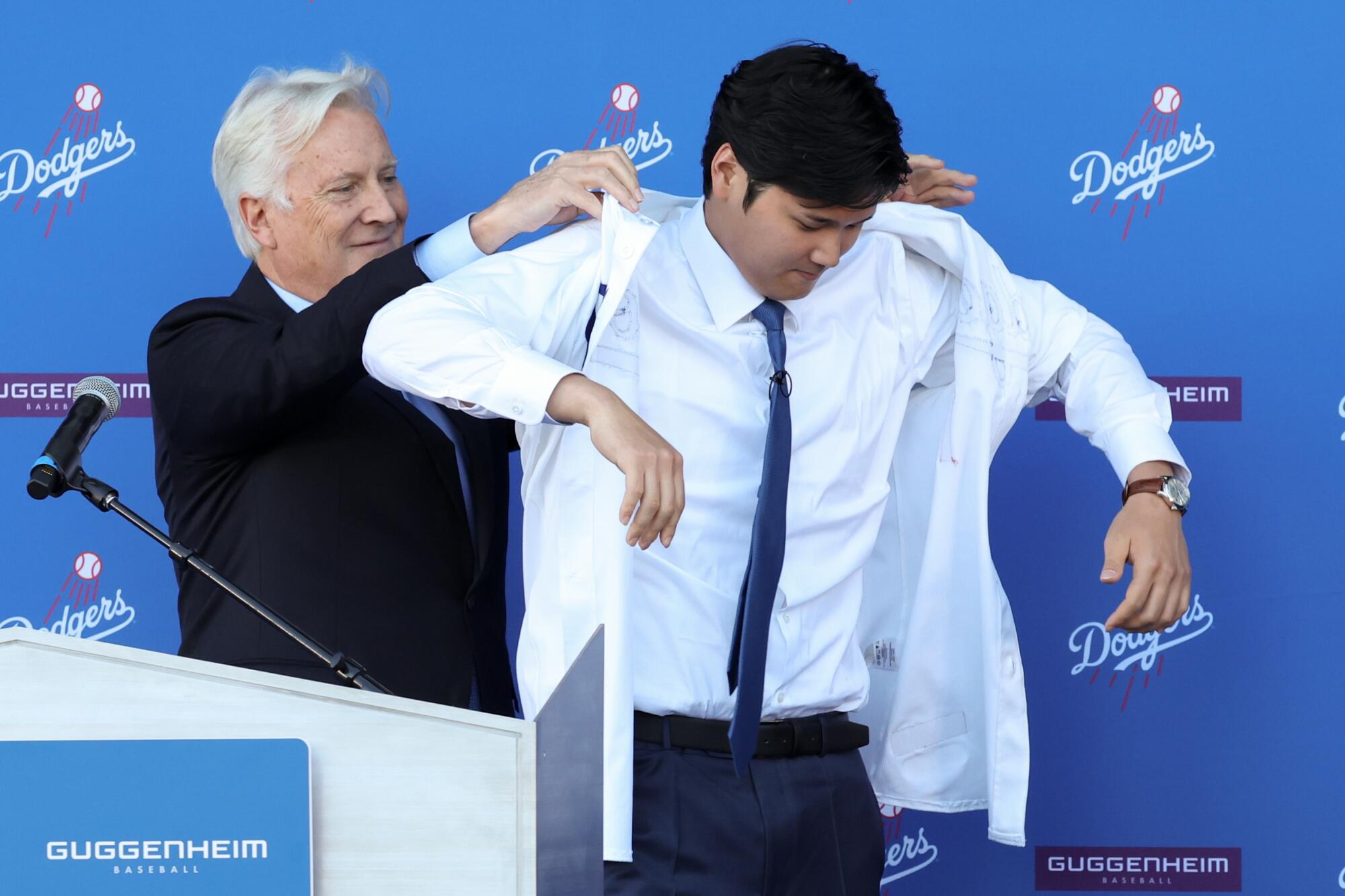
Dodgers owner Mark Walter helps Shohei Ohtani put on a jersey during a news conference on Dec. 14, 2023, after the two-way star signed a 10-year, $700-million deal with the team.
(Wally Skalij / Los Angeles Times)
Since Walter and his Guggenheim Baseball Management Group purchased the team in 2012, they have spared no expense in winning 12 of the last 13 National League West championships and three World Series titles.
Nobody in baseball spends like Walter, or will ever spend like Walter. From allowing the team to travel on two planes to adding baseball’s highest-paid player and relief pitcher last winter — Kyle Tucker and Edwin Díaz have been busts, but there’s time for redemption — nobody is willing to pay more for success than Walter.
Fans benefit from a Walter partnership on a daily basis. Witness Snell’s six shutout innings against the Pirates on Sunday. The Dodgers swept the three-game weekend series against the supposed contenders behind three starting pitchers who will lead off the playoffs yet who would not all be here if Walter didn’t own the joint.
Who else could pay to acquire superstars Yoshinobu Yamamoto and Snell while building up a farm system that could produce prospects who were used to acquire Tarik Skubal?
The three starters combined to allow the Pirates just five runs in 19 innings with 26 strikeouts and five walks, and how good is that going to look in October?
While Andrew Friedman supplies the talent and Kasten works the business, none of it is possible without the seemingly endless flood of money approved by Walter.
Well, the end might be near.
If Walter sells the team, they could possibly lose their two MVPs — Friedman and Ohtani. Unless the new owners give Friedman a piece of the team, he could set off to build another dynasty elsewhere. And Ohtani has a clause famously included in his contract that allows him to leave if either Friedman or Walter leaves. If Walter goes, Ohtani could demand a new contract with terms that a new cash-strapped owner cannot afford.
As of last week, there is so much at stake, so many reasons to worry, and even all the winning by baseball’s best-run team won’t offer much relief.
Now baseball’s best owner is suddenly its most embattled owner, and Dodgers fans should be afraid.
Dodgers president Stan Kasten wants to make it clear that majority owner Mark Walter will not sell the team.
Following Walter’s decision to sell his majority stake in the Lakers, questions about his majority ownership of the Dodgers were raised amid his company’s financial difficulties, which include a federal probe of his businesses. But Kasten said it will have no effect on Walter’s majority ownership of the Dodgers.
“The Dodgers are not being sold,” Kasten said. “They’re not going to be sold. They’re not for sale. There’s no process that has been started to sell [the franchise]. Period. … I just wanted this to be clear because this question keeps coming up. I understand the questions; I do. The Lakers thing was what we call sui generis, one of those one-of-a-kind things. Really has nothing to do with what’s happening with [the Dodgers] or the other teams.
“I wanted you to hear it definitively: We are not selling the Dodgers. We are continuing with our plans going forward, like we always have had them. This comes from Mark. He’s gung-ho about continuing to try to win, again, including next year, subject to whatever next year’s climate looks like.”
Kasten added that he doesn’t expect the Dodgers’ operations to be interrupted, describing the franchise as “very stable, well-managed, and [with] very solid ownership.”
“I know nothing involving the Dodgers is part of the investigation,” Kasten said. “I’m promising you, when it’s over, you’re going to realize [things] are being mischaracterized. You don’t have to trust me, but I’m telling you.”
When Kasten was asked about reports Walter is trying to sell his stake in English Premier League team Chelsea FC and tried to cash out of lucrative TV deals with Charter Communications, he said they were mischaracterized.
“Those things don’t go together for a bunch of reasons I’m not going to get into today,” Kasten said.
Kasten took a similar tone when asked about reports of Walter having to repay insurance companies.
“I’m not in that part of the investigation,” Kasten said. “Things are going on behind the scenes, obviously, in connection with that. I’m not privy to all of them, don’t need to know, don’t want to know. But one thing we are all certain about: the sports portfolio is going to remain intact.”
Walter has additional ownership stakes in the Sparks, the Cadillac Formula One team, the Professional Women’s Hockey League and the Billie Jean King Cup tennis event.
“I can tell you from the guy running the team, knowing how the business runs and what it can support in terms of revenues and expenses — the Dodgers aren’t going anywhere,” Kasten said. “I feel that very strongly, and Mark feels even stronger than I do. I’m 74. I don’t know how long I’m going to be running it, but Mark, I think, is going to be running it a lot longer.
“I think Mark has done an extraordinary job as an owner, and all he’s ever cared about is providing the best experience in order to make us more money, to make this project successful,” Kasten added. “I think so far it has been; I expect that to continue far into the future.”
For more than four decades, the Lakers were a family-run business. The sibling rivalries still remain.
Jeanie Buss is fighting back after her siblings reportedly voted to sell the family’s remaining stake in the Lakers on Monday. The team’s governor, Buss sent a letter through her attorney to her brothers’ attorneys stating any votes to sell the family’s remaining 17.8% stake in the team to new majority owners Bob Iger and Joshua Kushner are void because the sale cannot be completed without approval of the other trustees: Jeanie and her younger siblings, Janie and Joey.
ESPN reported Monday that the six Buss family siblings, who took over team ownership after their father, Jerry Buss, died in 2013, are selling their shares of the Lakers to Iger and Kushner following a family vote. Iger, the longtime Disney chief executive, and Kushner, a venture capitalist and entrepreneur, agreed last week to buy Mark Walter’s controlling stake of the Lakers for a record valuation of $12.5 billion.
The transactions still need to be approved by the NBA board of governors. Jeanie Buss, who was to remain the Lakers governor for at least five years after Walter’s purchase of the team was approved last October, no longer would be eligible to serve on the board if the Buss family sells its shares. Governors are required to own at least a 15% stake.
“The co-trustees are bound to vote the Los Angeles Lakers, Inc. shares to ensure that the minimum 15% ownership requirement is maintained in order to ensure that Jeanie Buss may remain controlling owner,” the letter from Buss’ attorney reads, citing a 2017 court ruling outlining Jeanie Buss’ role. “Any attempt by the co-trustees to do otherwise and any attempt to aid or abet the co-trustees as such would constitute a breach of trust, breach of fiduciary duty and be in contempt of court.”
The trust was revised in 2017 after a series of legal battles between Jeanie and her older brothers, Johnny and Jim. It stipulated that co-trustees “would take all actions reasonably available to them, including voting the trust’s shares to ensure that [Jeanie Buss] is elected as the controlling owner of the Lakers on an annual basis during [her] lifetime.”
The statement to ESPN attributed to the Buss family regarding the sale read: “We have decided as a family to sell the remaining Buss Family Trust shares to the Bob Iger group as part of the ongoing transaction. We love the Lakers, Laker fans and will continue to support Los Angeles; but it is time to use this opportunity to move on and exit gracefully while we still can.” ESPN didn’t report a price for the shares.
The Buss family has owned the team since 1979, when Jerry Buss bought the franchise, the Forum and the Los Angeles Kings for $67.5 million. The family patriarch leveraged Hollywood glamour with entertainment spectacle to elevate the Lakers into an internationally recognized brand. The NBA’s biggest stars shone brightest in L.A.; Jerry West, Kareem Abdul-Jabbar, Magic Johnson, Shaquille O’Neal and Kobe Bryant helped pile up 10 championships under Buss. The Laker Girls became a harbinger of sports dance teams to come. Celebrities flocked to the courtside seats. Books and TV shows told the team’s Hollywood story.
Each of Buss’ six children — Jeanie, Jim, Johnny, Janie, Joey and Jesse — held titles in the organization. Jeanie was her father’s hand-picked successor. She fought to maintain her position against Johnny and Jim, who tried to reorganize the board of directors to push Jeanie out in 2017. She eventually ousted them from team operations. Joey and Jessie, the two youngest, were fired by the new owners last November. Joey was the team’s alternate governor and vice president of research and development, and Jesse was the assistant general manager. Janie held an administrative role directing the team’s charitable services.
The booming sports business quickly caught up to the team that once held the attention of the city with the league’s biggest stars, iconic “Showtime” style and old Hollywood feel. The Lakers slogged through a six-year playoff drought from 2013-19. The team started falling behind in resources and revenue compared to other organizations that controlled their own arenas and could maximize alternative revenue streams. The Buss family voted to relinquish a majority ownership of the team last year, bringing in Walter, who also owns the Dodgers.
Walter then shockingly flipped the NBA’s crown jewel franchise for a profit of $2.5 billion last week. The investment mogul who is under federal investigation for unpaid loans agreed to sell his stake in the Lakers to Kushner and Iger. Kushner is a co-founder of Thrive Capital, which started a permanent holdings company, Thrive Eternal, this year to invest in sports and cultural brands. Iger is the longtime Disney CEO who already owns Southland soccer club Angel City FC and previously flirted with NFL ownership by trying to build a stadium in Carson before the project ultimately went to the Stan Kroenke-led group that built SoFi Stadium in Inglewood.
Before including the Buss shares, the deal for the Lakers’ majority stake already was the largest sum paid for any professional sports franchise, surpassed only by Walter’s $10-billion purchase of the team. It still sits below Sportico’s estimate for the most valuable franchise, with the outlet listing the Dallas Cowboys’ valuation at $15.5 billion.
Minority stakeholders Dr. Patrick Soon-Shiong, who also owns the Los Angeles Times Media Group; real estate billionaire Ed Roski; and Walter business partner Todd Boehly own about 14% of the Lakers, according to Sportico.
How Iger and Kushner will finance the Lakers deal is unclear.
When the duo agreed to buy Walter’s share last week, Kushner and Iger released a statement that in part praised the Buss family’s work with the Lakers.
“We have immense respect for the leadership and vision of Jerry and Jeanie Buss,” the statement read. “Our long-term commitment is to build on that foundation, compete at the highest level, and serve this extraordinary team, its fans, and the city of Los Angeles.”