Raised in Alabama, Nicholas Brownlee is now a world-class opera star
MUNICH, Germany — Nicholas Brownlee had just fallen in love with opera and was eager to see if his emerging bass-baritone voice could handle Richard Wagner’s music. It did not go well.
“I kept reading how you have to wait to sing this big repertoire,” Brownlee said. But there was one bit of Wagner — Wolfram’s “Song to the Evening Star” from “Tannhäuser” — that’s “a little bit lighter. I figured it was more appropriate.”
So he brought it to his teacher, Thomas Rowell, at the University of South Alabama and asked what he thought.
“I just laughed at him and told him to go away,” Rowell recalled. “He knew that big voice was there, and he was so eager to try on the clothes, but they didn’t fit for a while. It was still a very young instrument.”
Reminded of that exchange nearly 20 years later, Brownlee smiles. “I was a bit ambitious,” he said. “But this was just me.”
Now that ambition — what he calls “a fire in my belly that burns brighter every day,” — has helped propel Brownlee to the very top of his profession at age 37. And he’s done it by singing a lot of Wagner.
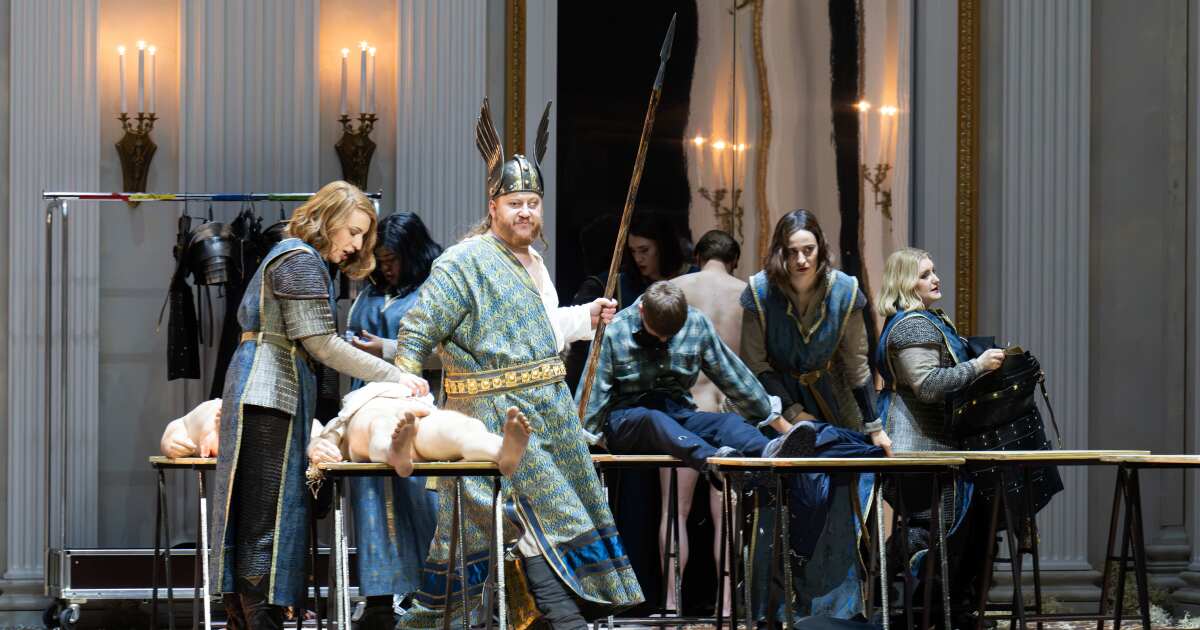
Brownlee recently made his debut as Wotan, embattled king of the gods, in “Die Walküre” at the Bavarian State Opera House, part two of a complete “Ring” cycle directed by Tobias Kratzer. He had previously sung the role in “Das Rheingold,” the opera that opens the cycle.
The critics reached for superlatives. “A heroic baritone straight out of a textbook,” wrote Markus Thiel in Merkur, “with a powerful, resonant voice, a force of nature.” Carlota Moseguí in Platea Magazine praised his voice and said Brownlee “possesses all the qualities to become the definitive Wotan of his generation.”
Next, Brownlee heads to the Wagner shrine in Bayreuth, Germany, where he will star as the title character in “Der Fliegende Holländer” (“The Flying Dutchman.”) And his upcoming season is one Wotan after another.
“It’ll be ‘Siegfried’ time in Munich, then ‘Walküre’ time in Buenos Aires, then ‘Rheingold’ time in Barcelona,” he said. Add to that two of the “Ring” operas in Frankfurt and then two complete cycles next summer back in Munich.
“It’s a once-in-a-lifetime thing to have a student who goes that far, especially from a small regional state university like ours,” said Rowell, who remains close friends with Brownlee and officiated his wedding to mezzo-soprano Jennifer Feinstein. “I have to pinch myself. I’m enjoying it vicariously.”
Does Brownlee worry at all about damaging his voice from so much heavy singing?
“I don’t think you’re supposed to say this, but no, not really,” he replied. “We like to put this big stamp on Wagner and say ‘Be Careful!’” But he said he finds the demands of each opera different enough to help him avoid burnout.
Still, he promises that his roles the following season will be more varied, including a return to one of his favorites — Baron Scarpia in Puccini’s “Tosca.” And down the road are two Verdi roles — the villainous Iago in “Otello” and the comic Falstaff.
Of the latter, he said, “I want to flex a different muscle. I talk fast, I’m a bubbly, fun guy, but what I do on stage is so serious all the time. Boy it would be fun to just be a jolly fat guy!”
Just how did a boy from a working-class family in a small town outside Mobile, Ala., become one of a handful of go-to singers in the world for these demanding roles?
His first success as a vocalist actually came as the youngest grandchild in a large extended family, performing Conway Twitty imitations to grab attention. Classical music had to wait until he fell under the spell of his high school choral director.
When he went to college, he planned to study conducting, but Rowell heard him sing and cajoled him into joining the Mobile Opera chorus.
“I went in the first day and I hated it,” Brownlee recalled. “I said, this is in Italian, who cares? That’s for stuffy elite people, not for us blue-collar fellas.”
Still, his curiosity made him determined to figure out why some people loved the art form. So he sat by the side of the stage one night to watch the emotional final scene of Verdi’s “La Traviata,” when the heroine dies after being reunited with her lover.
“When she said, ‘O, gioia!’ and she fell into his arms, and now she’s dead, Alfredo’s weeping over her, and Germont is feeling half-responsible, I was weeping uncontrollably,” he said. “And I didn’t even know what they were saying.”
That’s when he started taking voice lessons, and from there followed years of study and apprenticeships both in the U.S. and later in Germany. Along the way he competed twice in the Metropolitan Opera’s National Council Auditions.
The first time, still in his early 20s, he made it to the semifinals in New York. “I did not go on to the finals, which was absolutely correct,” he said. “Failure is a great lesson.” (Coincidentally, one of the winners that year was Ryan Speedo Green, who performed Wotan in May at Walt Disney Hall and will bein the Met’s upcoming “Ring” cycle.)
Brownlee returned in 2015, and this time he took home one of the top prizes. Other awards have followed, including in 2025, best male singer at the International Opera Awards and the Richard Tucker Award for most promising American singer.
Yet this American singer is still barely known to most opera audiences in his native country. Brownlee’s career has so far been largely in Germany, where he and Feinstein are raising their two daughters and are currently applying for dual citizenship.
“I can perform anywhere in Europe and be home in two hours to see my girls,” he said. “In America that’s just not something you can do.”
He may be rooted in Europe for now, but major U.S. houses are beckoning with increasing urgency.
When he appeared at Chicago’s Lyric Opera this past spring as the prophet Jochanaan in Richard Strauss’ “Salome,” general director John Mangum called his performance “absolutely thrilling.” He said Brownlee is “definitely going be at the top of our list” as the company charts its future Wagner performances.
And Peter Gelb, the Met’s general manager, who heard him sing a major role for the first time during the Munich run of “Walküre,” said “I was blown away. … We’ll definitely be offering him big roles at the Met in upcoming seasons.”
Silverman writes for the Associated Press.