Vinyl records are hurting the environment. These labels are helping
Sorry to rain on your all-analog parade.
It’s no secret that vinyl records’ resurgence has hit a new plateau, outselling CDs for the first time since 1987 as of 2022, according to a report from the Recording Industry Assn. of America. Three years later, its year-end report flaunts another statistic: Vinyl record sales surpassed $1 billion in 2025 — the first time since 1983.
But there’s an inevitable downside to anything that’s partially made of liquid dinosaur bones. Modern vinyl records are crafted with PVC resin, which makes up more than 75% of an average disk The synthetic polymer itself is made of chlorine and fossil fuel-derived feed stock.
To put its harm in perspective, a first-of-its-kind report from Vinyl Alliance, published in June 2024, found that 50% of a record’s carbon emissions come from this resin. The carbon footprint of a single LP was estimated to be roughly equal to the pollution a gas-powered vehicle emits over a three-mile trip. It adds up quick, considering that 46.8 million new records were sold last year.
Thankfully, it’s not all grim.
Organizations like Music Declares Emergency and the Music Climate Pact initiative are coming together to address the issue. A campaign by the groups — in collaboration with record labels and distribution teams at Secretly Group, Exceleration Music, Warp Records, Ninja Tune and Beggars Group — features titles pressed on 100% reclaimed material.
The release, set in tandem with World Environment Day on Friday, boasts marquee titles such as Elliott Smith’s “Roman Candle,” Bon Iver’s “For Emma, Forever Ago” and Dinosaur Jr.’s “You’re Living All Over Me.”
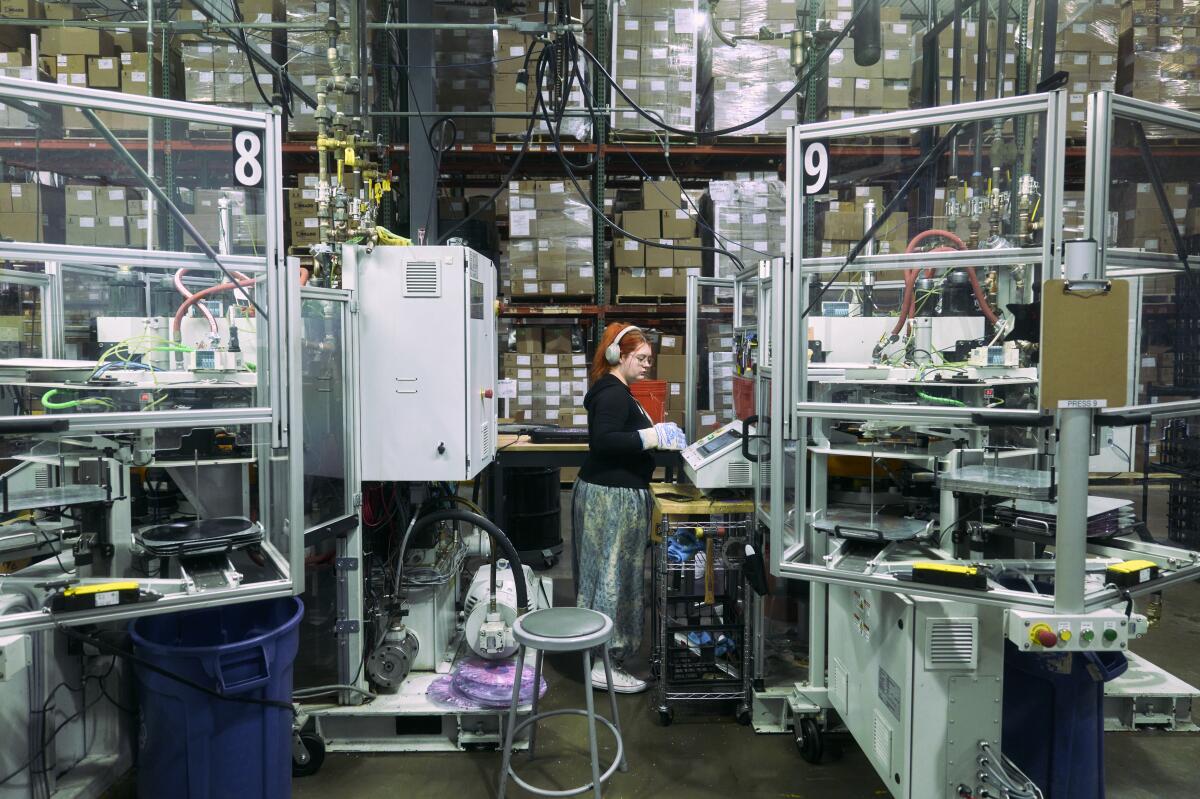
“What we found talking to a lot of our artists and to customers is that … they are concerned about the environment, and they want to find ways to reduce their footprint,” says Ben Swanson, co-founder of both Secretly Group and the Independent Record Pressing plant in Bordentown, N.J., where the LPs are made. “It’s about 16% less footprint than the traditional piece of vinyl.”

Soren Smith working at Independent Record Pressing in Bordentown, N.J., on May 26, 2026.
(Dutch Doscher / For The Times)
Largely, it’s been people like Swanson who have fully committed to the cause. He says that during the height of the COVID-19 pandemic, in an “activist moment,” several labels signed onto the Music Climate Pact, declaring their intention to reduce their emissions and be better stewards of Earth.
“It had almost no teeth to it,” Swanson explains. “A lot of people signed it, posted something on Instagram, and it sat there for a few years. For us, it was pretty frustrating … it felt very perfunctory.”
His work continued, along with a few others, thanks to support from Murmur, an organization designed to support labels and industry names, effectuating the commitments made when the Music Climate Pact was signed.
“We’re more doers than sayers,” Swanson says. “We’ve really been experimenting with what we’re calling ‘Revinyl’ — post-industrial, pre-consumer, recycled vinyl as a means to reduce our footprint at IRP.”
This is what some of Friday’s release is made of — all the trimmings, tidbits and overstock that would otherwise end up in landfills or on the factory floor. For the time being, it certainly won’t solve the climate cost of vinyl records, but it helps to mitigate it.
Between 2024 and 2025, total units produced at Independent Record Pressing increased by 41% while emissions — which also benefited from lower-carbon transportation — decreased by 34%.
“The idea is, if you can make those records 16% more efficient and also show fans of those records … that it is viable, maybe it makes it a little bit easier next year when we go out to ask other artists to jump on board,” Swanson explains. “We’re not making records that are just going to go sit on the shelf — these are records we’re continually repressing all the time anyway.”
Similarly, Ian Stanton, head of sustainability at Beggars Group, was among the first to sign the pact in 2021. His role was created five years ago to give indie labels a voice in light of minimal resources and capabilities. Though these roles do exist at larger labels, he says they have “slightly different drivers.”
When it comes to records, the pure plastic pollution that comes from them is also a concern. When old records make it to a landfill, they’re not only likely to outlive the site, but can also leach plasticizers, a Keele University report found.
“Vinyl is not like a single-use plastic; we don’t throw it away after one listen. We treasure it, we pass it on through generations, and people have a real connection with it,” he says. “But like any other product, there are ways of making it more sustainable.”
He refers to certain plastics, such as shrink wrap, as the most “visible” aspect of vinyl record pollution to consumers. From a collector’s point of view, shrink wrap can actually increase the value of a record. Though there has been discourse over the years around whether this can actually damage the sleeve, many sellers champion an “in the shrink” label as they mark up prices.

Splatter-patterned records arrive at the trim station at Independent Record Pressing in Bordentown, N.J., on May 26, 2026.
(Dutch Doscher / For The Times)
Other visible aspects, such as the paper sleeves in which the records are housed, are also harmful. However, Swanson says that swapping those for recycled materials outputs a relatively negligible difference in emissions impact, largely due to the process behind producing them.
For the time being, vinyl records made from reclaimed materials are the best that companies like Swanson’s can do, though they’re are always on the lookout for other, viable options for improving their footprint. As an example, they’re actively experimenting with how existing record material can help them.
What can the beat-up, worn-out records at your local thrift store do to dodge a landfill and keep the Earth spinning? As it stands, not much.
Stanton lists an array of challenges, including outdated materials, modern production regulations and contaminants.
“I suppose what we need with PVC for records is a really high-quality, contamination-free material to get that sound reproduction,” he explains. “When you bring in stuff from that post-consumer environment, you’ve got to make sure there’s no contamination in there, because you’re going to end up with sound quality issues.
“It’s all in process,” he adds.
For now, they look to fix the most immediate problems first, such as freight emissions, where Beggars Group has converted the vast majority of its shipping operations to sea freight, a far less harmful alternative compared with air freight.
“We want to look at the full life cycle … not only thinking from the cradle to the grave, but from the point where the raw materials are extracted at the beginning,” Stanton says. “This life cycle analysis now looks at all different environmental indicators on this — the chemical usage, the water usage, and the end-of-life impacts on that side of things.”