Weekly insights and analysis on the latest developments in military technology, strategy, and foreign policy.
For nearly four weeks now, a very stealthy high-altitude, long-endurance (HALE) surveillance and reconnaissance drone commonly and unofficially referred to as the RQ-180, or an evolution thereof, has been seen flying around Larissa Air Base in Greece. New, remarkably detailed videos of the uncrewed aircraft that have recently spread on social media offer insights into its sensor package and other aspects of the design. Just yesterday, TWZ also published an in-depth feature exploring the likely role of the ‘RQ-180’ in the ongoing conflict in Iran and how it ties to a secret Cold War drone program that was, in many ways, its progenitor.
The very large and very stealthy flying wing-type drone was first spotted in the skies around Larissa Air Base, also known as Larissa National Airport, in the city of the same name in Greece, back on March 18. Local spotter Efthymios Siakaras shared two new video clips offering especially good views of the uncrewed aircraft in flight, one on Sunday and another on Monday, which our friends over at The Aviationist were first to report on. Similar to the stealthy RQ-170 Sentinel being dubbed the “Beast of Kandahar” after it was first spotted in Afghanistan in the late 2000s, many are now also calling this drone the “Lady of Larissa.”
🇺🇸🇬🇷 O drone de reconhecimento furtivo americano RQ-180, de uso secreto, foi avistado pela segunda vez ontem, pousando em Larissa, na Grécia.
Esta é a melhor imagem até o momento da aeronave altamente secreta e ainda não confirmada.
Of the features visible in the latest footage of the Lady of Larissa, the most notable are a pair of large electro-optical sensor apertures underneath its central fuselage, right behind the main landing gear bay. The two windows are noticeably angled to the left and right. Behind those transparencies would be a large multi-spectral sensor system that can look down to the ground below and out at long slant angles towards the horizon from the aircraft’s very high perch. By having one window on each side, the RQ-180 could run racetrack patterns some distance from its target while providing continuous coverage. If a sensor is housed under each window, it could collect intelligence over much larger swathes of terrain at any given time.
As TWZ has noted for years, the RQ-180 would, with near certainty, carry a powerful radar with ground moving target indicator (GMTI) and synthetic aperture radar (SAR) modes as its primary sensor, along with electronic intelligence collection capabilities. Optical camera systems were always another possibility, one that seems to have proven true now.
“At its most basic, GMTI allows battle managers to see the enemy’s ground movements in real-time and then quickly adapt their game plan to counter those enemy forces before they can ever attack, or even pose a threat to friendly forces. GMTI is also a critical capability for detecting changes in force posture, establishing patterns of enemy movements over time, and identifying new targets of interest. Modern GMTI products can also be looped into a ‘kill web’ for rapid targeting purposes.“
“Some of this is also achieved through the aforementioned SAR mode, which basically provides a satellite-like image of a target area using radar. It also has the ability to see some things optical systems cannot, and, like GMTI, it can work under nearly all atmospheric conditions, day or night. When paired with GMTI, SAR can be used to help positively identify targets, as well as gain better situational awareness about the targets being tracked.“
A generic example of GMTI tracks overlaid on top of a SAR image. Public Domain
“Passive electronic intelligence collection that allows for radiofrequency-emitters to be quickly detected and geolocated via onboard antennas and interferometry-based computing is another part of the equation. Long-range optical sensors can also provide higher-fidelity intelligence and spot movements of infrared signatures over large areas. You can imagine how fusing all these capabilities together, combined with advanced networking, on a single platform could be incredibly potent. Basically, detecting a target or target group of interest, and then training advanced sensors on it to rapidly build up a high-quality understanding of what is going on and even to provide real-time targeting data to ‘shooters’ would be this aircraft’s bread and butter.“
The drone’s electro-optical system and radar, together with the rest of its sensor suite, could offer a secondary air-to-air surveillance capability, as well.
As an interesting aside, Scaled Composites’ Proteus high-altitude test aircraft has previously been seen flying with an extremely similar-looking sensor suite with an oddly angled aperture housing. The high-flying Proteus has a long history of being used to test and evaluate new sensors and other advanced capabilities. Scaled Composites is also a wholly-owned subsidiary of Northrop Grumman, widely understood to be the prime contractor behind the RQ-180.
When we saw pics of that EO aperture on Proteus years ago I said to Joe, “well that’s sure to be for the 180!” https://t.co/iGT83KX4JC
In addition, the underside of the drone’s central fuselage, which is where the main array for the aforementioned radar would go, has a very pronounced bulge. This would house a rotating radar or a two-sided one so that the aircraft can scan the same area while traveling in either direction. Supplemental conformal arrays, or even load-bearing ones, could also be positioned all around the aircraft, along with communications antennas, electronic warfare gear, and electronic surveillance measures hardware.
The new views of the drone flying around Larissa underscore just how widely positioned its tricycle landing gear is, along with its very broad wingspan. As we’ve noted previously, a landing gear configuration like this allows for a large volume for payload and good stability on the ground.
It is worth pointing out that there looks to be a foreign object debris (FOD) deflector fitted around the wheel of the nose landing gear. In general, the radar absorbent coatings and the composite skins of stealthy aircraft are very sensitive. What might look to be relatively minor surface damage at a casual glance can have significant negative impacts when it comes to radar cross-section, which is critical for the aircraft’s mission effectiveness and survival. From what we can see, the drone will be sitting very low on its gear when on the ground. This only increases the potential for foreign objects to get kicked up and hit its belly during takeoff and landing. This is especially true for the low-hanging ventral bulge where sensor apertures are, right behind the nose gear. So, this debris guard makes total sense.
The trailing-link style nose landing gear otherwise has a two-wheel configuration very much in line with that of the B-21 Raider bomber, but in a scaled-down form. This is not all that much of a surprise, as the B-21 shares a general planform with the RQ-180. The Raider’s development was likely heavily influenced by the RQ-180, or a progenitor of the flying wing uncrewed aircraft we are seeing today.
A close-up look at the nose landing gear on a preproduction B-21 Raider bomber. USAF
The drone’s main landing gear looks extremely similar to what is found on F-15 fighters. Borrowing existing, proven components for experimental or low-production aircraft like this is a time-honored tradition. The use of an F-15’s main landing gear points to a high gross takeoff weight. The maximum takeoff weight of the latest F-15EX variant is 81,000 pounds, according to Boeing, and the F-15 has a much smaller, single nose wheel. For comparison, the high-flying Global Hawk drone’s maximum takeoff weight is 32,250 pounds, per the U.S. Air Force, and it has distinctly less robust landing gear to match.
A look at one of the US Air Force’s new F-15EX fighters, offering a good look at its main landing gear. USAFThe less robust design of the RQ-4 Global Hawk’s landing gear is plainly visible in this stock picture of one of the drones. USAF
At the same time, the Lady of Larissa would not necessarily need to make use of all of that capacity, or it could even have a bit higher gross weight, and various additional factors could have influenced the choice of landing gear. The overall design is likely to be light for its overall size to maximize range, endurance, and high-altitude performance. With its reconnaissance and surveillance mission sets, there would be no need for a payload bay structure to carry heavy weapons. This, along with the lack of any need to support a crew, would allow the aircraft to be absolutely packed with fuel.
While its similarities to the B-21 are glaring, the Lady of Larissa is even more optimized for high-altitude flight than the Raider, which itself is a step beyond in altitude performance over the B-2. You can read all about this in our past feature here. The drone’s overall massive flying wing shape and its very clean, laminar flow-like sculpting, along with wings that look designed to allow the RQ-180 to loiter at relatively extreme altitudes, support its penetrating, persistent reconnaissance mission set.
Furthermore, the most recent videos of the Lady of Larissa offer new looks at the control surfaces in action. Like what is found on the B-21 and Northrop’s preceding B-2 Spirit bomber, the drone has flaperons along the trailing edges of the wings and along its diamond-like empennage. There may also be a central variable geometry ‘beaver tail’ section, something also found on the B-2, but not on the B-21, although this could just be the inboard flaps being slightly extended.
The B-2’s ‘beaver tail’ control surface can be seen here in this picture of one of the bombers.USAF
Much remains to be learned about the drone’s design and capabilities, as well as why it is operating out of Greece and how long it has used Larissa as a forward base. Why such a sensitive asset continues to be seen flying in the middle of the day is also curious. After the highly exotic uncrewed aircraft was first spotted at Larissa, reports said that it had landed there after experiencing some kind of technical issue, though this remains unconfirmed. The drone could have diverted there after taking off for a mission from another operating location, even one potentially inside the United States. All that being said, as we’ve noted in the past, Larissa does look to have unique facilities that seem very well suited for hosting an aircraft like this, and that were only built in recent years.
It may be that it simply has no place to hide any longer, and more flexibility is being exercised as to when it can and can’t depart and land from wherever it’s operating from. This could also mean the Pentagon may be more willing to acknowledge its existence in the not-so-distant future.
As mentioned at the start of this story, TWZ just yesterday laid out a detailed case for why the RQ-180 would be very relevant for helping hunt Iranian mobile missile launchers. That is a mission set that likely evolved from work on a previous secret Cold War-era stealthy drone program called the Advanced Airborne Reconnaissance System (AARS), also known by the codename Quartz. There are many other roles it could execute in relation to Operation Epic Fury, as well.
Overall, we have gotten our best look at the so-called RQ-180. We now know it is capable of radio-frequency and electro-optical sensing, and we have a bit better idea of its overall size and mass. This is a very large unmanned system that is smaller in size than the B-21, but far larger than RQ-170. A very cursory guess supports a wingspan of something on the order of 130 feet or larger, but again, that is just a guess. This aircraft is clearly optimized to fly at least at Global Hawk altitudes (upwards of 60,000 feet) and possibly higher, approaching that of the U-2, giving it a huge line of sight to target areas. Being such an efficient-looking design and being so large with so much internal volume, it likely measures its endurance in days, not hours.
Content creator Sophie Royston shares how she’s ditched hotels and embraced car camping for stunning views and flexibility
17:12, 07 Apr 2026Updated 17:22, 07 Apr 2026
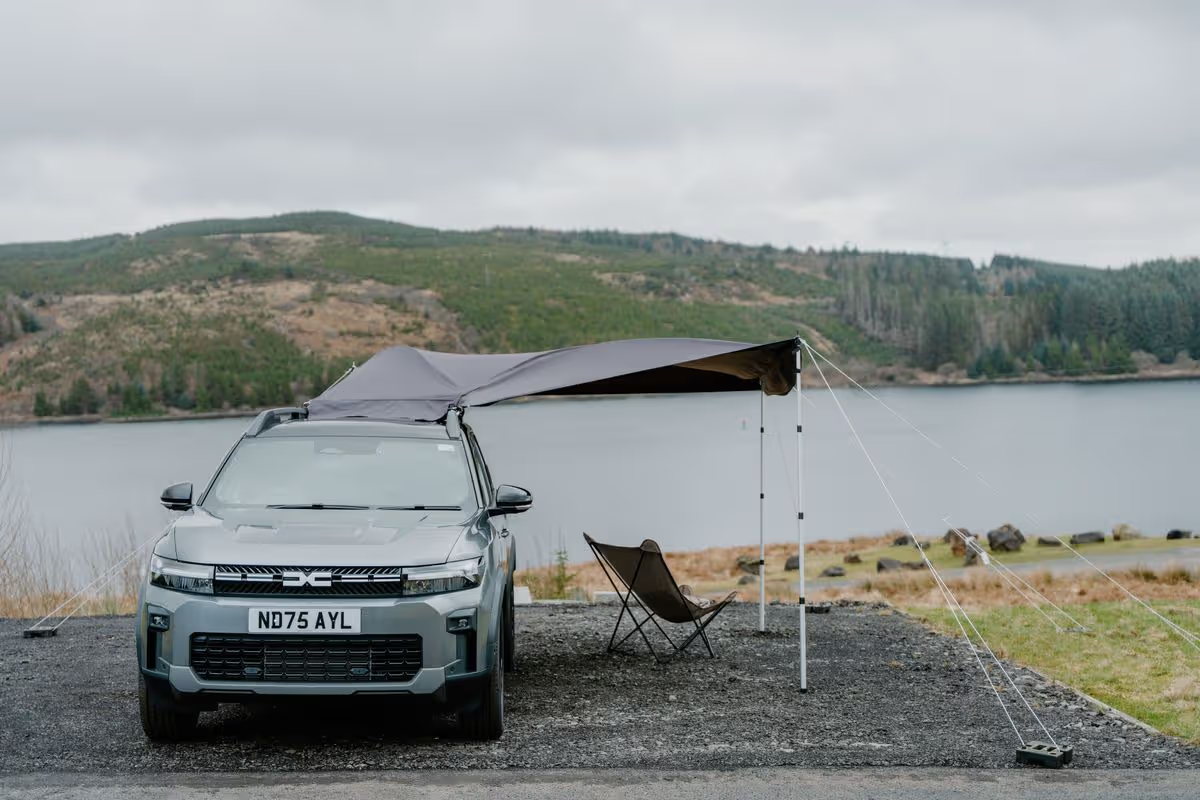
Fitness and travel blogger Sophie camps in a Dacia
Adventurers are swapping hotels for cars in an emerging trend which sees them use their trusty cars as their hotel for the night. Sophie Royston, like countless other keen globe-trotters, has adopted the trend, using her Dacia as a mobile camper. The content creator insists the “freedom”, “incredible views” and simplicity of converting your car into accommodation beats the hassle of reserving a hotel.
The adventurous traveller, who boasts thousands of Instagram followers, embraced the trend with the intention to cut costs and save money, but confessed she now does it to reach stunning locations away from the tourist trail.
“I love the freedom of it. If I find somewhere beautiful, I can just stay there,” said Sophie. “Waking up and opening the back of the car to an incredible view is the best part.
“It was initially about saving money and using what I’d saved on a hotel to enjoy experiences. But this soon turned into the benefit of flexibility and spontaneity, as well as the spirit of adventure and essentialism.
“More people are realising you don’t need a campervan to enjoy an amazing road trip.”
Sophie used her car to camp beside a Scottish Loch as well as the snow-covered peaks of the Alps, using her vehicle as a home away from home. The 31 year old insists she gets a better night’s sleep in her car than she ever did when stopping in hotels.
She claims this is down to a new Sleep Pack that easily fits into her Dacia Bigster, which is available with a number of Dacia’s cars. “It makes me feel more free to sleep in my Dacia rather than stay in a hotel,” she added.
“I have stayed in hotels where you can see a beach in the distance, but with camping in my car, I can actually be on that beach. Quite the difference and quite the experience.”
As an avid hiker, she admits that car camping makes everything simpler, allowing her to reach her destination and recuperate on-site ahead of walking the next day.
With the trend gaining momentum and more people following in Sophie’s footsteps, she says: “It’s amazing to see more people embrace outdoor travel.
“There are so many solutions available to make this easier and more accessible like the Sleep Pack and the set up in the Dacia Bigster. I think this is why it’s growing in popularity.”
To get the most out of the experience, she recommends curling up with a good book or treating yourself to a hot chocolate before settling down for the night.
She adds: “Find the perfect park spot, get the Sleep Pack set up, cook some tasty food and then get cosy for the evening. I always make sure I get into some warm, comfy clothing, especially when car camping in winter, have a nice hot chocolate and then climb into the cosy set up and wind down for the evening.”
The island town is known for its vibrant town centre, long history and stunning waterside setting nestled between the two sides of a glistening freshwater lake
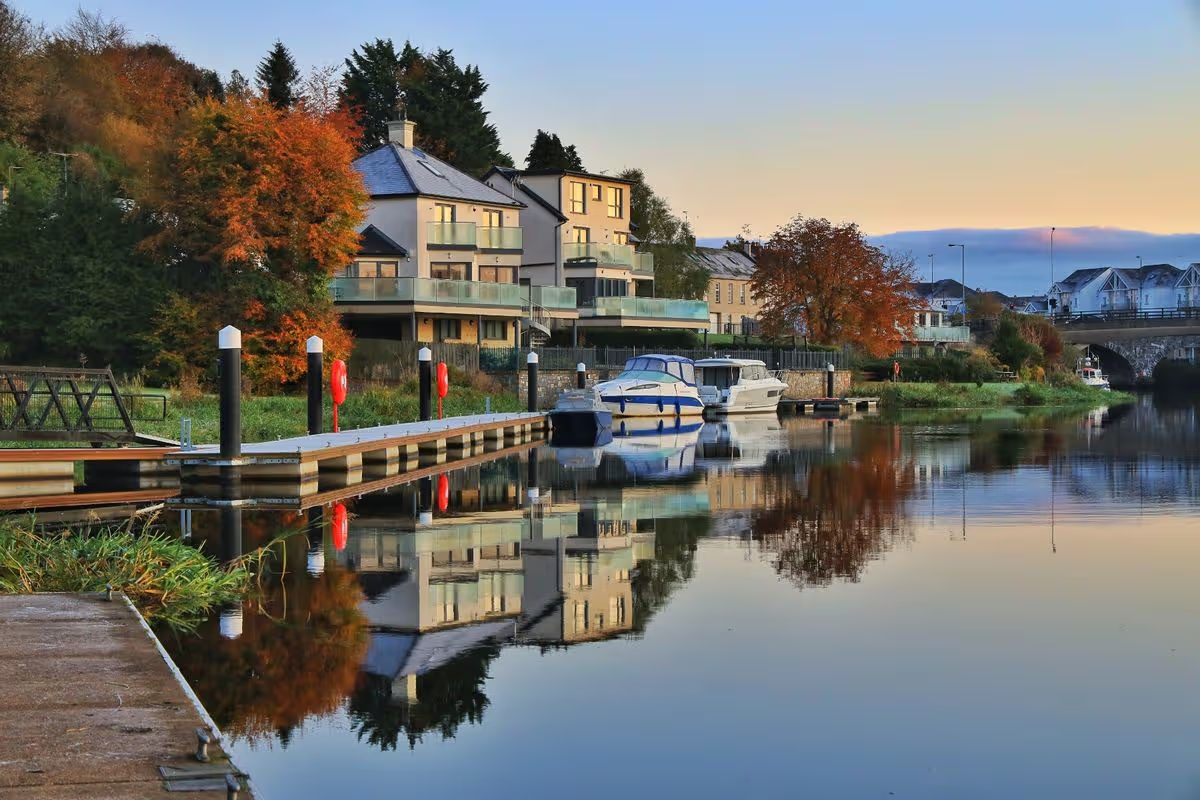
“It’s a heavenly place to live,” says Barry Flanagan as we bob along on the sparkling water.
Barry is a water taxi tour guide in Enskillen, where he spends his days enthusing about the town. He combines his unique talent for talking, honed during ten years on local radio, with boating skills learned on the waterways of his hometown.
“Enniskillen is Ireland’s only island town. It is completely surrounded by water. We’re so lucky we live here,” he adds in a borderlands brogue.
If you’re from the centre of Ireland, then you’ll have heard of the town of 14,000. Enniskillen is known for its vibrant town centre, long history and stunning waterside setting nestled between Upper and Lower Lough Erne in County Fermanagh.
The first place to start when discovering its delights is on the water. Lough Erne is the third largest freshwater lake in the UK and stretches across the south-western border. There is a brightness and cleanliness about the place. Flooded drumlin landscape stretches away from the loch past reedswamps, islets, and devilish-looking cormorants drying their wings in the sunshine.
With the water taxis chugging by, it’s easy to mistake its waterways for rural Netherlands or the Croatian delta of Vid. At least, in the brief moments when sleet showers are replaced by sunshine.
It’s also got a lot of history.
A short boat ride out of town takes you to Devenish Island. “There are 254 islands on Lough Erne, and Devenish Island is the jewel. It is a 6th-century monastic sight,” Barry explains.
Henry VIII’s dissolution of the monasteries cleared Devenish of its once bustling 1,000-person population, but the remains of the buildings have stayed, including a perfectly preserved tower.
Rising up on a nearby hill is the imposing Enneskillen Royal Grammar School, where Oscar Wilde and Samuel Beckett were pupils at a similar time as two truanting young lads who managed to blow up the nearby 1613 Portora Castle using explosive skills honed in the chemistry lab.
Made of sturdier stuff is the 600-year-old Enskillen Castle. Guarding one of the few passes into Ulster, it has remained strategically important since the charmingly named Hugh the Hospitable swung open its drawbridge.
The British took it over in the 17th century, turning it into a plantation stronghold for English and Scottish settler ‘undertakers’ tasked with controlling confiscated Gaelic land.
Despite such dicey moves, it remains remarkably intact today and serves as an enjoyable low-key museum.
“Fermanagh is a small county, but it packs a huge punch,” Barry enthuses as our tour comes to a close with a quick sail past Erne Water Taxi’s newest vessel, a completely solar-powered party boat.
“Would you believe in Fermanagh we have 14 plantation castles, three National Trust properties, a geopark that runs across the border, the Stairway to Heaven, and the Marble Arch Caves. It’s a heavenly place to live and we’re so lucky we live here.”
Any local who has spent an evening in Blakes of the Hollow will certainly agree. The Victorian pub is one of the most famous in Ireland and was packed to the rafters when I visited. The vibe inside is excellent and oiled by £5 pints of Guinness and live music on the weekends.
Wander several flights down from the pub, and you’ll get to 28 at the Hollow, an award-winning restaurant run by husband and wife team, Glen Wheeler and Zara McHugh. The food and service is as exceptional as I had expected, given no fewer than three people at my hotel had suggested I check it out.
The hotel in question is the Lough Erne Resort, a curious place that’s part 5* hotel, part timeshare estate made up of crenelated mansions that run along the lakefront. OAP bellboys greet you at the door as you walk into the grand foyer, where wood fires crackle in the grates. The rooms are enormous and comfortable, designed as they are for golfers to relax after a hard day’s thwacking on the 36-hole course.
Once you’re up and at them the next day, a coffee and a croissant at FOLK will fuel you up enough for a proper rummage at Lougherne Vintage.
Sitting in the quaint Butter Market part of town, the shop is packed full of goodies plundered by Katie Murphy and her husband from bootfairs across Europe. Unlike most vintage shop proprietors, Katie does not get her goods from eBay and Vintage, instead putting in the hard yards early on Sunday mornings. The result is a shop brimming with genuine treasures, including a Vivienne Westwood dress for a very reasonable price.
Like Enniskillen as a whole, drop by and you’re sure to unearth a hidden gem or two.
Newly opened Ella Álkyna is an adults-only, all-inclusive 5-star resort on Corfu’s west coast with stunning sea views and private pools
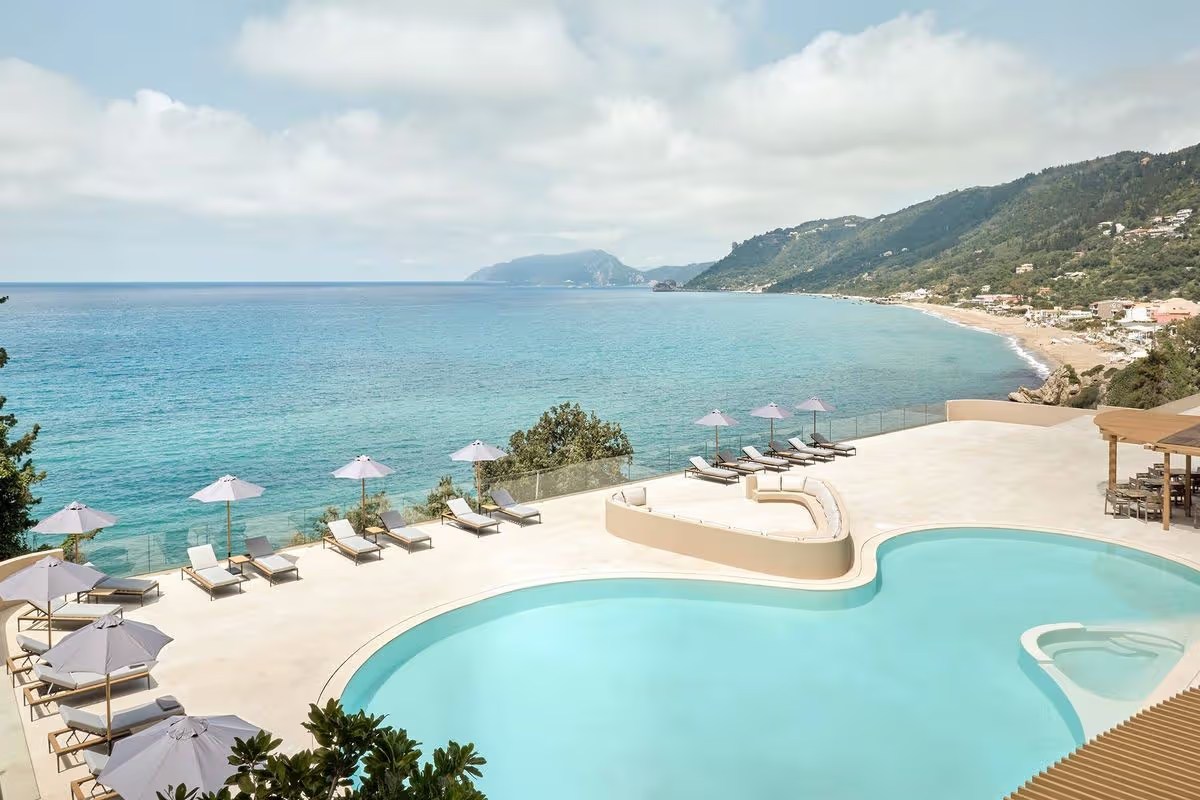
The resort sits close to the small village of Agios Gordios(Image: Ella Álkyna)
There arrives a moment in life when the notion of an adults-only, all-inclusive resort suddenly seems less of a luxury and more of a relief. No inflatable pool toys hurtling towards you, no frantic early-morning buffet chaos – simply sea vistas, excellent cuisine and the freedom to do absolutely nothing if that’s what you fancy. That’s precisely the atmosphere Ella Álkyna delivers to Corfu’s west coast.
Recently launched and positioned high above the dramatic bay of Agios Gordios, it’s crafted as a sophisticated, luxury retreat, yet without the eye-watering bill you’d typically encounter at other 5-star Mediterranean resorts.
The accommodation
The resort boasts 349 rooms, suites and villas, all orientated towards the Ionian Sea to ensure the panorama is practically inescapable. I stayed in a private pool sea-view room, which swiftly became the standout feature of the entire visit. At the more budget-friendly end of the spectrum, you can also reserve charming comfort rooms that still offer equally stunning vistas.
Inside, the design is serene and modern, featuring touches of pale timber, sandy hues and linen finishes that mirror the scenery beyond. But the genuine showstopper is the terrace. My compact private pool gazed straight out across the water, meaning mornings commenced with a pre-breakfast swim and evenings frequently concluded with another plunge as the sun descended behind the cliffs. Bathrooms are spaciously proportioned with rainfall showers and sumptuous robes, reports OK!.
The resort Álkyna is carved into the hillside overlooking Agios Gordios beach, and the location is breathtaking. The resort’s terraces tumble downwards, meaning virtually every spot – from the pools to the dining areas – boasts sweeping sea vistas. Amenities include two primary outdoor pools, an indoor pool, and a contemporary spa and wellness centre.
One point worth noting: the sunloungers surrounding the main pools tend to get snapped up fairly swiftly as the morning progresses. There’s no requirement for a crack-of-dawn towel dash, but if you’ve got your eye on a specific view, it’s wise to head down following breakfast rather than waiting until mid-afternoon.
Dining takes centre stage here, with three restaurants – Cocura, Nafs and Lucáta – plus six bars dotted throughout the resort. Several of the culinary concepts were developed alongside Michelin-starred chef Alex Tsiotinis, which accounts for why evening meals feel more akin to a chic metropolitan eatery than a typical hotel buffet.
Anticipate abundant Mediterranean touches such as grilled seafood, seasonal vegetables, regional olive oil and dishes crafted for leisurely, convivial dining rather than hurried consumption. Most tables are positioned outdoors, as you’d expect, meaning dinner frequently comes accompanied by a sea breeze and a stunning sunset.
It’s worth noting, however, that Corfu’s late-summer wasp season can make alfresco dining slightly more animated than anticipated. They appeared especially drawn to sweet cocktails and anything containing honey during my visit, so a touch of patience or a well-chosen seat makes all the difference if you’re planning to go in August or September.
What’s on offer at the resort
There’s no shortage of activities if you fancy keeping busy. Visitors can take part in fitness classes, yoga and Pilates sessions, or indulge at the spa with massages and facials designed to promote complete relaxation. I was especially taken with the on-site Roée Wellness spa’s Finnish sauna and steam room, and enjoyed the most soothing (and aromatic) 50 minutes of tranquillity thanks to the bespoke massage featuring Greek botanicals and natural oils.
Exploring the local area
The resort is located near the charming village of Agios Gordios, where traditional tavernas dot the seafront and the sunsets are renowned throughout the island. If you venture out just once, I’d urge you to visit Akrogiali Family Taverna, where I sampled the finest honey-drenched baklava and ice cream of my entire life.
I’d also strongly suggest making the journey to Kaiser’s Throne in the quaint town of Pelekas, merely a 20-minute drive away. The walk is brief, and the restaurant perched at the summit serves superb Greek salads alongside endless emerald vistas. For a change of scenery, Corfu Town is approximately a 30-minute taxi journey away and certainly worth a visit. Its Venetian alleyways, independent boutiques and bustling squares make it one of Greece’s most characterful island capitals. Boat excursions along the west coast are also sought-after and showcase some of Corfu’s most striking beaches and secluded coves.
Book it
Comfort Room with Sea View prices start from £215 per night based on an all-inclusive basis. To book, visit here. Flights to Corfu from major UK airports are served by Ryanair, easyJet, Jet2 and more.
The city could be an affordable option for those who want to work from home or start a remote business, as it’s more affordable than some of the surrounding areas, and offers access to beautiful countryside
Remote workers looking for a new home should consider this city(Image: Mike Kemp/In Pictures via Getty Images)
A city in the south west that offers affordable housing, a pretty centre, and easy access to the countryside for lunchtime walks has been named the UK’s best place to start a remote business.
A study that looked at factors including rent prices, number of post offices, business survival rates, and other information useful for remote workers identified Gloucester as the top place to work from your laptop.
The Roman city topped the list, compiled by payment provider Dojo, narrowly beating Norwich and Southampton. Carlisle and Swansea.
The average private rent in Gloucester came in at £1,069 in January 2026, and three-bedroom homes can be bought for under £200k according to Rightmove listings. The city has a five-year start-up survival rate of 43% thanks to local support networks, meaning entrepreneurs have a better chance of their business succeeding in this area.
Gloucester’s Forum in the Kings Quarter is one example of projects being run by the council to support local businesses. A multi-million-pound regeneration scheme has seen co-working spaces and offices open in the area, so if you get bored with homeworking, you can rent a desk.
Best Cotswolds holiday cottage deals
This article contains affiliate links, we will receive a commission on any sales we generate from it. Learn more
The Cotswolds is famous for its rolling hills, honey-coloured villages and quintessential English charm. Sykes Cottages has a wide range of places to stay, starting from £38 per night.
Just a short walk away is Gloucester Quays, another area of the city that has been given a complete makeover. Once an industrial wasteland, it has been turned into a pleasant waterfront promenade full of shops, restaurants and cafés, perfect for a lunchtime walk.
Around 88% of the Gloucester area also has access to ultrafast broadband – over 100 Mbps – a practical consideration that many homeworkers need to take into account.
If you’re just passing through the city, there’s plenty to see. Visit Gloucester Cathedral, a grand, imposing building that dates back to the 11th century and is the resting place of King Edward II. History buffs will also love the National Waterways Museum on the docks, where they can see vintage narrowboats up close and a replica lock.
Nature in Art is also worth a visit. Set in the grounds of a 17th-century mansion, this unique art trail includes paintings, sculptures, and many unique works.
Perhaps best of all, Gloucester is set within the Cotswolds, an area of outstanding natural beauty made up of rolling green hills, meadows, and charming traditional villages. You’re just a short drive away from country walks and cosy pubs to explore after work or at weekends.
Visit Haresfield Beacon just south of the city, a walk that combines woodland and grassland, with a one-mile circular walk that enjoys beautiful views. WWT Slimbridge is nearby on the banks of the River Severn. This wetland wildlife reserve includes flocks of flamingos, pretty swans, and mischievous otters, which can be seen in their natural habitat. The best way to see it is on a canoe safari. Grab a paddle and follow the trails to see wetland creatures up close.
Have a story you want to share? Email us at webtravel@reachplc.com
This stunning Cornish village is a must-visit destination with breathtaking views, award-winning Michelin Guide dining, and a vibrant community spirit
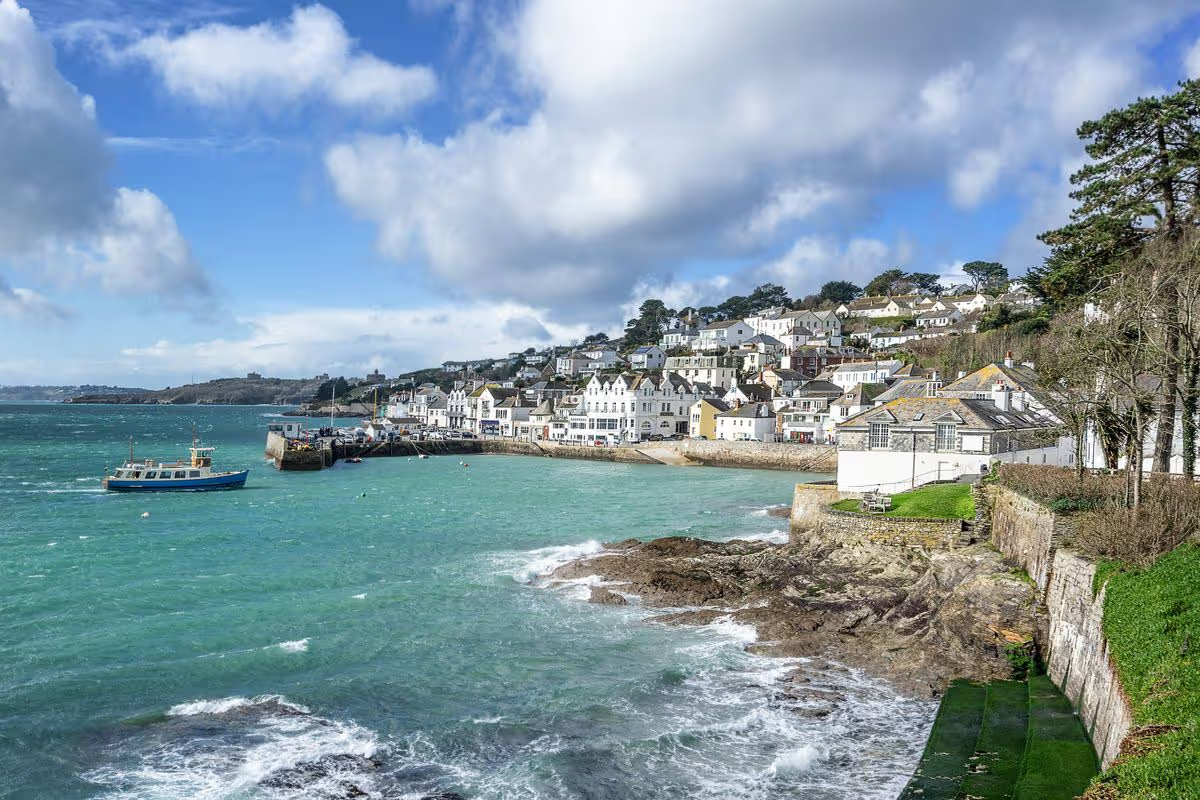
This stunning Cornish village is a must-visit destination with breath-taking views, award-winning Michelin Guide dining, and a vibrant community spirit(Image: GordonBellPhotography via Getty Images)
We won’t describe this village as a ‘hidden gem’ because its gloriously stylish existence is hardly a secret – in fact, its appeal among the wealthy and well-known only adds to its elusive allure. Nestled snugly at the very tip of a breathtaking peninsula, when we say the vistas stretching out from this hamlet are unrivalled – we mean every word.
If the promise of extraordinary views isn’t sufficient to tempt you into paying a visit, there’s a wealth of further attractions to consider: fresh locally-sourced produce, Michelin guide restaurants serving world-class cuisine, a spectacular waterfront setting and a vibrant community spirit in abundance. All of this and more make the fishing village of St Mawes in Cornwall a certified must-visit destination.
Situated at the furthest point of the Roseland Peninsula, this jewel in South Cornwall ranks among Britain’s most coveted holiday spots, frequently earning the nickname ‘the St Tropez of England ‘. It has everything you could possibly desire in a short break – a crystal-clear cove with waters reminiscent of the Caribbean, charming and colourful cottages brimming with seaside character, eateries impressive enough to leave you in a food coma, and the ribbon topping off an already remarkable package – a castle.
It comes as little shock, then, that The Times recently named it among the ‘most beautiful places to visit’ in England. What is shocking is that it hasn’t yet been completely swamped with tourists – unlike St Ives or Padstow – and that’s likely due to its remote location, which takes time to reach.
Getting to this Cornish village isn’t impossible by any stretch, though – a picturesque car ferry or 40-minute journey from St Austell or Truro will transport you there with ease, reports the Express.
What makes the seaside village special
St Mawes boasts a rich maritime history, having been constructed around a beautiful sheltered harbour on the eastern side of the Fal Estuary – undoubtedly one of Britain’s finest sailing locations.
Upmarket waterfront eateries enhance this hamlet’s irresistible charm, with one of the hotels (Hotel Tresanton) even providing its own yacht, Pinuccia, for charter.
If you need convincing, look to the royals. St Mawes has become a certified Royal Family favourite, with King Charles and Queen Camilla regularly visiting the village during their yearly trips to the area as the Duke and Duchess of Cornwall.
St Mawes appeared to have won over the previous generation of royals, too, with the village described as one of Queen Elizabeth II and the Queen Mother’s preferred destinations during their journeys aboard the Royal Yacht Britannia. The appeal is universal (and spans the generations), it seems, as in recent years, Prince William and Princess Kate have also been spotted bringing their family to this coastal gem.
Foodie heaven
For a village with a population of roughly 700 people, give or take, St Mawes punches well above its weight when it comes to dining options, enough to make even the most food-obsessed cities envious.
Dishing up gloriously fresh seafood using locally sourced Cornish produce alongside stunning harbour views, The Idle Rocks is a Michelin Guide restaurant that’s guaranteed to leave a lasting impression if you pay it a visit.
Another waterfront treasure, Hotel Tresanton, was awarded one of the inaugural Michelin Keys in 2024, celebrating extraordinary hotels worldwide. The cocktails and ambience of the venue are frequently described by guests as ‘top-tier,’ and the spectacular view of St. Anthony’s Lighthouse is the cherry on top.
St Mawes Bakery is another essential stop, particularly for lunch, while the neighbouring St Mawes Seafood Bar serves… well, unrivalled seafood. Evening drinks can be savoured at The Rising Sun or the more traditional Victory Inn, while the St Mawes Hotel is equally brilliant for a sit-down meal. Cafe Chandlers is a fantastic spot for coffee and delectable, freshly baked goodies. Harbourside dining at The Watch House in St Mawes is, quite simply, a no-brainer.
Things to do in the seaside haven
Top of the agenda is exploring St Mawes’ distinctive, clover leaf-shaped St Mawes Castle – a magnificent example of Tudor craftsmanship and engineering. Nearly circular in design, this stunning historical landmark was constructed by Henry VIII.
Children, in particular, will be captivated by the numerous cannons positioned across the castle’s terraced lawns, which command views over the beautiful bay. Boutiques and galleries add an artistic flair that any prosperous village needs to truly distinguish itself, and the Waterside Gallery is an excellent destination.
Summers Beach offers a wonderful sheltered location for swimming (not always guaranteed in Cornwall), while Tavern Beach, nearer to the castle, is ideal for some traditional rock-pooling.
Harbour Beach, situated right in the heart and only reachable at low tide, is the spot to visit with your four-legged friends. It’s worth noting that there are no lifeguards on duty in St Mawes. Be sure to visit Lamorran House Gardens, featuring its charming bridges and cascading waterways.
There’s no shortage of activities in this Cornish village, making it the perfect choice for your next UK break.
COLUMBIA, S.C. — When you look at the USC Trojans, one might think they’re setting the table for next year.
Buying time until JuJu Watkins returns. Keeping the ship afloat until the talented recruiting class that includes Saniyah Hall makes its way to campus.
But the Trojans showed Saturday that’s not the case. They’re making a plate and eating now.
The No. 9 seed Trojans gutted out a 71-67 overtime win over No. 8 seed Clemson in what USC coach Lindsay Gottlieb described as “a culture win.”
That game featured many tests for a young team in March and the Trojans responded well to the challenges. They are advancing on the back of freshman Jazzy Davidson’s 31 points and senior Kara Dunn’s 22.
Davidson, who appeared to be on the verge of tears as the referees reviewed the final play of regulation to determine whether she had committed a foul that would have set Clemson up for game-winning free throws, said on Sunday there’s a standard that this year’s Trojans feel they are responsible for meeting.
“I think our expectations, you know nobody wanted to lose JuJu, we all love her, but we have to keep going as you said and just holding that same expectation that they had last season. Just the program standard,” Davidson said. “And just resiliency and making sure that we’re doing our best every game.”
Dunn said the deck has been stacked against the Trojans all season and it’s forced them to grow stronger as a unit.
USC guard Kara Dunn drives to the basket in front of Clemson guard Taylor Johnson-Matthews during the first round of the NCAA tournament on Saturday in Columbia, S.C.
(Nell Redmond / Associated Press)
“I think this year has just been about focusing on going against all odds,” Dunn said. “A lot of people didn’t expect much from this team and they might have turned away at certain times when we had lower moments this season and I think that it built our own culture for this season specifically. I feel like we had to come together, we had to support each other when it didn’t feel like we had much support and I think that that’s been really important.”
She added that moving through the season with just the support of each other and their die-hard fans works in their favor as they prepare to take on powerhouse South Carolina on the Gamecocks’ formidable home floor.
“We have everything to gain, nothing to lose going into this game, so I feel like this has really helped us,” Dunn said.
The NCAA tournament game against the No. 1 seed on the Trojans’ side of the bracket will be a rematch of the unofficial “Battle of the Real USC” in November. The Gamecocks claimed a 69-52 win during that meeting.
USC guard Jazzy Davidson drives under pressure from Clemson guard Rachael Rose Saturday in Columbia, S.C.
(Nell Redmond / Associated Press)
Gottlieb said Sunday she scheduled that game to prepare her team for moments like Monday’s tough matchup.
“Maybe if we hadn’t played Notre Dame, UConn and South Carolina, maybe our record would be a little better coming in, but it doesn’t make you a better program,” she said. “Our goals remain the same; which is to win a national championship. So if you’re skipping those people in nonconference hoping to manipulate it, it doesn’t work that way. You have to see the best. You have to elevate your program to be the best, then ultimately, you have to beat the best to get to where you want to be.”
South Carolina is trying to avenge last season’s championship loss to UConn and secure its fourth national championship in program history and the third in five years. USC, meanwhile, is trying to match the Cheryl Miller era when she led the Trojans to back-to-back national titles in 1983 and 1984.
Trojan culture will be tested more than ever, but Dunn feels good about where the team is heading.
“Obviously that was the beginning of the season, now it’s towards the end and we’re two very different teams,” she said of the previous loss to South Carolina. “We’ve grown in a lot of ways, but we’re using that scout just to see what we did well and what we could’ve done better. We just want to make sure that we control those things first and then adjust.”
Davidson will have the chance to play in another legacy defining game during her second NCAA tournament appearance.
“I feel like I have nerves a little bit before every game, [Monday] especially because it’s a big game,” she said. “My teammates are always just making sure I’m calm and in the moment. The confidence that they instill in me every day really helps.”
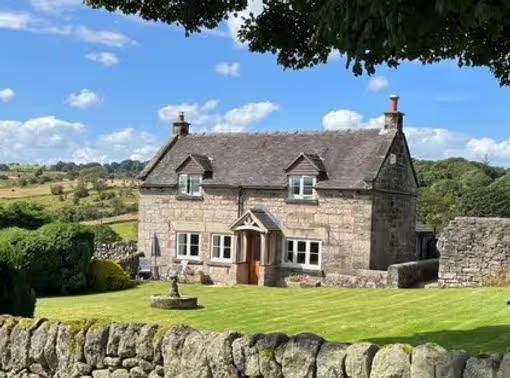
The Peak District National Park is one of the most beautiful areas Britain has to offer, and this town, paired with this tour, gives you the ultimate experience of it
‘I had the ultimate Peak District experience – with all the views and none of the walking’
The Peak District National Park in Derbyshire is a sight to behold, but with over 300,000 acres worth of land and some pretty sheer climbs, it can be overwhelming to know where to start. If caught by such doubt, there’s only one real answer.
One of the best ways to see the heights of the peaks and immerse yourself in their splendour is to ditch the hiking boots altogether. And the best place to begin, I’d argue, is at the very top, in Buxton – England’s highest market town.
When staying at The Buxton Crescent Hotel, the real heart of the town and a hub for a truly tranquil escape to Derbyshire, you can be assured that there’s a fantastic range of trails on your doorstep. There are a number of routes to take, so I hopped on a bike courtesy of PeakePedals and cycled out.
Best Derbyshire holiday cottage deals
This article contains affiliate links, we will receive a commission on any sales we generate from it. Learn more
Derbyshire is known for its dramatic Peak District landscapes, historic market towns and stately country houses. Sykes Cottages has hundreds of places to stay, with prices from £32 per night.
Bike Tours
Specifically designed for guests staying at the hotel and catering for those travelling in at Buxton Station is White Peak Adventure. This is a route created by the cycling experts at PeakePedals to help visitors experience the villages, valleys and hills of the White Peak, just south of Buxton.
Many guests opt to hire their e-bikes and a Garmin GPX navigation device with their chosen route pre-programmed. This means they can have their own day out, with clear directions, and none of the fuss.
However, we were lucky to have a tour guide in Dan, a team member and local expert, who took us through the winding roads and hills, pointing out the areas of interest along the way.
Touring on a bike means you can see a hell of a lot more of the Peaks than you naturally would on foot. We ended up going over 20 miles around the national park, winding through villages and along pretty country roads. This is perfect for someone who only has a day or a short weekend to explore and is keen to make the most out of that time – with all the views and none of the blisters.
Passing through the stunning ‘Dragon’s Back’ limestone reef was a true highlight of the ride for me, and having previously climbed it, I can assure you it was far less difficult and even more beautiful from below. The bike certainly offered a fresh perspective on the Peaks.
We stopped and gawped periodically, while our guide recommended pubs, cafés or the best villages we might want to spend a moment in. But Dan was happy to take our lead, as he would remind us: “It’s your day.” We opted for two stops, one in Longnor and the other in Hartington – two quintessentially English villages.
As a big coffee lover, this was ideal, as I can never get enough of stumbling upon a cosy coffee spot and sampling some homemade bakes. Of course, here in Buxton, the local delicacy is the Bakewell Tart, which is a must-try when in the Derbyshire area.
As charming a day as it was, it being Britain and March, cold and thick fog descended, obscuring the beauty of the hills a little.
Of course, it’s hard to come to the Peaks and not take on somewhat of a hike, and for a short hike with ease near Buxton, Lud’s Church is the perfect choice. Sitting less than a 20-minute drive outside of the town, it’s a popular route, proven by the groups of walkers we saw heading that way.
The terrain is easy, and the route isn’t steep. The hidden paradise that you reach is certainly a treat.
Beginning at The Roaches Gradbach Car Park, we were able to park up and begin the walk, following the signposts along the way. It took us past the scout camp, down a rocky path alongside farmers’ fields, before reaching a tranquil little bridge.
As you walk, you wind through forests and find yourself at the mysterious gorge, illuminated by green moss. When I stepped down into the chasm, I felt as though I’d stumbled across a hidden gem, like something out of Jurassic Park or Jumanji, with tropical-looking plants growing in between rocks, covered in layers of the brightest green moss.
Once you reach the other side of it, climbing out of the gorge, it’s mostly flat, and we had a carefree walk through the trees, slowly making our way back down in a circular route, back to the car. All in all, the walk typically takes two hours, but we were able to complete it in an hour and a half, driven on as we were by a desire to eat lunch.
Book it
Emily stayed at Champneys Buxton Crescent Hotel & Wellness Spa start from £185 including bed and breakfast. For general hotel bookings, please visit: buxtoncrescent.com and contact Email: info@buxtoncrescent.com Tel: +44 1298 808 999
Take a trip to the “most fairytale castle in the UK” which is a short trip away from London on train. It offers breathtaking views and a Bridgerton-meets-fairytale vibe
Christine Younan Deputy Editor Social Newsdesk
04:02, 22 Mar 2026Updated 08:14, 22 Mar 2026
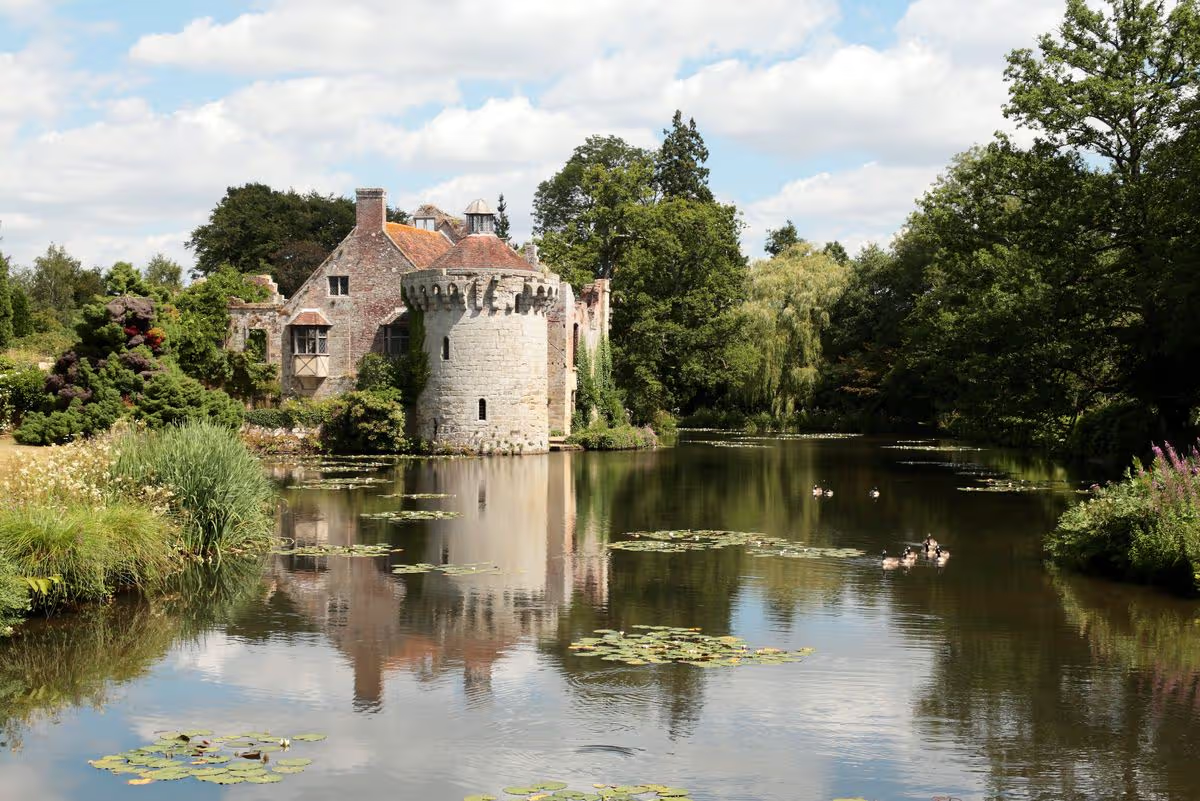
The castle looks like it’s out of a fairytale(Image: Getty Images/iStockphoto)
Embark on the most magical adventure of your life by visiting this fairytale castle – just 45 minutes away from London. If you fancy a trip outside of the city today, this location is a must for your bucket list.
It boasts breathtaking views, hidden pathways and is perfect for Bridgerton fans as it gives you that feel once you’re there. Whether you fancy a peaceful walk or a romantic picnic, why don’t you add Scotney Castle, in Tunbridge Wells, Kent, to your list now? It’s open daily from 10am all the way through to 5pm, which is ideal now that we’re blessed with more sunshine in the day.
One woman, who shares travel and lifestyle content on TikTok, recently paid a visit to the castle which has been dubbed the “most fairytale in the UK”.
In the video, she said: “The most fairytale castle in the UK – 45 minutes train from London Bridge, Scotney Castle – Royal Tunbridge Wells.”
Sharing her trip, the content creator took a 45-minute train journey from London Bridge to Tunbridge Wells then a 20-minute taxi ride to the entrance as there were no buses on Sunday.
She gushed: “Once there, you’ll be rewarded with breathtaking views, hidden pathways and a true Bridgerton-meets-fairytale vibe. Perfect for a peaceful photo walk or romantic picnic.”
Content cannot be displayed without consent
How to get to Scotney Castle:
If you’re travelling from London will have to drive for about 1 hour and a half, around 52.7miles, depending on where you are.
Otherwise some parts of the capital could take you about an hour. You will have to book as it’s likely the car park might be full which means you won’t be able to leave your vehicle on site.
As for trains, they frequently run from London Bridge to Tunbridge Wells which could cost around £20.
Alternatively, you can take a 50-55 minute train journey to Wadhurst, then a 15-minute taxi journey to Scotney Castle.
Wadhurst is the nearest station to the attraction, where it’s 7 miles, although Tunbridge Wells is also nearby (9 miles).
What to do at Scotney Castle:
The National Trust property offers a 14th-century moated castle ruin, a Victorian country mansion, and 770 acres of woodland and parkland.
You can explore the romantic gardens, check out the 1950s-style mansion, walk the estate trails, and visit the tea room.
There are also family activities available, like a “Summer of Play” area in the meadow with various activity zones which typically run through August.
The best time to visit is spring for blooming flowers, alternatively there are vibrant colours in autumn.
Tickets are approximately £22 per adult, £11 per child with gift aid and £4.50 for parking.
National Trust members can enjoy free entry and parking.
This place deserves far more recognition – it has amazing views, a real sense of community, and a fascinating history too.
Nicola Roy Multimedia content creator
04:01, 21 Mar 2026
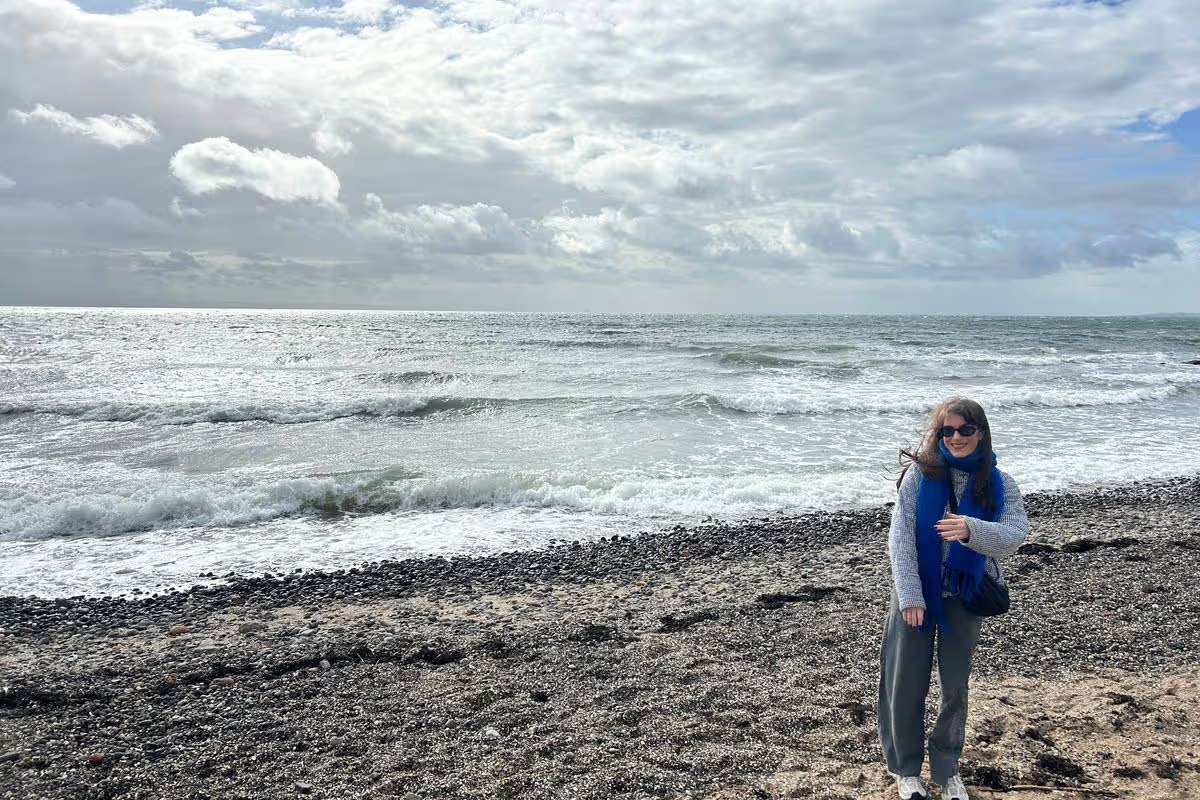
This coastal spot is a true hidden gem(Image: Nicola Roy)
There’s genuinely nothing better than those first sunny spring days as we leave winter behind. It immediately makes you crave a visit the seaside, even if there’s still a slight chill and it’s not quite swimming weather yet.
Last weekend, I chose to take advantage of my renewed enthusiasm and positivity for life, and drove to a stunning coastal village that many people have never heard of. Admittedly it’s tiny, and there’s barely anything there, but there’s a welcoming pub and restaurant, breathtaking sea views , and it’s near to another popular seaside destination too. Lower Largo in Fife has a population of approximately 2,300, and it’s one of the most picturesque places I’ve seen.
The compact village overlooks Largo Bay, on the northern side of the Firth of Forth in Scotland. It required roughly an hour and a half to drive from Glasgow, and from Edinburgh, it’s just an hour’s drive away.
Largo is a historic fishing village, divided into two separate sections – Lower and Upper, with the small village of Lundin Links just to the left. Here, you won’t discover amusement arcades or crowds of holidaymakers, and it boasts a far more peaceful atmosphere than other coastal villages I’ve visited lately.
But don’t let the lack of attractions put you off. The more relaxed rhythm of life here was captivating, and already I’m eager for my next opportunity to return.
Waking up to those stunning views was an instant mood-booster, especially when the sun was shining brightly. The chilly temperature didn’t matter – the setting looked perfect, and the fresh coastal air felt wonderfully revitalising, reports the Express.
Lower Largo’s shoreline consists of sand and rocks, and it’s pristine. We noticed plenty of dog walkers enjoying the area, and even saw one brave soul taking a plunge in the sea, which must have felt incredible once she got past the initial cold shock.
The surrounding streets were equally delightful to explore. It’s fairly peaceful, meaning you’ll hardly encounter any traffic, but you will discover some impressively decorated front gardens. The nautical theme ran strong throughout, with garden gates featuring pirates, fish and mermaids.
We had breakfast at The Aurrie, a delightful cafe set within a converted church that offered such a warm and inviting ambience. Artwork from local artists lined the walls and was available to purchase, alongside an excellent range of hot dishes, coffees, and a cake display packed with tempting options. I chose the veggie haggis and potato scone roll with a flat white, and it was absolutely lovely.
During our visit, we also ate at The Crusoe, another wonderfully welcoming four-star hotel featuring a restaurant and pub. It serves all the traditional pub favourites you’d anticipate, from mac and cheese to fish and chips, and my entire family really enjoyed the experience.
Just over the way is the Railway Inn, another pub boasting a real fire that I didn’t manage to pop into, but my parents assured me it was fantastic and the ideal place for a post-dinner drink.
The pub enjoys a prime location right next to an impressive viaduct, now disused but still standing tall. It spans the Keil Burn, and was constructed to serve a section of the Fife Coast Railway Line. It’s been out of service since 1965 due to the reorganisation of British railways known as the Beeching cuts, but it remains a significant landmark and is well worth a look.
Another fascinating aspect of Lower Largo’s past is that it’s actually the birthplace of the man who inspired Daniel Defoe’s Robinson Crusoe – hence the hotel’s name.
Born in 1676, Alexander Selkirk was born in the village, and the house that now occupies his birthplace at 99-105 Main Street showcases a life-sized statue of him gazing out towards the horizon.
A signpost at the harbour points in the direction of the Juan Fernández Islands, some 7,500 miles distant, where he spent over four years shipwrecked.
I’m already looking forward to my next trip to Lower Largo. The overall atmosphere of the place was so welcoming, and it’s clear it has a strong sense of community.
It’s the ideal spot to enjoy a peaceful few days, but if you fancy exploring further afield, the beloved coastal town of St Andrews is just a 20-minute drive away.
While it’s best known for its golfing heritage and as the location where Prince William and Princess Catherine first crossed paths, there’s also a wealth of excellent pubs and eateries, bookshops and cafés to discover.
Slovenia heads to the polls on Sunday in a closely contested race between incumbent Prime Minister Robert Golob and right-wing former Prime Minister Janez Jansa.
Opinion polls currently suggest no clear winner between Golob’s Freedom Movement (GS) and Jansa’s Slovenian Democratic Party (SDS), with the outcome likely to hinge on smaller parties and coalition-building.
Recommended Stories
list of 4 itemsend of list
Jansa has served three times as prime minister, between 2004-2008, 2012-2013 and 2020-2022.
Golob’s domestic agenda has been broadly reform-driven and welfare-focused, with a mix of social policy, green transition, and institutional reforms, something Jansa has promised to reverse by introducing tax breaks for businesses and cutting funding for welfare programs.
The election will also decide which direction the Alpine nation, which gained independence in 1991, will take on foreign policy, especially given the wildly divergent views on Israel and Palestine.
Slovenia’s government has been an outspoken critic of Israel’s war; in contrast, Jansa is a staunch supporter of Israel.
Slovenian then Prime Minister Janez Jansa and Israeli Prime Minister Benjamin Netanyahu met in Jerusalem on December 8, 2020 [Ohad Zwigenberg/Pool via Reuters]
Diverging views on Israel-Palestine
For a small nation – roughly the size of New Jersey in the United States – home to two million people, the Israel-Palestine conflict has played a significant role in its politics.
Slovenia’s current government has openly criticised Israel’s actions in Gaza and the occupied West Bank, even introducing a ban on imports of goods produced in the occupied Palestinian territory.
In May 2024, the country recognised Palestinian statehood, raising a Palestinian flag alongside the flags of Slovenia and the European Union in front of a government building in downtown Ljubljana.
A Palestinian flag flies next to a Slovenian and an EU flag, at the government building in Ljubljana, Slovenia, May 30, 2024 [Borut Zivulovic/Reuters]
In May 2025, Slovenia’s President Natasa Pirc Musar told the European Parliament that the EU needed to take stronger action against Israel, condemning “the genocide” in Gaza.
Later in the year, it banned far-right Israeli cabinet ministers Itamar Ben-Gvir and Bezalel Smotrich from entering the country and became the first country in the EU to ban all weapons trade with Israel over its genocidal war on Gaza.
It has also backed Slovenian International Criminal Court (ICC) Judge Beti Hohler, after she was sanctioned by the US for her role in issuing arrest warrants for Israeli Prime Minister Benjamin Netanyahu and former Defense Minister Yoav Gallant.
In a letter sent to the EU heads of state on March 13, Golob and Musar warned that Europe’s refusal to condemn the sanctions indicated that “concern for economic consequences has taken precedence over a principled defence of judicial independence and international justice … at a moment when armed conflicts rage, when international law is being violated, when the victims of the gravest crimes look to the ICC as their last hope for justice.”
Palestinian Foreign Minister Varsen Aghabekian Shahin meets with Slovenia’s Prime Minister Robert Golob, at the Office of the Prime Minister of the Republic of Slovenia, in Ljubljana, Slovenia, August 25, 2025 [Borut Zivulovic/Reuters]
Nika Kovac, a Slovenian sociologist and cofounder of the 8th of March Institute, a nongovernmental organisation focused on human rights, told Al Jazeera that support for Palestine is in part rooted in the fact that Slovenia is “a very young country”, which means “there is … solidarity with countries that want to be independent, and they cannot be.”
However, the country’s approach to Palestinian rights could shift if pro-Israel Jansa were to be elected.
Jansa has been a close ally to Israeli Prime Minister Benjamin Netanyahu and lambasted Slovenia’s decision to recognise the state of Palestine, with a statement from his party claiming it was tantamount to “supporting the terrorist organisation Hamas”.
A woman votes during the early voting before national elections, in Ljubljana, Slovenia, March 17, 2026 [Borut Zivulovic/Reuters]
Accusations of ‘foreign information manipulation’
In the lead-up to the election, a series of covertly recorded conversations was published online, featuring a Slovenian lobbyist, a lawyer, a former minister and a manager.
The videos purportedly show the individuals discussing ways to influence decision-makers in Golob’s coalition to expedite procedures and secure contracts.
On Tuesday, Golob accused “foreign services” of interfering in Slovenia’s elections, after a report by the 8th of March Institute and investigative journalists claimed that representatives of the Israeli private spy firm Black Cube had visited the country in December and Jansa’s headquarters in the weeks leading up to the leaks.
On Wednesday, Slovenia’s Intelligence and Security Agency confirmed the arrival of Black Cube representatives in Slovenia and presented a report on foreign interference in elections, which the agency’s director said was alleged to have been carried out at the behest of people in Slovenia.
The State Secretary for National and International Security in the Office of the Prime Minister of the Republic of Slovenia, Vojko Volk, made a statement following the announcement, saying, “According to information available to date, representatives of Black Cube have stayed in Slovenia on four occasions over the past six months.”
On Thursday, Golob sent a letter to European Commission President Ursula von der Leyen notifying her of “alarming information regarding what appears to constitute a grave instance of foreign information manipulation and interference currently unfolding in the Republic of Slovenia”.
French President Emmanuel Macron told reporters on Thursday that Golob “was the victim of clear-cut interference” by “third countries”.
“Today, in every election in Europe, there is interference that disrupts electoral processes,” Macron said.
Jansa has admitted to meeting with a Black Cube representative but denied any wrongdoing.
The fishing village sits magnificently in a stunning cove on a peninsula, offering fresh seafood, timeless charm and an escape from typical tourist crowds
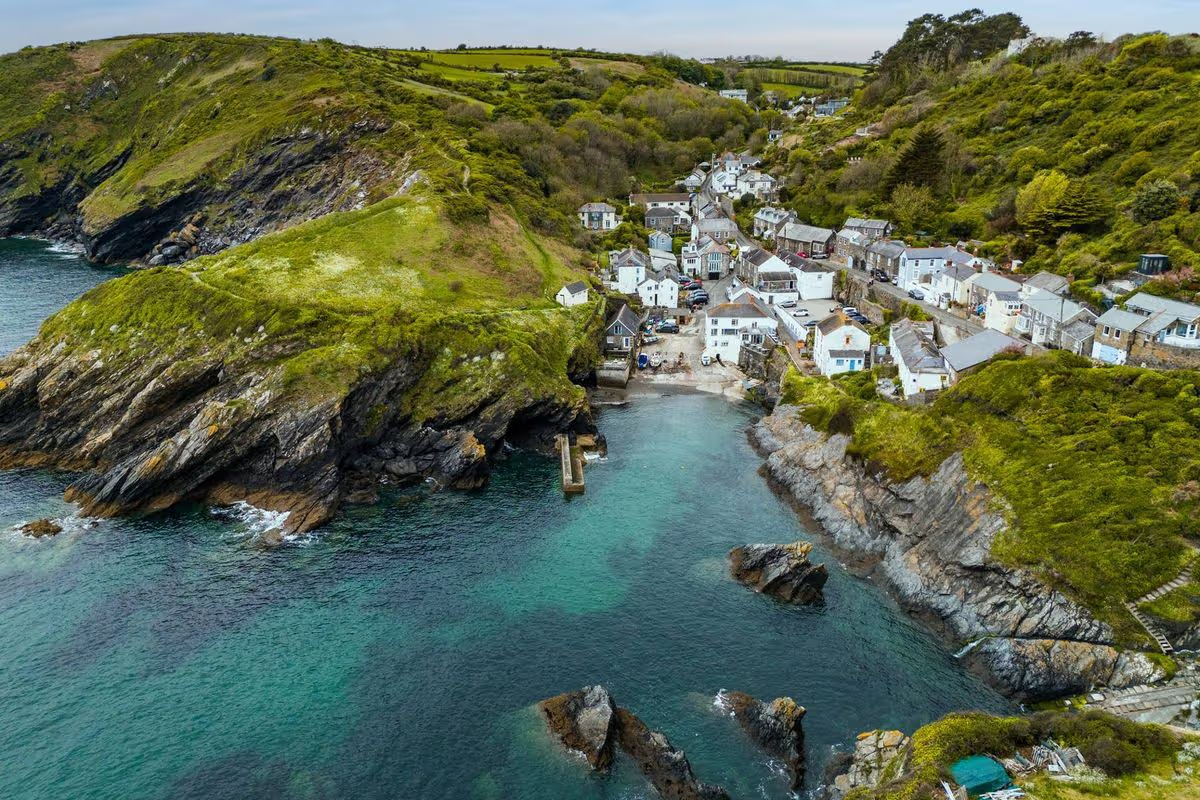
The village seems to be frozen in time(Image: Getty Images)
Cornwall harbours a hidden gem which truly seems frozen in time.
Encircled by stunning scenery and overflowing with authentic Cornish charm, this South Cornwall fishing village stands amongst the area’s most exceptional locations.
Described by Secrets of Cornwall as “a great secret frozen in time”, this tiny harbour village nestles magnificently at the foot of a steep, dramatic valley that opens out onto the splendid Veryan Bay.
Considered the crown jewel of Cornwall’s Roseland Peninsula, this coastal village provides quintessentially Cornish views, yet remarkably stays free from the usual tourist masses.
The late Sir John Betjeman – Poet Laureate and famously the campaigner who saved St Pancras Station from destruction during the 1960s – once described this little hamlet as “one of the least spoiled and most impressive of Cornish fishing villages”, and it’s safe to say Portloe has fully lived up to such acclaim.
Save on the best holiday cottages in Cornwall
This article contains affiliate links, we will receive a commission on any sales we generate from it. Learn more
Famous for its rugged coastline, golden beaches, picture-perfect villages and rich maritime heritage, Cornwall is one of the most-visited corner of the UK. Sykes Cottages has a large number of holiday homes to choose from, with prices from £36 per night.
Timeless Cornish treasure
The village derives its name from the Cornish ‘Porth Logh’, meaning ‘cove pool’ – a fitting description reflecting its picturesque position within a cove surrounded by dramatic hillsides.
This naturally sheltered spot established its role as a flourishing pilchard fishing harbour throughout the 17th and 18th centuries.
In fact, until the 20th century, over 50 fishing boats operated from the village’s protected cove harbour, a number that has since dropped to just two.
These remaining operational vessels continue their work, hauling in lobster and crab which is then supplied to the village’s two venues – The Lugger and The Ship Inn.
Considered among Cornwall’s most delightful villages, Portloe stands as a true hidden gem, preserved from the passage of time and modern development, reports Cornwall Live.
The steep valleys encircling the village have guaranteed Portloe’s protection from urban sprawl over the years, leaving the settlement and its buildings practically unaltered since their initial construction during the 17th and 18th centuries.
Like much of Cornwall, Portloe’s past is linked with smuggling, with French brandy being the main contraband transported through the village in a bid by locals to supplement the hamlet’s dwindling fishing trade.
Famous connections
Portloe provides a genuine escape from Cornwall’s well-known summer crowds, offering simply a scenic historic harbour and a small beach which exposes a limited stretch of sand at low tide – its picture-perfect surroundings undisturbed by tourist commotion.
The village’s unspoilt appeal has also rendered it a popular filming destination over the years, most notably appearing in Forever England (1935) starring John Mills, Treasure Island (1949), The Camomile Lawn (1991), and more recently in Richard Curtis’ rom-com blockbuster About Time (2013), the BBC’s Wild West television series, and Irish Jam (2006).
What to see and do in the picturesque coastal village
Tourists should not overlook Portloe’s two most renowned establishments – The Lugger hotel and The Ship Inn.
Situated right at the top of the harbour slipway, The Lugger provides diners with the opportunity to relish freshly caught lobster, crab and fish while taking in unmatched views of the Cornish coastline.
Immersed in Portloe’s history, The Lugger was once a notorious smuggler’s refuge, with its landlord even meeting his end at the gallows during the 18th century for smuggling French brandy.
For those favouring a valley-facing view and a more traditional pub atmosphere, the much-adored Ship Inn awaits – originally a 17th-century fisherman’s abode that remains decorated with maritime memorabilia.
Serving delicious meals, The Ship Inn has established its reputation on fresh seafood whilst also accommodating lovers of more typical pub favourites.
One Tripadvisor review of this beautiful village reads: “One of those hidden treasures that we love. Tucked away and not easy to find, but so well worth the trip.
“There is no beach to speak of, this is still very much a fishing village. One hotel, one pub, lots of fancy pants second homes and a handful of old fishing boats plying their trade.
“A great place to start a section of the coast path also. Or just sit and be, and let the day drift by.”
Another visitor said about Portloe: “Lovely, timeless location, where they still winch small fishing boats up on the beach. The only other place I know of like this is Cadgwith Cove on the Lizard peninsula. Simple and unspoiled – thankfully not inundated with tourists like Polperro. There are beautiful clifftop walks to enjoy, or you can just sit and listen to the waves lapping on the shore.”
There’s remarkably little else to keep you busy in this charming Cornish fishing village apart from dining, enjoying a drink and absorbing the breathtaking coastal views – and frankly, we can’t think of a better way to spend your holiday time.
If you’re on the hunt for the perfect spring getaway, this beach needs to be on your radar.
This article contains affiliate links, we will receive a commission on any sales we generate from it. Learn more
This spot has some of the best views in the country(Image: Getty)
As the UK welcomes warmer weather and springtime approaches, the allure of the beach becomes irresistible. With an abundance of stunning coastlines to choose from in the UK, deciding on the perfect spot can be a challenge.
Thankfully, the experts at Go Outdoors have done the hard work for you, compiling a list of the crème de la crème by analysing data from across the country. The research considered spring temperatures, rainfall records, sunshine hours and Google reviews of UK beaches, culminating in a definitive list of the nation’s top springtime beaches.
Taking the top spot is a breathtaking beach boasting 7.8 hours of daily sunshine during spring and minimal rainfall.
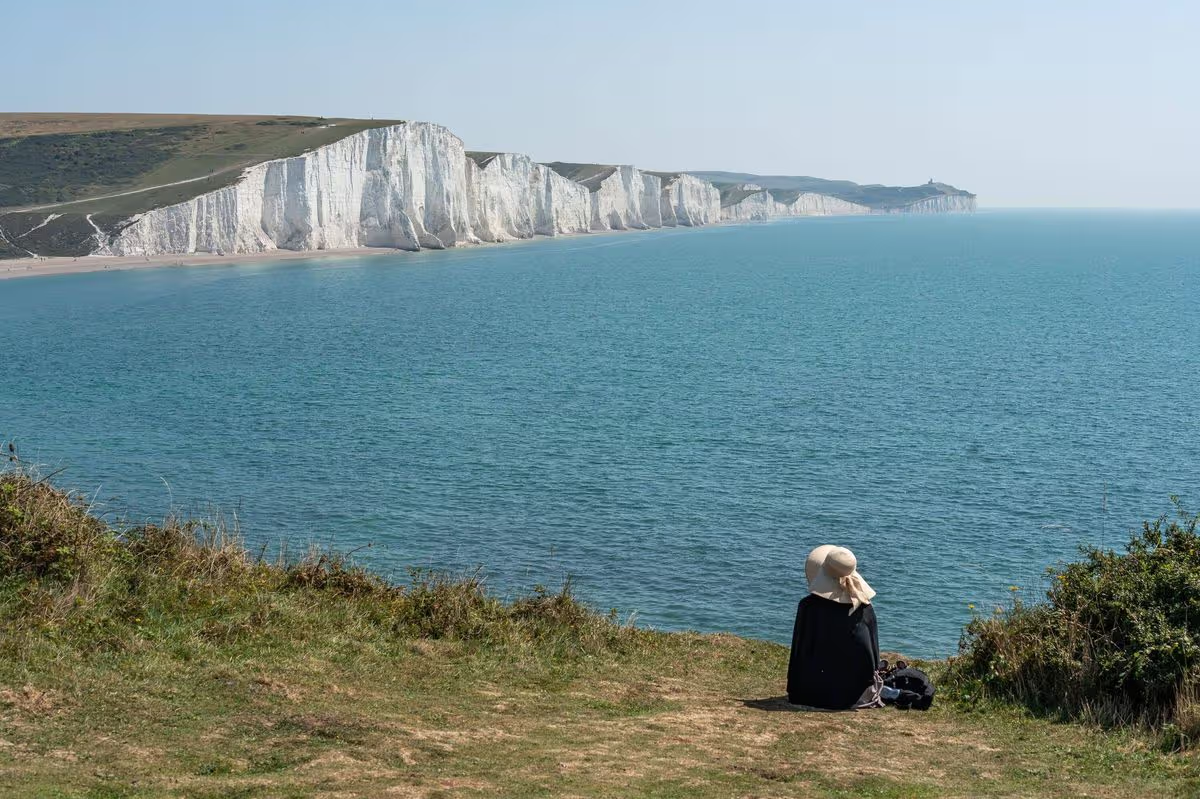
This idyllic location is none other than Cuckmere Haven in East Sussex, which achieved an impressive score of 9.60 out of ten in the Go Outdoors study. Visitors can enjoy picturesque river walks, a vast coastline and views of some of the country’s most renowned cliffs.
The beach itself is a sight to behold, but there’s also plenty to discover in the surrounding area. It offers one of the best vantage points of the Seven Sisters – England’s iconic white cliffs – and you can meander along the Cuckmere River towards the sea, reports the Express.
Praise for the beach abounds on TripAdvisor, with one gentleman enthusing: “Absolutely stunning scenery. Long walks and perfect for the family I loved every second of walking these beautiful cliffs. You can also see the Seven Sisters the whole time for those are into history.”
Another commented: “Wow – this iconic sight takes your breath away! The cliffs are blindingly white and the beach and surrounding countryside is so pretty. Everyone should see this once in their lifetime.”
Numerous visitors caution that some of the pathways around the beach can become muddy and slippery, so proper footwear is essential – though there are ample spots to pause and rest along your journey.
Calum Jones, author and outdoor enthusiast at GO Outdoors, advised: “When planning your spring beach trip, keep in mind that British weather can still be unpredictable. Bring a waterproof jacket to stay dry in case of sudden showers, choose supportive, waterproof footwear for any slippery sand or rocks, and layer your clothing so you can easily adjust to changing temperatures.
“Sun protection is also important, even in spring. Apply a generous layer of suncream before you head out, and don’t forget a cap and sunglasses to shield yourself from harmful UV rays.”
WASHINGTON — Days after he was named Iran’s next supreme leader, and over a week since U.S. and Israeli bombing wiped out much of his family, Mojtaba Khamenei issued his first statement on Thursday demanding vengeance against the alliance over the war it unleashed.
He called on Iranian forces to continue thwarting vital shipping traffic through the Strait of Hormuz. He vowed to open new fronts against the United States and Israel. And he warned that Gulf states hosting U.S. bases would remain targets of Iranian attack.
Yet, what concerned the White House most was what the new supreme leader didn’t say.
Khamenei made no mention of a strategic endeavor that had brought the Islamic Republic to war: Its nuclear program, suspected for decades of harboring military dimensions.
The omission was not lost on officials in the Trump administration, who told The Times they are largely in the dark over the new supreme leader’s stance on whether Iran should break out to build a nuclear weapon.
Khamenei’s deep alliance with the Islamic Revolutionary Guard Corps, which has advocated for weaponization in the past, has raised concern that the new leader will depart from his father’s long-standing position against building a bomb.
U.S. intelligence assessments long held that the late ayatollah, Ali Khamenei, had adopted a strategy of remaining at the threshold of developing a nuclear weapon while avoiding the costs and risks of actually building one. In 2003, as the United States invaded Iraq over false claims that Saddam Hussein possessed weapons of mass destruction, Khamenei issued a religious edict — a fatwa — declaring nuclear weapons to be forbidden under Islam.
That doctrine is now in doubt, with the new supreme leader wounded and stewing underground over the U.S. assault that has devastated Iran’s military and killed his father, his mother and his sister, among other family members.
Concern among U.S. officials comes as Trump has expressed interest in ending the war “very soon,” even though a stockpile of uranium — a key ingredient in the construction of nuclear weapons — remains buried but accessible to Iranian authorities.
Defense officials are skeptical that the nuclear program can be fully dismantled without sending in a substantial U.S. ground force, an escalation that Trump has sought to avoid. But ending the war with Iran’s nuclear infrastructure partially intact could have devastating repercussions. The U.S.-Israeli campaign could force the new Iranian leader to conclude that regime survival requires a nuclear deterrent, one official said.
“Even if President Trump declares victory tomorrow, and points to the damage done to Iran’s conventional military, the fact of the matter is you have a more hardline regime in place with the key ingredients for a nuclear weapon,” said Eric Brewer, deputy vice president of the nuclear materials security program at the Nuclear Threat Initiative, who noted that Tehran still has a stockpile of 60% enriched uranium — close to weapons grade — and advanced centrifuges to take it over the finish line.
“What’s the plan for day after,” Brewer added, “as Iran starts to build back, and potentially seeks nuclear weapons?”
Patrick Clawson, director of the Iran program at the Washington Institute for Near East Policy, said that Mojtaba Khamenei’s position on the nuclear program has been a stubborn mystery. Reports spreading on social media that he opposed the Joint Comprehensive Plan of Action, a nuclear deal brokered among world powers and Iran during the Obama administration, are unsubstantiated, he said.
“While Mojtaba often advised his father on domestic issues, there is much less information about his position on foreign affairs, other than opposition to Israel,” Clawson said. “I have never seen any indications he took a position about the JCPOA.”
President Trump has outlined the destruction of Iran’s nuclear capabilities as a major goal. But in closed door briefings to Congress, defense officials have been less emphatic, according to Democratic lawmakers.
On Tuesday, shortly after Khamenei was named to succeed his father, Defense Secretary Pete Hegseth warned him to disavow continued nuclear work in an exchange with reporters.
“He would be wise to heed the words of our president, which is to not pursue nuclear weapons,” Hegseth said, “and come out and state as such.”