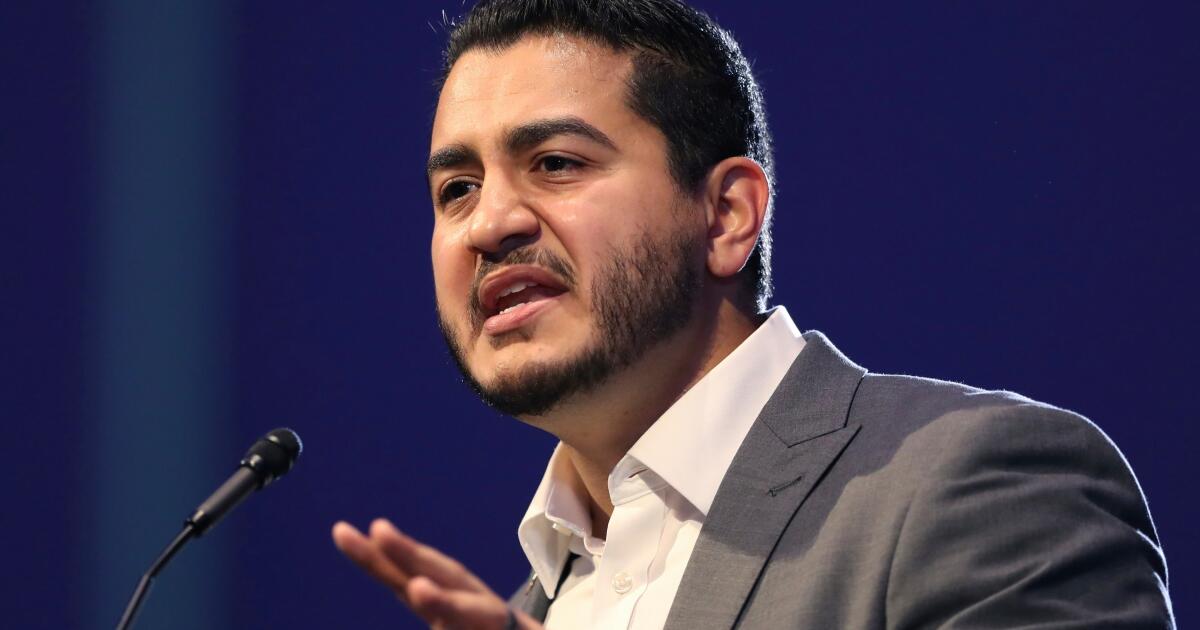
ANN ARBOR, Mich. — By the time Hasan Piker takes the microphone at two campaign events with a Senate candidate in Michigan on Tuesday, the popular but controversial online streamer will have already generated plenty of noise inside the Democratic Party.
Some have pitched him as a gateway to young people — particularly young men — who have drifted to the right in recent years. Others fear he is a sign of the party beholden to its extremes, pointing to inflammatory rhetoric like “Hamas is a thousand times better” than Israel, describing some Orthodox Jews as “inbred” and that “America deserved 9/11.”
Piker’s scheduled appearances with Abdul El-Sayed, a progressive candidate in the Democratic primary for U.S. Senate in Michigan, have catalyzed questions of how big a tent the party wants to build as it works to regain power in the midterm elections and win back the White House.
In an interview with the Associated Press, Piker cast the reaction as part of a broader fight for the party’s future.
“There is definitely, I think, a battle right now for who gets to be more representative of the national Democratic Party,” he said.
Piker remains largely unapologetic for his past remarks, although he’s said some were poorly worded. He called the renewed focus on them “totally ridiculous, especially considering that there are far more consequential things happening in the world right now.”
“The super wealthy are picking apart the scraps of the American carcass like a bunch of vultures, and some of the Democrats are talking about their affiliations with a Twitch streamer,” Piker said. “I think Americans understand that this is totally ridiculous.”
The 34-year-old Turkish American streamer has 3.1 million followers on Twitch and 1.8 million on YouTube, making him an influential voice in a shifting media landscape where mainstream outlets are losing clout. Unlike traditional podcasts, his livestreams are often unscripted and interactive. He has hosted prominent Democrats, including Rep. Alexandria Ocasio-Cortez and New York City Mayor Zohran Mamdani.
Piker said he is a “megaphone” for an angry electorate, and he believes the criticism that he faces is less about him personally and more about what he represents — a younger, more populist wing of the party.
“I think they find me to be a more appropriate target than to just actively disparage the voters,” he said.
El-Sayed, who has been backed by progressive Sen. Bernie Sanders, is attempting to channel that appeal in appearances at Michigan State University and the University of Michigan on Tuesday. A physician and former county health official, he is locked in a competitive Senate primary with U.S. Rep. Haley Stevens and state Sen. Mallory McMorrow. It’s a critical race for a seat being vacated by Democratic Sen. Gary Peters and the winner of the primary will likely face former Republican Rep. Mike Rogers.
The three candidates have differing views on U.S. foreign policy toward Israel. Both El-Sayed and McMorrow have described the war in Gaza as a genocide. El-Sayed wants to stop all military assistance while McMorrow has pushed for a two-state solution. Stevens has described herself as a “proud pro-Israel Democrat.”
McMorrow told Jewish Insider that Piker was someone who “says extremely offensive things in order to generate clicks and views and followers,” and she compared him to white supremacist Nick Fuentes. Trump’s decision to dine with Fuentes between his presidencies ignited a firestorm of controversy over his association with extreme voices on the right. Stevens said El-Sayed is “choosing to campaign with someone who has a history of antisemitic rhetoric.”
El-Sayed responded to the backlash over Piker by saying “if we want to have a conversation where we’re actually bringing people together about the things that we need and deserve, we’re gonna have to go to unlikely and uncommon places.”
Not everyone in the party wants to go to those places. Rep. Brad Schneider of Illinois, who chairs the moderate New Democratic Coalition and co-chairs the Congressional Jewish Caucus, called Piker “an unapologetic antisemite.”
“We are deeply disappointed by the decision to host a speaker at the University of Michigan with a documented record of antisemitic rhetoric,” said Rabbi Davey Rosen, the CEO of Michigan Hillel. “Such invitations normalize hate and contribute to a hostile environment for Jewish students.”
Piker said he is not antisemitic and describes himself as anti-Zionist. Hostility toward Israel has risen across the political spectrum and became a fault line within the Democratic Party during the war in Gaza.
Criticism has centered on Piker’s past remarks. After the Oct. 7 attack on Israel, Piker argued that whether reports of sexual violence are accurate “doesn’t change the dynamic” of the conflict. He has repeatedly said the core issue is Israel’s conduct in Gaza.
Piker has drawn backlash for a comment in which he said “America deserved 9/11,” made during a 2019 livestream while discussing U.S. foreign policy. Piker has said the remark was poorly worded and added in the AP interview that he “didn’t mean that Americans deserved to die.”
ABOARD THE CRESCENT — There’s something melodic about watching the sun rise over a rural stillness broken only by the rhythms of steel wheels on tracks. Or so we tell ourselves.
In this case, being aboard a train at all owed more to politics than poetry.
Congress and President Trump were mired in their latest budget stalemate, one rooted in his immigration crackdown and the tactics of federal forces he has sent to U.S. cities. But this impasse has upended a foundational constant of American life today: easy air travel.
In Atlanta, my hometown airport, cheerfully marketed as the world’s busiest, had descended into organized chaos. Unpaid federal employees called out from work, leaving a diminished security staff to screen travelers frustrated by hours-long waits in line. I wanted to get to Washington for the NCAA basketball tournament. So I eliminated the risk of a missed flight and booked the train overnight and into game day across a 650-mile route.
In this fraught moment in U.S. politics, I slowed down and thought about things we take for granted. Who ever ponders the conveniences of that 20th century innovation, the airplane, that makes 21st century hustle possible? We book and board. An unconscious, first-world flex of modernity. It’s even rarer to grapple with the inconvenience.
My decision had taken me further back, to the 19th century and another defining innovation: the long-distance train.
A 14½-hour weekend train ride is time aplenty to appreciate how completely politics, economics, social strife and fights over identity and belonging have always affected the order of our lives, including how, when and where we move around in these United States. But Amtrak’s Crescent also allowed me to see the expanse of our collective experience.
I traversed the urban, suburban and rural breadth of East Coast America. I learned how other travelers came aboard. And in that, I found the portrait of people, past and present, who refuse to be as paralyzed as some of their elected leaders.
Convenience on the railways
There is little glamour late night in a crowded Amtrak station. Children are up past bedtime and tended by frazzled parents. Older adults struggle with luggage and stairs.
Airports are not red-carpet affairs either, of course. But there is a certain cache to Delta’s Atlanta-Washington flights. They typically take about two hours gate to gate. They often are slotted at a midpoint gate of the concourse nearest the main terminal. That is almost certainly a nod to members of Congress who use it, but who have lost some airline perks during this extended partial shutdown — which as of Sunday is the longest government shutdown in U.S. history.
In normal circumstances I can get from my front porch to Capitol Hill or downtown in as little as 4½ hours. Security lines these days could at least double my overall air travel time.
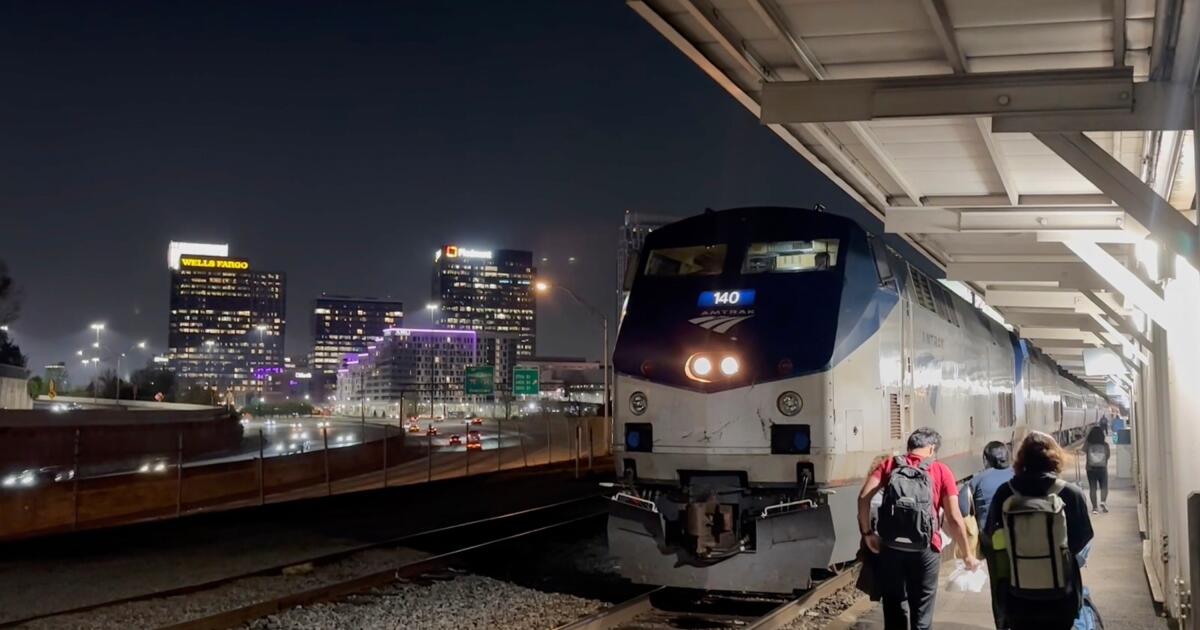
The train is still longer, and time is money, we are taught. But certainty has value, too, even if it means an 11:29 p.m. departure. And at the Amtrak station, there were no standstill lines, no Transportation Security Administration agents, no ICE agents as stand-ins.
Passengers who arrived mere minutes before departure made it on board and found seats quickly — assigned in boarding order, not predetermined zones that yield jammed aisles. There’s no in-seat service or satellite TV. But even coach seats, the lowest Amtrak tier, are as spacious as airline first-class — and there is Wi-Fi, so it’s not the 19th century or even 20th century after all.
On board, I heard one crew member joke, “I’m no TSA agent.”
The pathways of history
As a boy in rural Alabama, I counted train cars and wondered where they were headed. I’ve since read diary entries and letters from my grandmother and her sisters recounting World War II-era weekend trips to Atlanta.
The South’s largest city has a historical hook too. Originally named “Terminus,” Atlanta developed in the antebellum era as a critical intersection of north-south and east-west rail routes. That is what drew Gen. William Tecumseh Sherman for one of the Civil War’s seminal campaigns that helped defeat the Confederacy.
A century after the Civil War, Delta chose Atlanta for its headquarters rather than Birmingham, Ala., which was the larger city as of the 1960 census. The company’s decision was tied up in tax breaks for the airline, named for its crop duster origins in the Mississippi Delta region. According to some interpretations, Delta’s decision was made easier because of the more overt racism of Alabama’s and Birmingham’s leaders as they defended Jim Crow — a code that, among other acts, allowed states to segregate the passenger trains that predated Amtrak.
On this night, I heard many languages and accents, notable given the role that immigrant labor played in building the U.S. rail system and especially striking now with immigration — legal and illegal — at the forefront in Washington, my destination. I saw faces that reflected U.S. pluralism, a different mix from what my grandmother and aunts would have seen a lifetime ago.
The array of voices celebrated the freedom and ease of rail travel. So did Agatha Grimes and her friends after they boarded in Greensboro, N.C., as part of a long weekend trip to celebrate her 62nd birthday.
“I got stuck in the Atlanta airport last week,” Grimes said, as her group laughed together in the dining car. “It’s just nuts.”
Beretta Nunnally, a self-described “train veteran” who organized their trip, said, “There’s no worry about parking. No checking bags. You come to the station, you get where you‘re going, and you come home.”
An era for planes, trains and automobiles
Still, that is not as easy in the United States as it once was.
Just as politics, economics and subsidies helped expand U.S. railroads, those factors diminished the network as auto manufacturers, oil companies, road builders and, finally, airline manufacturers and airlines commanded favor from politicians and attention from consumers.
Riding hours across rural areas, I noticed the junkyards where kudzu and chain-link fencing framed rows of rusted automobiles. I saw the farmland and equipment that helps feed cities and the rest of the nation. I awoke to see the night lights of office towers in Charlotte, N.C., and its NFL stadium. I saw vibrant county seats — and I thought of countless other towns like them that are not thriving as they sit disconnected from passenger rail and far from the Eisenhower-era interstate system that we crossed multiple times on our way.
In each setting, voters — conservatives, liberals, the extremes and betweens — have chosen their representatives, senators and a president who now set the nation’s course.
When I arrived in Washington, I paused to enjoy Union Station’s grand hall and its Beaux Arts appeal, and I lamented how much splendor has been lost because so many striking U.S. terminals have been razed. I stepped outside and looked up at the Capitol dome.
While I had slept, the Senate managed a bipartisan deal to fund all of the Department of Homeland Security except immigration enforcement. As I continued northward, House Republican leaders rejected it. The stalemate continued.
The president, however, took executive action to pay TSA workers, and their paychecks may resume within days, though long airport lines may continue awhile longer.
I was a weary traveler but renewed citizen. I had a game to get to. And the train rolled on.
Weekly insights and analysis on the latest developments in military technology, strategy, and foreign policy.
Operation Epic Fury will hit a month old by the weekend. It and the massive military build-up to it were made possible by a global logistics chain that only the Pentagon can supply. At the heart of it is the aerial refueling fleet. These aircraft have flown thousands of sorties to get materiel where it needs to be and fast. These have included stuffing the fuel tanks of C-17s with cargo holds full of Patriot missiles to dragging stealth fighters across the globe. Epic Fury has been one of many operations to heavily tax the tanker fleet in recent years. To get a much better insight into the tanker portion of the war and its impacts, we talked to one man with an extreme level of experience behind the controls of USAF tankers.
For more than 20 years, Troy Pananon, a retired Air Force colonel, served in the aerial refueling community. He flew KC-10 Extender and KC-135 Stratotanker refueling jets and served as deputy commander of the 6th Air Mobility Wing at MacDill Air Force Base in Tampa, Florida (now 6th Air Refueling Wing), and later as commander of the 100th Air Refueling Wing at RAF Mildenhall in England. Both of these installations and their KC-135s are instrumental in the ongoing war in Iran.
In a two-hour, wide-ranging exclusive interview, Pananon offered insights into the strain of the war on the jets and personnel and the challenges of keeping the aging KC-135s flying as they perform hundreds of sorties gassing up fighters, airlifters and other aircraft. One of those missions resulted in the deaths of six airmen after a suspected midair collision over Iraq. Pananon also addressed a whole host of other issues, including how Epic Fury is affecting readiness for a fight against China, the scourge of drone incursions and much more, which will be addressed in future installments.
Pananon, who began his career as an enlisted Marine, retired from the Air Force in 2023 and is now a 737 first officer with United Airlines. The first installment of our conversation focuses on Epic Fury and the toll on the tankers, crews and maintainers. Some of the questions and answers have been lightly edited for clarity.
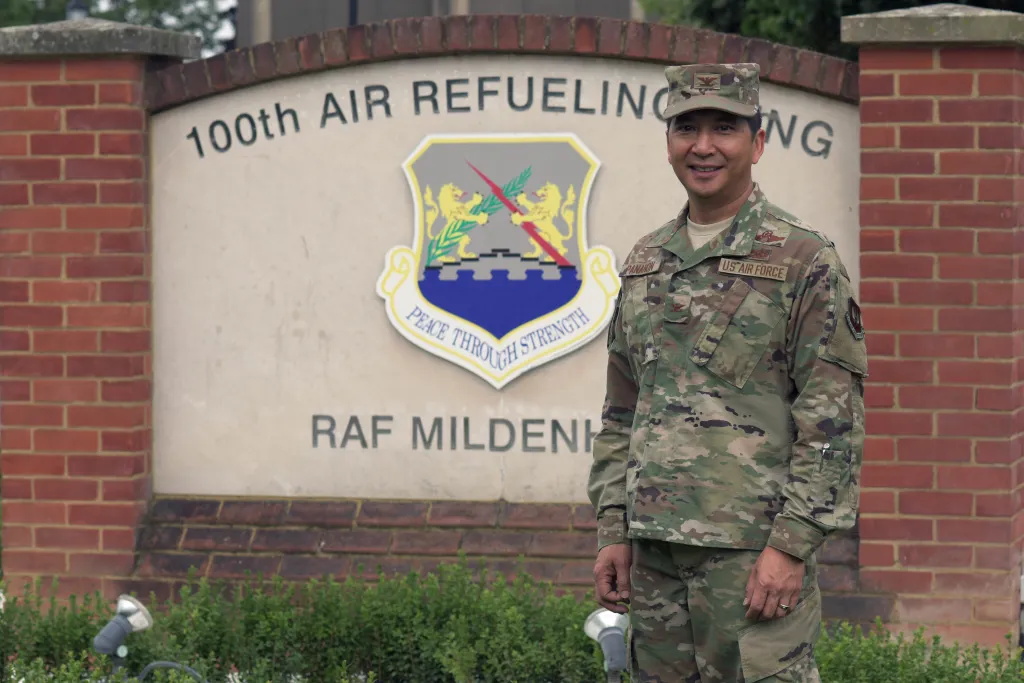
U.S. Air Force Col. Troy Pananon, 100th Air Refueling Wing commander, poses for a photo at RAF Mildenhall, England, July 9, 2019. Pananon served five years as an enlisted Marine prior to receiving his commission from Embry-Riddle Aeronautical University, Daytona Beach, Fla., in 1996. He was initially assigned as a maintenance officer at Hurlburt Field, Fla., and then attended Undergraduate Pilot Training at Columbus Air Force Base, Miss. (U.S. Air Force photo by Senior Airman Benjamin Cooper) Tech. Sgt. Benjamin Cooper
A: I would categorically say that there’s a huge strain on the entire ecosystem. The KC-135s were rolling off the assembly line in the 50s and 60s. Some of the technology, and we called it technology back then, was graduated from the Wright brothers technology. Parts on that aircraft are still reminiscent of some of the things that were invented by the Wright brothers. So it’s amazing to me that the KC-135 is able to operate, and it’s due in large part to the maintainers and the relentless effort that they follow through to keep those aircraft air worthy.
If you think about the [airmen], how they’re operating in places you mentioned all over the world, they’re there. We’ve broken their normal routine. They’re away from home, away from their family and friends. So that’s a mental and physical stressor, because they’re in environments that they’re not accustomed to.
We don’t know how long this conflict could last. We’re approaching a high heat of summer in that region, and so depending on where some of these personnel are based or stationed, they’re certainly out of their normal circadian rhythm, their normal environmental routines. It is a huge strain on those maintainers and the airframes that we’re placing in different parts of the world, exposed to different elements than they may have been exposed to at their normal pace. Maintaining these aging aircraft is a strain on the entire ecosystem, and we are operating them at a high operations tempo, and surely that puts a lot of a significant strain on the KC-135.
We do have the KC-46 that is helping to fill some of that void, but we just retired the KC-10, which was a tremendous workhorse. And so I would say that there’s a significant strain on the ecosystem.
U.S. Air Force 100th Maintenance Squadron, aircraft maintainers conduct maintenance on the KC-135 Stratotanker at RAF Mildenhall, England, Dec. 10, 2025. (U.S. Air Force photo by Airman 1st Class Iris Carpenter) Airman 1st Class Iris Carpenter
Q: What are the biggest challenges in keeping these Cold War-era jets like the KC-135 flying? How difficult is it to find parts, and what do you do when you can’t?
A: That’s 100% accurate. There have been some breakthroughs in technology. I know that they’ve used 3D printing to help source some parts. They’ve even gone back to the boneyard and pulled parts off of older KC-135s. So resources will always be a great puzzle for our entire team to source.
There’s no new assembly line. They shut that assembly line down back in the ’50s and ’60s. Some of the parts for those aircraft in general were from the ’60s, ’70s and ’80s. And then, you have to take those back and refurbish those certain parts. There’s not a lot of new technology that’s going on to these core platforms. The avionics, for sure, is newer. But everything that you add to this aircraft, I call it the Frankenstein effort – taking bolt-on technology to try and help modernize the fleet. And by modernizing that means that you’re also helping with the parts availability. But going back to the age of these aircraft, some of these parts were developed back in the ’40s and machined back in the ’50s and ’60s. Our teams have to get creative with the acquisition. And that’s a huge, huge challenge. But they currently have done a great job of putting new engines on the aircraft. And so that means that the parts availability is better in some cases, but it’s not a solution.
Davis Monthan AMARG Boneyard tour with KC-135s and Boeing 707s
Q: What are some of the old parts you’re talking about that go back to the ’40s, or to the Wright brothers era?
A: Just think about the flight controls. If you, for whatever reason, need to replace certain pulleys or elements within the flight control system, those parts were thought-up and developed way back in the ’40s. Machined maybe back in the ’50s and ’60s. It’s still not a fly-by-wire aircraft like some of the modern aircraft that we have nowadays. And so you have to go back and machine some of these parts if they get wear and tear.
Two guardsmen from the 171st Maintenance Group, 171st Air Refueling Wing, Pennsylvania Air National Guard, work on top of a KC-135 Stratotanker aircraft while it undergoes an isochronal inspection, Aug. 17, 2021, in Pittsburgh, Pennsylvania. (U.S. Air National Guard photo by Staff Sgt. Zoe M. Wockenfuss) Tech. Sgt. Zoe Wockenfuss
Q: What are the complexities of supporting such a high tempo operation like the war against Iran with aerial refueling? We’ve heard that the airspace over Iraq is chaotic and that the lack of onboard situational awareness is a major issue with tanker crews and receivers. What have you heard about this?
A: Obviously I haven’t operated over there in a number of years, but I do go back to the times when I was operating aircraft in that theater. That puts me back into the Enduring Freedom, Iraqi Freedom timeframe. We have deconfliction procedures. We have airspace procedures that we study and that we follow. We have aircraft in there that help us deconflict the airspace and ensure that we have safe separation. And it goes to training, it goes to situational awareness.
Back then, we didn’t have some of the avionics and software suites that we have available to us today, so our situational awareness wasn’t as high, but yet we had good, solid procedures and processes that ensured clear deconfliction and separation in the airspace that they’re operating in. Now, I would assume that it’s congested and it’s contested, and so having the ability to have higher situational awareness with onboard avionics suites that are connected is probably more and more essential as we go forward.
A view from inside the cockpit of a Block 45 KC-135R during a land approach. The wide-area digital multi-function display in the center of the cockpit is another key feature of the upgrade package. (USAF)
Q: But have you heard anything about the chaotic nature of the current airspace and lack of onboard situational awareness? Is it a major issue right now with the tanker crews and receivers?
A: I really can’t comment on it, because I don’t have firsthand knowledge. What I can say is that it’s in a contested environment, and our crews are definitely trained to operate in these kinds of environments. And you know, it’s just like anything there. There are elements that we have little control over, and I call it the fog and friction of warfare. But I have 100% absolute trust in the personnel. They’ve been trained. They are equipped. Could they be equipped better? Could they be resourced better? Sure. But again, it still goes back to the fact that even if we resource them with the newest technology, they then have to go back and be trained to understand how to integrate it and how to use it effectively.
There is still an opportunity here. You can’t solve it overnight, but it does need to happen so it would help. I’m certain that if we ever get into conflict with a near peer, it’s going to be even more challenging.
A U.S. Navy F/A-18F Super Hornet aircraft refuels from a U.S. Air Force KC-135 Stratotanker aircraft during a mission in support of Operation Epic Fury over the U.S. Central Command area of responsibility, March 8, 2026. (U.S. Air Force photo) U.S. Central Command Public Affa
Q: When was the last time tanker crews flew in contested airspace against adversaries with more robust air defenses than we have seen in past conflicts?
A: I would like to say that any time that you’re operating within a conflict zone, that’s considered contested airspace, right? The tankers are considered a high-value, low-density. We don’t have an infinite number of tankers, so they’re going to tend to operate outside the reach of the adversary’s missiles, or fighter aircraft that would try to reach and take down one of these tankers. So they’re really going to try and operate within a safe, safe zone. I would frankly say that in a conflict, tankers operate in contested airspace all the time, and it’s really contingent on the ability of our joint force to clear that airspace and to allow our tankers to move closer to the tip of the spear, but generally speaking, it is really sacrosanct to keep tankers an arm’s reach away from an adversary’s ability to take them down.
U.S. Air Force airmen prepare for aerial refueling on a KC-135 Stratotanker aircraft during Operation Epic Fury over the U.S. Central Command area of responsibility, March 20, 2026. (U.S. Air Force photo) U.S. Central Command Public Affa
Q: Do you have any sense of what happened in the fatal March 12 KC-135 crash in Iraq that led to the deaths of Maj. John “Alex” Klinner, 33, of Auburn, Alabama; Capt. Ariana G. Savino, 31, of Covington, Washington; Tech. Sgt. Ashley B. Pruitt, 34, of Bardstown, Kentucky; Capt. Seth R. Koval, 38, of Mooresville, Indiana; Capt. Curtis J. Angst, 30, of Wilmington, Ohio; and Tech. Sgt. Tyler H. Simmons, 28, of Columbus, Ohio?
A: There’s an investigation taking place and it’d be wrong of me to comment on what I think took place. These crews are highly trained. They have a process. They have procedures. I don’t know what was taking place on the flight decks of both of those aircraft. There was probably some confusion as to who and where each aircraft was supposed to be, but I don’t know what led to that. There’s a lot of speculation out there. It’d be hard for me to really say what I think actually did happen.
A: Well, I have a deep background in the KC-10, and that also gives gas and takes gas. So I’ve been within 10 feet of another aircraft, operating at close to 350 miles an hour. It’s an inherently dangerous occupation when you’re trying to receive fuel from another aircraft. I don’t think that was the case in this particular incident over Iraq. But at all times, everything we do is inherently dangerous because we operate within safe operating margins, but they’re tight. So, a simple split-second decision or maybe error puts you in a precarious position. But we have procedures that, if we make a mistake and we come close to another aircraft – there is a term that we use, which is ‘breakaway.’ And that tells both aircraft, ‘hey, we’re in a situation where we need to create some space between our aircraft,’ and we follow our procedures. It’s a safe maneuver, but probably makes the hair on the back of your neck stand up a little bit. I’ve been in this, I’ve been in situations where I’ve had to rapidly escape from another aircraft.
But again, we get trained for this. We are highly trained. And I think because of the training, when a situation like that occurs, your instinct kicks in and you know what to do. And so, I don’t recall instances where two KC-135s had a midair collision, but certainly, we have had air-to-air collisions, just none in my recent memory.
Aerial refueling missions, which require close contact between aircraft traveling at high speeds, are inherently dangerous. (USAF) (USAF)
Q: The air refueling tanker community is tight. You served at MacDill Air Force Base in Tampa, Florida, with Tech. Sgt. Pruitt, one of the airmen who was killed in the crash. Tell me about how the crash affected the community. Tell me a little bit about Pruitt.
A: From my time at MacDill, I do remember her family. In general, losing anyone is just a shock to the system. And especially somebody that you may have worked with in the past, and you know. I just feel for their families. And we have a community. The tanker community – it’s just a system, a brotherhood and sisterhood. We are just one big family. Anytime we have a tragedy that strikes our community, especially like this, it’s tough.
I know that there are teams of people out there that are remorseful for the loss and that are doing anything in their power to support the families of these airmen. And I know there’s a lot of effort right now within our tanker community and outside of our tanker community with Go-Fund-Me pages. This is critical, because the families that have been affected by this lost a parent, right? A brother or sister or a spouse. I really do feel for these families, and I applaud the efforts of the supporters out there that are contributing to help with some of the things that are going to end up financially costing these families; but emotionally, you know that they will need support, probably for the rest of their lives. And so it’s a huge, huge loss.
U.S. Air Force airmen attend a vigil held by the 909th Air Refueling Squadron at Kadena Air Base, Japan, March 20, 2026. The vigil brought airmen together in remembrance of six airmen who died in a KC-135 Stratotanker crash while supporting Operation Epic Fury. (U.S. Air Force photo by Senior Airman James Johnson) Senior Airman James Johnson
Q: What can you tell me about Tech. Sgt. Pruitt?
A: Ashley was full of energy and was extremely bright, tenacious, and had an unmatched work ethic. She was a real, genuine people person. When you walked into a room, you knew she was there. But she was incredibly talented and someone that you could rely upon to help others, and she was absolutely an incredible boom operator and highly skilled and her death is this huge, huge loss. For her legacy, she impacted so many people and so many of these airmen and their families were certainly enriched by her being in their lives. At the time, I was the vice commander of the [then-6th Air Mobility Wing] at MacDill. And on occasion, I would go out and go fly with the KC-135 crews. I didn’t have a daily interaction with her, but everybody knew her, and everybody knew of her. And that’s the important part. There are many other airmen that are in our ranks right now that have benefited from being introduced to her and being taught by her and being mentored by her. So she’s surely missed.
An undated photo of Tech. Sgt. Ashley B. Pruitt, 34, of Bardstown, Ky., assigned to the 6th Air Refueling Wing at MacDill Air Force Base, Fla. Pruitt was one of six airmen who died March 12, 2026, when a KC-135 aircraft crashed in western Iraq while supporting Operation Epic Fury. (Courtesy photo)
Q: Give me a sense of how RAF Mildenhall and other bases in Europe and elsewhere keep these aircraft flying to generate sorties and deploy to combat zones like the Middle East.
A: The best part about having a forward operating base like Mildenhall is that you have all the resources in place, and in this particular case, they’re closer to where the conflict is. You don’t have as much of a long logistical chain, but you still have a logistics chain that you have to support. And so operating at a place like Mildenhall, a round the clock operation every day of the year, you do have weather to contend with on occasion, and you do have airspace constraints that you do have to contend with. But again, all of these crews are highly trained and so I would say that the operations tempo at a place like Mildenhall is extremely high.
Just being able to have the support of the government there and the host nation that there is, and the local community is a big deal. I enjoyed my time there. Of course, we were there during COVID, during the global pandemic, and the lengths and support that we received from the host nation to ensure the safety of our community and our airmen was incredible.
Seven U.S. Air Force KC-135 Stratotanker aircraft line up on the flight line at Royal Air Force Station Mildenhall, United Kingdom, on March 13, 2006. (DoD photo by Staff Sgt. Jeanette Copeland, U.S. Air Force. (Released)) Staff Sgt. Jeanette Copeland
Q: The 100th Air Refueling Wing has 15 tankers and more transit through. What are the concerns and checklists of objectives for a Mildenhall commander during a major contingency operation like Epic Fury?
A: It’s just our ability to support, right? You mentioned there are 15 tankers, but the airfield itself was able to surge to support twice as many. I currently don’t know how many aircraft that we’re currently supporting out of Mildenhall, but the ability to support that means that you have to be able to flex to the surge of the operation that you’re encountering. You have personnel that are helping to fuel the aircraft. You need personnel to maintain and sustain the aircraft. And so I would assume that we are getting support from bases in the United States. And they’re deployed there from all parts of our country and major units. The tanker fleet is a total force effort. Nearly half of the force resides in the [Air Reserve Component] ARC, and so personnel from Reserve, Guard, active duty, I’m sure, have been sent to help support operations like that.
In our next installment, Pananon talks about the KC-46’s lack of a boom pod, how Epic Fury is affecting the ability to potentially fight China and the dangers of flying long distances over the Pacific against an adversary with robust and plentiful modern air defenses.
Los Angeles Mayor Karen Bass has a lead over her challengers in her bid for reelection, but more than half of voters view her unfavorably, according to a poll released Sunday.
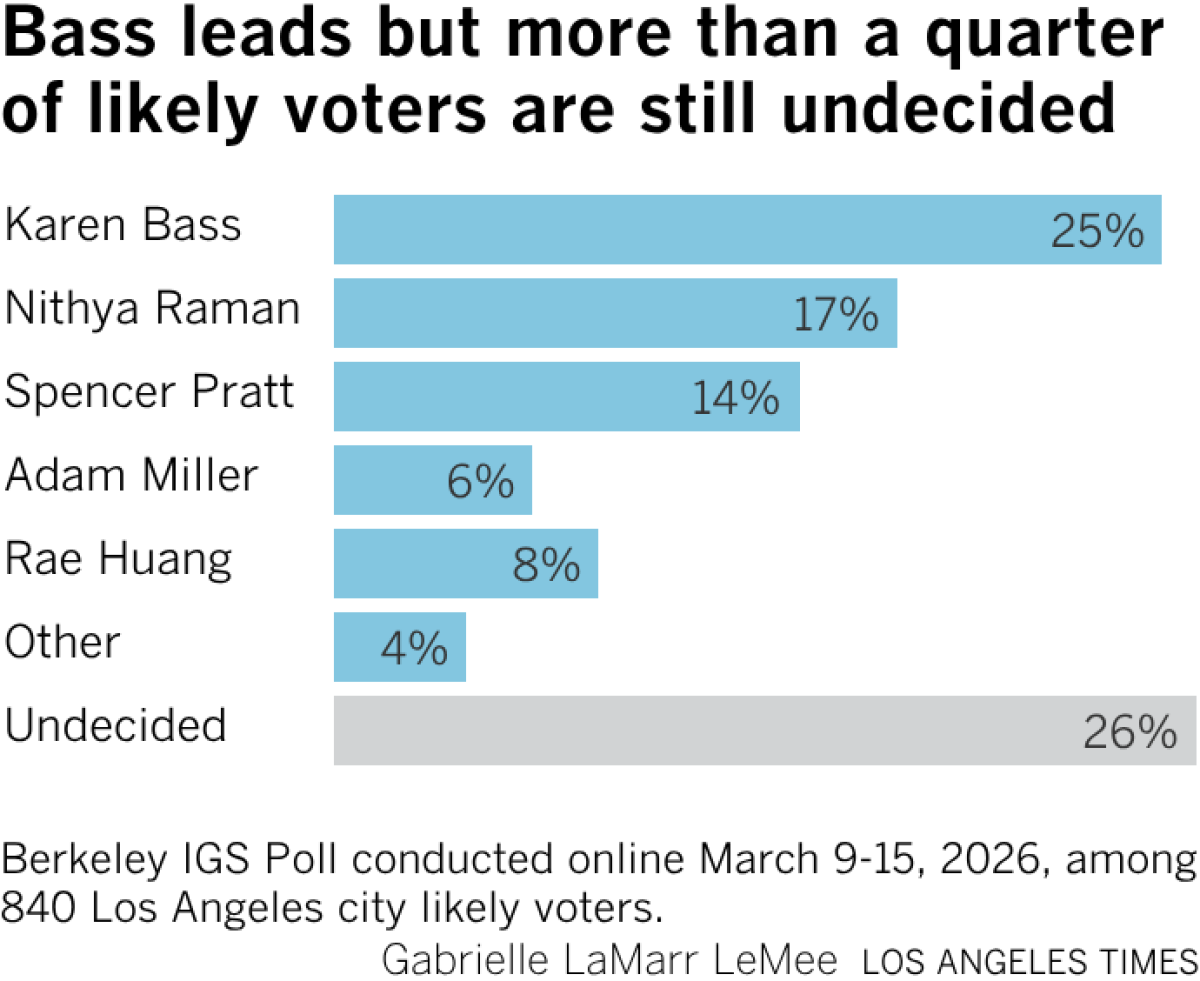
Bass was supported by 25% of voters, while City Councilmember Nithya Raman drew 17% and conservative reality TV star Spencer Pratt came in third at 14% in the poll by the UC Berkeley Institute of Governmental Studies, co-sponsored by The Times.
About a quarter of voters were undecided, the poll found.
Bass has come under heavy criticism for her handling of the devastating Palisades fire. More than a year later, 56% of those polled said they had an unfavorable view of her, while 31% viewed her favorably.
The survey of 840 likely voters between March 9 and 15 provides one of the first snapshots of the mayoral race, less than three months before the June 2 primary.
Beyond the top three, leftist Rae Huang notched support from 8% of those polled, while tech entrepreneur Adam Miller drew 6%.
Despite Bass’ lead, the poll is “borderline catastrophic” for her, because the field of candidates is so weak, said Dan Schnur, a politics professor at USC, UC Berkeley and Pepperdine.
“That she’s having this much trouble against this field, against such a little-known field of opponents, bodes very, very poorly for her,” Schnur said. “The only thing saving her at this point is that the top tier of potential candidates who were considering running against her decided to stay out of this race.”
The mayoral race solidified in early February, when Raman shocked the political establishment by jumping in against her ally Bass, hours before the filing deadline.
By that time, other well-known politicians, including billionaire developer Rick Caruso and L.A. County Supervisor Lindsey Horvath, had opted to stay out of the race. Former Los Angeles schools Supt. Austin Beutner dropped out following the death of his 22-year-old daughter.
Those decisions have left Angelenos with a field of candidates they hardly know. While they have strong views about Bass, slightly more than half of those polled said they didn’t know enough about Raman to have an opinion. Even more voters were unfamiliar with the other candidates.
Bass was on a diplomatic trip to Ghana when the Palisades fire ignited on Jan. 7, 2025, killing 12 people and destroying thousands of homes. She was unsteady in her initial public appearances and has since come under attack by Pratt, Caruso and others over the LAFD’s management of the fire and the pace of the recovery as well as allegations that she ordered an after-action report on the fire to be watered down.
Bass’ campaign has pointed to declining homelessness and crime as among the successes of her first term as mayor.
“It’s clear Angelenos are frustrated by decades of inaction on major issues,” Douglas Herman, a spokesperson for the Bass campaign, said in a statement. “This campaign will show that it’s Karen Bass who changed the direction on these issues and that others running responded with reports while Karen Bass took action.”
Raman, who represents Los Feliz and parts of Silver Lake and the San Fernando Valley, was viewed favorably by 26% of those polled and unfavorably by 23%. The 51% who said they didn’t have an opinion of her could be an indication that she has yet to expand her name recognition citywide.
She has said that her decision to run was driven in part by her frustration with city leaders’ inability to get the basics right, such as fixing streetlights and paving streets.
“I am very grateful that our campaign to make our city more affordable is resonating with so many Angelenos,” she said in a statement.
Former City Councilmember Mike Bonin, who runs the Pat Brown Institute for Public Affairs at Cal State L.A., said that after the shock of Raman’s entry into the race, the mayoral campaign has taken on a sleepier pace.
“Candidates are raising money and doing their due diligence … but it’s felt like a staid, quiet race,” he said. “This poll reflects that.”
Bonin said the most important number is the gap between Raman and Pratt.
If no candidate gets more than 50% of the vote in the primary, the top two finishers will proceed to a November run off. According to Bonin, Raman and Pratt will likely be jockeying to face off against Bass.
“While voters are clearly looking for an alternative [to Bass], they haven’t chosen one,” Bonin said.
The poll showed Bass — the city’s first female mayor and first Black female mayor — with strong support from Black voters, at 43%, while Raman has 6%.
Raman, who if elected would be the city’s first South Asian mayor, leads with Asian and Pacific Islander voters at 34%, with Bass at 10%.
Bass performs better with older voters, while Raman and Huang are appealing to younger voters, the poll found. Huang led the pack at 19% with voters between 18 and 29 years old.
In the poll, Angelenos ranked their top priorities for the next mayor to address. Building more affordable housing came in first, followed by fixing streets, sidewalks and streetlights and then moving homeless Angelenos indoors.
One potential bright spot for Bass was policing.
The poll found that 39% of Angelenos think the LAPD needs to increase in size, with 29% saying the department should stay the same size and 19% saying it should shrink.
Raman, meanwhile, has said that she believes the police force is the right size at around 8,700 officers, down from a peak of 10,000 in 2020.
“Bass is going to make Raman look like AOC’s liberal sister,” said Schnur, referring to progressive U.S. Rep. Alexandria Ocasio-Cortez (D-N.Y.). “If she ends up in a runoff against Raman, she can run as a tough-on-crime centrist.”