DAVID and Victoria Beckham have offered to meet son Brooklyn with lawyers or therapists to try to end their feud, it is claimed.
Brooklyn, 27, is also said to be considering taking back ownership of his own name — ten years after his mother trademarked it.
Sign up for the Showbiz newsletter
Thank you!
Brooklyn Beckham is also said to be considering taking back ownership of his own name, pictured with wife Nicola PeltzCredit: GettyParents David and Victoria have offered to meet son Brooklyn ‘with lawyers or therapists’ in a bid to end their feud, it is claimedCredit: Instagram
The aspiring cookery influencer, who changed his name to Peltz-Beckham after marrying US actress Nicola, reportedly wants to regain control.
It has also emerged that the rabbi at Brooklyn’s 2022 nuptials called him “David” twice.
He is now said to be considering making a legal move as it is up for renewal in December.
A source said: “Victoria trademarked the Intellectual Property for his full name in 2016-17 in order to protect him, and ensure no one else could exploit his famous name.
“It certainly wasn’t a malicious thing, and the view was that Brooklyn could do with it what he wanted in adulthood.
“But from Brooklyn’s perspective, it was yet another example of control being displayed over him.
“He feels infantilised and just wants to claw back control over the most simple of things — his name.
“He is weighing up all his options but no decisions have been made yet.”
Brooklyn has not spoken to his parents in 15 monthsCredit: Getty
The trademark covers commercial rights in Europe and the UK for goods such as beauty products and toys.
It means Brooklyn would technically need permission to launch a brand using his full name.
Meanwhile, another embarrassing detail from his wedding was revealed by New York-based magazine, The Cut.
A witness described it as “uncomfortably Oedipal”.
Brooklyn also claimed in his statement that his mother “danced very inappropriately on me” at his wedding.
The Sun first revealed Brooklyn sent Posh and Becks a cease and desist letter last summer, telling them not to tag him on Instagram.
Brooklyn, who has formed a close bond with in-laws Nelson and Claudia, unfollowed chef Gordon Ramsay after his interview with The Sun about the Beckhams’ rift.
Brooklyn’s devastating six-page Instagram statement in January said the feud was fuelled by ‘pressure to sign away the rights to his name’Credit: Getty
Cruz Beckham appeared to take another dig at his estranged brother Brooklyn before poking fun at his mum VictoriaCredit: instagramCruz made crepes for his girlfriend Jackie before replying to someone in the comments and involving his mumCredit: instagramVictoria Beckham maintains her slender figure by not having eaten chocolate since the 90sCredit: Getty
Brooklyn, who launched a nuclear attack on his ‘controlling’ parents and vowed not to reconcile earlier this year, famously shares cookery videos on social media and deems himself a budding chef.
In Cruz’s video, he cooked some crepes for his girlfriend Jackie Apostel, and served them up with some Nutella.
A man called Daley Thompson penned: “I love when a son cooks for his mum,” which seemed to be a dig at Brooklyn being a chef and being estranged from his family.
Cruz then cheekily replied: “You think VB is eating a Nutella crepe [laughing emoji] no chance Daley.”
His initial statement read: “I have been silent for years and made every effort to keep these matters private.
“Unfortunately my parents and their team have continued to go to the press, leaving me with no choice but to speak for myself and tell the truth about only some of the lies that have been printed.
“I do not want to reconcile with my family. I’m not being controlled, I’m standing up for myself for the first time in my life.”
He then went on to recall the night of his wedding and how his mother danced in an “inappropriate way”.
Brooklyn often shares cookery videos on his social media accountsCredit: InstagramThe Beckham family has been somewhat estranged in recent yearsCredit: Splash
VICTORIA Beckham has shared a sweet message for Geri Horner as they spend time together after the Spice Girls reunion was cancelled.
Geri, 53, showed up to support Victoria’s son Cruz and his band The Breakers at their final gig in London on Friday night.
Sign up for the Showbiz newsletter
Thank you!
Victoria Beckham has shared a sweet message for Geri HornerCredit: InstagramThe pair posed with David at Cruz’s final show with his bandCredit: Instagram
Victoria, 51, appreciated her pal’s support as she took to her Instagram stories to share a snap of the two of them.
In the picture, the two women are seen smiling while twinning in white t-shirts mid gig.
Posh Spice wrote across it: “Last night! @cruzbeckham @itsthebreakers. Love you @gerihalliwellhorner.”
The longtime pals also posed for a photo with Victoria’s other half David as they watched Cruz sing his heart out on stage.
Their reunion comes after The Sun exclusively revealed that the Spice Girls’ 30th anniversary reunion has been cancelled as they failed to pull their plans together in time.
Victoria and Geri as well as Mel C, Mel B and Emma Bunton had been in talks to reunite for a string of concerts to mark three decades since the release of their debut single Wannabe.
The Sun understands they failed to reach an agreement and plans for a comeback tour in 2026 have been ditched.
Confirming the news during an interview on The Smallzy Show on Australia’s KIIS Radio, Mel C, 52, said: “No, there is no reunion.
“We are communicating all the time. We want to do something – who knows when.
“But I still feel very optimistic and I keep my fingers crossed that you will see the Spice Girls together at some point in the future.”
The Sun told last April how Geri was back in touch with the band’s former manager Simon Fuller and had flown out to Miami to try and agree on a deal.
As recently as January, Mel C had insisted they were still in active discussions about celebrating the milestone.
And even Victoria had prompted hopes she could return to the group, saying she “loves” the idea of a residency at Las Vegas venue Sphere.
She said in October of the prospect: “It would be tempting. But could I take on a world tour? No I can’t. I have a job…
Victoria and Geri were trying to get the Spice Girls together for their 30th anniversaryCredit: Richard Young
“How good would the Spice Girls be at the Sphere! I love the idea of it. I mean I don’t know if I could even still sing, I mean I was never that great!”
However, in recent weeks, plans have fallen apart, with just a collectible coin from the Royal Mint being announced to mark the anniversary.
A planned Netflix drama based on the group was shelved last month amid reported tensions in the group.
The Spice Girls have not performed together as a five-piece since the London 2012 Olympics closing ceremony.
They last reunited without Posh in 2019 for a sold out 13-date stadium tour of the UK and Ireland, selling 700,000 tickets and making £4.4m each.
The Spice Girls’ reunion has been cancelledCredit: Instagram
Victoria Pedretti was fresh out of Carnegie Mellon University’s School of Drama when she was cast in Mike Flanagan’s acclaimed 2018 horror series, “The Haunting of Hill House.”
In her breakout role as Nell Crain, the youngest and most sensitive of five adult siblings reckoning with wounds from a childhood summer spent in a cursed home, Pedretti became the undisputed heart of “Hill House,” anchoring the show with a spellbinding performance that christened her as a scream queen. Her subsequent appearances in “The Haunting of Bly Manor” and “You” were characterized by a similar dramatic intensity, solidifying her renown in the horror genre.
But in Pedretti’s new “Forbidden Fruits,” a horror-comedy directed by Meredith Alloway making her feature debut and produced by “Jennifer’s Body” screenwriter Diablo Cody, the actor shines in all-new soapy splendor.
Set in a Dallas shopping mall, “Forbidden Fruits” revolves around an elite clique of retail employees who run a witches’ coven out of the basement of their boho boutique Free Eden. Pedretti stars alongside Lili Reinhart, Lola Tung and Alexandra Shipp.
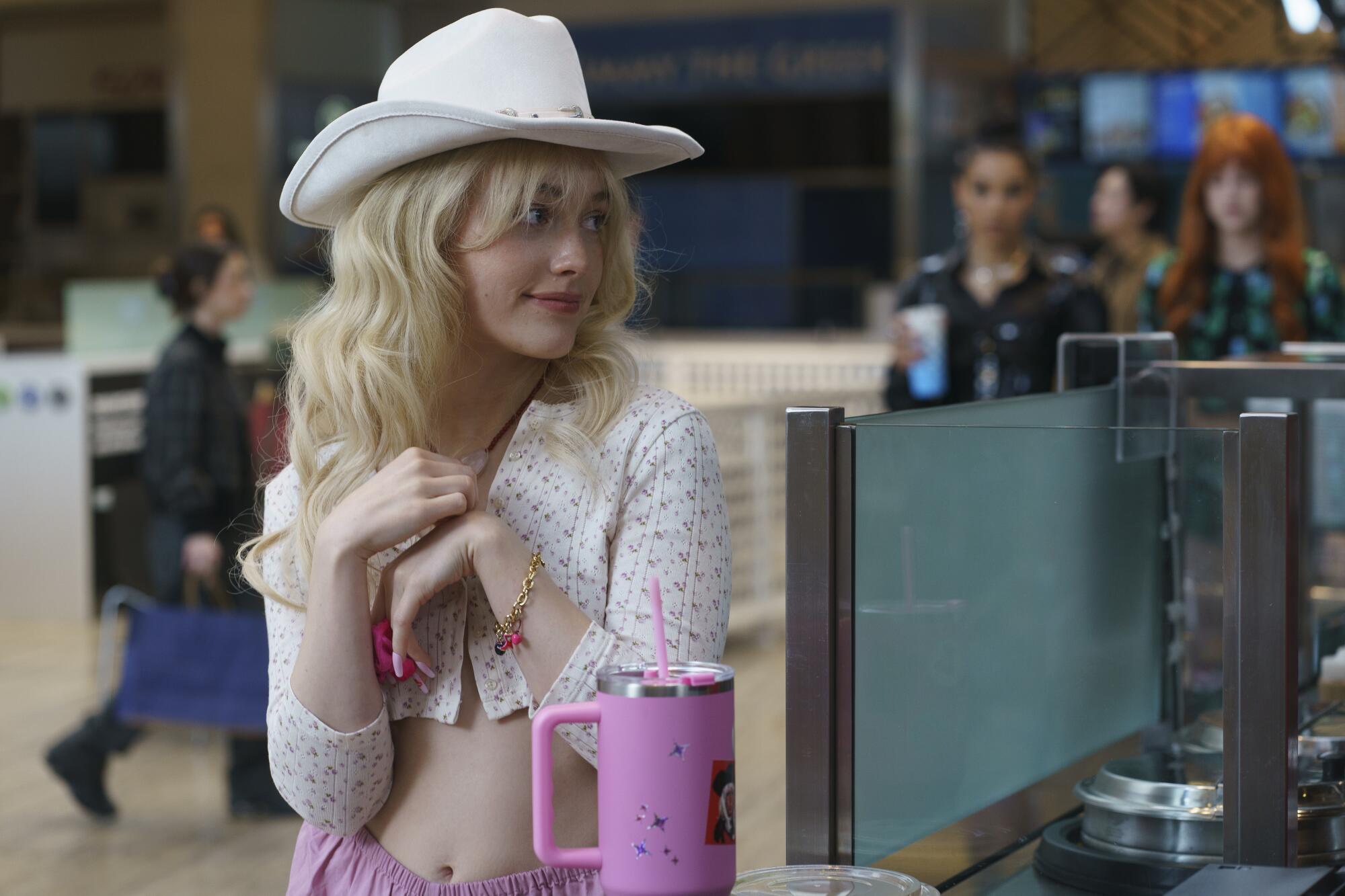
Victoria Pedretti in the movie “Forbidden Fruits.”
(Sabrina Lantos / Independent Film Company and Shudder)
Initially asked to look at both the roles of whimsigoth physics buff Fig and the bubbly yet emotionally complex Cherry, described by Alloway as a “Texas Brigitte Bardot,” Pedretti fell hard for the latter.
“She really popped off the page,” Pedretti, 31, says on a recent Zoom interview she takes while on a sandwich run in L.A. “I entered into this glorious flow state.”
“I can’t say I’ve had any experience quite like it, where I really didn’t spend a lot of time questioning myself,” the actor says. “She kind of took over.”
That confidence was perhaps the product of Pedretti performing in two stage plays before “Forbidden Fruits” — or maybe it was the nighttime filming schedule. Either way, Pedretti says she improvised constantly and always kept swinging until somebody said, “Cut.”
The result: Pedretti in Alloway’s instant cult classic is a laugh-out-loud-funny unending well of charm, packing humor into even her most routine dialogue. In her best quotable moments, she seamlessly infuses her sometimes shrill timbre with a dash of Southern drawl. One of her most iconic facial expressions in the film is already circulating as a reaction meme online.
“I was enjoying being in this character so much, I just wouldn’t stop,” Pedretti says, adding that Alloway, who was sensitive to cast members’ interpretations of their roles, supported experimentation.
Alloway praises the Philadelphia-born Pedretti for nailing Cherry’s comedic moments yet also grounding the character in a traumatic backstory — a balancing act the director knew she was capable of after watching “Hill House.”
“I saw her in that show and I was like, ‘Who is that?’” Alloway says. “She is magnificent and so raw. I didn’t feel like I was watching someone acting. I was worried for her.”
After later watching Pedretti nail her role in “You” as Love Quinn, a wealthy, charismatic chef who hides a psychopathic nature, Alloway was convinced of her star power.
Victoria Pedretti in the movie “You.”
(John P. Fleenor / Netflix)
Cody was most familiar with Pedretti’s performance in “You,” pegging the actor as an “intense brunet” that didn’t square at first with her interpretation of Cherry as an Anna Nicole Smith type.
“Then I see the movie and I’m like, oh my God, she has that fragility,” Cody recalls. “She has that humor. She has that sexuality. She has all of it.
“Victoria brought all of those layers and I’m really blown away by her,” the Oscar-winning “Juno” screenwriter adds.
Cody says she wasn’t surprised that the film drew such talent. From the moment Alloway and Lily Houghton, who wrote the play “Forbidden Fruits” is based on and cowrote the film’s screenplay, brought the material to Cody and her producing partner Mason Novick, she became obsessed.
“It feels spiritually like a film that I would want to be part of my body of work,” Cody says. She remembers being especially delighted by the echoes of “Jennifer’s Body” present in Alloway and Houghton’s screenplay.
“Jennifer’s Body” was widely considered a box-office flop and critical failure upon its release in 2009 — grossing only $31 million worldwide against a $16-million budget — but in recent years has enjoyed a reappraisal as a stealth-feminist essential, reclaimed by superfans.
“I don’t think that the world was ready for these kinds of themes,” Cody says of the movie’s ideas, including the cost of toxic femininity, the nuances of female friendship and the pervasiveness of the male gaze.
When it came to promoting “Jennifer’s Body,” the producer adds, “there was a huge emphasis on trying to market it to straight men, based on Megan [Fox] being attractive, and that was not at all the point of the film, so that was frustrating.” Conversely, “Forbidden Fruits” speaks intimately to the female experience and “doesn’t attempt to pander to any other demographic.”
“The current zeitgeist is a great place for a movie like this,” she says. “This movie is for the girls, gays and theys, as they say.”
Alloway, a trained actor who worked as a film journalist before moving into directing, was struck with a similar feeling when she first discovered Houghton’s play, right around the time she was consuming copious media about women criminals, such as Tori Telfer’s 2017 book “Lady Killers: Deadly Women Throughout History.”
“I was so entrenched in why women commit acts of crime,” Alloway said, adding that she was disappointed to find that revenge films on the subject still often revolved around men.
Picking up Houghton’s script, the director recalls feeling relieved. “Oh, this is just about women,” she says, her face brightening. “This is about women friendships, women being pitted against each other.”
In an early meeting with Houghton, Alloway told the playwright she’d like to bring a genre lens to “turn up the dial on the emotions that you feel reading the play and make them accessible to people who haven’t had these experiences — or validate people who have.”
Outside of the opportunity to work with so many other young women, Pedretti said she was drawn to “Forbidden Fruits” because of its use of style and tone.
“It asks a lot of people to try to step into a world like this one,” the actor says of the unabashedly histrionic screenplay. “And as nerve-racking as it may be to take that big swing, you gotta take the big swing.”
“She has that fragility,” says producer Diablo Cody of Pedretti. “She has that humor. She has that sexuality. She has all of it.”
(Evelyn Freja / For The Times)
And swing she does: Pedretti plays up Cherry’s emotional volatility, giving her a full-bodied form of expression. The actor even did her own onscreen makeup (as did Reinhart) and collaborated heavily with costume designer Sarah Millman on Cherry’s wardrobe and styling. Plus, she performed her first topless scene — in a sequence that doesn’t involve men or even sex.
“I’m really proud of the way we use nudity to show a certain kind of unspoken comfortability among women,” she continues. “I remember always getting such a thrill at the comfort level of a girl being like, ‘We’re going to the bathroom together,’ and to me, that is that moment.”
It’s a perfect example of a scene that doesn’t try to speak to anyone except those it’s specifically written for, and one that you only get with women at the helm of a production.
Reflecting on the agency she had to shape Cherry, Pedretti says she is more inspired to explore directorial projects of her own.
“I am so interested in protecting these spaces to be positive, creative experiences for everyone involved,” she says.
Whenever Pedretti does make her feature debut behind the camera (she’s already made a short or two), perhaps Cody will pick up the phone.