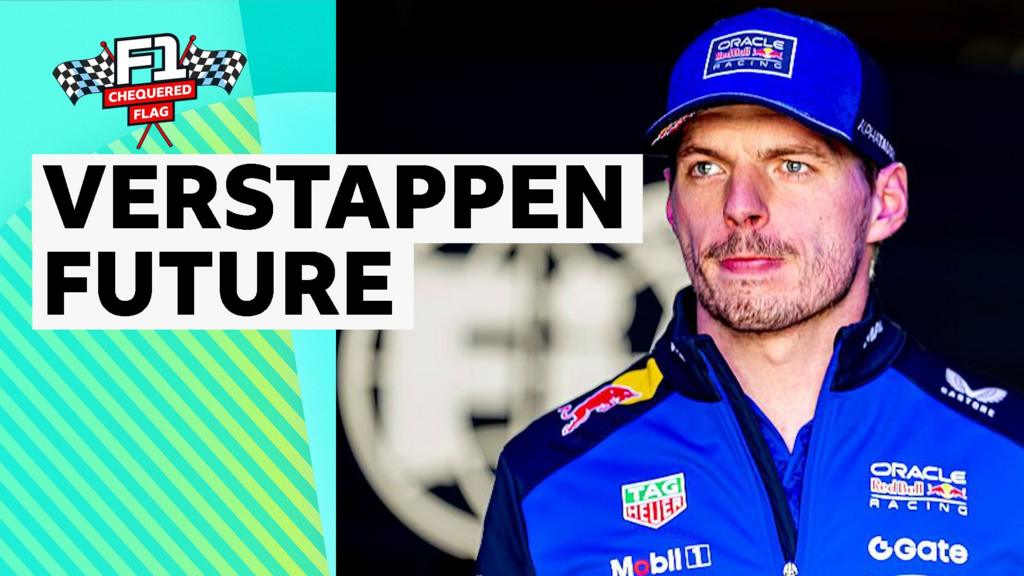
Verstappen

Japanese Grand Prix: Max Verstappen says he is considering his future as he is ‘not enjoying’ new regulations

Verstappen’s dissatisfaction with F1 is focused on the degree of energy management required of the new engines.

They need to be recharged several times a lap, and that is leading to drivers losing speed on the approach to corners at the end of long straights as the engine runs out of battery power and starts to recharge.

It is also generating a form of racing that has proved attractive to fans and many in the sport, with places swapping and swapping back again.

But Verstappen does not like the way this happens as a result of different stages of battery charge between two drivers racing.

Discussing his attempts to pass Alpine’s Pierre Gasly for seventh place, Verstappen said: “You can pass around here, but then you have no battery for the next straight.

“So I tried once just to have a look, but then of course Pierre immediately got by me again on the main straight and I think that was basically the story of today. You can pass, but then you get re-passed. That was basically it.”

Commenting further on his thoughts about his future, Verstappen said: “I see it like this: You hear it from a lot of sports people when you speak to them about how are you successful. It all starts with actually enjoying what you’re doing before you can actually commit to it 100%.

“Now I think I’m committing 100% and I’m still trying, but the way that I am telling myself to give it 100% I think is not very healthy at the moment because I am not enjoying what I’m doing.

“And now people can easily say, ‘Yeah, well, you’ve won so many championships and races and now just because the car is not good you are complaining.’ Maybe you can see it like that, but I see it different.”

He added that one option would be to go and race in sports cars – he is already planning to take part in the Nurburgring 24 Hours this year.

“I have a lot of other projects anyway that I have a lot of passion about,” he said. “The GT3 racing. Not only racing it myself but also the team. It’s really nice and fun to build that. And I really want to build that out further in the coming years.

“It’s not like if I would stop here that I’m not going to do anything. I’m always going to have fun. And also I will have fun in a lot of other things in my life.

“But it’s a bit sad to be honest that we’re even talking about this. It is what it is. You don’t need to feel sorry for me. I’ll be fine.”

Referring to the bosses of F1 and his potential loss from the paddock, he implied that a change of the rules would make a difference to his decision.

“They know what to do,” Verstappen said.

F1 bosses are due to meet in the four-week gap between Japan and the next race in Miami to discuss changes to the rules to allow drivers to push flat-out in qualifying.

The need to manage energy over one ultimate lap and the effect this having on driving is unanimously regarded in F1 as an issue that needs fixing.

Source link

F1 Q&A: Verstappen and Red Bull, Newey and Aston Martin, Audi, Cadillac and F1’s sustainable fuel

The simple answer is that the top management of Aston Martin and Audi have felt things were not working at various junctures and decided to act.

As far as Audi is concerned, it was clear some time ago that not enough investment was being put into Sauber early enough for the team to be in good shape when Audi officially entered F1 in 2026.

Andreas Seidl, the first chief executive officer, had been concerned about that for a while, and there was a bit of a power struggle between him and Oliver Hoffmann, the chairman of the boards of all Sauber companies, through 2023 and 2024.

It was expected one would win out. In the end, Audi decided to remove them both, and appoint Mattia Binotto and Jonathan Wheatley in a dual leadership role, Binotto as chief operating and technical officer and Wheatley as team principal.

Many in F1 raised their eyebrows at that – dual leaderships rarely work. Add in that at Audi there was another senior figure, in chief executive officer Adam Baker, and many felt the leadership of Audi looked unwieldy.

So it was not a massive surprise when that structure was streamlined, with Baker removed, and Binotto made head of the Audi F1 project under Audi CEO Gernot Dollner.

That was supposed to be that. Binotto was in overall charge, Wheatley ran the race team.

But when Wheatley decided that he wanted to come back to the UK, his talks with Aston Martin leaked, and he and Audi agreed to split with immediate effect.

As for Aston Martin, Lawrence Stroll is an ambitious man, he wants success, and he has invested a lot of money in it.

So it’s hardly a surprise that, when he feels things are not working, he takes action.

All the changes he has made have seemed logical on one level or another. There was clearly a problem with car design – after they made a big leap forward in 2023 under new technical director Dan Fallows, the team failed to develop the car effectively in season. They started 2024 less competitively and fell backwards again.

At the same time, Stroll was recruiting Newey. Why wouldn’t he, given he was available having left Red Bull? And with Newey on board, and the team stumbling under Fallows, it’s hardly a surprise Fallows would be considered surplus to requirements.

Same with the leadership. Mike Krack became team principal but the team was not moving in a convincing direction. Hence Stroll looked for change. Andy Cowell is highly regarded; his recruitment made sense.

Stroll would not have expected a clash between Cowell and Newey, but he got one, so another change was made.

Each change is understandable in isolation. But success in F1 is founded on stability not disruption and there has been little evidence of that at either team for the past two or three years.
Source link