The siblings changed the face of the sport when they emerged as precocious teenagers in the 1990s, going on to dominate the sport with a combined 30 Grand Slam singles titles and 14 doubles victories as a pair.
Three decades later, the sport remains captivated by them.
Serena, a 23-time Grand Slam women’s singles champion, coming out of retirement this summer sparked excitement among those who saw her in their prime and those too young to have witnessed it.
Seven-time major winner Venus has never “evolved away” from the sport – the words chosen by her younger sister when she last played in 2022 – but instead continued her career with the help of sporadic wildcards.
While that has proved controversial in some quarters, there were few objections about the sisters being invited to play once again at Flushing Meadows.
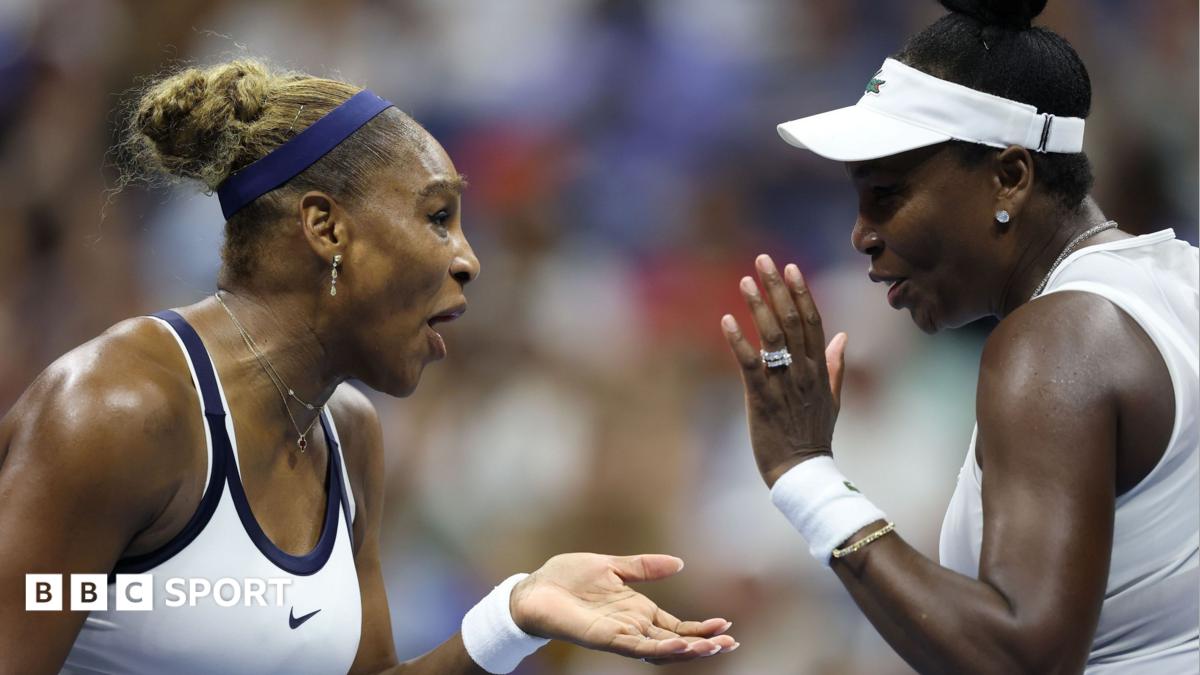
Their planned return at Wimbledon was scuppered by the knee injury which Serena suffered in her singles match there – ironically a defeat by 20-year-old Joint – before they finally reunited at the WTA event in Cincinnati.
The comeback ended in a match tie-break defeat by Ukraine’s Marta Kostyuk and her American partner Peyton Stearns, with the same fate befalling them in New York.
When the Williams sisters last played on Ashe four years ago, they suffered a straight-set defeat by Czech pair Lucie Hradecka and Linda Noskova in the first round.
It looked like being a similar outcome as they meekly surrendered the first set against Chan and Joint, then batted off four break points in the fifth and seventh games of the second set.
But once Serena upped her level to match her impressive sister, they managed to switch the momentum back in their favour and level the match.
An absorbing contest featuring some sensational points saw the Americans fight back again in the decider, only to falter from a commanding lead in the tie-break.
Overall it was a more than credible performance from the veteran pair. Their solid groundstrokes, sharp movement and never-say-die attitude caused problems for their opponents, who deserve huge credit for staying focused in a partisan environment.
“The atmosphere was surreal,” said Joint.
“It was something we’ve never experienced before, and to play against such legends of the game was super special.”
NEW YORK — Whenever Venus and Serena Williams decide to permanently close the door on their storied careers — the duo are competing in the U.S. Open’s women’s doubles this week after receiving a wild-card invitation — the extraordinary tale of two sisters from Compton, just 15 months apart, who both reached No. 1 and won bushels of major titles will continue to reverberate. It might be the most implausible sports story of the last 50 years.
Although Serena’s career accomplishments exceed her older sister’s by considerable margins, including a 23-7 advantage in singles majors, what if Venus had been the baby of the Williams bunch? Would those numbers have evened out?
It’s a fair question.
Research has shown that younger siblings often benefit from being last in the birth order, sometimes called a “younger-sibling effect.” Turns out, the proverbial runt of the litter may have an edge. And while the Williams sisters remain the gold-standard example in tennis, the sport has no dearth of cases, from Alexander Zverev and Andy Murray to Naomi Osaka and Tracy Austin, to name a few.
The birth-order advantage
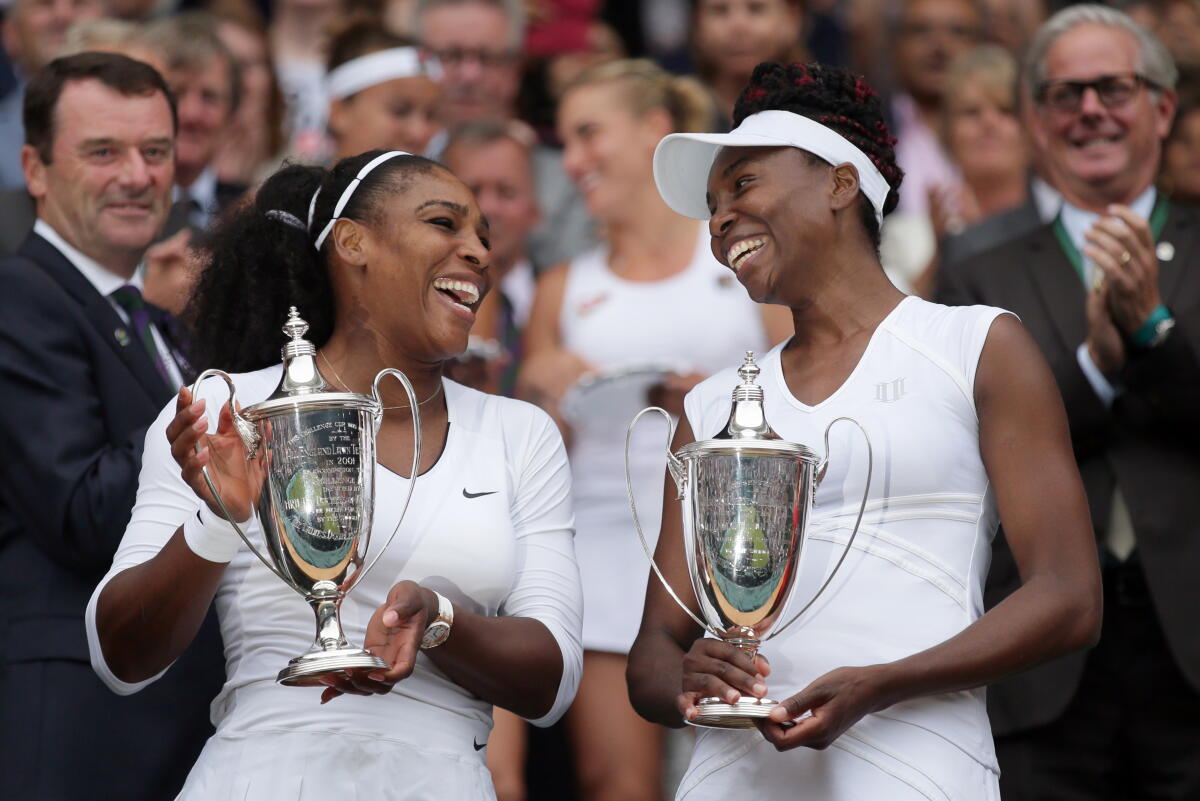
Serena and Venus Williams hold their trophies after winning the women’s doubles final at Wimbledon on July 9, 2016.
(Tim Ireland / Associated Press)
To researchers, Serena’s rise is not an isolated miracle of genetics, but a classic expression of family dynamics. Dr. Joseph Baker, a sports scientist at the University of Toronto, has found that elite athletes are statistically far more likely to be later-born children. “The birth-order effect means there’s some kind of social or genetic element in the family environment that’s driving it,” Baker says.
Dr. Frank Sulloway, a psychology research associate at the University of California, Berkeley, has found that the younger-sibling effect is a modest but reliable and statistically significant trend. While not deterministic — elite firstborns like John McEnroe and Novak Djokovic remain towering counter-examples, and both had younger siblings that played professionally — the later-born tilt repeats across the athletic landscape.
The backyard crucible
Some investigators trace the younger sibling effect to “situated learning.” That is, developing mastery through hands-on engagement, social modeling, and “vicarious experience,” according to Baker.
“Seeing someone from the same family unit achieve greatness gives the younger sibling the confidence to achieve the same,” he says.
For Serena, who is the youngest of five sisters in the blended Williams family, that meant learning to return Venus’s blistering serve on Compton’s public courts. It meant watching her more heralded older sibling navigate a mostly white women’s tour as a teenager. Because Venus was more experienced and stronger, Serena was forced to accelerate her development just to compete. And since their father, Richard Williams, largely kept them out of junior tournaments, that interdependent learning likely proved especially potent.
“I was able to learn, so I didn’t make the same mistakes she made,” Serena said in 2009. Now 44, Serena returned to compete at Wimbledon in singles and has teamed up for several doubles events this season, including in Cincinnati last month with 46-year-old Venus, after saying she was “evolving away from tennis” following her last appearance at the 2022 U.S. Open.
Sisters Jessica Korda and Nelly Korda walk on the ninth green at the Aramco Championship on April 3 in Las Vegas.
(Harry How / Getty Images)
This crucible is not unique to tennis.
Michael Jordan famously credited his older brother, Larry, with igniting his competitive fire. Golfer Nelly Korda followed older sister Jessica onto the LPGA Tour before surpassing her with major titles and an Olympic gold medal, while Peyton and Eli Manning grew up amid the backyard competition of a football-obsessed family that produced two Super Bowl-winning quarterbacks.
The “rough draft” of parenting
Beyond hardwood or turf battles, younger siblings can benefit from a profound shift in parental behavior, a phenomenon Louisiana Tech University sport and exercise psychology professor Dr. Jordan Blazo calls the “rough draft hypothesis.”
Firstborn children are often a parent’s athletic test drive. Parents often face a steep, expensive learning curve when navigating youth sports with older children, overscheduling them and committing developmental mistakes. By the time a younger sibling arrives, parents know the ropes and the pathways to pursue, according to Blazo, who studies sibling relationships and social comparison in sports. They are more attuned to financial and other feasibilities, which gives them a clearer road map to success.
Southern California native Austin, the youngest of three accomplished tennis children and the youngest U.S. Open champion in history at 16 years and 9 months, says her physicist father maintained healthy boundaries. When Tracy once invited him to watch her play German great Steffi Graf, he declined because of a computer club meeting. “Having a parent that wasn’t overly engrossed in my winning and losing was the healthiest thing,” Austin says.
Meanwhile, her mother, having navigated four older siblings’ athletic careers, was free to travel with 14-year-old Tracy because the nest was empty.
Russia’s Mirra Andreeva, 19, agrees. The reigning French Open winner followed her sister, Erika, three years older, onto the pro tour. “I had more benefits because I’m younger,” said fifth-ranked Mirra of her sister, who has been ranked as high as No. 65. “[My] parents obviously knew what to do. Tennis-wise… maybe that saved me some time.”
Zverev, who followed brother Mischa, 9 years his senior, says traveling to pro events as a kid helped normalized the ATP Tour early. “Maybe I wasn’t as nervous… because I’ve seen them and known them for years,” says Germany’s Zverev, who captured his first major title at this year’s French Open and is the top seed in New York.
Swing for the fences: Risk-taking
This competitive ecosystem also shapes how younger siblings play. Sulloway’s research on birth order and risk-taking reveals that later-borns are more psychologically wired to take strategic risks to carve out their own niche and stand out in the family.
Sulloway’s 2010 study of Major League Baseball brothers, conducted in collaboration with psychologist Richard Zweigenhaft, found that later-born siblings were vastly more likely to attempt to steal bases (and were more successful at it) than their first-born brothers. They were also far more likely to strike out because they were literally swinging for the fences, a high-risk, high-reward strategy. In tennis, this could translate to a willingness to play more aggressively, such as going for more on second serves rather than playing it safe, according to Sulloway.
Warmth over hostility
Yet, this sibling incubator seems to work best with one critical condition: the familial relationship is based on warmth and companionship. Blazo’s research shows that when sibling dynamics are colored by hostility and toxic comparisons, younger siblings experience “differentiation.” They can suffer from lower perceived competence, burn out, and ultimately quit or flee to other sports to escape the older sibling’s shadow, which isn’t necessarily a negative course correction. Sometimes it works out best for both.
In other words, the most successful sporting siblings preserve their emotional bonds. Richard and Oracene Williams famously enforced a sisters-first rule, allowing Venus and Serena to battle on court but walk off as best friends. Mirra Andreeva says her parents taught them that sisters are “the closest people we’re gonna have in life,” and to protect that bond they rarely practice together to keep emotions from getting “messy.”
Sisters Venus and Serena Williams hold the U.S. Open doubles winners’ trophy on Sept. 12, 1999.
(Al Bello / Getty Images)
When Venus and Serena were leapfrogging each other early in their careers, often clashing in Grand Slam finals across continents and surfaces, Serena insisted their competition existed in a supportive environment. Certainly it did in doubles, where they teamed up to win three Olympic gold medals and 14 major titles, including two at the U.S. Open in 1999 and 2009.
At the 2001 U.S. Open, where Venus beat Serena in the first all-Williams Grand Slam final, Serena said: “If anything I prefer to play Venus because that means that we have reached our maximum potential and that we’ll both go home winners. So for me, I always want to see Venus do well. I never want to see Venus lose.”
The long shadow
The McEnroe brothers, John and Patrick, separated by seven years, also saw their supportive relationship boost Patrick’s career. When Patrick, the youngest of three boys, was struggling in college and his mother pressured him to take the law boards, John stepped in, telling her to let Patrick chase his pro tennis dreams. Patrick eventually cracked the top 30 in singles and reached No. 3 in doubles, though he never reached the heights of John, who won seven Grand Slam titles and reached No. 1 in both singles and doubles.
“I think it holds water,” Stanford University alum Patrick said of his last-born experience, citing other examples such as Andy Roddick, whose older brother John was an accomplished collegiate player, and Hall-of-Famer Arantxa Sánchez Vicario, the youngest of four whose two older brothers, Emilio and Javier, were top ATP players. “It just so happened that my brother was exponentially more talented than I was as an athlete, but it’s definitely what at least got me into tennis.”
John McEnroe, left, and his younger brother Patrick compete during in a doubles match in Richmond, Va., on Sunday, Feb. 6, 1984.
(Joanna Pinneo / Associated Press)
The comparisons to John, however, played both ways. Patrick said they motivated him as a junior, but felt like a burden when he was trying to establish himself on tour.
With many physical, emotional and psychological variables in play, researchers admit it’s hard to pinpoint where DNA ends and drive begins when it comes to sibling dynamics. Ultimately, genetics and talent establish the ceiling, but the evidence suggests a supportive sibling ecosystem helps alchemize raw potential into greatness, and the sibling that benefits most is the one that comes later.
For Serena, the competitive yet protective shield provided by Venus was critical to her own success. Venus went first. She absorbed the bulk of pressure, provided the model and set the standard her younger sister spent a lifetime chasing, and eventually surpassing.
“Just everything that she does inspires me,” Serena said.
American wildcard Sofia Kenin beat 46-year-old compatriot Venus Williams 6-2, 7-6(6) in a US Open first-round match that began past midnight in New York, the latest start in women’s tournament history.
The match at Arthur Ashe Stadium on Monday got under way after Novak Djokovic’s loss to Mariano Navone in five sets, with a sizable contingent of fans staying on well past midnight for one more look at Williams, who was playing as a wildcard in her 96th career Grand Slam main draw appearance.
“It was extremely late,” Williams told reporters. “I’ve never played a match that late before, and I was happy to see that so many people stuck around for that. It was a real honour to play in front of them.”
Kenin broke serve in the opening game and never trailed in the first set, racing to a 3-0 lead as both players struggled to find their rhythm, combining for nine double faults.
Williams, cheered on by chants of “Let’s go Venus”, broke back to love to trim the deficit to 3-1 but dropped serve again as Kenin pulled away to close out the set.
Kenin reeled off three straight games to lead 3-1 in the second set, and while Williams showed flashes of the form that earned her seven Grand Slam titles, she struggled to string points together, with her second serve proving especially costly.
Kenin saved four break points to level at 5-5, leaving Williams screaming in frustration at handing her opponent another game with unforced errors. However, Williams still found a way to hold for 6-5 before Kenin forced a tiebreak.
Williams appeared to have the upper hand in the tiebreak but could not convert any of her seven set points, as Kenin dug in to close out the win.
“It’s not ideal,” Williams said. “I would have preferred something else, definitely. It wasn’t great for either of us, so I think we both tried our best.
“I just don’t know any other sport where you have to start that late. I definitely think there’s room for improvement there.
“It’s not easy to do in the first round. It’s not easy to do it at 1 or 2 in the morning to try to find your rhythm and play your best, but I tried my best.”
Kenin, the 2020 Australian Open champion, will next face top-ranked American Jessica Pegula.
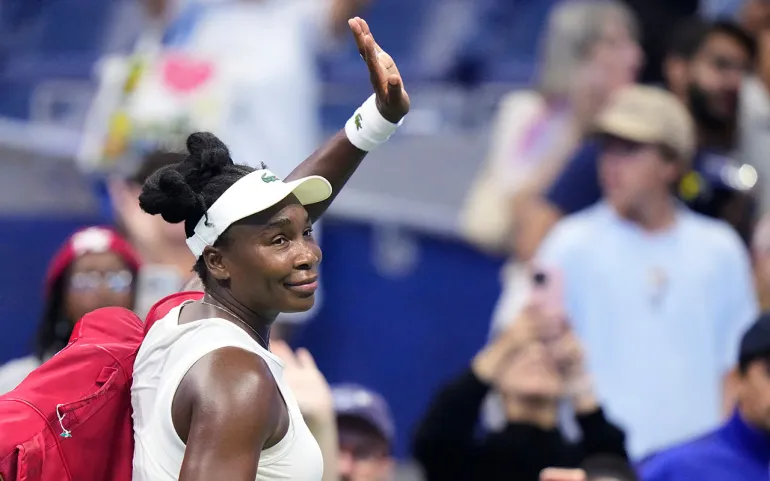
Venus Williams waves as she leaves the court [Frank Franklin II/AP Photo]
Medvedev out, Paolini through
Meanwhile, former champion Daniil Medvedev and Pegula advanced with little fuss earlier in the day, as players began their campaigns to grab a slice of the record prize purse of $108m up for grabs.
Russian Medvedev had crashed out in a chaotic first-round defeat a year ago but was all business on Sunday at Arthur Ashe Stadium, downing French qualifier Hugo Gaston 6-4, 6-2, 6-4 to quieten doubts after a frustrating run-up to the tournament.
“The last couple of weeks were not easy,” said Medvedev, who exited the Cincinnati and Montreal tournaments early. “I’m happy that today I managed to produce high-level tennis.”
Dozens of ticketholders were lined up long before the action kicked off, and the home crowd was rewarded as world number three Pegula beat Romania’s Elena-Gabriela Ruse 6-3, 6-2 in the first match at the showpiece stadium.
Twice Grand Slam champion Barbora Krejcikova earlier became the first seeded player to exit the tournament, saving six match points before succumbing to Kamilla Rakhimova 7-6(4), 6-2 on the outer courts.
Italian Jasmine Paolini survived a scare to beat Slovenia’s Veronika Erjavec 6-3, 3-6, 6-4 in the opener at Louis Armstrong Stadium to set up a meeting with compatriot Lucrezia Stefanini.
Czech Jiri Lehecka kicked off the action on the Grandstand with a 6-1, 7-6(5), 4-6, 6-2 win over Spain’s Pablo Carreno Busta before Ukraine’s Marta Kostyuk swatted aside Australian Storm Hunter 6-4, 6-1 at the same stadium.
Kostyuk was joined in the next round by compatriot Elina Svitolina, who eased past Solana Sierra 6-1, 6-2.
Former champion Marin Cilic and 2022 runner-up Casper Ruud pulled out due to injuries shortly after the tournament got under way.
Daniil Medvedev chases a shot from Hugo Gaston [Angela Weiss/AFP]