Vance

Trump’s economic claims collide with reality in a Pennsylvania city critical to the midterms

When Idalia Bisbal moved to this Pennsylvania city synonymous with America’s working class, she hoped for a cheaper, easier life than the one she was leaving behind in her hometown of New York City.

About three years later, she is deeply disappointed.

“It’s worse than ever,” said the 67-year-old retiree, who relies on Social Security, when asked about the economy. “The prices are high. Everything is going up. You can’t afford food because you can’t afford rent. Utilities are too high. Gas is too expensive. Everything is too expensive.”

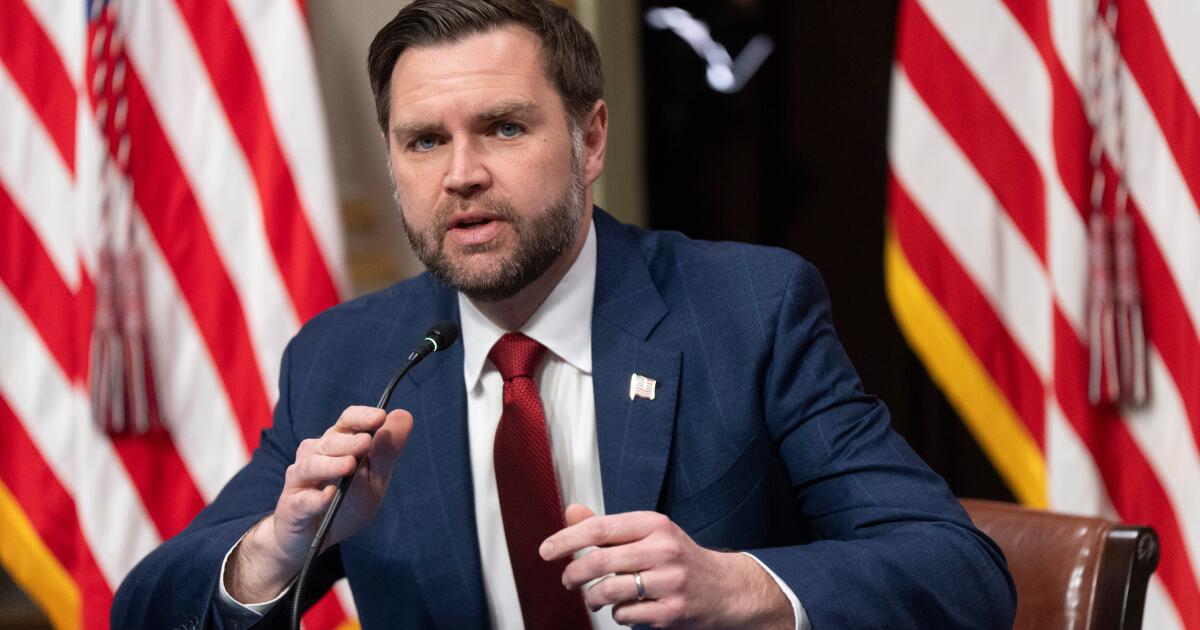
Bisbal was sipping an afternoon coffee at the Hamilton Family Restaurant not long after Vice President JD Vance rallied Republicans in a nearby suburb. In the Trump administration’s second high-profile trip to Pennsylvania in a week, Vance acknowledged the affordability crisis, blamed it on the Biden administration and insisted better times were ahead. He later served food to men experiencing homelessness in Allentown.

The visit, on top of several recent speeches from President Trump, reflects an increasingly urgent White House effort to respond to the economic anxiety voiced by people across the country. Those worries are a vulnerability for Republicans in competitive congressional districts like the one that includes Allentown, which could decide control of the U.S. House in next year’s midterms.

But in confronting the challenge, there are risks of appearing out of touch.

Only 31% of U.S. adults now approve of how Trump is handling the economy, down from 40% in March, according to a poll from the Associated Press-NORC Center for Public Affairs Research. Yet Trump has called affordability concerns a “hoax” and gave the economy under his administration a grade of “A+++++.” Vance reiterated that assessment during his rally, prompting Bisbal to scoff.

“In his world,” Bisbal, a self-described “straight-up Democrat,” responded. “In the rich man’s world. In our world, trust me, it’s not an ‘A.’ To me, it’s an ‘F,’ ‘F,’ ‘F,’ ‘F,’ ‘F,’ ‘F.’”

Agreement that prices are too high

With a population of roughly 125,000 people, Allentown anchors the Lehigh Valley, which is Pennsylvania’s third-largest metro area. In a dozen interviews last week with local officials, business leaders and residents of both parties, there was agreement on one thing: Prices are too high. Some pointed to gas prices while others said they felt the shock more at the grocery store or in their cost of healthcare or housing.

Few shared Trump’s unbridled boosterism about the economy.

Tony Iannelli, the president and CEO of the Greater Lehigh Valley Chamber of Commerce, called Trump’s grade a “stretch,” saying that “we have a strong economy but I think it’s not yet gone to the next stage of what I would call robust.”

Tom Groves, who started a health and benefits consulting firm more than two decades ago, said the economy was at a “B+,” as he blamed the Affordable Care Act, widely known as Obamacare, for contributing to higher health costs, and he noted stock and labor market volatility.

Joe Vichot, the chairman of the Lehigh County Republican Committee, referred to Trump’s grade as a “colloquialism.”

Far removed from Washington’s political theater, there was little consensus on who was responsible for the high prices or what should be done about it. There was, however, an acute sense of exhaustion at the seemingly endless political combat.

Pat Gallagher was finishing lunch a few booths down from Bisbal as she recalled meeting her late husband when they both worked at Bethlehem Steel, the manufacturing giant that closed in 2003.

Now retired, Gallagher too relies on Social Security benefits, and she lives with her daughter, which helps keep costs down. She said she noticed the rising price of groceries and was becoming exasperated with the political climate.

“I get so frustrated with hearing about the politics,” she said.

A front-row seat to politics

That feeling is understandable in a place that often gets a front-row seat to the national debate, whether it wants the view or not. Singer Billy Joel’s 1982 song “Allentown” helped elevate the city into the national consciousness, articulating simultaneous feelings of disillusionment and hope as factories closed.

In the decades since, Pennsylvania has become a must-win state in presidential politics and the backdrop for innumerable visits from candidates and the media. Trump and his Democratic rival in 2024, Kamala Harris, made several campaign swings through Allentown, with the then-vice president visiting the city on the eve of the election.

“Every race here, all the time,” Allentown’s mayor, Democrat Matt Tuerk, recalled of the frenzied race last year.

The pace of those visits — and the attention they garnered — has not faded from many minds. Some businesses and residents declined to talk last week when approached with questions about the economy or politics, recalling blowback from speaking in the past.

But as attention shifts to next year’s midterms, Allentown cannot escape its place as a political battleground.

Trump’s win last year helped lift other Republicans, such U.S. Rep. Ryan Mackenzie, to victory. Mackenzie, who unseated a three-term Democrat, is now one of the most vulnerable Republicans in Congress. To win again, he must turn out the Republicans who voted in 2024 — many of whom were likely more energized by Trump’s candidacy — while appealing to independents.

Mackenzie’s balancing act was on display when he spoke to the party faithful Tuesday, bemoaning the “failures of Bidenomics” before Vance took the stage at the rally. A day later, the congressman was back in Washington, where he joined three other House Republicans to rebel against the party’s leadership and force a vote on extending Obamacare subsidies that expire at the end of the year.

Vichot, the local GOP chairman, called Mackenzie an “underdog” in his reelection bid and said the healthcare move was a signal to voters that he is “compassionate for the people who need those services.”

A swing to Trump in 2024

Lehigh County, home to Allentown and the most populous county in the congressional district, swung toward Trump last year. Harris’ nearly 2.7-percentage-point win in the county was the tightest margin for a Democratic presidential candidate since 2004. But Democrats are feeling confident after a strong performance in this fall’s elections, when they handily won a race for county executive.

Retaking the congressional seat is now a top priority for Democrats. Gov. Josh Shapiro, a Democrat who faces reelection next year and is a potential presidential contender in 2028, endorsed firefighter union head Bob Brooks last week in the May primary.

Democrats are just a few seats shy of regaining the House majority, and the first midterm after a presidential election historically favors the party that’s out of power. If the focus remains on the economy, Democrats are happy.

The Uline supplies distribution factory where Vance spoke, owned by a family that has made large donations to GOP causes, is a few miles from the Mack Trucks facility where staff was cut by about 200 employees this year. The company said that decision was driven in part by tariffs imposed by Trump. Shapiro eagerly pointed that out in responding to Vance’s visit.

But the image of Allentown as a purely manufacturing town is outdated. The downtown core is dotted by row homes, trendy hotels and a modern arena that is home to the Lehigh Valley Phantoms hockey team and hosts concerts by major artists. In recent years, Latinos have become a majority of the city’s population, driven by gains in the Puerto Rican, Mexican and Dominican communities.

“This is a place of rapid change,” said Tuerk, the city’s first Latino mayor. “It’s constantly changing ,and I think over the next three years until that next presidential election, we’re going to see a lot more change. It’s going to be an interesting ride.”

Sloan writes for the Associated Press.

Source link

Turning Point USA’s Erika Kirk backs Vice President JD Vance’s potential 2028 presidential bid

Erika Kirk, widow of Turning Point USA founder Charlie Kirk and the organization’s new leader, endorsed a potential presidential bid by Vice President JD Vance on the opening night of the conservative youth group’s annual conference.

After telling the cheering crowd that Turning Point would help keep Congress in Republican hands next year, she said, “We are going to get my husband’s friend JD Vance elected for 48 in the most resounding way possible.”

Vance would be the 48th president if he takes office after President Trump.

Kirk’s statement on Thursday is the most explicit backing of Vance’s possible candidacy by a woman who has been positioned as a steward to her late husband’s legacy. Charlie Kirk had become a powerbroker and bridge builder within the conservative movement before he was assassinated in September.

Vance was close with Charlie Kirk, whose backing helped enable his rapid political rise. After the assassination, Vance and his wife joined Erika Kirk in Utah to fly her husband’s remains home to Arizona aboard Air Force Two.

Vance is set to speak to Turning Point on Sunday, the conference’s last day. The convention has featured the usual spectacle and energy that have characterized the organization’s events, but the proceedings have also been marred by intense infighting among conservative commentators and estranged allies who have turned on each other in the wake of Kirk’s death.

As Trump’s vice president, Vance is well-positioned to inherit the movement that remade the Republican Party and twice sent Trump to the White House. But it would be no small task for him to hold together the Trump coalition, which is built around personal loyalty to him more than shared political goals.

Various wings of the conservative movement already are positioning to steer the party after Trump’s presidency, a skirmish that’s becoming increasingly public and pointed.

Turning Point, with its thousands of young volunteers, would provide a major boost for Vance in a fractious primary. Now 41, Vance would be the first Millennial president if elected, a natural fit for the organization built around mobilizing youth.

Trump has repeatedly mused about running for a third term despite a constitutional prohibition. However, he’s also speculated about a 2028 ticket featuring Vance and Secretary of State Marco Rubio.

Although Rubio previously ran for president in 2016, he has said he would support Vance as Trump’s successor.

Brown and Cooper write for the Associated Press. Brown reported from Washington.

Source link

Trump stands by chief of staff after shock remarks about Vance, Bondi, Musk | Donald Trump News

US President Donald Trump said he was standing by his White House chief of staff, Susie Wiles, after Vanity Fair magazine published interviews in which Wiles revealed internal tensions in Trump’s administration and painted an unflattering picture of the roles played by some of the president’s inner circle.

Trump, who regularly describes Wiles as the “most powerful woman in the world”, told the New York Post on Tuesday that he has full confidence in his chief of staff and that she had “done a fantastic job”.

Recommended Stories

list of 4 itemsend of list

Vanity Fair published two articles based on the interviews, giving insights into what Wiles thinks about other key figures in Trump’s second presidency.

Speaking about Trump, Wiles described the teetotaling president as having “an alcoholic’s personality” and an eye for vengeance against perceived enemies.

“He has an alcoholic’s personality,” Wiles said of Trump, explaining that her upbringing with an alcoholic father prepared her for managing “big personalities”.

Trump does not drink, she noted, but operates with “a view that there’s nothing he can’t do. Nothing, zero, nothing”.

In his defence of Wiles, Trump said she was right to describe him personally as having an “alcoholic’s personality”, even though he does not drink alcohol.

“I’ve often said that if I did, I’d have a very good chance of being an alcoholic,” Trump said. “I have said that many times about myself, I do. It’s a very possessive personality,” he said.

White House Chief of Staff Susie Wiles stands with U.S. Army members during U.S. President Donald Trump's visit to Fort Bragg to mark the U.S. Army anniversary, in North Carolina, U.S., June 10, 2025. REUTERS/Evelyn Hockstein
White House Chief of Staff Susie Wiles, centre, stands with US Army members during US President Donald Trump’s visit to Fort Bragg in North Carolina, in June 2025 [Evelyn Hockstein/Reuters]

Speaking on the Trump administration’s failure to quickly deliver its promise to share information related to convicted sex offender Jeffrey Epstein, Wiles suggested that Trump’s attorney general, Pam Bondi, had failed to clearly read the situation with the public.

“First, she gave them binders full of nothingness,” Wiles said of Bondi, noting that Vice President JD Vance had more fully grasped how important the issue was to some people, since he is himself “a conspiracy theorist”.

Of Trump’s inclusion in the Epstein files, Wiles said, “We know he’s in the file”, but claimed the file did not show him doing “anything awful”.

Referring to other members of the Trump administration, Wiles called Russ Vought, the chief of the White House Office of Management and Budget, a “right-wing absolute zealot” and branded tech tycoon Elon Musk an “odd, odd duck”, Vanity Fair said.

On Ukraine, Wiles said that Trump believes Russian President Vladimir Putin “wants the whole country”, despite Washington’s push for a peace deal.

Wiles also affirmed that Trump wants to keep bombing alleged drug boats in the waters off the coast of Venezuela until that country’s leader, Nicolas Maduro, “cries uncle”.

In a post on X, Wiles called the Vanity Fair story “a disingenuously framed hit piece on me and the finest President, White House staff, and Cabinet in history”, saying it omitted important context and selectively quoted her to create a negative narrative.

Other members of Trump’s inner circle also defended Wiles after the articles were published.

Vance said in a speech in Pennsylvania that he and Wiles had “joked in private and in public” about him believing conspiracy theories.

“We have our disagreements, we agree on much more than we disagree, but I’ve never seen her be disloyal to the president of the United States,” Vance said.

White House press secretary Karoline Leavitt told reporters outside the West Wing that Wiles was “incredible” and accused Vanity Fair of the “bias of omission”, while Secretary of Defense Pete Hegseth said on X that there was “absolutely nobody better!” than Wiles.

Source link