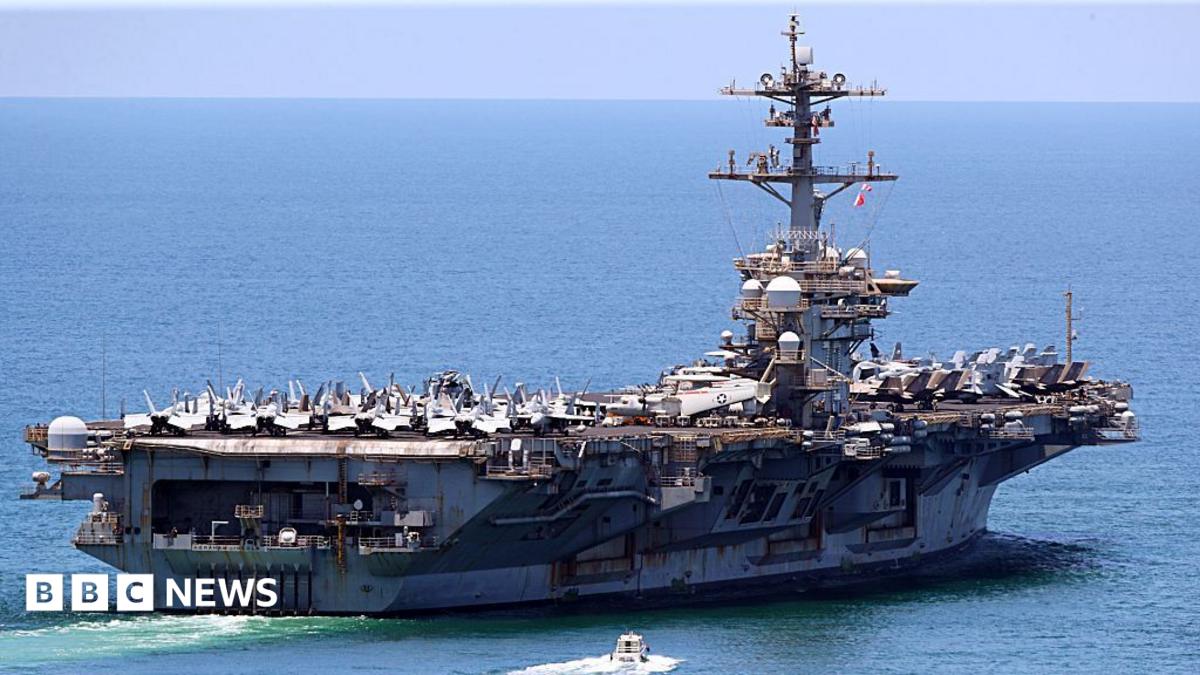
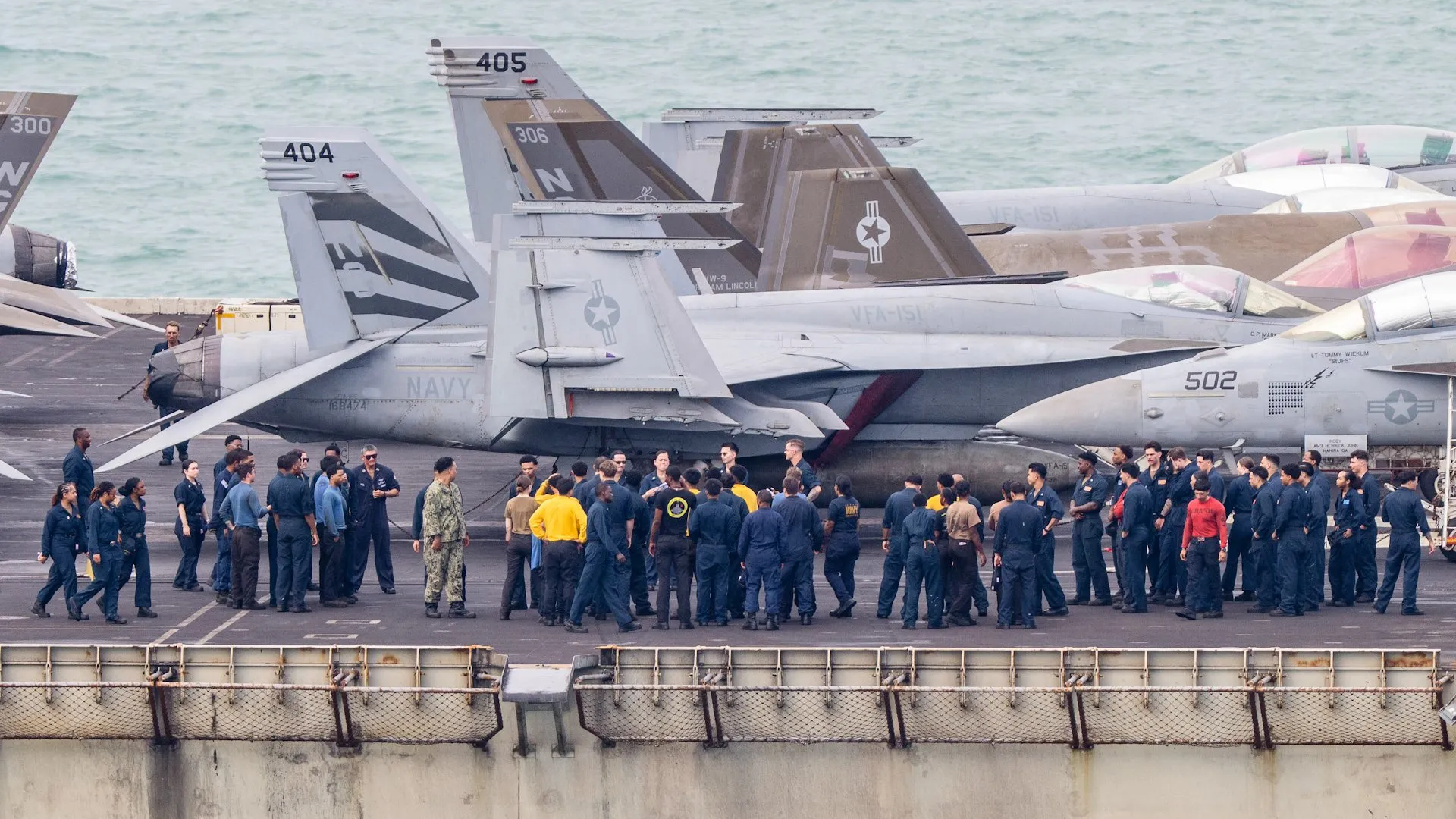
Acting Navy Secretary Hung Cao has said that eight crew members who were assigned to the USS Abraham Lincoln carrier strike group attempted suicide during their lengthy deployment.
The disclosure was made in a letter to Senator Kirsten Gillibrand of New York on Tuesday in response to questions from the Democrat on the well-being of sailors onboard following mounting concerns.
Family members of sailors had raised alarm about deteriorating mental health and grim conditions during a prolonged mission in the Middle East as part of the US war in Iran.
The carrier, which had been deployed since last November, is now returning to the US. The BBC has contacted the US Navy for comment.
In his letter, Cao said that there were five chaplains and multiple mental health professionals available on board to meet the “spiritual and emotional needs of the crew”.
He said the eight sailors included “the Lincoln crew and sailors from the carrier airwing, strike group and destroyer squadron staff, escorting destroyers and all embarked aviation squadrons”.
While the US Navy has previously acknowledged supply challenges on the carrier, it denied that a mental health crisis was taking place on the Lincoln, which had some 5,000 crew aboard.
Cao’s letter also denied widespread concerns about broken plumbing and shortages of fresh food, but acknowledged temporary “localized piping failures” and problems with the reverse osmosis desalination units, and some meal options were reduced for a “short time”.
Senator Gillibrand, a member of the Senate’s armed services committee, criticised the Trump administration’s previous responses to reports of grim conditions, calling the treatment of service members “completely unacceptable”.
“What Trump and Secretary Hegseth dismissed as ‘fake news’ turned out to be serious and deteriorating conditions for our service members,” she said in a statement to the BBC on Wednesday.
“Our troops and their families make immense sacrifices every single day, yet the president dismissed them with open disrespect,” she added.
The carrier left California in November for the South China Sea and was sent to the Middle East ahead of attacks on Iran in February. The deployment, which was originally set to end in May, was repeatedly extended.
In August, the USS George Washington, an aircraft carrier, was sent to replace the USS Abraham Lincoln following a nine-month deployment.
US sailors stopped in Thailand on their way home, hitting bars, malls and beach areas in their first time on land before continuing on to the US.
Suicide remains a leading cause of death in the US Navy and Marines, according to an analysis of military data by USNI News, while veterans have higher rates of suicide than Americans who have not served in the military, according to the Veterans Administration.
A study, external of 956 sailors released in January 2025 found that troops aboard US Navy ships suffer the highest rates of “serious psychological distress” compared to other branches of the US military.
The study cited “unique stressors, such as poor habitability, noise and demanding schedules that leave inadequate time for sleep and rest”.
If you or anyone you know has been affected by the issues raised in this article, details of organisations offering information are available at BBC Action Line or you can call the US Suicide and Crisis Lifeline on 988.
Voters in two US states — New Hampshire and Rhode Island — will head to the polls this week to select Democratic and Republican candidates for this November’s United States midterm elections.
In what’s been a campaign season full of unexpected twists and turns, from the continued growth of the Democrats’ progressive arm to mixed results for President Donald Trump-endorsed Republican candidates, the contests mark some of the last primaries before the US makes a final determination on which party will control both chambers of the US Congress.
Recommended Stories
list of 3 itemsend of list
Before that happens, candidates in some of these New England states’ most notable races will have to contend with some of this midterm’s biggest themes: How much Republicans should align with Trump, and whether a Democratic incumbent can fight off a primary challenger.
Here are the races to watch:
US Representative Chris Pappas of New Hampshire announces his bid to succeed retiring US Senator Jeanne Shaheen, a fellow Democrat, in Manchester, New Hampshire, the US [File: Robert F. Bukaty/AP Photo]
In New Hampshire, a battle to replace a retiring senator
When does voting in New Hampshire start? Opening times for polling locations vary across the state, but all polls must open on Tuesday, September 8 by 11am (15:00 GMT).
When does voting in New Hampshire end? Closing times also vary, but state law stipulates polls cannot close earlier than 7pm (23:00 GMT).
The most notable race in New Hampshire will determine the two candidates who will face off to replace outgoing Democratic Senator Jeanne Shaheen.
US Representative Chris Pappas has emerged as the frontrunner to win the Democratic nomination. On the Republican side, John Sununu holds the benefit of strong name recognition from being a part of the state’s most prominent political dynasty.
Democrats have hoped to retain this seat, a critical must-keep as they look to take back the US Senate currently controlled by Republicans. But recent polling of likely voters conducted by Senate Republicans’ campaign arm shows Sununu leading Pappas by one point. The survey, conducted in the final days of August, found nearly one in four voters are undecided.
However, both candidates, if they win their primaries on Tuesday, may have to confront actions by their party’s top figures, who could complicate their campaigns.
In the Democratic primary, Pappas remains the favourite, but his lead has dropped by double digits, according to some polls.
Pappas’s closest opponent is democratic socialist Karishma Manzur, who has picked up support, in part, over her calls to “end US complicity in the genocide of Palestinians”. While Pappas has stressed the importance of the current US-Israel relationship, the congressman has also said he supports a two-state solution and “increasing” aid to Gaza.
Manzur has criticised Pappas for connections to political donors, including those connected to Israel.
Former US Vice President Kamala Harris endorsed Pappas last week. Harris’s support, which Pappas said he was “proud” to receive, could help him across the finish line in the state’s Democratic primary, where most of the party’s voters lean more moderate. Pappas has served in the US House since 2019 and has held elected office almost continuously since graduating from college in 2002. He defeated Karoline Leavitt in his 2022 reelection bid before her stint as Trump’s White House press secretary.
In the Republican primary, Sununu is running to recapture the Senate seat he once held before being defeated by Shaheen in 2008. He faces Scott Brown, also a former senator who once held Massachusetts US Senator Elizabeth Warren’s seat, along with seven other opponents.
Sununu has been trying to put distance between himself and Trump. Trump is, however, backing Sununu over Brown in the primary, despite an ongoing war of words he’s had with Sununu’s family over the years — Sununu’s father and brother have both served as governor, and all have been critical of Trump.
Brown won a special election in Massachusetts after the death of Senator Ted Kennedy in 2009, lost his seat three years later, and unsuccessfully challenged Shaheen in 2014. In Trump’s first administration, Brown served as the US Ambassador to New Zealand and Samoa.
Rhode Island Governor Dan McKee speaks at the local Democratic Party headquarters in Johnston, Rhode Island, the US [File: David Goldman/AP Photo]
In Rhode Island, can an unpopular sitting Democratic governor fight off a challenge?
When does voting in Rhode Island start? With the exception of one town, voting starts on Wednesday, September 9 at 7am (11:00 GMT).
When does voting in Rhode Island end? Polls close at 8pm on Wednesday (00:00 GMT on Thursday).
Unlike other states this election cycle, the biggest race in Rhode Island is for governor, not for seats in the US Congress.
Vulnerable Democratic Governor Dan McKee is fighting off a strong primary challenge from pharmacy executive Helena Foulkes.
The highly unpopular incumbent has trailed Foulkes, whose grandfather and uncle were both lawmakers in the neighbouring US state of Connecticut, by as much as 38 points, according to a recent poll. Foulkes has also outraised McKee.
This race is a rematch of a bitter, hard-fought primary four years ago, when McKee, who had been elevated to governor when his predecessor became former US President Joe Biden’s commerce secretary, narrowly beat Foulkes in a crowded race.
While most of this year’s competitive midterm primaries have centred on ideological or generational differences, the outcome of this race could come down to complaints about a freeway bridge in Providence, the state’s largest city, that was partially closed in 2023 due to safety issues.
The resulting congestion and economic fallout caused by the closure have fuelled strong voter resentment towards McKee, one of the most endangered elected Democrats this cycle. Should McKee be unsuccessful in warding off Foulkes, he would become the first sitting US governor to lose a primary in eight years.
In the Republican primary, Aaron Guckian and Elaine Pelino are vying for the nomination. Guckian is a state trade association executive and was the nominee for lieutenant governor in 2022. He won the two-way primary that year with about 68 percent of the vote. Pelino is a former actress and first-time candidate. The state’s Republican Party has endorsed Guckian.
It’s been 20 years since Rhode Island elected a Republican governor.
The U.S. Navy’s supercarrier USS Abraham Lincoln is now in Thailand for a much-deserved and highly publicized liberty port call. The carrier had gone 286 days without making such a stop, with much of that time spent executing grueling combat operations against Iran. The ship has been run very hard, relying on at times a rickety conveyor of sea replenishments to continue operating for months on end, and it has the scars to show for it. The Lincoln looks very much worse for wear, with so-called “running rust” and algae caked all along the sides of the hull, as well as around the edges of the flight deck and sponsons on either side. It’s something of a startling appearance for one of the most powerful ships on the planet and a major symbol of U.S. power projection, but it is also a reminder of what the vessel and its crew have endured for months on end.
The Lincolnarrived in the Thai port of Laem Chabang earlier today. The carrier did make a stop in Guam in December 2025 and reportedly made another one somewhere in the Middle East in July. However, in both cases, these have been characterized as brief logistical stopovers that did not offer any real opportunity for personnel onboard to disembark. Thai media reports say the carrier is expected to remain in Laem Chabang through the end of the weekend.
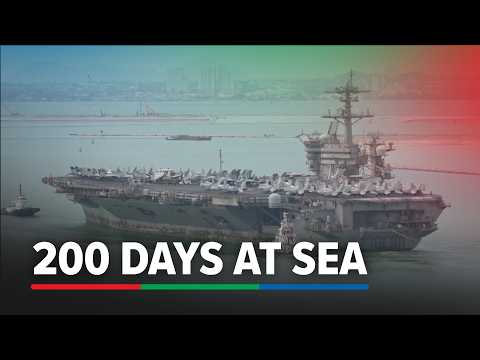
After over 200 days at sea, U.S. aircraft carrier arrives in Thailand | ABS-CBN News
“Our arrival in Laem Chabang provides a well-deserved opportunity for our Sailors and Marines to rest and recharge. It also underscores the strong and enduring partnership and alliance between the United States and Thailand,” Rear Adm. Robert E. Loughran, commander of Carrier Strike Group 3 (CSG-3), said in a statement in a press release today. “What this strike group has accomplished is truly historic. I could not be prouder of the exceptional professionalism and expertise demonstrated by every member of this team during our operations in the U.S. Central Command area of responsibility.”
An official picture the US Navy has released of the USS Abraham Lincoln arriving in Thailand today. USN
Lincoln and its strike group had left port in San Diego in November 2025 for what was originally expected to be a routine cruise in the Pacific. The carrier, its air wing, and escorts were subsequently directed to the Middle East and arrived in that region in January 2026.
Two of the Arleigh Burke class destroyers assigned to CSG-3, the USS Michael Murphy and the USS Spruance, are still understood to be operating in the Western end of the Indian Ocean. A third destroyer in the strike group, the USS Frank E. Petersen Jr., accompanied the Lincoln to Thailand and is now docked in a separate port in Sriracha, near Laem Chabang. The Ticonderoga class cruiser USS Robert Smalls also helped escort the carrier, and that warship “also arrived in Map Ta Phut, Thailand for their own scheduled port visit,” according to the Navy.
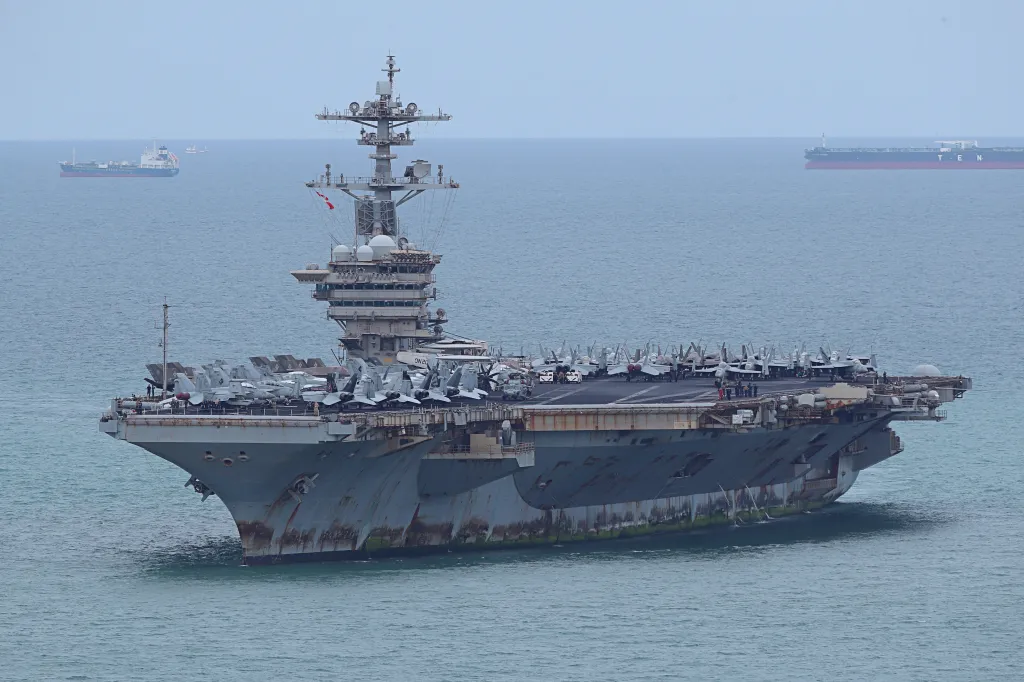
As mentioned, Lincoln definitely looks like it’s been at sea more or less continuously for the last nine and a half months or so. Pictures and videos of the ship in Laem Chabang seen throughout this story plainly show big dark rust stains all around the hull and other similar signs of wear elsewhere. There is also a bright green ring of algae layered on the hull at the waterline. While carriers have very large crews and usually keep the ship’s appearance up relatively well while on cruise, there is only so much that can be done out of port on particularly long deployments, where all resources are focused on sustained high-tempo combat operations.
USS Abraham Lincoln seen arriving in Laem Chabang, Thailand, today. Thananuwat Srirasant/Getty ImagesAnother look at the Lincoln arriving in Thailand today. ANTHONY WALLACE / AFP via Getty ImagesA closer look at the side of Lincoln‘s hull, with ‘running rust’ and algae plainly visible. ANTHONY WALLACE / AFP via Getty Images
“It’s terrible. I think they should be ashamed,” John Phelan told members of Congress at a hearing last year after being shown pictures of a very worn-looking Arleigh Burke class destroyer, the USS Dewey, during a stopover in Singapore. “Would you want to go on that ship?”
A picture of the USS Dewey covered in “running rust” during a recent port visit in Singapore is shown at the confirmation hearing for Secretary of the Navy nominee John Phelan on January 27, 2025. Senate Armed Services Committee capture
Lincoln‘s current condition is, of course, an extreme case that is the result of very specific operational circumstances. The carrier has already been in the news for weeks now due to the aforementioned morale issues, which family members of those onboard have been very vocally calling attention to through the media. One sailor had to be rescued last month after deliberately jumping overboard. There were reports that at least one other individual onboard had attempted to do the same. President Donald Trump and Secretary Pete Hegseth, among others, have pushed back on concerns about mental health and other issues on the ship. In a statement shared on social media on August 16, Navy Adm. Brad Cooper, head of U.S. Central Command (CENTCOM), acknowledged, but still downplayed, the seriousness of the mental health situation, in particular.
At the same time, the carrier’s marathon deployment is indicative of larger shipbuilding, readiness, and other issues that the Navy continues to struggle with. Strains on the service carrier fleets in particular have been steadily building for years and are now becoming a low-level crisis. The USS Gerald R. Ford wrapped up a historic 326-day-long deployment in May. The Navy has publicly said that the USS Theodore Roosevelt, which is set to begin its latest cruise soon, could be away from home for at least eight months. The longer the ships remain deployed, the longer they typically have to spend in port afterward, further compounding the situation with each passing day during months-long extensions. This all has very worrisome cascading impacts on even routine maintenance cycles, let alone deep overhauls and upgrade efforts, as well as personnel management matters, as we have explored in detail in the past.
USS Abraham Lincoln in Guam in December 2025. USN
“It’s my earnest attempt to really try to keep those [deployments] at seven months,” Chief of Naval Operations Adm. Daryl Caudle, the Navy’s top officer, said during a question-and-answer session at Fort Meade, Maryland, Monday, which was livestreamed. He also said he wanted a Navy “that can sustain a seven-month deployment and still give our combatant commanders the amount of naval force they need to accomplish their missions, solve their key operational problems, and make sure they have all the naval force necessary to do what they need to do.”
The Lincoln‘s visibly worn state certainly draws new attention to the stress on America’s carrier fleets as personnel onboard are now finally getting a much-earned reprieve in Laem Chabang.
Video emerged on social media of local workers cleaning the carrier. Two of them can be seen on a scaffolding platform, dressed in silver-colored protective clothing, yellow helmets, face shields and black boots, spraying the side of the big ship. You can see that most of the rust, as well as all of the green swath of algae, was removed from the section where they are working.
The camera also pans across the ship, showing the extent of the work still needed.
Those recent viral rust photos/footage of the USS Abraham Lincoln (CVN-72) in Thailand overstated the story.
Yes, the hull looked rough in pictures, but the ship itself was never in question, that’s the part the headlines skipped.
It is unclear whether this work had already been scheduled as part of routine maintenance or whether it had been ordered after images of the ship emerged showing its rough condition. The ship was a huge focus of attention even before it got to Thailand.
Interest in the Lincoln flared up anew after it arrived in Thailand due to its condition, as well as intense curiosity about how the crew would fare in a Thai port call after being at sea for so long.
The USS Abraham Lincoln (CVN-72) aircraft carrier arrives at Laem Chabang Port on Sept. 2, 2026 in Si Racha, Thailand. (Photo by Thananuwat Srirasant/Getty Images) Thananuwat Srirasant
“It’s terrible. I think they should be ashamed,” John Phelan told members of Congress at a hearing last year after being shown pictures of a very worn-looking Arleigh Burke class destroyer, the USS Dewey, during a stopover in Singapore. “Would you want to go on that ship?”
One driving factor in the condition of ships like Lincoln is the operational tempo of deployments, a Navy official noted earlier this year.
“We know what to do, but we choose not to do it,” Mark Lattner, director of the Navy’s Ship Integrity and Performance Engineering, Naval Systems Engineering Directorate, said in January during a panel at the Surface Navy Association’s annual symposium that TWZ attended. “And we choose not to do it because there’s always some other problem I’ve got to fix. I don’t have time. Our corrosion can wait. And so we don’t implement the fixes.”
Finding a solution to the Navy’s rust problem became one of Lattner’s main missions in the wake of the fallout from Trump’s late-night texts to Navy officials demanding answers about the condition of theArleighBurke class guided missile destroyer USS Dewey after he saw pictures of it covered in running rust as it pulled into Singapore last year.
A picture of the USS Dewey covered in ‘running rust’ during a recent port visit in Singapore is shown at the confirmation hearing for Secretary of the Navy nominee John Phelan on January 27, 2025. (Senate Armed Services Committee screen capture) Senate Armed Services Committee capture
Port calls offer critical time to fix long-standing issues and resupply the ship of pretty much everything you can think of, from jet fuel to food. So it’s no surprise that the Lincoln would be swarmed with support personnel and supplies while much of her crew enjoys being on land once again for a few days.
It’s unclear how long the clean-up work on the Lincoln will last or how much of it will be finished by the time the ship and crew leave port. Either way, from what we have seen so far, it will look much better leaving Thailand than when it arrived.
A U.S. Navy helicopter lands on the nuclear-powered aircraft carrier USS Abraham Lincoln (CVN-72) while the ship sails to dock at the deep-sea port in Laem Chabang, Chonburi province, Thailand, Wednesday. The Nimitz-class nuclear-powered aircraft carrier with roughly 5,000 sailors and Marines aboard and other vessels from its Carrier Strike Group, is docked with personnel to come ashore in Thailand to rest and recuperate while the warship replenishes supplies after an extended deployment. Photo by Rungroj Yongrit/EPA
Sept. 2 (UPI) — The USS Abraham Lincoln docked in Thailand Wednesday morning, the first break for the sailors aboard since before Thanksgiving.
The 5,000 crew members aboard the nuclear-powered aircraft carrier stepped on land and headed to the beach town of Pattaya, Thailand, to begin their first significant shore leave in nine months.
The ship, based in San Diego, has spent more than 250 consecutive days supporting actions in Venezuela and Iran. The crew has faced issues with morale, plumbing and food supplies. At least one sailor aboard the ship has attempted suicide, and there have been reports of more.
During the Lincoln’s deployment in the Middle East, the U.S. naval base in Bahrain was mostly destroyed at the beginning of the war, making restocking and repairs more challenging.
After public outcry, the Navy replaced the Lincoln with the USS George Washington, allowing the Lincoln to head home.
The Lincoln docked Wednesday at Laem Chabang, north of Pattaya, and crew members traveled by bus into the beach town. Many of them booked hotels for their shore leave, said Pattaya Mayor Poramet Ngampichet.
“It is a well-deserved break for all of the crew, and we really look forward to our time here,” said Capt. Daniel J. Keeler, commanding officer of the Lincoln, The New York Times reported.
“It’s good to have you here,” the mayor said, shaking hands with the Captain.
The mayor and other local dignitaries greeted the first arriving sailors at the Hard Rock Hotel in Pattaya. They handed the crew members gifts and welcomed them to the area.
“Our arrival in Laem Chabang provides a well-deserved opportunity for our sailors and Marines to rest and recharge. It also underscores the strong and enduring partnership and alliance between the United States and Thailand,” Rear Adm. Robert E. Loughran, commander of Carrier Strike Group 3, which includes the Lincoln, said in a statement. “What this strike group has accomplished is truly historic. I could not be prouder of the exceptional professionalism and expertise demonstrated by every member of this team during our operations in the U.S. Central Command area of responsibility.”
The statement pointed out that Thailand has been a partner of the United States since the 1833 Treaty of Amity and Commerce, and it’s the only treaty ally in mainland southeast Asia.
Pattaya is just north of U-Tapao, where an airbase hosted U.S. B-52 bombers during the Vietnam War. It also provided a rest and relaxation spot for U.S. servicemembers during the war and since. For this shore leave, local authorities said the military has restricted certain activities, including consuming marijuana, parasailing and jet skiing.
After the weekend in Thailand, the Lincoln is scheduled to leave for San Diego Sunday.
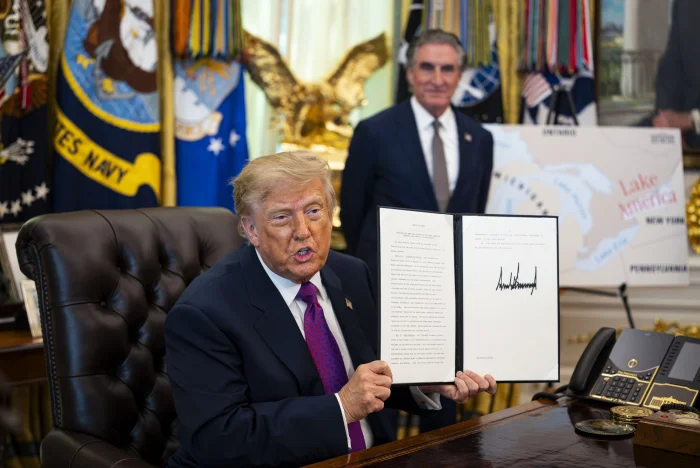
President Donald Trump signs an executive order to rename Lake Ontario as Lake America in the Oval Office of the White House on Thursday. Photo by Al Drago/UPI | License Photo
Thailand’s Pattaya is expecting a business boost as 5,000 US sailors arrive after spending nine months at sea aboard the USS Abraham Lincoln. The carrier supported the US war on Iran, while its record deployment was marked by deteriorating conditions on board.
Under heavy escort, the USS Abraham Lincoln transited the Strait of Malacca and Singapore Strait over the weekend, en route to Thailand for a highly publicized and much-needed liberty port call. Guided-missile cruiser USS Robert Smalls led the three-ship column, with guided-missile destroyer USS Frank E. Petersen Jr. following astern of the supercarrier as she entered the South China Sea. Multiple Thai officials have confirmed the upcoming port visit since it was first reported by USA Today last week, with the flattop expected to pull into port at Laem Chabang in the coming days. Meanwhile, America’s other two deployed carrier groups are in the Middle East enforcing the ongoing blockade as the U.S. and Iran exchange fire for the first time since July.
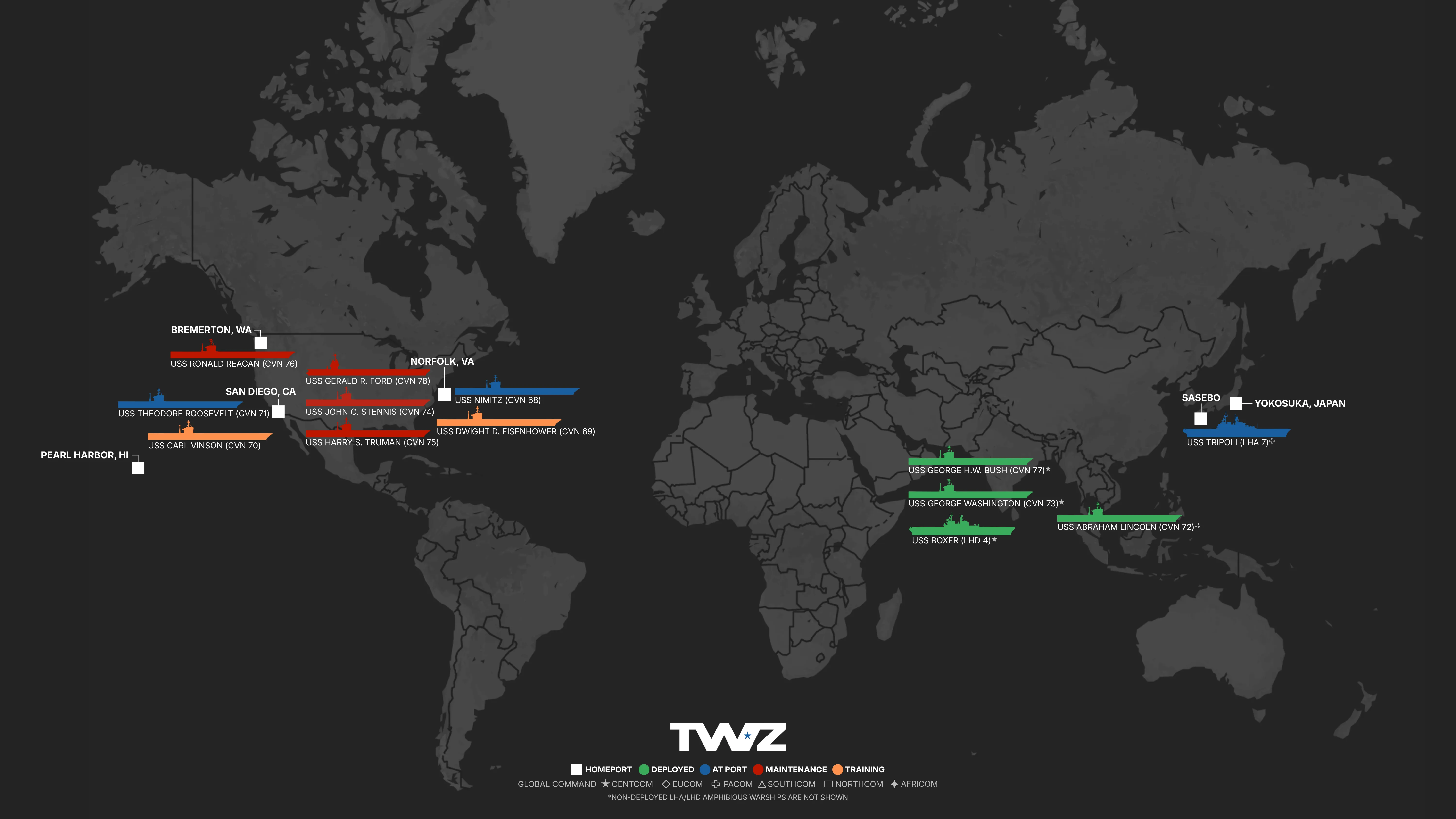
Here’s TWZ’s weekly carrier tracker monitoring America’s flattop fleet, including deployed Carrier Strike Groups (CSG) and Amphibious Ready Groups (ARG), using publicly available open-source information. Check out last week’s report here.
TWZ/IAN ELLIS-JONES (HIGH RESOLUTION)
Lincoln Enters The South China Sea, Again, En Route To Thailand For Liberty
Abraham Lincoln flipped her Automatic Identification System (AIS) transponder on ahead of the transit, broadcasting the flattop’s position publicly for the first time since January 28, 2026, when the CSG made the transit in the opposite direction prior to Operation Epic Fury. Lincoln has now been deployed for 285 days without a liberty call, but that streak is set to end this week.
For friends and family, we anticipate an arrival back home in late September or early October, depending on how long the crew stays in Thailand and whether any other stops are made along the way. When all is said and done, Abraham Lincoln’s deployment will likely become the second-longest in the modern carrier era behind the historic 326 days logged by the USS Gerald R. Ford earlier this year.
Time-lapse of USS Abraham Lincoln transiting the Strait of Malacca. Source: @CVN_72 on X.
While the composition of the Abraham Lincoln CSG has shifted over the nine-plus-month deployment, Frank E. Petersen Jr., a Flight IIA Technology Insertion (TI) Arleigh Burke class destroyer and one of the newest in the fleet, embarked the commander of Integrated Air and Missile Defense (IAMD) throughout the six months of almost nonstop combat operations against Iran. The IAMD commander is responsible for coordinating the detection, response, and interception of inbound aerial threats, and Petersen Jr. is equipped with the world’s foremost integrated naval combat system – the Aegis Combat System Baseline 9 – which delivers quick reaction times, concentrated and networked firepower, and advanced electronic countermeasure capabilities for anti-air warfare.
The unannounced addition of Ticonderoga class cruiser USS Robert Smalls, which has historically served as the IAMD commander for the carriers forward-deployed out of Yokosuka, Japan, adds 122 Vertical Launch System (VLS) cells packed with missiles for protection and firepower. The rationale for the additional Tico cruiser, an iconic class that will be completely retired over the coming years without a comparable replacement, is unclear. TWZ has not received an on-the-record response from the U.S. Central Command (CENTCOM) or U.S. Naval Forces Central Command (NAVCENT) public affairs explaining the redirection.
Robert Smalls was part of the George Washington CSG as recently as August 18, making the northwest-bound Malacca Strait transit with the strike group the week prior, before peeling off to escort the Abraham Lincoln back through.
Guided-missile destroyer USS Frank E. Petersen Jr. transiting the Arabian Sea in June 2026. U.S. Central Command Public AffaUSS Robert Smalls transiting the South China Sea in July 2026. U.S. Navy photo by Petty Officer 3rd Class Nicolas Quezada
U.S. Launches Another Round of Strikes Against Iran Today As Tensions Escalate
Ahead of publication on Tuesday, CENTCOM announced a fresh round of strikes against targets in Iran that began at noon Eastern Time. “The strikes follow recent attempted attacks by the IRGC against commercial shipping in the Strait of Hormuz and against American service members deployed to the region,” the command posted in a statement on social media.
George Washington, which is currently accompanied by a single destroyer, USS Shoup, relieved the Abraham Lincoln in the Middle East earlier this month. Other U.S. 5th Fleet ships are reportedly moving in and out of the CSG, but the situation is fluid and TWZ cannot confirm the current, complete composition of the group. It’s unknown which warship, if any, is currently serving as IAMD commander for the CSG, which chopped into the CENTCOM area of responsibility (AOR) on or around August 19.
Flight ops on the flight deck of USS George Washington in the Middle East. U.S. Naval Forces Central CommanAn F-35C Lightning II, attached to Strike Fighter Squadron (VFA) 147, aboard Washington. Petty Officer 3rd Class Nicolas QuezadaAn MH-60R Seahawk readies for takeoff on the deck of Washington. U.S. Naval Forces Central Comman
Also operating in the Middle East, the four-ship George H.W. Bush CSG is underway at an undisclosed location in the Arabian Sea. Alongside USS George H.W. Bush is Tico cruiser USS Princeton, the IAMD commander, and two Burke destroyers, USS Ross and USS Donald Cook.
The carriers are enforcing the ongoing blockade of Iran – and presumably participating in the latest round of airstrikes – although they are both officially on station to “support maritime security and stability in the Middle East,” according to DVIDS, the military’s content-sharing platform. CENTCOM forces have redirected 84 commercial vessels, disabled three using kinetic force, and boarded another two since the blockade resumed, as of September 1.
USS George H.W. Bush conducts flight ops in U.S. Central Command. U.S. Navy video.
Over the weekend, the United States and Iran traded blows for the first time in over a month. CENTCOM opened the tit-for-tat exchange on Sunday by targeting rocket systems on Larak Island, located in the Strait of Hormuz on the Iranian side of the northern corridor, that are fitted to launch naval mines, after the Islamic Revolutionary Guard Corps (IRGC) was observed making preparations to fire into the contested waterway.
“I can confirm that earlier today U.S. forces struck two Iranian launchers on Larak Island,” Navy Capt. Tim Hawkins, CENTCOM’s spokesman, told TWZ. “Islamic Revolutionary Guard Corps forces were observed preparing to launch rockets with sea mines into the Strait of Hormuz,” he added. The IRGC retaliated by launching a salvo of ballistic missiles at Muwaffaq Salti Air Base, a Jordanian installation the U.S. military operates from. Jordan’s military said it successfully intercepted eight missiles.
The preemptive strikes to prevent Iran from deploying additional mines came just days after CENTCOM commander Adm. Brad Cooper said U.S. forces “successfully cleared” Iranian sea mines from international shipping lanes in the Strait of Hormuz. Commercial traffic through the strait is slowly recovering but still well below pre-war levels.
CENTCOM commander Adm. Brad Cooper provides an update on mine clearing efforts in the Strait of Hormuz. Source: @CENTCOM on X
On the other side of the world, in the United States, three carriers are active: two are underway training while one is in homeport getting ready for an upcoming deployment. USS Dwight D. Eisenhower, which left Norfolk on August 21, transited south in the Atlantic Ocean and was last operating approximately 70 nautical miles off the coast of Florida, well into East Coast Fleet Replacement Squadron (FRS) and Training Command (TRACOM) Carrier Qualifications (CQ). After departing San Diego on August 10, USS Carl Vinson was spotted on satellite imagery off the California coast by ship-tracker MT Anderson, in the process of completing Tailored Ship’s Training Availability (TSTA) and Final Evaluation Period (FEP) training.
USS Theodore Roosevelt, the next carrier slated to deploy from the continental U.S., is pierside at Naval Air Station North Island in San Diego, based on commercial satellite imagery. Speculation is rampant about where Theodore Roosevelt will deploy, but as the Navy has told us many times, “we do not discuss future operations or timelines.”
The balance of America’s carriers (excluding USS Nimitz, which will begin deactivation in 2027) is either in maintenance or scheduled to begin an availability in the future.
The next flattop that will re-enter service, USS Ronald Reagan, is expected to finish a roughly 17-month Docking Planned Incremental Availability (DPIA) soon. “The docking planned incremental availability for Ronald Reagan is on track for its scheduled completion at the end of August 2026,” Catherine Norton, the Public Affairs Officer (PAO) for Puget Sound Naval Shipyard and Intermediate Maintenance Facility, told Stars and Stripes earlier this month. However, the ship has not gotten underway as of publication, even though yesterday was the end of the month, and it appears the DPIA will stretch into September. TWZ reached out to Puget Sound’s PAO but has not received a response yet. For the latest status of the other three carriers in current or upcoming maintenance, marked in red on the map above, check out our recent deep-dive here.
USS Ronald Reagan in Bremerton, Washington, as of August 29, 2026. Source: @BulletOneOneTwo via @WarshipCam on X
Current Big Deck Force Posture At A Glance
Overall carrier force posture is unchanged compared to our previous report on August 24. Three U.S. carriers are deployed (although one is on the tail end of her deployment and heading home to San Diego), one is preparing to deploy in the near term, two are working up in various states of readiness, four are in maintenance, and another, the USS Nimitz, is being used primarily for training before deactivating next year. One amphibious ready group is deployed, one is forward-deployed and at homeport, four are working up or in port, and three are in maintenance.
Note: Positions are general approximations. Non-deployed LHA/LHD amphibious warships are not shown.