Pastry chef, baker and champion of whole grains Roxana Jullapat opened Friends & Family in East Hollywood nine years ago, a forerunner among a new wave of artisanal bakeries in Los Angeles. Her first book, “Mother Grains,” served as an introduction to baking with freshly milled ancient grains such as rye, barley, buckwheat, corn, oat, rice, sorghum and local wheat. Her follow-up cookbook, “Morning Baker,” centers the same whole grains with an emphasis on incorporating them into easy, everyday bakes and weekend projects, from muffins and scones to viennoiserie and naturally leavened and yeasted breads, along with French toast, pancakes, waffles, doughnuts and quiche. With the first book, “I didn’t anticipate that people were so ready and hungry for cooking and baking with grains,” she said recently. “They were ingredients they already had in their kitchen.” The follow-up book is also a snapshot of Friends & Family’s morning bake, the daily production of several dozen kinds of pastries that fill the pastry case to overflowing. There are recipes that are easy to jump into, and there is a chapter devoted to whole-grain croissants, made with spelt and whole wheat. A primer on her favorite flours and recommended millers is a vital resource.
For seven innings on Friday night, the much anticipated college baseball showdown between No. 1 UCLA and rival No. 12 USC, lived up to expectations before an overflow crowd at Jackie Robinson Stadium. There were three home runs, diving catches, two elite starting pitchers competing at a high level and both teams refusing to let the other separate itself.
UCLA sent up 12 batters and scored seven runs to turn a tight game into a rout and come away with a 12-4 victory in the first game of a three-game series.
“It’s a cruddy way to end it,” USC coach Andy Stankiewicz said. “We were right there and it went sideways fast.”
UCLA (27-2) took a 5-4 lead in the seventh on an RBI single from Will Gasparino. In the eighth, the Bruins loaded the bases with none out on a walk, hit batter and infield single. Then came a two-run single from Mulvai Levu, an infield single from Roman Martin and a two-run single by Payton Brennan. The inning kept going and going. There was a dropped pop fly in foul territory, a misplayed ball in center that went for a triple by Phoenix Call, wild pitches and walks.
“At the end of the day, it was a very tight game that doesn’t look like a tight game,” Savage said.
USC celebrates a second-inning home run by Andrew Lamb (29).
(Craig Weston)
Two of the top pitchers in the nation, Logan Reddemann of UCLA and Mason Edwards of USC, each gave up home runs and faced challenges from top hitters. Reddemann gave up a two-run home run to Andrew Lamb and a solo home run to Augie Lopez. UCLA scored three earned runs off Edwards, doubling the run total he has given up all season. Martin had a home run.
“I thought you had two premier pitchers against two really good offenses,” Savage said. “They had to fight for every out. Mason is clearly the best pitcher in college baseball the first half of the season. We did a good job making him work.”
UCLA pulled off a rare pick off play when USC stole second with a man on third. Catcher Cashel Dugger did an acting job worthy of an Academy Award throwing the ball hard to Reddemman on the mound, who then got the runner on third leaving the bag.
“I thought it was executed perfectly,” said Miller, the third baseman on the play.
It doesn’t happen often, but UCLA had to find a sign gathering cobwebs in the ticket office to post at the entrance of Jackie Robinson Stadium on Friday night: “Game sold out.”
The same sign will be posted again on Sunday. Some 2,000 people were allowed in.
“I wish the ballpark was bigger,” Savage said.
Tickets were going for more than $100 on the secondary market. The auxiliary bleachers were filled. The UCLA versus USC baseball series hasn’t received this much attention and interest since the days of Rod Dedeaux winning 11 College World Series titles at USC, the last in 1978. Savage won an NCAA title in 2013 and was drawing big crowds in 2010 when future first-round picks Gerrit Cole and Trevor Bauer pitched UCLA to Omaha.
“We’re a competitive team,” Savage said. “They like challenges. This was a big challenge. USC has played as well as any team in the country. It was two really good teams playing in the first game of a series. The city of Los Angeles was excited. It’s good for Southern California, it’s good for recruiting, it’s good for people to come in and see the talent USC and UCLA have.”
UCLA’s relief pitching continues to be a major strength. Freshman Zach Strickland and sophomore Easton Hawk combined for three hitless innings to finish out the victory. And UCLA didn’t have to use its best reliever this season, Wylan Moss, giving Savage options for the rest of the series.
Gasparino and Brennan each finished with three hits. USC dropped to 27-4.
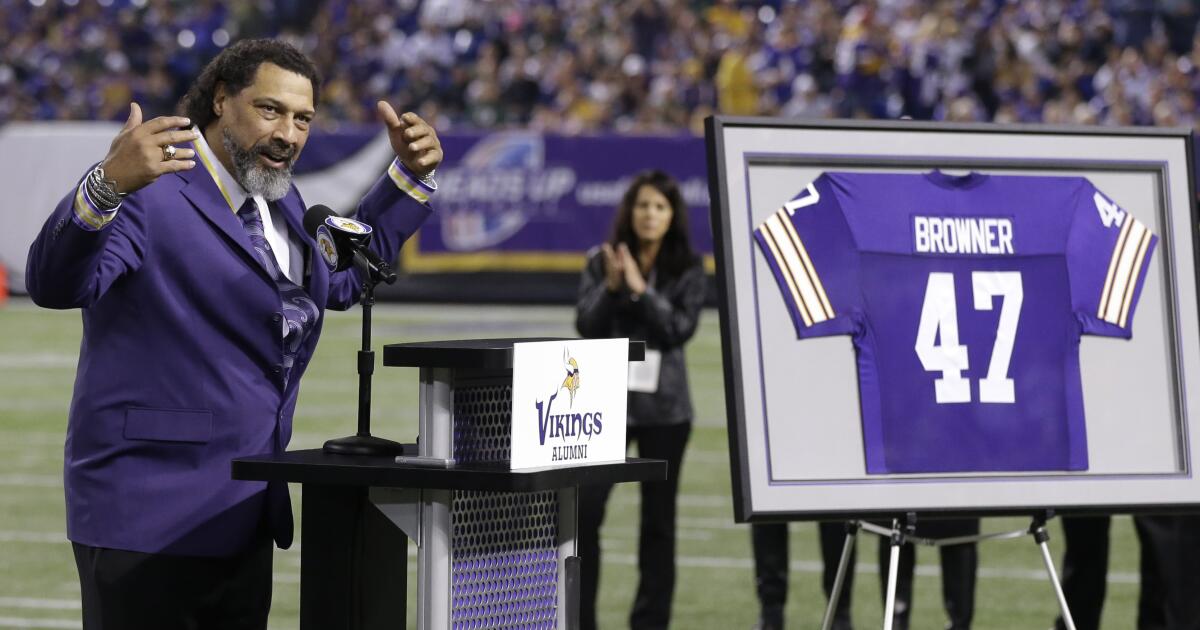
Joey Browner, a star defensive back at USC and a six-time NFL Pro Bowl selection, has died. He was 65.
“The Vikings are mourning the loss of Ring of Honor member Joey Browner,” the team said Sunday in a statement. “Browner will be deeply missed by former coaches and teammates, as well as many others he impacted throughout his life.”
The Vikings added in a separate post: “He helped define what it is to be an NFL safety.”
No cause of death was given. In August, former Minnesota quarterback Tommy Kramer organized a fundraiser for Browner, who Kramer said was “battling through some serious health issues.”
On Sunday, Kramer wrote about Browning on Facebook: “Not only a great player, a great person. Rest in peace my friend.”
Browner was one of six brothers, all of whom played college football and four of whom went on to play in the NFL. Younger brother Keith Browner, who also played at USC and spent five seasons in the NFL, died in November at age 63 after a sudden illness.
Oldest brother Ross Browner, who played 10 NFL seasons for the Cincinnati Bengals and Green Bay Packers, died in 2022. Another older brother, Jim Browner, who played two seasons for the Bengals, died in 2024.
A high school standout in football, basketball and track and field, Browner played at USC from 1979-1982. He was named team MVP his senior year and finished his college career with nine interceptions and 40 pass deflections, as well as one punt return for a touchdown.
In the 1983 draft, Browner became the first defensive back to be selected by the Vikings in the first round (19th overall). He went on to play nine seasons in Minnesota, making the Pro Bowl six times (1985-1990), and spent his final NFL season with the Tampa Bay Buccaneers.
Browner finished his career with 37 interceptions, 17 forced fumbles and 17 fumble recoveries. He was named to the NFL 1980s all-decade team, as selected by the Pro Football Hall of Fame, and inducted into the Vikings’ Ring of Honor in 2013.
Sean Salisbury, a former quarterback whose career intersected with Browner’s in college and the NFL, was one of many in the football community paying their respects to the four-time All-Pro player.
“This is a major gut punch,” Salisbury wrote on X. “I was blessed to be his teammate at USC and with the Vikings! Phenomenal player and loved by so many. One of the best players I’ve ever played with in both college and the NFL. Very grateful to have called him a good friend. God Bless him and his family.”
Former tight end Steve Jordan, who played nine seasons with Browner in Minnesota, recently visited his former teammate in the Twin Cities, according to a Vikings news release.
“We’ve lost a great friend and one of the best Vikings teammates,” Jordan said in a statement released by the team. “God blessed Joey with phenomenal talent and a big heart to love people and be a beacon of positivity. Truly, he will be missed.”
Former quarterback Rich Gannon, who played five seasons with Browner in Minnesota, wrote on X: “Sad to hear about the passing of my former teammate Joey Browner. On the football field he was one bad dude, off he was a kind soul!”
Retired punter Greg Coleman wrote on X that “one of the happiest moments of my time with the Vikings” was learning that Browner was going to be added to the punt team.
“One of the best teammates you could have and a man I called Friend!” Coleman wrote. “Prayers up for his family. RIP JB!”
Current Vikings cornerback Dwight McGlothern wrote on X: “Dang, I had a chance to meet him my rookie year & I was wearing #47 at the time during camp & hearing about his accomplishments, I’m grateful to [have] had the chance to meet him & [represent] the # he wore with the Vikings !! Everytime I walk in the DB room I always see greatness on the wall !!”
Three weeks into spring practice, USC football coaches are making one thing clear: 95% of their best will not be accepted or tolerated. Wednesday’s practice started with some of the players doing up-downs after forgetting equipment.
“It was a good message from some of our staff and leaders in terms of the approach that we need to have every day that we come out here,” Trojans coach Lincoln Riley said.
A sentiment that was shared by junior defensive tackle Jide Abasiri: “We just have to be better prepared.”
After the hiccup, Riley said the team responded well and it was back to business.
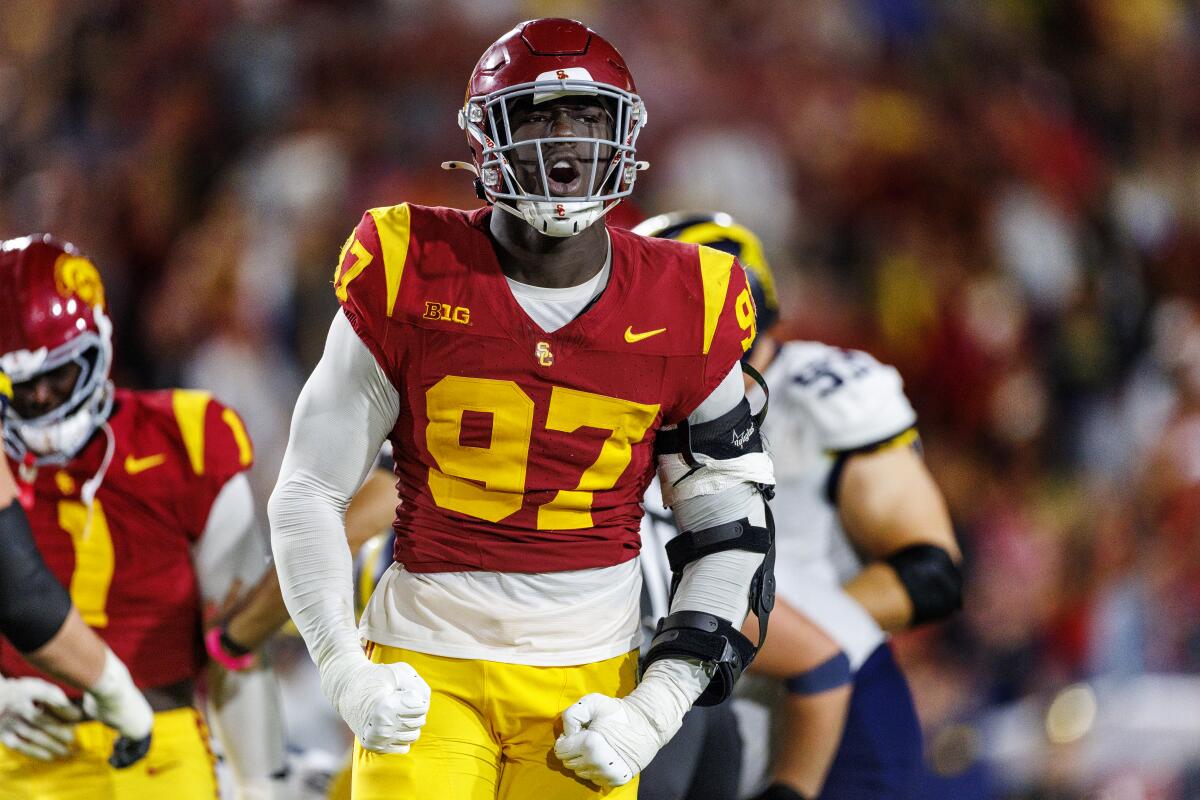
USC defensive tackle Jide Abasiri (97) is pushing himself to be a more vocal leader as a the Trojans help young players get acclimated to the program.
(Gina Ferazzi/Los Angeles Times)
After a spirited day on the field on Tuesday following a one-week spring break, Wednesday’s practice was scripted with the intent to cause stress and create discomfort — stacking multiple two-minute drills after a 6 a.m. team meeting. The goal is to build a no-excuses program.
“It’s invaluable time, invaluable reps,” Riley said. “Coming out and working plays and the techniques, great. When you start putting those guys in real-life situations and you make it really difficult on them, you really start to see who rises up and they’re great teaching moments for these guys and for the team in terms of what we want to be and what we want them to be.”
Regardless of the mental challenges Riley applied, the Trojans’ morale remains positive as players compete for spots in the lineup. The energy of the team comes from within, Riley said.
“It allows us as a staff to really hone in on pushing these guys, and coaching and critiquing and correcting,” Riley said. “And they’re taking it well.”
Attention to detail has always been important at USC, but Abasiri said this year there is an extra emphasis being placed on play-specific details. The staff has implemented drills that focus on a player’s specific movement or job during various plays.
Entering his third season with the Trojans, Abasiri said he felt like he needed to be a team leader. USC landed the No. 1 class in the nation for the first time since 2006. With so many new young players joining spring practice and a limited number of Trojans with three years of experience, Abasiri felt it was his job to lead.
“Just being an older guy, I feel like it’s important for me to … help them just come along,” Abasiri said.
So far, his advice has been to “just have fun with it.”
“I mean, obviously, stay on top of everything and all your stuff, but I feel like people get so stressed and so caught up in what they’re doing that they forget that this is supposed to be enjoyable,” Abasiri said.
The coaching staff, meanwhile, is balancing teaching schemes and the playbook.
“You have to be able to do both at this level,” Riley said. “The new guys that came in did have a pretty good foundation. A lot of them came from really good programs. A lot of them had a pretty good working football knowledge to where when we got started with them, it wasn’t like you felt like you were starting from literal square one.”
Return game is still unsettled
USC is still working to identify its top kickoff and punt return options.
“We haven’t done a lot of live returns yet,” Riley said. “We’re just trying to figure out who really fields the ball well, who understands it, who makes decisions and honestly, the returners, they’re showing us a lot of what they can do just in the offensive and defensive periods.”
The coaching staff has a pretty good idea who some of the best players in that position are, but at the moment, they just want to develop the skills, from a return standpoint.
A proposed gubernatorial forum hastily cobbled together in the hours after USC canceled its Tuesday debate fell apart because the candidates of color who were excluded from the previously planned event were unable to show up in person at KNBC-TV’s studio in Universal City, according to multiple sources.
Facing mounting pressure that its debate selection criteria excluded every candidate of color, the university canceled its debate late Monday. On Tuesday morning, billionaire Tom Steyer — a Democrat — proposed holding an alternative face-off, with KNBC moderating. But the candidates who had not been invited to the USC debate had already made other commitments.
“A lot of this came out of nowhere — there’s a debate and you’re not invited, followed by there’s no debate, and then maybe we should all hang out and have a conversation,” said Kyle Layman, a strategist advising former U.S. Health and Human Services Secretary Xavier Becerra.
USC officials declined to comment on Tuesday’s developments — as did KABC-TV, one of the broadcast partners of the canceled debate. KNBC did not respond to a request for comment, but someone involved with planning a potential debate there said pulling together such an event in just a few hours was impossible, and also unfair to the candidates who had made other plans after initially being excluded from the USC debate.
“We looked into the possibility of doing something. It just wasn’t possible because of the last-minute logistics. It was not feasible,” said the person, who asked for anonymity to speak candidly. “We couldn’t get everybody here.”
The fact that the candidates excluded from the USC debate couldn’t find a way to participate in Tuesday evening’s alternative forum irritated some people involved in the planning, however. Becerra, state Supt. of Public Instruction Tony Thurmond, former Los Angeles Mayor Antonio Villaraigosa and former state Controller Betty Yee had loudly protested not being invited to the USC event.
“This is like probably one of the last opportunities they have to be with other leading contenders of the race, so why not take this opportunity?” said someone who took part in conversations about the proposed last-minute debate, who asked for anonymity to speak openly. “If the whole thing is about bringing your message to the voters, making sure voters have as much information as possible, talking about the issues that matter, wouldn’t you want to take every opportunity to do that?
“If you’re going to talk a big game about taking your message to voters, the importance of debates, why not do it?” this person said.
Becerra, Thurmond, Villaraigosa and Yee have reportedly formed an informal pact not to participate in any debate that does not include all of them, which Yee referenced in a Tuesday afternoon news conference.
“The idea that none of the candidates of color are going to be joining a debate is just inappropriate for a state like California,” Yee said. “We also need to have a commitment from all of the debate sponsors that they will include all of us going forward.”
Yee and Thurmond were not invited to the next major televised debate, which will take place April 1 at Fresno State University. Becerra and Villaraigosa had previously confirmed their attendance, according to a news release from the Western Growers Assn., one of the event’s sponsors.
And all four candidates of color, along with San José Mayor Matt Mahan, were not invited to a debate on April 22 in San Francisco that will be hosted by KRON-TV and broadcast on Nexstar Media Group stations throughout California.
“We don’t need gatekeepers,” Mahan said in a statement Tuesday evening. “I’m calling on my fellow candidates to work together to organize our own debates — so we can take our ideas for a better California to every corner of California. Let’s let the voters truly decide.”
The scrapped USC debate was going to be hosted by the institution’s Dornsife Center for the Political Future and co-sponsored by KABC and Univision. Six candidates had been invited to participate: Democrats Rep. Eric Swalwell (D-Dublin), former Orange County Rep. Katie Porter, Mahan and Steyer; along with the leading Republicans, conservative commentator Steve Hilton and Riverside County Sheriff Chad Bianco.
Candidates and elected officials called the criteria used to determine participation in the debate biased because it included Mahan, a white candidate who is polling near the bottom of the pack but is supported by notable names in the USC community. Hours after the debate was canceled, Steyer’s campaign sought to create an alternate event that would include all of the candidates.
“We were trying to do the right thing upon learning that the debate was canceled at USC,” said a member of Steyer’s campaign who asked for anonymity to speak candidly. “Tom immediately was like, ‘We can do something alternative.’ People want to hear from the gubernatorial candidates. It was on the table. It was offered.
“NBC couldn’t get all the candidates here, but we tried,” this person said. “Given the short amount of time we were trying to put this together, it ultimately could not happen because not all the candidates could get to the studio.”
Thurmond, who was in Sacramento and Richmond on Tuesday, joined a political influencer on YouTube Tuesday evening, while Yee attended previously scheduled events with the East Area Progressive Democrats and a women’s group in the L.A. area. Villaraigosa had lined up other interviews at his Wilshire campaign office, Becerra was traveling, and Porter was scheduled to host a livestream on her Instagram account Tuesday evening.
No. 9 USC struggles to contain Joyce Edwards and Madina Okot and commits 27 turnovers in a 101-61 loss to South Carolina in the second round of the NCAA tournament.
COLUMBIA, S.C. — Monday night served as a litmus test for ninth-seeded USC to see how a program on its way back to prominence measured up against top-seeded powerhouse South Carolina.
The Trojans were no match in the frontcourt against South Carolina, suffering 101-61 season-ending loss in the second round of the NCAA tournament.
South Carolina’s Joyce Edwards and Madina Okot got going early, scoring nine of the Gamecocks’ first 11 points. South Carolina would finish the game with 60 points in the paint. Edwards finished the game with 23 points and 10 rebounds and Okot had 15 points and 15 rebounds.
USC freshman Jazzy Davidson, who scored a phenomenal 31 points in her NCAA tournament debut Saturday against Clemson, missed her first two shots. But she recovered and found some offensive rhythm, finishing with 16 points. Kennedy Smith picked up the slack in the first half, scoring nine of USC’s first 15 points. Unfortunately, she struggled after that and finished four for 15 from the floor.
Londynn Jones was a spark off the bench for USC, finishing with 20 points to lead the Trojans.
South Carolina, meanwhile, will play No. 4 Oklahoma in the Sweet 16 on Saturday.
Davidson hit a three with 3:54 left in the first half that seemed to give the Trojans some life despite a 14-point deficit. However, things just got worse — USC (18-14) turned it over six times before halftime. South Carolina (33-3), meanwhile, went on a 16-0 run to take a 51-21 halftime lead.
“You know, you can lose, you can not necessarily be as good as a team, but I thought we were conceding,” USC coach Lindsey Gottlieb said after the game. “You don’t need to throw the ball away to the team. We had some careless things that I wasn’t pleased with and just wanted to see a different competitive level in the second half.”
The second half was not easy on USC, with South Carolina forcing three more turnovers in the first three minutes. The Trojans finished with 27 turnovers, which South Carolina converted into 29 points.
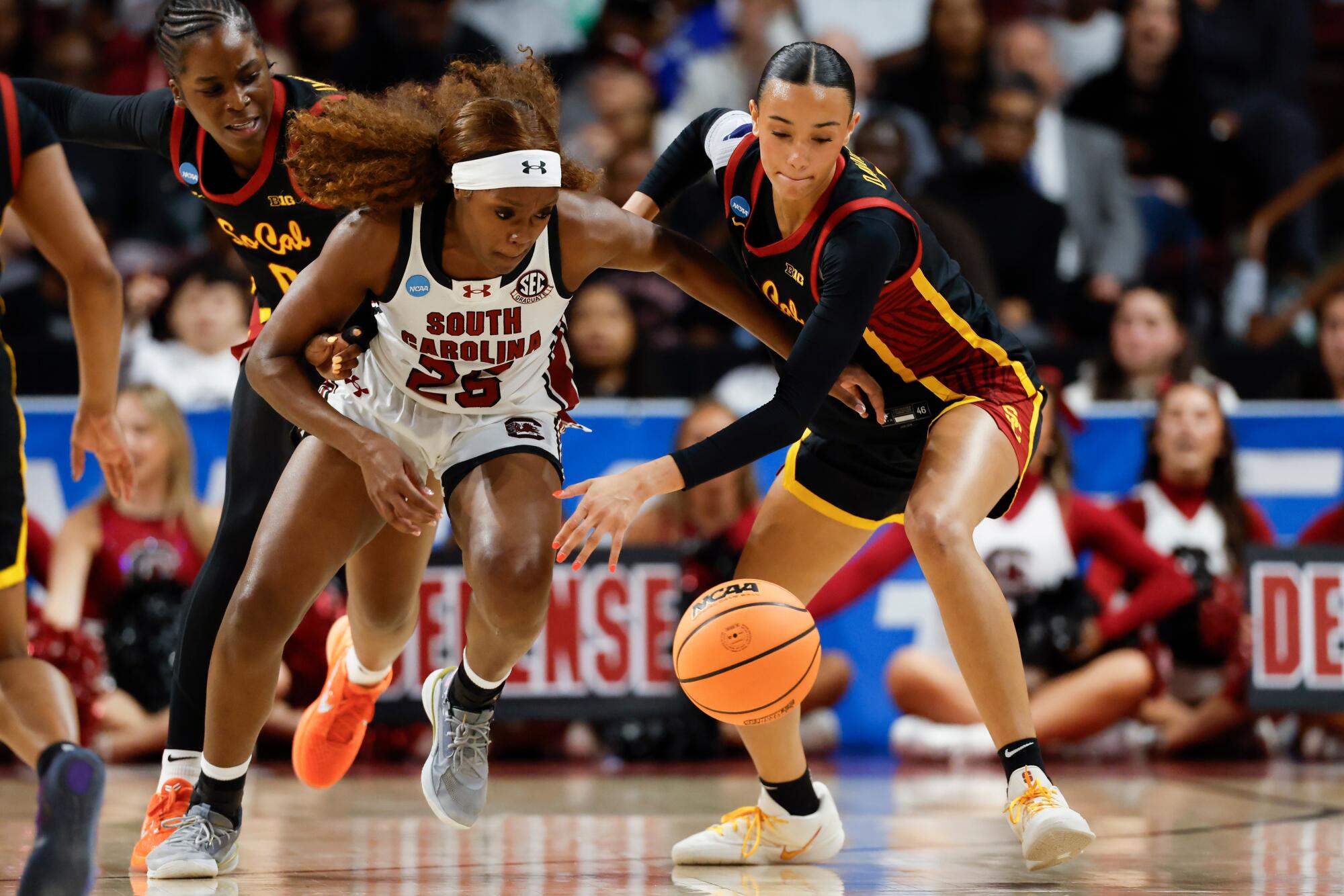
USC guard Jazzy Davidson battles South Carolina guard Raven Johnson for a loose ball during the first half of the Gamecocks’ win Monday in Columbia, S.C.
(Nell Redmond / Associated Press)
“They’re an elite defensive team, there’s no doubt about that. They have been all season. That’s definitely a huge part of their identity,” Davidson said of the Gamecocks. “We just had to be tougher with the ball throughout the game. The turnovers were another big thing for us just as a group.”
South Carolina also won the rebound battle 43-27, which compounded USC’s problems.
“I think we needed just a little bit better ball pressure. We just really didn’t box out well, either,” Smith said. “They had a lot of o-boards, I think Okot had about seven in the first quarter, so just trying to limit that is something I don’t think we did very well. I feel like going into the third and fourth quarter we did a little bit better, but we were in a little too deep.”
A tearful Davidson spoke about the influence Kara Dunn and Jones had on her as a player and a person during a short time. She added that said she’s excited to get back in the gym and return next season as an improved player.
USC guard Kennedy Smith drives under pressure from South Carolina guard Ayla McDowell Monday in Columbia, S.C.
(Nell Redmond / Associated Press)
“I need to get better. That’s kind of the bottom line,” Davidson said. “I think, obviously, it’s hard to lose in general, but losing this way really sucks, and I think I could have done a lot better for my team today.”
Gottlieb said there’s no doubt in her mind that Davidson will bounce back. She’ll have the benefit of playing alongside star JuJu Watkins, who sat out this season while recovering from a torn anterior cruciate ligament.
“Jazzy has, in particular, taken on every single thing this season and grown from it. That’s going to be part of her greatness,” she said. “I think she and I will look back at this day when we took a butt-kicking her freshman year in an NCAA tournament, and it will be very, very different at some point. And I think that’s because of how she’s handled every single situation.”
Democratic legislative leaders on Monday called on voters to boycott USC’s upcoming gubernatorial debate if the university does not invite candidates who were excluded from participating.
The unsparing letter adds another layer of controversy to Tuesday’s forum, which as a result of the university’s selection criteria would not include any of the leading candidates of color.
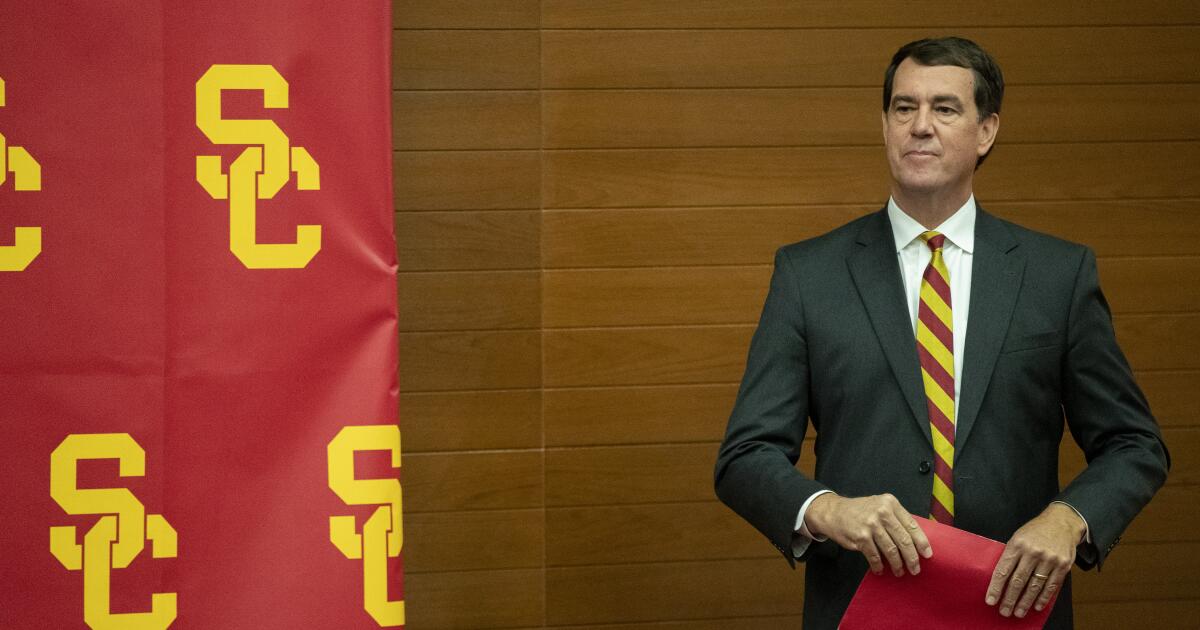
“We are writing to demand you open the March 24 gubernatorial debate to all leading candidates,” said the letter sent Monday evening to USC President Beong-Soo Kim by Assembly Speaker Robert Rivas (D-Hollister), Senate President Pro Tem Monique Limón (D-Goleta) and the leaders of the legislative Latino, Black, Asian and Pacific Islander, Native American, LGBTQ, Jewish and women’s caucuses. “The outcry over this debate is deafening and includes legal demands from the excluded candidates’ attorneys, public calls by elected leaders across the state, concerns from the included candidates’ own campaigns, and growing alarm from California voters. Instead of responding to these valid concerns by expanding the debate, USC has doubled down.”
USC officials did not immediately respond to a request for comment Monday. Tuesday’s debate is scheduled less than two months before ballots begin arriving in voters’ mailboxes.
The university has been embroiled in controversy over the criteria it used to select the candidates it invited to participate in Tuesday’s debate, which is co-sponsored by KABC-TV Los Angeles and Univision.
Specifically, critics have pointed out the methodology allowed San José Mayor Matt Mahan — a white candidate who recently entered the race and is polling poorly — to vault above former U.S. Health and Human Services Secretary Xavier Becerra, former Los Angeles Mayor Antonio Villaraigosa, state Supt. of Public Instruction Tony Thurmond and former state Controller Betty Yee.
“The university’s selection process — built on a formula never before used for a debate of this scale, has delivered a result that is biased,” the letter says. “When a methodology produces this outcome — one that elevates a candidate with notable ties to USC’s donor community and the co-director of the Dornsife Center for the Political Future — the burden falls on USC to explain itself, not on everyone else to accept it. If USC does not do the right thing, we call on California voters to boycott this debate.”
Mike Murphy, a co-director of the USC center hosting the debate, has been voluntarily advising an independent expenditure committee backing Mahan. The veteran GOP strategist previously said he had nothing to do with organizing the debate and that he has asked for unpaid leave at the university through the June 2 primary if he takes a paid role in the campaign.
USC has also received tens of millions of dollars in donations from billionaire real estate developer Rick Caruso and his wife. Caruso, a USC alumnus who served as a trustee for years, is also a Mahan supporter.
“I had no conversations with the debate hosts or organizers,” Caruso said in a statement to The Times on Monday. “This is the most important election for California in a generation, and I encourage everyone to be engaged, learn as much as possible about each candidate, then form an opinion who can move California forward in the most positive of ways. Watching debates is a part of that process. That is why I believe debates should include all the credible candidates.”
The debate sponsors released a joint statement on Friday defending their decision.
“We want to be clear that we categorically, unequivocally deny any allegations that the debate criteria was in any way biased in favor or against any candidate and want to clarify the facts,” said the statement by the USC Dornsife Center for the Political Future and its broadcast partners. “The methodology was based on well-established metrics consistent with formulas widely used to set debate participation nationwide — a combination of polling and fundraising — and developed without regard to any particular candidate.”
Hours later, the four prominent Democrats who were excluded from the debate called on their rivals to boycott the event, reiterating their concerns that the criteria used to determine who was invited to participate resulted in every prominent candidate of color being excluded from the forum.
The four Democrats who are participating in the debate — Rep. Eric Swalwell of Dublin, former Orange County Rep. Katie Porter, billionaire climate activist Tom Steyer and Mahan — all issued statements criticizing USC’s selection criteria, but did not pull out of the debate.
“It is a shame that USC has decided to elevate one candidate at the expense of others,” Swalwell wrote on X on Sunday. “USC, and every host of a gubernatorial debate, should employ fair, objective, and honest criteria for all candidates. I remain hopeful they will do so Tuesday night.”
Porter expressed similar thoughts.
“Criteria used to determine which candidates qualify to participate in a debate must be transparent, fair, and objective,” she wrote on X. “I’m disappointed by how USC handled the process for Tuesday’s debate. Candidates and Californians deserve answers.”
Welcome back to the Times of Troy newsletter, where, as colleague Chaunte’l Powell pointed out after Saturday’s thrilling win, you’d be forgiven for having already looked ahead to the next women’s college basketball season.
After all, as the USC women stumbled into this NCAA tournament on a four-game losing streak, they hadn’t offered much reason for optimism. When coach Lindsay Gottlieb added another five-star prospect — 6-4 forward Sara Okeke — to the mix for ‘26 last week, it only made it more enticing to close the book on this season and start dreaming of where USC might end up in the next one.
Fight on! Are you a true Trojans fan?
Get our Times of Troy newsletter for USC insights, news and much more.
By continuing, you agree to our Terms of Service, which include arbitration and a class action waiver. You agree that we and our third-party vendors may collect and use your information, including through cookies, pixels and similar technologies, for the purposes set forth in our Privacy Policy such as personalizing your experience and ads.
But this team, the one set to face No. 1 South Carolina on Monday night for a spot in the Sweet 16, has been limited from the start without an injured JuJu Watkins.
Through most of three quarters of Saturday’s first-round matchup with Clemson, the same issues that bothered USC through much of the season were bothersome once again. The Trojans had hit just three of 17 from three-point range heading into the fourth quarter. They made six free throws. They were outrebounded. And the bench had contributed all of two points. Gottlieb was frustrated.
But Saturday’s final quarter, plus overtime, would prove to be the defining stretch of this USC women’s basketball season. During those 15 minutes, we saw exactly what Gottlieb meant when she insisted her team had another level to unlock in the tournament.
This was the team Gottlieb had envisioned when building for a JuJu-less roster.
“We’d play with a lot of grit,” Davidson told reporters after the game, “and a lot of heart.”
That came through on the defensive end most, as USC forced six turnovers and scored eight points off of them in the fourth quarter alone. Clemson didn’t manage a single second-chance point in the second half. Kara Dunn, who’d barely been a factor, found herself in the final minutes and blew up for 11 points in a seven-minute stretch. And freshman Jazzy Davidson turned things up another notch as well, scoring 13 over fourth quarter and overtime.
There were others, too. Kennedy Smith hit a tying jumper late, in addition to her relentless defense. Malia Samuels drained a late free throw to put Clemson away. Laura Williams had a late block with the game tied. That sort of alchemy had been rare through this season.
“We were playing for each other,” Dunn said. “We made the changes we needed to make, and we didn’t repeat the same mistakes we had probably in the past. I really felt like we came together.”
Even still, it might have all been for naught, had Clemson’s Mia Moore lifted off a couple milliseconds later for her final buzzer beater. Her successful last-second heave — as well as the whistle on USC — were both called off after a lengthy review so close it required a stop watch.
Those few milliseconds turned out to be the break USC hadn’t gotten all season. They told each other in the sideline huddle that they would take advantage.
“When we heard it was overtime,” Dunn said, “we said we don’t get second chances in life.”
So the Trojans defense turned up yet another notch, while its star freshman went nuclear in overtime. A pair of clutch 3-pointers from Davidson would be the dagger. She would finish with 31 points, six rebounds and five assists in a performance that seemed to announce that this was just the start of her star turn.
She — and everyone else — will have to be special Monday to even have a shot against South Carolina, a team that beat USC by 17 in November. The Gamecocks are the more talented team. Their opponents shot 34.5% on average against them this season, the fifth-best mark in the nation, while they shoot better from 3-point range (36.5%) than all but three teams left in the tournament.
Chances are that’ll prove too much for the Trojans, who enter this game as 22-point underdogs. But even if it does end here, USC found something on the court Friday, something that should in the very least help next season, when its ceiling will be higher than ever before.
Times of Troy poll
Eric Musselman
(Ronaldo Bolanos / Los Angeles Times)
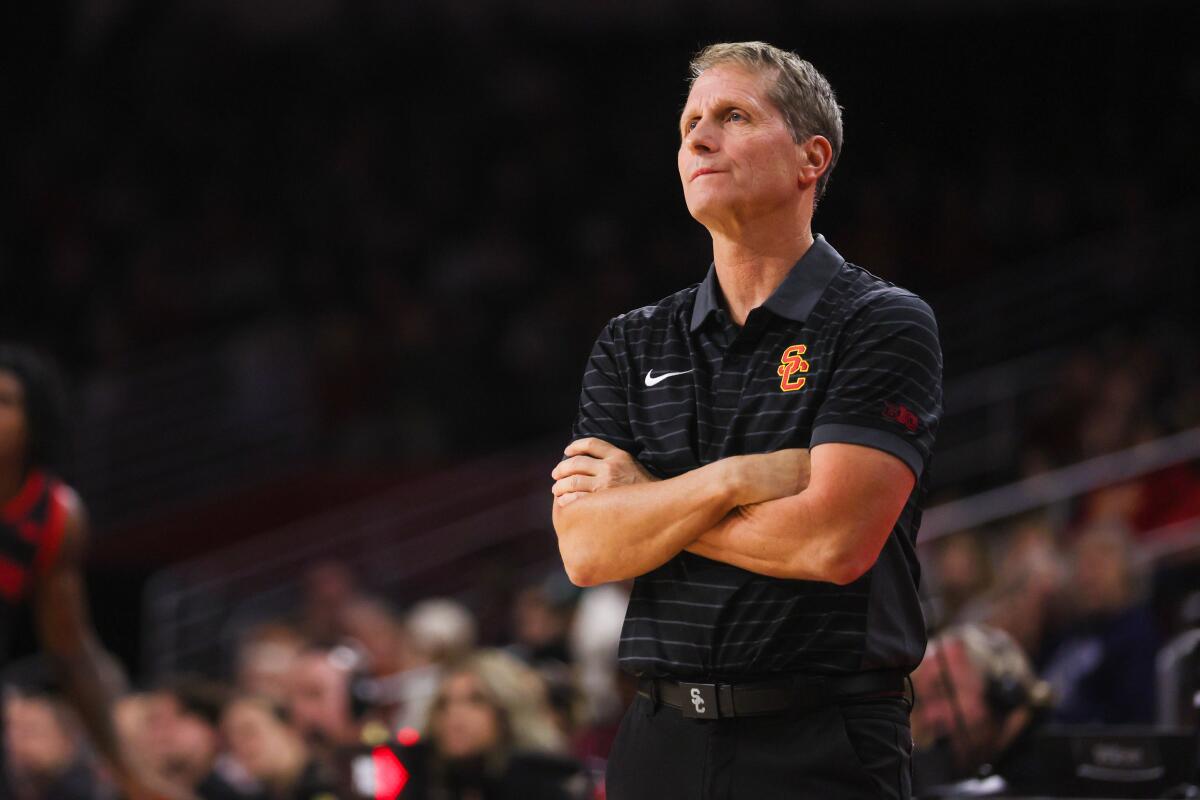
Two years into Eric Musselman’s tenure with the Trojans, the USC men have yet to return to the NCAA tournament. This season, they totally unraveled, losing their last eight games to finish 18-14.
I’ve heard varying feelings from fans about the nascent Musselman era. So let’s make the conversation a bit more scientific with a poll:
What’s your confidence level in Eric Musselman as USC’s men’s basketball coach after two seasons? (with 1 being “Let me off the Muss Bus” to 5 being “I’m still riding shotgun on the Muss Bus”
—Five-star St. John Bosco forward Christian Collins committed to USC. The No. 9 overall forward, per 247 Sports, Collins is the highest-rated player to join USC under Musselman and the highest-rated player Musselman has signed since 2022. Collins has all the tools to be a force on both ends, if he can put it all together. But he’s not necessarily the type right now to be the center of a team’s offensive attack. Expect him to get off to a slow start when he does arrive this summer.
—USC hoops assistant Todd Lee is finalizing a deal to become Cal State Bakersfield’s coach, a source says. Lee has been one of Musselman’s most trusted assistants since they first worked together with the Rapid City Thrillers of the CBA back in the early 90’s. Musselman hired Lee to join his Arkansas staff, then brought him along to USC. Now he heads to Bakersfield, where he inherits a program that’s been through a lot this last year.
—Matt Leinart won’t unretire his jersey. Good for him. Leinart’s podcast went viral last week, when he noted that USC asked him on multiple occasions if an incoming transfer or freshman could wear his No. 11 jersey. It’s his prerogative if he wants to allow that. But I completely understand why he wouldn’t. Why bother retiring jerseys at all if it doesn’t actually mean anything?
—Mason Edwards’ dominance on the mound continues. The Trojan ace struck out 12 in his most recent start against Washington and gave up just one hit. Through 36 innings, Edwards now has given up just one run and seven hits. His fellow starter, Grant Govel, has been no slouch either. Govel leads the nation in wins (6) and, after a two-run outing, now has an ERA of 0.69 and he hasn’t been the best starting pitcher on his team. Wild.
Olympic sports spotlight
It has been a tough few weeks for USC women’s lacrosse. Through their most difficult stretch of the season, the Trojans have lost four straight, all to ranked teams, by a margin of 67-31. That’s the first time in program history that USC has had a losing streak that long.
That’s a concern when you consider that USC lost five out of seven to finish out last season, too. The Trojans gave up 20 goals in a game for just the first ever against Johns Hopkins last week and were trounced by Maryland in the follow-up.
With one more loss, USC would match its loss total from 2025 … with five games still remaining.
What I’m watching this week
PJ and Anthony in “Jury Duty.”
(Courtesy of Prime)
When it premiered in 2023, “Jury Duty” was one of the most surprising and unique shows I could remember airing on TV. The first season followed Ronald, an unsuspecting, totally normal guy who was called to jury duty. What he didn’t know is that everyone else involved was an actor. Hilarity ensued.
The second follows Anthony, another unsuspecting normal guy on a company retreat for his new temp job.
I figured it was impossible to make a second season, what with everyone’s familiarity with the first go-round. But somehow Amazon has managed to make this work for another season. And that’s a hell of an accomplishment in itself.
That concludes today’s newsletter. If you have any feedback, ideas for improvement or things you’d like to see, email me at ryan.kartje@latimes.com, and follow me on X at @Ryan_Kartje. To get this newsletter in your inbox, click here.
COLUMBIA, S.C. — When you look at the USC Trojans, one might think they’re setting the table for next year.
Buying time until JuJu Watkins returns. Keeping the ship afloat until the talented recruiting class that includes Saniyah Hall makes its way to campus.
But the Trojans showed Saturday that’s not the case. They’re making a plate and eating now.
The No. 9 seed Trojans gutted out a 71-67 overtime win over No. 8 seed Clemson in what USC coach Lindsay Gottlieb described as “a culture win.”
That game featured many tests for a young team in March and the Trojans responded well to the challenges. They are advancing on the back of freshman Jazzy Davidson’s 31 points and senior Kara Dunn’s 22.
Davidson, who appeared to be on the verge of tears as the referees reviewed the final play of regulation to determine whether she had committed a foul that would have set Clemson up for game-winning free throws, said on Sunday there’s a standard that this year’s Trojans feel they are responsible for meeting.
“I think our expectations, you know nobody wanted to lose JuJu, we all love her, but we have to keep going as you said and just holding that same expectation that they had last season. Just the program standard,” Davidson said. “And just resiliency and making sure that we’re doing our best every game.”
Dunn said the deck has been stacked against the Trojans all season and it’s forced them to grow stronger as a unit.
USC guard Kara Dunn drives to the basket in front of Clemson guard Taylor Johnson-Matthews during the first round of the NCAA tournament on Saturday in Columbia, S.C.
(Nell Redmond / Associated Press)
“I think this year has just been about focusing on going against all odds,” Dunn said. “A lot of people didn’t expect much from this team and they might have turned away at certain times when we had lower moments this season and I think that it built our own culture for this season specifically. I feel like we had to come together, we had to support each other when it didn’t feel like we had much support and I think that that’s been really important.”
She added that moving through the season with just the support of each other and their die-hard fans works in their favor as they prepare to take on powerhouse South Carolina on the Gamecocks’ formidable home floor.
“We have everything to gain, nothing to lose going into this game, so I feel like this has really helped us,” Dunn said.
The NCAA tournament game against the No. 1 seed on the Trojans’ side of the bracket will be a rematch of the unofficial “Battle of the Real USC” in November. The Gamecocks claimed a 69-52 win during that meeting.
USC guard Jazzy Davidson drives under pressure from Clemson guard Rachael Rose Saturday in Columbia, S.C.
(Nell Redmond / Associated Press)
Gottlieb said Sunday she scheduled that game to prepare her team for moments like Monday’s tough matchup.
“Maybe if we hadn’t played Notre Dame, UConn and South Carolina, maybe our record would be a little better coming in, but it doesn’t make you a better program,” she said. “Our goals remain the same; which is to win a national championship. So if you’re skipping those people in nonconference hoping to manipulate it, it doesn’t work that way. You have to see the best. You have to elevate your program to be the best, then ultimately, you have to beat the best to get to where you want to be.”
South Carolina is trying to avenge last season’s championship loss to UConn and secure its fourth national championship in program history and the third in five years. USC, meanwhile, is trying to match the Cheryl Miller era when she led the Trojans to back-to-back national titles in 1983 and 1984.
Trojan culture will be tested more than ever, but Dunn feels good about where the team is heading.
“Obviously that was the beginning of the season, now it’s towards the end and we’re two very different teams,” she said of the previous loss to South Carolina. “We’ve grown in a lot of ways, but we’re using that scout just to see what we did well and what we could’ve done better. We just want to make sure that we control those things first and then adjust.”
Davidson will have the chance to play in another legacy defining game during her second NCAA tournament appearance.
“I feel like I have nerves a little bit before every game, [Monday] especially because it’s a big game,” she said. “My teammates are always just making sure I’m calm and in the moment. The confidence that they instill in me every day really helps.”
Four Democrats running for governor called on their fellow candidates to boycott an upcoming debate at USC, reiterating concerns that the criteria used to determine who was invited to participate resulted in every prominent candidate of color being excluded from the forum.
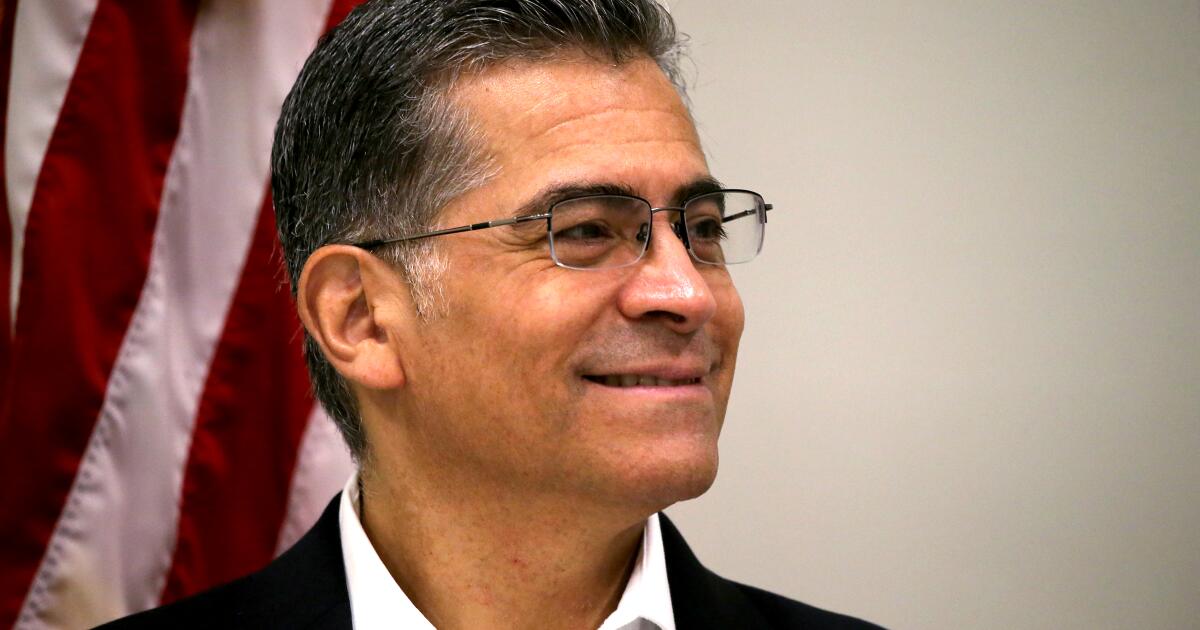
“We ask each and every candidate who is in this race to recognize that if we can’t have a fair process for a debate, then we should all not participate,” said Xavier Becerra, the former U.S. Health and Human Services secretary. “We call on them to withdraw from this biased forum.”
Becerra’s call was echoed by former Los Angeles Mayor Antonio Villaraigosa, state Supt. of Public Instruction Tony Thurmond and former state Controller Betty Yee during a Friday afternoon news conference.
The candidate’s request comes a week after some of them raised concerns about the criteria for Tuesday’s debate, arguing that it was engineered to allow the inclusion of San José Mayor Matt Mahan, who entered the race in late January and quickly raised millions of dollars from Silicon Valley executives.
“The rules initially were polling and money. Matt Mahan is [polling] lower than some of us, period,” Villaraigosa said, adding that the debate organizers “then added time in the race,” which resulted in Mahan’s invitation.
Mahan’s campaign did not respond to a request for comment on Friday, but when Becerra raised such concerns last week, Mahan said the former Biden administration official ought to be included in the debate.
The matter is further complicated by Mahan supporters who have notable ties to the university.
Mike Murphy, a co-director of the USC center hosting the debate, has been voluntarily advising an independent expenditure committee backing Mahan. The veteran GOP strategist said last week that he had nothing to do with organizing the debate and that he has asked for unpaid leave at the university through the June 2 primary if he takes a paid role in the campaign.
USC has also received tens of millions of dollars in donations from billionaire real estate developer Rick Caruso and his wife. Caruso, a USC alumnus who served as a trustee for years, is also a Mahan supporter.
A representative for Caruso did not respond to a request for comment.
The debate, hosted by the USC Dornsife Center for the Political Future, KABC-TV Los Angeles and Univision, is scheduled to take place on campus at 5 p.m. Tuesday — less than two months before ballots begin arriving in voters’ mailboxes. The forum will be streamed and broadcast on ABC and Univision affiliates across the state.
USC and the television stations put out a joint statement Friday morning, prior to the candidates’ news conference, justifying the criteria used to determine who was invited to participate and saying none of the debate partners had any influence on the methodology.
“We want to be clear that we categorically, unequivocally deny any allegations that the debate criteria was in any way biased in favor or against any candidate and want to clarify the facts,” they said in a statement, adding that Christian Grose, a USC political science professor, was asked to develop “data-driven” benchmarks to determine which candidates were invited.
“The methodology was based on well-established metrics consistent with formulas widely used to set debate participation nationwide — a combination of polling and fundraising — and developed without regard to any particular candidate.”
After the Democratic candidates called for their competitors to not participate, USC and KABC declined to comment further. Univision did not respond to a request for comment.
Grose defended the methodology he crafted as “objective” in an interview Friday, and said he met with Becerra as well as the staff of other candidates to explain it.
“The idea that it was biased or designed to create some sort of outcome to disfavor the candidates who spoke at the press conference is just not correct,” Grose said, adding that attacks on the methodology have a “chilling effect” on universities and media outlets who sponsor debates.
“I’m not worried about the optics,” he said. “The optics are we are having a debate at USC to inform voters and educate students.”
Jarred Cuellar, a political science assistant professor at Cal Poly Pomona, described Grose’s methodology as “thoughtful” and “empirically grounded,” and characterized the concerns raised by candidates not included in the debate as unfounded and not credible.
“The formula is methodologically sound and represents a clear improvement over how debate participation has often been determined,” he said. “Rather than relying on a single metric such as polling, it takes a multidimensional approach to evaluating candidate viability. That approach better reflects how political scientists measure complex phenomena like electoral competitiveness.”
But the controversy has caused consternation among USC professors past and present.
“It seems like an unforced error that is casting the entire event in a bad light,” said a current USC professor who closely follows politics but is not involved in the debate, and who asked for anonymity to speak candidly. “It’s super important that if the debate happens, it happens correctly.”
Darry Sragow, a veteran Democratic strategist who taught election and environmental law at USC for 19 years, said that while he believes the large field of Democratic candidates needs to be winnowed, that’s not the job of a university or media outlets.
“Every one of these eight [Democratic candidates] is capable of running the state of California,” he said. “ It would certainly be my advice to USC and to Univision and to ABC to allow all the candidates to take part, or to cancel the debate.”
The four Democratic candidates not invited to the debate argued that voters are just starting to pay attention to the thus-far sleepy race and that diverse candidates should be represented.
“We are a minority-majority state, and the idea that the four candidates of color are not going to be on the stage to bring those perspectives, to really speak to those communities, is really not doing right by the voters,” Yee said.
Becerra said some of the candidates had requested to speak with top university leadership, including President Beong-Soo Kim. In other conversations, he said university officials raised the possibility of “either canceling this debate or incorporating more of the candidates in it. Evidently they could not agree to do that. … I think they recognize that there were problems with the way this debate had been organized.”
Becerra said he reviewed the formula and has “never seen” debate criteria like it before during his decades of serving in elected office.
“Your fundraising numbers are divided by the number of days you’ve been out there campaigning in front of voters,” he said. “So you could have raised millions of dollars, but if you’ve been in longer than someone else who just raised millions of dollars very quickly, you get penalized.”
Campaigns for the invited candidates — Democrats Rep. Eric Swalwell of Dublin, former Orange County Rep. Katie Porter, climate activist Tom Steyer and Mahan; as well as Republicans Chad Bianco, the sheriff of Riverside County, and former Fox News host Steve Hilton — did not respond to requests for comment on the call to boycott the debate.
USC has settled a lawsuit with a former high-ranking athletic department official who alleged the university allowed former athletic director Mike Bohn to racially harass and discriminate against her, then fired her when she voiced concerns about Bohn’s behavior.
Joyce Bell Limbrick was the highest-ranking Black and female official in USC’s athletic department when she was fired by the university in September 2023, four months after Bohn resigned amid an internal investigation into his conduct and the culture of the department. Bell Limbrick filed suit early last year, accusing USC of wrongful termination.
That dispute was settled out of court this week. Terms of the settlement were not disclosed.
When reached by The Times, Bell Limbrick declined to comment. Bohn has never publicly addressed the allegations.
While the lawsuit never made it to trial, it nonetheless offered the most detailed account yet of the conduct that led to Bohn’s resignation.
Bell Limbrick filed a Title IX complaint with the university against Bohn in October 2022, after an incident in which she says Bohn punched her on the arm at a USC volleyball match. That complaint ultimately compelled an investigation, during which, according to her complaint, Bell Limbrick told USC officials of “Bohn’s history and rumors of inappropriate and unwanted touching involving … other females at both Cincinnati and USC.”
The university hired an outside law firm that specializes in institutional responses to racial and sexual harassment and discrimination to investigate Bohn five months later. The Times learned of that investigation shortly thereafter, as well as a previous investigation into Bohn’s conduct at Cincinnati, and in May, asked both Bohn and USC about those concerns.
Bohn resigned a day later.
Soon after that, the university fired Bell Limbrick, citing “a pattern of poor performance.” She was the only member of an 11-member executive team to lose her job and, according to the complaint, had just been awarded a “merit increase” on account of her “overall job performance.”
Bell Limbrick worked at USC for nine years, initially as the director of athletic compliance, before Bohn was hired in 2019. Shortly after he became athletic director, Bohn promoted Bell Limbrick to senior woman administrator, one of the highest-ranking positions in the department. According to her complaint, she had been one of the few Black women to hold such a position at a major American university.
“Ms. Bell Limbrick had a thriving career at USC and she loved her work. Then, Mike Bohn arrived,” her attorney, J. Bernard Alexander, said in a statement in 2025.
”[Bohn’s] incessant, racially charged remarks made Joyce feel uncomfortable and undervalued, but more than that — he actively isolated her from the executive team and undermined her work. She already was vulnerable as the only Black woman on the team, and rather than support her, the university allowed Bohn to make her life hell.”
Her complaint detailed inappropriate comments made in front of USC donors and staff, as well as insensitive or discriminatory remarks made in her presence. At the time, The Times spoke with six people with knowledge of the department’s inner workings who largely corroborated her claims about Bohn’s conduct.
Bohn declined to respond to The Times’ questions about his conduct leading the athletic department, but he provided a statement to The Times on the day of his resignation in May 2023 stating he would “always be proud of leading the program out of the most tumultuous times in the history of the profession.”
“In moving on, it is important now that I focus on being present with my treasured family, addressing ongoing health challenges, and reflecting on how I can be impactful in the future,” Bohn said in the statement.
Former U.S. Health and Human Services Secretary Xavier Becerra, one of the top Democrats running for California governor, on Friday blasted USC and the ABC affiliate in Los Angeles for hosting a debate that he argues purposely excludes all candidates of color.
Becerra said he and the other candidates were excluded from the televised debate unfairly, a decision that he said “smells of election rigging” in a hotly contested race less than three months before the June primary.
“My father used to tell me of the days when he would encounter signs posted outside establishments that read ‘No Dogs, Negroes or Mexicans Allowed,’” Becerra wrote in a public letter to USC President Beong-Soo Kim. “USC’s actions may not seem so transparent. But, you have deliberately chosen to selectively filter the voters’ view of the field of gubernatorial candidates in what all observers characterize as a wide-open race.”
The university said in a statement that it authorized a political expert to create the formula to determine who would be included in the debate.
“At the request of the Center for the Political Future, Dr. Christian Grose, Professor of Political Science and International Relations, independently established the methodology that determined eligibility for the debate,” according to a statement from the center. “No one in the USC administration had any role in developing, reviewing or approving those criteria.”
The center later said in a statement on Friday that it reiterated the criteria that determined which candidates were invited to participate in the debate, and that nothing had changed since the forum was first planned.
The criteria for gubernatorial candidates to participate considered opinion polling and campaign fund raising. Six candidates were asked to participate in the March 24 debate, which is cosponsored by ABC7 Los Angeles and Univision.
There was conflicting information about USC’s stated criteria, however. The methodology says that the fundraising totals considered were based on semi-annual reports campaigns filed with the California Secretary of State’s office. However, the document later says that the fundraising figures also includes large donations that campaigns are required to immediately report.
This is a critical difference, because San José Mayor Matt Mahan did not enter the race until late January, and thus far has not been required to file any semi-annual fundraising disclosures with the state. However, he has received significant donations since he entered the race.
Mahan agreed with Becerra, saying that he ought to be part of public forums about who will lead the state.
“The former Secretary is absolutely correct, he should be included in the debate,” Mahan said in a statement. “His long record of service to California has earned him a place on every debate stage in this campaign for Governor.”
USC officials said they are clarifying how they selected candidates to participate in the race.
“We are reissuing the criteria to make clear that they include current fundraising totals, including semi-annual and late reports, which were always part of the formula,” the Center for the Political Future said in a statement. “We are not changing the criteria. We have updated even as of today and the rank order includes the same top 6 candidates.”
Grose said that the selection of candidates was based upon polling and fundraising numbers, and that the sentence about semi-annual fundraising reports was inaccurate.
“It was just a wording issue. It’s not a methodology issue,” he said.
Six candidates are scheduled to appear at the debate: Republicans Riverside County Sheriff Chad Bianco and conservative commentator Steve Hilton; and Democrats Northern California Rep. Eric Swalwell, former Orange County Rep. Katie Porter, billionaire hedge-fund founder Tom Steyer and Mahan.
The kerfuffle occurs after Democratic candidates of color accused state party leaders of trying to oust them from the race in favor of white candidates, who have more support in opinion polls.
In addition to Becerra, other prominent Democratic candidates excluded from the debate include former state Controller Betty Yee, state Supt. of Public Instruction Tony Thurmond and former Los Angeles Mayor Antonio Villaraigosa, who also condemned the candidate-selection formula.
“Californians deserve a fair process, and voters deserve to hear from all qualified voices,” Villaraigosa, who taught public policy at USC for three years after leaving office, said in a statement. “But this biased and bigoted action by USC to manipulate the data to exclude every qualified Black, Latino, and API candidate in favor of a less qualified white candidate is shameful.”
Becerra said USC went to great lengths to justify the candidates that were excluded, but the bias was clear.
“You can’t escape the detestable outcome: you disqualified all of the candidates of color from participating while you invited a white candidate who has NEVER polled higher than some of the candidates of color, including me,” he said.
Becerra was clearly referring to Mahan, who recently entered the race and has received millions of dollars of support from Silicon Valley leaders. Becerra noted that veteran GOP strategist Mike Murphy, co-director of the USC Center for the Political Future, which is a sponsor of the debate, is assisting an independent expenditure committee backing Mahan.
Murphy said he had recused himself from anything involved in the debate, and that he was a volunteer for the outside group backing Mahan. If he becomes a paid advisor to the independent expenditure committee, he said he has requested unpaid leave from the university through the June 2 primary.
“I’ve been transparent that I’m personally a Mahan supporter,” Murphy said. “I’ve had zero to do with the debate.”
CHICAGO — The eventual end of the USC men’s basketball season came the same way that it fizzled out during the past month, with yet another second-half collapse that featured the added pain of overtime.
The Trojans led the Huskies by 13 in the second half and had chances to win at the end of regulation and overtime, only to miss all three potential game-winning or game-tying shots and go 2-for-5 from the free-throw line in overtime. For a team that was once in NCAA tournament consideration before stumbling, that failure to finish was a persistent flaw.
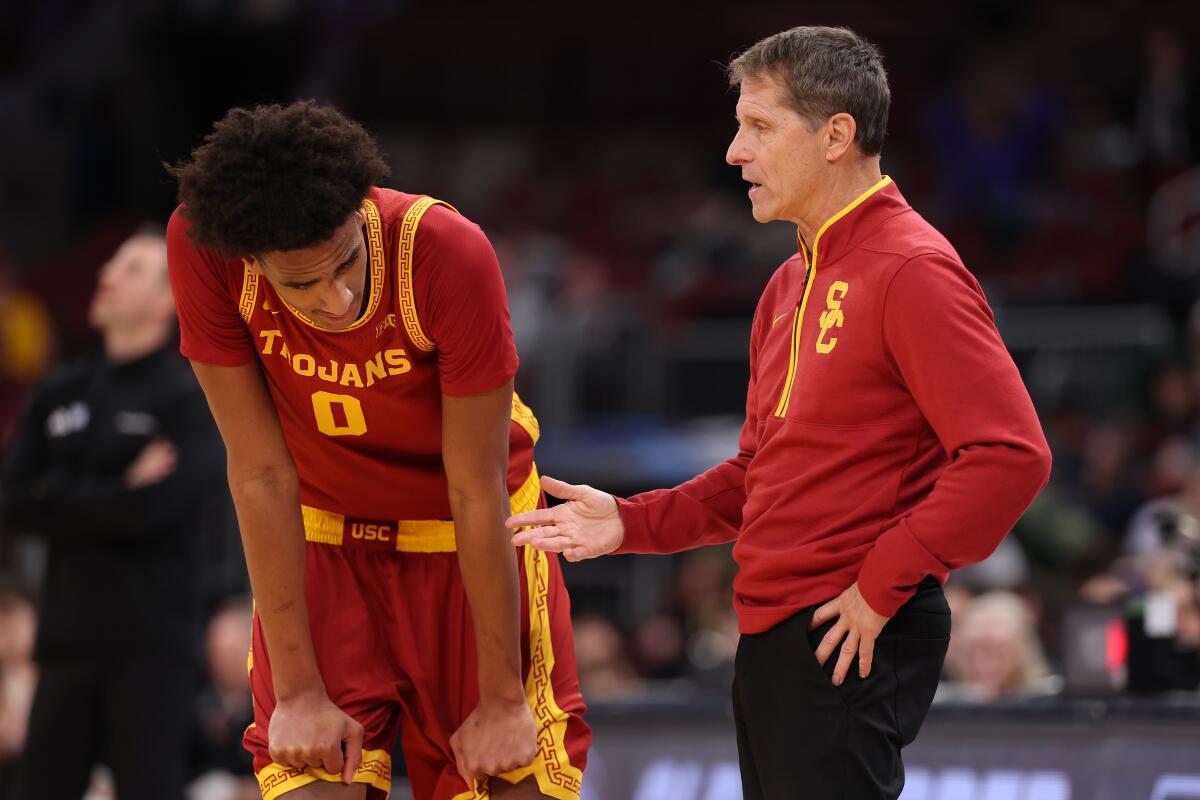
USC guard Alijah Arenas talks with coach Eric Musselman during the Trojans’ loss to the Huskies in the Big Ten tournament on Wednesday in Chicago.
(Michael Reaves / Getty Images)
“That’s been the story of our last eight games,” Musselman said. “I think we’ve led at halftime four of our last eight games, and as a group, we haven’t figured out how to close games, the last 20 minutes with a lead. It’s a disappointing last eight games of the season. I thought up until that point we played good basketball.”
With the Trojans likely to decline any postseason invitation, Musselman said, he was headed to the team hotel Tuesday night to get back to work filling out next season’s recruiting class, starting with more freshmen before the transfer portal officially opens next month.
That group already includes two top-30 recruits in the Ratliff twins, Adonis and Darius, but if USC learned anything from the way this season ended, all too similar to the way last season ended, it’s that whatever depth and talent Musselman has assembled in his two years at USC hasn’t been enough, whether that’s freshmen or transfers.
“We want a blend of both,” Musselman said. “It’s early in our tenure, and we’ve got to figure out a way to get better than what we’ve done the last two years.”
Tuesday, the Trojans had no shortage of chances to fend off the end.
They had a double-digit lead with 13 minutes to play. They had the ball at the end of regulation with the score tied. They had a chance to win it in overtime and were gifted a last-chance shot to tie it.
They missed all three pivotal shots — the first two by Kam Woods, the last a 3-pointer by Jordan Marsh — to see a game they once led comfortably slip away again and again.
“On the last one, I feel like I missed Ezra [Ausar] on that cut,” said Woods, a grad transfer who joined the team in midseason. “Coach trusted me with the ball in my hands, and I feel like I let him down.”
Woods finished with 24 points while Jacob Cofie scored 14, Marsh 13 and Ausar and Ryan Cornish 10 each for 13th-seeded USC (18-14) as the 12th-seeded Huskies (16-16) beat the Trojans for the third time this season.
Freshman Alijah Arenas, who led the Trojans in scoring in both games without Baker-Mazara, was held to six points on 3-for-10 shooting and sat out the final six minutes of regulation and all but eight seconds of overtime. Musselman said that was his decision, as was the virtual absence of senior Terrance Williams, who played only one minute.
That left USC with what was essentially a six-player rotation to conclude a season that began without the injured Arenas and ended without Rodney Rice and Amarion Dickerson, both hurt, as well as the departed Baker-Mazara — all of which factored into Musselman’s position on any postseason plans.
“I haven’t had in-depth conversations with the administration yet about that, but I would assume we’re not going to play, just based on the number of bodies and how we played the last eight games,” Musselman said.
It was not all that long ago that USC was thinking about the NCAA tournament. Winners of the Maui Invitational, USC was 18-6 and above .500 in the Big Ten standings after a February 8 win at Penn State, solidly in a workable position on the NCAA tournament bubble.
But as the injuries mounted and momentum waned, second-half struggles just like the Trojans’ on Tuesday became an increasingly fatal flaw as they slumped to their longest losing streak in a decade. The loss to Washington compounded the misery of a second straight frustrating season, in familiar fashion.
“As a team, we faced a lot of adversity,” Cofie said. “I felt like we did a good job sticking with it and trying to play for each other. We had to deal with a lot of injuries. I felt like that played a huge deal in it. We still fought. We tried our best.”