US-Venezuela Tensions

Trump says no more Venezuelan oil or money to go to Cuba, demands ‘deal’ | Donald Trump News

United States President Donald Trump says no more Venezuelan oil or money will go to Cuba, and he has suggested the communist-run island should strike a deal with Washington, ramping up pressure on the longtime US nemesis.

Venezuela is Cuba’s biggest oil supplier, but no cargo has departed from Venezuelan ports to the Caribbean country since the abduction of Venezuelan President Nicolas Maduro by US forces on January 3 amid a strict US oil blockade on the OPEC country, according to the latest shipping data.

Recommended Stories

list of 3 itemsend of list

“THERE WILL BE NO MORE OIL OR MONEY GOING TO CUBA – ZERO! I strongly suggest they make a deal, BEFORE IT IS TOO LATE,” Trump wrote on his Truth Social platform on Sunday.

“Cuba lived, for many years, on large amounts of OIL and MONEY from Venezuela,” Trump added.

Trump did not elaborate on his suggested deal, but US officials have hardened their rhetoric against Cuba in recent weeks.

Earlier on Sunday, Trump also reposted a message on Truth Social suggesting US Secretary of State Marco Rubio could become the president of communist-ruled Cuba.

Trump shared that post with the comment: “Sounds good to me!”


Cuban President Miguel Diaz-Canel rejected Trump’s threats in a post on X.

“Cuba is a free, independent, and sovereign nation. Nobody dictates what we do,” Diaz-Canel said.

“Cuba does not attack; it has been attacked by the US for 66 years, and it does not threaten; it prepares, ready to defend the homeland to the last drop of blood.”

Earlier, Cuban Foreign Minister Bruno Rodriguez insisted “right and justice are on Cuba’s side”.

The US “behaves like an out-of-control criminal hegemon that threatens peace and security, not only in Cuba and this hemisphere, but throughout the entire world”, Rodriguez posted on X.

Rodriguez also said in a separate post on X that Cuba had the right to import fuel from any suppliers willing to export it. He also denied that Cuba had received financial or other “material” compensation in return for security services provided to any country.

Reporting from Cucuta, Colombia, Al Jazeera’s Alessandro Rampietti said that, despite its defiant rhetoric, Cuba may struggle to find alternative sources of fuel.

“Cuba is going through a very, very difficult situation with rolling blackouts, fuel shortages on a daily basis,” he said.

He added that an oil embargo from the US could worsen and could pressurise Havana to reach a deal with Washington.

Under a US trade embargo, Havana since 2000 has increasingly relied on Venezuelan oil provided as part of a deal struck with Maduro’s predecessor Hugo Chavez.

As its operational refining capacity dwindled in recent years, Venezuela’s supply of crude and fuel to Cuba has fallen. But the South American country is still the largest provider with about 26,500 barrels per day exported last year, according to ship-tracking data and internal documents of Venezuela’s state-run oil company, PDVSA. Venezuela’s shipments covered roughly 50 percent of Cuba’s oil deficit.

Cuba also relies on imported crude and fuel provided by Mexico in smaller volumes.

Mexican President Claudia Sheinbaum last week said her country had not increased supply volumes but, given recent political events in Venezuela, Mexico had turned into an “important supplier” of crude to Cuba.

Meanwhile, amid Trump’s threats to Cuba, Al Jazeera’s Patty Culhane said Americans generally want Trump to focus on the domestic economy.

“There is an affordability crisis in this country, groceries are expensive, housing is expensive, health insurance has gone up,” she said, reporting from Washington, DC.

“This is a president who has said he will focus on America First. We have now seen him bomb seven countries, … so within [Trump’s] base, they are starting to see cracks because this is not what he promised on his campaign trail,” she added.

Source link

Colombia’s Petro on US threats and whether he fears Maduro’s fate | US-Venezuela Tensions

Colombia’s president responds to US pressure and what it means for sovereignty and stability in Latin America.

Since the United States abducted Venezuelan President Nicolas Maduro, accusing him of “narcoterrorism”, Colombia has found itself under growing pressure from Washington. President Gustavo Petro responds to President Donald Trump’s accusations. The Colombian leader also addresses diplomacy vs confrontation, regional sovereignty and whether Latin America is entering a dangerous new chapter.

Source link

Trump says he doesn’t need international law amid aggressive US policies | Donald Trump News

United States President Donald Trump has dismissed international law, saying only his “own morality” can curb the aggressive policies he is pursuing across the world after the abduction of Venezuela’s Nicolas Maduro.

“I don’t need international law. I’m not looking to hurt people,” Trump told The New York Times on Thursday.

Recommended Stories

list of 3 itemsend of list

Asked whether he needs to abide by international law, Trump said he does, but it “depends what your definition of international law is”.

Trump has shown a willingness to use the brute force of the US military to achieve his foreign policy goals.

On Saturday, the US launched an early-morning attack on Venezuela, with explosions reported across the capital Caracas and at Venezuelan military bases.

US troops ultimately abducted Venezuelan President Maduro from Caracas in what critics say was a clear violation of the United Nations Charter, which prohibits “the threat or use of force against the territorial integrity or political independence of any state”.

The attack on Venezuela appears to have supercharged the belligerence of the US president, who received the inaugural FIFA Peace Prize Award last month.

In the immediate aftermath of the attack, Trump said the US would “run” Venezuela and exploit the country’s vast oil reserves, though his administration has said it would cooperate with interim President Delcy Rodriguez.

Still, the Trump administration said it would “dictate” policy to the interim government and repeatedly threatened a “second wave” of military actions if US demands were disobeyed.

“If she doesn’t do what’s right, she is going to pay a very big price, probably bigger than Maduro,” Trump said of Rodriguez in a Sunday interview with The Atlantic.

Earlier this week, Trump also suggested that the US may carry out a strike against Colombia’s left-wing President Gustavo Petro, and he has escalated his campaign to acquire the Danish territory of Greenland.

In June, Trump joined Israel’s unprovoked war against Iran, ordering the bombing of the country’s three main nuclear sites.

Trump aide Stephen Miller has criticised the post-World War II international order, saying that, from here forward, the US would “unapologetically” use its military force to secure its interests in the Western Hemisphere.

“We’re a superpower, and under President Trump, we are going to conduct ourselves as a superpower,” Miller told CNN on Monday.

But experts warn that disregard for international law could have catastrophic consequences for the entire global community, including the US.

International law is the set of rules and norms that govern ties between states. It includes UN conventions and multilateral treaties.

Margaret Satterthwaite, the UN special rapporteur on the independence of judges and lawyers, told Al Jazeera earlier this week that US statements dismissing international law are “extremely dangerous”.

Satterthwaite said she is concerned the world may be returning to an “age of imperialism”, stressing that degrading international laws may embolden Washington’s adversaries to launch their own acts of aggression.

“International law cannot stop states from doing terrible things if they’re committed to doing them,” Satterthwaite told Al Jazeera.

“And I think that the world is aware of all of the atrocities that have happened in Gaza recently, and despite efforts by many states and certainly by the UN to stop those atrocities, they continued. But I think we’re worse off if we don’t insist on the international law that does exist. We’ll simply be going down a much worse kind of slippery slope.”

Yusra Suedi, an assistant professor of international law at the University of Manchester, warned against the belief that “might is right” and the trend towards disregarding international law.

“It signals something very dangerous, in that it gives permission to other states to essentially follow suit – states such as China, who might be eyeing Taiwan, or Russia with respect to Ukraine,” Suedi told Al Jazeera.

Ian Hurd, a professor of political science at Northwestern University, said history illustrates the perils of US policies in Latin America.

The region has witnessed more than a century of US invasions and US-supported military coups, leading to instability, repression and human rights abuses.

“There are innumerable examples historically of this, from Panama to Haiti to Nicaragua to Chile in the ’70s and on and on,” Hurd told Al Jazeera.

He added that Trump’s policies in Venezuela are “in line” with how the US has previously attempted to decide how other parts of the Americas are governed.

“You can see that in every one of those cases, the US came to regret its choice to intervene. These never work well.”

Source link

US says it wants to control Venezuelan oil indefinitely. Can it? | Oil and Gas News

The United States government has said it aims to control Venezuelan oil sales indefinitely.

“We need to have that leverage and that control of those oil sales to drive the changes that simply must happen in Venezuela,” Energy Secretary Chris Wright said on Wednesday.

Recommended Stories

list of 4 itemsend of list

His comments come days after US forces abducted Venezuelan leader Nicolas Maduro on Saturday. Since then, the administration of US President Donald Trump has announced a deal under which Venezuela would turn over 30 million to 50 million barrels of sanctioned oil to the US to sell.

That comes against a backdrop of demands that Venezuelan government officials open up access to US oil companies or risk further military action.

On Friday, executives from several major oil companies, including ExxonMobil, ConocoPhillips, and Chevron, are slated to meet with the president to discuss potential investments in Venezuela.

Can the US control Venezuelan oil sales indefinitely?

“The US federal government can absolutely intervene, make demands, capture what it wants, and redirect those barrels accordingly. I don’t know of anything that would meaningfully interfere with the federal government if that’s what it decided to do,” Jeff Krimmel, founder of Krimmel Strategy Group, a Houston, Texas-based energy consulting firm, told Al Jazeera.

There are, however, geopolitical hurdles. The US has less leverage than it did more than two decades ago when the US military and its allies entered Iraq, another oil-rich country. Today, other superpowers could stand in the way in ways they did not in 2003.

“When we went into Iraq, we were living in a unipolar moment as the world’s only great power. That era is over. China is now a great power, and most experts consider it a peer competitor. That means it has ways to hurt the US economy and to push back militarily, including through proxy conflicts, if it chooses to oppose such actions,” Anthony Orlando, professor of finance and law at California State Polytechnic University, Pomona, told Al Jazeera.

China is the largest purchaser of Venezuelan crude, although it only imports about 4 percent of its oil from the South American nation.

“It’s a question of whether they want to draw a line in the sand with the United States and say, ‘You can’t do this, because if we allow it, you’ll keep pushing further,’” Orlando said.

“If you’re a minor power like Venezuela, not China or Russia, you’re a country vulnerable to US intervention. That creates an incentive to align more closely with China or Russia to prevent it from happening, and that’s not a good outcome for the United States,” Orlando continued.

In the days since Maduro’s abduction, members of the Trump administration have also renewed calls to take over Greenland.

How does this compare with Iraq?

The US intervention in Venezuela has been compared to its involvement in Iraq, which began under the administration of former President George W Bush in 2003. At the time, Iraq had the second-largest oil reserves in the world, with 112 billion barrels.

However, production was limited. Prior to the invasion, Iraq produced 1.5 million barrels per day (bpd), rising to 4.5 million bpd by 2018.

While the Iraqi government retained ownership of oil, US companies were often given no-bid contracts to operate there, including ExxonMobil and BP, and the majority of sales went to Asian and European markets.

In 2021, Iraq’s then-President Barham Salih claimed that an estimated $150bn in money stolen through corrupt deals had been “smuggled out of Iraq” since the 2003 US-led invasion.

Unlike during the Bush administration and its aims for Iraq’s oil, the Trump administration has been explicit about the role of oil in its attack on Venezuela.

“The difference between Iraq and this is that [Bush] didn’t keep the oil. We’re going to keep the oil,” Trump said in a conversation with MS Now anchor Joe Scarborough.

Comparatively, in 2002, prior to the US invasion, then-Secretary of Defense Donald Rumsfeld asserted that the operation to take control of post-war reconstruction had “literally nothing to do with oil”.

“When the Bush administration went into Iraq, they claimed it wasn’t about that, even though there was substantial evidence it was a factor. This time it’s more explicit, so it’s clear it will impact oil markets. [But] one lesson from the Iraq war is that it’s easier said than done,” Orlando, the professor, told Al Jazeera.

Will this benefit oil companies?

Analysts argue that investments in Venezuela might not actually benefit oil companies due to rising economic uncertainty, the need for major infrastructure improvements, and the fact that large companies like ExxonMobil and Chevron already have capital programmes planned for the remainder of the decade.

“Either [the companies] will have to take on more debt or issue more equity to raise the capital needed, or they’ll have to divert capital expenditures from other regions into Venezuela. In either scenario, I expect substantial shareholder pushback,” Krimmel, the energy consultant, said.

Increased production will also require infrastructure improvements. Venezuelan oil is dense, which makes it more difficult and expensive to extract compared to oil from Iraq or the US.

Venezuelan oil is often blended with lighter grades from the US. It is comparable in density to Canadian oil, which, despite tensions between Ottawa and Washington, comes from a US ally with more modern extraction infrastructure.

“I don’t think Canada’s going to be too happy about all this,” Orlando said.

However, Chevron, the only US company currently operating in Venezuela, is seeking authorisation from Washington to expand its licence to operate in the country after the US placed restrictions on it last year, the Reuters news agency reported on Thursday, citing unnamed sources.

The US role in energy, particularly oil and gas, has surged in recent years amid the rise of fracking technology. The US is now the largest producer of oil in the world. But recent cuts to alternative energy programmes and increasing energy demands from the artificial intelligence industry have led Republicans to double down on expanding the oil and gas sector.

“There is an oil supply surplus. Even if we were in a supply deficit right now, military action in Venezuela wouldn’t unlock incremental barrels quickly. So even if you were trying to solve a short-term supply deficit, which, to be clear, we do not have, Venezuela wouldn’t be an answer because it would take too long and be too expensive to ramp production up,” Krimmel added.

While Venezuela holds the world’s largest oil reserves, the OPEC member represents only 1 percent of global oil output.

Currently, Chevron is the only US company operating in Venezuela. ExxonMobil and ConocoPhillips operated in Venezuela before Hugo Chavez nationalised the oil sector in 2007, leading to a downturn in production over years of disinvestment and poorly run facilities. In the 1990s, Venezuela produced as much as 3.5 million bpd. That has since fallen due to limited investment, with production averaging 1.1 million bpd last year.

“Venezuela’s infrastructure has deteriorated under both the Chavez and Maduro regimes. While they are extracting oil, returning to production levels from 10 or 20 years ago would require significant investment,” Orlando said.

Source link

Brazil to send national guard near border with Venezuela | US-Venezuela Tensions News

Tensions rise as Brazil reinforces its northern border following US air strikes in Venezuela and the abduction of its President Nicolas Maduro.

Sao Paulo, Brazil – Brazil plans to send national guard troops to northern Roraima state, which borders Venezuela and has a strong presence of illegal armed groups who traffic drugs and mine illegally on both sides of the international boundary, according to a government decree.

In an official decree published on Thursday, the government authorised an unspecified number of National Public Security Force (FNSP) troops to be sent to Pacaraima, as well as Roraima’s capital, Boa Vista, about 213km (132 miles) from the border.

Recommended Stories

list of 3 itemsend of list

The move comes after the US on Saturday bombed Venezuela and abducted its president, Nicolas Maduro. On Sunday, Brazil temporarily closed its border with Venezuela near Pacaraima.

The decree said the FNSP will support the state’s public security agencies and operate in ways “essential to the preservation of public order and the safety of people and property”.

Brazilian media reported on Wednesday that Venezuela was reinforcing its military presence on the border, and multiple armed groups, including Venezuelan colectivos and Brazilian gangs like the First Capital Command (PCC) and the Red Command (CV), operate in the area.

Gimena Sanchez, Andes director for the Washington Office on Latin America (WOLA), told Al Jazeera that Brazil’s deployment of guard troops to the border is an “appropriate move”. She said that violence caused by Colombian rebel groups active in Venezuela is pushing the population further south towards Brazil.

She added it “makes sense [for Brazil] to reinforce the border”, but noted there still has notbeen a mass displacement of Venezuelans.

Brazil has been a fierce critic of the US attacks. On the social media platform X, its president, Luiz Inacio Lula da Silva, said the US had crossed an “unacceptable line”.

Asked whether President Lula’s comments could provoke Washington, Sanchez said that the US is more concerned with Cuba, Mexico and Colombia at the moment. “Given that context and also that some European countries as well condemned it, I don’t think Brazil is at risk of being the focus of ire of the Trump administration,” she concluded.

Source link

Trump says he wants to free up Venezuelan oil flow. What was blocking it? | US-Venezuela Tensions News

United States President Donald Trump and Secretary of State Marco Rubio say they want to free up the flow of Venezuelan oil to benefit Venezuelans after US forces abducted President Nicolas Maduro from Caracas.

“We’re going to rebuild the oil infrastructure, which requires billions of dollars that will be paid for by the oil companies directly,” Trump said at a media briefing at his Mar-a-Lago estate in Florida hours after Maduro was seized on Saturday. “They will be reimbursed for what they’re doing, but it’s going to be paid, and we’re going to get the oil flowing.”

Then, on Tuesday, the US president said he wanted to use proceeds from the sale of Venezuelan oil “to benefit the people of Venezuela and the United States”. Rubio has echoed Trump in his comments in recent days.

But what has been holding back the flow of Venezuelan oil, preventing the country from attracting investments and driving the country into poverty?

A key reason is one that Trump and Rubio have been silent about: Washington’s own efforts to strangle Venezuela’s oil industry and economy through sanctions, which also have set off a refugee crisis.

What has Trump said about Venezuelan oil?

In a post on his Truth Social platform on Tuesday night, Trump said Venezuela will turn over 30 million to 50 million barrels of sanctioned oil to the US.

Trump wrote: “This Oil will be sold at its Market Price, and that money will be controlled by me, as President of the United States of America, to ensure it is used to benefit the people of Venezuela and the United States!”

Trump added that he had directed his energy secretary, Chris Wright, to execute the plan “immediately”.

“It will be taken by storage ships, and brought directly to unloading docks in the United States,” Trump wrote.

During the news conference on Saturday, Trump said US oil companies would fix Venezuela’s “broken infrastructure” and “start making money for the country”.

Earlier Trump had accused Venezuela in a Truth Social post of “stealing” US oil, land and other assets and using that oil to fund crime, “terrorism” and human trafficking. Top Trump adviser Stephen Miller has made similar claims in recent days.

What does it mean for the US to take Venezuelan oil?

Oil is trading at roughly $56 per barrel.

Based on this price, 30 million barrels of oil would be worth $1.68bn and 50 million barrels of oil would be worth $2.8bn.

“Trump’s statement about oil in Venezuela is beyond an act of war; it is an act of colonisation. That is also illegal based on the UN Charter,” Vijay Prashad, the director of the Tricontinental Institute for Social Research based in Argentina, Brazil, India, and South Africa, told Al Jazeera.

Ilias Bantekas, a professor of transnational law at Hamad Bin Khalifa University in Qatar, told Al Jazeera that the US involvement in Venezuela was “less about Maduro as it is about access to Venezuela’s oil deposits”.

“This [oil] is the number one target. Trump is not content with just allowing US oil firms to get concessions but to ‘run’ the country, which entails absolute and indefinite control over Venezuela’s resources.”

According to the website of the US Energy Information Administration, the US consumed an average of 20.25 million barrels of petroleum per day in 2023.

What has Rubio said about Venezuelan oil?

In an interview on the NBC TV network’s Meet the Press programme that aired on Sunday, Rubio said: “We are at war against drug trafficking organisations. That’s not a war against Venezuela.”

“No more drug trafficking … and no more using the oil industry to enrich all our adversaries around the world and not benefitting the people of Venezuela or, frankly, benefitting the United States and the region,” Rubio said.

Rubio said in the interview that since 2014, about eight million Venezuelans have fled the country, which he attributed to theft and corruption by Maduro and his allies. According to a report by the Office of the UN High Commissioner for Refugees from May, nearly 7.9 million people have indeed left Venezuela.

But he was silent on the US’s own role in creating that crisis.

What are the US sanctions against Venezuela’s oil?

Venezuela nationalised its oil industry in 1976 under then-President Carlos Andres Perez during an oil boom. He established the state-owned Petroleos de Venezuela SA (PDVSA) to control all oil resources.

Venezuela continued to be a major oil exporter to the US for some years, supplying 1.5 million to 2 million barrels per day in the late 1990s and early 2000s.

After President Hugo Chavez took office in 1998, he nationalised all oil assets, seized foreign-owned assets, restructured the PDVSA and prioritised using oil revenue for social programmes in Venezuela.

From 2003 to 2007, Venezuela under Chavez managed to cut its poverty rate in half – from 57 percent to 27.5 percent. Extreme poverty fell even more sharply, by 70 percent.

But exports declined, and government authorities were accused of mismanagement.

The US first imposed sanctions on Venezuela’s oil in retaliation for nationalising US oil assets in 2005.

Under US sanctions, many senior Venezuelan government officials and companies have been barred from accessing any property or financial assets held in the US. They cannot access US bank accounts, sell property or access their money if it passes through the US financial system.

Critically, any US companies or citizens doing business with any sanctioned individual or company will be penalised and risk becoming subject to enforcement actions.

Maduro took over as president in 2013 after Chavez’s death. In 2017, Trump, during his first term in office, imposed more sanctions and tightened them again in 2019. This further restricted sales to the US and access for Venezuelan companies to the global financial system. As a result, oil exports to the US nearly stopped, and Venezuela shifted its trade mainly to China with some sales to India and Cuba.

Last month, the Trump administration imposed yet more sanctions – this time on Maduro family members and Venezuelan tankers carrying sanctioned oil.

Today, the PDVSA controls the petroleum industry in Venezuela, and US involvement in Venezuelan oil drilling is limited. Houston-based Chevron is the only US company that still operates in Venezuela.

How have sanctions hurt Venezuela’s oil flows?

Trump might today be interested in getting Venezuelan oil flowing, but it is US sanctions that blocked that flow in the first place.

Venezuela’s oil reserves are concentrated primarily in the Orinoco Belt, a region in the eastern part of the country stretching across roughly 55,000sq km (21,235sq miles).

While the country is home to the world’s largest proven oil reserves – at an estimated 303 billion barrels – it earns only a fraction of the revenue it once did from exporting crude.

[BELOW: The sentence above promises statistics that will show how much oil exports have dropped, but the next graf doesn’t deliver. We should add that figure]

According to data from the Observatory of Economic Complexity, Venezuela exported $4.05bn of crude oil in 2023. This is far below other major exporters, including Saudi Arabia ($181bn), the US ($125bn) and Russia ($122bn).

How have US sanctions hurt Venezuelans and the country’s oil infrastructure?

The US sanctions on Venezuelan oil prevent US and non-US companies from doing business with the PDVSA. Because the US is a market no one wants to lose, firms, including banks, are wary of taking any steps that could invite Washington’s sanctions.

In effect, that has meant Venezuela’s oil industry has been almost entirely deprived of international financial investment.

The sanctions additionally restrict Venezuela from accessing oilfield equipment, specialised software, drilling services and refinery components from Western companies.

This has resulted in years of underinvestment in the PDVSA’s infrastructure, leading to chronic breakdowns, shutdowns and accidents.

The sanctions have also resulted in broader economic turmoil.

The country’s gross domestic product per capita stood at about $4,200 in 2024, according to World Bank data, down from more than $13,600 in 2010.

From about 2012, the economy went into a sharp decline, driven by domestic economic policies, a slump that was later deepened by US sanctions. The resulting hardships have pushed millions of Venezuelans to leave the country – the same people who Trump and Rubio now argue should benefit from Venezuela’s oil revenues.

Does the US have any claim to Venezuelan oil?

US companies began drilling for oil in Venezuela in the early 1900s.

In 1922, vast petroleum reserves were initially discovered by Royal Dutch Shell in Lake Maracaibo in Zulia state in northwestern Venezuela.

At this point, US companies ramped up their investments in the extraction and development of Venezuelan oil reserves. Companies such as Standard Oil led development under concession agreements, propelling Venezuela to a position as a key global supplier, especially for the US.

Venezuela was a founding member of OPEC, joining at its creation on September 14, 1960. OPEC is a group of major oil-exporting countries that work together to manage supply and influence global oil prices.

But the claims by Trump and Miller that Venezuela somehow “stole” US oil are baseless under international law, experts said.

The principle of permanent sovereignty over natural resources, adopted by the UN General Assembly in a resolution in 1962, is clear that sovereign states have the inherent right to control, use and dispose of their resources for their own development.

In other words, Venezuela alone owns its oil.

Source link

Rodriguez says ‘no foreign agent’ running Venezuela, US role still unclear | US-Venezuela Tensions News

Venezuela’s interim leader, Delcy Rodriguez, has said that “no foreign agent” is running Venezuela in the wake of Nicolas Maduro’s abduction by United States military forces.

Rodriguez, who had been Maduro’s vice president before his abduction, spoke during a televised event on Tuesday, a day after Maduro and his wife, Cilia Flores, pleaded not guilty in a New York court to drug-trafficking conspiracy charges.

Recommended Stories

list of 3 itemsend of list

“The government of Venezuela is in charge in our country, and no one else. There is no foreign agent governing Venezuela,” Rodriguez said.

Venezuela’s prosecutor general, meanwhile, called for the immediate release of Maduro and his wife.

“The military operation, without a declaration of war or a UN Security Council resolution, represents an illegal act of armed aggression of a terrorist nature,” Tarek William Saab said.

The statements come amid the continuing fallout from Saturday’s military operation, which left dozens of people in Venezuela dead. The offensive has been broadly condemned as a violation of international law.

Venezuela on Tuesday released a list of the 24 soldiers killed in the predawn assault. Cuba also announced that 32 members of its military had died. Rodriguez declared a seven-day period of mourning to commemorate the fallen military members.

Since seizing Maduro from his residence, the administration of US President Donald Trump has offered little clarity about its plans for Venezuela.

Trump said on Saturday that the US would “run” Venezuela, a statement US Secretary of State Marco Rubio walked back the next day.

The top diplomat instead said that US officials would guide the “direction” of how the country is run and use sanctions and an ongoing embargo to force more access to Venezuela’s oil industry.

Rubio, US Secretary of Defense Pete Hegseth and Chairman of the Joint Chiefs of Staff Dan Caine briefed a bipartisan group of Congress members on Monday about the Venezuela operation.

But several lawmakers said that the administration had offered scarce insight into its justification for conducting the strike without first seeking approval from Congress, much less its plans for Venezuela’s future.

“This briefing, while very extensive and long, posed far more questions than it ever answered,” Senate Minority Leader Chuck Schumer said afterwards.

On Tuesday, Senate Majority Leader John Thune, a Trump ally in the Republican Party, said the next few days would show Venezuela’s “government structure and how willing they are to work with the US”.

In a social media post, Thune called Rodriguez a “practical person, pragmatic person” who “will understand the importance of figuring out a path forward to where America’s national security priorities can be prioritized by Venezuela”.

Trump, meanwhile, offered few new details on the operation during a retreat with Republicans on Tuesday, beyond praising the abduction as an “amazing military feat” and “brilliant tactically”.

Speaking from exile in Miami, Florida, former Venezuelan opposition leader Juan Guaido said the country had a “wonderful and incredible opportunity”.

Guaido, who fled Venezuela in 2023, said that rebuilding the country’s democracy would allow millions of Venezuelans to return, and help “bring back to life the oil fields” and restore prosperity.

He condemned Rodriguez as “an acting dictator”, describing the current period as “a phase of transition” that will only be complete “once the rule of law has been reinstalled”.

Unease in Caracas

In Venezuela’s capital, Caracas, crowds gathered on Tuesday for a state-organised display of support for the government.

Some marchers flashed “V” victory signs. Hardline Minister of Interior Diosdado Cabello – who, like Maduro, has been indicted by the US Department of Justice – was seen wading through the gathering. He wore a blue cap emblazoned with the slogan, “To doubt is to betray.”

But Noris Argotte Soto, a Venezuelan reporter in Caracas, told Al Jazeera that the situation in the capital continues to be tense, with most residents staying inside their homes.

“In the peripheral areas of the city, everybody remains at home. The tension is rising; people are on edge. And people are very much afraid of going out into the streets, mostly because [of] the security forces that we see at the main points of the city,” she said.

Soto added that government-aligned paramilitaries have been working alongside the military in recent days to maintain security and crack down on potential dissent.

“They were working yesterday with the security forces,” she said.

“They were basically bullying people, intimidating people, searching their cars, even demanding their cell phones to check their messages, check their social media.”

Regional uncertainty

Anxiety was also felt across the region, as the Trump administration has upped its threats against Venezuela’s neighbour, Colombia, as well as the island of Greenland in the northern Atlantic.

In the aftermath of Saturday’s attack, Trump said he had not ruled out an attack on Colombia for allegedly failing to tamp down on the illegal drug trade.

He described the country’s president, Gustavo Petro, who has been a vocal critic of US operations in Venezuela, as a “sick man who likes making cocaine and selling it to the United States”.

On Tuesday, Colombia’s Foreign Affairs Minister Rosa Yolanda Villavicencio announced she will meet with the US Embassy’s charge d’affaires in Bogota to present a formal complaint over the recent US “threats”.

Villavicencio said she hopes to reassure the Trump administration “about all that we are doing in the fight against drug trafficking”.

Greenland and Denmark also called for an expedited meeting with Rubio on Tuesday to “discuss the significant statement made by the United States”, Greenland’s foreign minister, Vivian Motzfeldt, wrote on social media.

In the wake of Maduro’s abduction, Trump again floated taking control of Greenland, which is an autonomous territory of Denmark.

Trump aide Stephen Miller later said that Washington has a right to seize sovereign territories if it deems such moves to be in its national interest.

The statement was in line with a White House national security strategy released in December, which pledged to re-establish US “pre-eminence” in the Western Hemisphere.

The White House on Tuesday again said it was exploring options to seize Greenland, adding that “utilizing the US military is always an option”.

An array of European countries, as well as Canada, have rushed to support Greenland, noting that Denmark is a NATO member. Therefore, an attack on the island would constitute an attack on the entire bloc.

On Tuesday, the leaders of France, Germany, Italy, Poland, Spain and the United Kingdom joined with Denmark to issue a joint statement denouncing Trump’s remarks.

“Greenland belongs to its people. It is for Denmark and Greenland, and them only, to decide on matters concerning Denmark and Greenland,” the statement said.

Source link

Trump’s attacks on Venezuela put Mexico on edge | Donald Trump News

The attack on Venezuela and the abduction of President Nicolas Maduro over the weekend have sent shockwaves across Latin America, where many countries fear a return to a period of overt United States interventionism.

Those fears are particularly prominent in Mexico, the US’s neighbour and longtime ally.

Recommended Stories

list of 3 itemsend of list

The country was one of several — along with Cuba and Colombia — that US President Donald Trump singled out in remarks after Saturday’s attack on Venezuela, which killed dozens of people and was widely condemned as a violation of international law.

Trump suggested that the US could carry out military strikes on Mexican territory in the name of combating drug traffickers.

“Something’s going to have to be done with Mexico,” Trump said in an interview with Fox News on Saturday morning, after the Venezuela strikes.

“She [President Claudia Sheinbaum] is very frightened of the cartels,” he added. “They’re running Mexico.”

‘We are free and sovereign’

Sheinbaum has responded to Trump’s threats with a firm insistence on Mexican sovereignty.

“We categorically reject intervention in the internal matters of other countries,” Sheinbaum said in comments to the media on Monday.

“It is necessary to reaffirm that, in Mexico, the people rule and that we are a free and sovereign country,” she added. “Cooperation, yes; subordination and intervention, no.”

Even in good times, Mexican leaders have walked a line between seeking productive relations with their powerful northern neighbour and defending their interests from possible US encroachment.

That balancing act has become more difficult as the Trump administration employs rhetoric and policies that have drawn parallels to earlier eras of imperial intervention.

“Historically, there’s a record of US intervention that is part of the story of Mexican nationalism,” Pablo Piccato, a professor of Mexican history at Columbia University, told Al Jazeera.

Many of those instances loom large in the country’s national memory. The US launched a war against Mexico in 1846 that saw US troops occupy Mexico City and annex enormous swaths of territory, including modern-day California, Nevada, and New Mexico.

Later, during the Mexican Revolution, from 1910 to 1920, US Ambassador Henry Lane Wilson worked with conservative forces in Mexico to overthrow the country’s pro-reform president.

US forces also bombed the port city of Veracruz in 1914 and sent forces into northern Mexico to hunt down revolutionary leader Pancho Villa.

“These are seen as important moments in Mexican history,” said Piccato.

“There is a quote attributed to Mexican President Porfirio Diaz, ‘Poor Mexico. So far from God, so close to the United States.’”

In recent statements, Trump has linked the US’s history in the region to his present-day agenda. While announcing Saturday’s strike, he cited the Monroe Doctrine, a 19th-century policy that the US has used to assert primacy over the Western Hemisphere.

“The Monroe Doctrine is a big deal, but we’ve superseded it by a lot, by a real lot. They now call it the ‘Donroe Doctrine’,” Trump said.

On Monday, the US State Department also shared an image of Trump on social media with the caption: “This is OUR hemisphere.”

‘Balancing on a thin wire’

Sheinbaum’s insistence on Mexican sovereignty has not prevented her from offering concessions to Trump on key priorities, such as migration, security and commerce.

When faced with Trump’s threats of 25 percent tariffs last February, Sheinbaum agreed to deploy 10,000 Mexican National Guard troops to her country’s border with the US, to help limit irregular immigration and drug-trafficking.

Mexico has also maintained close security ties with the US and cooperated in its operations against criminal groups, including through the extradition of some drug traffickers.

In February, for instance, Sheinbaum’s government extradited 29 criminal suspects that the US accused of drug trafficking and other charges. In August, it sent another 26 suspects to the US, earning a statement of gratitude from the Trump administration.

Washington has historically pressured Mexico to take a hardline stance towards combating drugs, leading to policies that some Mexicans blame for increasing violence and insecurity in their country.

Still, while Sheinbaum has received praise for managing relations with Trump, she has consistently said that unilateral US military action on Mexican territory would be a red line.

Experts say Sheinbaum’s willingness to cooperate should be an incentive for the US government not to launch attacks on Mexican soil.

“Sheinbaum has gone out of her way to cooperate with the US,” said Stephanie Brewer, the director of the Mexico programme at the Washington Office on Latin America (WOLA), a US-based research group. “There would be no rational reason to break this bilateral relationship by crossing the one red line Mexico has set out.”

But the strikes on Venezuela have also underscored the Trump administration’s increasingly aggressive posture towards Latin America.

“I don’t think US strikes on Mexican territory are any more or less likely than they were before the attacks in Venezuela,” said Brewer. “But they do make it abundantly clear that the Trump administration’s threats need to be taken seriously, and that the US is willing to violate international law in its use of military force.”

“Sheinbaum is doing a balancing act on an increasingly thin wire,” she added.

Source link

Price hikes, queues and tension: Venezuela shoppers uneasy after US bombing | US-Venezuela Tensions News

Caracas, Venezuela – The normally noisy capital of Caracas was eerily quiet on Monday, two days after the United States bombed the city and abducted Venezuela’s leader, Nicolas Maduro.

But many “caraqueños” nevertheless ventured out to buy food and other necessities, albeit at marked-up prices.

Recommended Stories

list of 3 itemsend of list

The tense atmosphere on Caracas’s streets was yet another sign of the uncertainty facing everyday Venezuelans, as they face the looming threat of further US intervention.

Local authorities have called for regular economic activity to continue in Venezuela. But some stores nevertheless remained closed, while households stocked up on basic supplies in case of shortages.

At Caracas’s central market, Quinta Crespo, many shopkeepers had shuttered their businesses for fear of unrest and looting.

Lines of 10 or more people often stretched outside the stores that remained open, despite the midday sun. Officers from the Bolivarian National Police patrolled outside to keep the queues calm.

Shoppers told Al Jazeera they were buying non-perishables, like corn flour, rice and canned goods, in case the security situation deteriorated in the capital.

“I’m looking for basic necessities, given the situation the country is going through,” said Carlos Godoy, 45, who lives in the western Caricuao district of Caracas. “We are waiting to see what happens. We are all in suspense, in uncertainty.”

A look inside one of Caracas's markets
Many stores in Caracas were shuttered in the aftermath of the US attack, for fear of further military action and looting [Julio Blanca/Al Jazeera]

Among the most expensive products Godoy saw on his shopping trip was powdered milk, which he said is selling for $16 per kilogram.

Another shopper, Betzerpa Ramírez, said she felt calm, despite the early-morning attack on Saturday. While she felt no need to hoard food items, she did note that prices for some goods have increased.

“Hygiene items are more expensive, even more than food,” she said.

Alexandra Arismendi, who works in a mobile phone shop at the Sambil mall in one of Caracas’s busiest shopping districts, expressed frustration with some of the recent price spikes.

The price of eggs, she said, was “exaggerated”.

“Prices are high,” she said. “A carton of eggs is selling for $10, which is beyond normal.”

Her colleague at the mobile shop, 23-year old María Gabriela, lamented the slump in sales, as shoppers stay indoors for fear of further unrest.

The normally bustling mall had largely emptied of its usual crowds. Gabriela herself was hesitant to show up for work. She travelled by taxi to avoid public transport.

“We thought people would be looking for chargers or power banks [for possible power failures], but they have been looking for other things,” Gabriela said.

“There has been no usual activity. It has been one of the strangest days in recent months.”

Venezuelans have become accustomed to volatile price increases and supply shortages over the past decade. Experts often blame government corruption, mismanagement and US sanctions for destabilising Venezuela’s economy.

During Maduro’s presidency, oil prices plummeted, sending Venezuela’s petroleum-heavy economy into free fall.

By 2018, inflation hit more than 130,000 percent, according to the country’s central bank. The COVID-19 pandemic also dealt the economy a wallop, leading to shortages of food and health supplies.

Maduro’s government has not published inflation statistics since he claimed victory in 2024’s disputed presidential election.

A view inside a Caracas grocery store
Some shoppers in Caracas stocked up on essential supplies, in case of continued unrest [Julio Blanca/Al Jazeera]

It remains unclear to what degree normalcy will return to Venezuela after the US attack on Saturday.

Early that morning, the administration of US President Donald Trump launched munitions against military installations in the states of Caracas, Aragua, Miranda and La Guaira.

At least 80 people died in the attack, according to an anonymous Venezuelan official quoted in The New York Times.

The US military offensive was over in a matter of hours. But Trump has warned he could authorise a “second wave” of attacks, should his demands for Venezuela not be fulfilled.

The Venezuelan government has also declared a state of emergency to “immediately begin the national search and capture of everyone involved in the promotion or support for the armed attack by the United States”.

It has maintained that Maduro remains the leader of Venezuela, despite his abduction to the US.

To Arismendi, the tension in Venezuela has not yet reached the level seen after the 2024 election, when thousands of protesters took to the streets.

“I feel that there was more tension around the elections,” said Arismendi. “Thank God we’re not at that level right now, but I feel like we’re not that far off either.”


Source link

Maduro abduction shows influence, limits of US Secretary of State Rubio | Donald Trump News

Washington, DC – United States Secretary of State Marco Rubio has not been shy about his desire to see the toppling of Venezuelan President Nicolas Maduro.

Infamously, the former Florida senator even posted a series of photos of slain deposed leaders, including a bloodied former Libyan leader Muammar Gaddafi, as tensions with the US and Maduro’s government spiked in 2019.

Recommended Stories

list of 3 itemsend of list

But it wasn’t until the second administration of US President Donald Trump that Rubio’s vision of a hardline approach to Latin America and his longtime pressure campaign against leftist leaders was realised – culminating on Saturday with the illegal abduction of longtime Venezuelan leader Maduro.

Experts say Rubio has relied on an ability to capitalise on the overlapping interests of competing actors within the Trump administration to achieve this, even as his broader ideological goals, including the ousting of Cuba’s communist government, will likely remain constrained by the administration’s competing ambitions.

“It took a tremendous amount of political skill on his part to marginalise other voices in the administration and elsewhere who were saying: ‘This is not our conflict. This is not what we stand for. This is going to upset our base,’” Alejandro Velasco, an associate professor of history at New York University, told Al Jazeera.

Those agendas included US President Donald Trump’s preoccupation with opening Venezuela’s nationalised oil industry, US Secretary of Defense Pete Hegseth’s desire for a more pugilistic military approach abroad, and adviser Stephen Miller’s fixation on migration and mass deportation.

“So that’s the way that Rubio was able to bring into line not quite competing, but really divergent agendas, all of them to focus on Venezuela as a way to advance a particular end,” Velasco said.

AFP PICTURES OF THE YEAR 2025 US Secretary of State Marco Rubio whispers in the ear of President Donald Trump during a roundtable about Antifa in the State Dining Room of the White House in Washington, DC, on October 8, 2025. (Photo by Jim WATSON / AFP) / NO USE AFTER JANUARY 31, 2026 23:00:00 GMT - AFP PICTURES OF THE YEAR 2025
US Secretary of State Marco Rubio whispers in the ear of President Donald Trump during a roundtable discussion about antifa in the State Dining Room of the White House in Washington, DC, on October 8, 2025 [File: Jim Watson/AFP]

A hawk in ‘America First’

A traditionalist hawk who has regularly supported US military intervention in the name of spreading Western democracy and human rights abroad, Rubio initially appeared to be an awkward fit to be Trump’s top diplomat in his second term.

His selection followed a campaign season defined by Trump’s vow to end foreign wars, eschew US-backed regime change, and pursue a wider “America First” pivot.

But the actual shape of Trump’s foreign policy has borne little resemblance to that vision, with the administration adopting a so-called “Peace Through Strength” doctrine that observers say has resulted in more room for military adventurism. That has, to date, seen the Trump administration launch bombing campaigns against Yemen and Iran, strike armed groups in Nigeria and Somalia, and attack alleged drug smuggling boats in the Caribbean.

The approach of Trump 2.0 has more closely aligned with Rubio’s vision of Washington’s role abroad, which has long supported maximum-pressure sanctions campaigns and various forms of US intervention to topple governments.


The US secretary of state’s personal ideology traces to his South Florida roots, where his family settled in the 1960s after leaving Cuba three years before the rise of Fidel Castro, in what Velasco described as an “acerbically anti-communist” political environment.

“I think for him, it started as a question of finally making real the hopes and dreams of Cubans in Florida and elsewhere to return to their homeland under a capitalist government,” Velasco explained.

“It went from that to what this could represent, if we think about it more hemispherically – a bigger shift that would not only increase, but in fact ensure, US hegemony in the region for the 21st century.”

‘Vacuum was his to fill’

After tangling with Trump in the 2016 presidential election, in which the future president deridingly dubbed his opponent “Little Marco” while Rubio decried him as a “con man”, the pair forged a pragmatic working relationship.

Rubio eventually endorsed Trump ahead of the 2016 vote, helping to deliver Florida. In Trump’s first term, Rubio came to be seen as the president’s “shadow secretary” on Latin America, an atypical role that saw the lawmaker influence Trump’s eventual recognition of Juan Guaido as interim president in opposition to Maduro.

Analysts note Rubio’s approach to Venezuela has always been directly aimed at undermining the economic support it provides to Cuba, with the end goal of toppling the island’s 67-year-old Communist government. Following Maduro’s abduction on Saturday, Rubio quickly pivoted to the island nation, telling reporters: “If I lived in Havana and I was in the government, I’d be concerned”.

Still, in the early months of Trump’s second term, Rubio appeared largely sidelined, with the president instead favouring close friends and family members to spearhead marquee negotiations on ceasefires in Gaza and Ukraine.

During this time, Rubio was slowly amassing a sizeable portfolio. Beyond serving as secretary of state, Rubio became the acting administrator of the Trump-dismantled US Agency for International Development (USAID) and the acting archivist of the US National Archives. Most notably, he became the acting director of National Security, making him the first top US diplomat to also occupy the impactful White House role since Henry Kissinger.

epaselect epa12624353 Venezuelans in Miami hold a picture of US Secretary of State Marco Rubio while taking part in a rally in response to the US military strikes in Venezuela, Miami, Florida, USA, 03 January 2026. President Trump announced that US forces have successfully captured Venezuelan President Nicolas Maduro and his wife during a series of large-scale strikes on Caracas on 03 January 2026. EPA/CRISTOBAL HERRERA-ULASHKEVICH
A Venezuelan in Miami holds a picture of US Secretary of State Marco Rubio during a rally in response to US military strikes in Venezuela; in Miami, Florida, the US, January 3, 2026 [Cristobal Herrera-Ulashkevich/EPA]

Rubio eventually found himself in a White House power vacuum, according to Adam Isacson, the director of defence oversight at the Washington Office on Latin America (WOLA).

“Rubio’s somebody who understands Washington better than the Grenells and Witkoffs of the world,” Isacson told Al Jazeera, referring to Trump’s special envoys Richard Grenell and Steve Witkoff.

“At the same time, other powerful figures inside the White House, like Stephen Miller and [Director of the Office of Management and Budget] Russ Vought haven’t cared as much about foreign policy,” he said, “so the vacuum was his to fill.”

Meanwhile, Rubio showed his ability to be an “ideological weather vane”, pivoting regularly to stay in Trump’s good graces, Isacson said. The National Security Strategy released by the White House in December exemplified that approach.

The document, which is drafted by the National Security adviser with final approval from the president, offered little in tough language towards Russia, despite Rubio’s previous hard lines on the war in Ukraine. It supported the gutting of US foreign aid, despite Rubio’s years-long support for the system. It offered little of the human-rights language with which Rubio had earlier in his career styled himself as a champion.

It did, however, include a “Trump corollary” to the Monroe Doctrine, which dovetailed with Rubio’s worldview by calling for the restoration of US “preeminence” over the Western Hemisphere.

A pyrrhic victory?

To be sure, the toppling of Maduro has so far proved a partial, if not pyrrhic victory for Rubio, far short of the comprehensive change he has long supported.

In a news conference immediately following Maduro’s abduction, Trump doused support for exiled opposition leader Maria Corina Machado, who has hewed close to Rubio’s vision for a future Venezuela. Several news agencies have since reported that US intelligence assessed that installing an opposition figure would lead to widespread chaos in the country.

Rubio has so far been the point man in dealing with Maduro’s former deputy and replacement, Delcy Rodriguez, who has been a staunch supporter of the Hugo Chavez-founded Chavismo movement that Rubio has long railed against. Elections remain a far-off prospect, with Trump emphasising working with the government to open the oil industry to the US.

The secretary of state has not been officially given a role connected to the country, but has earned the less-than-sincere title in some US media of “viceroy of Venezuela”.

On news shows, Rubio has been tasked with walking back Trump’s claim that the US would “run” the South American country, while selling the administration’s oft-contradicted message that the abduction of Maduro was a law enforcement action, not regime change, an act of war, or a bid for the country’s oil.

“I think he’s sort of lying through his teeth,” Lee Schlenker, a research associate at the Quincy Institute for Responsible Statecraft, told Al Jazeera.

“Even he doesn’t seem to believe a lot of the sort of rhetorical and discursive pretexts that have been deployed about drugs, about narco-terrorism, about a law enforcement-only operation, about just sort of enforcing a Department of Justice indictment,” he said.

Having to work with Rodriguez, and reportedly, Venezuela’s security czar and Minister of Interior Diosdado Cabello, has been a “bucket of cold water on Rubio’s broader illusions”, Schlenker added, noting that Rubio’s end goal still remains “the end of the Chavista project”.

Rubio is also likely to face further reality checks when it comes to his expected attempts to pitch the overthrow of what he will likely argue is a weakened Cuba.

The island, without the economic resources of Venezuela and no known drug trade, is seen as far less appealing to Trump and many of his allies.

“Compared to Venezuela,” Schlenker said, “there are a lot more reasons why Trump would have less interest in going after Cuba.”

Source link

Congress’s role questioned as Democrats vow to rein in Trump on Venezuela | Donald Trump News

Washington, DC – It has become a familiar pattern. United States presidents conduct unilateral military actions abroad. Congress shrugs.

On Saturday, in the hours after the US military abducted Venezuelan leader Nicolas Maduro, Democrats in the Senate pledged to raise yet another resolution to rein in US President Donald Trump’s military actions.

Recommended Stories

list of 4 itemsend of list

Chuck Schumer, the top Democrat in the chamber, has said the party will push for a vote within the week. By all accounts, the odds of its success remain long.

Since Trump took office for a second term in 2025, Congress has weighed multiple bills that would force him to seek legislative approval before initiating a military strike.

But the latest attack on Venezuela offers a stark instance of presidential overreach, one that is “crying out for congressional action”, according to David Janovsky, the acting director of the Constitution Project at the Project on Government Oversight.

Experts say it is also one of the clearest tests in recent history of whether Congress will continue to cede its authority to check US military engagement abroad.

“There are a lot of angles where you can come at this to say why it’s a clear-cut case,” Janovsky told Al Jazeera.

He pointed out that, under the US Constitution, Congress alone wields the authority to allow military action. He also noted that the Venezuela attack “is in direct contravention of the UN Charter, which is, as a treaty, law in the United States”.

“Any of the fig leaves that presidents have used in the past to justify unilateral military action just don’t apply here,” Janovsky added. “This is particularly brazen.”

An uphill battle

Since August, the Trump administration has signalled plans to crank up its “maximum pressure” campaign against Venezuela.

That month, Trump reportedly signed a secret memo calling on the US military to prepare for action against criminal networks abroad. Then, on September 2, the Trump administration began conducting dozens of strikes on alleged drug-smuggling boats off the Venezuelan and Colombian coasts.

That deadly bombing campaign was itself condemned as a violation of international law and an affront to Congress’s constitutional powers. It coincided with a build-up of US military assets near Venezuela.

Trump also dropped hints that the US military campaign could quickly expand to alleged drug-trafficking targets on Venezuelan soil. “When they come by land, we’re going to be stopping them the same way we stopped the boats,” Trump said on September 16.

The strikes prompted two recent votes in the House of Representatives in December: one that would require congressional approval for any land strikes on the South American country, and one that would force Trump to seek approval for strikes on alleged drug-smuggling boats.

Both resolutions, however, failed roughly along party lines. A similar resolution in the Senate, which would have required congressional approval before any more attacks, also fell short in November.

But speaking to reporters in a phone call just hours after the US operation on Saturday, Senator Tim Kaine said he hoped the brashness of Trump’s latest actions in Venezuela would shock lawmakers into action.

Republicans, he said, can no longer tell themselves that Trump’s months-long military build-up in the Caribbean and his repeated threats are a “bluff” or a “negotiating tactic”.

“It’s time for Congress to get its a** off the couch and do what it’s supposed to do,” Kaine said.

In an interview with CNN’s Dana Bash, US Senator Chris Murphy also agreed that it was “true” that Congress had become impotent on matters of war, a phenomenon that has spanned both Democratic and Republican administrations.

Bash pointed to former President Barack Obama’s 2011 military deployment to Libya, which went unchecked by Congress.

“Congress needs to own its own role in allowing a presidency to become this lawless,” Murphy responded.

Republicans ho-hum about resolutions

Under the US Constitution, only Congress can declare war, something it has not done since World War II.

Instead, lawmakers have historically passed Authorizations for Use of Military Force (AUMFs) to approve committing troops to recent wars, including the US invasions of Iraq and Afghanistan and the strikes on alleged al-Qaeda affiliates across the Middle East, Africa and Asia.

No AUMFs have been passed that would relate to military action in Venezuela.

When lawmakers believe a president is acting beyond his constitutional power, they can pass a war powers resolution requiring Congressional approval for further actions.

Beyond their symbolism, such resolutions create a legal basis to challenge further presidential actions in the judiciary.

However, they carry a high bar for success, with a two-thirds majority in both chambers of Congress needed to override a presidential veto.

Given the current makeup of Congress, passage of a war powers resolution would likely require bipartisan support.

Republicans maintain narrow majorities in both the House and Senate, so it would be necessary for members of Trump’s own party to back a war powers resolution for it to be successful.

In November’s Senate vote, only two Republicans — co-sponsor Rand Paul of Kentucky, and Lisa Murkowski, of Alaska — split from their party to support the resolution. It failed by a margin of 51 to 49.

December’s vote on a parallel resolution in the House only earned 211 votes in favour, as opposed to 213 against. In that case, three Republicans broke from their party to support the resolution, and one Democrat opposed it.

But Trump’s abduction of Maduro has so far only received condemnation from a tiny fragment of his party.

Overall, the response from elected Republicans has been muted. Even regular critics of presidential adventurism have instead focused on praising the ouster of the longtime Venezuelan leader, who has been accused of numerous human rights abuses.

Senator Todd Young, a Republican considered on the fence ahead of November’s war powers vote, has praised Maduro’s arrest, even as he contended the Trump administration owed Congress more details.

“We still need more answers, especially to questions regarding the next steps in Venezuela’s transition,” Young said.

Some Democrats have also offered careful messaging in the wake of the operation.

That included Debbie Wasserman Schultz, a Democrat who represents a large Venezuelan diaspora community in Florida.

In a statement on Saturday, Wasserman Schultz focused on the implications of Maduro’s removal, while avoiding any mention of the military operation that enabled it. Instead, she asserted that Trump owed Congress an explanation about next steps.

“He has failed to explain to Congress or the American people how he plans to prevent the regime from reconstituting itself under Maduro’s cronies or stop Venezuela from falling into chaos,” she wrote.

In December, however, Wasserman Schultz did join a group of Florida Democrats in calling for Congress to exercise its oversight authority as Trump built up military pressure on Venezuela.

What comes next?

For its part, the Trump administration has not eased up on its military threats against Venezuela, even as it has sought to send the message that Maduro’s abduction was a matter of law enforcement, not the start of a war.

Trump has also denied, once again, that he needed congressional approval for any further military action. Still, in a Monday interview with NBC News, he expressed optimism about having Congress’s backing.

“We have good support congressionally,” he told NBC. “Congress knew what we were doing all along, but we have good support congressionally. Why wouldn’t they support us?”

Since Saturday’s attack and abduction, Trump has warned that a “second wave” of military action could be on the horizon for Venezuela.

That threat has extended to the potential for the forced removal of Maduro’s deputy, Delcy Rodriguez, who was formally sworn in as the country’s interim president on Monday.

“If she doesn’t do what’s right, she is going to pay a very big price, probably bigger than Maduro,” Trump told The Atlantic magazine.

The administration has also said that strikes on alleged drug-smuggling boats near Venezuela will continue and that US military assets will remain deployed in the region.

Constitutional expert Janovsky, however, believes that this is a critical moment for Congress to act.

Failure to rein in Trump would only further reinforce a decades-long trend of lawmakers relinquishing their oversight authorities, he explained. That, in turn, offers tacit support for the presidency’s growing power over the military.

“To say this was a targeted law enforcement operation — and ignore the ongoing situation — would be a dangerous abdication of Congress as a central check on how the United States military is used,” Janovsky said.

“Continued congressional inaction does nothing but empower presidents to act however they want,” he added.

“To see Congress continue to step back ultimately just removes the American people even farther from where these decisions are actually being made.”

Source link

US critics and allies condemn Maduro’s abduction at UN Security Council | Nicolas Maduro News

Denmark and Mexico, also threatened by US President Donald Trump, warn that the US violated international law.

Members of the United Nations Security Council (UNSC), including key US allies, have warned that the abduction of Venezuelan President Nicolas Maduro and his wife by US special forces could be a precedent-setting event for international law.

The 15-member bloc met for an emergency meeting on Monday in New York City, where the Venezuelan pair were also due to face drug trafficking charges in a US federal court.

Recommended Stories

list of 4 itemsend of list

Venezuela’s ambassador to the UN, Samuel Moncada, condemned the US operation as “an illegitimate armed attack lacking any legal justification”, in remarks echoed by Cuba, Colombia and permanent UNSC members Russia and China.

“[The US] imposes the application of its laws outside its own territory and far from its coasts, where it has no jurisdiction, using assaults and the appropriation of assets,” Cuba’s ambassador, Ernesto Soberon Guzman, said, adding that such measures negatively affected Cuba.

Russia’s ambassador, Vassily Nebenzia, said the US cannot “proclaim itself as some kind of a supreme judge, which alone bears the right to invade any country, to label culprits, to hand down and to enforce punishments irrespective of notions of international law, sovereignty and non-intervention”.

Notable critics at the emergency session included traditional US allies, Mexico and Denmark, both of whom Trump has separately threatened with military action over the past year.

Mexico’s ambassador, Hector Vasconcelos, said that the council had an “obligation to act decisively and without double standards” towards the US, and it was for “sovereign peoples to decide their destinies,” according to a UN readout.

His remarks come just days after Trump told reporters that “something will have to be done about Mexico” and its drug cartels, following Maduro’s abduction.

Denmark, a longstanding US security ally, said that “no state should seek to influence political outcomes in Venezuela through the use of threat of force or through other means inconsistent with international law.”

“The inviolability of borders is not up for negotiation,” Denmark’s ambassador, Christina Markus Lassen, told the council in an oblique reference to Trump’s threat that the US would annex Greenland, a self-governed Danish territory.

France, another permanent member of the UNSC, also criticised the US, marking a shift in tone from French President Emmanuel Macron’s initial remarks that Venezuelans “can only rejoice” following Maduro’s abduction.

“The military operation that has led to the capture of Maduro runs counter to the principle of peaceful dispute resolution and runs counter to the principle of non-use of force,” said the French deputy ambassador, Jay Dharmadhikari.

Representatives from Latvia and the United Kingdom, another permanent UNSC member, focused on the conditions in Venezuela created by Maduro’s government.

Latvia’s ambassador, Sanita Pavļuta-Deslandes, said that Maduro’s conditions in Venezuela posed “a grave threat to the security of the region and the world”, citing mass repression, corruption, organised crime and drug trafficking.

The UK ambassador, James Kariuki, said that “Maduro’s claim to power was fraudulent”.

The US ambassador, Mike Waltz, characterised the abduction of Maduro and his wife as a “surgical law enforcement operation facilitated by the US military against two indicted fugitives of American justice”.

The White House defended its wave of air strikes on Venezuela, and in the waters near it, and Maduro’s abduction as necessary to protect US national security, amid unproven claims that Maduro backed “narcoterrorist” drug cartels.

Source link

Delcy Rodriguez sworn in as Venezuela’s president after Maduro abduction | US-Venezuela Tensions News

Delcy Rodriguez, formerly Venezuela’s vice president, has been formally sworn in to lead the South American country following the abduction of Nicolas Maduro in a United States military operation.

On Monday, Rodriguez appeared before Venezuela’s National Assembly to take her oath of office.

Recommended Stories

list of 3 itemsend of list

Speaking before the legislative body, composed largely of government loyalists, Rodriguez reaffirmed her opposition to the military attack that led to the capture and removal of Maduro and his wife, Cilia Flores.

“I come with pain over the kidnapping of two heroes who are being held hostage: President Nicolás Maduro and First Lady Cilia Flores,” Rodriguez, 56, told the assembly.

“I swear to work tirelessly to guarantee the peace, spiritual, economic and social tranquillity of our people.”

A former labour lawyer, Rodriguez has been serving as acting president since the early-morning attack that resulted in the abduction. Explosions were reported before dawn on Saturday in the capital, Caracas, as well as at nearby Venezuelan military bases and some civilian areas.

Monday’s swearing-in ceremony was overseen by Rodriguez’s brother – the president of the National Assembly, Jorge Rodriguez – and Maduro’s son, Nicolás Maduro Guerra, who held a copy of the Venezuelan Constitution.

Other members of Maduro’s inner circle, including Interior Minister Diosdado Cabello and Defence Minister Vladimir Padrino, were also in attendance.

The ceremony took place as Maduro, her predecessor and former boss, faced an arraignment proceeding in a New York City courthouse.

Federal prosecutors in the US have charged Maduro with four counts related to allegations he leveraged government powers to export thousands of tonnes of cocaine to North America.

The charges include narco-terrorism conspiracy, cocaine importation conspiracy, the illegal possession of machine guns and other destructive devices, and conspiracy to possess such guns and devices.

Maduro and his wife have pleaded not guilty to the charges, and their allies, including Rodriguez, have denounced the pair’s abduction as a violation of international law, as well as Venezuelan sovereignty.

In court on Monday, Maduro maintained he remained the rightful leader of Venezuela, saying, “I am still president.”

The administration of US President Donald Trump, however, has signalled that it plans to work with Rodriguez for the time being, though Trump himself warned that her tenure as president could be cut short, should she fail to abide by US demands.

“If she doesn’t do what’s right, she is going to pay a very big price, probably bigger than Maduro,” Trump told The Atlantic magazine in a Sunday morning interview.

A day earlier, in a televised address announcing the attack, Trump had said his administration plans “to run the country until such time as we can do a safe, proper, and judicious transition”.

On Air Force One on Sunday, as he flew back to Washington, DC, Trump doubled down on that statement.

“Don’t ask me who’s in charge, because I’ll give you an answer that will be very controversial. We’re in charge,” he told reporters.

He added that Rodriguez is “cooperating” and that, while he personally has not spoken to her, “we’re dealing with the people who just got sworn in”.

The Trump administration’s seeming willingness to allow Rodriguez, a former labour lawyer, to remain in charge has raised eyebrows.

Rodriguez, who served as vice president since 2018, is known to be a stalwart “chavista”: an adherent of the left-wing political movement founded by Maduro’s mentor, the late Hugo Chavez. She has held various ministerial roles under Maduro, including leading the Ministry of Foreign Affairs.

But Trump’s allies in the Republican Party have argued that keeping Rodriguez in place is simply a practical reality.

“We don’t recognise Delcy Rodriguez as the legitimate ruler of Venezuela. We didn’t recognise Nicolas Maduro as a legitimate ruler,” Republican Senator Tom Cotton told CNN on Sunday.

“It is a fact that she and other indicted and sanctioned officials are in Venezuela. They have control over the military and security services. We have to deal with that fact. That does not make them a legitimate leader.”

While on Air Force One, Trump largely avoided committing to new elections in Venezuela, indicating he would instead focus on “fixing” the country and allowing US oil companies access to its vast petroleum reserves.

One reporter on the aeroplane asked, “How soon can an election take place?”

“Well, I think we’re looking more at getting it fixed, getting it ready first, because it’s a mess. The country is a mess,” Trump replied. “It’s been horribly run. The oil is just flowing at a very low level.”

He later added, “We’re going to run everything. We’re going to run it, fix it. We’ll have elections at the right time. But the main thing you have to fix: It’s a broken country. There’s no money.”

Recent presidential elections in Venezuela have been widely denounced as fraudulent, with Maduro claiming victory in each one.

The contested 2018 election, for example, led to the US briefly recognising opposition leader Juan Guaido as president, instead of Maduro.

Later, Maduro also claimed victory for a third term in office during the 2024 presidential race, despite election regularities.

The official vote tally was not released, and the opposition published documents that appeared to show that Maduro’s rival, Edmundo Gonzalez, had won. Protests erupted on Venezuela’s streets, and the nonprofit Human Rights Watch reported that more than 2,000 protesters were unlawfully detained, with at least 25 dead in apparent extrajudicial killings.

The opposition has largely boycotted legislative elections in Venezuela, denouncing them as rigged in favour of “chavistas”.

Monday’s swearing-in ceremony included the 283 members of the National Assembly elected last May. Few opposition candidates were among them.

Source link

Maduro’s son delivers message to father at Venezuelan congress | US-Venezuela Tensions

NewsFeed

“We are here fulfilling our duties until you return.” The son of abducted Venezuelan leader Nicolas Maduro delivered a message to his father from the floor of the country’s congress, where he also serves as a lawmaker. He also mentioned his mother, Cilia, who is also in US custody.

Source link

Venezuela’s abducted leader Nicolas Maduro, wife appear in NYC court | US-Venezuela Tensions News

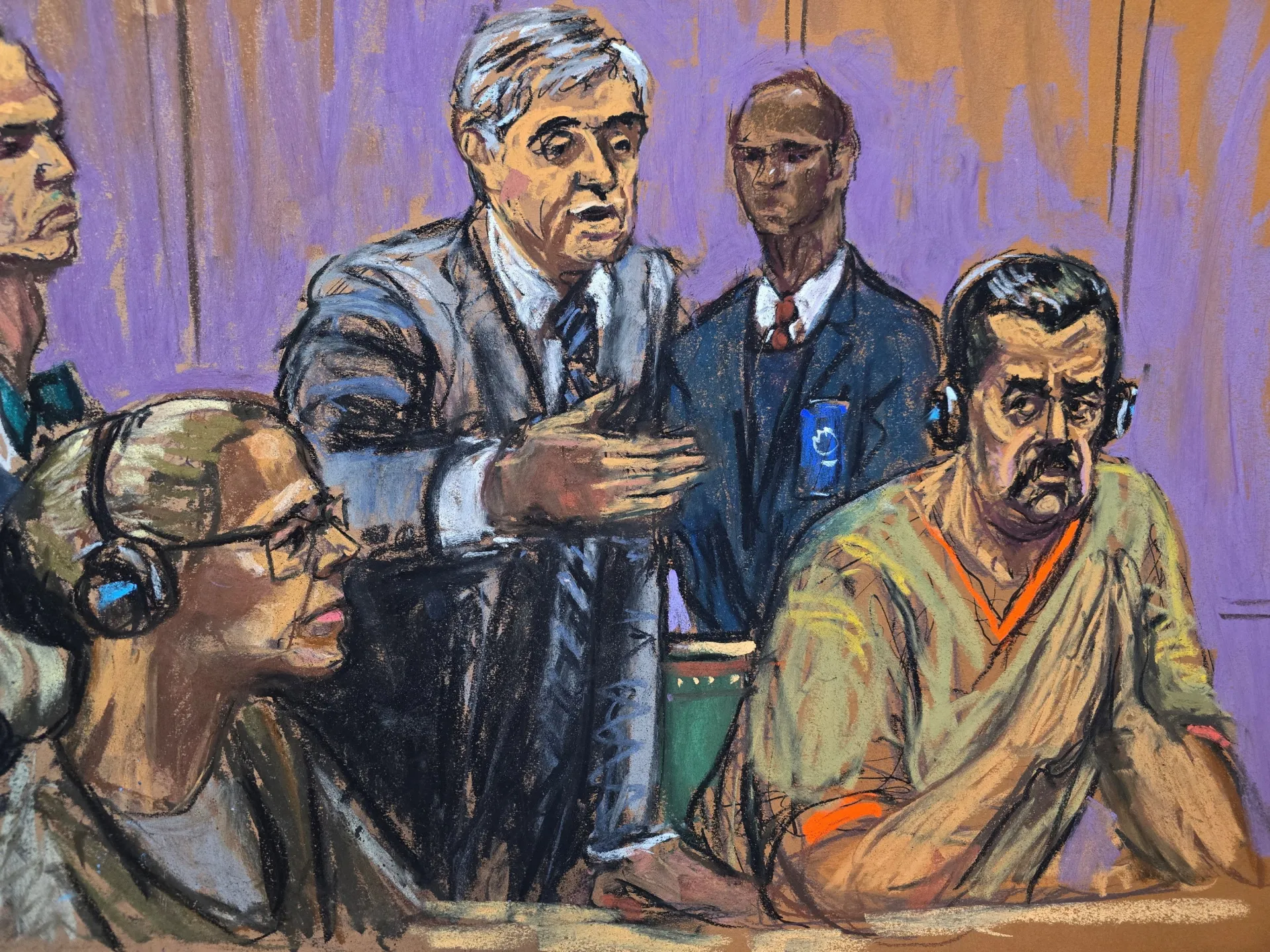
Venezuelan President Nicolas Maduro – recently abducted with his wife by US commandos from his home – has appeared in a federal courtroom in New York City for a hearing on alleged “narco-terrorism” and other charges.

Maduro and his wife, Cilia Flores, were brought before US District Judge Alvin K Hellerstein at 12pm (17:00 GMT) on Monday for a brief legal proceeding that kicks off a long legal battle over whether they can face trial in the United States.

Recommended Stories

list of 4 itemsend of list

Handcuffed and wearing blue jail uniforms, Maduro and his wife were led into the court by officers, and both put on headsets to hear the English-language proceeding as it was translated into Spanish.

Maduro pleaded not guilty in the US court, telling the judge: “I was captured. I am innocent and a decent man, the president of my country.”

Across the street from the courthouse, the police separated a small but growing group of protesters from about a dozen pro-intervention demonstrators, including one man who pulled a Venezuelan flag away from those protesting the US abduction.

The left-wing leader, his wife, son and three others could face life in prison if convicted of allegedly working with drug cartels to facilitate the shipment of thousands of tons of cocaine into the country. Some observers say there is no evidence linking him to cartels.

Maduro’s lawyers said they’ll contest the legality of his arrest, arguing he is immune from prosecution as a sovereign head of a foreign state, though he is not recognised as Venezuela’s legitimate leader by the US and other nations around the world.

Flores also pleaded not guilty to US charges against her during the arraignment. Hellerstein ordered the Venezuelan leader to next appear in court for a hearing on March 17.

INTERACTIVE - US attacks on Venezuela map-1767437429

‘Attacks’ against US people

Near the end of the hearing, Maduro’s attorney Barry J Pollack said his client “is head of a sovereign state and entitled to the privilege” that the status ensures.

Pollack said there were “questions about the legality of his military abduction”, and there will be “voluminous” pretrial filings to address those legal challenges.

Earlier, images showed the pair being led handcuffed and under heavy guard from a helicopter en route from a detention facility to the courthouse, two days after they were forcibly removed from Caracas in a brazen US special forces operation.

“The United States arrested a narco-trafficker who is now going to stand trial in the United States,” US Ambassador to the United Nations Mike Waltz told an emergency UN Security Council meeting about the US attack on Venezuela on Saturday.

Waltz accused Maduro of being “responsible for attacks against the people of the United States, for destabilising the Western Hemisphere, and illegitimately repressing the people of Venezuela”.

Samuel Moncada, Venezuela’s ambassador to the UN, accused the US of carrying out an illegal armed attack against his country.

Venezuela was subjected to bombing, the destruction of civilian infrastructure, the loss of civilian and military lives, and the “kidnapping” of Maduro and his wife, Moncada said.

The abduction of a sitting head of state breached a core norm of international law, the personal immunity of leaders in office, he added, warning that such actions set a dangerous precedent for all countries.

Vast oil wealth

All eyes are on Venezuela’s response to the swiftly moving events after US President Donald Trump said late on Sunday that the US is “in charge” of the South American nation, which has the world’s largest proven oil reserves.

Interim President Delcy Rodriguez, who took the place of her ally Maduro, initially took a defiant stand against the seizure of the president in what some observers labelled a return to “US gunboat diplomacy”. But she has now offered “to collaborate” with Washington.

Venezuela’s opposition appreciates US intervention to remove Maduro from power, but is alarmed by Trump’s comments about US plans to “run” Venezuela, apparently with members of his government, one analyst said.

“Trump doesn’t recognise the decision of the Venezuelan people. We are not a colony of the US. We are an independent country,” Jose Manuel Puente, a professor at the Instituto de Estudios Superiores de Administracion, a private university in Caracas, told Al Jazeera.

“We want to initiate a transition to democracy, to rebuild the institutions, to rebuild the economy, to rebuild the oil sector. And we don’t see that from Trump until now.”

Rodriguez has served as Maduro’s vice president since 2018, overseeing much of Venezuela’s oil-dependent economy and its feared intelligence service, and was next in the presidential line of succession.

She’s part of a band of senior officials in Maduro’s administration who now appear to control Venezuela, even as Trump and other US officials say they’ll pressure the government to fall in line with their vision for the oil-rich nation.

On Sunday, some 2,000 Maduro supporters, including rifle-wielding men on motorcycles, rallied in Caracas with crowds shouting and waving Venezuelan flags. The Venezuelan military, loyal to Maduro, announced it recognised Rodriguez and urged calm.

The White House indicated on Sunday that it does not want regime change, only Maduro’s removal and a pliant new government that will enable US companies to exploit the country’s vast oil reserves – even if the government is filled with his former associates.

Source link

Trump has made US militarism worse | US-Venezuela Tensions

For many years before becoming president, Donald Trump publicly criticised the George W Bush administration over its decision to launch the war on Iraq. And yet, today, in his second term as president, he finds himself presiding over a military debacle that is quite reminiscent of Bush’s.

Trump ordered a military intervention to remove an antagonistic foreign leader, based on a flimsy argument of national security, with the goal of accessing that country’s oil. In both cases, we see a naive confidence that the United States can simply achieve its goals through regime change. US intervention into Venezuela reeks of the same hubris that surrounded the Iraq invasion two decades ago.

Yet there are also important differences to consider. The most important distinguishing feature of the operation in Venezuela is its lack of an overarching vision. On Saturday after Trump finished an hour-long news conference alongside his secretaries of defence and state, it was not clear what the plan was for Venezuela going forward, or if there was a plan at all. His statements threatening more attacks in the following days brought no clarity either.

Past instances of US-led regime change fit into the larger ideological visions of the incumbent US commander-in-chief. In 1823, President James Monroe declared the Western Hemisphere off-limits to European colonialism. As the United States spent the 20th century consolidating its sphere of influence across the Americas, the Monroe Doctrine would justify various interventions in Latin America and the Caribbean. The Cold War added new justifications for the United States to overthrow leftist regimes and install friendly governments in the Americas.

As the Cold War ended, President George HW Bush sought to serve as a caretaker for a “new world order” in which the US had emerged as the world’s lone superpower. When Bush sent troops to Somalia in 1992 and his successor Bill Clinton reversed a military coup in Haiti in 1994, they did so under the paradigm of “humanitarian intervention”. When George W Bush ordered the invasion of Iraq, it was done under the umbrella of the post-9/11 “war on terror”. When President Barack Obama intervened against the forces of Libyan leader Muammar Gaddafi in 2011, he was guided by the “responsibility to protect” doctrine concerning civilians in danger.

But in the case of the US attack on Venezuela, there has been no ideological justification. Trump and his team have haphazardly thrown around references to humanitarianism, counterterrorism and more to justify the attack. The president even brought up the Monroe Doctrine. But just as it seemed that he was grounding his foreign policy in a larger ideology, albeit one borrowed from two centuries ago, he made a joke of the concept.

“The Monroe Doctrine is a big deal,” Trump explained on Saturday. “But we’ve superseded it by a lot, by a lot. They now call it the Donroe Doctrine.” Trump did not make up this pun; it was used by the New York Post a year ago to describe Trump’s aggressive foreign policy as he threatened to annex Canada, Greenland and the Panama Canal.

The president’s decision to embrace the tongue-in-cheek term illustrates a disturbing reality of his foreign policy: Any notion that he is promoting an ideological vision is a joke.

The truth is Trump is pursuing an increasingly aggressive and militaristic foreign policy in his second term, not because he wants to impose a grand vision, but because he has discovered he can get away with it.

Striking a variety of foreign “bad guys” who have little capacity to fight back – ISIL (ISIS) affiliates in Nigeria who are “persecuting” Christians and “narcoterrorists” in Latin America – appeals to members of Trump’s base.

After he mentioned the Venezuelan gang Tren de Aragua during Saturday’s news conference, he went on a minutes-long tangent to brag about his military interventions into US cities. While the president’s inability to stay on topic may be concerning for those questioning his health and mental fitness, this digression into domestic affairs had some relevance for his Venezuelan intervention, at least as far as he was concerned: His increasingly militarised war on drugs and crime abroad justifies an increasingly militarised war on drugs and crime at home.

Past presidents have used US power to pursue a wide variety of ideologies and principles. Trump appears to be paying lip service to past ideologies to justify the use of US power. Many times, the “good” intentions of previous  presidents paved the way to hellish outcomes for the peoples who found themselves on the receiving end of US intervention. But those intentions at least created a level of predictability and consistency for the foreign policies of various US administrations.

Trump, by contrast, seems driven solely by immediate political concerns and short-term prospects for glory and profit. If there is a saving grace of such an unprincipled foreign policy, it may be the ephemeral nature of interventions conducted without an overarching vision. An unprincipled approach to military intervention does not foster the kind of ideological commitment that has led other presidents to engage in long-term interventions like the Iraq occupation.

But it also means that Trump could conceivably use military intervention to settle any international dispute or to pursue any ostensibly profitable goal – say assuming control of Greenland from Denmark.

Last year, he decided tariffs were a potent tool for asserting his interests and started applying them almost indiscriminately on allies and adversaries alike. Now that Trump has grown comfortable using the US military to achieve a range of goals – profit, gunboat diplomacy, distraction from domestic scandals, etc – the danger is that he will grow similarly haphazard in his use of force.

That does not bode well for the US nor for the rest of the world. At a time when multiple global crises are overlapping – climate, conflict and impoverishment – the last thing the world needs is a trigger-happy superpower without a clear strategy or a day-after plan.

The views expressed in this article are the author’s own and do not necessarily reflect Al Jazeera’s editorial stance.

Source link