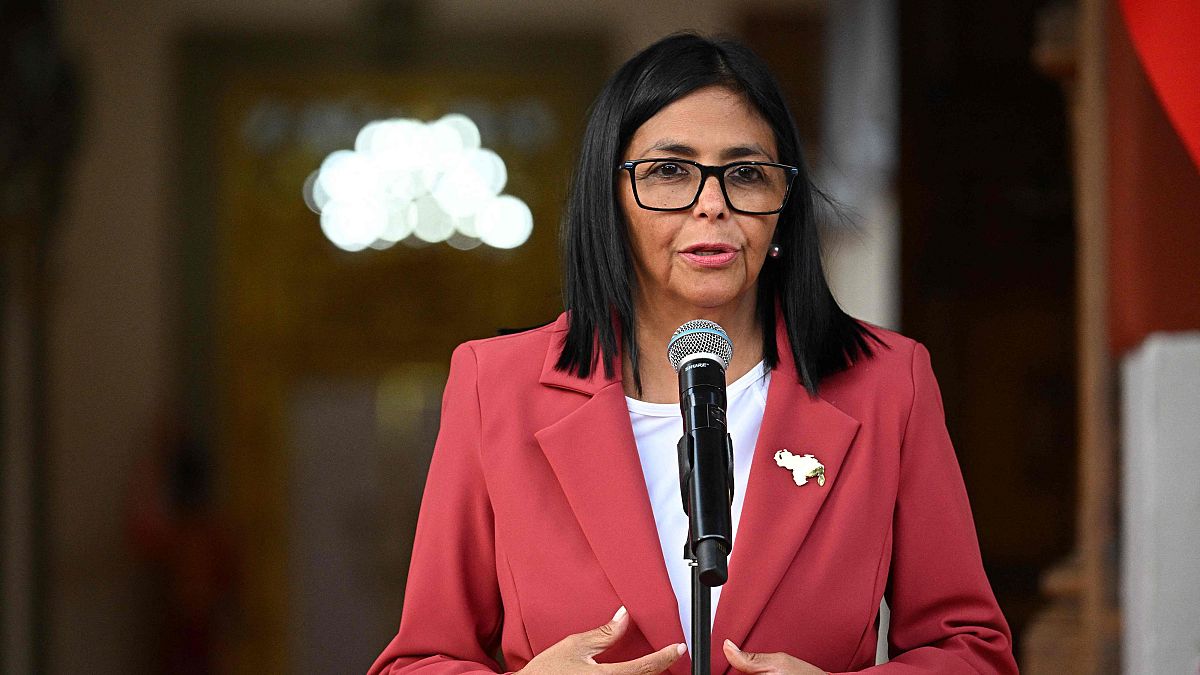
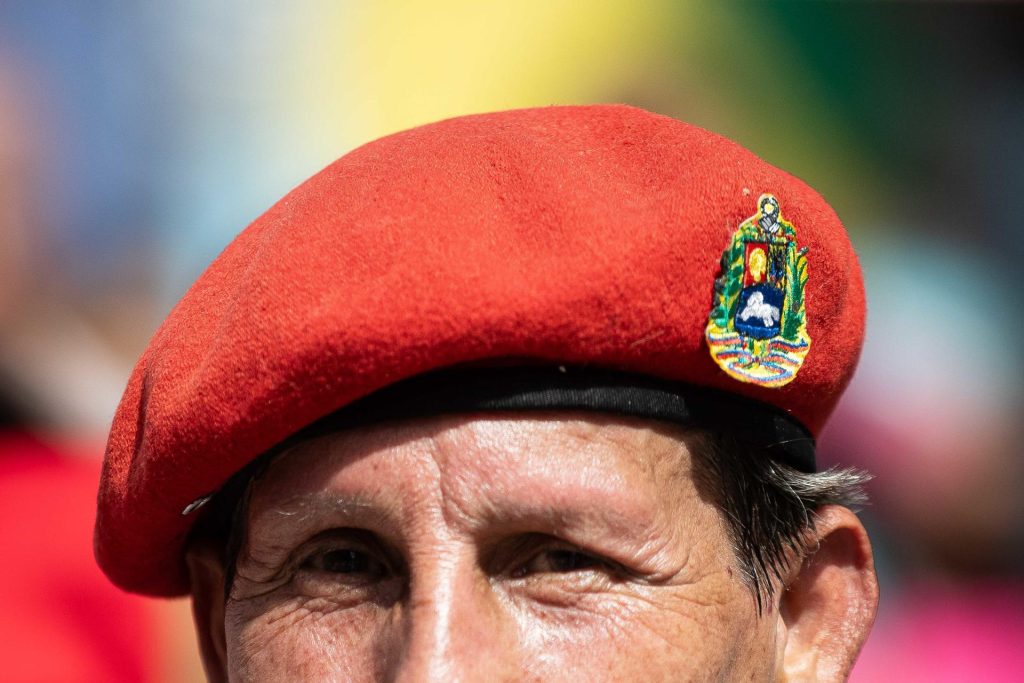
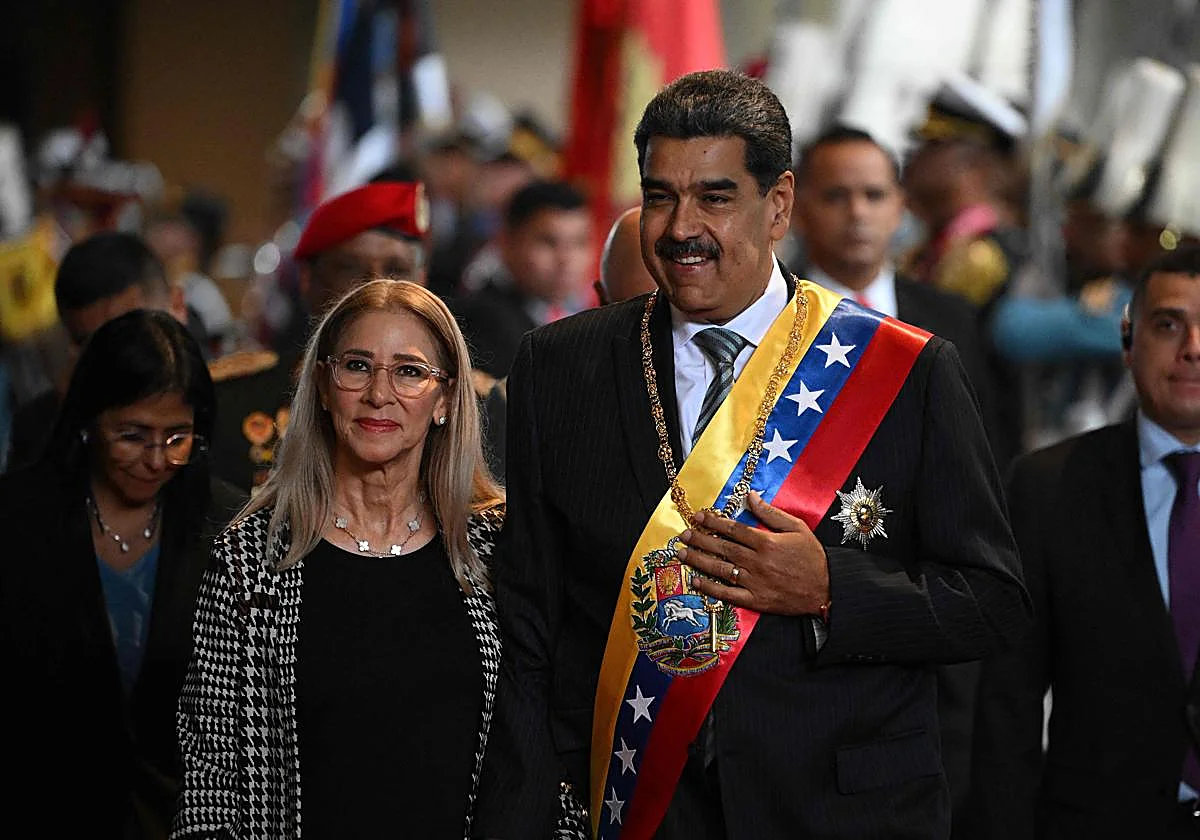
The Venezuelan acting leader called the decision “a step for the normalization” of bilateral relations. (RTVE)
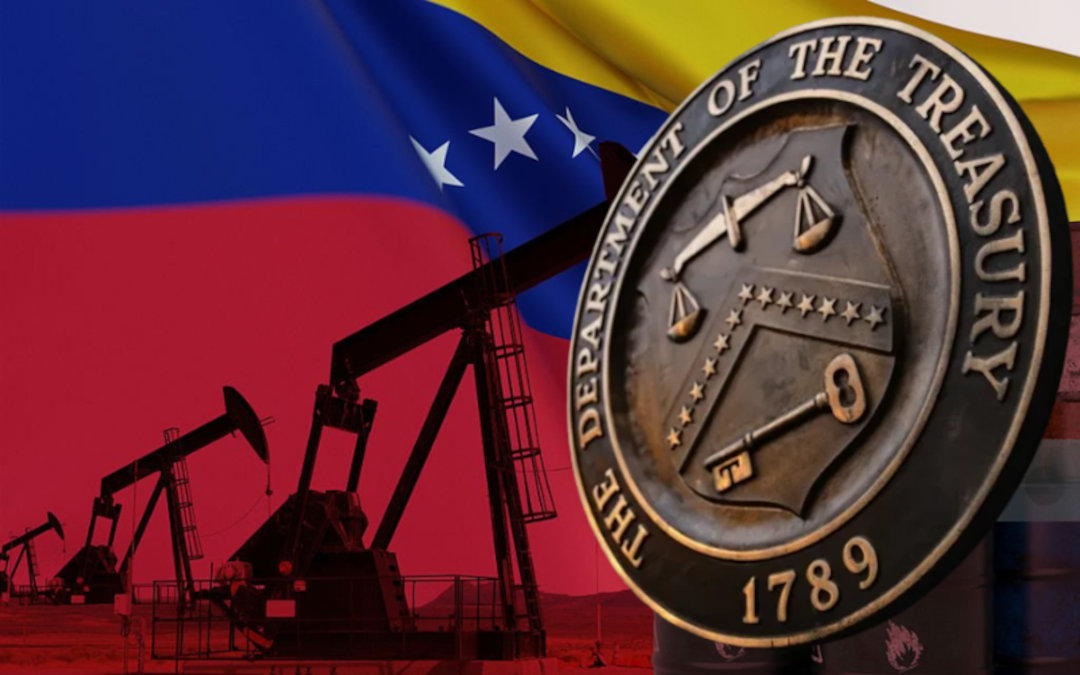
Caracas, April 2, 2026 (venezuelanalysis.com) – The US Treasury Department removed Venezuelan Acting President Delcy Rodríguez from the Office of Foreign Assets Control (OFAC) “Specially Designated Nationals” list on Wednesday, April 1.
Rodríguez had been on the list since 2018. The sanctioned individuals are barred from any sort of economic or financial relationship with US entities and have any US-based assets frozen.
The Venezuelan acting head of state reacted to the decision with a message on her X account, calling it “a step in the direction of normalizing and strengthening relations between our countries.”
Rodríguez added that she is confident this step will lead to the lifting of all sanctions currently in place against Venezuela “in order to guarantee an effective binational cooperation agenda” that benefits both Washington and Caracas. In recent weeks, the Trump administration has issued licenses allowing Western corporations to engage with the Venezuelan energy and mining sectors, but wide-reaching coercive measures remain in place.
The US government targeted Rodríguez in September 2018, Trump’s first presidential term, alleging that the then–vice president was part of a group that contributed “to the destruction of democracy.” The same round of sanctions targeted First Lady and Deputy Cilia Flores, as well as Vladimir Padrino López and Jorge Rodríguez, who respectively served as defense and communications ministers at the time.
Delcy Rodríguez denounced the 2018 measures as “illegal” and “unjust,” arguing that they were part of an “economic blockade” that undermined her country’s right to food, health, and sovereignty.
The Venezuelan leader’s sanctions removal opens the door for direct engagement with US entities and multilateral organizations such as the IMF. Creditors have likewise expressed intentions to launch renegotiation efforts surrounding Venezuela’s sizable foreign debt.
The Trump administration’s move comes on the heels of a fast-tracked rapprochement with Washington that Rodríguez has spearheaded since the January 3 attacks and kidnapping of President Nicolás Maduro. Rodríguez, who took over the acting presidency, has hosted a number of high‑ranking US officials, among them Trump Energy Secretary Chris Wright.
Similarly, last week Rodríguez took part via videoconference in a business gathering in Miami organized by Saudi Arabia’s Future Investment Initiative Institute. During her address, she touted the country’s recent pro-business reforms and urged investors to come to Venezuela.
Caracas and Washington formally reestablished diplomatic ties on March 5, with the Trump administration recognizing the acting president as Venezuela’s “sole” leader days later.
Regaining control of CITGO
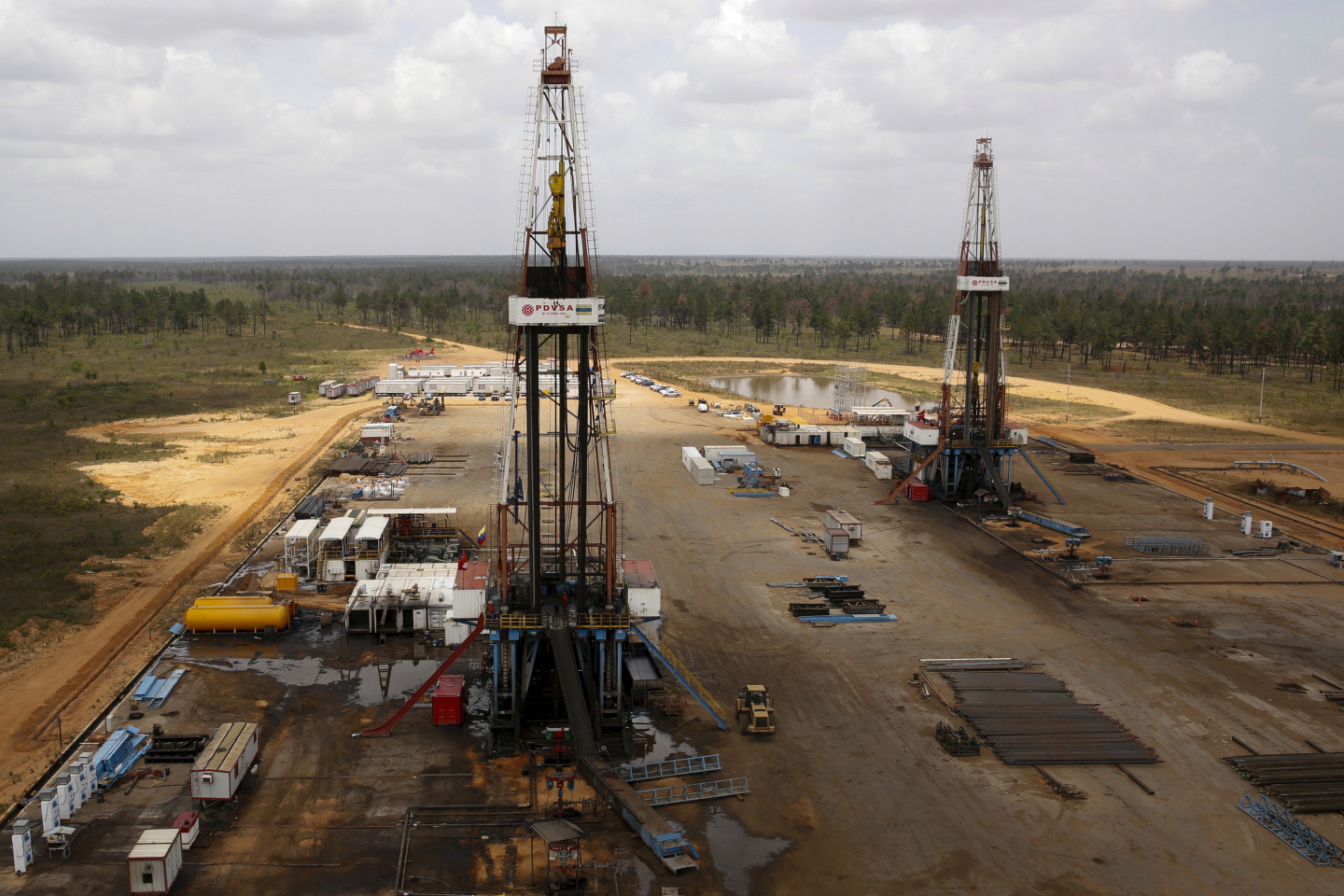
The lifting of coercive measures against the Venezuelan acting president raised the possibility of the Rodríguez acting government retaking control of US-based assets that had been frozen and placed under the control of the hardline opposition. According to Reuters, Venezuelan authorities are preparing to take control of the boards of directors of the US subsidiaries of state oil company PDVSA, including refiner CITGO. However, the US State Department must also sign off on the appointments.
This past March, PDVSA’s board ratified Asdrúbal Chávez, cousin of the late Venezuelan President Hugo Chávez, as director of all its US subsidiaries. Nonetheless, Chávez, who was previously denied a US visa to run Houston-based CITGO, has been unable to manage the companies for more than seven years.
CITGO has been administered since 2019 by boards of directors appointed by a defunct Venezuelan opposition‑led National Assembly whose term expired in January 2021. The company, which is Venezuela’s most valuable foreign asset, underwent a long and protracted court-mandated auction to satisfy creditor demands which concluded with a winning bid from vulture fund Elliott Management.
The CITGO sale requires a US Treasury license in order to conclude. The Trump administration has not publicly disclosed whether it will greenlight or halt the ownership transfer.
The Venezuelanalysis Podcast is back. In our new season premiere, we tackle the fallout of the January 3rd military escalation against Caracas, an event that marks a volatile new chapter in the long history of US intervention in the region.
Join Venezuelanalysis Lead Editor Ricardo Vaz, Associate Editor Lucas Koerner, and VA Founder Greg Wilpert as they break down the geopolitical shift from “maximum pressure” to direct confrontation. This episode goes beyond the headlines to analyze the underlying causes and the global consequences of Washington’s renewed focus on “its” hemisphere.
Caracas and Washington have fast-tracked a diplomatic rapprochement following the January 3 bombings and kidnapping of President Nicolás Maduro. (VTV)
Mérida, March 31, 2026 (venezuelanalysis.com) – The Venezuelan government has officially retaken control of its diplomatic headquarters in Washington, DC, as part of the two countries’ diplomatic rapprochement.
The move followed days of high-level activity in the US capital by a Venezuelan delegation with the aim of rehabilitating consular services for hundreds of thousands of nationals residing in the United States.
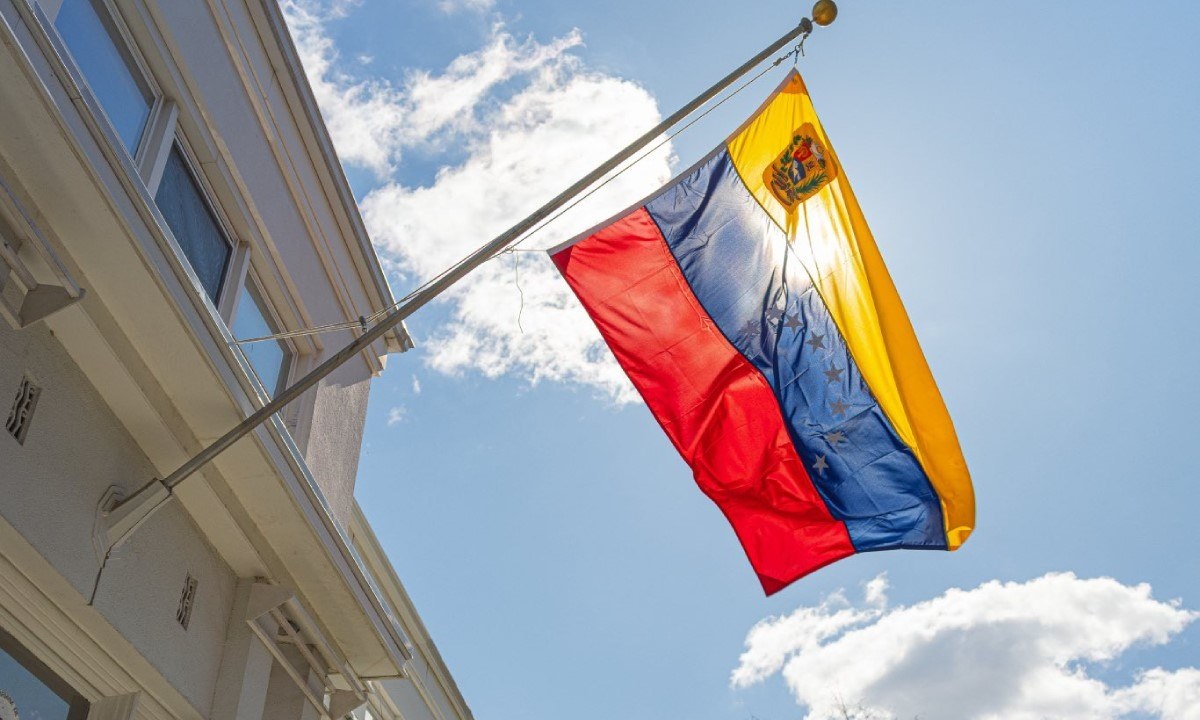
On Thursday, Venezuelan officials re-hoisted the national flag at the diplomatic mission buildings, which had been under the “temporary control” of the US State Department since 2023.
The properties, including the embassy in Georgetown and the ambassador’s residence, were previously handed over to the self-proclaimed “interim government” led by Juan Guaidó after the first Trump administration recognized it as Venezuela’s legitimate authority in 2019. The Venezuelan embassy was forcefully taken over by security forces after a group of solidarity activists attempted to defend it from the US-backed hardline opposition.
Caracas’ delegation, sent by Acting President Delcy Rodríguez, was led by Félix Plasencia, Venezuela’s Chargé d’Affaires to the US, and Oliver Blanco, Vice-Minister for Europe and North America. The group inspected the facilities, and Plasencia confirmed that the buildings would undergo an immediate “rehabilitation process” to resume institutional functions.
“This is a significant achievement in the protection of our national assets,” Plasencia stated via social media, sharing images of the Venezuelan flag outside diplomatic venues.
“We are working to reinstate these spaces as a service to all Venezuelan citizens, to support them in their consular needs, the authentication of their identity documents, and the protection of their rights abroad,” he added.
According to Blanco, the delegation held meetings with several State Department officials last week with the purpose of “exploring opportunities to strengthen the bond between both nations” and establishing a permanent presence to address bilateral interests, specifically in trade, migration, and energy.
Venezuela’s retaking of its diplomatic facilities on US soil was made possible by the US Treasury Department’s Office of Foreign Assets Control (OFAC) issuing General License 53.
The sanctions waiver allows the provision of goods and services to Venezuela’s diplomatic missions, allowing them to engage in financial transactions to ensure the normal functioning of consular activities.
Since 2019, Venezuelans residing in the US have faced hurdles to access official channels for passport renewal and birth certificate issuance, and have been forced to seek alternative solutions through third-country consulates or by utilizing expired documentation.
Venezuelan migrants have also been heavily targeted by the Trump administration’s anti-migration crackdown, with hundreds of thousands placed at risk of deportation with the suspension of Temporary Protected Status (TPS) and the CHNV parole program. US and Venezuelan authorities presently coordinate three weekly deportation flights.
Caracas and Washington fast-tracked a diplomatic re-engagement in the wake of the January 3 military attack that saw US special forces kidnap Venezuelan President Nicolás Maduro and First Lady Cilia Flores. The pair is currently facing charges including drug trafficking conspiracy.
The two countries formalized the reestablishment of diplomatic ties on March 5 following a seven-year hiatus. Days later, the Trump administration recognized Rodríguez as Venezuela’s “sole” authority. On Monday, the US State Department announced the reopening of the US embassy in Caracas.
Since January, the acting president has hosted multiple White House officials who have praised her government’s pro-business reforms in the energy and mining sectors. For her part, Rodríguez has defended diplomacy and the prospect of “mutually beneficial” relations with the US.
“Faith diplomacy” gathering
The Rodríguez administration’s outreach to the US recently included a high-profile “faith diplomacy” gathering with evangelical pastors. Venezuelan authorities stated that the meeting aimed to promote “peace and spiritual union.”
The Friday event in the Poliedro in Caracas featured prominent international religious figures alongside Venezuelan cabinet members and the national evangelical community. The guest of honor was Pastor Ramiro Abel Peña Jr., a key figure in the “Office of Faith-Based and Neighborhood Partnerships” during Trump’s first term and a current spiritual advisor to the US President.
Peña, a pastor from the “Christ the King” Baptist Church in Waco, Texas, has cultivated close ties with the Trump family and has been a vocal advocate for hardline evangelical and zionist causes. During the event, Peña led the central prayer for the “restoration” and “blessing” of Venezuela.
He was joined by other international religious leaders such as Pastor Roosevelt Fonseca of the “Christian Life Mission” (Colombia-USA), who participated in “revival prayers” intended to foster social cohesion during the 2026 Holy Week.
For her part, Rodríguez called for “an end to hatred” and reaffirmed the government’s commitment to a national amnesty law that has seen thousands released from prison or have their judicial cases dropped. She urged a prayer for an end to US sanctions and advocated for Venezuelans to look to “the words of Jesus” as a guide to overcoming the country’s struggles.
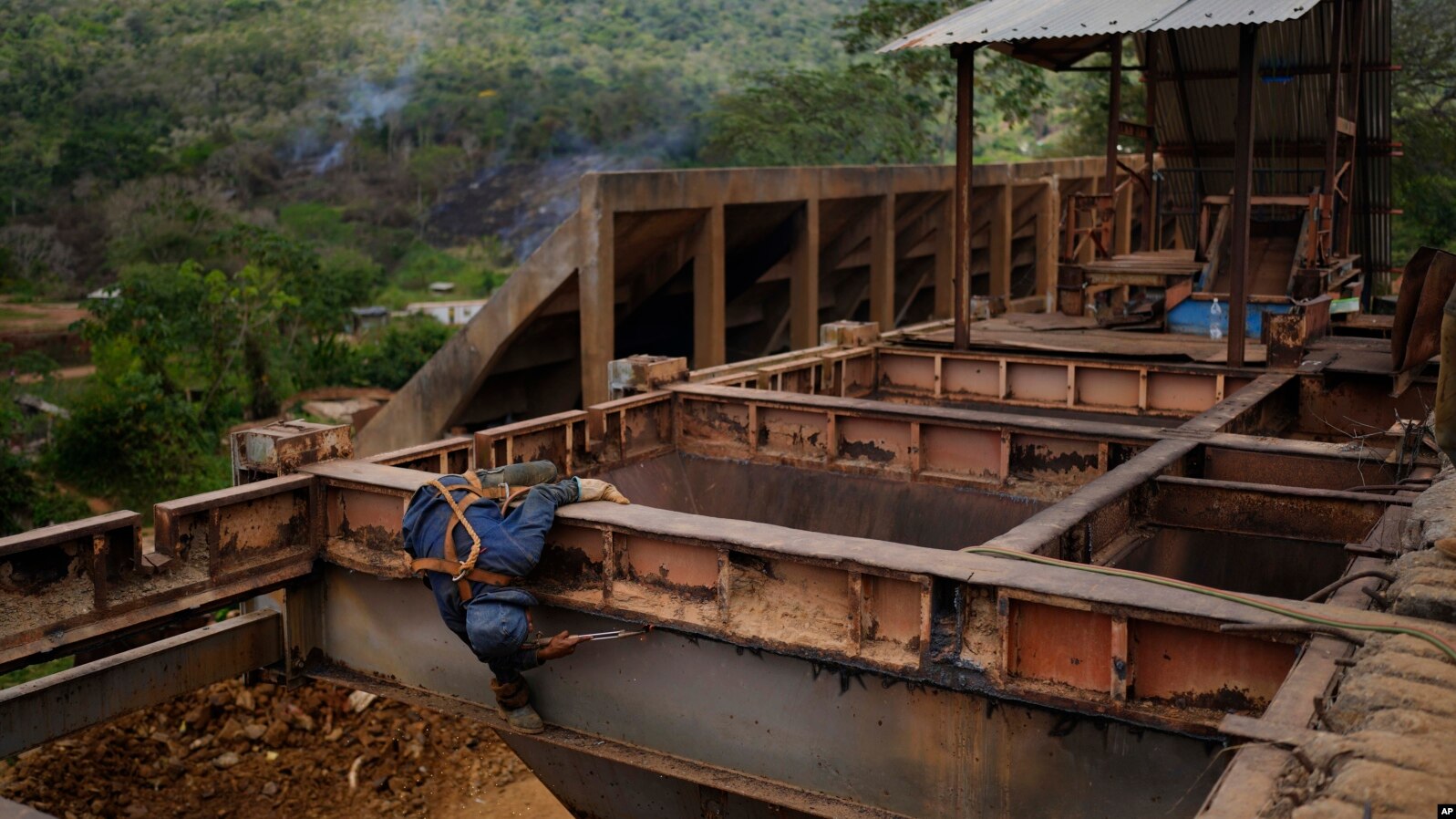
Venezuela contains extensive gold reserves in the east of the country. (AP)
Caracas, March 30, 2026 (venezuelanalysis.com) – The US Treasury Department has published three sanctions waivers related to the Venezuelan mining sector.
On Friday, the Treasury’s Office of Foreign Assets Control issued general licenses 51A (GL51A), 54 (GL54) and 55 (GL55) to authorize Western conglomerates’ dealings with Venezuelan minerals.
GL51A allows US entities to engage in operations to purchase, transport, and sell “Venezuelan-origin minerals, including gold.” However, it does not permit extraction or refining activities. The waiver replaced General License 51, which established conditions only for gold-related operations.
GL54 allows US entities to provide “goods, technology, software, or services” connected to mining activities in Venezuela. Finally, GL55 grants corporations permission to engage with Venezuelan state entities to negotiate contracts, but requires them to apply for a specific license before the contracts are enacted.
The latest US Treasury sanctions exemptions mirror recent licenses related to the Venezuelan energy industry, blocking transactions with entities from Cuba, China, Iran, North Korea, and Russia. They likewise mandate that all Venezuela-bound payments be made to a US Treasury-run account. Since January, the Trump administration has imposed control over Venezuelan oil exports, collecting revenues before disbursing a portion at its discretion to Caracas.
On Friday, Canadian conglomerate Roland Mineral Enterprises announced plans to “aggressively seek out and acquire interests in Venezuelan mineral properties.”
“Recent material events in Venezuela, including the new Draft Mining Law, make Venezuelan gold, silver and copper deposits and resources especially attractive for pioneering, transformative and rapidly adaptable resource companies like Roland Mineral Enterprises,” a press statement read.
Roland went on to disclose deals to access information on Venezuelan natural resource deposits and declare interest in gold projects such as Las Cristinas, estimated to contain over 14 million ounces of gold.
Western interest in Venezuelan minerals was boosted by a recent visit from US Interior Secretary Doug Burgum, who holds the natural resource portfolio. Burgum, accompanied by over 20 US and Canadian mining executives, held a meeting with Venezuelan Acting President Delcy Rodríguez and trumpeted the lucrative opportunities in the sector.
Burgum’s visit also saw US $100 million worth of gold bars shipped to the US in a deal involving Trafigura.
The negotiation of mining contracts remains contingent on an ongoing process to introduce new legislation. On March 9, the Venezuelan National Assembly preliminarily approved a new Organic Mining Law establishing favorable conditions and incentives for foreign capital.
Legislators have advanced in debating a second and updated version of the law, approving the first 55 of its 130 articles on Thursday. A final session is expected in early April. According to a draft of the latest version of the law seen by Venezuelanalysis, the bill establishes a new regulatory framework for mining at different scales, while also allowing private companies to take disputes to international arbitration.
The law expands conditions for private mining concessions, which can last up to twenty years and be renewed for two additional ten-year periods, and do not require National Assembly approval. Additionally, the executive can lower fiscal responsibilities for mining firms at its discretion. The law establishes 13 and 6 percent caps for royalties and a mining tax.
The law’s approval will repeal the current mining law, approved by the Hugo Chávez government in 1999, as well as a 2015 decree imposing state control over mining activities. Since 2015, the Nicolás Maduro administration looked to mining as a potential revenue source, particularly in the 112,000 square-kilometer Orinoco Mining Arc. Nevertheless, the sector was targeted by US sanctions, while the proliferation of irregular mining groups has generated environmental and human rights concerns.
Venezuela possesses vast proven reserves of gold, iron, and bauxite, as well as lesser quantities of copper and nickel. Analysts have also drawn attention to Venezuela’s significant reserves of coltan.
Venezuela’s mining reform follows a pro-business overhaul of the country’s Hydrocarbon Law. In recent weeks, Western energy giants Chevron, Eni, Repsol, and Shell have signed agreements for oil and gas exploration under the improved conditions of the new law. Acting President Rodríguez has touted the country’s reforms in lobbying foreign investors.
In parallel to oil and mining, Venezuelan authorities are also preparing to open the state-run electric sector to private capital. Acting President Rodríguez announced legislative reform plans, while a spokesman for the FEDECÁMARAS business lobby reported that Siemens and General Electric recently sent delegations to evaluate Venezuela’s electrical infrastructure.
Mendoza Potellá situates the recent oil reform in the historical context of foreign influence over Venezuela’s energy sector. (Venezuelanalysis)
Carlos Mendoza Potellá is an economist and university professor with vast experience and expertise regarding the Venezuelan oil industry. In this exclusive interview with Venezuelanalysis, Mendoza Potellá offers his analysis on the recent reform of the Hydrocarbon Law, the longstanding influence of Western conglomerates over Venezuela’s energy sector, and the struggle for sovereignty.
In late January, the Venezuelan National Assembly approved a reformof the Hydrocarbon Law. What are your views on the new law?
In broad terms, it is the relinquishing of our condition as a sovereign nation, plain and simple. We are not a nation anymore. We are a territory with some delegate administrators implementing decisions made abroad. Who decides? Emperor Trump, who has his proconsul Marco Rubio.
The approved law meets the maximum demands that the Venezuelan right and the oil conglomerates have been making for at least the last 25 years. The 2002 coup against Chávez was to impose something like this, the return to the old concession model. It is the fulfillment of all the dreams of the old “meritocratic” leadership of [state oil company PDVSA], the people who did everything to minimize the fiscal contributions to the country, whether that meant buying 37 refineries abroad or other disasters that wrecked the country.
The reform is a victory for international oil capital, alongside a discourse that hands over the destiny of the industry to major corporations and diminishes national participation as some unproductive “rentierism.”
The Venezuelan oil industry has gone through various stages, with varying degrees of influence from major transnational corporations, whether that is the period prior to the formal nationalization in 1976 or the Oil Liberalization (Apertura Petrolera) of the 1990s. How do we situate the new law within that context?
I believe this is a step backward beyond the apertura or the pre-nationalization period –perhaps it’s a return to 1832! In 1829, Simón Bolívar issued a decree transferring the Spanish crown’s mining rights to Gran Colombia. This, in turn, was based on old medieval law, essentially establishing that mines were the property of the sovereign, the king. In fact, that is where the term “royalty” comes from –as a tribute to the king. And in 1832, when Venezuela separated from Gran Colombia, that decree ratified the nation’s ownership of its mines.
Obviously, oil didn’t emerge until 30 or 40 years later, but by 1866 concessions were already being granted. For a time, people spoke of “material that comes from the subsoil,” even though everyone already knew it was oil.
Our first boom was with asphalt. In 1883, Guzmán Blanco granted the Lago Guanoco concession to his buddy Horacio Hamilton, who later transferred it to the New York & Bermúdez Company, a subsidiary of the US firm General Asphalt. The asphalt boom lasted 50 years, and with it, streets and highways were built all over the United States.
But the example of New York & Bermúdez is significant because when Cipriano Castro came to power in 1899, he found out that the company had not paid taxes and attempted to collect them. What did the corporation do? It financed the so-called Revolución Libertadora led by Manuel Antonio Matos, a banker from La Victoria, which was ultimately defeated after two bloody battles. It was the first instance of foreign hydrocarbon interests seeking to control national politics. And it was always linked to the United States.
In the 1920s, then-dictator Juan Vicente Gómez tasked his minister, Gumersindo Torres, with drafting a hydrocarbons law, but the foreign companies did not like it. And Gómez told them, “Well, then, write the law yourselves!” Later, in 1936, the López Contreras administration drafted a very good law, but since it wasn’t retroactive, the companies did not mind because they already had their concessions granted.
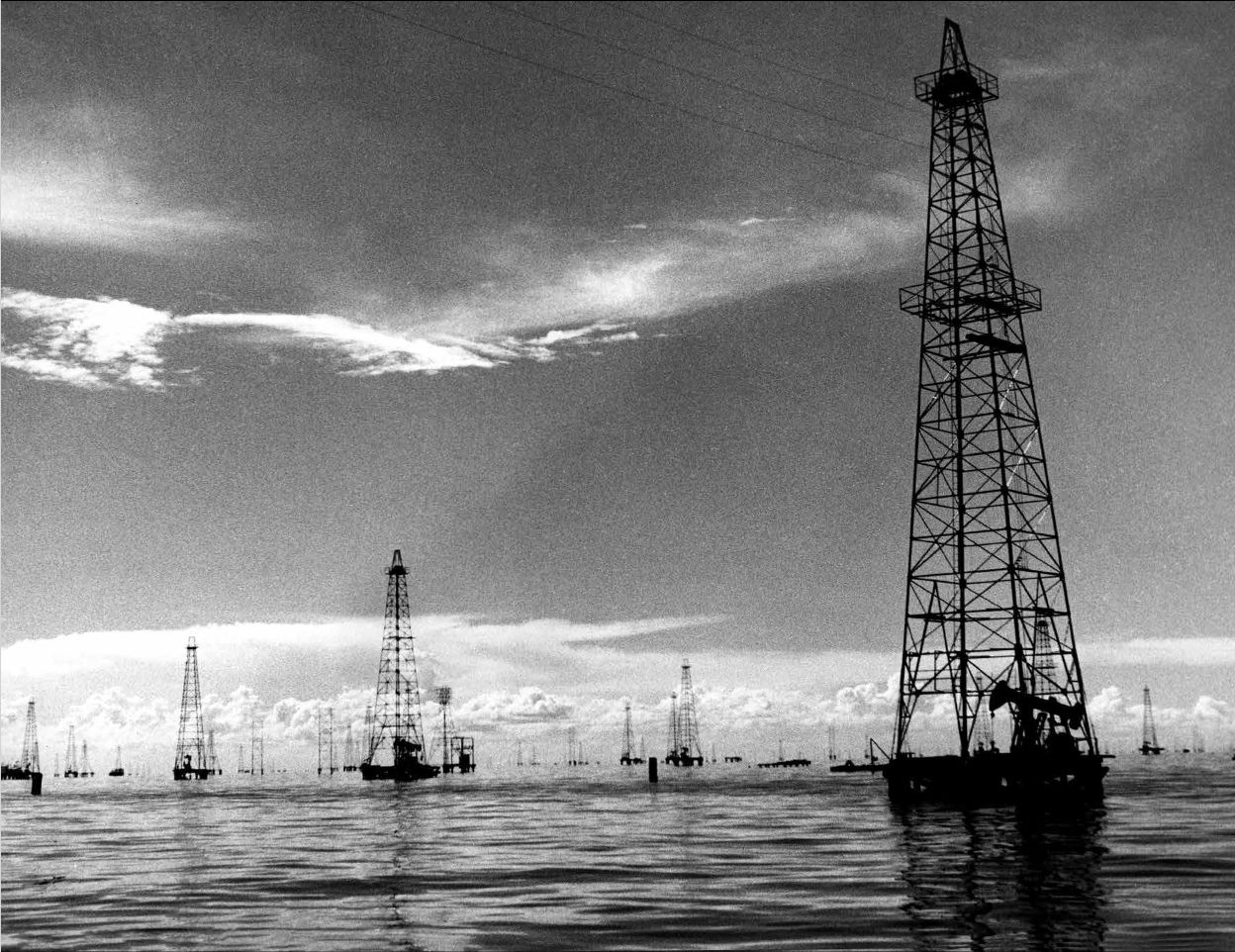
Lake Maracaibo was one of the main hubs of the Venezuelan oil industry in the 20th century. (Archivo Fotografía Urbana)
When do we start seeing the first steps toward Venezuelan oil nationalism?
It was precisely in 1941 that Medina Angarita took office and commissioned a massive dossier on all the concessions in the country, informing the US government that Venezuela was aware of the importance of its oil. This was during World War II, and the oil companies were haunted by the specter of the 1938 Mexican nationalization under the government of Lázaro Cárdenas.
What was [Franklin D.] Roosevelt’s response? He sent a delegation from the State Department, not to intercede on behalf of the oil companies, but to convince them to accept Medina’s reform, because Venezuelan oil was vital to the war effort. The law passed in 1943 was quite progressive. Its first article stated that hydrocarbons are a matter of national public interest, and as such, concessions were granted for a maximum term of 40 years. Eighty percent of the concessions were granted at that time, to expire in 1983.
Venezuelan production grew through the 1970s, but as the end of the concessions approached, the transnational corporations began implementing policies to somewhat ease the hostility toward foreign investment.
Thus, a policy of “Venezuelanization” of the industry’s management was put into effect. That is why, when the so-called nationalization took place (1976), companies such as Shell and Creole, a subsidiary of Standard Oil-Exxon, had Venezuelans serving as president or vice president. These executives later assumed leadership of the newly created national companies. Their passports were Venezuelan, but their hearts belonged to foreign corporations!
Historically, how was the relationship between foreign corporations and Venezuelan authorities? And how did they respond to the 1976 nationalization?
The corporations grew accustomed to the idea of an industry tailored to their interests. I mentioned how they were the ones who drafted the first Hydrocarbons Law. Oversight bodies, such as the Technical Office of Hydrocarbons, were constantly undermined in their efforts to regulate oil activities. And so the companies could extract oil without paying royalties, violate technical standards for field exploitation, or export gasoline instead of fuel oil.
The 1970s were a turbulent time for the oil sector, marked by geopolitical tensions and the 1973 crisis in the Arab countries. In 1973, James Akins, the Nixon administration’s Director of Energy at the State Department, wrote an article in Foreign Affairs titled “The Oil Crisis; This Time the Wolf Is Here.” He argued that Venezuela could be key to reducing dependence on the Middle East, and that in the face of growing oil nationalism, it was necessary to cede some ground and consider other models of participation, while maintaining control over critical areas such as refining and commercialization.
Put differently, it was possible to offer some token concessions to the nationalist aspirations of oil-producing countries like Venezuela. And that rhetoric spread to the transnational corporations. The president of Shell said at the time, “Venezuela is going to have to take action regarding its oil industry,” while the head of Creole spoke of “the Venezuelans’ oil”!
There were growing signs of how the nationalization would take shape and how the transnationals were restructuring. A good example is the Venezuelan Petroleum Corporation (CVP), created in 1960. Juan Pablo Pérez Alfonzo, whom I consider a visionary and a deeply nationalist figure, had conceived it as a company that would develop until the time came for the state to take over production. But the governments did not let it grow; they did not assign concessions it was entitled to, and by the time of nationalization, the CVP was simply one more operator among 13 or 14.
In contrast, [Petróleos de Venezuela, SA] PDVSA, created with the nationalization, did have a very clear vision from the start. I remember hearing senior PDVSA executives talking among themselves, discussing how one came from the “Exxon culture,” which was more vertical, and the other from the “Shell culture,” which was more horizontal. And these were the managers! They were the leaders of the Venezuelan oil industry, which had very little “Venezuelan” about it. What we are seeing now is the reconstitution of all these things.
Mendoza Potellá has long criticized “grandiose” plans surrounding the Orinoco Oil Belt. (El Universal)
Circling back to the current reform, we have seen that sovereignty is a central issue. How is it affected on different fronts?
For me, a fundamental issue is the return of concessions. Because that means going back decades, handing control back to transnational conglomerates. With taxes and royalties, the problem is not whether the rate is 30% or 15%; that flexibility existed in the past. But now it is the transnational corporations that tell the government what their operating costs are and how much goes to the Venezuelan state. There is no oversight body to verify this; instead, the company says, “I need you to lower royalties to this level” for the project to be profitable.
The return of international arbitration is also a brutal setback, because it means that disputes are not settled in Venezuelan courts, but in other bodies that have a history of defending corporate interests. There is no role left for the Public Solicitor’s Office (Procuradoría General), which is essentially the nation’s attorney.
For months we were told we were ready to confront imperialism, but the truth is that everything is being imposed on us. Even the National Assembly is castrating itself. It has enacted a law stating that oil projects no longer require the parliament’s approval; they need only be notified. And on top of all that, there is also the constitutional issue. The reform conflicts with Articles 1, 12, 150, 151, and several others of the Constitution. But this is not merely a constitutional violation; it is a total surrender. A surrender of sovereignty that calls into question our status as a republic.
One of the issues under debate is the distinction between a country that owns oil and a country that produces oil. How should we understand the difference?
Of course, that’s fundamental. A country that owns oil simply collects royalties, and it does so according to its political capabilities. At the moment, Venezuela’s capabilities are limited, because the military cannot confront the enemy, and allies like Russia and China have not shown themselves willing to take any risks. So, there is little room to impose conditions on the US.
But this is a country that has grown used to the multinational corporations having free rein over its oil sector. Unfortunately, there are many people, within the industry itself, who believe that “the foreign conglomerates developed this and therefore have a right to these privileges.” Curiously, that is the same rhetoric Trump uses!
This struggle for sovereignty is fundamental in oil-producing countries. We have seen this with the countries of the Middle East, which try to assert themselves but remain highly dependent on the United States. Obviously, they have the advantage of not being as close as we are. But in my opinion, historically we have lacked nationalism on this issue.
Trump Energy Secretary Chris Wright recently toured Chevron’s facilities in Venezuela alongside Acting President Delcy Rodríguez. (EFE)
One of the arguments in favor of reforming the Hydrocarbon Law was the need to attract investment to so-called “green fields,” on the grounds that when the previous law was passed in 2001, there were many mature fields ready for development and this is no longer the case. However, major corporations have not shown much enthusiasm. What is your reading on this?
Those are fantasies about oilfields that have always been unviable; it is the obsession with the Orinoco Oil Belt. Humberto Calderón Berti, minister of mines in the 1980s and a major proponent of PDVSA’s internationalization, was already talking about green fields back then. By the way, Calderón Berti is now talking about the possibility of fracking in Lake Maracaibo, which would make the lake’s environmental disaster even worse.
The idea that an avalanche of investment is coming is an illusion, and the oil companies themselves know it. Trump talks about investments of $100 billion, but transnational corporations like ExxonMobil use the word “uninvestable.” With market volatility, no one is thinking about investing in oil with extremely high production costs. There is a study that concludes that increasing production to 2.6 million barrels per day based on the Orinoco Belt would require US $90 billion in investments and $122 billion in operating expenses over the next 10 years to drill 13,000 new wells! In other words, it is completely unfeasible.
On top of that, OPEC’s forecasts for oil demand over the coming decades aren’t particularly ambitious. (1)
So who stands to benefit from this new landscape? On the one hand, small “rogue” companies that can take on a well here and there. But above all, the conglomerates that are already here, like Chevron, which know the lay of the land and can expand their operations or make their current operations more profitable. The same goes for Eni and Repsol, which have some crown jewels, like the offshore Perla natural gas field. The corporations that come will be betting mostly on conventional fields, not the Orinoco Belt.
It is very commonplace to hear about US refineries in the Gulf of Mexico that are built to receive Venezuelan crude. That is true, but it is not oil from the Orinoco Belt! It is oil from the Oriente (East) and Occidente (West) oil-producing regions.
Let us stay for a moment on the Orinoco Oil Belt, since that is where the talk of the “largest oil reserves on the planet” centers, as well as the prospects for a massive increase in production. What are the myths and realities surrounding these deposits?
The Orinoco Belt is a geological miracle. Eighty million years ago, 10–15 percent of all life that existed on the planet was fossilized north of the Orinoco River. It is something to cry out to the heavens. But that is not exploitable oil. It is extra-heavy crude, a sticky mess that needs to be upgraded. First it must be converted into liquid petroleum so it can flow through pipelines, and then taken to be refined and turned into gasoline.
In the 1970s, the United States saw the energy crisis coming and asked, “When conventional oil runs out, where can we find oil around the world?” In three places: the Soviet Union, Canada, and Venezuela. And where in Venezuela? In the Orinoco Oil Belt. Pérez Alfonzo spoke of the belt as “something for the future,” but the United States wanted to accelerate exploitation and sent a delegation in 1971 to convince President Rafael Caldera to begin the process. In fact, the name was changed from “Tar Belt” to “Oil Belt” to make it more attractive.
The US Geological Survey estimates that there are 513 billion barrels of “technically recoverable” oil. But that is absurd, because there is no capacity. What makes a reserve recoverable has to do with economic ability, the market, and the available technology. Nevertheless, the Orinoco Belt has been at the center of grandiose projections over the past few decades, alongside the highly lucrative business of certifying reserves.
Former President Hugo Chávez imposed the state’s sovereignty over the oil industry in the 2000s. (Archive)
The oil reform took place in a specific context, following years of economic sanctionsthat have left PDVSA in a very difficult situation. What would be an alternative path? How can the industry recover without surrendering sovereignty?
There are no magic solutions, obviously. We are facing imperialism in the Trump era; we see all its destructive potential. It is a phase where the US, paradoxically, recognizes its weakness and is entrenching itself in its “backyard.” But we must be aware that the industry’s current course is one of total capitulation.
Whether we can recover, whether it is possible or not, we must think about it rigorously, in a sovereign manner. And above all, we must have a serious plan; we cannot be dreaming of 5 or 6 million barrels a day.
There are 17,000 conventional oil wells, with the capacity to produce, abandoned around the country. Of the 35,000 wells in Venezuela, only half are currently producing. The others require investment, though not particularly large ones. And what kind of oil will these wells produce? Crude grades ranging from 20 to 30 degrees. But we need a plan, to examine wells one by one. These are wells that will produce 20, 50, or 100 barrels a day, but it is light and medium crude—the “classic” Venezuelan oil.
So, from a nationalist perspective, what does the future hold for Venezuela’s oil industry?
The future is to build a post-oil Venezuela. This was already being discussed by theorists such as Francisco Mieres and Pérez Alfonzo in the 1970s. Then, in recent years, many began talking about a post-oil or post-rentier country, but mostly to cover up their incompetence and inability to maintain production levels.
There is no magic solution, and the oil industry will have to play an important role. But the current situation is dire. We are in a new phase of absolute political dependence. It’s not just about oil, or that the US controls revenues, imposes concessions, and so on. It is that the country has lost the ability to make its own decisions.
There are also expectations of the people, who to a large extent have become accustomed to the idea that their oil will last forever. That creates the illusion that things can improve very quickly. The path will be slow, but it has to start with regaining sovereignty.
Note
(1) The interview was conducted before the launch of the US-Israeli war against Iran.
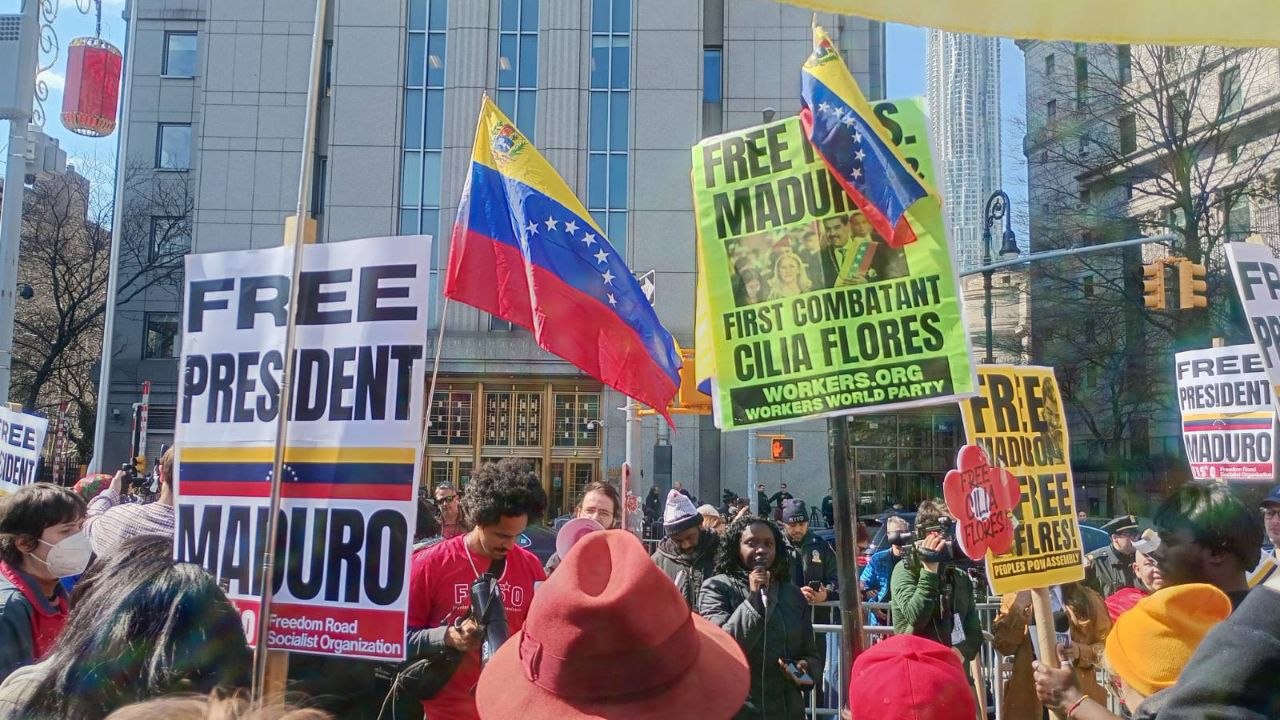
Solidarity activists gathered outside the courthouse and demanded the release of Maduro and Flores. (Katrina Kozarek / Venezuelanalysis)
Caracas, March 26, 2026 (venezuelanalysis.com) – US Judge Alvin Hellerstein ruled out dismissing the case against Venezuelan President Nicolás Maduro and First Lady Cilia Flores in a hearing on Thursday in Brooklyn.
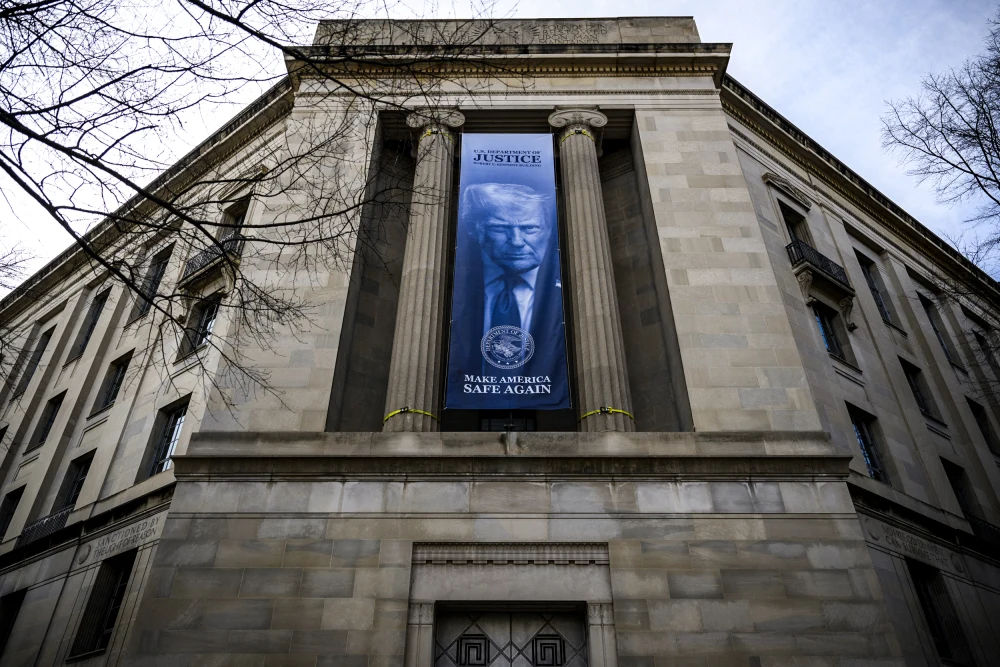
The defense team for Maduro and Flores—who face charges including drug trafficking conspiracy and weapons possession—requested that the case be thrown out after the US Treasury’s Office of Foreign Assets Control (OFAC) denied them authorization to use Venezuelan state funds to pay for legal counsel. OFAC had initially granted the license on February 9 but revoked it three hours later.
New York Southern District Judge Hellerstein declined to throw out the charges due to the blockaded funds, calling it “a serious step based on hypotheticals.” However, he did not formally rule and left the door open to revisit the decision in the future.
US Justice Department prosecutor Kyle Wirshba argued that allowing access to Venezuelan state funds would undermine existing sanctions policy, adding that if the defendants are unable to hire private attorneys, court-appointed counsel could be assigned. Maduro attorney Barry Pollack countered that such a measure would violate their Sixth Amendment right to choose their own legal representation.
During the hearing, Hellerstein challenged the prosecutors’ arguments, adding that OFAC’s personal sanctions against Maduro and Flores would also block them from using personal funds. The judge likewise disagreed with the prosecution’s claims that the blocking of funding for the defense was a matter of national security, stating that Maduro and Flores “no longer represent a threat.”
He further remarked that “things have changed” and that the United States is already “doing business” with Venezuela.
According to observers in the courthouse, Maduro and Flores, both in beige prison uniforms and handcuffed, appeared calm throughout the hearing, using headphones for simultaneous translation. Neither spoke. Observers noted that Maduro appeared thinner. Flores’ attorney, Mark Donnelly, made an urgent request for a medical evaluation, specifically an electrocardiogram, citing a pre-existing condition. The judge approved the request.
Hellerstein will set a new court date in the coming days. Maduro and Flores have not requested bail and were returned to the Metropolitan Detention Center in Brooklyn after the hearing.
Maduro and Flores, who is also a lawmaker, were kidnapped by US special forces during a military attack against Caracas on January 3. They pleaded not guilty at their arraignment two days later. Despite recurring “narcoterrorism” accusations over the years, US officials have not presented evidence tying high-ranking Venezuelan leaders to narcotics activities. Specialized agencies have consistently found Venezuela to play a marginal role in global drug trafficking.
Trump calls for additional ‘charges’
Prior to the hearing, US President Donald Trump argued before reporters that additional charges should be brought against the Venezuelan president.
“He emptied his prisons into our country, and I expect that at some point he will be charged for that,” he said. Trump has repeatedly raised unfounded claims that the Venezuelan government “emptied” prisons and mental institutions into US territory.
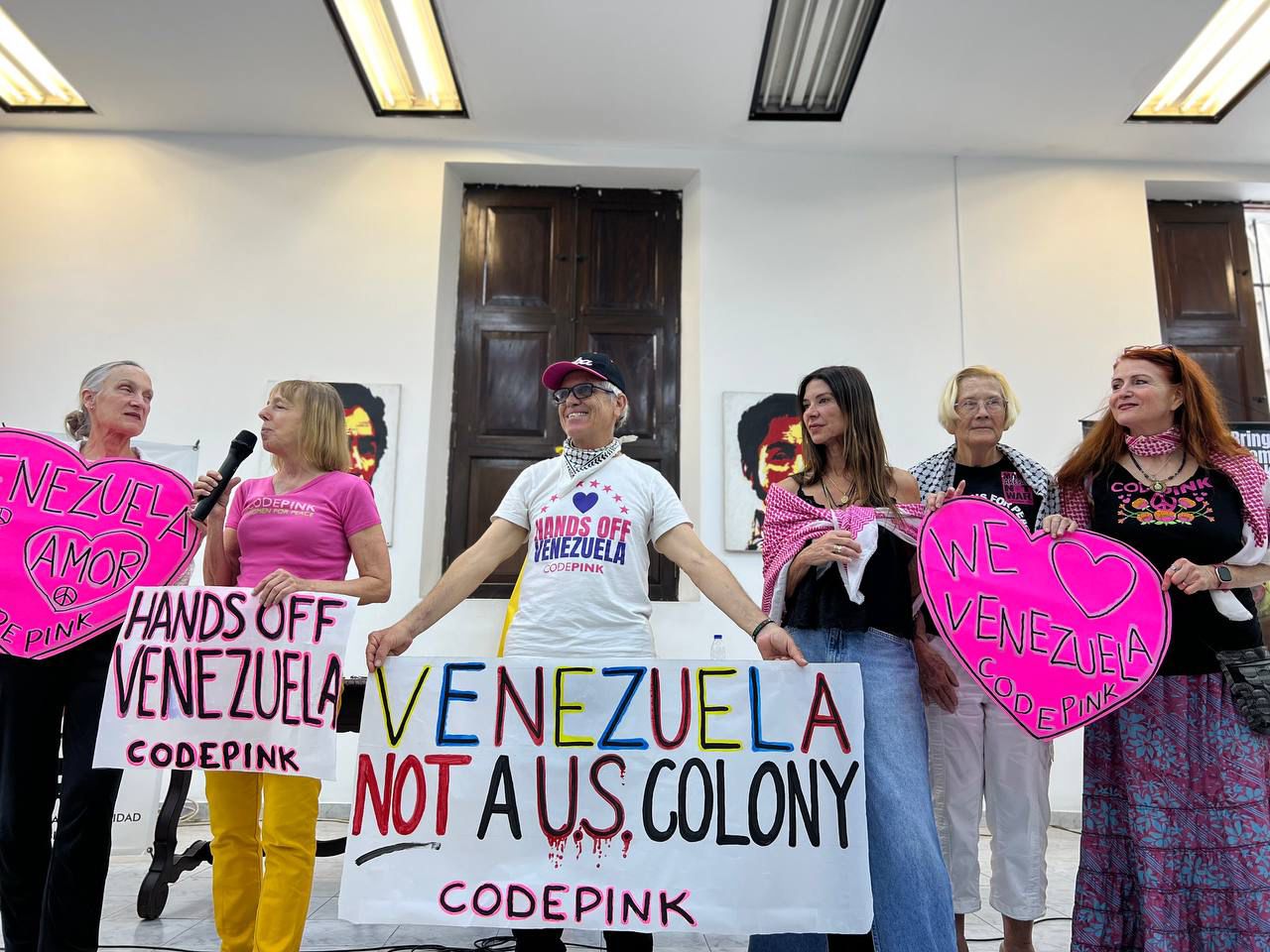
Outside the courthouse, a heavy police presence separated Venezuelan opposition supporters from solidarity activists demanding the release of Maduro and Flores and an end to US attacks against the Caribbean nation.
In Caracas, social movements gathered at Plaza Bolívar to express support for the president and first lady. The demonstration followed another mobilization earlier in the week demanding the lifting of US economic sanctions against Venezuela.
Speaking at the rally, lawmaker Nicolás Maduro Guerra—the president’s son and also facing US Justice Department charges—described his father as “a worker” who identifies “as a son of God above any political office.” Days earlier, in a social media post, Maduro Guerra had said his father would appear “in high spirits” and “in good shape” due to regular exercise.
He was joined by Caracas Mayor Carmen Meléndez, while the ruling United Socialist Party of Venezuela (PSUV) also called for Maduro’s release in a public statement.
For her part, Acting President Delcy Rodríguez has yet to comment on Thursday’s hearing. Venezuelan authorities have also not publicly addressed US efforts to block the funding of Maduro and Flores’ legal expenses.
Since January 3, the Rodríguez administration has led a diplomatic rapprochement with Washington, with several White House officials visiting Venezuela in recent weeks. A Venezuelan government delegation arrived in the US capital on Thursday, led by Vice Minister Oliver Blanco, who reported meetings with State Department officials to boost “mutually beneficial” relations.
The Trump administration has issued sanctions waivers while mandating that royalty and tax payments be made to US Treasury-run accounts. (Archive)
In the wake of Washington’s January 3 military attack and then problematic détente with Caracas, corporate media suggest a meaningful shift in Venezuela policy, implying relief for a country long subjected to economic coercion. However, far from dismantling the sanctions regime, the US has merely adjusted its application through licensing mechanisms, leaving the core structure of coercive measures fully intact.
Reutersreported “US lifts some Venezuela sanctions,” followed by news of sanctions being further “eased.” Both NBC News and ABC News likewise reported sanctions “eased,” while the Financial Times wrote that Washington “relaxes sanctions.” Reuters later found that “US waives many of the sanctions,” and the Los Angeles Times noted “targeted relief from sanctions.” The Washington Office on Latin America (WOLA) described a “huge easing of sanctions.”
Not a single sanction has been rescinded
In fact, there is no evidence of any revocation of executive orders, removal of Venezuela-related sanctions authorities, and certainly no formal termination or suspension of Washington’s sanctions regime.
At a February 21 meeting I attended in Venezuela, Anti-Blockade Vice Minister William Castillo described sanctions as a “policy of extermination.” These measures, “the most cruel aggression against our people,” had been renewed the day before by Trump. To do so, he had to certify the original mistruth first fabricated by Barack Obama in 2015: that Venezuela poses an “extraordinary threat” to US national security.
Castillo cited 1,087 measures imposed by the US and another 916 by its echo, the European Union. These unilateral coercive measures have a corrosive effect on popular support for the government, which is precisely the purpose of this form of collective punishment, illegal under international law.
In 2023, Castillo described Washington’s economic aggression as a means to destroy Venezuela without having to invade. The Bolivarian Revolution’s successful resistance, including positive GDP growth while under siege, suggests why the US felt compelled to escalate with a military incursion on January 3, killing over 100 and kidnapping the country’s lawful head of state and his wife.
In Castillo’s words, the US escalated from “a war without gunpowder…against the civilian population” to an actual one. As grave as the direct US military aggression has been – including 157 fatalities since last September in alleged drug interdictions of small craft in the Caribbean and eastern Pacific – the body count from the coercive economic measures has been far higher. Former UN Special Rapporteur Alfred de Zayas estimated that sanctions have caused over 100,000 excess deaths.
There is even a literal playbook on how to apply sanctions to inflict “pain” on civilians for “maximum effectiveness.” The author of The Art of Sanctions is Richard Nephew, a former US State Department senior official in the Biden administration who was responsible for implementing such policies.
Licenses vs. sanctions
What has happened in practice is a much more limited form of relief under the sanctions regime. The Treasury’s Office of Foreign Asset Control (OFAC) has issued broad licenses allowing certain dealings primarily with Venezuela’s state oil (PDVSA) and gold (Minerven) sectors.
OFAC licenses carve out limited exceptions principally benefitting US and other foreign corporations, not necessarily the Venezuelan people. Activities are authorized that would otherwise be illegal under US law, even though such activities are lawful under international law. They come with conditions, limits, and reporting requirements and can be revoked at any time.
In practical terms, sanctions remain in place, although certain transactions are temporarily allowed under strict licensing rules. “The result is a hybrid scheme in which formal sanctions and operational licenses coexist, enabling limited flows of economic activity,” according to Misión Verdad.
This flexible arrangement of sanctions combined with licenses allows US and other foreign corporations to make a profit off of the coercive system. Under sanctions alone, the targeted people overwhelmingly suffer but, secondarily, US and other corporations are shut out. Under this hybrid system, control is maintained and money is made.
However, most foreign investors are reluctant to make important investment decisions when there is uncertainty, especially given Mr. Trump’s mercurial reputation. A temporary license does not provide the security that corporations normally require. Recuperating the Venezuelan oil industry would necessitate “a gigantic investment.” Such investments will be unlikely if Venezuela is sanctioned, the licenses notwithstanding.
Media framing and blaming
Meanwhile, Venezuelan President Nicolás Maduro and “First Combatant” Cilia Flores remain in a New York City jail, reportedly in solitary confinement.
Regarding what happened on January 3, corporate media sources overwhelmingly use relatively anodyne terms such as “downfall,” “removal,” or “ouster,” rather than the more pointed “kidnapping” or “abduction.” When the legality of this clearly illegal act of war is questioned by either the media or by the Democrats, it is mainly confined to whether President Trump required congressional approval.
Likewise, application of international law regarding the illegality of unilateral coercive measures is largely absent from media coverage. Where legal issues appear, they tend to address mechanics (e.g., the US-controlled fund arrangement), rather than whether sanctions themselves violate international law.
When media outlets express concern about Washington’s restrictions, it is often that easing them would “reward Maduro loyalists.” While the plight of the Venezuelan people may be acknowledged, the blame is mainly attributed to corruption and economic mismanagement, with little if any opprobrium for sanctions.
As former political science professor at the Universidad de Oriente Steve Ellner (pers. comm.), notes, corruption and mismanagement do exist. But the overwhelming factor has been the sanctions regime. The blockade targeted Venezuela’s oil industry – at one point accounting for 99% of foreign-exchange earnings – forcing the country out of normal dollar-denominated markets and into black markets to survive.
What Alfred de Zayas dubs the “human rights industry” similarly exhibits a convenient blind spot regarding sanctions. WOLA, for example, advocates “addressing the complex humanitarian emergency.” Yet the NGO strongly opposes sanctions relief for the people, because the coercive measures are such an effective “pressure” tool on the leadership.
Former WOLA staffer David Smilde is preoccupied with “restoring” American-style democracy by imposing pressure on the “regime.” He argues: “The democratic transition in Venezuela…requires the support of international organizations.”
In contrast, acting President Delcy Rodríguez views ending interference by foreign actors in Venezuela’s internal affairs as a precondition for credible elections. In particular, she calls for the US “blockade and sanctions against Venezuela [to] cease.” With sanctions still in place, the US remains the biggest obstacle to free and fair elections in Venezuela.
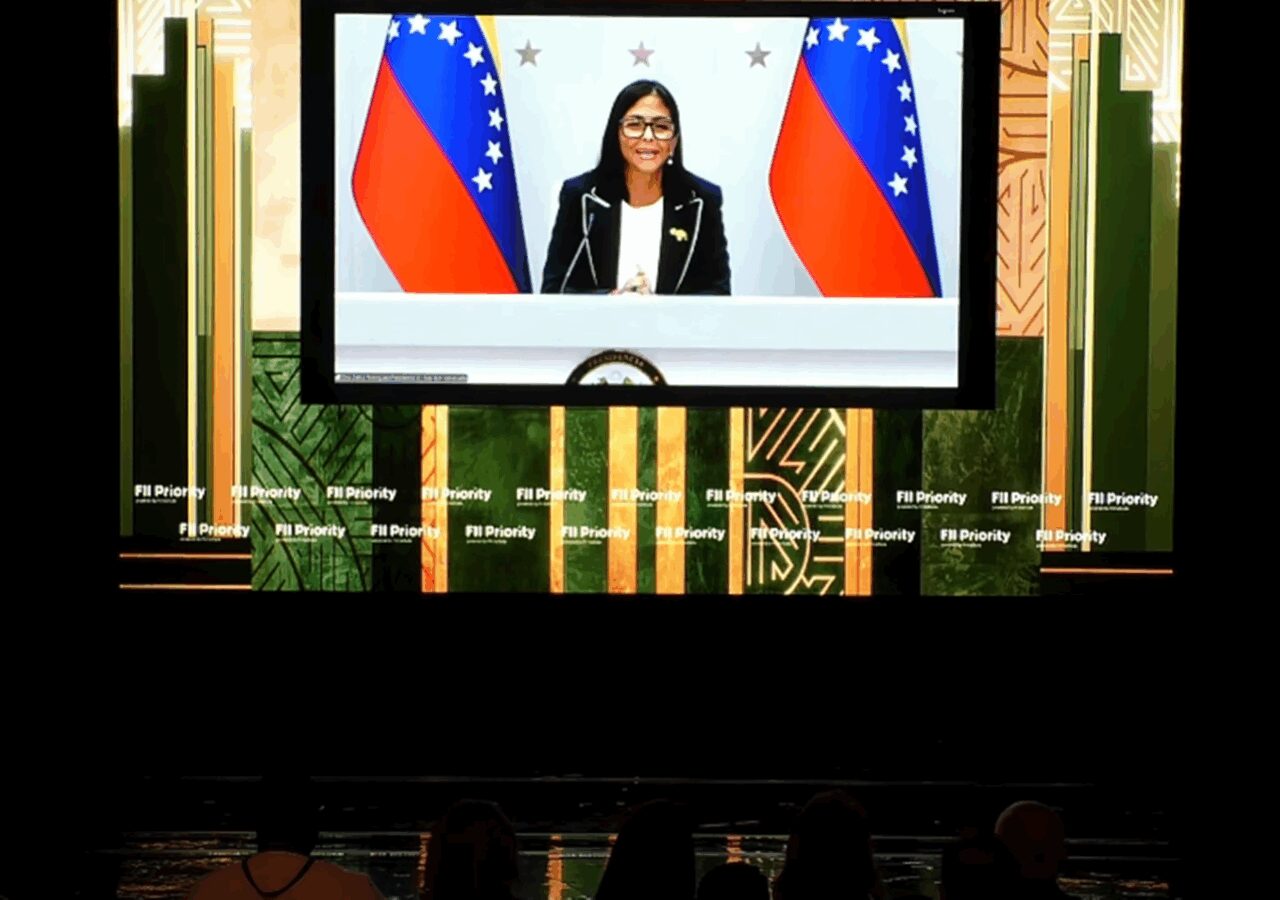
Rodríguez connected remotely to the FII Priority conference. (Archive)
Caracas, March 25, 2026 (venezuelanalysis.com) – Venezuelan Acting President Delcy Rodríguez has reiterated calls for foreign investment in the Caribbean nation.
Addressing the FII PRIORITY Miami Summit, Rodríguez showcased Venezuela’s economic growth and lauded the investment opportunities in the country’s vast oil, natural gas, gold, and other mineral resources. The Venezuelan leader highlighted the recent pro-business overhaul of the country’s Hydrocarbon Law and other upcoming reforms as key in generating “flexibility,” “guarantees,” and “security” for investors.
“The new Hydrocarbon Law creates important mechanisms for private sector control over production and commercialization,” Rodríguez said in her video message from Caracas. “It also creates flexible fiscal arrangements and establishes alternative conflict-resolution processes such as international arbitration.”
The acting president added that 64 percent of the price of a barrel is up for “negotiations with investors” in terms of reduced royalties and taxes, as well as dividends.
Approved in late January by the Venezuelan National Assembly, the new Hydrocarbon Law allows the executive to reduce taxes and royalties at its discretion. The reform also grants expanded control to private corporations, curtailing the state’s sovereignty over the industry established under Hugo Chávez under the 2001 Hydrocarbon Law and subsequent reforms.
In her remarks, Rodríguez urged “de-ideologization,” vowing, “regardless of different [political] views, a favorable climate can be created so that investors have the mechanisms so that their investments foster returns.” She added that she has met with representatives from 120 multinational corporations since January.
“Our reforms are a call for investors to participate,” Rodríguez stated. She went on to press for greater Latin American economic integration and for an end to unilateral sanctions against Venezuela, though she refrained from mentioning the US by name.
The Future Investment Initiative (FII) Institute is a non-profit run by Saudi Arabia’s Public Investment Fund and holds regular conferences bringing together business executives, analysts, and political leaders.
Rodríguez’s participation in the Saudi initiative came amid unprecedented energy market volatility as a result of the US and Israeli war against Iran. In spite of strong Venezuelan ties with Iran over the past 25 years, the Rodríguez administration has not taken a firm stance on the conflict, having published and later withdrawn a controversial statement. Caracas expressed solidarity with Qatar and the UAE after Iran retaliated against US military assets in the region.
The Venezuelan leader’s Wednesday message to investors in Miami followed a meeting with business executives at Miraflores Presidential Palace on Tuesday. The companies represented were not disclosed, though Houston-based oil giant Exxon Mobil has confirmed it has a team in Caracas “looking to assess the state of the resource that’s there.”
Rodríguez delivered a similar pitch hailing Venezuela’s natural resource potential and the prospects for foreign conglomerates opened by ongoing reforms. She appealed for the full lifting of sanctions, arguing that US Treasury licenses hurt investor confidence.
Since January, the Trump administration has issued a number of sanctions waivers allowing Western entities to engage with the Venezuelan energy and mining sectors. The licenses block transactions with companies from China, Cuba, Iran, North Korea, and Russia.
Additionally, the Treasury exemptions mandate that all royalty, tax, and dividend payments destined for Venezuelan state entities be deposited in US-run accounts. Washington currently controls Venezuelan oil proceeds, having returned a reported US $500 million, out of an initial $2 billion agreement, to Caracas.
On Tuesday, Rodríguez likewise announced the imminent departure of a Venezuelan diplomatic mission to Washington. Félix Plasencia, slated to become the country’s ambassador to the US, will lead the delegation.
“Our delegation will manage this new stage of diplomatic relations and dialogue between our two countries,” she affirmed.
Caracas and Washington fast-tracked a diplomatic rapprochement in the wake of the January 3 US attacks against Venezuela and kidnapping of President Nicolás Maduro and First Lady Cilia Flores. The two governments reestablished diplomatic relations in early March after a seven-year hiatus. The Trump administration went on to recognize Rodríguez as Venezuela’s “sole leader” days later.
Rodríguez, who had served as vice president since 2018, assumed the presidency in an acting capacity on January 5 with the endorsement of the Venezuelan National Assembly and Supreme Court, which declared Maduro’s absence as temporary.
Maduro and Flores pleaded not guilty to charges including drug trafficking conspiracy and will have a court hearing on Thursday. US officials have not presented evidence to sustain reiterated “narcoterrorism” accusations against Venezuelan leaders, while data from specialized agencies has found Venezuela to play a marginal role in global narcotics trafficking.
The oil reform and the stance regarding the war against Iran are key elements scrutinized. (EFE)
The early morning of January 3, 2026, marked a turning point in Venezuela’s recent history. An operation carried out by US forces combined airstrikes on Caracas and strategic military areas with a ground incursion that culminated in the abduction of President Nicolás Maduro and his wife, Cilia Flores, and their subsequent rendition to New York. The operation left more than 90 dead, including 32 members of the Cuban special forces who fought to protect Maduro, inflicting some damage on the imperialist forces before being killed.
While it is certainly strange that the United States could carry out the operation to kidnap Maduro and his wife without encountering significant resistance—beyond that offered by the innermost security ring, most of whom were of Cuban origin, like the aforementioned 32 martyrs—perhaps even more surprising are the statements made by Defense Minister Vladimir Padrino López. Weeks after Maduro’s kidnapping, Padrino asserted that it was impossible to deploy fighter jets at the time of the attack given the United States’ air superiority, with 150 aircraft. He thus acknowledged that, with the exception of the president’s personal guard and a few soldiers stationed near the residence, the Venezuelan Armed Forces did not respond to the imperialist aggression.
We cannot speculate on military matters, since we are not experts and do not have all the necessary information on the issue. That falls outside our purview. In any case, Padrino López’s own words and the events that unfolded during the attack indicate that, for some reason or another, the decision was made not to respond militarily to the Delta Force attack in the early hours of January 3 in Caracas.
To the surprise of many, Maduro’s abduction did not lead to an immediate or complete institutional collapse. Vice President Delcy Rodríguez assumed the interim presidency, backed by the Supreme Court and the National Assembly, headed by Jorge Rodríguez. This “two-pronged approach” allowed for a certain degree of formal stability to be maintained while the administration of the country’s strategic resources was reorganized and the implementation of policies to adapt to the new context was accelerated.
Coordination with Washington was immediate. On January 15, CIA Director John Ratcliffe – who just days earlier had overseen the aggressive operation alongside Donald Trump in Florida – visited Caracas and met with Delcy Rodríguez. A few days later, the reform of the Organic Law on Hydrocarbons was presented and approved. This timeline reveals an almost symbiotic alignment between Venezuelan authorities and the US administration aimed at ensuring that oil wealth flows under the empire’s supervision, while simultaneously safeguarding the interests of large corporations and international creditors. Whether this link is the result of betrayal or capitulation is, for now, irrelevant. However, what is becoming clearer every day is that, if this were a tactical retreat, it seems unlikely that it could be corrected without strategic direction. And the latter appears to be beyond the reach of the country’s new authorities.
The liquidation of oil sovereignty: from Chávez to Delcy Rodríguez
The recent reform of the Organic Law on Hydrocarbons (LOH) is not a minor amendment to the previous law, but rather the culmination of a process of gradual neoliberal regression that finally took shape in the substantial repeal of the 2001 law – a cornerstone of the Chavista social project and a historic achievement in the assertion of Venezuelan sovereignty.
The original 2001 law, enacted by Hugo Chávez as an Enabling Law, alongside subsequent reforms in 2006 and 2007, marked the peak of Venezuela’s oil nationalization. It established exclusive state ownership of hydrocarbons in the subsoil, PDVSA’s monopoly on international marketing, majority state control in all joint ventures, state planning of investment, and the priority allocation of revenue to social development.
Throughout the various phases of Maduro’s administration, and in the face of the economic crisis caused by brutal US-led sanctions, revenue-seeking policies were implemented in an effort to secure liquidity and foreign currency, which gradually eroded the Chavista socioeconomic structure. This laid the groundwork for the gradual privatization of national resources, even though commercial control and ownership of the oil remained formally in the hands of the state.
Furthermore, during the 2019–2024 period, Maduro granted operating licenses to Chevron and other foreign corporations that allowed for direct exploitation and marketing in certain areas, setting precedents for private control over production. These agreements, presented as “temporary exceptions” to revive output and alleviate the social burden of sanctions, established the framework of dependency that the 2026 reform ultimately consolidated legally.
The January 2026 reform promoted by the Delcy Rodríguez administration, designed in accordance with the requirements of January 9 Trump administration Executive Order 14373, completes this process of erosion and represents a substantial rollback of the economic foundations of Chavista social transformation. Many of the changes introduced reflect mechanisms imposed under the Anti-Blockade Law (2020) and the Special Economic Zones Law (2022), which loosened restrictions on the private sector’s role, primarily through broad tax exemptions and trade incentives, while the 2026 LOH eliminates any remaining obstacles to private operational control of that sector. Or, in other words: what under Maduro were exceptions designed to circumvent sanctions – particularly pressing in the context of the pandemic and post-pandemic period – are formalized in Rodríguez’s reform to institute open subordination.
First, the exclusive state ownership of hydrocarbons in the subsoil – which the 1999 Constitution reaffirmed as an inalienable principle and which even Maduro formally upheld – has been rendered meaningless. While Article 5 of the 2001 law stated that “hydrocarbons in the subsoil are the property of the Republic,” the 2026 reform establishes that foreign private operators can acquire property rights over production from the moment of extraction, allowing them to market it directly without the state involvement that characterized the original Chavista model. The qualitative difference from the Maduro era is that this direct commercialization is now generalized across the entire sector, and the geographical and temporal restrictions that maintained a prospect of state control have been eliminated.
Second, the reform permanently eliminates the state monopoly on international commercialization. The 2001 law and subsequent reforms stipulated that PDVSA was the only entity authorized to export. The 2026 reform allows Western conglomerates such as Chevron, ExxonMobil, Shell, and Repsol to directly market all or portions of production, thereby undermining the state’s sovereign authority to decide to whom to sell, under what conditions, and at what price. Private companies now determine the destination of shipments, negotiating directly with refiners and distributors, while the Venezuelan state receives only royalties and dividends subject to external control mechanisms.
This commercial subordination is further reinforced by a restrictive framework imposed by Washington: General Licenses 46, 50A, and 52 issued by the US Office of Foreign Assets Control (OFAC) strictly prohibit Venezuelan crude oil from reaching entities based in Russia, China, Iran, North Korea, or Cuba, extending the ban to any company that maintains ties of ownership or control with individuals from those countries. Far from restoring commercial autonomy, the 2026 reform institutionalizes these barriers: while transnational corporations are given carte blanche to negotiate directly with Western refiners, all transactions with Chavismo’s historical partners remain prohibited. The Venezuelan state is reduced to collecting royalties under foreign supervision, with no capacity to direct oil flows toward those markets that for years guaranteed the sustainability of the Bolivarian project. This leads to a situation as deplorable as it is surreal, where the Zionist entity has been able to receive Venezuelan crude without hindrance, while Cuba is left helpless against Washington’s strangulation.
Third, the reform abolishes state control over investment and exploitation. The 2001 law reserved for the state the right to plan investment. The 2026 reform allows private operators to unilaterally determine investment levels, the technology to be used, and reserve policy, eliminating any need for approval from Venezuelan authorities beforehand. Foreign companies acquire the right to import equipment and personnel without restrictions, operating under a regime of fiscal and legal extraterritoriality.
Fourth, the reform dismantles the framework for protecting social investments. The 2001 law stipulated that oil revenues must be allocated primarily to economic and social development. The 2026 reform includes provisions allowing for international arbitration to resolve disputes, prioritizing the protection of private investments over any social claims. Funds derived from oil production are subject to foreign control mechanisms.
Lastly, the aforementioned OFAC licenses effectively establish an architecture of fiscal subordination that privileges foreign interests, with Venezuelan oil proceeds deposited in US Treasury-run accounts. By accepting these licenses – and with the additional stipulations of the reform – the Delcy Rodríguez administration is effectively subject to mechanisms for external validation of its budgets.
Oil reform and foreign oversight are not isolated processes: they constitute a neocolonial arrangement disguised as economic normalization, which maintains formal sovereignty while relinquishing operational control. In strategic terms, Venezuela has gone from being an actor with a relative capacity to define its energy policy— despite sanctions and threats — to a subordinate whose critical decisions are dictated by the United States.
Condemning Iran: geopolitical alignment as submission
Structural subordination is also evident in foreign policy. In the face of the recent imperialist aggression against Iran, launched jointly by the United States and the Zionist entity on February 28, 2026, which left more than 200 dead in the first few hours (including 148 girls killed in the bombing of an elementary school in Minab), the Delcy Rodríguez government rushed to abandon its traditional alliance with Tehran.
In an initial statement, it took a stance condemning both the imperialist aggression and the response of the attacked country, falling into a shameful and ridiculous position of neutrality. This official statement, issued on February 28 stated that the Venezuelan government “condemns and deeply regrets that the military option was taken against Iran” and expressed dismay over the civilian casualties. However, the text then went on to refer to “Iran’s inappropriate and reprehensible military reprisals against targets in various countries in the region.” In doing so, the Delcy Rodríguez administration denied the bombed country the right to self-defense, placing the aggressor and the victim on the same level.
This statement, which Foreign Minister Yván Gil ended up deleting from his social media accounts hours later, marks a definitive break with the anti-imperialist stance that Venezuela had been building for two decades. The condemnation of the response by Tehran – a historic ally of Chavismo and high-level strategic partner since 2022 – shows that alignment with imperialism is now a fait accompli.
The Venezuelan communiqué cannot be understood without considering the context: the complete opening of the oil sector to foreign capital, the aforementioned reception in Caracas of the CIA director, and the subsequent arrival of US Chargé d’Affaires Laura Dogu as a diplomatic representative, along with visits by US Secretary of Energy Chris Wright, US Interior Secretary Doug Bergum, and the head of US Southern Command, General Francis Donovan; all within a few weeks, prior to Trump’s own recognition of Delcy Rodríguez as Venezuela’s president.
The Rodríguez administration not only hands over the oil and refuses to stand up to the empire, but also politically legitimizes US hegemony, breaking with the internationalist and popular legacy that Chavismo had always fostered, defended, and pushed forward. The condemnation of the Iranian resistance – which undoubtedly amounts to a condemnation of the entire anti-Zionist Axis of Resistance and all peoples oppressed by the colonial entity – is presented as “international responsibility” and a “commitment to peace.” The new Venezuelan administration thus disguises its surrender of diplomatic sovereignty and buries the solidarity-driven, internationalist Venezuela that Chavismo led, both during Chávez’s and Maduro’s tenures.
Cabral’s Dilemma: betrayal of the Chavista project or class suicide
To fully understand what has happened in Venezuela, it is quite helpful to examine it in light of the political theory of Amílcar Cabral, the independence leader of Guinea-Bissau and Cabo Verde and one of the most incisive thinkers of African and Third World liberation. Cabral first formulated the concept of “class suicide” in his 1964 message to Guinean militiamen, later developing it in numerous speeches throughout the 1960s and 1970s, particularly in his address, “The Weapon of Theory,” delivered at the First Tricontinental Conference of the Peoples of Asia, Africa, and Latin America, held in Havana in January 1966.
In the context of Guinea-Bissau’s liberation struggle, Cabral further developed this theory by applying it to that specific reality in his work Guinea-Bissau: An African Nation Forged in Struggle, posthumously published in 1974. The Guinean petty bourgeoisie, formed under the Portuguese colonial administration, had to choose between joining the African Party for the Independence of Guinea and Cabo Verde (PAIGC) and its peasant base, renouncing their privileges as colonial officials, or remaining on the sidelines and eventually collaborating with Portugal. Cabral had no illusions about the difficulties of this choice. The historical dilemma of this petty bourgeoisie, according to Cabral, is strictly binary: “either it betrays the Revolution or it commits suicide as a class.” There is no third way, no middle ground, and no possible compromise. Any attempt to maintain a neutral stance ends, sooner or later, in subordination to imperialism and the betrayal of national interests.
Class suicide did not mean the physical disappearance of individuals, but rather the destruction of their particular class status. It entailed a radical and conscious transformation. As Cabral explained, the petty bourgeoisie had to “renounce the class position it occupies in social life” and “integrate itself with the popular forces – that is, with the workers and the peasants.” In other words: voluntarily abandon their privileges as an intermediate class, cease to be a class separate and distinct from the people, and fully identify with the popular forces as part of a project of national and social liberation.
The betrayal of the revolution – the other option in this dilemma – occurs when the bourgeoisie preserves its class existence and its intermediary privileges through subordination to imperialism. It does not renounce its position, does not identify with the people, and does not dismantle its networks of privilege. On the contrary, it negotiates its corporate survival with the enemy, becoming a comprador bourgeoisie. This betrayal is not always explicit or conscious. It often presents itself as “realism,” “pragmatism,” or “tacticism.” But its result is always the same: the consolidation of structural dependence and the blocking of any emancipatory project aimed at true sovereign independence, an indispensable requirement for delinking from the imperialist system.
The theory of class suicide has profound methodological implications for political analysis. First, it establishes that national liberation cannot be led by the national bourgeoisie or by the petty bourgeoisie unless they have committed class suicide. Second, it demonstrates that formal independence does not equate to real liberation if the political leadership retains its character as a subordinate intermediary class. Third, it points out that the class struggle continues during the revolutionary process and that the principal contradiction is not always between the people and external colonialism, but also between the people and their own leadership that resists class suicide.
What sets the Venezuelan case apart is that the petty bourgeoisie – whether treacherous or capitulationist – is not the traditional colonial class that Cabral analyzed, but rather a bureaucratic bourgeoisie forged in the very process of revolutionary change. Over two decades of Chavismo, this class has accumulated experience in state administration, built autonomous power networks, developed a distinct corporate identity, and created a social base of support. Class suicide would mean renouncing all this historical accumulation, dissolving into the popular masses, and reconfiguring the project from the ground up by aligning with the proletariat and the communal project. Betrayal, on the other hand, allows for the preservation of bureaucratic and clientelist power structures by adapting them to the new framework of subordination. A bureaucratic bourgeoisie that controls the state and oil revenues has its own material interests that may conflict with a direct confrontation against imperialism.
In the wake of the rapid and radical changes implemented by the Delcy Rodríguez administration that we have described, we can observe with bitterness how the national bourgeoisie has ceased to administer independence – the original purpose of the Chavista project – and has instead come to manage dependence.
All of this is being presented, as one would expect, under the guise of Bolivarian continuity, the preservation of symbols, and rhetoric about historical responsibility, all of which serve to obscure the surrender of oil revenues to imperialist control, demolishing what was once the cornerstone of the Chavista social project. This is accompanied by a rupture or abandonment of historic alliances such as with Iran and Cuba, with national resources destined for the Zionist entity without question, in a shameful capitulation to US interests.
The 2026 oil reform is the key element of this submission: state ownership of oil – a pillar of the sovereign development project – is being dismantled in favor of corporate control and placed at the mercy of the US Treasury. This constitutes a sophisticated form of neocolonial domination because it hinders resistance to the brutal imperial agenda. Indeed, the masses are not facing an enemy in the form of a foreign occupation, but rather an elite that speaks their language, appropriates their symbols and folklore, and maintains a patriotic rhetoric, all while systematically dismantling the core foundations that Chavismo built over decades in its quest for a historic break with dependency.
Conclusion
The history of liberation struggles teaches us that if the revolutionary project is the lighthouse, the revolutionary class must be its operator. As such, its cause must be anchored in a historical strategy capable of guiding even the most difficult tactical retreats. But there can be no tactical retreat without strategy, nor strategy without the material foundations on which to sustain it. Economic independence is not a mere ideological ornament of the revolutionary process: it is its condition of possibility. When a nation’s sources of wealth are handed over to the empire’s management, when the revenue that fueled the social project is subjected to external control, and when the state voluntarily relinquishes the instruments that allowed it to decide on its own development, there is no room left for future strategic maneuvering. What is presented as prudence or realism is nothing more than, at best, the institutionalization of capitulation; at worst, of betrayal.
Those same processes of national liberation have also shown that no revolution has survived without cadres willing to take on the risks demanded by the confrontation with imperial power. Revolutionary leaders are not called upon merely to manage structures, but to embody a historic will capable of sustaining the conflict to its final consequences. In the early hours of January 3, as the Venezuelan state apparatus sealed its commitment to servile negotiation, those willing to give their lives for that cause were the Venezuelan soldiers and 32 Cuban internationalists who fell defending the presidential residence. And in that event, both brutal and symbolic, lies the essence of the dilemma Cabral articulated decades ago: in the face of imperialism, there is no lasting middle ground between class suicide and betrayal. Everything else – the rhetoric, the symbols, the appeals to tactics – are merely transient ways of naming a decision that, sooner or later, history ultimately reveals.
Joan López and Alejandro Pedregal are members of the Anti-Imperialist Network (AIN), anti-imperialist.net.
The views expressed in this article are the authors’ own and do not necessarily reflect those of the Venezuelanalysis editorial staff.
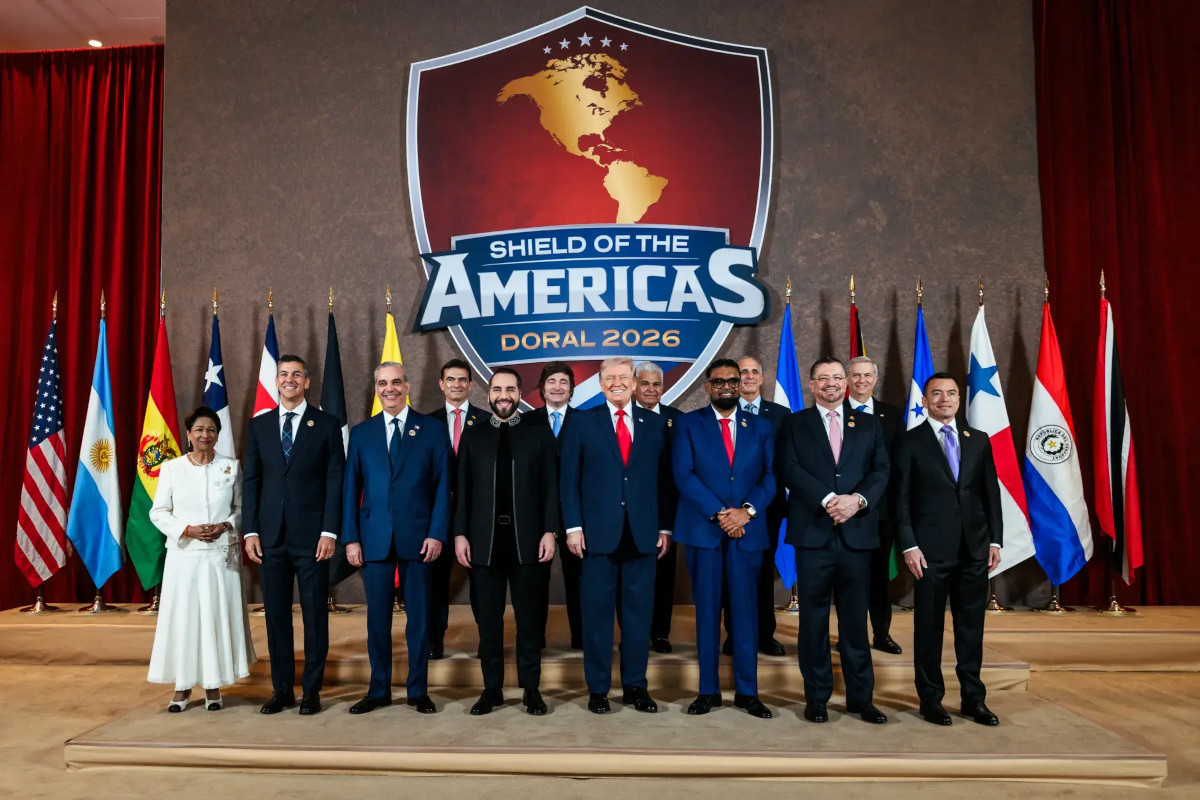
Trump gathered loyal Latin American allies for a “Shield of the Americas” summit. (Archive)
The “Trump Corollary” to the Monroe Doctrine is a central feature of U.S. strategy designed to secure hegemony and limit Chinese and Russian influence in Latin America and the Caribbean. It does not, however, represent a decisive shift in Washington’s relations with the region. Although the corollary does not make this explicit in its formal statement, in practice it makes more evident what liberal rhetoric has long sought to mask: military and covert interventions aimed at preserving U.S. domination in the Western Hemisphere, undermining progressive movements and governments, and backing right-wing regimes. In this sense, it abandons even the pretense of respect for international law and human rights. In what follows we argue that the Trump Corollary constitutes not only an ideological and imperialist offensive against decolonial and multipolar currents in Latin America, but also a strategic project whose assault on Venezuela has broader geopolitical implications.
The ideological backdrop
Although Washington’s unrestrained militarism, which enjoys bipartisan support, is indeed cause for alarm, the erosion of even the pretense of commitment to liberal-democratic values, human rights, and international law did not begin with the Trump administration. The live-streamed Israeli genocide in Gaza, enabled and backed by the Biden administration, has made this difficult to deny. Moreover, it highlights how the U.S.-European axis has normalized impunity for systematic violence against non-combatants. This erosion of even its own professed liberal values has helped consolidate a political climate in which the Trump administration could intensify its offensives against Venezuela and Cuba and pursue a war of aggression against Iran.
This normalization of necropolitics can be better understood through the ideological logic used to justify it. We can make sense of this logic by distinguishing between two different tendencies within Western Eurocentric modernity. On the one hand is the myth of European supremacy, what Enrique Dussel calls the “developmentalist fallacy,” which has been used to justify colonization, with its racial hierarchy, since the invasion of Amerindia in 1492. On the other is a rational, emancipatory current rooted in ideas of community, equality, and liberty. As critical historians have shown, these emancipatory traditions did not originate solely in Europe; they were also present among some Indigenous peoples, such as the Haudenosaunee Confederacy, whose Great Law of Peace established participatory forms of government centuries before European contact. Historically, these ideals were never extended fully to colonized peoples, nor to people of color within the metropole. This contradiction persists. Washington’s recent rhetoric justifying attacks on Venezuela, Cuba, and Iran expresses the colonial, violent side of modernity while discarding its emancipatory, humanist dimensions.
Civilizational rhetoric and the objectives of the Trump Corollary
It is this myth of European supremacy, often expressed with religious fervor even when stripped of its humanist facade, that serves as the ideological justification for the offensives launched this year. This worldview was crystallized in a speech delivered by Secretary of State Marco Rubio at the 62nd Munich Security Conference on February 14, 2026. That speech anticipated the inauguration in Miami, on March 7, of Shield of the Americas, a new U.S. partnership with right-wing allies in Latin America and the Caribbean, to be led by former Secretary of DHS Kristi Noem. Rubio, in effect, called for a rejection of historical accountability, stating:
We do not want our allies to be shackled by guilt and shame. We want allies who are proud of their culture and of their heritage, who understand that we are heirs to the same great and noble civilization, and who, together with us, are willing and able to defend it. . . . The great Western empires had entered into terminal decline, accelerated by godless communist revolutions and by anti-colonial uprisings that would transform the world and drape the red hammer and sickle across vast swaths of the map in the years to come.
This rhetoric illustrates Rubio’s disdain for anti-colonial struggles that commenced not with the Cold War and communism, but at the very start of the European invasions of Amerindia. Indeed, the “guilt and shame” surrounding the subjugation and exploitation of Indigenous peoples was expressed as early as the sixteenth century, when Bartolomé de Las Casas documented and denounced the tortures inflicted upon them in the name of a European civilizing mission. The same civilizational appeal surfaced again at the Miami summit, where Secretary of Defense Pete Hegseth called upon members of the Shield to defend their shared cultures and, in particular, “Western Christian civilization.” By casting anti-colonialism as an insidious force, Rubio’s rhetoric functions to blunt decolonial critiques of the Trump Corollary.
Despite Washington’s zeal for exporting Western ideals, decolonizing currents in Latin America’s political, economic, social, and cultural life have taken deep root. Since the 1960s, Marxism, along with liberation theology, liberation philosophy, and Indigenous struggles for self-governance, have helped articulate ethical and political critiques of colonial domination, racial hierarchy, and dependent forms of development from the perspective of the Global South. Indigenous cosmovisions and the philosophy of buen vivir have influenced constitutional and political life in the region and beyond. For example, the United Nations now recognizes the concept of the rights of nature as central to sustainable development. The recognition of the rights of Mother Earth has also been incorporated into the constitutions of both Bolivia and Ecuador, and the plurality of Indigenous and Afro-descendent nationalities is recognized in several Latin American constitutions.
The Trump Corollary emerges in direct opposition to these decolonial currents. It seeks to restore U.S. primacy over the hemisphere’s governance and resources by curtailing the region’s expanding commercial and diplomatic ties with China, Russia, and other non-Western partners. To advance this agenda, Washington has worked to destabilize or overthrow progressive governments while favoring right-wing administrations more aligned with its interests, in some cases through intimidation, electoral interference, or direct military intervention. Much like the Alliance for Progress, Operation Condor, and the invasion of Panama before it, this latest evolution of the Monroe Doctrine invokes the pretext of security to reassert Washington’s influence over hemispheric political and economic life while limiting the region’s turn toward greater autonomy. Yet that effort confronts a regional reality that Washington cannot easily reverse. Trade relations transcend political divisions in Latin America and the Caribbean. And in South America, China has become the principal trading partner for much of the subregion. This complicates Washington’s efforts to rein in Latin America’s turn toward multipolarity. China’s Third Policy Paper on Latin America and the Caribbean presents the region as an “essential force” in the move toward a multipolar world and economic globalization, and describes the bilateral relationship in terms of equality, mutual benefit, openness, and shared well-being. This stated approach stands in clear contrast to the Trump Corollary’s posture of coercion, Western supremacy, and geopolitical subordination. It is, in part, this regional turn toward multipolarity that the assault on Venezuela seeks to counter.
Venezuela: The central case
The violent reality of the Trump Corollary has been most clearly revealed in Venezuela. Washington’s campaign of deadly strikes against maritime vessels in the Caribbean, a series of extrajudicial killings that claimed the lives of more than 145 people, served as a prelude to the January 3 surprise aerial assault on Caracas, named Operation Absolute Resolve. The maritime victims included people from nations such as Colombia, Saint Lucia, Trinidad and Tobago, and Venezuela who were targeted without public evidence of narco-trafficking or due process. Operation Absolute Resolve itself claimed the lives of more than 120 people, including civilians and security forces, and culminated in the kidnapping of President Nicolás Maduro and First Lady Cilia Flores. In Venezuela, the Trump Corollary deploys military force, coercive diplomacy, and control over strategic resources. It also deals a blow to the Bolivarian cause by making an example of a state that has stood as the leading force of regional independence and integration for more than two decades.
Rather than moving, in the short term, to dismantle Chavista institutions, as many Venezuelan opposition hard-liners in Miami and Madrid expected, the Trump administration in the aftermath of Operation Absolute Resolve instead has resorted to “deal-making” with Acting President Delcy Rodríguez. The recognition of interim president Delcy Rodríguez as “the sole Head of State” of Venezuela might be part of an effort by the Trump administration to strip President Nicolás Maduro and First Lady Cilia Flores of the presidential immunity to which they are entitled. Despite Trump’s praise for a supposedly mutually beneficial relationship with the Chavista government, this is not a win-win situation. Acting President Rodríguez is attempting to balance Washington’s demands for unfettered access to the country’s natural resources with Venezuela’s own economic interests and the long-term survival of the Bolivarian Revolution. That coercive political context also affects the economic arrangements now taking shape in Venezuela.
As new economic agreements are being “negotiated,” major Venezuelan state assets previously frozen, seized, or placed beyond Caracas’s control remain unrecovered. Prior to Operation Absolute Resolve, the U.S. seized Venezuelan aircraft and targeted ships carrying Venezuelan oil that U.S. authorities said were involved in sanctions evasion. The most egregious case is that of Citgo, Venezuela’s most valuable foreign asset. Caracas has already lost real control over it, and U.S. courts are now overseeing proceedings that could permanently strip Venezuela of ownership to pay creditors.
More recently, a series of Trump administration officials have gone to Caracas to press for greater U.S. influence over Venezuela’s oil industry. They have also “negotiated” with the Chavista government to bring about legal reforms that will facilitate U.S. investment in the extraction of critical minerals and other natural resources. According to Venezuela Analysis (02/20/26), “The Trump administration is forcing all royalty, tax, and dividend payments from Venezuelan oil production [to] be paid into accounts managed by Washington.” For Venezuelan critics of U.S. intervention, these arrangements may result in a significant transfer of national wealth under pressure. Other observers argue that renewed investment could bring Venezuela badly needed revenues. In any case, there is no doubt that these economic arrangements are being carried out in a coercive context.
Regional extensions of the corollary
The offensive against Venezuela did not occur in isolation. It was soon followed by a strangling energy embargo on Cuba designed to provoke a humanitarian crisis to bring about “regime change.” After more than sixty-six years of U.S. embargo against Cuba, this latest escalation is intended not only to destabilize and isolate the island but also to shatter the morale of the forces of resistance throughout the region. At the same time, it has galvanized worldwide solidarity, despite the betrayals of governments that have succumbed to U.S. pressure to expel Cuban doctors and dismantle other forms of Cuban internationalist assistance. Meanwhile, the administration has been pressuring Mexico with the specter of unilateral military strikes against drug cartels, signaling a disregard for Mexico’s repeated insistence on its own sovereignty. In Colombia, Washington antagonized President Gustavo Petro with politically charged drug-trafficking allegations and threats of military intervention, a confrontational posture that later gave way to rapprochement after Petro met with Trump at the White House. In Honduras, the U.S. intervened to back the presidency of the right-wing candidate Nasry “Tito” Asfura who won the presidential election in December 2025 and took office on January 27.
The latest example of this interventionist regional posture was the U.S.-Ecuadorian military operation launched on March 3, which conducted bombings near the Colombian border in northeastern Ecuador, ostensibly aimed at narco-terrorists and illegal mining. In Ecuador, as in Peru, small-scale artisanal mining is often practiced within Indigenous communities living near mineral deposits and employs methods with a far lighter environmental impact than industrial-scale extraction. Whatever its stated purpose, the operation may have the effect of displacing artisanal mining and opening mineral-rich territory to large North American transnational corporations. In brief, by convening twelve compliant right-wing regional leaders in Miami, the Shield of the Americas summit serves to institutionalize Washington’s renewed drive toward regional hegemony. But the significance of this offensive is not only regional.
Geopolitical implications
The Trump Corollary has geopolitical importance because the recent offensive to consolidate U.S. hegemony in the Americas has served as a strategic prelude to the U.S.-Israeli war against Iran. The offensive in Venezuela not only stops Venezuelan crude from reaching Cuba, thereby sharpening the knife of the subsequent energy embargo, but also secures strategic leverage over the largest oil reserves in the world ahead of Iran’s restrictions on passage through the Strait of Hormuz. In this sense, Venezuela is not peripheral to the wider conflict, but central to it. This does not, however, mean that the Trump administration ever had a clear, coherent rationale for starting this war of aggression against Iran.
The ever-shifting rationale for the war was at first framed in terms of protecting demonstrators in Iran, then became an effort to overthrow the government, and has now dissolved into incoherence, with no consistent justification offered at all. In any case, the war may also carry broader geopolitical implications, insofar as prolonged disruption in Gulf oil exports would place pressure on China, whose energy needs depend heavily on Middle Eastern crude shipments. It is also beginning to generate visible political strains within NATO, as doubts about the direction of the war grow in Europe, with Spain as the clearest example. It has likewise raised concerns among some U.S. allies in the Gulf about the wisdom of continuing to host major U.S. bases.
Taken together, the shifting rationale for the war, the U.S.-Israeli callous disregard for civilian life and infrastructure, its mounting economic costs, and the danger that the conflict could spiral out of control and raise the specter of the possible deployment of nuclear weapons suggest that the decision to wage war on Iran was a profound miscalculation, one harmful not only to Iran and the wider region, but also to the people of the U.S. and the global economy. It also exhibits in stark relief the same colonial ideology that underlies the Trump Corollary. For these reasons, opposition to the war, as well as to the Trump Corollary, is growing both at home and abroad.
William Camacaro is a Venezuelan-American National Co-Coordinator in the Alliance for Global Justice. He was a co-founder of the Bolivarian Circle of New York “Alberto Lovera” and Senior Analyst for the Council on Hemispheric Affairs (COHA). He holds a Master’s Degree of Fine Arts and a Master’s Degree in Latin American Literature from City University of New York. William has published in the Monthly Review, Counterpunch, COHA, the Afro-America Magazine, Ecology, Orinoco Tribune and other venues. He has organized delegations to Ecuador, Bolivia and Venezuela. He has been a long-time activist for social justice in the United States, such as organizing protests against police brutality in NYC, for the independence of Puerto Rico, and for the freedom of political prisoners. William has also been a leader in defense of progressive governments and social movements in Latin America.
Frederick B. Mills, Ph.D., is professor of philosophy and a member of the Philosophy of Liberation Association and the American Philosophical Association. He has received awards for excellence in teaching and international outreach from Bowie State University. Mills has published articles on philosophy of mind, ethics and public policy, Descartes, Spinoza, Kant, Sartre, Merleau-Ponty, Mario Bencastro, Enrique Dussel as well as political analysis on contemporary Latin American politics. He has contributed articles to Counterpunch, the Council on Hemispheric Affairs, and other independent media.
The views expressed in this article are the author’s own and do not necessarily reflect those of the Venezuelanalysis editorial staff.
Chevron, Eni, Repsol, and Shell have struck energy agreements under the favorable conditions of the recent legislative reform. (Reuters)
Caracas, March 20, 2026 (venezuelanalysis.com) – The US Treasury Department has issued a new sanctions waiver as the Trump administration seeks to deepen US control over Venezuela’s oil sector.
General License 52 (GL52), published on Wednesday, authorizes US entities to engage in transactions with Venezuelan state oil company PDVSA under conditions that limit Venezuelan sovereignty.
An updated FAQ from the Treasury’s Office of Foreign Assets Control clarified that the exemption allows US companies to engage in activities related to the exportation of Venezuelan-origin oil products, export diluents and inputs to Venezuela as well as enter into new contracts for oil and gas production.
However, in line with recent US licenses, GL52 mandates that all tax, royalty, and dividend payments be made into US Treasury-controlled accounts.
Following the January 3 US military strikes and kidnapping of Venezuelan President Nicolás Maduro, the Trump administration has taken control over Venezuelan crude exports while imposing conditions favorable to Western energy conglomerates.
Thus far, Washington has returned US $500 million out of an initial January deal worth $2 billion. US authorities have also confirmed Venezuelan imports of US-manufactured medicines and medical equipment. Trump officials had vowed that US energy revenues could only be used for purchases from US suppliers and that Caracas would need to submit a “budget request” to access its funds.
The White House issued GL52 amid soaring energy prices caused by the US and Israeli war against Iran. Tehran has responded to massive bombings by targeting US military assets in the region and closing the strategic Strait of Hormuz.
Last week, the US Treasury amended licenses to allow US imports of fertilizers from Venezuela, as well as repair works in the South American country’s electric grid. Venezuela’s electrical infrastructure remains in a precarious state after years of US sanctions, and expanded power capacity is a precondition for recovery of the oil industry.
Despite the broadened waivers for corporations hand-picked by the White House to engage with Venezuela, PDVSA and its subsidiaries remain under financial sanctions, while third-country firms risk secondary sanctions should they enter into agreements without a US Treasury special license.
In late January, Venezuelan authorities approved a pro-business overhaul of the country’s Hydrocarbon Law, granting private companies reduced fiscal responsibilities, increased control over production and exports, and the possibility of taking disputes to international arbitration bodies.
Chevron and Shell, with US Treasury approval, were the first companies to take advantage of the new incentives. Chevron’s Petropiar joint venture with PDVSA was granted a new 500 square-kilometer bloc to drill for extra-heavy crude in the Orinoco Oil Belt, while Shell is set to take over light and medium crude and natural gas operations in the eastern state of Monagas.
Last week, European energy giants Eni and Repsol, who were also given the inside track by the White House, announced an agreement with the Venezuelan government for the development of the Cardón IV offshore natural gas project.
Eni and Repsol each own 50 percent stakes in Cardón IV, which has been in operation since 2009. Neither firm nor Caracas offered details on the renewed agreement, though both enterprises had lobbied for improved conditions and mechanisms to recoup accumulated debt due to US sanctions.
According to Bloomberg, ONGC Videsh (India), Maha Capital AB (Sweden), and J&F Investimentos (Brazil) are among the companies likely to receive special licenses for involvement in Venezuela’s oil sector as Washington seeks to counter rising crude prices. Nevertheless, analysts stress that the Venezuelan oil industry does not have the capacity to significantly ramp up output in the near future.
On March 11, the Trump administration formally recognized Acting President Delcy Rodríguez as Venezuela’s “sole authority,” days after Venezuela and the US reestablished diplomatic ties following a seven-year hiatus.
On Monday, Rodríguez appointed new executive boards for PDVSA’s US-based affiliates, including refiner CITGO. Asdrúbal Chávez, who held multiple roles in both PDVSA and CITGO since the 2000s, was picked as president of CITGO and its parent company, PDV Holding. At the time of writing, US authorities have not commented on the proposed new leadership for the companies, which had been run by the US-backed opposition since 2019.
CITGO is currently in the closing stages of a court-mandated auction that will see Venezuela lose ownership of its most prized foreign asset to address creditor claims against the country. The sale to Amber Energy, a subsidiary of vulture fund Elliott Management, is pending authorization from the US Treasury Department.
Venezuelans took to the streets to celebrate the WBC title. (AFP)
Caracas, March 18, 2026 (venezuelanalysis.com) – Venezuela won the World Baseball Classic after defeating the United States 3–2 on Tuesday at LoanDepot Park in Miami.
The Caribbean nation’s first major international baseball title was secured thanks to a decisive double by Eugenio Suárez that broke a tie in the top of the ninth inning.
“I have no words. Seeing Javier (Sanoja) score on my double in the ninth was the greatest moment of my life. We knew we could do it. Nobody believed in Venezuela, but now we are the champions. This is a celebration for the whole country,” Suárez told Fox Sports after the game.
The United States had tied the score at 2-2 in the eighth inning when Bryce Harper launched a two-run home run against Venezuelan reliever Andrés Machado.
Earlier in the game, a sacrifice fly from Maikel García in the third inning and a home run by Wilyer Abreu in the fifth—off rookie pitcher Nolan McLean—had given Venezuela a 2–0 lead before a crowd of 36,490 people that was heavily in favor of the South American team.
Sports journalist Jason Mackey said he had never witnessed such passionate fan support at a sporting event—not even at the Super Bowl. Venezuela’s victory also sparked spontaneous celebrations in several cities across the country, including the capital, with fireworks displays and caravans blaring horns along the main avenues.
Venezuela finished the tournament with six wins and one loss, the latter coming against the Dominican Republic during the group stage. Before reaching the championship, the Venezuelan squad defeated three-time tournament champion Japan 8–5 in the quarterfinals and Italy 4–2 in the semifinals.
The tournament’s Most Valuable Player, Maikel García, emphasized that the team’s motivation centered on representing the country. “We didn’t play the final to represent Dominicans or Latinos. We did it for Venezuela. Maybe some people didn’t like that, but the jersey said Venezuela, not Latin America,” he said.
Meanwhile, the US team fielded the most star-studded roster in its history but fell short in its second consecutive final to extend its winless draught to nine years. The Americans had previously lost the 2023 final 3–2 to Japan.
Following the victory, Venezuela’s Acting President Delcy Rodríguez declared Wednesday a National Day of Jubilation, encouraging people to celebrate in public squares, parks, and sports fields. She also invited the public to attend a large concert titled “Venezuela Triunfa Unida” (“Venezuela Triumphs United”).
For his part, US President Donald Trump used the moment to again suggest that Venezuela could become a US state. “Statehood,” he wrote on his Truth Social account.
In the run-up to the final, Trump had posted a similar message: “Good things have been happening to Venezuela lately. I wonder what this magic is… the 51st state?”
Tuesday’s final happened in the wake of the US’ January 3 military strikes against Caracas and nearby areas that also saw special forces kidnap Venezuelan President Nicolás Maduro. In the two months since, the two countries have fast-tracked a rapprochement and reestablished diplomatic ties. Despite the strong political overtones surrounding the matchup, players and coaches largely avoided commenting on the state of relations between the two nations.
Maduro and Flores will have a court hearing on March 26. (AFP)
Caracas, March 17, 2026 (venezuelanalysis.com) – The Trump administration has opposed a motion from Venezuelan President Nicolás Maduro and First Lady Cilia Flores for the dismissal of US criminal charges on the grounds of the US Treasury blocking their legal defense funds.
In a court filing, US Justice Department prosecutors argued that “the defendants and their former regime” have been sanctioned by the US government for several years and that regulations from the Office of Foreign Assets Control (OFAC) “expressly prohibit” that funds from a “sanctioned entity” be used to pay a “sanctioned person’s” legal expenses.
“OFAC’s denial of that request does not mean the [US] government violated the defendants’ due process rights. The motions to dismiss should be denied,” the statement read.
Last month, Maduro and Flores’ legal teams urged Judge Alvin Hellerstein to throw out the cases over the US government’s interference with their “ability to retain counsel.” Defense attorney for the Venezuelan president, Barry Pollack, argued that Washington’s actions violated Maduro’s Sixth Amendment rights.
In a sworn statement handed to the court, Maduro declared that under Venezuelan law he is “entitled” to have his legal expenses covered by Caracas and confirmed that Pollack is his “counsel of choice.”
Pollack further added that, on January 9, OFAC issued permission for the Venezuelan government to cover Maduro and Flores’ legal fees, only to withdraw it hours later. The high-profile attorney has announced plans to invoke Maduro’s immunity as a sitting president as part of his legal strategy.
US prosecutors have claimed that the defendants are allowed to use “personal funds” to pay their attorneys’ fees. However, both Maduro and Flores, as well as multiple immediate relatives, are under OFAC sanctions, making it illegal for US persons and entities to engage in financial transactions with them.
The Venezuelan Communications Ministry did not immediately respond to a request for comment. Venezuelan officials, including Acting President Delcy Rodríguez, have yet to weigh in on the Trump administration’s efforts to hamper Maduro and Flores’ defense efforts.
President Maduro and his wife, who is also a National Assembly deputy, were kidnapped by US Special forces on January 3 amid a bombing campaign against Caracas and nearby areas. Rodríguez, as sitting vice president, assumed the presidency on an acting basis after the Venezuelan Supreme Court decreed that Maduro’s abduction constituted a “temporary absence.”
Maduro was indicted on charges of “narcoterrorism conspiracy, cocaine importation conspiracy, possession of machineguns and destructive devices, and conspiracy to possess machineguns and destructive devices against the United States.” Flores faces the latter three counts. Both pleaded not guilty in their arraignment hearing on January 5. The next hearing is scheduled for March 26.
Despite reiterated “narcoterrorism” accusations, US officials have not presented evidence tying Maduro and other high-ranking officials to narcotics activities. Specialized reports have likewise found Venezuela to play a marginal role in global drug trafficking.
Following the January 3 attacks and presidential kidnapping, Rodríguez has fast-tracked a diplomatic rapprochement with the Trump administration. The acting president has hosted several US officials in Caracas while promoting a pro-business overhaul of the country’s oil and mining laws aimed at courting Western corporations.
Caracas and Washington reestablished diplomatic ties on March 5 following a seven-year hiatus, with the White House formally recognizing Rodríguez as Venezuela’s “sole leader” last week.
Since January 3, Venezuelan government supporters have staged multiple demonstrations to condemn the US attacks and demand the immediate release of the Venezuelan president and first lady.
US-based solidarity movements have also organized rallies in support of Maduro and Flores, including outside the Metropolitan Detention Center in Brooklyn where they are detained.
The US Justice Department reiterated its non-recognition of Maduro since 2019 ahead of a March 26 hearing. (AFP)
Caracas, March 13, 2026 (venezuelanalysis.com) – Venezuelan Acting President Delcy Rodríguez welcomed on Wednesday the formal recognition granted by the United States government to her administration as the South American country’s “sole” and legitimate authority.
Rodríguez argued that Washington’s decision goes beyond any individual figure or government.
“It is not recognition of a person or a government; it is recognition of a country so that it is able to recover its life,” she said during a televised broadcast, referring to the impact of wide-reaching US unilateral coercive measures imposed since 2015.
The Venezuelan leader affirmed that the diplomatic move could help advance “national unity” and contribute to the “normalization” of the country’s political, economic, and social life. “What matters to me is that this can bring a process of reordering and normalization,” she added.
The recognition was communicated by Manhattan US Attorney Jay Clayton in a “statement of interest” addressed to federal Judge Sarah Netburn. Clayton is likewise heading the prosecution in the US Justice Department’s case against Venezuelan President Nicolás Maduro.
Maduro was kidnapped by US special forces alongside First Lady Cilia Flores on January 3 during a military operation. The pair has pleaded not guilty to charges including drug trafficking conspiracy and will face a hearing on March 26. US officials have not provided evidence tying Venezuelan high-ranking officials to narcotics activities, while specialized reports have consistently found Venezuela to play a marginal role in global drug trafficking.
Clayton’s missive referenced a letter from State Department official Michael Kozak which identified Rodríguez as Venezuela’s “sole Head of State.” Kozak’s letter expressed the Trump administration’s argument that the recognition will help advance US interests in the Caribbean nation.
Trump publicly acknowledged Washington’s recognition of the Venezuelan government for the first time during the Shield of the Americas Summit on March 7. The White House argued that its stance would contribute to Venezuelan stability and economic recovery, as well as create the conditions for “a peaceful transition toward a democratically elected government.”
Caracas and Washington reestablished diplomatic ties on March 5 and have taken steps to reopen their respective embassies and consulates. The Maduro government severed ties with the first Trump administration in 2019 when the latter recognized then–National Assembly president Juan Guaidó as Venezuela’s “interim president.”
Kozak reiterated in his letter that since January 23, 2019, the US has not recognized Maduro as Venezuela’s head of state and that this position had not changed.
“Maduro is an accused narco-terrorist awaiting trial in a US federal court for his crimes,” the document read. The Venezuelan president’s defense team is expected to argue that Maduro should be entitled to immunity from prosecution as a sitting head of state.
Washington’s formal recognition of the acting government in Caracas could also have implications for Venezuelan assets abroad. Since 2019, several bank accounts and US-based Venezuelan refiner CITGO have been frozen or under the control of the US-backed opposition.
The White House’s move will also pave the way for renegotiations surrounding Venezuela’s sizable sovereign debt, with creditors eager for a potential windfall after buying defaulted bonds at very depressed prices.
While Clayton’s address identified Rodríguez as the only person “able to take action on behalf of Venezuela,” US authorities have not clarified whether the Venezuelan government will retake control of its US-based assets.
In addition, the Justice Department attorney declined to take a position regarding “which counsel is authorized to represent certain Venezuelan state-owned entities.” On Thursday, Judge Netburn requested further clarification from the administration regarding the representation of Venezuelan interests before US courts before March 26.
In her Wednesday address, Rodríguez went on to acknowledge “daily exchanges” with US counterparts and expressed “gratefulness” for the reestablishment of trade relations. The acting president stated that Venezuela has imported medical equipment and medicines from US companies in recent weeks.
Since early 2026, the Trump administration taken direct control of revenues generated by Venezuelan oil exports, depositing funds into accounts held by the US Treasury. Around a quarter of an initial US $2 billion crude sale agreement has reportedly been returned to Caracas.
Recently issued US licenses allowing transactions in the Venezuelan oil and mining sectors likewise mandate that proceeds be deposited in Treasury-run accounts.
US officials have claimed that Venezuelan authorities need to submit a “budget request” to access the country’s funds and will only be allowed to import goods and services from US manufacturers.
Edited and with additional reporting by Ricardo Vaz in Caracas.
Western mining conglomerates have expressed strong interest in Venezuela’s mineral potential. (Archive)
Caracas, March 10, 2026 (venezuelanalysis.com) – The Venezuelan National Assembly preliminarily approved a new mining law on Monday as part of continued efforts to attract foreign investment to the country.
Venezuelan Acting President Delcy Rodríguez had announced the new legislation last week during a visit from US Interior Secretary Doug Burgum alongside mining executives and urged parliament to act “swiftly.”
“This law will increase all the legal guarantees that can generate confidence and attract national and foreign investment,” said Orlando Camacho, a congressman from the ruling PSUV-led bloc, during the legislative session.
Camacho added that the bill is adapted to the Caribbean nation’s “present needs” and aims to take advantage of the country’s vast mineral riches, mostly located in the country’s Southeast.
Monday’s vote was endorsed by the pro-government legislative majority. Opposition deputies abstained, complaining that they received the draft less than one hour before the parliamentary session. The text will be subject to consultations and proposals before being put to a second and definitive vote in the coming weeks.
Consisting of 126 articles split into 19 sections, the bill establishes regulations for small, medium, and large-scale mining, as well as the state’s ability to declare certain minerals as strategic and reserve areas for security purposes. It also creates a “social fund” to support mining workers, an oversight superintendency, and a state-run data bank.
Concerning mining activities, the proposed law establishes that joint ventures, private corporations, and small-scale artisanal mining groups are allowed to receive concessions. The new law will replace a 2015 decree that imposed state control over mining exploration, as well as the 1999 Mining Law.
The legislation establishes concessions of up to twenty years that can be renewed for two additional ten-year periods. The issuing of contracts is the responsibility of the Ministry of Ecological Mining Development and will not require National Assembly approval. Corporations are also entitled to several tax breaks, likewise granted at the ministry’s discretion, and can take disputes to international arbitration outside the Venezuelan court system.
The Venezuelan government is also seeking to reorganize the mining sector. A decree published on Friday ordered the Venezuelan General Mining Company (MINERVEN) to be absorbed by the Venezuelan Mining Corporation (CVM).
The mining reform follows a similar pro-business overhaul of Venezuela’s Hydrocarbon Law in January. In an interview, National Assembly President Jorge Rodríguez vowed that parliament would “adapt” laws to attract US investors in the wake of the January 3 US military strikes and kidnapping of President Nicolás Maduro
During his visit last week, Burgum touted Venezuela’s mineral riches and potential opportunities for Western conglomerates. On Friday, the Trump official announced the arrival of US $100 million worth of Venezuelan gold as part of a deal involving Trafigura to export up to 100 tons of gold doré bars worth approximately $165 million.
However, Caracas is not expected to immediately receive the revenue. The US Treasury issued General License 51 (GL51) allowing US entities to purchase, transport and resell Venezuelan-sourced gold but mandating that proceeds be deposited in US government-run accounts before being returned to Venezuela under conditions dictated by the White House.
The sanctions waiver additionally blocks transactions with companies from Cuba, Iran, Russia, and North Korea, and bans involvement in exploration and refining activities.
In tandem, the Trump administration reportedly issued a 30-day license allowing select companies, including Canada’s Gold Reserve, to negotiate mining concessions with the Venezuelan government.
Venezuela possesses vast proven reserves of gold, iron, and bauxite, in addition to lesser quantities of copper and nickel. Analysts have also drawn attention to Venezuela’s significant reserves of coltan, which has important military, aerospace, and electronics applications, as well as unproven deposits of rare earth minerals.
Former President Hugo Chávez sought to end foreign mining concessions in the 2000s, pushing instead for the state to play a leading role and link extraction activities to its basic industries in sectors such as steel and aluminum.
The Chávez government likewise revoked a number of concessions from Western mining companies. Several of them, including Canada’s Crystallex and Gold Reserve, went on to secure compensation via international arbitration bodies.
Since 2015, the Nicolás Maduro administration looked to mining as a potential revenue source amid escalating US sanctions, particularly in the 112,000 square-kilometer Orinoco Mining Arc. Nevertheless, the sector was likewise hit by unilateral coercive measures, while the proliferation of irregular mining groups has generated environmental concerns.
Code Pink participated in a solidarity brigade to Venezuela in February. (Instituto Simón Bolívar)
On our recent delegation to Venezuela, one quote echoed again and again — a warning written nearly two centuries ago by Simón Bolívar in 1829:
“The United States appears destined by Providence to plague America with misery in the name of liberty.”
For many Venezuelans, that line no longer feels like history. It feels like the present.
The January 3 U.S. military operation that seized President Nicolás Maduro and First Lady Cilia Flores marked a dramatic escalation in a conflict that Venezuelans describe not as sudden but as cumulative — the culmination of decades of pressure, sanctions, and attempts at isolation. “We still haven’t totally processed what happened on January 3,” sanctions expert William Castillo told us. “But it was the culmination of over 25 years of aggression and 11 years of resisting devastating sanctions. A 20-year-old today has lived half his life in a blockaded country.”
Carlos Ron, former deputy foreign minister and now with the Tricontinental Institute for Social Research, described the buildup to the invasion as the result of a carefully constructed narrative. “First there was the dangerous rhetoric describing Venezuelans in the United States as criminals,” he said. “Then endless references to the Tren de Aragua gang. Then the boat strikes blowing up alleged smugglers. Then the oil tanker seizures and naval blockade. The pressure wasn’t working, so they escalated to the January 3 invasion and kidnapping of President Maduro and his wife, Cilia Flores, and the deaths of over 100 people.”
While in the United States the events of January 3 have largely been forgotten, replaced by a devastating war with Iran, in Venezuela the reminders are everywhere. Huge banners draped from apartment buildings demand: “Bring them home.”Weekly protests call for their release.
In the Tiuna neighborhood of Caracas, we met Mileidy Chirinos, who lives in an apartment complex overlooking the site where Maduro was captured. From her rooftop, she told us about that dreadful night, when the sky lit up with explosions so loud her building shook and everyone ran outside screaming.
“Have your children ever woken up terrified to the sound of bombs?” she asked.
We shook our heads.
“Ours have,” she said. “And they are U.S. bombs. Now we understand what Palestinians in Gaza feel every day.”
She told us psychologists now visit weekly to help residents cope with the trauma.
Within days of the U.S. invasion, the National Assembly swore in Vice President Delcy Rodríguez as acting president. President Trump publicly praised Rodríguez for “doing a good job,” emphasizing his strong relationship with her. But from the beginning, she has been negotiating with the United States with a gun to her head. She was told that any refusal to compromise would result not in the kidnapping of her and her team, but death and the continued bombing of Venezuela.
The presence of U.S. power looms large. Nuclear submarines still patrol offshore. Thousands of troops remain positioned nearby. Every statement and decision made by the government is scrutinized. And on February 2, despite Trump’s praise for Delcy Rodríguez, he renewed the 2015 executive order declaring Venezuela an “unusual and extraordinary threat” to U.S. national security.
The visits from the heads of the CIA and Southern Command have undoubtedly been difficult for the government to swallow. Delcy’s revolutionary father was tortured to death in 1976 by a Venezuelan government that worked closely with the CIA. The U.S. Southern Command coordinated the January 3 attack.
But the government is not without leverage.
“The United States thought the state was weak, that it didn’t have popular support, that the military was divided,” said Tania Díaz of the ruling PSUV party. “January 3rd could have triggered looting, military defections, or widespread destabilization. None of that happened.”
The United States has overwhelming military dominance, but it was also aware that millions of Venezuelans signed up to be part of the people’s militia. This militia, along with the army that remained loyal to the government, gave Washington pause about launching a prolonged war and attempting to replace Delcy Rodríguez with opposition leader María Corina Machado.
While Machado enjoys enthusiastic support among Venezuelan exiles in Miami and the Trump administration recognized her movement as the winner of the 2024 election, the picture inside Venezuela is very different. The opposition remains deeply divided and Trump realized there was no viable faction ready to assume power.
Besides, as William Castillo put it bluntly: “Trump does not care about elections or human rights or political prisoners. He cares about three other things: oil, oil, and oil.” To that, we can add gold, where the U.S. just pushed Venezuela to provide direct access to gold exports and investment opportunities in the country’s gold and mineral sector,
Certainly, under the circumstances, the Venezuelan leadership has had little choice but to grant the United States significant influence over its oil exports. But while Trump boasts that this is the fruit of his “spectacular assault,” Maduro had long been open to cooperation with U.S. oil companies.
“Maduro was well aware that Venezuela needed investment in its oil facilities,” Castillo told us, “but the lack of investment is because of U.S. sanctions, not because of Maduro. Venezuela never stopped selling to the U.S.; it is the U.S. that stopped buying. And it also stopped selling spare parts needed to repair the infrastructure. So the U.S. started the fire that decimated our oil industry and now acts as if it’s the firefighter coming to the rescue.”
In any case, the easing of oil sanctions — the only sanctions that have been partially lifted — is already bringing an infusion of much-needed dollars, and the government has been able to use these funds to support social programs.
But in Venezuela the conflict is not seen as simply about oil. Blanca Eekhout, head of the Simon Bolivar Institute, says U.S. actions represent a brazen return to the 1823 Monroe Doctrine. The doctrine originally warned European powers not to interfere in the Western Hemisphere, but over time it became a justification for repeated U.S. interventions across the region.
“We have gone back 200 years,” she said. “All rules of sovereignty have been violated. But while the Trump administration thinks it can control the hemisphere by force, it can’t.”
The historical contradiction is stark. In 1823, the young United States declared Latin America its sphere of influence. A year earlier, Bolívar envisioned a powerful, sovereign Latin America capable of charting its own destiny. That tension still echoes through the present.
Bolívar’s dream is also being battered by the resurgence of the right across the region. The left in Latin America is far weaker than during the days of Hugo Chávez. Bolivia’s Evo Morales and Ecuador’s Rafael Correa have been replaced by conservative leaders. Cuba remains under a suffocating U.S. siege. Progressive regional institutions like CELAC and ALBA have faded, and the vision of Latin American unity that once seemed within reach now feels far more fragile.
In Caracas, the situation is tangled, contradictory, and volatile. But amid the uncertainty, one thing felt clear: the Venezuelan left is not collapsing. It is recalibrating.
As Blanca told us before we left:
“They thought we would fall apart. But we are still here.”
And in the background, Bolívar’s warning continues to drift through the air — like a storm that never quite passes.
The views expressed in this article are the author’s own and do not necessarily reflect those of the Venezuelanalysis editorial staff.