unexpected

World’s best Christmas market has been named and it comes with unexpected advantage

This lesser known traditional Christmas market has been crowned the world’s best Christmas market for 2026 with up to 180 stalls

With Christmas fast approaching, a trip to a traditional Christmas market abroad tops many people’s festive wish lists, and there’s one that truly stands out from the rest.

Plenty of people choose a weekend break to soak up the seasonal atmosphere, and this particular destination has just ranked highly in new research carried out by Christmas Tree World, which assessed various markets based on key criteria.

They examined Google searches, December hotel costs, admission charges, number of stalls and access to public transport to ultimately crown the world’s finest Christmas markets for 2026.

Their findings revealed that Nottingham’s Winter Wonderland is ideal for budget-conscious travellers, Dresden’s Striezelmarkt is perfect for families, and Winter Wonders in Brussels serves up the most affordable mulled wine.

Yet, there could only be one overall champion, and that honour went to the hidden treasure that is Christkindlesmarkt in Nuremberg, Germany.

If any location could stake a convincing claim to wearing the crown as the ultimate Christmas market destination, it would be Nuremberg.

It’s nestled within a picturesque and historic city and provides the ideal traditional escape with reasonable prices, accommodation and excellent value for money.

It achieved an impressive 8.2/10 in the study, as a market that has been running for 398 years and still attracts huge crowds today.

Make sure our latest travel updates always show up at the top of your Google Search by setting us as a Preferred Source Click here to activate or add us as Preferred Source in your Google search settings.

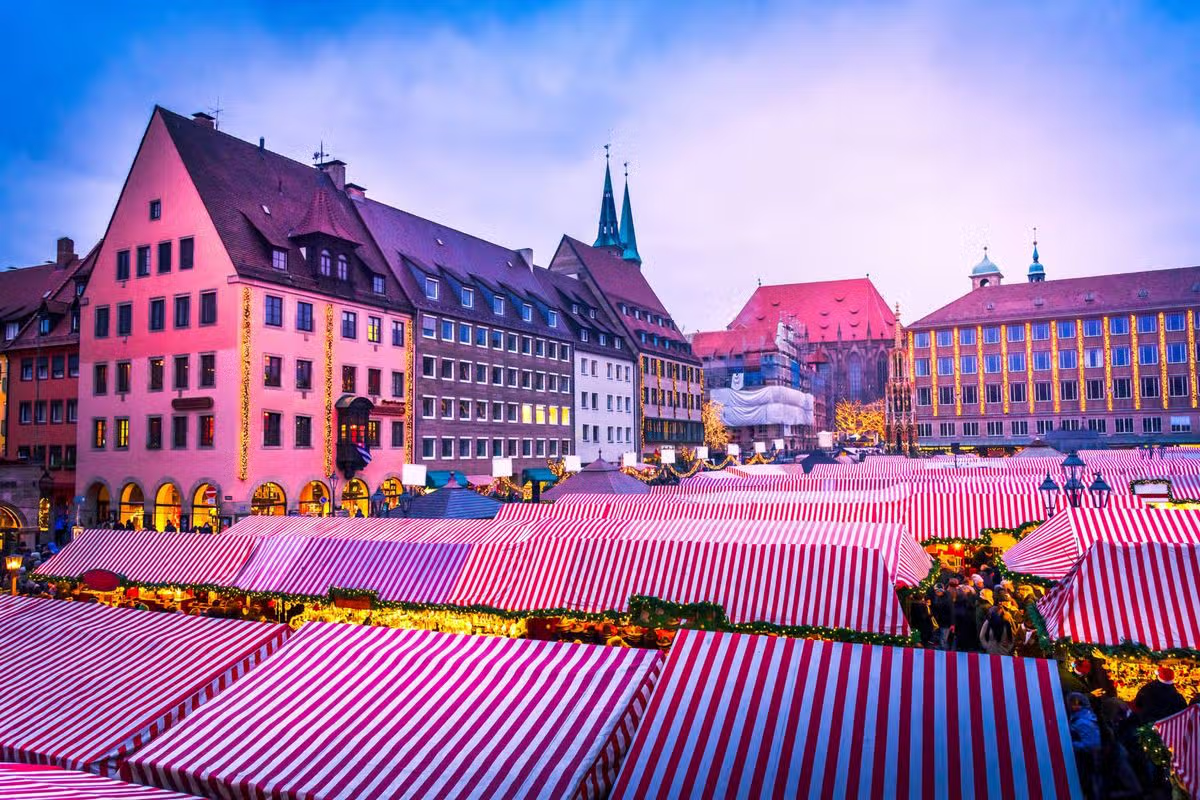
Thanks to its fascinating history and delightful setting, it represents the quintessential traditional German Christmas market many people fantasise about, and with its enormous range of stalls, it certainly delivers. It’s thought to feature around 180 stalls, offering glühwein, bratwurst and the market’s own distinctive Zwetschgenmännle, which are small and adorable decorative figures traditionally crafted using dried prunes.

After paying a visit, one traveller left a review, writing: “The Nuremberg Christmas Market is absolutely magical. The atmosphere is festive and authentic, with beautiful lights, traditional wooden stalls, and a wonderful holiday spirit.

“There is a great variety of local food, mulled wine, and handmade crafts. It can be busy, but it’s well organised and definitely worth the visit. A must-see Christmas market in Germany.”

Another shared their experience, saying: “Visited here after seeing multiple reviews, stating that Newberg market is one of the best in Germany and it truly lived up to the expectation.

“The number of stalls, different handicrafts, and gift items – and obviously the gluhwein was one of the experiences. There are multiple parking spots around the market and easily reachable by train and bus.”

In comparison to other markets throughout Europe and beyond, a December hotel stay costs an average of £144 per night, making it considerably more affordable than other destinations. Most significantly, admission to the market is entirely free, and mulled wine comes at a relatively modest price.

The market runs from Friday 27 November until Thursday 24 December this year, situated in the heart of Hauptmarkt, Nuremberg.
Source link

Hauntingly different Halloween at very unexpected place – ghosts, ghouls and thrills

Halloween at Kew is back for its third year and it’s even more spectacular than ever

Kew Gardens – the world famous botanical garden nestled in West London is famed for its serene and tranquil atmosphere.

Nothing can beat whiling away the hours, meandering through the vast open space with some of the oldest, most impressive and most endangered plants, trees and flowers on the planet.

The calm that befalls people when they amble into the Palm House, soon to undergo an incredible multi-million transformation where every pane of glass will be replaced, or the Temperate House, should be bottled and sold – it would make the world a far nicer place.

However, as soon as October hits and darkness falls, Kew Gardens is transformed into a terrifying Halloween wonderland of ghouls, witches, Egyptian mummies, spectres and monsters – and it’s genuinely both awe-inspiring and a little bit terrifying.

The younger sibling of the botanical gardens Kew at Christmas, Halloween at Kew first burst onto the light trail scene two years ago and is so popular it’s definitely here to stay.

Running for two weeks until November 1, the trail is suitable for all ages and comes in three time slots – warning, I’m a fully grown adult and the later slot definitely sent shivers up my spine.

There are daylight sessions for little ones (or those not keen to be spooked) with the absolute bare minimum of scaries, a twilight slot between 6pm and 7.30pm where things are certainly getting a little spookier as the sun starts to disappear and the moonlight session from 7.30pm onwards, where everything is completely dark – and scarier.

Now, full disclaimer, I am an absolute wimp. I will not watch horror films because I get so frightened I start to cry and even cartoons have been known to make me jump.

With this in mind, one of the more intense Halloween experiences on offer around the country is definitely not something I want to be experiencing, but having been an avid fan of Christmas at Kew, there was no way I was passing up the chance to see what the brains behind the stunning light trails could cook up for Halloween – and it certainly didn’t disappoint.

From the very off it’s both magical and just the right side of spooky – a stunning tree, bedecked in ghoulish green lights with a real cloaked horseman (with his head I must say) guarding it, onto an enchanted tunnel of pumpkins and a witch cooking up spells in the front garden of a cottage in the woods.

Next up is the Egyptian section. You are warned before entering – this light trail is very interactive – things could get a little spooky. A mummy (don’t worry, yhey don’t touch you) growls at walkers as they make their way through. Even though I knew this wasn’t real, I have to confess I jumped about six feet in the air when he popped up.

What makes Kew at Halloween so spookily magical isn’t just the huge array of lights, concepts and scary scenes before you… it’s also the music and soundtrack as you walk through the black as night garden.

From ghostly moans, to creaking doors in grave yards, to a sinister and chilling sound track as you move through woodland filled with chilling cloaked figures, you really feel totally immersed in the whole experience.

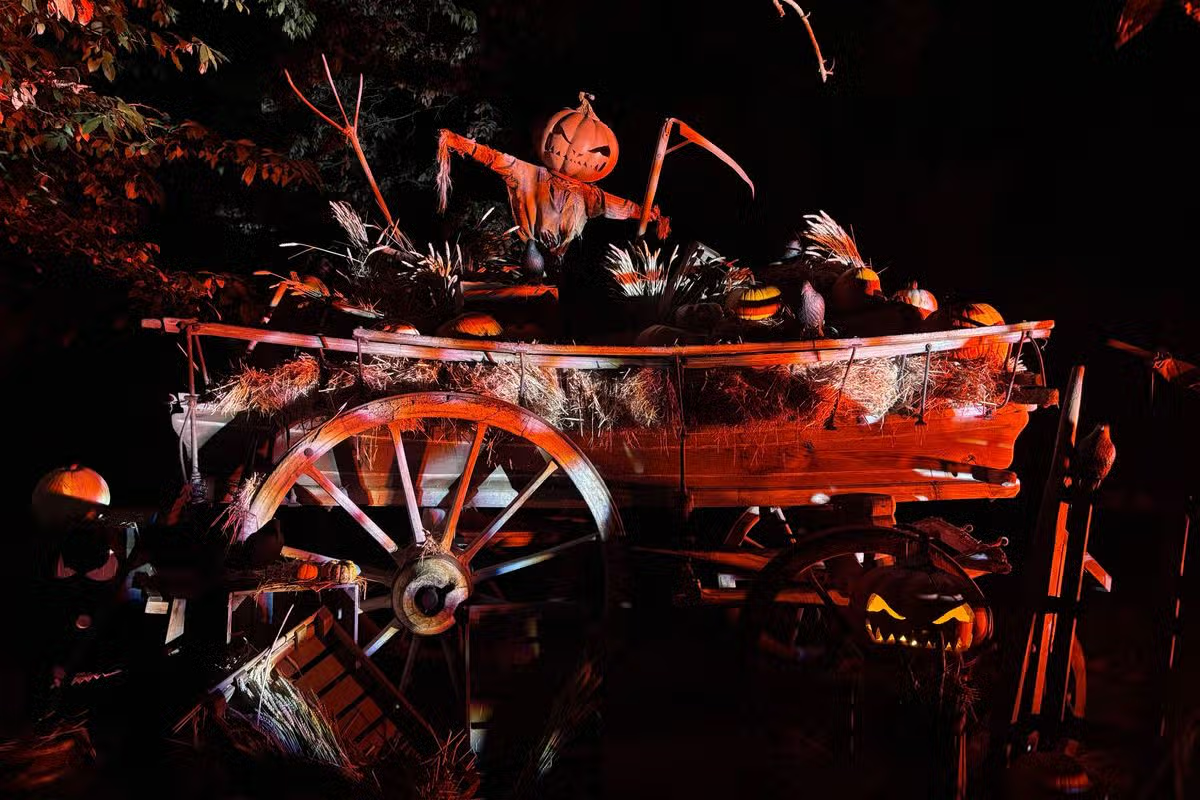
From vampires putting on shows, the pumpkin patches with a real life dancing Mr Pumpkin head and haunted tractors, from giant disco skeletons (these have to be seen to be believed) to pagan gods lining the walkways, there really is nothing that hasn’t been thought of and whoever dreamt this up is an absolute genius.

We took part in the moonlight walk and there were many moments where I was genuinely unsettled and at times really frightened. If you’re parents to younger children – and there were a few on the walk in our time slot – I would recommend taking them to an earlier one. There were plenty of tears in the pitch black spooky world.

But this really is a family friendly experience. The interactive characters along the way add enormously to the fun and there are plenty of places to stop for food, a hot chocolate, or to toast marshmallows (and even something stronger if you feel your nerves need it).

So, yes, Kew is already a magical place in daylight hours, make sure you run don’t walk to get your tickets for Halloween at Kew to see this incredible offering after dark.

Tickets for Halloween at Kew start at £19.50 and family tickets are available.

Source link

‘We tried a DIY family digital detox and there was one unexpected benefit’

As new research reveals young people could spend 42% more time on their phones during the school holidays, mum of two Hannah Britt took matters into her own hands on a DIY digital detox

With half term approaching, screen time may be about to soar. In fact, young people could spend 42% more time on their phones during the summer holidays compared to term time, according to research by Vodafone. But it doesn’t have to be this way. Mum of two Hannah Britt booked her family into a remote farmhouse in France for a DIY digital detox to reap the rewards of going screen-free…

I’m not going to lie, I’m completely addicted to my phone. As is my partner John. We spend our evenings scrolling social media, sending endless Reels back and forth. We work on small screens during the day, take breaks and look at our tiny screens… then watch the big screen in the living room to unwind.

Thankfully our two young children don’t have a phone, but they do both own a Kindle and are quite partial to a Peppa Pig marathon. Like many, during school holidays their screen time soars. And this is something I’m determined to change. When I read the research that young people could spend 42% more time on screens on school holidays, it gave me an idea.

Leaving the Kindles at home, I booked a remote French farmhouse on Airbnb and packed us off for a DIY digital detox. And I’m so glad I did. The stone farmhouse, in Saint-Sauveur-de-Cruzieres provided the perfect backdrop for old fashioned family fun – not a telly or smartphone in sight.

Parenting expert Kirsty Ketley explains. “School provides children with structure and built-in limits on screen use, and of course, once home, there are less hours in the day for screens, but once the holidays arrive, that structure disappears,” she says.

“Parents are often juggling work, childcare, and the cost of keeping kids entertained, so screens naturally become a convenient option. On top of that, digital entertainment is designed to be engaging and hard to switch off from, so it’s no surprise children gravitate towards it when they have long stretches of free time.”

So what’s the issue? “It’s not that screens are inherently ‘bad’,” says Kirsty. “In fact, they can be educational, social, and even calming at times. However, when screen time dominates, it can crowd out other important activities like active play, real-world socialising, outdoor time, and rest.

High levels of screen use are also linked to disrupted sleep, reduced concentration, and higher stress levels in both children and adults. The key issue isn’t the screen itself, but what’s being displaced when usage creeps up too high. It’s why having consistent boundaries around screen time is important, so that kids strike a healthy balance.”

But back to the Airbnb farmhouse. It was a Guest Favourite (easy to recognise as they have a special logo on the properties, and a collection of the most-loved homes on Airbnb, according to guests), and soon became a home from home.

On arrival, John and I placed our phones in a drawer, along with the children’s Kindles. Finding the TV remote, we hid it on the top shelf of a bookcase. The DIY digital detox had begun!

And soon we found there was plenty to do that didn’t involve a device. The pool, of course, provided hours of entertainment, as did the swings, hammock and garden games. With no phone to check, I found myself truly engaged the whole time, present and in-the-moment. The girls were the same.

Peppa Pig was replaced with a performance of the Backstreet Boys in the outdoor dining area, and Instagram was shunned in favour of a nature walk in the grounds. We saw a rabbit, hundreds of crickets and the back end of a badger for our troubles.

The farmhouse’s long indoor table was close to the aircon, and provided a place to draw and read when the weather outside reached boiling point. And we spread blankets out on the parched grass to lounge upon and play tea parties.

We did use a satnav (technically a screen) when exploring the local area, but car games provided entertainment on journeys to Barjac for its antique market, and and phones were stashed in bags when out and about, only taken out to pay for fridge magnets and snacks.

As the days wore on, the kids stopped asking for their Kindles, or to watch TV, and I missed my phone less and less. I felt more relaxed than I had in ages, more present and calm. By the time our week at the farmhouse was up I was almost sad to take my device from its drawer, something totally unexpected. And I can’t wait to go screen free again.

Exploring Saint-Sauveur-de-Cruzières and beyond

  • Barjac: Stroll through the shady, cobbled streets of this neighbouring Renaissance village (about 7.4 km away), known for its stone architecture, local artisan shops, and vibrant markets.
  • Saint-Montan: Wander around a beautifully restored medieval village clinging to the rocks near the Sainte-Beaume gorges.
  • Local Markets: Visit nearby regional open-air markets, such as Barjac on Fridays or Saint-Ambroix on Tuesdays, to sample local goat’s cheese, honey, and charcuterie.
  • Gorges de l’Ardèche & Pont d’Arc: See the famous natural stone arch of Le Pont d’Arc (about 16 km away) and enjoy canoeing, swimming, or lounging on the river beaches.
  • Bois de Païolive: Hike through a magical, labyrinth-like stone forest filled with bizarrely shaped limestone rocks and ancient oak trees.

Plan fun offline activities

  • Cook and bake together: Involve children in prepping meals, measuring ingredients, or baking treats to build teamwork and practical skills.
  • Head outdoors: Go for family bike rides, visit a local park, or kick a football around to boost physical health and burn energy.
  • Play together: Break out board games, card games, puzzles, or building blocks like Lego for low-stress, interactive group play.
  • Create easy access to crafts: Keep colouring books, crafting supplies, and building kits in a visible, reachable spot so family members can grab them out of boredom instead of reaching for a screen

*For more information on Airbnb, see HERE

Source link