uneasy

Price hikes, queues and tension: Venezuela shoppers uneasy after US bombing | US-Venezuela Tensions News

Caracas, Venezuela – The normally noisy capital of Caracas was eerily quiet on Monday, two days after the United States bombed the city and abducted Venezuela’s leader, Nicolas Maduro.

But many “caraqueños” nevertheless ventured out to buy food and other necessities, albeit at marked-up prices.

Recommended Stories

list of 3 itemsend of list

The tense atmosphere on Caracas’s streets was yet another sign of the uncertainty facing everyday Venezuelans, as they face the looming threat of further US intervention.

Local authorities have called for regular economic activity to continue in Venezuela. But some stores nevertheless remained closed, while households stocked up on basic supplies in case of shortages.

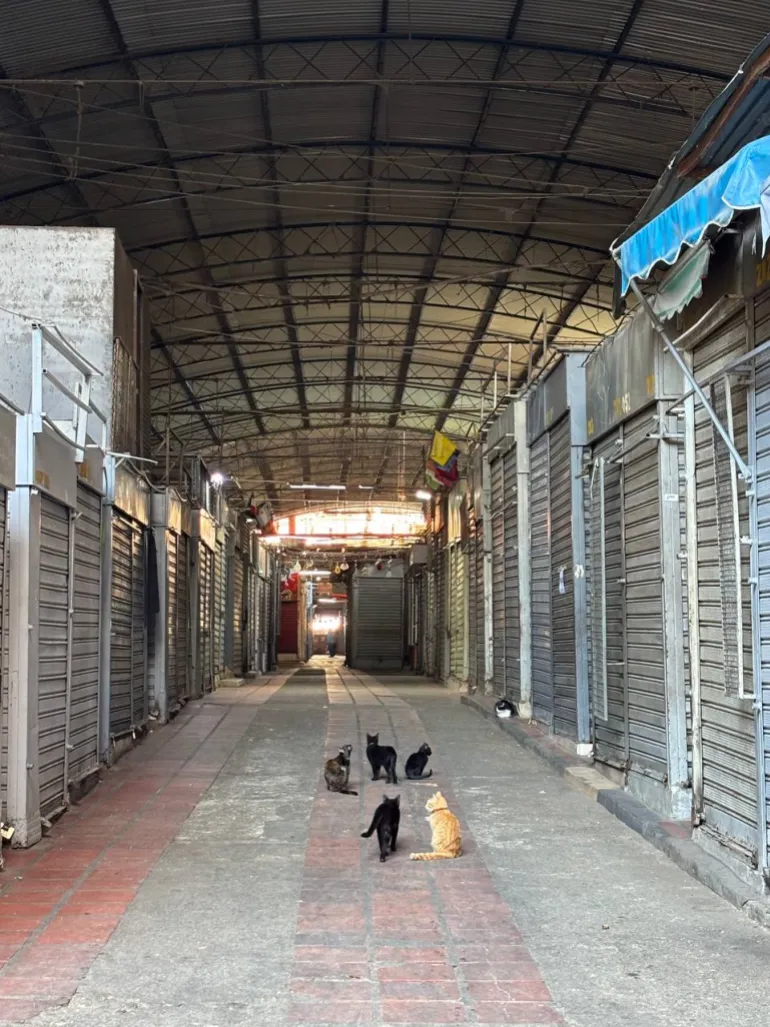
At Caracas’s central market, Quinta Crespo, many shopkeepers had shuttered their businesses for fear of unrest and looting.

Lines of 10 or more people often stretched outside the stores that remained open, despite the midday sun. Officers from the Bolivarian National Police patrolled outside to keep the queues calm.

Shoppers told Al Jazeera they were buying non-perishables, like corn flour, rice and canned goods, in case the security situation deteriorated in the capital.

“I’m looking for basic necessities, given the situation the country is going through,” said Carlos Godoy, 45, who lives in the western Caricuao district of Caracas. “We are waiting to see what happens. We are all in suspense, in uncertainty.”

A look inside one of Caracas's markets
Many stores in Caracas were shuttered in the aftermath of the US attack, for fear of further military action and looting [Julio Blanca/Al Jazeera]

Among the most expensive products Godoy saw on his shopping trip was powdered milk, which he said is selling for $16 per kilogram.

Another shopper, Betzerpa Ramírez, said she felt calm, despite the early-morning attack on Saturday. While she felt no need to hoard food items, she did note that prices for some goods have increased.

“Hygiene items are more expensive, even more than food,” she said.

Alexandra Arismendi, who works in a mobile phone shop at the Sambil mall in one of Caracas’s busiest shopping districts, expressed frustration with some of the recent price spikes.

The price of eggs, she said, was “exaggerated”.

“Prices are high,” she said. “A carton of eggs is selling for $10, which is beyond normal.”

Her colleague at the mobile shop, 23-year old María Gabriela, lamented the slump in sales, as shoppers stay indoors for fear of further unrest.

The normally bustling mall had largely emptied of its usual crowds. Gabriela herself was hesitant to show up for work. She travelled by taxi to avoid public transport.

“We thought people would be looking for chargers or power banks [for possible power failures], but they have been looking for other things,” Gabriela said.

“There has been no usual activity. It has been one of the strangest days in recent months.”

Venezuelans have become accustomed to volatile price increases and supply shortages over the past decade. Experts often blame government corruption, mismanagement and US sanctions for destabilising Venezuela’s economy.

During Maduro’s presidency, oil prices plummeted, sending Venezuela’s petroleum-heavy economy into free fall.

By 2018, inflation hit more than 130,000 percent, according to the country’s central bank. The COVID-19 pandemic also dealt the economy a wallop, leading to shortages of food and health supplies.

Maduro’s government has not published inflation statistics since he claimed victory in 2024’s disputed presidential election.

A view inside a Caracas grocery store
Some shoppers in Caracas stocked up on essential supplies, in case of continued unrest [Julio Blanca/Al Jazeera]

It remains unclear to what degree normalcy will return to Venezuela after the US attack on Saturday.

Early that morning, the administration of US President Donald Trump launched munitions against military installations in the states of Caracas, Aragua, Miranda and La Guaira.

At least 80 people died in the attack, according to an anonymous Venezuelan official quoted in The New York Times.

The US military offensive was over in a matter of hours. But Trump has warned he could authorise a “second wave” of attacks, should his demands for Venezuela not be fulfilled.

The Venezuelan government has also declared a state of emergency to “immediately begin the national search and capture of everyone involved in the promotion or support for the armed attack by the United States”.

It has maintained that Maduro remains the leader of Venezuela, despite his abduction to the US.

To Arismendi, the tension in Venezuela has not yet reached the level seen after the 2024 election, when thousands of protesters took to the streets.

“I feel that there was more tension around the elections,” said Arismendi. “Thank God we’re not at that level right now, but I feel like we’re not that far off either.”



Source link

The business of predicting the future is booming but EU regulators remain uneasy

What started as a niche corner of the internet has evolved into a multibillion-dollar industry.

In 2025, prediction markets have become a substantial instrument for speculation and the forecasting of real-world events in both finance and media. Two major players in the sector, Polymarket and Kalshi, have amassed a combined volume of over $37 billion (€31.5bn) in wagers placed this year, according to the 2026 Digital Assets Outlook Report.

A prediction market is essentially a platform where people bet on what they think will happen, and the price of the bet becomes a forecast. For example, instead of asking people directly or through on-the-street interviews who they expect will win an election, you let people put money on their answer.

The market price tells you what outcome people collectively think is most likely, and the forecast updates in real time, which is why some believe prediction markets capture collective thinking better than polls.

The sheer amount of capital flowing through these exchanges has triggered a gold rush. This month, Kalshi secured a Series E funding round of $1 billion(€850mn) valuing the platform at $11 billion (€9.4bn).

Polymarket hit a milestone back in October when Intercontinental Exchange (ICE), the parent company of the New York Stock Exchange, announced a strategic investment of up to $2 billion (€1.7bn) and valued the platform at $8 billion (€6.8bn). Additionally, ICE became the distributor of Polymarket’s data to institutional investors globally.

The overall interest from financial institutions is undeniable. Terrence Duffy, the CEO of CME Group, the world’s leading derivatives exchange, described prediction markets as “a legitimate domain of speculation and information aggregation that our clients are demanding” during their third-quarter earnings call.

EU-based or homegrown prediction markets have yet to take off, and EU regulations have kept the existing ones largely offshore.

From beating polls to signing partnerships

As platforms, prediction markets function similarly to a financial exchange. Users buy and sell binary contracts, betting yes or no, on the outcomes of unknown future events such as election results, corporate earnings reports and sports scores.

Typically, these contracts pay out $1 if the event occurs and $0 if it does not. For example, if a contract is priced at $0.50 it implies that the collective belief of the participants is pricing a 50% probability of an event occurring.

The relevance of prediction markets was cemented after the 2024 US presidential election and the 2025 German snap election. In both cases, these platforms functioned as real-time scoreboards, consistently pricing outcomes and delivering predictions that were nearly as reliable or even more so than traditional polling.

This perceived accuracy has now forced legacy media to adapt.

Earlier this month, CNN set a global precedent by partnering with Kalshi to integrate live prediction market data into its broadcasts. A couple days later, CNBC made a similar announcement.

Before the recent partnerships, several media outlets were already starting to incorporate these predictions into their regular news stories, such as interest rate decisions and legislative votes, granting them similar editorial weight to conventional polling.

Hyper-commodification, insider trading and outcome manipulation

Critics of prediction markets argue that they have effectively gamified everyday human outcomes, drawing a dangerously thin line between serious forecasting and high-stakes gambling.

This gamification has accelerated a phenomenon some call “hyper-commodification”, which refers to the process of turning every aspect of social life into a commodity that becomes subject to market forces.

In its worst form, the phenomenon encourages gambling, creates new opportunities for insider trading and incentivises manipulating the outcomes of real-world events.

In early December, a Polymarket trader nicknamed “AlphaRaccoon” sparked controversy after winning 22 out of 23 bets related to Google’s 2025 Year in Search rankings.

The trader netted over $1 million (€850,000) in 24 hours, and was later accused of being a Google employee who used internal access to proprietary search data to find out the most searched terms ahead of the company’s announcement.

The incident raised concerns about the integrity of prediction markets, especially since the fact that users can be anonymous makes it more difficult for those engaging in insider trading to be immediately weeded out.

In late October, Coinbase CEO Brian Armstrong, who leads one of the largest crypto assets exchanges, turned the company’s third-quarter earnings call into ademonstration of the risks of outcome manipulation in prediction markets.

Users on Polymarket and Kalshi had thousands of dollars riding on whether Brian Armstrong would use specific buzzwords and the CEO intentionally paused the call to enunciate a list of those words. Within seconds, the implied probability of those terms being mentioned spiked from roughly 15% to 100%.

Armstrong later tweeted that the exercise was “spontaneous” but for regulators it served as a stark example of the dangers of prediction markets being manipulated and losing their advantages as neutral forecasting tools.

The EU’s regulatory firewall

In the European Union, the crackdown on prediction markets began in late 2024 when the French National Gaming Authorityblocked Polymarket, ruling that its operation constituted unlicensed gambling.

In the following months, Belgium, Poland and Italy also issued bans.

The Romanian National Gambling Office (ONJN) blacklisted Polymarket in October after it hosted wagers on the Romanian 2025 presidential election held in May. In this case, the volume traded exceeded $600 million and the President of ONJN stated that “regardless of whether you bet in lei or crypto, if you bet money on a future result, under the conditions of a counterpart bet, we are talking about gambling that must be licensed.”

However, there are still many EU member states where prediction markets are accessible, such as Germany and Spain. The broader EU regulatory landscape remains fragmented, with no unified framework in place.

As we head into 2026, prediction markets also face the full implementation of the EU’s Markets in Crypto-Assets (MiCA) regulation, as most of these platforms make use of blockchain technology.

By July of next year, the grandfathering period ends for securing a Crypto-Asset Service Provider licence. According to the European Securities and Markets Authority, MiCA contains strict market abuse regimes that will apply to any prediction market using crypto assets.

The new reality is that every world event is being priced in real-time and the EU must decide if it will be a part of this era or opt for an outright ban.

Source link