undecided

Poll shows Roy leads in L.A. city attorney race — with most undecided

California Deputy Atty. Gen. Marissa Roy has a lead in the race to replace Los Angeles City Atty. Hydee Feldstein Soto, who lost her seat in a historic primary rout this spring, new polling shows.

Among likely Los Angeles voters, Roy leads by 10 percentage points over her rival, Los Angeles County Deputy Dist. Atty. John McKinney, following the pair’s shocking electoral upset in June, according to a poll released last week by UC Berkeley’s Institute of Governmental Studies and co-sponsored by The Times.

The spread closely mirrors City Councilmember Nithya Raman’s breakaway lead in her bitter fight to unseat Mayor Karen Bass, who has outraised her for months.

But that’s where the similarities end.

The mayor’s contest has been called a “knife fight” for its no-holds-barred campaigning. It has also drawn sustained — and occasionally sensational — national attention since Raman’s buzzer-beating entrance in February.

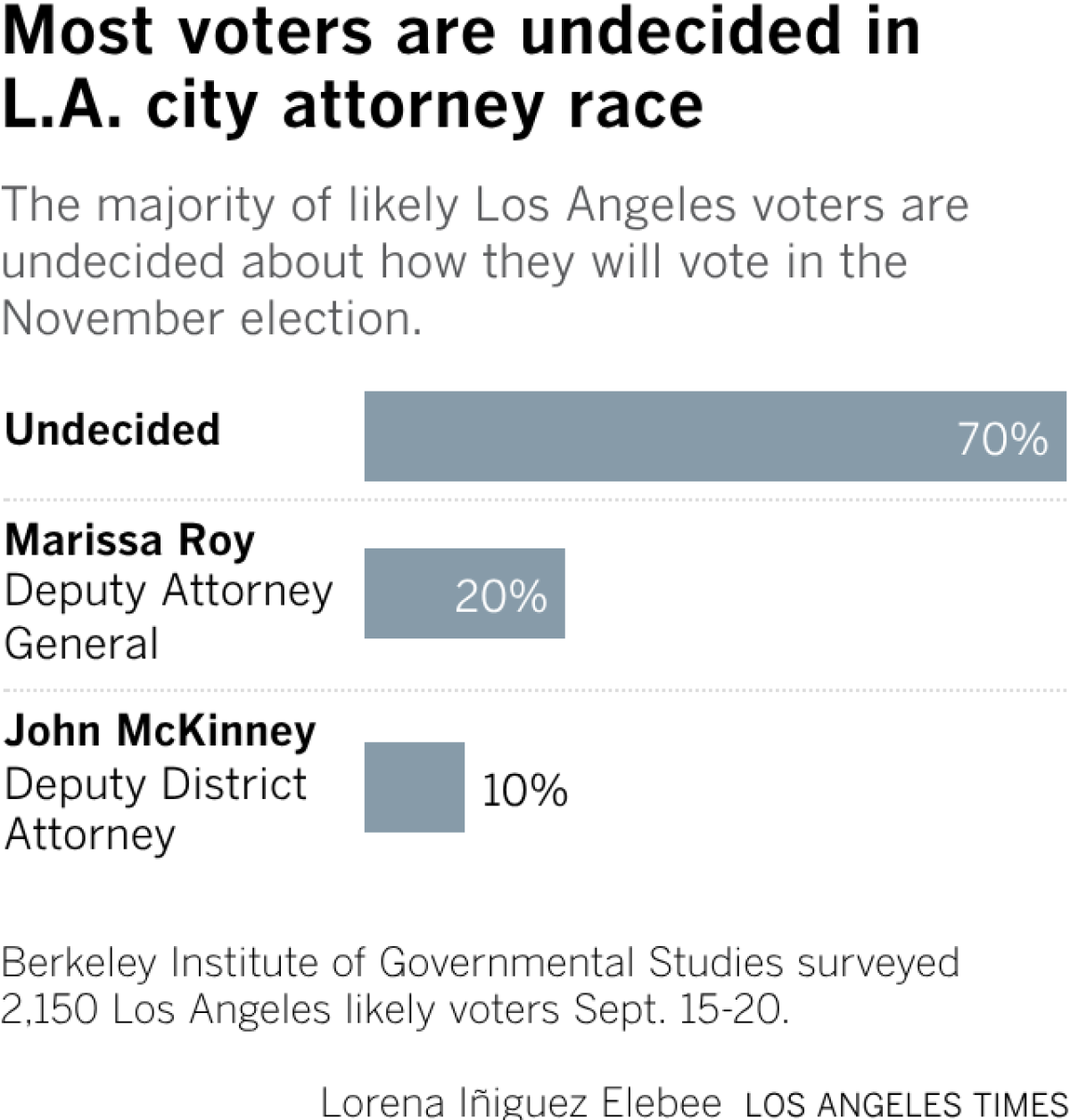
By contrast, the city attorney’s race remains all but unknown: More than two-thirds of likely voters are still undecided, versus about a third who remain uncommitted in the mayor’s contest, polling showed.

L.A.’s top litigator commands a budget of nearly $200 million, plays a role in shaping city ordinances, and wages court battles on behalf of the public. The city attorney also prosecutes misdemeanors — a job most other cities keep separate. Each year, the office weighs some 120,000 violations, deciding whether to file charges and how to pursue them.

More recently, city attorneys across the country have championed activist litigation, spearheading suits against the Trump administration, among others.

Yet, few local voters know the job exists, and fewer still know the candidates by name.

Seventy percent of likely voters said they had no opinion of either McKinney or Roy — a fairly typical result for a down-ballot race, experts note.

Still, new data about voter priorities could signal how those undecideds might shake up the race in its final weeks.

Roughly a third of L.A. voters rank “moving homeless people indoors” and “crime and public safety” as top priorities, respectively; just slightly less say “fixing streets, sidewalks, streetlights and other city infrastructure” is essential.

McKinney, 58, pitches himself as a law-and-order moderate with plans to use the city attorney’s prosecutorial power to reduce disorder and move unhoused people off the streets. He manages more than 300 people at the district attorney’s office and spent decades in the courtroom securing high-profile convictions — advantages that he contends outweigh his lack of civil litigation experience.

Roy, 34, campaigns with an aura of sunny progressive pragmatism, arguing that the city can rein in ballooning liability in part by tackling its vexing infrastructure issues. She nods to the recent $17-billion settlement with Meta — a case her team at the attorney general’s office led — as evidence of the kind of ambitious, public interest litigation a large municipal attorney’s office could join.

Those disparate visions — along with crucial endorsements and influxes of cash — helped the pair define clear brands and constituencies going into the primary.

Both also got a boost from nationwide anti-incumbent fervor, staking sides across a mutual opponent whose name recognition had turned sour while rarely taking aim at each other.

But the general election is a different animal.

Although the Los Angeles electorate has been moving leftward for years, primary voters typically skew older and more conservative than those who show up for the general election, experts said.

Polls suggest that fact could create an uphill battle for McKinney, whose sway is biggest among conservatives, about 19% of the city’s electorate.

Some 21% of Republicans and nearly 30% of self-identified MAGA voters favored McKinney in the most recent poll, while Roy is favored by 25% of Democrats and by 3 in 10 voters who identify as progressive or democratic socialists.

By contrast, about a quarter of Republican voters now say they favor Bass for mayor, while Raman has a 14-point lead among Democrats. (Both are about equally underwater with MAGA voters.)

Like Raman, Roy has deep ties to the city’s insurgent democratic socialist political machine and hard-won endorsements from its progressive clubs. She has also successfully courted L.A.‘s influential unions and got an early boost from the L.A. County Democratic Party when it endorsed her this spring.

McKinney is endorsed by the city’s powerful police union and championed by L.A. County Dist. Atty. Nathan Hochman.
Source link

All those undecided L.A. voters may actually know what they want

Political polls are like weather forecasts. They’re worth passing consideration, maybe, but you’d have to be a fool to bet your house on their accuracy.

And yet there’s something that rings true about the recent poll suggesting that L.A. Mayor Karen Bass is in deep trouble among likely voters as she tries to hold on to a job that Councilmember Nithya Raman is trying to snatch away from her.

Here are the numbers, as compiled by the UC Berkeley Institute of Governmental Studies and co-sponsored by The Times:

Raman: 39%.

Bass: 28%.

Undecided: 33%.

Bass has naturally tried to debunk the poll. What else could she do, when her supporters are outnumbered by people who can’t make up their minds? Bass would need to dominate the undecided vote to have a chance, but given her high unfavorability rating, that’ll be hard to do.

On the other hand, Raman certainly hasn’t put things out of reach, despite the fact that Bass carries the baggage of the Palisades fire and has made only minimal progress on her signature issue — homelessness. Election day is less than two months away, and Raman has failed to convince anywhere near a majority that she’s the answer.

So what do Raman and Bass need to do between now and Nov. 3?

Some speculate that Bass may need to step up the negative attacks.

I beg to differ.

We need both candidates to be bolder, more creative, more convincing, and to tell us things we haven’t heard before.

All the recent L.A. mayors I’ve known had their faults and failures, whether the task was filling potholes, building out transit or addressing the high cost of housing. But among their best qualities, Dick Riordan was arrogantly confident, Jim Hahn had a steady hand on the tiller, Antonio Villaraigosa was tireless and passionate, Eric Garcetti was a long-range thinker on earthquakes, water and energy.

L.A. needs a mayor with all of those qualities. A cheerleader. A task master. A ball buster.

Running the second-largest city in the country is no easy task, because many of the problems at street level begin well beyond local control, related in part to an economy that leaves too many people behind.

But if you want to lead a world-class city, you need to have world-class answers on the big stuff like housing and homelessness and on the basics, too, like fractured sidewalks and neglected parks. Most voters don’t give a hoot about which candidate is more of a socialist or a moderate. City Hall is broken, and they want to know who can fix it.

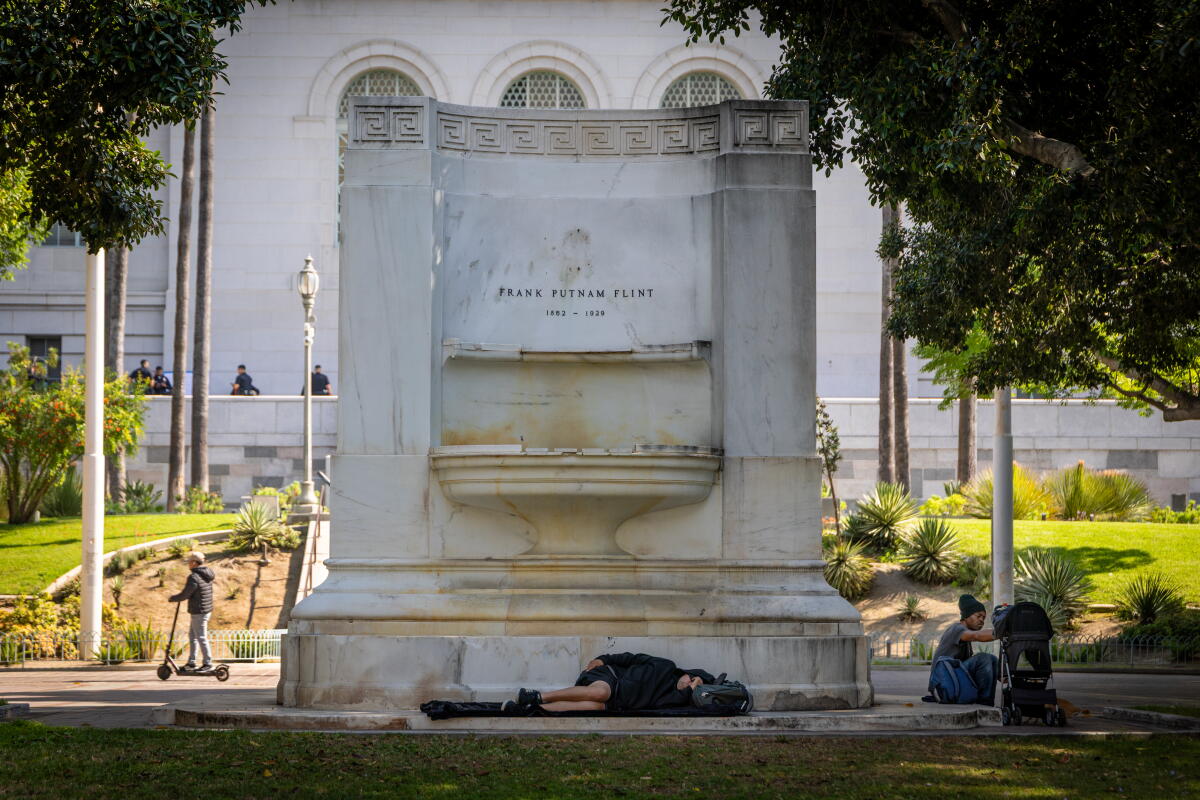
On Wednesday, I checked the same sadly neglected area around City Hall that I wrote about in April and found only minimal improvements. Graffiti has been washed from the Frank Putnam Flint fountain, but it remains a broken-down monument to neglect, as it has for most of the past 60 years. And all around it, most of the little placards identifying native plants are broken or missing.

People sleep and rest on a fountain in the shade outside City Hall

People rest on the Frank Putnam Flint fountain outside City Hall, a sadly neglected area.

(Allen J. Schaben / Los Angeles Times)

The L.A. Mall is still a largely abandoned wreck, with broken planter boxes and weeds at street level. A woman with two shopping carts told me she’s been homeless for 5½ years. The restaurant next to the nearby police department is shuttered; the restaurant across the street from it is long dead, and the once-vibrant downtown — which generated revenue that benefited every neighborhood of the city — is gasping.

I drove down Hope Street, south of 12th Street, because a reader who lives in that area and has told me about repeated fires at abandoned properties. A tractor was clearing debris from a recent blaze.

I drove west on Olympic toward Alvarado, an area I visit regularly to see a friend. Streets are strewn with trash. They’re always strewn with trash. At Olympic and South Lake, where encampments line the street and a fire once spread into a church parking lot, destroying vehicles, there’s a concrete triangle that was heaped with trash. It’s always heaped with trash, like a municipal dump on a busy thoroughfare.

Next I headed west on Wilshire to the RFK Memorial I wrote about 10 months ago, near the site of the 1968 Bobby Kennedy assassination. It remainsfenced-off, with trash and graffitiand with overgrown vines covering tributes to Kennedy. The city was going to help the school district clean things up. Then the school district took on the task.

It’s still a mess. Actually, it’s more than that. It’s an indictment. And so is the fact that in Studio City, where frustrated neighbors complained for five years that an abandoned property had been taken over by squatters, it took a recent fire to get City Hall’s attention.

The property, since cleared, is in Raman’s district, and she and Bass traded accusations about who had dropped the ball.

“As far as homelessness goes, I don’t see either candidate really showing a clear vision to solve this,” said Kayt Miranda, whose home was damaged by the fire at the abandoned property. “I mean, it’s a tall order, and I wouldn’t want to be in charge of that. But I’m not hearing anything from either of them that sounds like it will work or hasn’t been tried already.”

To be fair, Bass and Raman have each had lots of success on homelessness, with thousands of people being brought indoors. That job is not easy, especially given the number of people with mental illness and addiction issues. I know this from personal experience, having spent a year trying to steer a friend in from homelessness.

But the pace is too slow and the cost too high. As my colleague David Zahniser reported earlier this year, $300 million had been spent on the mayor’s Inside Safe program since December 2022, and as of last December, 40% of the 5,800 people who had been housed were back on the street.

And that was with an estimated annual cost per person of $82,000. Raman, who had supported the program, became a critic of it and touted a less expensive strategy that itself has been criticized for its slow pace, as Times City Hall reporter Noah Goldberg wrote in August.

Not long ago, a homelessness policy expert suggested to me that if we could figure out a way to double the nearly $1,000 Social Security Disability subsidy many homeless people get, it would open some doors in a housing market they’re now priced out of. Too expensive? It’s cheaper than what we’re doing.

I’d like to hear the candidates rethink the playbook like that, double down on what works and drop what doesn’t.

I’d like to hear from a candidate with a realistic plan to get L.A. out of the cellar in park rankings nationally, to break up the 10-year logjam for a sidewalk repair and the two-year wait to fix a street light.

All those undecided voters know exactly what they want.

A mayor who says fix the busted fountain by the end of the week, or else.

They want someone to win their vote.

steve.lopez@latimes.com

Source link