Uncloseted

The harsh truth about HIV phobia in gay dating

“Internalized stigma is what occurs when applying the stereotypes about who gets HIV, the prejudice, the negative feelings, onto yourself,” says Smith.

In 2024, 38% of people living with HIV reported internalized stigma. And studies show that it can predict hopelessness and lower quality of life, even when people are engaged in care or virally suppressed.

Internalized stigma can also affect how people practice safe sex and communicate about the virus. A 2019 survey of men who have sex with men found that individuals who perceived greater community-level stigma were less likely to be aware of—and use—safer-sex functions available on dating apps, such as HIV-status disclosure fields, as well as sexual health information and resources.

“[HIV phobia] is probably the most intense, subvert bigotry I think you could experience,” Joseph Monroe Jr., a 48-year-old living in the Bronx, told Uncloseted Media.

On dating apps, men have messaged him things like, “You look like you’ve got that thing” and “Go ahead and infect someone else.”

Monroe Jr. has also dealt with misinformed people who rudely opine about how he contracted the virus: “Who fucked you? That’s how you got it, right?” people will say to him.

“You end up internalizing all these stereotypes about who gets HIV—that you were promiscuous, that you didn’t care about yourself, that you did something wrong,” says Smith. “You carry that in, and then you have to relearn: ‘No, I didn’t. This is just a health condition.’”

What HIV Acceptance Looks Like and Raising Awareness

For those living with HIV, acceptance feels far away.

“You’re living under this threat of HIV and the threat that others find you threatening. It inhabits you socially and sexually,” Koester says. “People are hunkering down. Not putting themselves out there and having a mediocre quality of life. To have a sense of empowerment, you have to be legitimate and seen in the world and it’s hard to do that with the stigma that exists.”

Researchers say the path forward lies as much in conversation as in medicine.

Koester says she talks about HIV and PrEP anywhere she can, including in salons, cafes and restaurants. “Whenever I get into a cab with someone, I’m going to bring up HIV so the driver gets accustomed to hearing about it. … We have a long way to go in terms of exposure and awareness and every little bit helps.”

Part of this lies in increasing awareness through targeted marketing campaigns. PrEP is still profoundly misunderstood outside major urban centers, with uneven uptake among minority groups and usage gaps in the bible belt. And a 2022 U.S. survey found that 54.5% of people living with HIV didn’t know what U=U meant, and less than half of Americans agree that people living with HIV who are on proper medications cannot transmit the virus.

While eradicating stigma is slow, there is hope for acceptance.

Years after Jack’s diagnosis, in 2021, he told a man he was on a third date with that he was HIV-positive but undetectable. His date’s reply was almost casual: “Oh—is that it? I thought you were going to say you had a boyfriend or something. I’m on PrEP. You’re fine.”

“It felt so good to hear him say that and accept me,” says Jack. “I was like, ‘This is my person. You’re my person.’” One year later, they got married.

Back in Florida, 19-year-old Cody Nester isn’t feeling this acceptance. He still scrolls past profiles that read “Only negative guys” and tries to ignore the hateful messages.

“It still hurts, but I know it’s coming from fear,” he says. “I wasn’t too informed about HIV before I got it. … When I got it, I really jumped into the rabbit hole and began to learn. I really do think [HIV and stigma] is because people are not knowledgeable. … When people don’t know details, they tend to get scared.”

Additional Reporting by Nandika Chatterjee.

If objective, nonpartisan, rigorous, LGBTQ-focused journalism is important to you, please consider making a tax-deductible donation through our fiscal sponsor, Resource Impact, by clicking this button:
Donate to Uncloseted Media

Source link

Why Queer Spaces Often Fail South Asian Women

Internalized Shame

This community rejection can be painful. “It wasn’t strangers attacking me. It was my own people, speaking the same language I grew up with, who decided I didn’t deserve respect anymore. And that hurts in a way racism from outsiders never could, because it feels like rejection from your own bloodline,” says Vairavanathan.

Mental health professionals who work with South Asian clients say that collectivist traditions, where family reputation is often prioritized over individual expression, can lead to the stigmatization of LGBTQ identities.

On the AAHNA South Asian therapy website, they write that understanding taboos associated with sexual orientation “is crucial for effective therapeutic practice, as they can significantly influence mental health and well-being.”

Balancing Dual Identities

Jiya Rajput, a British Indian content creator and founder of the QPOC Project, says the balancing act of her sexual and racial identity can be tough: “Being both South Asian and queer sometimes feels like having two vastly different identities,” Rajput told Uncloseted Media. “I have tried my best to blend my queerness with my desi identity. However, it is not often easy, with stereotypes and prejudice sometimes making me feel out of place.”

This balancing act may involve navigating stereotypes and racism inside queer spaces, which can have negative mental health outcomes. A 2022 survey of LGBTQ Asian Americans found that discomfort with one’s race or ethnicity within queer communities was associated with lower psychological well-being for those who consider their racial identity important.

Dating as a Queer South Asian Woman

Balancing this dynamic can make dating challenging. A 2023 study revealed that queer Asian American women are frequently subject to rigid racial dating preferences, with most preferring to date within their own racial group, often as a reaction to feeling fetishized or rejected from white queer spaces.

And even dating within communities of color presents its own set of challenges. “Racism is not exclusively a white people’s issue,” Patel says, noting that she experienced subtle discrimination with another girlfriend who was neither white nor South Asian.

Photo courtesy of Patel

“[She] was genuinely trying to relate with me, she just couldn’t,” she says.

Patel remembers her girlfriend holding many assumptions, such as the belief that all South Asians share the same cultural traditions, such as Bhangra, a lively Punjabi dance, or Garba, a traditional Gujarati folk dance performed during festivals.

“It comes from a place of just wanting to be seen for their own culture,” Patel says, noting that many people of color aren’t accustomed to being truly heard or understood. “There’s so much excitement in dating someone from a different background that sometimes you forget to actually listen and receive the culture through their lens.”

When South Asian women do decide to date white women, Patel says it can feel like one “should just assimilate … and try to keep the pressures of being brown [and] growing up in a stricter, possibly patriarchal, culture at bay.”

These pressures in queer spaces caused Lavina Sabnani to leave her culture behind in an effort to feel accepted.

“It felt wrong to push away everything my ancestors carried with them for so long,” Sabnani told Uncloseted Media. “There’s a standard of whiteness at Pride, at lesbian parties, at cultural and social clubs. … Me and the other brown girls never get noticed. It was like you’re invisible within a community where you’re supposed to be counted in.”
“Being a lesbian South Asian means breaking the mold in every possible way,” says Hubiba Ali, a first-generation Pakistani American, self-described “butch lesbian” and food scientist from Chicago. “Pakistani women I was raised around don’t wear boyish clothes, have short, cropped hair, thick muscles, and hairy legs. They do not eat with gusto, laugh and joke boisterously, or take up space. I gave up a lot of my birthright participation in my culture in order to live free.”

Underrepresented and Under Researched

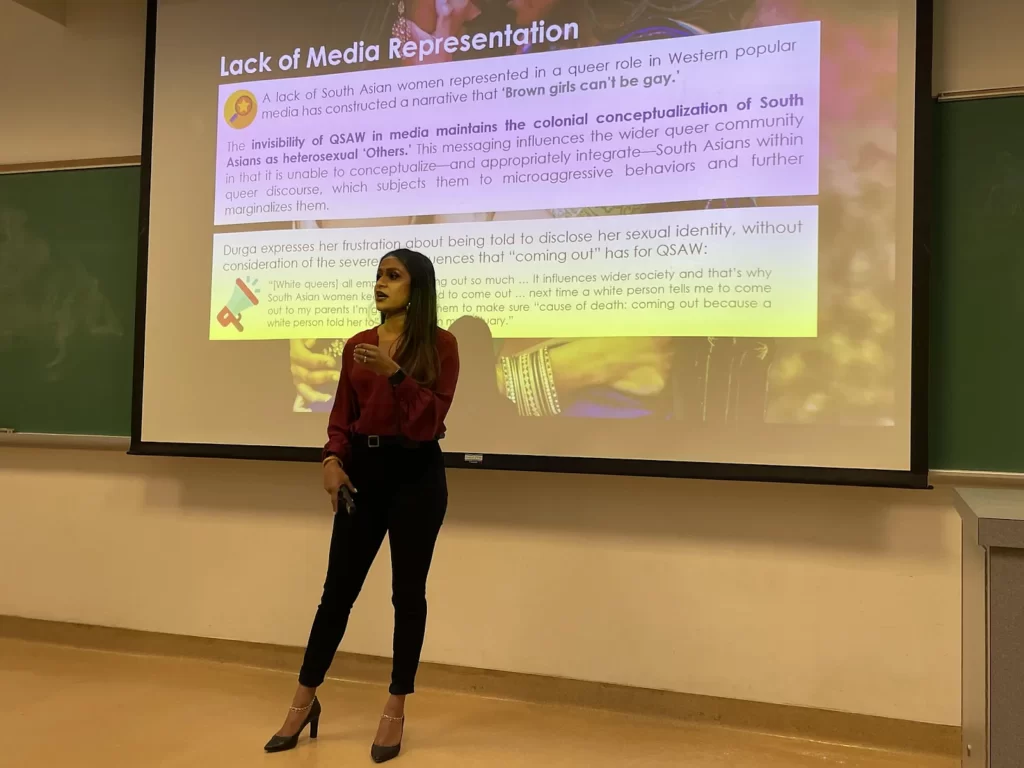
To make change, Sabnani says South Asian representation in queer spaces is essential. But it’s not happening yet. According to GLAAD’s “Where We Are on TV” 2024-2025 study, Asian Pacific Islanders represented only 11% of LGBTQ characters on broadcast, 2% on cable and 14% on streaming.

Even shows that strive for diversity, like “The L Word: Generation Q,” fail to include South Asian characters. “They had everyone—Black, Latinx, East Asian—but not a single South Asian woman,” says Patel.

She recalls a dating app called Her that featured an image of two white women kissing—one of whom had a tattoo of a Hindu deity.

“They’ll use our gods, but not our faces,” she says.
Outside of Patel’s research, little information exists about racism and homophobia toward queer South Asian women.

Photo courtesy of Patel

And even in queer nightlife, Ali describes feeling sidelined. She says that while there are a few South Asian LGBTQ organizations in Chicago, finding meaningful representation is hard even in those scenes.

“They tend to be hosted in a part of town colloquially known as ‘Boystown,’ which semantically already does not center women or lesbians,” she says. “The events are usually held at gay bars for gay men.”

Finding Acceptance

Patel says that to make spaces truly inclusive, folks need to “start by listening to queer brown women, understanding our unique challenges, and amplifying our voices.”

And despite all of these challenges, many queer South Asian women are still surviving and building a more inclusive future.

Artists like MANI JNX, a British Punjabi indie musician, are using music to explore queer South Asian love, trauma and joy. And visual creators like Mina Manzar are building online communities through art. “Funnily enough, here in NYC, so far from Pakistan, is where I’ve found the most vibrant and beautiful South Asian queer community,” Manzar told Uncloseted Media.

As for Patel, she has found a relationship with a Tamil woman that is grounded in mutual respect and cultural exchange. “I’ve learned how to make Tamil food, I’m learning the language, and she comes to Garba with me and dances every year,” she says. Their shared commitment to honoring each other’s traditions illustrates the importance of genuine cultural understanding in queer relationships that goes beyond surface-level acceptance or stereotypes.

Her hope is that the commitment to understanding that she has developed with her partner can become more reflective of how society tries to understand the experiences of queer South Asian women.

“Let’s just address each racialized group as a different racialized group and give them some damn visibility,” Patel says. “It’s not that hard.”

If objective, nonpartisan, rigorous, LGBTQIA+ focused journalism is important to you, please consider making a tax-deductible donation through our fiscal sponsor, Resource Impact, by clicking this button:

Donate to Uncloseted Media

Source link