Congress redefines hemp, causing worries in CBD, THC industry

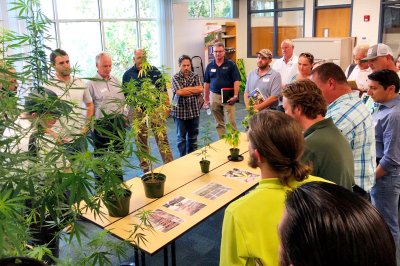
Farmers and businessmen attend a public workshop about growing hemp in August 2019, held by the University of Florida in Apopka. Congressional legislation used to reopen the government has caused uncertainty in the industry. File Photo by Paul Brinkmann/UPI
WASHINGTON, Nov. 26 (UPI) — A new federal definition of hemp tucked into Congress’ recently passed spending bill has reopened the debate over legal cannabis and set up a year-long fight that could determine the future of hemp-derived CBD and THCA products — and thousands of small businesses behind them.
The Agriculture Improvement Act of 2018, also known as the 2018 Farm Bill, allowed hemp production and removed the plant from the Drug Enforcement Administration’s schedule of Controlled Substances.
But now, Congress has sharply moved to restrict the hemp industry after slipping new language into the latest continuing resolution that ended the 43-day government shutdown Nov. 13.
This change could redefine what counts as legal hemp and effectively outlaw many of the products that have fueled the sector’s rapid growth over the last seven years.
Jonathan Miller, the U.S. Hemp Roundtable’s general counsel, said this provision was introduced more than a year ago as part of the House appropriations bill. Sen. Mitch McConnell, R-Ky., then brought it to the Senate six months ago.
The controversial provision was then included in the House’s fiscal year 2026 Agriculture Appropriations draft. Lawmakers, including Rep. James Comer, R-Ky., and Rep. Andy Barr, R-Ky., publicly opposed the provision’s language, while Rep. Nancy Mace, R-S.C. was a staunch leader pushing the provision through.
“Members of Congress were forced to choose between saving the hemp industry or reopening government, and there was just too much at stake. As a result, we lost this battle. The good news is it doesn’t go to effect for a year, so we’ve got over 350 days now to try to get it reversed and to replace it with a regulatory framework,” Miller said.
The U.S. Hemp Roundtable emphasized that once the legislation moved to the Senate, McConnell included a 365-day delay before the restrictions take effect. The grace period which runs to Nov. 13, 2026, is planned to give hemp businesses time to push Congress toward adopting a regulatory framework rather than an all-out ban.
Since 2018, manufacturers and retailers have taken advantage of what some describe as a “loophole” in federal hemp regulations to produce products containing hemp-derived CBD.
Under federal law, hemp is cannabis containing less than 0.3% THC by dry weight, the psychoactive compound that produces a “high.” Because this threshold is calculated on dry weight, companies have formulated products that technically comply but may deliver stronger effects.
This loophole helped expand the hemp industry, particularly cannabidiol, or CBD, a non‑psychoactive compound touted for therapeutic benefits.
A new congressional provision would redefine hemp to include all forms of THC — including THCA — within the 0.3% limit, and prohibit hemp‑derived CBD products manufactured for consumption in beverages, edibles, or vapes.
Lawmakers argue these products exploit the current definition while producing intoxicating effects.
Many tied to hemp production have responded with fears of a widespread economic blow to an industry worth $28.4 billion and employs a large number of Americans.
“There are 300,000 jobs affiliated with the industry. Those would go away. There’s $1.5 billion of state and local tax revenue that would go away. Many farmers would would lose their farms. Many small [companies] would lose their businesses,” Miller said.
“Many consumers, including veterans and seniors, who rely on these products for their health and wellness would lose access to them.”
“It’s a $28 billion market, which means there is a ton of demand for these products. If they’re made illegal, people will find a way to access them illegally, and which means there will be no safety protections and no regulatory regime,” he added.
The U.S. Hemp Roundtable, one of the industry’s largest national coalitions, said the measure could ban “more than 95% of all hemp extract products.” While the law would continue the sales of products containing less than 0.4 mg. of total THC per container, the group says items that meet that threshold are “very rare.”
“If it goes through as is, the industry is over as we know it. Ninety-five percent of our products would be considered schedule one narcotics, akin to heroin, and the remaining 5% it would be impossible to produce because of the restrictions on extraction,” Miller said.
Conversely, supporters of including this provision in the continuing resolution that reopened the government believe closing the loophole was overdue, arguing that the hemp-derived intoxicating products are largely unregulated.
For example, the American Trade Association for Cannabis and Hemp praised Congress for moving to clarify federal intent. In a press release, it said the bill “carefully distinguishes between intoxicating and non-intoxicating products” and would, for the first time, provide federal recognition and protection for non-intoxicating hemp-derived items.
The policy shift will potentially cause conflict between federal and state governments. Several states have created their own regulatory frameworks for hemp-derived products, including testing, age limits and potency caps. These could be disrupted by the new federal standards.
“It’s difficult to say how state implementation of the new federal hemp policy will look across states. It will certainly differ based on the state policy environment and state priorities and goals,” Gillian Schauer said, executive director of the Cannabis Regulators Association.
The association is a nonpartisan, nonprofit that helps regulate cannabis, marijuana and hemp across more than 45 states, the District of Columbia, three U.S. territories and a number of international governments.
“Ultimately, regulators are primarily implementers — they will implement what comes down from their state legislatures. Most of these policy implementation decisions will be made legislatively. With legislative sessions right around the corner in most states, those decisions may be made before we have any further federal guidance,” Schauer said.
Kentucky is one of the top producing hemp states, along with California, Colorado and Oregon. The two Kentucky senators are on opposite ends of viewpoint on the provision being added.
After the continuing resolution passed, McConnell released a statement saying, ”I am proud to have championed this language that keeps these products out of the hands of children, secures the future of regulated hemp businesses and keeps our promise to American farmers and law enforcement by clarifying the intention in the 2018 Farm Bill.”
“The language included in [the] bill preserves the legitimate hemp industry, while addressing the rise of intoxicating and synthetic THC products. Industrial hemp and CBD will remain legal for industrial applications — such as seed, stock, fiber, grain oil — or used in drug trials, federally authorized research or research at an institution of higher education,” he added.
Countering that, Sen. Rand Paul said he opposed this provision. On the Senate floor before it passed, he said “The bill, as it now stands, overrides the regulatory frameworks of several states, cancels the collective decisions of hemp consumers and destroys the livelihoods of hemp farmers.”
He added: “Farmers’ costs have increased as the price of fertilizer and machinery have jumped, while prices for their crops, like soybean, corn and wheat, have declined. For many farmers, hemp has proved to be a lifeline, a new cash crop.”
In effect, the same language McConnell praised drew criticism from Paul, who argued it would wipe out existing markets and override state authority.
“The numbers put forward in this bill will eliminate 100% of the hemp products in our country. That amounts to an effective ban, because the limit is so low that the products intended to manage pain or anxiety will lose their effect,” Paul said.
“This bill will effectively preempt and nullify all state laws concerning hemp. Most of the things your states have regulated and made legal will be made illegal by this bill,”