u. s. election

Trump signs executive order limiting mail-in ballots; California leaders say they’ll fight

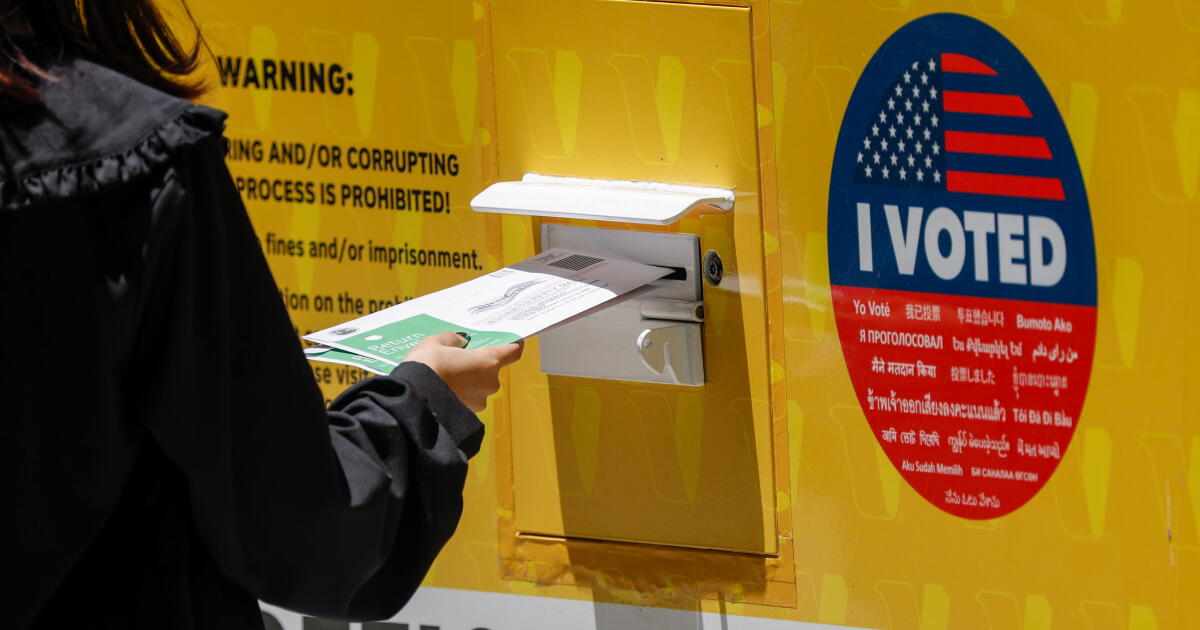
President Trump signed an executive order Tuesday purporting to place new federal controls on voting by mail in states such as California, repeating his long-held but unsubstantiated claim that mail-in ballots are a source of widespread fraud in U.S. elections.

California leaders immediately responded with promises to fight the order in court. They said mail ballots are a safe and secure method for voting relied on by millions of Californians, that Trump’s order infringes on the state’s constitutional right to administer elections as it sees fit, and that it amounts to an “illegal power grab” ahead of midterm elections in which his party is poised to suffer substantial losses.

The order directs the United States Postal Service to take control of mail balloting by designing new envelopes with special bar codes that will allow the federal government to ensure that such ballots go out only to eligible voters, and that only eligible voters return such ballots.

It requires states to submit to the USPS process if they plan to use the federal mail system for sending or receiving ballots, and to submit to the USPS lists of eligible voters in advance of such ballots passing through the mail system.

It also requires the Department of Homeland Security, U.S. Citizenship and Immigration Services, and the Social Security Administration to “compile and transmit to the chief election official of each State a list of individuals confirmed to be United States citizens who will be above the age of 18 at the time of an upcoming Federal election and who maintain a residence in the subject State.”

Those lists will be drawn from federal citizenship and naturalization records, Social Security records and “other relevant Federal databases,” and the USPS will be barred from transmitting ballots that do not match those lists, the order says.

“Secure ballot envelope identifiers provide a reliable, auditable mechanism to enforce Federal law without unduly burdening or infringing on the rights of eligible voters,” the order reads. “Unique ballot envelope identifiers, such as bar codes, enable confirmation that only citizens receive and cast ballots, reducing the risk of fraud and protecting the integrity of Federal elections.”

Trump — who recently voted by mail himself in Florida — framed the order as a solution to “massive cheating” in U.S. elections currently, which he did not back up with evidence.

“The cheating on mail-in voting is legendary. It’s horrible what’s going on,” Trump said.

“He’s going to make sure that mail-in ballots are safe secure and accurate,” said Commerce Secretary Howard Lutnick, who appeared alongside Trump and whose agency the order requires to be involved in the coordination of the new voting measures.

California officials blasted the president for attacking and undermining election integrity, rather than shoring it up, and said they would fight the order from taking effect.

“President Trump’s Executive Order marks a dangerous and unprecedented escalation in his ongoing attacks on our elections. The power to regulate elections belongs to the States and to Congress — he has no role to play. We blocked his previous Executive Order on elections in court, and we are prepared to stop him again,” said California Atty. Gen. Rob Bonta.

“The reality is that President Trump and Congressional Republicans see the writing on the wall — that they are likely to lose in the upcoming midterms — and they are pushing to make it harder for people to vote,” Bonta added. “We won’t stand idly by.”

Sen. Alex Padilla (D-Calif.), in a statement to The Times, said Trump’s actions were “a clear and present threat to our democracy,” that he will “use every tool I can to stop him,” and that he expects “immediate legal challenges in order to protect our free and fair elections.”

“Instead of focusing on lowering the cost of energy, groceries, and health care, Donald Trump is desperately attempting to take over and rig our elections and avoid accountability in November. This executive order is a blatant, unconstitutional abuse of power,” said Padilla, the ranking Democrat on the Senate Committee on Rules and Administration.

“The President and the Department of Homeland Security have no authority to commandeer federal elections or direct the independent Postal Service to undermine mail and absentee voting that nearly 50 million Americans relied on in 2024,” he said. “A decade of lies about election fraud does not change the Constitution.”

“In the middle of an unauthorized war abroad and an escalating authoritarian crackdown by ICE here at home, Trump is attempting another illegal power grab,” Padilla said.

A vast majority of Californians vote by mail. In the state’s 2025 special election on Proposition 50, the state’s mid-decade redistricting measure, nearly 89% of votes were cast by mail, according to California Secretary of State Shirley Weber’s office — or nearly 10.3 million out of about 11.6 million votes cast.

Trump has long criticized mail-in ballots — without evidence — as a source of fraud and a factor in his losing the 2020 election to President Biden, which he still contends was illegitimate.

Election experts, voting rights advocates, local elections officials and other California leaders have all dismissed those claims as unfounded and inaccurate. They have also been preparing for Trump to act to curtail such voting.

Padilla previously warned colleagues that he would force a vote on any effort by Trump to declare a national emergency in order to seize control of this year’s midterm elections from the states, forcing them to either co-sign on the power grab or resist it.

Critics of mail ballots have also been actively working to end or curtail the practice. Just last week, the U.S. Supreme Court heard arguments in a case in which the Republican Party challenged a Mississippi law that allows ballots to be accepted and counted if they arrive up to five days after election day.

During those arguments, the court’s six conservatives sounded ready to rule that federal law requires ballots to be received by election day in order to be counted as legal.

Weber, California’s top elections official, has warned that attacks on mail-in voting risked undermining a system the state has spent years building around universal mail voting.

Trump’s executive order is the latest front in a years-long campaign he has led attacking the integrity of U.S. elections — which has contributed to a steep decline in voter trust in U.S. elections.

On Tuesday, Trump said his order was drafted by “great legal minds,” and will survive any legal challenges unless “rogue” judges rule against it inappropriately.

“We want to have honest voting in our country,” he said.

Rick Hasen, an election law expert and director of the Safeguarding Democracy Project at UCLA Law, argued otherwise in a post Tuesday, noting that an earlier executive order purporting to place new federal controls on elections was blocked in court, and “this one is likely to fare no better.”

“To put this in plain terms: the order would use the USPS, which is not under the direct control of the President, to interfere with a state’s lawful transmission of ballots. If the state does not comply with these rules, federal law would purport to interfere with a state’s conduct of its own elections,” Hasen wrote. “The President does not have the authority to do this.”

Source link

As Trump voter ID bill stalls, some states making moves

While the U.S. Senate remains deadlocked over President Trump’s call for strict citizenship voting requirements, Republicans in some states are pressing ahead with their own measures that could require documentary proof of citizenship to join or remain on the voter rolls.

Proof-of-citizenship legislation won final approval this week in South Dakota and Utah, already has passed one chamber in Florida and received a committee hearing in Missouri. In Michigan, supporters of voter citizenship documentation submitted 750,000 petition signatures this week in a bid to get a constitutional amendment on the November ballot.

Federal law already prohibits noncitizens from voting in U.S. elections, with violators subject to fines, imprisonment and potential deportation.

When people register to vote, they affirm under penalty of perjury that they are U.S. citizens. But Trump contends that’s not enough. He wants prospective voters to show proof of their citizenship.

Democrats and voting rights advocates say the Republican measures amount to voter suppression, as they may prevent many eligible voters from casting ballots. Similar laws have been overturned by courts as an unconstitutional burden on voting rights.

What would the federal legislation do?

The federal Safeguard American Voter Eligibility Act, or SAVE America Act, would require documentary proof of U.S. citizenship to register to vote. That could be satisfied with such things as a U.S. passport, citizen naturalization certificate or a combination of a birth certificate and government-issued photo identification.

The federal bill also would require a photo identification to cast a ballot, which some states already mandate. The Republican-led House approved the legislation last month on a mostly party-line vote, but it has stalled in the Senate under a filibuster threat from Democrats.

South Dakota and Utah

Legislation passed in South Dakota and Utah would create a two-tier voting system. People who provide documentation of their citizenship could vote in all elections. Those who don’t could vote only in federal elections for president, U.S. Senate and U.S. House.

The bifurcated voting system is modeled after Arizona, where tens of thousands of voters who have not provided proof of citizenship can cast ballots only in federal elections. Arizona implemented its system after the U.S. Supreme Court ruled in 2013 that the state could not require citizenship documentation for federal elections.

The bills in South Dakota and Utah would take effect upon a governor’s signature, meaning they could be in place for newly registered voters ahead of the November elections.

Utah’s bill also directs election officials to use an online service from U.S. Immigration and Customs Enforcement to check the citizenship status of existing voters. Those flagged would be sent notices asking for proof of citizenship to remain eligible to vote in all elections.

Florida and Michigan

Neither the Michigan initiative nor legislation passed by the Florida House would require people to submit proof of citizenship when registering to vote. Instead, the measures would create a behind-the-scenes review that could result in some people being asked for citizenship documentation.

Under the Michigan measure, the secretary of state would review driver’s license records, juror records and federal Homeland Security and Social Security data to determine whether registered voters are citizens. Those flagged would be removed from the voter rolls if they cannot provide proof of citizenship.

The Florida legislation would require election officials to verify the citizenship of all registered voters using the state’s driver’s license database. Anyone whose citizenship could not be verified would be required to submit documentary proof.

Why are some pushing for proof of citizenship?

Trump and some fellow Republicans have complained for years about noncitizens voting in U.S. elections, although evidence of doing so is rare. The few cases found are not nearly enough to affect an election result, studies have shown, and those caught face severe penalty.

In 2024, a student from China was charged with perjury and attempted illegal voting after registering to vote by showing a University of Michigan student ID and signing a document asserting he was a U.S. citizen. He later contacted a local clerk’s office requesting to get his ballot back, and ultimately fled the country.

The case provided part of the impetus for the Michigan ballot initiative, said Paul Jacob, chairman of Americans for Citizen Voting, which is backing the measure.

“We want a system we can have confidence in,” Jacob said. “The way you avoid big problems in elections is to fix the small problems when they rise up and present themselves.”

Voting rights advocates’ concerns

Constitutional amendments limiting voting to “only citizens” have won widespread support when placed on state ballots. But voting rights advocates note that requiring documentary proof can get complicated.

During a recent debate in the Florida House, Democratic state Rep. Ashley Gantt recounted how her aunt was born in a South Carolina home at a time when some hospitals didn’t accept Black patients. As a result, she has no birth certificate and has had difficulty trying to demonstrate her citizenship, Gantt said.

A proof-of-citizenship law “would stop many thousands — if not more — U.S. citizens from voting in Florida,” said Michelle Kanter Cohen, policy director and senior counsel at the nonprofit Fair Elections Center. “It requires documentation that a lot of eligible citizens don’t have, or don’t have access to.”

Nationwide, about 21 million people — 9% of voting-age citizens — lack documentary proof of citizenship or cannot easily obtain it, according to a 2024 report by the Center for Democracy and Civic Engagement at the University of Maryland.

Other states

Legal challenges are common when states pass proof-of-citizenship requirements for voters.

After Kansas adopted a proof-of-citizenship law 15 years ago, more than 31,000 U.S. citizens ended up getting blocked from registering to vote. Federal courts declared the Kansas law an unconstitutional burden on voting rights, and it hasn’t been enforced since 2018.

Two years ago, New Hampshire and Louisiana both passed proof-of-citizenship laws, prompting lawsuits. New Hampshire’s law went to trial last month and is awaiting a ruling. Louisiana’s election commissioner acknowledged in a December court filing that the requirement has not been enforced.

A nonprofit group also filed a legal challenge to a Wyoming proof-of-citizenship law passed last year. But a federal court dismissed that case while ruling the group lacked standing to sue.

Lieb writes for the Associated Press.

Source link

Padilla preps for Trump trying to control elections via emergency order

Sen. Alex Padilla (D-Calif.) is preparing for President Trump to declare a national emergency in order to seize control of this year’s midterm elections from the states, including by bracing his Senate colleagues for a vote in which they would be forced to either co-sign on the power grab or resist it.

In the wake of reporting last week that conservative activists with connections to the White House were circulating such an order, Padilla sent a letter to his Senate colleagues Friday stating that any such order would be “wildly illegal and unconstitutional,” and would no doubt face “extremely strict scrutiny” in the courts.

“Nevertheless, if the President does escalate his unprecedented assault on our democracy by declaring an election-related emergency, I will swiftly introduce a privileged resolution [and] force a vote in the Senate to terminate the fake emergency,” wrote Padilla, the ranking Democrat on the Senate Committee on Rules and Administration.

Padilla wrote that such an order — which could possibly “include banning mail-in voting, eliminating major voting registration methods, voter purges, and/or new document barriers for registering to vote and voting” — would clearly go beyond Trump’s authority.

“Put simply, no President has the power under the Constitution or any law to take over elections, and no declaration or order can create one out of thin air,” Padilla wrote.

The same day Padilla sent his letter, Trump was asked whether he was considering declaring a national emergency around the midterms. “Who told you that?” he asked — before saying he was not considering such an order.

The White House referred The Times to that exchange when asked Tuesday for comment on Padilla’s letter.

If Trump did declare such an emergency, a “privileged resolution,” as Padilla proposed, would require the full Senate to vote on the record on whether or not to terminate it — forcing any Senate allies of the president to own the policy politically, along with him.

Experts say there is no evidence that U.S. elections are significantly affected or swung by widespread fraud or foreign interference, despite robust efforts by Trump and his allies for years to find it.

Nonetheless, Trump has been emphatic that such fraud is occurring, particularly in blue states such as California that allow for mail-in ballots and do not have strict voter ID laws. He and others in his administration have asserted, again without evidence, that large numbers of noncitizen residents are casting votes and that others are “harvesting” ballots out of the mail and filling them out in bulk.

Soon after taking office, Trump issued an executive order purporting to require voters to show proof of U.S. citizenship before registering and barring the counting of mail-in ballots received after election day, but it was largely blocked by the courts.

Trump’s loyalist Justice Department sued red and blue states across the country for their full voter rolls, but those efforts also have largely been blocked, including in California. The FBI also raided an elections office in Georgia that has been the focus of Trump’s baseless claims that the 2020 presidential election was stolen from him.

Trump is also pushing for the passage of the Save America Act, a voter ID bill passed by the House, but it has stalled in the Senate.

In recent weeks, Trump has expressed frustration that his demands around voting security have not translated into changes in blue state policies ahead of the upcoming midterm elections, where his shrinking approval could translate into major gains for Democrats.

Last month, Trump wrote on his Truth Social platform, “I have searched the depths of Legal Arguments not yet articulated or vetted on this subject, and will be presenting an irrefutable one in the very near future. There will be Voter I.D. for the Midterm Elections, whether approved by Congress or not!”

Then, last week, the Washington Post reported that a draft executive order being circulated by activists with ties to Trump suggests that unproven claims of Chinese interference in the 2020 election could be used as a pretext to declare an elections emergency granting Trump sweeping authority to unilaterally institute the changes he wants to see in state-run elections.

Election experts said the Constitution is clear that states control and run elections, not with the executive branch.

Democrats have widely denounced any federal takeover of elections by Trump. And some Republicans have expressed similar concerns, including Sen. Mitch McConnell (R-Ky.), who chairs the Senate rules committee.

In the Wall Street Journal last year, McConnell warned against Trump or any Republican president asserting sweeping authority to control elections, in part because Democrats would then be empowered to claim similar authority if and when they retake power.

McConnell’s office referred The Times to that Journal opinion piece when asked about the circulating emergency order and Padilla’s resolution.

Padilla’s office said his resolution would be introduced in response to an emergency declaration by Trump, but hoped it wouldn’t be necessary.

“Instead of trying to evade accountability at the ballot box,” Padilla wrote, “the President should focus on the needs of Americans struggling to pay for groceries, health care, housing and other everyday needs and put these illegal and unconstitutional election orders in the trash can where they belong.”

Source link