Trump says U.S. will ‘run’ Venezuela after capturing Maduro in audacious attack
WASHINGTON — An audacious overnight raid by elite U.S. forces that seized Venezuelan President Nicolás Maduro from his bedroom in Caracas plunged the country into turmoil on Saturday, prompting international concern about Venezuela’s future and President Trump’s decision to take control of a sovereign nation.
Trump justified the stunning attack by accusing Maduro of sending “monsters” into the United States from Venezuelan prisons and claiming his involvement in the drug trade. But Trump focused more on Venezuela’s vast oil reserves, accusing the Venezuelan government of stealing U.S. oil infrastructure in the country decades prior and vowing that, under new U.S. government control, output would increase going forward.
The president spoke little about democracy in Venezuela, dismissing a potential role for its longstanding democratic opposition in running the country in the immediate aftermath of the operation. Instead, Trump said his team was in touch with Maduro’s hand-picked vice president, Delcy Rodriguez, whom he called “very gracious” and said was “essentially willing to do what we think is necessary to Make Venezuela Great Again.”
“We’re going to run the country until such time as we can do a safe, proper and judicious transition,” Trump said. “We’re going to have our very large United States oil companies, the biggest anywhere in the world, go in, spend billions of dollars, fix the badly broken infrastructure, the oil infrastructure and start making money for the country.”
“We’re not afraid of boots on the ground,” he added.
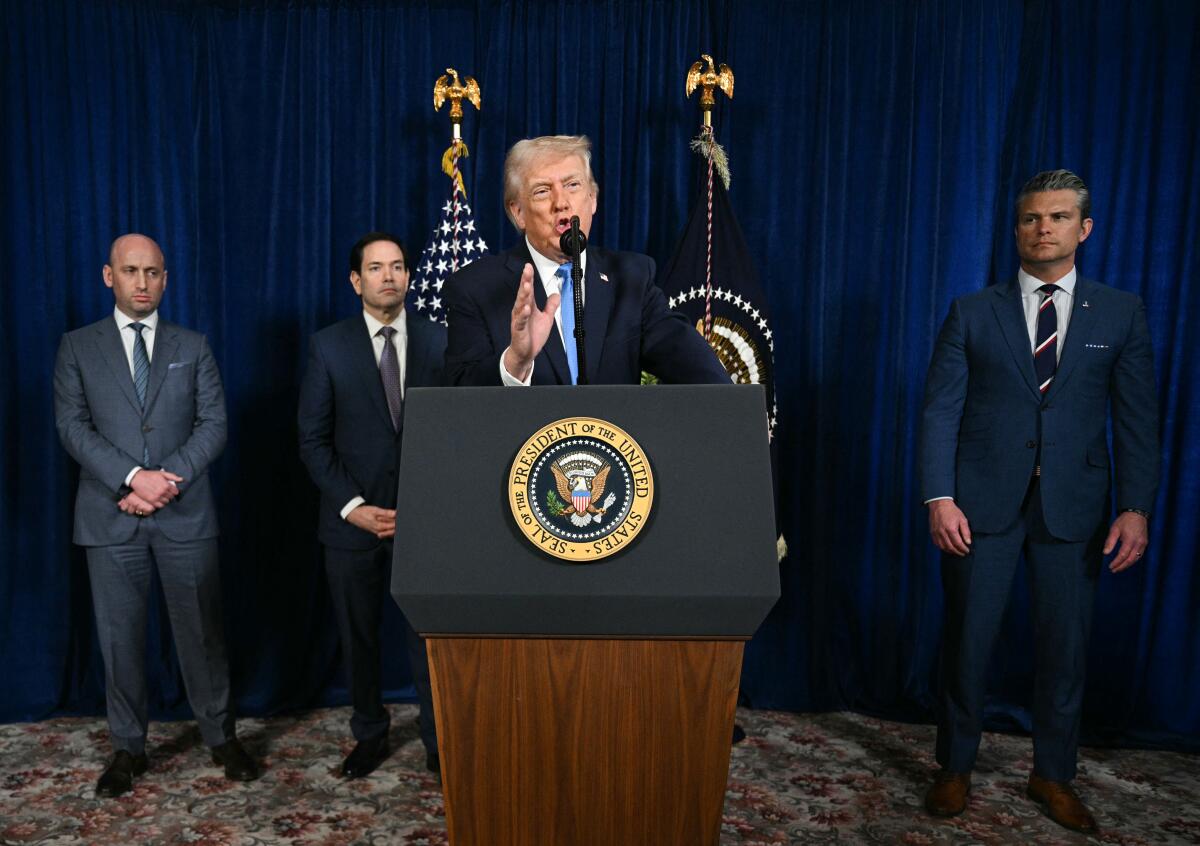
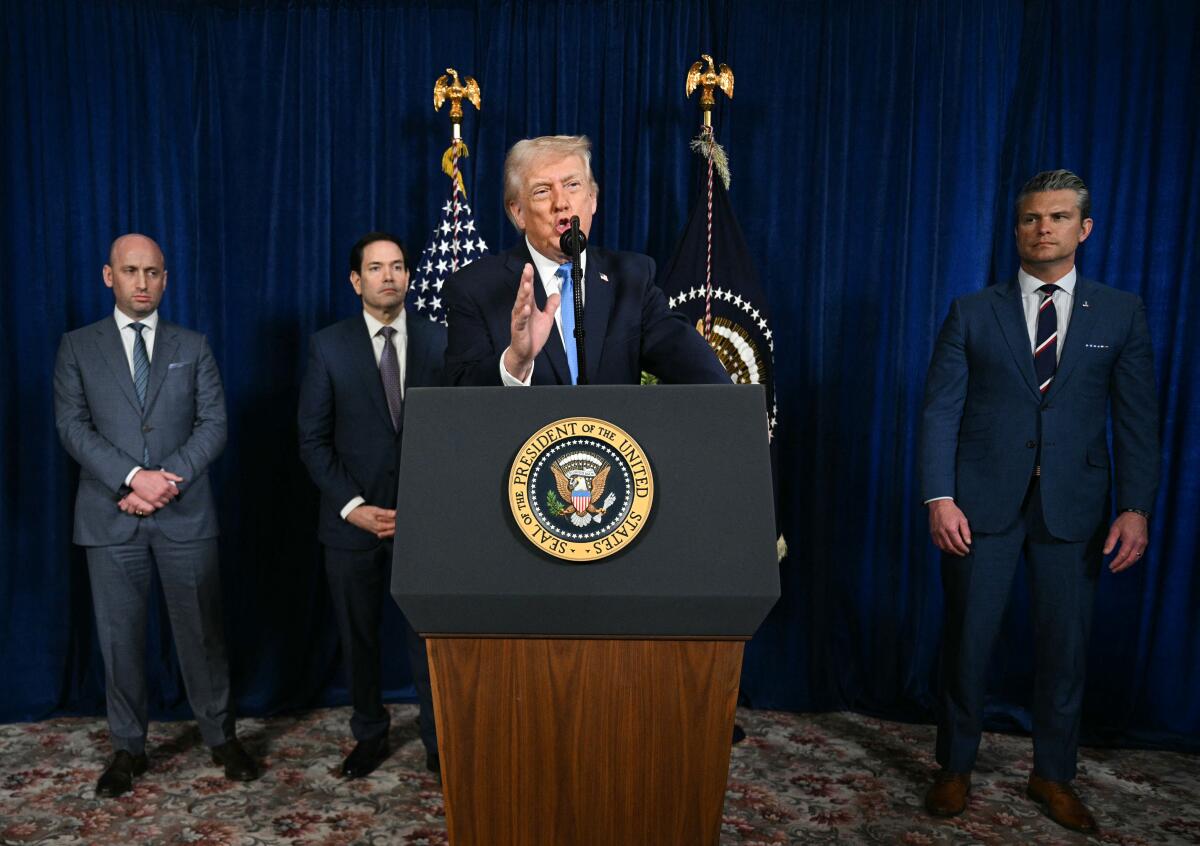
President Trump, alongside Deputy Chief of Staff Stephen Miller, Secretary of State Marco Rubio, and Defense Secretary Pete Hegseth, speaks to the media on Saturday following U.S. military actions in Venezuela.
(Jim Watson / AFP via Getty Images)
The president did not offer a timeline for how long a transition would take, or which Venezuelan factions he would support to assume leadership.
Maria Corina Machado, a leader of the Venezuelan opposition and a recipient of the Nobel Peace Prize, said Saturday that she and her team were prepared to assume control of Venezuela.
“The hour of freedom has arrived,” she wrote on social media. “We are prepared to assert our mandate and take power.”
But in a surprising statement, Trump told reporters on Saturday that he did not believe Machado had the “respect” needed to run the country.
Trump instead focused on how the United States intends to run Venezuela in the immediate aftermath, saying American oil companies are ready to descend on the oil-rich country and begin “taking out tremendous amount of wealth out of the ground.”
“That wealth is going to the people of Venezuela and people from outside of Venezuela that used to be in Venezuela, and it goes to the United States of America, in the form of reimbursement for the damages caused to us by that country,” Trump said.
The operation began with explosions throughout Caracas, as more than 150 U.S. aircraft, including F-35 fighter jets, B-1 bombers and remotely piloted drones, cleared away Venezuelan air defenses to make way for the interdiction team, which included U.S. law enforcement officers. Electricity was cut throughout much of the city as the assault unfolded, Dan Caine, chairman of the Joint Chiefs of Staff, told reporters.
A Delta Force unit penetrated Maduro’s heavily fortified compound at 2:01 a.m. local time, capturing him and his wife as they attempted to escape into a safe room, U.S. officials said. Only one helicopter in the U.S. fleet was hit by Venezuelan fire, but was able to continue flying through the mission. No U.S. personnel were killed, Caine said.
Trump, who had ordered the CIA to begin monitoring Maduro’s movements months ago, watched as the operation unfolded from a room at his Mar-a-Lago estate in Florida, “literally like I was watching a television show,” the president said in an interview with Fox News on Saturday morning.
From there, Maduro and his wife, Cilia Flores, were taken to the USS Iwo Jima, stationed in the Caribbean alongside a third of the U.S. naval fleet, before the ship set course for New York, where Atty. Gen. Pam Bondi said Maduro will face “the full wrath of American justice” over his alleged ties to illicit drug trafficking.
“If you would’ve seen the speed, the violence,” Trump told Fox. “Amazing job.”
In Caracas on Saturday, the mood was tense. Long lines formed at supermarkets and pharmacies as shoppers, fearful of uncertainty, stocked up on essentials.
Maduro’s supporters gathered throughout the city, many bearing arms, but seemed unsure of what to do next. Across Latin America, reaction to the U.S. operation was mixed. Right-leaning allies of Trump including Argentina’s Javier Milei and Ecuador’s Daniel Noboa backed the U.S. attack, while leftists broadly condemned it.
Colombian President Gustavo Petro criticized an “aggression against the sovereignty of Venezuela and Latin America” and said he was ordering the deployment of the Colombian armed forces along his nation’s 1,300-mile-long border with Venezuela.
Brazilian President Luiz Inácio Lula da Silva said that the U.S. “crossed an unacceptable line” and compared the action to remove Maduro to “the darkest moments of [U.S.] interference in Latin America and the Caribbean.”
Trump, meanwhile, boasted that the U.S. operation in Venezuela would help reassert U.S. dominance in Latin America.
“American dominance in the Western Hemisphere will never be questioned again,” he said. “We are reasserting American power in a very powerful way in our home region.”